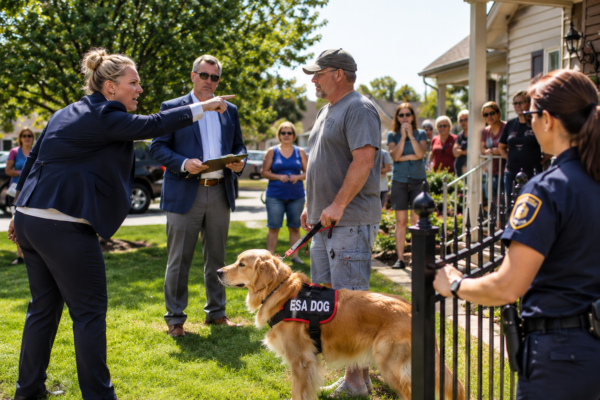
HOA president Diane Holloway called 911 and told deputies my wife had threatened her with a weapon, and by the time I reached our house three sheriff’s cruisers were blocking the street while Laura stood on the porch with both hands visible and Ranger, her German Shepherd service dog, sitting motionless beside her.
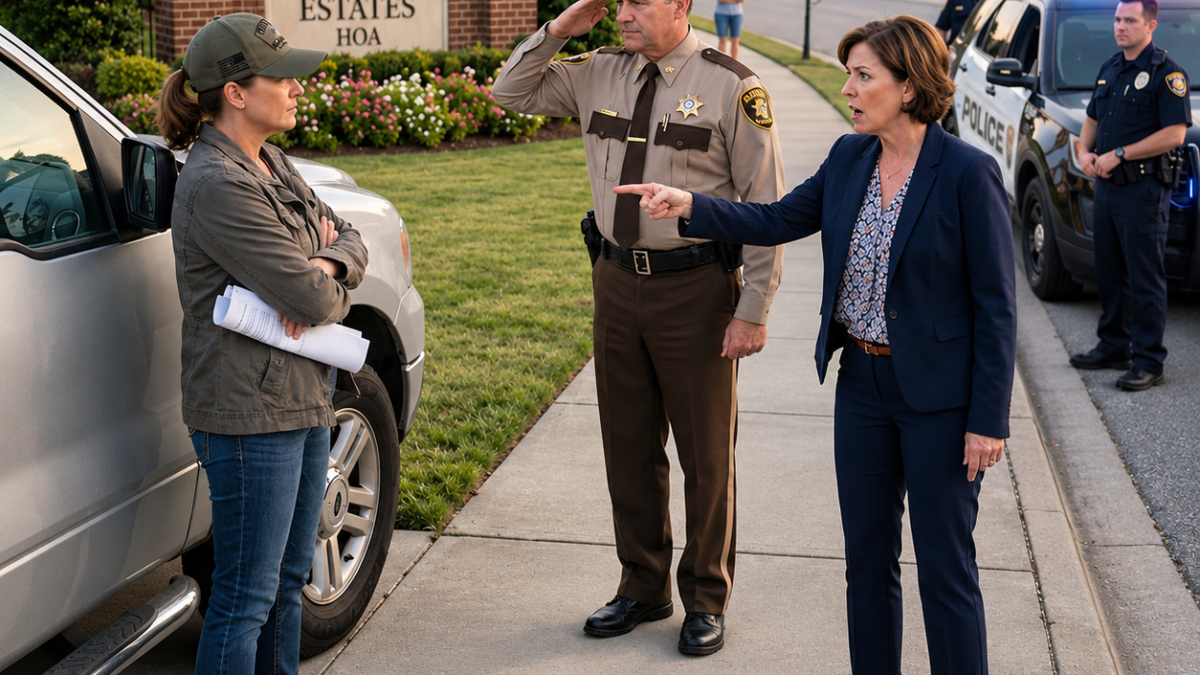
HOA president Diane Holloway called 911 and told deputies my wife had threatened her with a weapon, and by the time I reached our house three sheriff’s cruisers were blocking the street while Laura stood on the porch with both hands visible and Ranger, her German Shepherd service dog, sitting motionless beside her.
For months Diane had singled us out over mailbox angles, trash-can timing, our approved memorial garden, and even Laura’s service dog, but accusing a former Army captain of threatening to kill her with what turned out to be a gardening trowel was the first time her campaign could have put my wife in handcuffs.
What Diane never expected was that the sheriff walking toward our porch had once served overseas in the same unit area where Laura commanded soldiers, and his respectful salute did not make him take her side—it made half the neighborhood finally speak up, exposing a previous court case and HOA removal Diane had never disclosed when Maple Ridge elected her president.
My name is Ethan Walker, and Laura and I moved to Maple Ridge Crossing outside Franklin, Tennessee, because after two deployments she wanted quiet more than anything else.
We bought a small brick house beneath old oaks, with a wraparound porch and enough backyard for Ranger.
Diane Holloway introduced herself before our moving truck was empty.
Mailbox rules.
Paint colors.
Approved flowers.
Trash schedules.
At first we laughed.
Then the notices began.
One claimed our mailbox leaned outside the approved angle.
Another said our trash bin remained visible seventeen minutes too long after pickup.
Diane photographed Laura walking Ranger and insisted the dog made residents uncomfortable, even though Ranger was her trained service companion and spent most afternoons letting neighborhood children scratch his ears.
One day Diane told Laura, “People like you shouldn’t need dangerous animals in family neighborhoods.”
Laura scratched Ranger’s neck and answered, “He’s protected more frightened people than you probably ever will.”
After that, Diane stopped pretending the conflict was impersonal.
Laura later planted a small memorial garden beside our porch with yellow roses, lavender, and a flat stone engraved with the first name of a medic she had lost overseas.
She obtained written architectural approval before planting anything.
Diane still marched across our lawn demanding its removal.
Laura showed her the approval.
Diane barely looked at it.
Then she said, “People like you always expect special treatment because of a uniform.”
Laura did not answer.
She simply looked at the flowers and told me, “She’s not finished.”
Two days later my phone rang while I was working across town.
“Ethan, there are deputies outside.”
“Why?”
“Someone says I threatened a neighbor with a weapon.”
I drove home to find Laura standing exactly where deputies had instructed her to remain.
Diane stood across the street telling everyone Laura was aggressive.
Then Sheriff Tom Granger stepped from the lead cruiser.
He looked at Laura.
Stopped.
Removed his sunglasses.
“Captain Laura Bennett?”
Laura stared.
“Tom?”
He smiled.
“Sheriff Granger now.”
Then he straightened and gave her a brief salute before returning immediately to business.
He did not dismiss Diane’s accusation.
He asked for evidence.
Diane claimed Laura had screamed, threatened to kill her, waved a weapon, and ordered Ranger to attack.
Laura quietly picked up the small gardening trowel she had been using beside the roses.
“That’s the only thing I was holding.”
Ranger laid his head across her boot.
Then I showed deputies months of saved notices, camera clips, voicemails, and photographs documenting Diane’s repeated visits to our property.
The source described that same pattern: selective citations, hostility toward Ranger, the already-approved memorial garden, the false weapon allegation, and Sheriff Granger recognizing Laura from Kandahar.
Then eighty-year-old Helen Alvarez walked across the street.
“Sheriff,” she said, “this isn’t the first family Diane has done this to.”
Diane’s face changed.
Helen told him Diane had lived in another Tennessee county before Maple Ridge.
She remembered a military family there.
Complaints.
Police calls.
A court order.
An HOA board fight.
Granger did not arrest Diane based on neighborhood gossip.
He asked another deputy to start documenting witness names and check the public records.
Twenty minutes later, they found enough to make one fact undeniable.
Diane Holloway had previously been removed from another HOA board after a retaliatory enforcement dispute involving a deployed servicemember’s family.
And Maple Ridge’s candidate disclosure form asked whether board nominees had ever been removed from another community association for misconduct.
Diane had checked NO.
Sheriff Granger looked at her.
Then at Laura.
Then at the garden.
“Mrs. Holloway,” he said quietly, “we need to talk about the report you made today.”
That was when Diane stopped smiling.
[END OF FACEBOOK CAPTION]
[FIRST COMMENT / FULL STORY CONTINUATION]
Diane’s first response was not denial.
It was anger.
“That has nothing to do with this.”
Sheriff Tom Granger stood near the edge of our porch with one hand resting loosely against his duty belt.
Not threatening.
Not casual either.
“Maybe not,” he said.
“That is why we investigate before deciding.”
Diane pointed toward Laura.
“She threatened me.”
Granger nodded once.
“We’re still talking about that.”
Then he turned to Deputy Marcus Ellison.
“Take Mrs. Holloway’s statement separately.”
“Get the exact sequence.”
“Exact words.”
“Where everybody was standing.”
“Anything she says she saw in Captain Bennett’s hands.”
Ellison guided Diane several yards away.
Diane protested immediately.
“Why am I being separated?”
“Because that’s normal when there are conflicting statements.”
“You were all just talking to them.”
“Yes, ma’am.”
“You’re already taking their side.”
Ellison stopped.
“No.”
“We’re separating witnesses.”
That was the first thing that struck me about Granger.
The recognition mattered emotionally.
The salute mattered.
But he refused to let it become the evidence.
He knew Laura.
He respected her.
That could have compromised the whole response if he had acted like old military history automatically made her truthful.
Instead, he called his watch commander.
Then asked another deputy to take the lead on the direct allegation while he documented the broader circumstances.
Laura noticed too.
Later she told me that was the moment she trusted him.
Not when he recognized her.
When he stepped back.
Deputy Rachel Owens took Laura’s statement.
She started with the simplest question.
“What were you doing before Mrs. Holloway approached?”
“Mulching the roses.”
“What tool?”
Laura pointed.
“Hand trowel.”
“Anything else?”
“Gloves.”
“Phone in my pocket.”
“Any firearms on you?”
“No.”
“In the house?”
“Yes.”
“Secured?”
“Yes.”
“Did you access one today?”
“No.”
“Did you threaten Mrs. Holloway?”
“No.”
“Did you tell Ranger to move toward her?”
“No.”
“Did Ranger move toward her?”
“No.”
Owens looked at the dog.
Ranger had not moved in ten minutes.
“What happened?”
Laura described it.
She had been kneeling beside the memorial stone.
Diane crossed the sidewalk and walked onto our lawn.
No knock.
No request.
She held a folder.
Diane said the garden remained a violation despite the architectural approval.
Laura stood.
Still holding the trowel.
She told Diane:
“You need to leave the property.”
Diane said:
“You don’t tell me where I can go when I’m performing HOA duties.”
Laura repeated:
“Please leave.”
Diane pointed at the memorial stone.
“That needs to come out.”
Laura said:
“No.”
Diane stepped closer.
Laura moved backward.
Ranger stood.
Not lunged.
Stood.
Diane said:
“Control that dog.”
Laura answered:
“He is controlled.”
Then Diane looked at the trowel.
“You threatening me now?”
Laura looked down at it.
“No.”
According to Laura, Diane took several steps backward, pulled out her phone, and said:
“You just made a serious mistake.”
Then called 911.
Owens asked:
“Did you say anything about killing her?”
“No.”
“Harming her?”
“No.”
“Teaching her a lesson?”
“No.”
“Your military service?”
“No.”
“Her son?”
Laura frowned.
“What son?”
That became relevant later.
At that moment we knew almost nothing about Diane’s life before Maple Ridge.
We knew only the person she showed us.
Clipboard.
Perfect clothes.
Rules.
A woman who could convert a trash can into a character judgment.
Deputy Owens asked:
“Security cameras?”
I answered from several feet away.
“Doorbell.”
“Driveway.”
“Side yard.”
“Front porch audio?”
“Doorbell has audio.”
“Does it capture the flower bed?”
“Partially.”
That changed the afternoon.
We went inside only after deputies said we could.
I pulled the app.
Camera One.
11:42 a.m.
Laura walking outside with Ranger.
Camera Two.
12:03.
Diane crossing the street.
Camera One caught the lower half of the interaction but not every movement because the porch column blocked part of the garden.
Audio was much better.
Diane:
“I’m tired of discussing this.”
Laura:
“Then stop coming over.”
Diane:
“The garden violates neighborhood standards.”
Laura:
“It was approved.”
Paper sound.
Diane:
“I don’t care what that committee signed.”
Laura:
“That sounds like a board problem.”
Diane:
“Remove it.”
Laura:
“No.”
Then Diane’s voice sharpened.
“Don’t take that tone with me.”
Laura:
“This is my yard.”
“Please leave.”
Diane:
“Put that down.”
Laura:
“What?”
“That weapon.”
Laura actually laughed once.
Not mockingly.
Surprised.
“It’s a trowel.”
Diane:
“You are threatening me.”
Laura:
“No.”
“I am gardening.”
Then Ranger barked once.
One bark.
The camera showed a delivery truck turning at the corner at the same moment.
Ranger’s head turned toward it.
Diane:
“Control that animal.”
Laura:
“Ranger.”
The dog sat.
Immediately.
Then Diane:
“People like you are always one bad day away from becoming dangerous.”
Silence.
Laura:
“Leave.”
Diane:
“I’m calling the police.”
Laura:
“Go ahead.”
End.
Nobody spoke for several seconds.
Deputy Owens replayed it.
Then again.
She looked at Laura.
“Did anything happen before this recording?”
“No.”
“After?”
“She stayed across the street until deputies arrived.”
Owens asked me for a digital copy.
I sent it.
Then she called her sergeant.
The tone of the scene changed.
Not because Diane’s old history had appeared.
Because her current accusation was collapsing on audio.
She had told dispatch Laura waved a weapon inches from her face.
The video showed distance.
She claimed Laura sicced Ranger on her.
The dog sat on command.
She claimed death threat.
No death threat.
Could something have happened off-camera?
Technically possible.
That is why investigators still took statements.
But Diane’s story had become much harder to support.
Granger came inside after a few minutes.
He did not smile.
“Captain.”
Laura said:
“Sheriff.”
“Your camera is useful.”
“I figured.”
Then:
“I’m going to say this once because I don’t want my prior relationship with you turning into a problem.”
“Understood.”
“I’m not clearing you because I know you.”
“I know.”
“I’ve asked Deputy Owens to make the primary assessment on the criminal complaint.”
“Good.”
“We will document everything.”
Laura nodded.
That was the officer I remembered from the street.
Not the salute.
That.
Professional enough to know when respect could look like bias.
I asked:
“What about the old HOA case?”
Granger looked at me.
“Separate issue.”
“Helen gave us a lead.”
“We found public records that appear consistent with part of what she said.”
“But we’re not making today’s decision based on somebody’s old reputation.”
Again.
Right.
A bad history does not prove a new accusation is false.
Evidence does.
Diane was still talking to Ellison.
Loud enough that everyone occasionally heard pieces.
“She’s manipulating all of you.”
“Ask about her PTSD.”
“That dog is dangerous.”
“You people don’t understand what veterans are like.”
That last sentence carried across the lawn.
Laura heard.
Her face did not change.
Ranger leaned against her leg.
I wanted to walk outside.
She caught my wrist.
“No.”
“She’s saying—”
“I heard.”
“She’s trying to—”
“I heard.”
Laura looked at me.
“Do not help her.”
That was military Laura.
Calm.
Strategic.
I stayed.
Mrs. Alvarez sat on our porch steps.
Someone had given her water.
She looked guilty.
Laura sat beside her.
Helen said:
“I’m sorry.”
“For what?”
“I knew there was history.”
Laura frowned.
“How?”
Helen explained.
Before moving to Maple Ridge, Diane had lived near Clarksville.
Helen’s sister lived in the same subdivision.
Diane served on that community’s architectural committee, then briefly on its board.
A National Guard family there had a long-running dispute over vehicle parking and lawn maintenance during the husband’s deployment.
Diane repeatedly reported them.
One confrontation became ugly.
Police were called.
Later, the servicemember’s wife sought a civil protective order after Diane continued showing up at the house despite written requests to stop.
The court entered a limited no-contact order.
Not a finding that Diane hated all veterans.
Not proof of discrimination.
But real.
Then the association removed Diane from the board after an ethics review concluded she had continued enforcement activity outside authorized procedures.
Helen said:
“My sister told me when Diane moved here.”
“Why didn’t you say anything?”
“I thought people deserve another chance.”
Laura nodded.
“That’s reasonable.”
Helen looked stunned.
“You’re defending her?”
“No.”
“I’m saying moving somewhere new should not make you guilty forever.”
“Then why does it matter?”
“Because if she lied on a disclosure and repeated the same pattern, the board needs to know.”
Exactly.
That became the dark secret.
Not some psychological hatred we could never prove.
Not the source’s rumor that Diane’s son failed a military evaluation and she blamed a female officer.
Maybe there was some version of that story.
Helen had heard it too.
We never used it.
There was no reliable record.
No need.
The documented secret was enough.
Diane had previously been removed from a community-association position after an enforcement-overreach investigation.
Maple Ridge’s candidate questionnaire specifically asked:
Have you ever been removed, censured, or asked to resign from a homeowners, condominium, neighborhood, or community association board or committee for misconduct or violation of governing procedures?
Diane checked:
NO.
Signed.
Dated.
That was an internal governance problem.
Separate from the police report.
The sheriff’s salute had simply changed the social dynamics enough for Helen to speak.
That was why people later told the story as:
Sheriff saluted veteran.
Karen’s dark secret exposed.
Reality was a chain.
Recognition.
Witness courage.
Public records.
Current video.
Board files.
Not magic.
Deputy Owens came back outside around forty minutes later.
She spoke first with Granger.
Then Diane.
Then us.
Her conclusion:
There was no probable cause to arrest Laura for aggravated assault, threat, or an animal attack based on the evidence available.
The gardening trowel was not treated as proof of criminal intent simply because it could theoretically injure someone.
Context mattered.
Laura had been gardening.
Video supported it.
Ranger had not attacked.
The audio did not support Diane’s death-threat allegation.
Then Owens turned toward Diane.
“Mrs. Holloway, we need to discuss the accuracy of your 911 statement.”
Diane folded her arms.
“I told dispatch what I perceived.”
“You stated Mrs. Bennett waved a weapon inches from your face.”
“She did.”
“The video does not show that.”
“The camera angle is bad.”
“You stated the dog was ordered to attack you.”
“He stood up.”
“That is different.”
“He’s huge.”
“You told dispatch she said she would kill you.”
Diane paused.
“She implied it.”
Owens:
“What words?”
Silence.
“I felt threatened.”
“That may be true.”
“We need the words you said were spoken.”
Another silence.
Diane’s face went red.
Then she made the mistake.
“You weren’t there.”
Owens nodded.
“No.”
“That’s why we’re reviewing evidence.”
Diane looked at Granger.
“You’re letting her get away with this because you served together.”
Granger answered calmly.
“No.”
“Deputy Owens is making the primary determination precisely because I know Captain Bennett.”
“Then why did you salute her?”
“Because she once outranked me in another part of my life.”
“That does not decide what happened today.”
Diane laughed.
Bitter.
“Sure.”
Granger said:
“Mrs. Holloway, you are not under arrest at this moment.”
She looked relieved for half a second.
“But a knowingly false emergency report is serious.”
“We will forward the evidence to the appropriate investigator and prosecutor.”
“You should preserve any messages, photographs, recordings, or HOA records connected to this incident.”
Diane’s relief vanished.
“Am I free to go?”
“Yes.”
“Do not enter the Walkers’ property.”
“That is not a formal protective order.”
“It is clear notice that you do not have consent.”
That distinction mattered.
Diane walked across the street.
Nobody clapped.
Nobody cheered.
Good.
Police scenes are not sporting events.
The cruisers left gradually.
Granger stayed last.
Before he left, he walked to the memorial garden.
He removed his campaign hat.
Looked at the engraved stone.
HANNAH.
“Medic?”
Laura nodded.
“Sergeant Hannah Cole.”
“Twenty-eight.”
Granger stared at the roses.
“She was with you?”
“Yes.”
He did not ask how she died.
Veterans know sometimes not to ask.
Then Granger stepped back.
Straightened.
Saluted Laura.
This time not recognition.
Respect.
Laura returned it.
Then he left.
That was the image neighbors remembered.
Not handcuffs.
There were none.
Not yelling.
The salute.
Diane watched from her front window.
I saw the curtain move.
The next morning started with pie.
Helen Alvarez.
Peach.
Still warm.
She stood on our porch.
“I should’ve said something.”
Laura hugged her.
“You said something yesterday.”
“After months.”
“Yes.”
“Still counts.”
Helen cried.
Laura did too.
Then Ranger tried to investigate the pie.
Emotional scene over.
More neighbors came.
Not sixty.
Not parade.
Four that morning.
Three in the afternoon.
Another two the next day.
Some apologized.
Others brought stories.
The Millers.
First family Diane focused on after becoming president.
Their violation:
A basketball hoop.
Approved originally.
Diane later claimed setback issue.
Months of letters.
Fine.
Resolved after appeal.
The Jacobs.
Grandchildren visited frequently.
Diane accused them of operating an unauthorized daycare.
No evidence.
Complaint withdrawn.
Mr. Turner.
Wind chimes.
Real noise rule existed.
But Diane measured violations herself from the sidewalk at odd hours and repeatedly cited him while ignoring louder properties.
Fine eventually waived.
Then us.
Pattern.
Not everyone had a legal claim.
But everyone had experienced selective pressure.
The board had treated each complaint as isolated.
Now residents compared notes.
That is how patterns become visible.
Alan Price, Maple Ridge vice president, called me Sunday.
“Can I come over?”
“Why?”
“I need to apologize in person.”
I almost said no.
Laura said:
“Let him.”
Alan arrived without clipboard.
Good.
We sat on the porch.
He said:
“I voted for Diane.”
“So did most people.”
“I nominated her.”
“That’s worse.”
“I know.”
He rubbed his forehead.
“She was organized.”
“Always read the documents.”
“Showed up.”
“Ran meetings.”
“Collected delinquent dues.”
“Got contractors to finish work.”
“She seemed competent.”
Laura asked:
“Did the board know about Clarksville?”
“No.”
“Candidate forms?”
“In the archive.”
“Did anyone verify?”
“No.”
There it was.
A checkbox nobody checked.
Alan said:
“We had no reason to.”
I answered:
“You have one now.”
He nodded.
“I pulled her form.”
“She answered no.”
“Do the bylaws require disclosure?”
“For board eligibility, yes.”
“Automatic removal?”
“No.”
“Board can censure.”
“Membership removes directors.”
“President can be removed as officer by board vote.”
Good.
Procedure.
Alan continued.
“I also reviewed the garden.”
“The committee approval is valid.”
“We know.”
“I know you know.”
“I’m saying the board knew too.”
Laura stared.
“Then why did no one stop her?”
Alan did not have a good answer.
“She said the committee exceeded its authority.”
“Did it?”
“No.”
Silence.
“She was president.”
That phrase.
Laura smiled sadly.
“That’s not authority.”
“I know.”
“Now.”
Alan looked toward Ranger.
“Did she really say people like you expect special treatment?”
“Yes.”
“Did you report it?”
“No.”
“Why?”
Laura shrugged.
“I didn’t want to spend my life proving every rude thing someone said.”
That stayed with me.
People later asked why we did not sue sooner.
Because living is a full-time job.
Most people do not want every insult converted into litigation.
You ignore.
Absorb.
Document maybe.
Move on.
Until something crosses a line so large that moving on becomes impossible.
The board held an emergency executive meeting Monday.
Diane attended with an attorney.
The board removed her as president by majority vote pending membership review.
She remained a director temporarily because members had elected her.
Alan became interim president.
The board retained outside counsel.
Why outside?
Because its regular attorney had advised Diane on unrelated enforcement matters and did not want conflicts during the investigation.
The outside lawyer was Priya Shah.
First thing she did:
Preservation notice.
Nobody deletes anything.
No texts.
No emails.
No violation files.
No candidate disclosures.
No complaint logs.
No meeting recordings.
Second:
Suspension of any discretionary enforcement initiated solely by Diane until reviewed.
Not all fines.
Not all rules.
Only matters where procedural concerns existed.
Third:
Independent governance review.
Laura asked me:
“Do you think she’s going to jail?”
“I don’t know.”
“Do you want her to?”
I thought.
“No.”
“Really?”
“I want someone official to determine what she did.”
“That wasn’t the question.”
I looked at the garden.
“No.”
“I want her away from us.”
Laura nodded.
“Same.”
A week later, Williamson County investigators interviewed us.
They had the 911 recording.
That recording was worse for Diane than what she said on the street.
Dispatcher:
“911, what is your emergency?”
Diane:
“My neighbor is threatening me with a weapon.”
Dispatcher:
“What kind of weapon?”
“A metal blade.”
Dispatcher:
“Knife?”
“She’s holding something sharp.”
Dispatcher:
“Is she pointing it at you?”
“She waved it.”
Dispatcher:
“Any firearms?”
“She’s military.”
Dispatcher:
“I’m asking whether you see a firearm.”
“No.”
Dispatcher:
“Has she threatened to shoot you?”
“She said she would kill me if I came onto the property.”
That sentence did not appear anywhere on our camera audio.
Investigator asked Diane where the threat occurred.
She said near the flower bed.
Camera captured it.
She then said maybe before audio started.
The camera activated before she crossed the sidewalk.
Hard.
Then the dog claim.
“She ordered it toward me.”
Video showed Ranger standing after a truck passed.
Laura saying his name.
Dog sitting.
Diane’s lawyer argued she perceived those actions as threatening under stress.
Possible.
Perception is subjective.
But the specific quote:
“I’ll kill you if you come onto my property”
was not subjective.
Either said or not.
No evidence she said it.
Investigator submitted the file to prosecutors.
They did not arrest Diane that afternoon.
That is another thing the source exaggerated.
Prior incidents do not automatically create probable cause for a current false-report charge.
Weeks passed.
Meanwhile, the HOA investigation moved faster.
Priya Shah traveled to Clarksville.
Pulled public court records.
Contacted the old association.
The prior civil case showed Diane had repeatedly contacted a National Guard spouse after being formally told to communicate through management.
A judge issued a limited protective order prohibiting direct contact for six months.
No violence finding.
No felony.
The old HOA’s minutes were more damaging to her candidacy.
They censured Diane for:
Unauthorized enforcement communications.
Entering a homeowner’s fenced side yard after permission was revoked.
Using committee letterhead without board approval.
Continuing direct contact after counsel advised communications should go through management.
She was later removed from her officer role and resigned her board seat after members petitioned for a recall.
Was that “removed from another association board or committee for misconduct”?
At minimum, it should have been disclosed.
Maple Ridge’s candidate form said so.
She had answered no.
Priya interviewed Diane.
Diane argued:
“I resigned.”
“The membership vote never occurred.”
Technically interesting.
The old board had removed her officer title.
She resigned the director seat before recall vote.
Candidate question included:
Removed, censured, or asked to resign.
Censured.
Documented.
No ambiguity.
She lied.
Why?
Her answer:
“I did not consider that misconduct.”
Priya said:
“The form did.”
That line circulated later.
I wish I had written it.
The son story surfaced during interviews.
Several long-term residents believed Diane’s resentment toward military women began after her adult son unsuccessfully attempted to enlist and blamed a female officer involved in an evaluation.
No one produced reliable documentation.
Priya left it out of the report.
So did police.
So did we.
That is important.
People love motive.
Motive makes stories neat.
She hates female veterans because of her son.
Maybe.
Maybe not.
We could prove behavior.
We did not need to diagnose her heart.
The governance report was fifty-eight pages.
It found:
Diane failed to disclose prior association censure.
She repeatedly initiated enforcement outside standard committee review.
She communicated violations before formal votes.
She selectively documented properties without clear complaint records.
She overrode or attempted to override valid architectural approvals.
She used personal photographs in enforcement discussions without consistent retention procedures.
She made statements about Laura’s military service that were inappropriate and unrelated to covenant enforcement.
The board had weak oversight.
Complaint appeals lacked independent review.
President had too much informal control over agendas.
Those were the real dark secrets.
Not one shocking criminal file.
A concealed pattern and a system that let it repeat.
The membership meeting to consider Diane’s removal drew almost everybody.
Maple Ridge had 142 homes.
One hundred eighteen households participated in person or by proxy.
The clubhouse could not hold them.
People stood along walls.
Outside doors.
Alan opened.
Priya summarized.
No dramatic video montage.
Documents.
Candidate form.
Old censure.
Current approval letter for our garden.
Violation log.
Emails.
Police report status.
Then Diane spoke.
She had every right.
People forget that when they dislike someone.
Her lawyer sat beside her.
Diane said:
“I have served this community for six years.”
True.
“Reserve funding improved.”
True.
“Contractor costs declined.”
True.
“Property maintenance improved.”
Arguable but evidence supported portions.
“Some residents dislike enforcement.”
Also true.
Then:
“The Bennetts arrived and immediately began demanding exceptions.”
Laura whispered:
“Here we go.”
Diane continued.
“Service animal.”
“Memorial landscaping.”
“Flag display.”
“Trash accommodations.”
I almost stood.
Laura touched my knee.
No.
Diane said:
“I treated them the same as everyone else.”
Mrs. Alvarez called from the back:
“No, you didn’t.”
Alan asked for quiet.
Diane continued.
“I made a police report because I felt threatened.”
“The decision not to charge Mrs. Bennett does not mean my fear was fake.”
That was actually her strongest point.
Feeling afraid is not illegal.
People can misinterpret.
Then Priya asked:
“Do you stand by your statement to dispatch that Laura Bennett said, ‘I’ll kill you if you come onto my property’?”
Diane froze.
Her lawyer leaned over.
Whispered.
Diane said:
“I stand by my belief that she threatened me.”
Priya:
“That was not the question.”
Diane:
“I was frightened.”
Priya did not push.
Members understood.
Then the candidate disclosure.
Priya projected it.
Question.
Diane’s NO.
Then Clarksville board censure.
Diane said:
“That old situation was political.”
Maybe.
Still disclose.
A homeowner named Sam Keene asked:
“If you thought it was political, why not put yes and explain?”
No answer.
That question did more damage than the report.
Laura eventually spoke.
She stood at the microphone.
No uniform.
Jeans.
Blue sweater.
Ranger at home.
She said:
“I don’t care whether Diane likes veterans.”
“I don’t care whether she likes me.”
“I do care that she treated a service dog as a threat after being told what he was.”
“I care that she tried to override a garden approval because she disliked what the garden represented.”
“And I care that she called 911 and told deputies I made a threat that the recording does not contain.”
She paused.
“Sheriff Granger knew me overseas.”
“Yes.”
“He saluted me.”
“Yes.”
“That does not make me more believable than anyone else.”
“The camera did.”
“The approval letter did.”
“The board records did.”
“The old censure did.”
“That’s what this vote should be about.”
Then she sat.
I loved her more at that moment than during any ceremony, uniform, or dramatic salute.
Because she refused to trade Diane’s misuse of authority for our own.
The vote:
96 to remove.
19 against.
3 abstentions.
Diane lost her board seat.
Not arrested.
Not publicly dragged away.
Removed through the governing documents she had used against everyone else.
That felt appropriate.
Afterward, Alan resigned as interim president.
Not from the board.
From the officer role.
“I need somebody else to be the face.”
Denise Choi became president.
Accountant.
Quiet.
Terrifyingly organized.
First sentence at her first meeting:
“Please stop emailing me violations without photographs and covenant citations.”
I liked her immediately.
Then the prosecutor called.
Two months after the 911 incident.
The DA’s office had reviewed the recording, camera footage, Diane’s statements, and witness accounts.
They offered a pretrial diversion agreement on a misdemeanor false-report charge rather than pursue a contested trial.
Why diversion?
Diane had no relevant criminal convictions.
No physical injury occurred.
She had already lost the HOA position.
The prosecution believed accountability could be achieved without jail.
Terms:
Twelve months.
No unlawful contact with Laura or me.
Community service.
Court costs.
Completion of a conflict-management program.
Written acknowledgment that emergency reporting must accurately distinguish perceived threat from statements actually made.
If completed, charge eligible for dismissal under the agreement.
People hated that.
Neighbors wanted handcuffs.
Headlines.
Conviction.
Laura did not.
She said:
“She doesn’t need jail.”
“She needs to stop.”
I agreed.
Diane accepted.
Her lawyer issued no public statement.
Good.
The HOA reforms were larger than the criminal case.
Denise created a compliance committee with rotating members.
President could not independently issue fines.
Every violation notice required:
Exact covenant or rule citation.
Photographic or documentary basis.
Correction period.
Appeal instructions.
Committee approval for contested matters.
No fines based on unpublished “community standards.”
Service animals handled through lawful accommodation processes rather than informal judgment.
Approved architectural decisions could not be reversed by president alone.
Board candidate disclosures verified against available records when practical.
Conflict disclosures annual.
Meeting agendas published.
Executive sessions logged by subject.
Complaint history accessible to directors.
An independent appeals panel.
The memorial garden remained.
Obviously.
But something unexpected happened.
Laura asked the board not to make it a community memorial.
That surprised everyone.
The source version had sixty neighbors arrive with flags and benches and turn Hannah’s small garden into a veterans park.
Beautiful image.
Wrong for Laura.
Hannah was not a symbol.
She was a person.
Laura told Denise:
“I don’t want a flagpole.”
“I don’t want plaques for everyone.”
“I planted that garden because I miss one friend.”
Denise nodded.
“Then it stays yours.”
That was the respectful ending.
Neighbors did contribute one thing.
A bench.
Only after asking.
Helen Alvarez organized it.
Simple cedar.
No bronze plaque.
No HOA logo.
On the underside, where almost nobody could see, Helen burned one word:
HANNAH.
Laura cried when she found it.
Then threatened Helen for making her cry.
Helen said:
“I’m eighty.”
“You can’t fight me.”
Accurate.
Ranger adopted the bench.
Any time Laura sat there, he lay underneath.
The yellow roses grew.
Diane’s house remained across the street for another year.
That made everything strange.
No-contact condition meant she did not approach us.
She drove past.
We saw her at mailbox stations.
Grocery store.
Board meetings she no longer controlled.
Neither side interacted.
Some residents stopped speaking to her.
Others did not.
I respected the ones who still waved.
Social exile is not due process.
Diane had done wrong.
That did not require everyone to turn cruelty into a community hobby.
Laura said:
“If people become bullies because Diane lost power, nothing changed.”
Again.
Annoyingly wise.
One afternoon, Diane’s husband, Robert, knocked.
I almost did not open.
He stood well back.
“Can I talk?”
“About Diane?”
“Yes.”
“I don’t think that’s a good idea.”
“Fair.”
He looked tired.
“I wanted to apologize for not stopping some of it.”
“You weren’t on the board.”
“No.”
“But I knew how angry she got.”
“I told myself it was HOA nonsense.”
“Not my business.”
Then police came.”
I did not know what to say.
He continued.
“She truly believed Laura threatened her.”
That irritated me.
“We have audio.”
“I know.”
“She hears conflict differently when she’s already angry.”
“That doesn’t make the quote real.”
“No.”
He nodded.
“That’s what I finally told her.”
We stood there.
Two husbands discussing people we loved from opposite sides of damage.
Robert said:
“We’re moving.”
“I heard.”
“Not because anyone forced us.”
“Good.”
“Our daughter lives near Knoxville.”
“Okay.”
He hesitated.
“Diane’s not evil.”
I almost laughed.
Then stopped.
“I know.”
He looked surprised.
“I think she got addicted to being necessary.”
Robert stared at the ground.
“That sounds right.”
Then he left.
The Holloways sold six months later.
Their buyers were a young couple with a toddler.
First day, Denise walked over.
Introduced herself.
No clipboard.
I watched from my porch.
Laura said:
“Don’t stare.”
“I’m observing history.”
“You’re nosy.”
“Professional curiosity.”
Ranger barked at a squirrel.
Life.
Sheriff Granger came by once after that.
Not on duty.
Veterans breakfast fundraiser.
He dropped off raffle tickets.
Laura made coffee.
They sat on the porch.
I finally asked:
“What happened in Kandahar?”
Laura looked at Tom.
He looked at her.
Tom said:
“Your wife prevented a bad convoy decision.”
Laura:
“That’s generous.”
“You did.”
“What decision?”
Laura sighed.
“Bad weather.”
“Bad route.”
“Tom’s team needed movement clearance.”
“I delayed them.”
Tom said:
“Six hours.”
“Everyone complained.”
“Then route got hit.”
Silence.
I knew pieces.
Not that.
Tom looked at Laura.
“That salute wasn’t because you had rank.”
“I know.”
“It was because I’m alive.”
Laura looked away.
I stopped asking.
That was the real secret behind the salute.
Not Diane’s.
Laura’s.
She had spent years treating that deployment as something she survived.
Tom remembered a decision she made that protected others.
Respect is complicated too.
Later Laura said:
“Don’t turn that into mythology.”
“I won’t.”
“Promise.”
“Promise.”
She had not saved every person.
Had not controlled the attack.
Had made a cautious operational call.
That was enough.
One good decision.
Life.
Diane had made a bad one.
Then another.
Then another.
That contrast became the whole story for me.
Authority is not proven by how confidently someone uses it.
It is proven by whether they can slow down when the stakes rise.
Laura did.
Diane did not.
Sheriff Granger did.
That mattered most.
Maple Ridge became quieter.
Not perfect.
A dispute over fence height lasted three meetings.
Someone accused Denise of favoritism over holiday lights.
A pool rule caused a twelve-email war.
Normal.
Healthy communities still disagree.
The difference was nobody could say:
Because the president said so.
You needed a rule.
A vote.
An explanation.
That changed the tone.
Our mailbox still leaned.
Maintenance committee sent notice.
I measured.
It actually did.
Half inch outside permitted alignment.
I fixed it.
Laura laughed for two days.
“Diane was right.”
“About one thing.”
“History will remember.”
“I’m destroying history.”
I tightened the post.
Ranger supervised.
Trash can timing became less ridiculous too.
The board replaced the seventeen-minute enforcement culture with a reasonable end-of-day standard.
Nobody’s property value collapsed.
Imagine.
The service-dog issue produced training for board members.
Not because Laura demanded it.
Management company recommended.
What can association regulate?
What must it accommodate?
What questions may be asked?
How to avoid treating disability-related accommodations as favors.
Laura declined to speak.
“I’m not the HOA’s free disability seminar.”
Fair.
They hired someone.
Good.
The garden approval stayed permanently in our file.
I scanned it three places.
Old habits.
Laura teased:
“If the house burns, the roses will still be legally approved.”
“Correct.”
“Thank God.”
The prosecutor closed Diane’s diversion case after she completed every condition.
No violation.
No contact.
Charge dismissed under the agreement.
Some neighbors were angry.
Helen was not.
She said:
“Then the system got what it asked for.”
Exactly.
Accountability is not satisfying only when someone suffers forever.
Sometimes the point is compliance.
Stopping.
Repair.
Learning.
Did Diane learn?
I do not know.
That is not a condition of my peace.
Years later, Laura still wakes before sunrise sometimes.
Less often.
She takes coffee to the back steps.
Ranger is older now.
Gray around his muzzle.
He lowers himself slowly.
Still notices her breathing before I do.
Sometimes she walks around front to Hannah’s roses.
Touches the stone.
Sits on Helen’s bench.
No big veterans monument.
No community flags.
Just yellow flowers.
A dog.
One name.
That suits her.
Helen still lives two houses down.
Ninety now.
Still baking.
Still knows everybody’s secrets.
When new residents ask about the famous “sheriff salute incident,” Helen corrects them.
“He didn’t arrest Diane because of a salute.”
“Video proved Laura hadn’t done what Diane said.”
Then she adds:
“The salute just made us cowards realize Laura had already earned respect somewhere else while we were too scared to show any here.”
Laura hates that sentence.
Helen repeats it more because of this.
I asked Helen once:
“Why did everybody stay quiet so long?”
She thought.
“Because Diane never targeted all of us at once.”
That answer might be the most important thing in this story.
The Millers thought their basketball hoop dispute was theirs.
The Jacobs thought the daycare accusation was theirs.
Turner thought the wind chimes were his.
We thought Ranger and the garden were ours.
Divide people into isolated conflicts and nobody sees the pattern.
Then one day three sheriff’s cars show up.
Suddenly everyone compares notes.
Power hates shared notes.
That is why I still keep everything.
Not because I expect another Diane.
Because memory gets cleaner with time.
Too clean.
People forget:
What was actually said.
Who knew.
Which rule existed.
Which did not.
Documents resist that.
The camera resisted it.
The 911 audio resisted it.
The candidate form resisted it.
The Clarksville censure resisted it.
Not perfect truth.
Better than confident memory.
Diane’s “dark secret” eventually became neighborhood mythology.
Some versions say she had been arrested twice before.
False.
Others say she was banned from three HOAs.
False.
That her son was kicked out of the Army because of Laura.
Completely false.
They never met.
That Sheriff Granger discovered a criminal warrant.
False.
The truth is less sensational.
She had previously been censured in another HOA for similar overreach.
A limited protective order had been issued during that conflict.
She concealed the censure on Maple Ridge’s candidate disclosure.
Then she repeated patterns of unauthorized enforcement and escalated a disagreement into a false or materially inaccurate emergency report.
That was enough.
Truth does not need extra crimes.
I learned that from Laura.
One evening, years after the Holloways moved, I asked her:
“If Tom hadn’t recognized you, what happens?”
She looked at me.
“Probably the same eventually.”
“Really?”
“The camera still exists.”
“The trowel still exists.”
“Ranger still sat.”
“Maybe it takes longer.”
“Maybe I get cuffed while they sort it out.”
That possibility hurt.
She saw it.
“Ethan.”
“What?”
“Police responding to a weapon call don’t know me.”
“They have to be cautious.”
“I know.”
“The problem was Diane creating that risk.”
“I know.”
She continued.
“Tom recognizing me helped everyone slow down.”
“But if our story depends on knowing the sheriff, it’s a bad story.”
There.
That became my rule for telling it.
The sheriff’s recognition was human context.
The evidence was justice.
Never reverse those.
Otherwise the lesson becomes:
Know powerful people.
Wrong.
The lesson is:
Preserve evidence.
Use process.
Speak when you see patterns.
Do not let titles substitute for authority.
And when someone calls police, cooperate long enough for facts to surface.
Harder than a viral line.
More useful.
Maple Ridge’s board created one final reform I loved.
A yearly “authority audit.”
Every rule listed.
Source.
Date.
Amendments.
Current enforceability.
Accommodations.
Appeal procedure.
If the board could not identify authority, the rule came off enforcement lists until clarified.
The first audit eliminated seven zombie rules.
Rules everyone thought existed but did not.
One governed decorative birdhouses.
Another banned visible vegetable gardens.
Another required garage doors closed except while vehicles entered or exited.
No valid adoption record.
Gone.
Residents celebrated vegetables.
Civilization survived open garages.
Diane would have hated it.
Or maybe not.
Maybe losing power changed her.
I genuinely do not know.
I hope so.
Not for my sake.
For hers.
Living as if every disagreement threatens your authority sounds exhausting.
Laura knows something about actual command.
Real command is not constant dominance.
It is responsibility.
Decisions.
Consequences.
Sometimes telling people no.
Sometimes changing your mind.
Sometimes taking blame.
She once explained it to me after I complained about Diane.
“Bad leaders think control proves leadership.”
“Good leaders know people follow you after they could walk away.”
That sentence described the difference between a salute and a clipboard.
Tom’s salute meant something because Laura could not order him to give it.
Diane’s compliance notices meant less every month because she tried to demand respect through them.
The title is dramatic:
HOA Karen Called Cops on My Veteran Wife—Sheriff’s Salute Revealed Her DARK Secret!
That is what happened, compressed.
Diane called police.
Tom recognized Laura.
Saluted her.
Neighbors finally spoke.
Public records revealed Diane’s undisclosed prior HOA censure and protective-order history.
Current video contradicted key parts of her accusation.
The board investigated.
Members removed her.
Prosecutors handled the false-report allegation through diversion.
Rules changed.
Nobody went to prison.
Nobody lost a pension.
Nobody magically confessed to hating veterans.
The truth was more ordinary and therefore more frightening.
A competent woman learned that people usually backed down when she sounded certain.
So she became more certain.
A board learned that letting one strong personality run enforcement was easier than oversight.
So they looked away.
Neighbors learned that staying silent kept Diane focused on someone else.
So they stayed silent.
Until one emergency call put all of those habits under bright daylight.
And then people finally saw them together.
The last time Sheriff Granger visited before retiring, Laura and I met him at a diner.
No uniforms.
He brought a photograph from overseas.
Group standing beside armored vehicles.
Dust everywhere.
Laura younger.
Tom younger.
Hannah was in the photo too.
Laura stopped breathing for a second.
Tom said:
“I thought you should have it.”
She touched Hannah’s face.
“Where did you get this?”
“Old box.”
“I forgot it existed.”
Laura looked at me.
Then back at the photograph.
“You know what Ethan tells people?”
Tom smiled.
“Something embarrassing?”
“He says your salute exposed Diane.”
Tom laughed.
“That’s giving me too much credit.”
“I know.”
He looked at me.
“What exposed Diane was a doorbell camera and Mrs. Alvarez deciding she was done being quiet.”
Laura smiled.
“Exactly.”
I raised my hands.
“Fine.”
“Title stays.”
They both groaned.
The photograph now sits inside our house.
Not in the memorial garden.
That remains Hannah’s quiet place.
The HOA never asked us to remove it again.
Children still stop to pet Ranger.
People still wave.
Some new residents have no idea anything happened.
That is good.
A healthy neighborhood should not need a permanent villain.
It should only keep the lessons.
Ask before entering property.
Use the rules that actually exist.
Treat accommodations like rights, not favors.
Do not confuse military service with instability.
Do not confuse military service with automatic credibility either.
Document.
Listen.
Review.
And if a neighbor tells you someone with authority has been targeting families for years, do not wait until three patrol cars arrive before comparing stories.
Laura still says she moved here for quiet.
She eventually got it.
Not because Diane disappeared.
Because Maple Ridge learned that quiet does not mean nobody speaks.
Sometimes real quiet only arrives after enough people finally do.