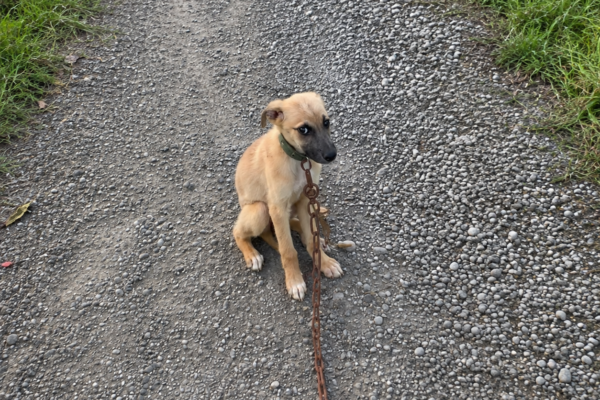
A frightened puppy hid his head deep among the cement debris of a construction site when Shugla came near, as though disappearing into the rubble felt safer than letting another human touch him.h
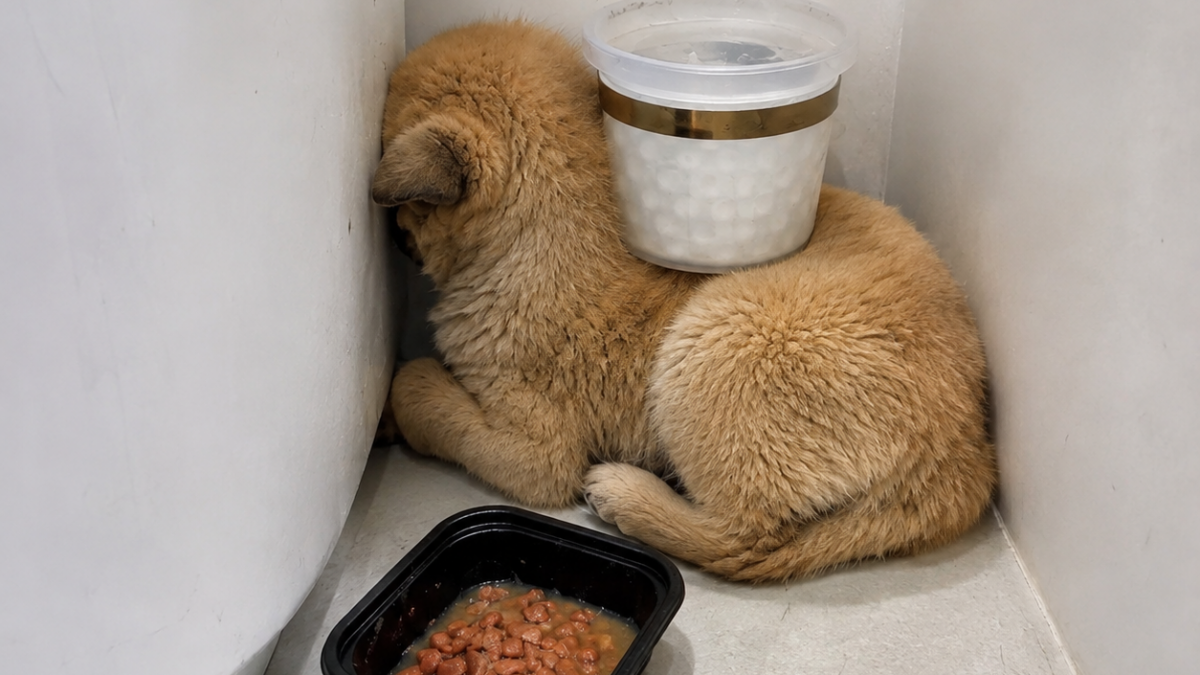
The construction site was not a place where anyone expected to find something as small and vulnerable as Thomas.
It was a place of rubble, broken pieces of material, dust, cement debris, and the unfinished remains of human work. Everything around him seemed hard. There were no soft blankets tucked beneath his body, no familiar bed waiting a few feet away, no toys scattered nearby, no person calling him toward safety.
There was only the rough shelter he had chosen for himself.
And even that shelter was barely shelter at all.
Thomas was a small puppy, but fear had already taught him one lesson very well: when something came close, hide.
So when Shugla happened to notice him and moved toward him, Thomas did not run happily to meet her.
He did not wag his tail and ask to be picked up.
He did not behave like a puppy who had spent his short life learning that human hands meant food, affection, and protection.
He became frightened.
His body tightened.
Then he pushed his head down among the cement debris as though, if he could not see what was coming toward him, perhaps it could not reach him.
It was a heartbreaking reaction precisely because it was so simple.
Thomas did not have many ways to protect himself.
He was small.
He was alone.
He did not have a safe person to run toward.
All he could do was make himself smaller.
Hide his face.
Tremble.
Wait.
Shugla could see the fear in him almost immediately.
She did not know every detail of what Thomas had experienced before that moment. She could not know exactly who had frightened him, how long he had been surviving around the streets, or what individual moments had taught him to react this way.
The source of his story tells only what was visible now.
Thomas was scared.
Deeply scared.
And his fear of people did not disappear simply because the person approaching him wanted to help.
That was something Shugla had to respect.
So instead of rushing in and overwhelming him, she approached more quietly.
Thomas cried helplessly.
His little body trembled.
The sound of that crying, combined with the sight of him trying to bury his head among the debris, made the scene difficult to witness.
A puppy should have been exploring.
Playing.
Following someone around the house.
Falling asleep after exhausting himself with the uncomplicated work of being young.
Thomas was doing none of those things.
He was using his energy to be afraid.
Shugla moved closer.
She reached out.
Then she touched him.
Her hand met soft fur made dirty by the place where he had been living.
Beneath that fur was a body still shaking with fear.
And beneath her hand, she could feel the frantic rhythm of his heart.
At first, Thomas had no reason to understand what this touch meant.
A human hand was still a human hand.
An approach was still an approach.
Closeness was still frightening.
But Shugla did not hurt him.
She stayed gentle.
She stayed calm.
And little by little, something changed.
His heartbeat began to slow.
Not all at once.
Not because Thomas suddenly became a different puppy.
Fear that deep does not simply vanish in a few seconds.
But his body began to register something important.
Nothing terrible was happening.
The hand touching him was not striking him.
The woman beside him was not pulling him roughly from his hiding place.
She was there.
She was quiet.
She was waiting for him to settle enough that she could help.
For Shugla, that small slowing of his heartbeat must have felt like the first opening in a wall Thomas had built around himself.
She did not need him to understand everything.
She only needed enough trust to get him somewhere safe.
Finally, Thomas allowed her to pick him up.
Even that moment did not mean his fear was gone.
He was still uncertain.
Still tense.
Still a puppy who had learned to hesitate.
But now he was in Shugla’s arms instead of hidden among cement debris.
For the first time in the story, the direction of his life had changed.
The construction site remained behind him.
Shugla carried him away.
She took him home.
For a puppy like Thomas, a home should have represented immediate comfort.
But safety and the feeling of safety are not always the same thing.
Shugla could change his surroundings in minutes.
She could not change what Thomas expected from the world nearly as quickly.
She gave him a place inside her house.
She prepared a bed for him.
She gave him toys.
She tried to create an environment where nothing around him demanded fear.
To Shugla, the message was obvious.
You are safe here.
To Thomas, everything was unfamiliar.
A bed was unfamiliar.
Toys were unfamiliar.
The rhythms of a house were unfamiliar.
The woman moving through the rooms was still a person he did not fully understand.
Even kindness could be confusing when a frightened animal had not learned how to receive it.
So Thomas hesitated.
He did not immediately explore every room.
He did not throw himself happily onto the bed.
He did not suddenly become playful because toys were placed near him.
He watched.
He retreated.
He kept a distance.
When Shugla tried to get close, Thomas sometimes moved toward a corner and hid.
The corner became another version of the cement debris.
Different place.
Same instinct.
If he felt uncertain, make himself small.
If someone approached, create distance.
If the world became too much, find a place where at least one or two walls were behind him.
Shugla could have taken that behavior personally.
She could have thought, I rescued you. Why are you still afraid of me?
But fear does not disappear because someone deserves gratitude.
Thomas was not rejecting her kindness.
He simply did not know how to trust it yet.
That distinction mattered.
Shugla seemed to understand it.
She did not give up when her affection was not immediately returned.
She kept trying.
She spent time near him.
She allowed Thomas to experience her presence again and again without anything bad happening.
That repetition was important.
One gentle touch at the construction site had allowed her to pick him up.
But one gentle touch could not rewrite everything Thomas had already learned.
Trust would need repetition.
Shugla gave him that.
She stayed near.
She spoke to him through her actions more than anything else.
The bed remained his.
The toys remained there.
No one chased him out of his hiding place simply because he was not responding quickly enough.
Food and care came without a demand that he first become brave.
And Shugla continued spending time beside him.
Sometimes she spent most of her time close to Thomas.
Sometimes she even slept beside him.
That choice reveals how worried she had become.
It was not enough for her to place him somewhere comfortable and assume that the problem had been solved.
She watched him.
And what she saw during sleep frightened her even more.
Thomas suffered from nightmares.
His body did not always become peaceful just because his eyes closed.
Sometimes, while asleep, he moved as though he were running.
His body reacted with fear even when the room around him was safe.
Shugla would watch this small puppy struggling in his sleep and feel helpless.
During the day, she could approach him slowly.
She could offer a gentle touch.
She could sit nearby.
She could let him retreat if he needed distance.
During a nightmare, she could not simply explain to him that he was home now.
She could not enter whatever frightening experience his sleeping mind seemed to be reliving.
She could only remain close.
Thomas was suffering even while he slept.
That realization hurt her.
Sometimes Shugla cried over his condition.
Not because Thomas was physically collapsing in front of her.
Not because anyone had told her he was dying.
She cried because the puppy was safe and still could not fully feel safe.
There is a painful difference between those things.
The door could be closed.
The construction site could be far behind them.
The bed could be soft.
The room could be quiet.
And still Thomas could run in his sleep.
Still his body could tremble.
Still fear could find him.
Shugla had already contacted a veterinarian.
She had made an appointment.
That appointment became an important point ahead of them because there were questions she could not answer herself.
Was Thomas physically ill?
Was he hiding pain?
Was there something wrong inside his body that she could not see?
Was his fear connected to a medical problem?
Shugla needed someone qualified to examine him.
Until then, she continued caring for him at home.
The days before the appointment gave Thomas more time to experience the pattern of his new life.
Shugla was there in the morning.
She was there later.
She was there when he hid.
She was there when he slept.
She did not disappear because he was difficult to reach.
She did not lose patience because he remained hesitant.
She did not treat his fear as bad behavior.
Thomas did not know it yet, but consistency was becoming the most important thing in his world.
The construction site had offered uncertainty.
Shugla offered repetition.
The same safe space.
The same bed.
The same gentle person.
The same absence of harm.
Again.
And again.
And again.
There is a reason trust often grows through ordinary moments instead of dramatic ones.
An animal who expects danger does not need a single grand gesture.
He needs evidence.
The evidence must accumulate.
One day without being hurt.
Then another.
One touch that feels gentle.
Then another.
One night where someone remains close.
Then another.
Thomas was beginning that process.
It was slow.
His instinct to hide remained strong.
He still did not simply walk up to Shugla every time she entered the room.
He still carried the uncertainty that had been visible among the rubble.
But now the fear had competition.
There was also warmth.
There was also care.
There was also the quiet possibility that this human might be different.
As the veterinary appointment approached, Shugla decided Thomas needed a bath.
His fur was still dirty from the life he had been living.
The idea of bathing a frightened puppy was not simple.
Water, handling, unfamiliar sensations—any one of those could have made Thomas withdraw even more.
So Shugla prepared a warm bath.
Warmth mattered.
Gentleness mattered.
Everything she had learned about Thomas suggested that he needed experiences to be introduced carefully.
At first, Thomas hesitated.
That was consistent with everything about him.
New things were not automatically exciting.
New things might be dangerous.
The first touch of water, the feeling of being held, the unfamiliar process of bathing—Thomas did not immediately surrender to it.
But Shugla continued carefully.
And then something unexpected happened.
Thomas began to relax.
The warm water touched the dirt in his fur.
Shugla’s hands moved gently over him.
There was no pain.
There was no roughness.
Nothing chased him.
Nothing threatened him.
He began to understand the bath through sensation rather than explanation.
Warm.
Safe.
Comforting.
His body softened.
The resistance faded.
And before long, Thomas seemed to enjoy it.
That small moment mattered far beyond cleanliness.
The puppy who had hidden his head from Shugla when she first approached was now allowing her to wash him.
At the construction site, touch had sent fear through his body.
Now touch, combined with warmth and patience, was helping him relax.
It was not complete trust.
But it was movement.
When the bath was finished, Shugla dried his wet fur.
The dirt was gone.
His coat looked clean.
He looked beautiful.
For perhaps the first time since she had found him, his appearance no longer immediately carried the construction site with it.
The cement debris was no longer caught in the image of him.
There was just Thomas.
Small.
Clean.
Wrapped carefully so he would stay warm.
Shugla looked at him and could see what fear had hidden so effectively.
He was a beautiful puppy.
Not broken beyond hope.
Not permanently destined to hide.
Just frightened.
And fear, unlike a severe physical injury, could potentially change with patience.
She did not know yet whether the veterinarian would find another problem.
That question remained.
The appointment finally arrived.
That morning, Shugla prepared Thomas and took him to the vet.
For Thomas, this meant another unfamiliar place.
Another person.
Another set of hands.
Another situation he did not control.
Given his behavior with Shugla, it would have been reasonable to expect him to withdraw immediately.
But the veterinarian handled him carefully.
The source describes the vet as highly qualified and professional, particularly good at dealing with Thomas.
That skill showed almost immediately.
Within only a few minutes, Thomas began to trust him.
For Shugla, seeing that must have been both surprising and encouraging.
Thomas had spent days hesitating around her.
He had hidden in corners.
He had suffered frightening dreams.
He had needed time to relax even during a warm bath.
Yet here, with someone who knew how to approach and handle him, he responded quickly.
That did not mean Shugla had failed.
Quite the opposite.
It showed that Thomas could trust.
The capacity was still there.
Fear had not destroyed it.
He needed the right kind of contact.
He needed patience.
He needed people who did not overwhelm him.
The veterinarian understood that.
Thomas relaxed enough for the examination to proceed.
The vet examined him very carefully.
He checked the puppy thoroughly.
Then he performed tests.
Shugla had waited for this moment because she needed answers.
Thomas could not tell her whether anything hurt.
He could not explain his nightmares.
He could not explain why he was frightened.
He could not describe his life before the construction site.
Medical evaluation could at least answer one part of the mystery.
Was something physically wrong?
When the results came, they brought relief.
Thomas was healthy.
Physically, everything was fine.
There was no serious hidden illness discovered.
There was no physical condition explaining his behavior.
His body was healthy and well.
The problem was his fear.
The veterinarian’s conclusion, as the story describes it, was that Thomas had psychological difficulties and did not trust people easily after what he had experienced while living on the streets as a puppy.
That explanation fit what Shugla had been seeing.
Thomas’s body was young and healthy.
His reactions told a different story.
He did not need an operation.
He did not need treatment for some newly discovered disease.
He needed time.
Care.
Stability.
Patient exposure to people who would not hurt him.
He needed a home where good treatment became ordinary enough to stop feeling suspicious.
In one sense, that was wonderful news.
Shugla had been afraid there might be something seriously wrong with his health.
There was not.
In another sense, the answer made the responsibility ahead very clear.
There was no pill that could instantly create trust.
There was no procedure that could erase fear.
Thomas’s progress would depend on what happened day after day.
And Shugla already knew how slowly that could move.
She had seen him hide.
She had watched him struggle in his sleep.
She had sat beside him for long stretches.
She knew the amount of attention he needed.
The question of what should happen next was unavoidable.
Thomas could have gone to a shelter.
But Shugla could not bear the thought of taking him there.
She had already brought him into her home.
She had already watched him begin to relax.
She had already seen how difficult unfamiliar environments could be for him.
She had already become emotionally invested in the frightened little puppy she had pulled from the construction site.
So she made a decision.
Thomas would go back home with her.
She would continue taking care of him.
She would give him time to improve.
Shugla understood that it would not be easy.
The vet’s reassuring physical results did not magically turn Thomas into a confident puppy.
He still had to learn.
She still had to be patient.
There would still be moments when he retreated.
There would still be work involved in showing him that people could be safe.
But Shugla believed she could do it.
She believed Thomas could change.
That belief did not come from pretending the previous days had been easy.
It came from the small signs she had already seen.
His heartbeat had slowed under her touch at the construction site.
He had allowed her to carry him.
He had relaxed in the bath.
He had trusted the veterinarian after careful handling.
These moments proved that fear was not the only thing inside Thomas.
Trust could appear.
Comfort could appear.
Enjoyment could appear.
The challenge was to help those feelings become stronger and more familiar than fear.
So Thomas returned home.
This time, the house was no longer completely new.
That distinction mattered.
The bed was familiar now.
The smells were familiar.
The rooms were becoming familiar.
Shugla was familiar.
The place where he had once hidden in a corner was still there, but so were the memories of nothing bad happening while he hid.
The toys were still waiting.
The safe routine resumed.
Shugla continued giving him attention.
She did not expect him to transform overnight.
The story describes days of care and attention before Thomas truly began to change.
Those days mattered because they were filled with the same kind of quiet evidence.
Shugla stayed.
She cared.
She tried.
Thomas watched.
He tested the world.
He pulled back.
Then he tried again.
Fear rarely disappears in a straight line.
A frightened puppy can seem comfortable one moment and uncertain the next.
A gentle experience can help, but the old instinct can still return when something feels unfamiliar.
Shugla did not treat those moments as failure.
She kept creating safety.
Thomas slowly learned that her presence predicted good things rather than danger.
He learned that when she came near, he was not going to be hurt.
He learned that the bed was his.
He learned that the toys did not need to be guarded from anyone.
He learned that he could rest.
He learned that the hands reaching toward him could comfort rather than frighten.
He learned that waking up in the same home meant he had not been abandoned during the night.
Those lessons were not taught through words.
They were taught through repetition.
And Thomas began to respond.
At first, the changes were easy to miss if someone expected something dramatic.
Maybe he stayed outside the corner a little longer.
Maybe he watched Shugla instead of immediately hiding.
Maybe his body stayed looser when she approached.
Maybe closeness no longer made his heart race the way it once had.
The source does not give a list of exact milestones, so they do not need to be invented.
What it does tell us is the result.
After days of care and attention, Shugla succeeded in making Thomas happy.
He began to trust people.
The frightened puppy who once tried to hide his entire face among pieces of cement no longer lived in constant suspicion.
That was an enormous change.
Happiness looked different on Thomas because fear had once occupied so much of him.
When a puppy has always been playful, seeing him play is ordinary.
When Thomas began to become happy, it carried the memory of the construction site.
Every relaxed moment stood in contrast to the trembling.
Every sign of enjoyment stood in contrast to the helpless crying.
Every step toward Shugla stood in contrast to the way he once moved away from people.
That contrast made his progress feel larger.
Thomas did not become a different dog.
He became more fully himself.
Fear had hidden his personality.
Safety allowed it to emerge.
The toys Shugla had given him now had a purpose.
A puppy who is terrified has little emotional room for play.
Play requires a certain amount of trust in the environment.
To play, an animal must believe, at least for that moment, that immediate survival is not the only concern.
As Thomas relaxed, life began offering him more than places to hide.
It offered things to enjoy.
And enjoyment slowly became normal.
That was the point when the story says his “perfect life” began.
Not perfect in the sense that nothing difficult had ever happened.
Thomas’s earlier fear remained part of his history.
The construction site had been real.
The nightmares had been real.
The hesitation had been real.
Shugla’s tears had been real.
But now those things were no longer controlling the present.
The home around him had become a place of good memories instead of constant uncertainty.
Thomas began growing quickly.
That, too, changed the picture.
The small puppy hidden in rubble was not staying small forever.
His body was developing.
His strength was increasing.
The frightened baby animal Shugla had carried home was becoming a dog.
And as he grew physically, the bond between them grew at the same time.
Shugla became deeply attached to him.
At first, she had only meant to help.
She had seen a puppy in trouble and responded.
Then she had taken him home because he needed somewhere safe.
Then she had made the veterinarian’s appointment.
Then she had stayed beside him through the fear.
Then she had taken him back home rather than placing him in a shelter.
At some point, care became attachment.
Attachment became love.
And love changed the question.
The question was no longer, “How long should Thomas stay here while he improves?”
The question became, “How could he leave?”
Shugla found that she could not bear being apart from him.
Thomas had become part of her daily life.
His presence was no longer temporary.
His bed was not simply a rescue bed.
His toys were not temporary supplies.
His place in the house had become emotionally permanent before any formal decision was made.
Thomas felt attached to her too.
The story describes him as coming to see Shugla as his mother.
That description makes sense within the bond they had built.
She was the person who had reached him when he was hiding.
She was the person who had carried him away from the construction site.
She had given him a home.
She had stayed near when he was afraid.
She had sometimes slept beside him.
She had cried because his suffering hurt her.
She had bathed him gently.
She had taken him to the veterinarian.
She had brought him home again when she could not bear sending him to a shelter.
She had taught him through patience that people could be trusted.
If Thomas had learned to associate one human being with safety above all others, it was Shugla.
That relationship changed both of them.
Thomas no longer hid from her.
Shugla no longer thought of him simply as the frightened puppy she was helping.
He was hers.
And she was his.
Eventually, she made the decision that had been growing through every day they spent together.
She adopted Thomas.
She gave him her home permanently.
She gave him her love permanently.
She became, as the story puts it, his mother for life.
There was no need for a dramatic ceremony.
The emotional decision had already been happening in small pieces.
Every night she stayed close.
Every time Thomas chose her over a hiding place.
Every moment of trust.
Every sign that he was happier.
Every day he remained in her home.
All of those moments had already been turning rescue into family.
Adoption simply made that truth complete.
From then on, Thomas’s life was no longer organized around fear.
It was organized around home.
He had a family.
He had a person who loved him.
He had daily routines that belonged to a normal, cared-for dog.
He played.
He went on walks.
He enjoyed his meals.
Those details may sound ordinary.
That is exactly why they are so meaningful.
Ordinary was something Thomas had not had.
At the construction site, every moment had been about uncertainty.
Where could he hide?
Who was approaching?
Was it safe to be seen?
Should he run?
Should he make himself smaller?
At Shugla’s home, the questions changed.
Where was the toy?
Was it time for a walk?
Was food coming?
Where was Shugla?
Could he follow her?
Could he rest?
The entire emotional vocabulary of his life changed.
Fear stopped being the center.
Joy took up more room.
The puppy who once trembled when someone came near grew into an active dog.
Today, Thomas is much bigger.
He is strong.
He enjoys life with his family.
That simple ending carries all the emotional weight the story needs.
There is no need to invent another tragedy.
No need to create an artificial final twist.
No need to imagine Thomas years later facing something the source never describes.
The transformation already happened.
The ending is the life he has now.
Strong.
Active.
Loved.
Part of a family.
When we look back at the beginning from that present moment, the image of Thomas hiding his head becomes even more painful.
He was not hiding because he was unfriendly.
He was hiding because fear was the only protection he understood.
That distinction changes everything.
People sometimes look at a frightened animal and see rejection.
The animal backs away, and they assume he does not want affection.
He hides, and they assume he does not want a home.
He trembles during handling, and they assume he will always be difficult.
Thomas’s story shows how incomplete those first impressions can be.
The puppy hidden in rubble was capable of tremendous attachment.
He simply did not know yet that attachment could be safe.
The puppy who avoided people was capable of seeing Shugla as his mother.
He simply needed someone patient enough to reach the part of him fear had buried.
The puppy suffering in his sleep was capable of becoming a happy, active dog.
He simply needed days in which waking life finally became gentler than whatever he remembered.
Shugla did not force those changes.
She created the conditions in which they could happen.
That may be one of the most important details in the entire story.
At the construction site, she approached quietly.
At home, she gave him space.
When he retreated, she kept trying without abandoning him.
When he suffered from nightmares, she stayed nearby.
When he needed medical evaluation, she arranged it.
When the vet confirmed that he was physically healthy but struggling with fear and distrust, she did not treat him like a hopeless case.
She took him home again.
When caring for him demanded time, she gave the time.
That is how Thomas learned.
Not through being pushed into trust.
Through being shown, over and over, that trust would not be punished.
The warm bath is a perfect example.
At first, Thomas resisted.
His hesitation was not unreasonable.
It was simply consistent with the dog he had been since Shugla found him.
Something unfamiliar was happening.
His body prepared to distrust it.
Then the experience itself taught him something different.
The water was warm.
Shugla’s hands were gentle.
He was not being hurt.
His body relaxed.
Then he actually began to enjoy it.
The sequence is small, but it mirrors his entire rescue.
Fear first.
Care second.
Relaxation slowly.
Then enjoyment.
Thomas’s whole new life followed that same pattern.
At first, the house frightened him.
Then it became safe.
At first, Shugla’s closeness made him retreat.
Then she became the person he could not bear to be away from.
At first, human contact was something to avoid.
Then the veterinarian gained his trust within minutes through careful handling.
At first, Thomas hid.
Then he played.
At first, he cried helplessly.
Then he grew into an active dog who enjoyed his family.
Nothing about that transformation required changing the facts of what happened.
It was already powerful enough.
Thomas had been living on the streets as a puppy.
He had learned distrust before he had learned security.
By the time Shugla found him, his fear was visible in every small movement.
That was the real injury she was trying to heal.
Not a broken bone.
Not an infection.
Not a physical disease.
A relationship with the world that had become organized around fear.
The veterinarian’s tests gave Shugla an important kind of relief.
Physically, Thomas was well.
There was a healthy puppy inside the frightened behavior.
That meant every day ahead could focus on helping that healthy puppy feel secure enough to live normally.
And once Thomas began to trust, the result was dramatic even without any dramatic event.
His personality opened.
His relationship with Shugla deepened.
His life became filled with activities that are completely unremarkable for a loved dog and almost unimaginable for the puppy in the rubble.
Playing.
Walking.
Eating.
Resting at home.
Spending time with family.
These were the things Thomas gained.
There is something deeply moving about rescue stories where the happy ending is ordinary.
Thomas did not become famous.
The source does not say newspapers came.
It does not say millions of people watched his recovery.
It does not say anyone gave him an award.
None of those things matter.
Thomas did not need a public audience.
He needed one person who would stay.
He found her.
And perhaps that is why Shugla’s decision to adopt him feels inevitable by the end.
She had already become the answer to nearly every fear Thomas carried.
When he was frightened, she was the calm presence.
When he needed a place to rest, she provided it.
When he needed medical care, she arranged it.
When the idea of a shelter appeared as the alternative, she could not bear to send him away.
When he needed time, she gave him time.
By the time Thomas trusted her completely, asking them to separate would have meant breaking the very security she had worked so hard to build.
Shugla knew that.
Her attachment was just as strong.
So the temporary rescue became a permanent home.
That transformation happened in her heart as much as it happened in Thomas’s behavior.
At first, she had seen a puppy who needed help.
Later, she saw her dog.
At first, she was trying to save him from fear.
Later, she could not imagine her own life without him.
That is often how animals enter a family.
Not through a carefully planned moment.
Through need.
Through care.
Through routine.
Through the slow realization that the living being you were helping has become woven into the shape of your day.
Thomas became part of Shugla’s day.
His presence mattered.
His progress mattered.
His fear mattered.
His happiness mattered.
Eventually, his absence would have mattered too much.
So she kept him.
For Thomas, adoption changed something he probably could not understand in legal or human terms but could experience emotionally.
He was not leaving.
The bed would remain.
The toys would remain.
Shugla would remain.
Home would remain.
A frightened animal learns security through permanence.
Thomas finally had permanence.
There would be another morning in the same place.
Another meal.
Another walk.
Another chance to play.
Another evening in the same home.
Another night with the person he trusted nearby.
The future stopped being an empty space.
It began to look like the present.
And the present was good.
That predictability may have been one of the greatest gifts Shugla gave him.
When Thomas was hiding at the construction site, he could not predict whether the next person would help or frighten him.
He could not know what the next hour would bring.
His instinct was defensive because uncertainty ruled everything.
At home, the pattern became reliable.
Care followed care.
Nothing terrible followed affection.
Sleep happened in safety.
Food came.
Walks came.
Play came.
Shugla came back.
Again and again, life confirmed the same lesson.
You can relax here.
That lesson eventually reached even the puppy who once seemed unable to stop being afraid.
Thomas’s nightmares had been one of the hardest things for Shugla to witness.
They showed that removing a puppy from danger did not immediately remove danger from the way his body reacted.
But the source does not describe those nightmares as the ending.
That matters.
The ending is not Thomas trapped forever inside fear.
The ending is Thomas strong and active, enjoying life with his family.
The story therefore moves from involuntary fear toward voluntary joy.
From running in sleep to running through life for the pleasure of it.
We do not need to invent a particular game or a particular place where he runs.
The meaning is already clear.
Movement that once seemed connected to panic eventually became part of a happy dog’s active life.
That is enough.
Shugla’s tears also belong to the earlier part of the story, not the ending.
She cried because she saw an animal suffering in a way she could not instantly fix.
That helplessness can be one of the hardest parts of caring for a frightened rescue.
You can make the room safe.
You cannot force the mind to believe it.
You can offer affection.
You cannot demand trust.
You can stay close.
You cannot decide the exact moment fear will loosen its grip.
Shugla had to accept that she could provide conditions but Thomas had to move at his own pace.
So she waited.
She tried.
She waited again.
And eventually, the puppy responded.
Not because she won a battle against him.
Because Thomas learned there was no battle.
No one in that house was trying to overpower him.
No one was asking him to defend himself.
The corner could stop being necessary.
The hiding could stop being necessary.
The constant hesitation could stop being necessary.
Safety had made those behaviors obsolete.
That is a beautiful thing about trust.
Once an animal truly begins to understand that he is safe, the energy once spent protecting himself becomes available for living.
Thomas could play instead of hide.
He could follow Shugla instead of retreat.
He could enjoy a walk instead of thinking only about escape.
He could eat in peace.
He could rest.
He could grow.
He could become strong.
All the ordinary energy of puppyhood, once trapped behind fear, could finally come forward.
That is the Thomas his family knows today.
Active.
Strong.
Enjoying life.
But understanding that dog requires remembering the small puppy in the rubble.
The past does not need to define Thomas forever.
It does help us understand the size of the change.
A confident dog is wonderful.
A confident dog who once buried his head among cement debris because a woman was approaching is something more.
A playful dog is joyful.
A playful dog who once retreated into corners whenever someone came near tells a story with every relaxed movement.
A dog enjoying family life is beautiful.
A dog who once did not know how to receive good treatment makes that family life feel almost astonishing.
Thomas’s happiness does not erase his fear.
It answers it.
Each part of his present is an answer to something he once lacked.
The home answers the construction site.
The bed answers the rubble.
The toys answer the empty survival of the street.
The walks answer the hiding.
The meals answer the uncertainty.
Shugla’s love answers his distrust.
Family answers loneliness.
And his strength today answers the image of a trembling little puppy trying to disappear.
That is why a rescue story does not always need a dramatic medical recovery to feel profound.
Thomas was physically healthy.
His hardest struggle was learning that he did not need to be afraid anymore.
That struggle is invisible in an X-ray.
It is visible in behavior.
The vet could run tests and confirm that Thomas’s body was well.
Shugla had to help with everything that could not be measured that way.
The distance he kept from people.
The corner he chose.
The nightmares.
The hesitation in the bath.
The need for constant reassurance.
These were the signs of what Thomas was carrying.
And because those signs were behavioral rather than physical, patience became part of the treatment.
Not medical treatment in the formal sense.
Human care.
The repeated experience of being safe.
Shugla provided that with unusual dedication.
Sleeping beside Thomas was not necessary for her own comfort.
She did it because his comfort mattered more.
Spending most of her time close to him was not the easiest way to organize her days.
She did it because he needed presence.
Taking him home after the veterinary visit, rather than moving him to a shelter, was not the detached choice.
She did it because she could not bear to break the bond forming between them.
Then, once he improved, she did not decide that her job was complete.
She adopted him.
That sequence shows something important about her care.
It was never just about solving a problem.
It became about loving Thomas.
A problem ends.
Love stays.
Thomas stopped being a rescue case.
He became family.
There is a subtle difference between those two identities.
A rescue case is defined by what happened to the animal.
Family is defined by who the animal is now.
Thomas is not permanently “the puppy from the construction site” inside Shugla’s home.
He is Thomas.
Her dog.
Her companion.
The one who plays.
The one who walks.
The one who eats his meals.
The one who grew.
The one who became strong.
The one who sees her as his mother.
The construction site explains how they met.
It does not describe the whole of his life.
That is the true victory.
Not that Thomas forgot everything.
The story does not tell us what he remembers.
Not that every trace of his early fear disappeared at some scientifically measurable moment.
The story simply tells us the result that matters.
He became happy.
He trusted people.
He bonded with Shugla.
He was adopted.
He grew strong.
He lives an active life with his family.
That is enough.
In fact, it is more than enough.
When Shugla first approached him, Thomas had no way to know any of this was possible.
His world was as small as the space where he hid his head.
Cement debris around him.
Fear inside him.
A stranger moving closer.
His entire decision was whether to hide.
If someone could have shown him the future in that moment, it would have seemed impossible.
A warm bath he would enjoy.
A veterinarian he would trust.
A bed that would remain his.
Toys he would eventually be comfortable enough to use.
A woman he would come to love.
A home he would never have to leave.
Walks.
Meals.
Family.
Strength.
Joy.
But Thomas did not need to see that future all at once.
He only needed Shugla to make the next moment safe.
That is how the entire story unfolded.
She made one moment safe.
Then another.
At the construction site, she touched him gently.
At home, she gave him space.
At night, she stayed close.
Before the appointment, she bathed him warmly.
At the clinic, she trusted a professional to examine him.
Afterward, she chose to bring him back home.
Then she continued care day after day.
A future was built from safe moments.
Thomas did not leap from terror to happiness.
He crossed the distance in small steps.
That gradual movement makes the story believable and emotionally honest.
Animals with deep fear often need time.
The important thing is not to demand a perfect timeline.
Shugla seems to have understood that instinctively.
She did not say, in effect, “I have been kind for two days, so you should trust me now.”
She kept proving herself.
There is humility in that kind of care.
It recognizes that the rescuer does not control the rescued animal’s emotions.
Thomas was allowed to be afraid until he no longer needed to be.
That freedom may have helped him trust faster than force ever could.
The veterinarian’s success with him also reinforces the point.
Thomas did not hate people.
He was not incapable of connection.
He was sensitive to how people approached him.
A skilled, careful person gained his trust within minutes.
That meant the wall around Thomas was not solid.
There were doors in it.
Gentleness could open them.
Shugla had already found one at the construction site.
The vet found another.
Then daily life opened more.
Eventually, Thomas no longer needed the wall at all.
He could live among people without expecting pain.
That is the point at which a frightened rescue begins to become simply a dog.
Not “the scared one.”
Not “the difficult one.”
Not “the puppy who hides.”
Just Thomas.
That identity is what Shugla preserved by adopting him.
She did not define him by his first behavior.
She allowed him to grow beyond it.
And grow he did.
The source specifically tells us that Thomas grew rapidly.
His small body changed.
He became much larger.
He became strong.
That physical growth happened alongside emotional growth, creating a powerful contrast between the puppy Shugla could lift from the rubble and the dog he became.
Yet even as he grew, the attachment to Shugla remained.
Size changed.
Trust did not.
If anything, it deepened.
Thomas had learned who his safe person was while he was still small.
Growing bigger did not change that emotional map.
Shugla was home.
That idea is more important than the building around them.
A house gave Thomas shelter.
Shugla gave the shelter meaning.
Without a trusted person, a room can still feel frightening.
With the right person, even an unfamiliar place can become manageable.
Thomas’s first experience at the vet showed that.
He was in an unfamiliar clinic, but careful handling let him relax.
Back at home, Shugla’s presence did even more.
She gave every object around him emotional meaning.
The bed meant rest because she allowed him to rest there.
The toys meant play because nothing bad happened when he relaxed.
The bath meant comfort because she handled him gently.
The house meant safety because she kept it safe.
Eventually, Thomas did not need to analyze any of those things.
They simply became normal.
Normal is the hidden miracle of rescue.
People often look for the dramatic moment.
The rescue from danger.
The first bath.
The vet’s verdict.
The adoption.
Those moments matter.
But the deepest transformation is when safety becomes so ordinary that the animal stops noticing it.
When Thomas could sleep without the house feeling strange.
When he could play without checking every movement around him.
When Shugla could walk toward him and his first instinct was no longer to hide.
When a meal was simply a meal.
When a walk was simply fun.
When being loved stopped surprising him.
That is when rescue became life.
Thomas reached that point.
The source tells us plainly that he became happy.
That he trusted people completely.
That he lived in a home filled with love.
That he spent much of his time playing, going on walks, and eating his meals.
Those are signs of normality.
Thomas earned that normality through no fault or effort of his own.
A puppy should not have had to earn it at all.
He deserved care from the beginning.
Shugla was the person who finally gave it.
There is sadness in imagining how frightened he was before she arrived.
But the story does not need to speculate about specific cruelty.
The source does not tell us exactly what happened to Thomas on the streets.
We do not need to invent someone hurting him.
His behavior already tells us that his experiences had left him distrustful.
That is enough.
Anything more would turn uncertainty into fact.
The emotional power lies in respecting what is known.
Thomas hid.
Thomas trembled.
Thomas cried.
Thomas retreated.
Thomas had nightmares.
Thomas distrusted people.
Then care changed him.
Those observable facts tell the story without embellishment.
And Shugla’s response was equally observable.
She approached quietly.
She touched him gently.
She carried him home.
She gave him a bed.
She gave him toys.
She spent time beside him.
She sometimes slept close to him.
She arranged veterinary care.
She bathed him.
She took him to the vet.
She brought him home again.
She continued caring.
She became attached.
She adopted him.
That is enough to understand who she was to Thomas.
A rescuer.
A caregiver.
Then family.
The movement between those roles is what gives the story its emotional shape.
At first, Shugla was simply the person who happened to see him.
That phrase—happened to see him—carries a lot of weight.
Thomas’s entire future depended on being noticed.
He was hiding.
He was not making himself easy to find.
Fear had pushed him into concealment.
Yet Shugla saw him.
She did not walk away.
She responded.
Sometimes rescue begins with extraordinary skill.
Sometimes it begins with attention.
Someone notices what others might miss.
A small body among debris.
A movement in a corner.
A pair of frightened eyes.
A sound of helpless crying.
Shugla noticed.
Then attention became responsibility.
She could have ended the interaction after getting Thomas somewhere temporary.
Instead, each stage drew her deeper into his life.
The more she saw his fear, the more she wanted to help.
The more she helped, the more he trusted.
The more he trusted, the more attached they became.
By the time adoption came, it was not a sudden twist.
It was the natural result of everything before it.
Thomas’s trust also makes the ending especially tender because trust had once been the central problem.
The vet said he did not trust people easily.
By the end, he trusted enough to live happily inside a human family.
That is not a minor behavioral improvement.
That is a complete transformation of his relationship with the world.
At the beginning, a person approaching made him hide.
At the end, family is the source of his happiness.
At the beginning, touch made his little body tremble.
At the end, he lives surrounded by love.
At the beginning, he needed cement debris between himself and a stranger.
At the end, he belongs in a home.
The distance between those images is the entire story.
And it was crossed through patience.
Patience is not passive.
For Shugla, patience meant action repeated without immediate reward.
Sitting beside a puppy who might not come closer.
Sleeping near him even if he still had nightmares.
Trying to make him happy when he did not yet know how to respond.
Bathing him carefully even though he was hesitant.
Taking him to the veterinarian despite the difficulty of new situations.
Continuing care after hearing that the problem was emotional rather than physical.
Waiting for trust.
Waiting for happiness.
Waiting for the puppy to discover that the new life around him was real.
That is active patience.
It asks something from the caregiver every day.
Shugla gave it.
Thomas eventually gave something back.
Trust.
Affection.
Attachment.
The bond became mutual.
That mutuality is one reason Shugla could not bear to let him go.
At some point, she was no longer simply giving Thomas a place to stay.
Thomas was giving her something too.
His presence.
His affection.
His growing confidence.
The joy of watching a frightened puppy become himself.
The story does not need to specify every emotional detail of Shugla’s experience to understand why separation became impossible.
She had been there for the transformation.
She had held the puppy who trembled.
She had watched him hide.
She had worried over his sleep.
She had cried for him.
She had seen him relax in warm water.
She had watched him trust the veterinarian.
She had brought him home again.
She had watched happiness return.
Thomas’s progress was tied to her presence.
Her heart became tied to him.
So she adopted him.
That decision gave the story its final stability.
Thomas would not need to adjust to another caregiver.
He would not need to move into another unfamiliar place.
He would not have to start trust from zero again.
The person who had already proven herself would remain his person.
For a dog whose deepest problem had been distrust, there could hardly have been a more fitting ending.
He stayed with the person he trusted most.
And she stayed with the dog she had come to love.
There is no contradiction in saying Thomas’s life became beautiful while acknowledging that it began painfully.
A beautiful life is not the same as an untouched life.
Thomas had a difficult beginning.
Then he received the chance to build different memories.
The source specifically describes his later life as filled with beautiful memories.
That phrase can be understood without inventing particular events.
Play itself creates memory.
Walks create memory.
Meals in safety create memory.
Time spent with family creates memory.
Sleeping in a home where no one threatens you creates memory.
Being greeted with affection creates memory.
Those ordinary experiences accumulate until the emotional weight of the past is no longer the only thing the animal carries.
Thomas’s home gave him that accumulation.
Day after day, positive experience became familiar.
Eventually, happiness was no longer a surprising visitor.
It was the structure of his life.
That may explain why he became active.
Fear can make an animal physically small even when the body is healthy.
The posture changes.
Movement becomes cautious.
The animal spends energy monitoring rather than exploring.
Thomas began as a puppy who tried to disappear.
Now he is described as active.
That word is almost the opposite of hiding.
Active means engaged.
Moving.
Interested.
Participating.
Living outwardly rather than withdrawing inward.
The change is emotional as much as physical.
Strong is another important word.
Thomas is strong now.
Again, strength does not need to mean he became some extraordinary animal.
It means the fragile-looking emotional state of the beginning no longer defines him.
He grew.
His body matured.
His confidence grew too.
The dog enjoying life with his family stands far from the puppy trembling among rubble.
Yet the continuity matters.
It is the same Thomas.
That is what makes the story hopeful.
Fear did not reveal his permanent personality.
It revealed his condition at that moment.
Safety changed the condition.
Then the personality underneath had room to appear.
This is one reason rescues like Thomas can be misunderstood at first.
A terrified animal may seem distant.
He may seem uninterested.
He may refuse to engage.
He may hide from food, toys, touch, or attention simply because fear overwhelms every other impulse.
The person looking at him must be willing to imagine that the behavior in front of them is not the final version of the animal.
Shugla did that.
She looked at a puppy hiding his head and saw someone worth bringing home.
She looked at a puppy retreating into a corner and kept trying.
She looked at a puppy running in his sleep and stayed close.
She did not know exactly what Thomas would become.
She simply believed he deserved enough time to find out.
That decision gave Thomas access to his own future.
Without time, fear wins by default.
With time, Thomas learned.
The veterinarian’s role was important but limited in the best way.
He examined Thomas.
He ran tests.
He confirmed physical health.
He handled Thomas well enough to gain his trust.
Then the long-term work returned to Shugla.
That balance is worth noticing.
Professional care answered the medical question.
Home answered the emotional one.
Thomas needed both.
Shugla did not assume love alone could replace an examination.
She made the appointment.
She took him in.
She allowed a qualified professional to check him.
Once she knew the physical picture was good, she continued the kind of care no clinic could provide twenty-four hours a day.
Familiarity.
Routine.
Affection.
Patience.
Home.
That combination worked.
Thomas improved.
And because the source tells us the outcome directly, we do not need to create invented setbacks to make the process dramatic.
The drama was already in the contrast.
A puppy too frightened to show his face.
A dog who now enjoys life openly.
A woman who first touched him cautiously.
A mother he eventually adored.
A temporary place in a house.
A permanent home.
Those are enough.
Sometimes storytellers add another accident, illness, disappearance, or tragedy because they think emotion requires constant escalation.
Thomas’s story proves otherwise.
Emotion can come from staying with one central transformation long enough to understand it.
Fear into trust.
Temporary rescue into family.
Hiding into living.
That is the whole arc.
And it is powerful because it remains simple.
The construction site is still an important image because it represents Thomas’s first world in the story.
Hard surfaces.
Dust.
Debris.
No clear protection.
He did not hide in a cozy den.
He hid among cement.
That fact alone communicates how little comfort was available to him.
Shugla’s house becomes the opposite image.
A bed.
Toys.
Warm water.
A place to be wrapped up after a bath.
Space to sleep.
A person nearby.
Meals.
Walks.
Play.
Family.
The environment transformed before Thomas did.
That order mattered.
Shugla could not wait for Thomas to become trusting before giving him a safe home.
She had to give him safety first.
Trust came later.
That principle sits quietly at the heart of everything.
Thomas was not required to prove he was affectionate before receiving affection.
He was not required to behave perfectly before receiving a bed.
He was not required to stop hiding before Shugla decided he deserved care.
He received good things while he was still afraid.
Because of that, he eventually learned not to be afraid.
That is unconditional care in practical form.
And once Thomas changed, Shugla did not act as though he now owed her something.
The source does not describe demands.
It describes attachment.
They simply became close.
That closeness was enough.
Thomas saw her as his mother.
Shugla could not bear being apart from him.
Adoption followed.
No complicated explanation was needed.
Love had already answered the question.
Today, Thomas’s family sees a dog enjoying ordinary life.
Those ordinary moments might not look dramatic to someone who never saw the beginning.
A walk is just a walk.
A meal is just a meal.
Play is just play.
But if you remember Thomas among the rubble, each one becomes evidence of how far he came.
A walk means he is willing to move through the world instead of hiding from it.
A meal means he can relax enough to focus on something other than fear.
Play means he feels secure enough to be a dog.
Time with family means human closeness has become a source of comfort rather than panic.
Rest means his body can let go.
Home means he has somewhere to return.
Shugla means someone belongs to him.
That final idea may be the most powerful.
Thomas does not simply belong to Shugla.
In the emotional sense, Shugla belongs to Thomas too.
She is his person.
His safe figure.
His familiar presence.
The one constant that connects the frightened puppy to the confident dog.
When everything else changed—his size, his confidence, his daily life—Shugla remained.
That continuity gave Thomas a foundation.
He grew on top of it.
The story’s blessing at the end feels natural because there is gratitude in everything that happened.
Thomas was fortunate to be seen.
Shugla was fortunate that the puppy she rescued became part of her life.
Each changed the other’s path.
Without Shugla, Thomas’s future at the construction site was uncertain.
Without Thomas, Shugla would not have experienced this particular bond.
Their relationship began in fear but did not remain there.
That is the reason the ending feels warm rather than merely sad.
We remember the trembling.
But we do not remain with it.
We move toward joy.
We remember the nightmares.
But we end with active days.
We remember Shugla crying.
But we end with the family together.
We remember hesitation.
But we end with attachment.
The emotional direction matters.
Thomas’s life moves forward.
It does not circle endlessly around trauma.
His story respects what happened without trapping him inside it.
That is exactly how a rescue story should honor an animal.
Not by turning suffering into the only interesting thing about him.
By showing what came after suffering.
Thomas is not valuable because he suffered.
He was valuable before anyone knew his story.
The suffering simply created a situation in which Shugla’s care became necessary.
What makes the ending beautiful is that Thomas eventually got to live as though his value was obvious.
No longer proving anything.
No longer asking anyone to notice.
No longer hiding.
Just living.
Strong.
Loved.
Active.
At home.
There is quiet dignity in that.
A dog does not need fame to have a meaningful life.
He needs his life to matter to someone.
Thomas’s life mattered deeply to Shugla.
That was enough to change everything.
She saw the puppy behind the fear.
Then she stayed long enough for that puppy to become the dog he was always capable of becoming.
The moment she first touched him among the debris becomes even more meaningful in retrospect.
Thomas’s heartbeat slowed.
That physical detail was the first sign.
His body recognized calm before his mind fully trusted it.
Maybe that was the beginning of the entire relationship.
Not adoption.
Not the veterinary visit.
Not even entering the house.
A heartbeat slowing under a gentle hand.
One body discovering that another being nearby was not a threat.
From there, everything expanded.
A slower heartbeat became being held.
Being held became being carried home.
Home became a bed.
A bed became a place to stay.
Staying became trust.
Trust became love.
Love became family.
Family became a life.
That progression is Thomas’s story.
And because it happened gradually, every stage feels earned without needing to be exaggerated.
Shugla could not have known that first touch would lead to adoption.
Thomas certainly could not have known.
Neither needed to.
They simply moved through one moment at a time.
That is often how the most important bonds begin.
Not with certainty.
With care.
The bath came later, but it echoed the same first lesson.
Warmth.
Touch.
No harm.
Relaxation.
Thomas began hesitant and ended comfortable.
His body was learning through experience.
The veterinary visit repeated it again.
New person.
Initial uncertainty.
Careful handling.
Trust.
Thomas was becoming capable of revising his expectations.
That is psychologically significant without needing to give him a formal diagnosis beyond what the source says.
He had learned one pattern on the streets.
Now repeated safe experiences were teaching him another.
Shugla became the center of that new pattern.
And once Thomas trusted her completely, the world itself may have seemed less threatening because he no longer faced it alone.
Walks with family are different from wandering without protection.
A home with a trusted person is different from hiding at a construction site.
Even meeting other people can feel different once one human has taught an animal that humans are not automatically dangerous.
That is why the vet’s early success was such a promising sign.
Thomas was not closed forever.
He was cautious.
Caution can soften.
And it did.
The word “mother” in the story carries emotional weight because Thomas’s original life is described without family.
He was a puppy on the streets.
Then Shugla became the consistent caregiver.
She provided the functions a vulnerable young animal needed.
Protection.
Food.
Shelter.
Closeness.
Comfort.
Guidance into new experiences.
For Thomas, that caregiving became the foundation of attachment.
He did not need to understand the human concept of adoption paperwork or family titles.
He only needed to know who stayed.
Shugla stayed.
So she became home in living form.
That is why her decision not to take him to the shelter was so important.
A shelter may have offered care, but Thomas already had a developing bond.
Shugla knew his fear.
She knew how much effort trust had required.
She knew his nightmares.
She knew the way he withdrew.
She had already built the beginnings of security around him.
Separating from him at that point felt unbearable.
So she kept him.
At first, she framed it as caring for Thomas until he improved.
That gave the story time for attachment to reveal itself.
She may have thought of the arrangement as temporary.
Her heart had other plans.
As Thomas became happier, Shugla became more attached.
The better he felt, the more of his personality she got to know.
And the more she knew him, the harder it became to imagine him elsewhere.
That is the quiet irony of rescue.
Sometimes people take an animal home because the animal needs them.
Later, they discover how much they need the animal’s presence too.
The source does not elaborate on Shugla’s life outside Thomas, so there is no need to invent specifics.
The emotional fact is enough.
She could not bear to be apart from him.
That is a strong statement.
It tells us her connection had moved far beyond duty.
Thomas was family before she officially decided to make him family forever.
The adoption only acknowledged what had already happened.
From that day forward, the story says, Thomas lived a beautiful life with his mother.
Again, the word “beautiful” does not require extraordinary events.
Beauty can be a dog playing without fear.
Beauty can be the same dog coming back from a walk to the same house.
Beauty can be a meal eaten in peace.
Beauty can be falling asleep without needing to hide.
Beauty can be growing from a trembling puppy into a strong adult while the person who first saved you is still there.
Thomas’s life became beautiful because safety became ordinary.
That is enough.
Today, when he moves actively through his home and family life, there may be no visible sign to a stranger of the puppy he once was.
Someone meeting Thomas now might simply see a strong dog.
They might see energy.
Interest.
Enjoyment.
They might never imagine the cement debris.
They might never imagine the corners.
They might never imagine Shugla watching him run in his sleep and crying because she could not understand how much fear one small puppy could carry.
That invisibility is a kind of victory too.
Thomas no longer has to look rescued.
He gets to look like himself.
He gets to be known for the life he has, not only the pain he survived.
Shugla gave him that freedom.
A rescue animal should not be required to perform gratitude forever.
Thomas’s happy life is gratitude enough, if anyone wants to call it that.
His strength is enough.
His trust is enough.
His bond with Shugla is enough.
The goal was never to keep him emotionally attached to the rescue moment.
The goal was to help him move beyond it.
He did.
That movement is what gives the story its satisfying ending.
The first Thomas was almost entirely reaction.
Someone approaches: hide.
Someone touches: tremble.
Sleep arrives: run in fear.
A new place appears: hesitate.
The later Thomas has choice.
He plays.
He walks.
He enjoys meals.
He seeks family.
He lives.
The difference between reacting to danger and participating in life is enormous.
Shugla helped create that difference.
And she did it without changing Thomas through force.
She did it by changing the world around him.
That may be the central truth.
Thomas did not need to be “fixed” as though fear made him defective.
He needed an environment where fear was no longer useful.
Once the danger disappeared and care remained, his behavior could change naturally.
The vet’s conclusion that he was physically healthy supported that.
Thomas was not broken.
He was scared.
There is hope inside that distinction.
A scared animal needs proof.
Shugla became the proof.
A bed every day.
Food every day.
Gentle contact.
Presence.
A warm bath.
Medical care.
Return home.
More care.
No betrayal.
No abandonment.
Eventually, Thomas believed the pattern.
And once he believed it, joy came through.
That joy is the final answer to the construction site.
He hid because he thought the world was dangerous.
Now he enjoys the world because he experiences it through safety.
He had no idea, when Shugla first touched his dirty fur, how completely his life was about to change.
She probably did not know either.
That is part of what makes rescue so moving.
The future can be hidden inside the smallest act of compassion.
A hand resting on a trembling puppy.
A heartbeat slowing.
An animal being lifted.
A door opening into a home.
Those things can look small.
For Thomas, they were everything.
There would be no need for a second dramatic rescue later.
The first one was enough because Shugla followed through.
That is another important distinction.
Rescue is not only removing an animal from a bad place.
It is making sure the next place becomes truly safe.
Shugla did not stop at the construction site.
She carried Thomas through the emotional aftermath.
That part was slower.
Less visible.
More demanding in some ways.
Pulling him from the rubble took a moment.
Helping him trust took days of repeated care.
Turning a frightened puppy into a secure family dog required more than transportation.
It required relationship.
Shugla gave him that relationship.
She was not simply the person who found Thomas.
She became the person he learned to depend on.
Dependence became attachment.
Attachment became love.
Love became permanence.
That is the full rescue.
And today, Thomas is the result.
Not a result in the sense of a project completed.
A living dog who continues enjoying the life that care made possible.
He is still Thomas.
Still the puppy Shugla saw among the debris, only grown.
The same life.
A completely different experience of that life.
If there is one image that can hold the entire story, it may be his head.
At the beginning, Thomas pressed his head into cement debris, trying to hide from Shugla.
Later, after his bath, she wrapped his clean body to keep him warm.
Those two moments show the change.
First, he tried to protect himself from her.
Later, her care was the protection.
That reversal did not happen because Shugla demanded it.
It happened because she earned it.
That is why trust is so precious in a frightened animal.
It cannot be taken.
It can only be given.
Thomas gave it slowly.
Then completely.
And once he did, he gave Shugla something permanent too.
His attachment.
His love.
His place in her life.
She responded by adopting him.
That exchange is the heart of the ending.
He gave trust.
She gave forever.
Neither of those things could have existed on the first day.
They had to grow.
Thomas grew physically at the same time.
From small puppy to strong dog.
From shaking to active.
From hiding to playing.
Every kind of growth moved in the same direction.
Toward life.
That is why the story does not end with the veterinarian saying Thomas was healthy.
Physical health was only the beginning.
A healthy body without emotional safety would still have left Thomas suffering.
The real ending required happiness.
The real ending required trust.
The real ending required home.
He got all three.
The veterinarian provided reassurance that no hidden physical illness stood in the way.
Shugla provided the rest.
And Thomas met her halfway once he was able.
The dog he became was always inside the puppy she rescued.
Fear had simply made him difficult to see.
Shugla waited long enough to see him.
That patience rewarded both of them.
Thomas found a mother.
Shugla found a dog she could not imagine losing.
The house gained a family member.
And the construction site became only the beginning of a story rather than its ending.
There is a quiet lesson there about first impressions.
Had someone judged Thomas only by the way he hid, they might have assumed he was too fearful.
Had they seen the nightmares, they might have assumed he would always be troubled.
Had they watched him retreat into corners, they might have decided he did not want people.
Every one of those conclusions would have been wrong.
Thomas wanted safety.
He simply did not know how to recognize it yet.
Shugla taught him.
Not through instruction.
Through experience.
When she touched him, the touch was gentle.
When she picked him up, she carried him to safety.
When she brought him home, she did not throw him back into uncertainty.
When he hid, she remained.
When he slept badly, she stayed near.
When he needed a vet, she took him.
When she had the option to send him away, she brought him home.
Every action corrected the expectation of harm.
That is how Thomas learned.
His trust was not naive.
It was based on evidence.
Shugla kept giving him good evidence.
Eventually, there was enough.
The nightmares, fear, and hesitation stopped defining the relationship.
Happiness did.
That is an extraordinary achievement precisely because it came from ordinary care.
There was no magical moment.
No sudden transformation described in one second.
Shugla “kept trying.”
That phrase is perhaps the most important in the source.
She kept trying.
When Thomas hid.
She kept trying.
When he was hesitant.
She kept trying.
When he suffered at night.
She kept trying.
When she knew the process would take time.
She kept trying.
And then, after days of care and attention, she succeeded.
Success did not mean Thomas became perfect.
It meant he became happy.
It meant trust replaced fear.
That is the right measure.
A rescue does not need to produce a flawless animal.
It needs to give an animal a life in which he can be himself without constant fear.
Thomas got that.
The source calls his later home perfect, but the deeper meaning is not literal perfection.
It is emotional completeness.
The things Thomas needed were there.
Love.
Care.
Family.
Safety.
Food.
Play.
Walks.
A trusted person.
That was perfect enough.
And the final image of Thomas as a strong, active dog enjoying life with his family shows that the care endured.
This was not a temporary improvement for one afternoon.
His life changed direction.
The frightened puppy grew into the happy dog.
That is the ending.
No added years are necessary.
No artificial farewell.
No future tragedy.
No memorial.
Thomas is alive.
Thomas is loved.
Thomas is home.
The story should remain there because that is where the source leaves him.
And it is a beautiful place to leave him.
Strong enough to enjoy his life.
Safe enough to play.
Secure enough to trust.
Loved enough that the woman who once rescued him became his mother.
If the construction site represents the world Thomas feared, Shugla represents the world he eventually learned to believe in.
She arrived quietly.
She did not demand anything.
She touched him gently.
And from that moment forward, she kept proving that his fear no longer had to make every decision.
Thomas did not know how to accept care at first.
He learned.
He did not know how to trust.
He learned.
He did not know how to relax in a home.
He learned.
He did not know that a bath could feel good.
He learned.
He did not know that a veterinarian’s hands could be safe.
He learned.
He did not know that one human could stay.
He learned.
And somewhere in that process, Shugla learned something too.
She could not let him go.
The frightened puppy had become part of her.
So she gave him the answer he had needed from the moment she first saw him hiding.
You do not have to find another place.
You do not have to hide anymore.
This is home.
She did not need to say those words for Thomas to live their meaning.
His life now says them for her.
Every game.
Every walk.
Every meal.
Every relaxed moment with family.
Each one says the same thing.
Home.
That word is the opposite of the construction site.
It is the opposite of the streets.
It is the opposite of hiding.
Home is where Thomas no longer needs debris between himself and the world.
Home is where his body can rest.
Home is where people are trusted.
Home is where a frightened puppy became a confident dog.
And home is where Shugla remains.
Thomas’s story could have been told as a story about fear.
Instead, because one person refused to give up, it became a story about trust.
It could have remained a story about a puppy hiding in rubble.
Instead, it became a story about a dog growing strong inside a family.
It could have ended when the veterinarian confirmed he was healthy.
Instead, it continued until health became happiness.
That is what makes it complete.
Physical survival is important.
Emotional life matters too.
Thomas had a healthy body from the beginning of Shugla’s care.
What he needed was the chance to believe that life itself could feel good.
Shugla gave him that chance.
Then she gave him permanence.
Now Thomas gets to spend his days doing what a dog should have been free to do all along.
Playing.
Walking.
Eating.
Being with his family.
Enjoying life.
There is nothing ordinary about those things when you remember where he began.
The puppy who once hid his head because someone was coming closer now has a person whose closeness means safety.
The puppy whose body trembled now has the strength to live actively.
The puppy who suffered in sleep now has a home filled with care.
The puppy who did not trust people now loves the woman who became his mother.
That is the transformation.
And it is enough.
God bless you, Shugla.
God bless you, Thomas.
[END OF FIRST COMMENT / FULL STORY CONTINUATION]