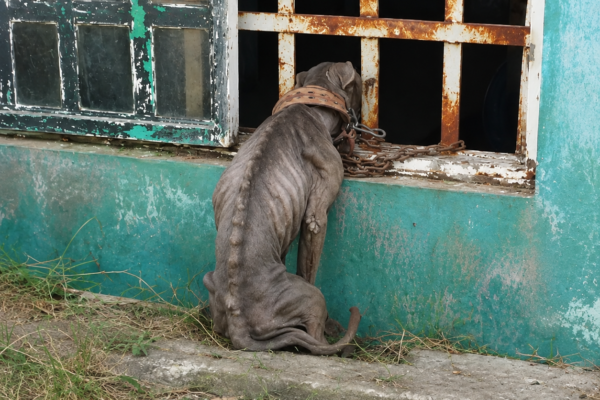
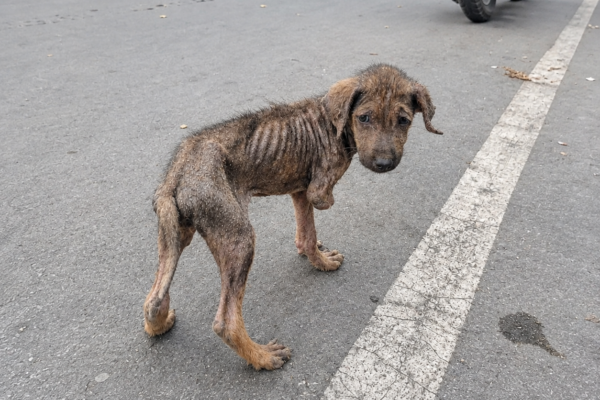
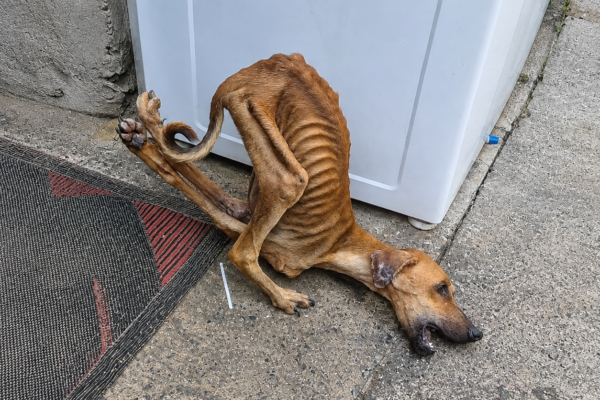
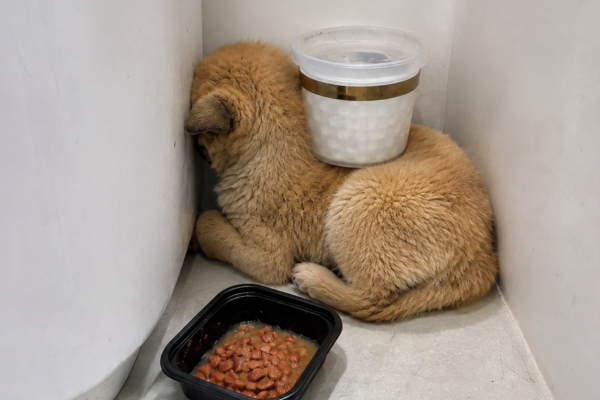
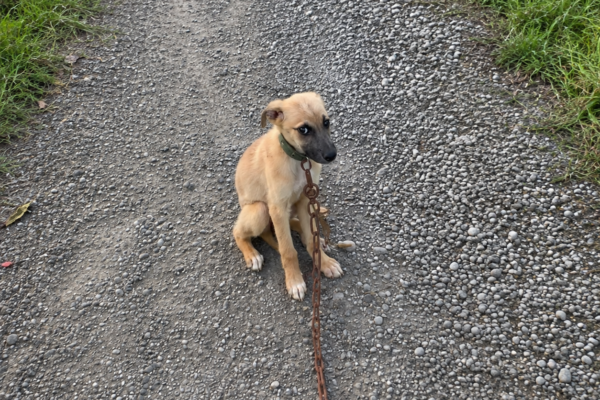
Abandoned in the grass because he was sick, Mira could barely stand when help finally reached him.h
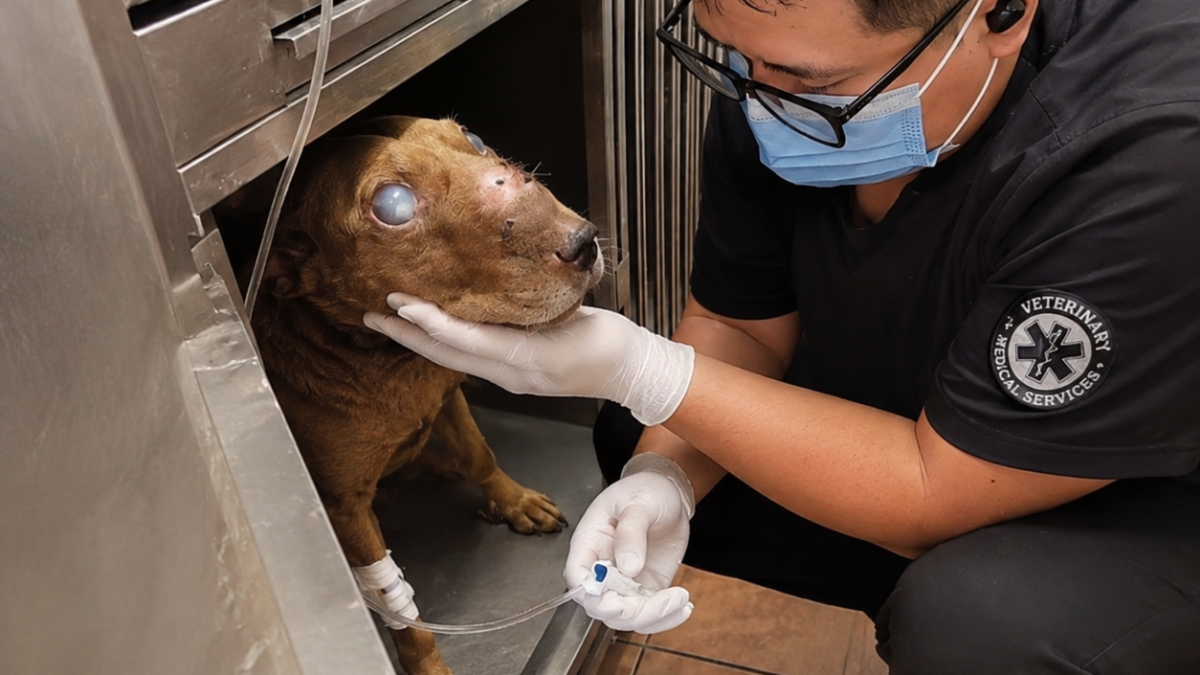
For a long time, the grass was the only place Mira had.
Not a home.
Not a room where someone checked on him.
Not a safe corner where he could sleep knowing that, when morning came, a familiar person would still be there.
Just the grass.
And pain.
His owner had abandoned him there because Mira was sick.
Treatment would cost money.
Instead of paying for that treatment, the person who had once been responsible for him chose to leave.
Mira was left behind with a body that was already failing him.
He could not understand the reason.
He could not know that money had entered into someone else’s decision about whether he deserved care.
He could not understand that his illness had become an inconvenience to the person who should have protected him.
He only knew the result.
He was alone.
For long nights, he cried.
The sound came from somewhere inside a body that had almost nothing left to give.
He moaned in the grass, weak and hurting.
No one came.
Night after night, his cries seemed to disappear into the darkness around him.
There is something especially cruel about suffering when no one appears to know you are suffering.
Mira was not hidden because he wanted to be.
He was not resting peacefully.
He was sick.
His face was swollen.
His body was exhausted.
The illness and the wounds had drained him so deeply that movement had become difficult.
Even standing was a struggle.
Yet he remained there.
Breathing.
Waiting, perhaps without even knowing what he was waiting for.
Animals do not understand abandonment through the same language people use.
Mira could not ask why his owner had left.
He could not demand an explanation.
He could not say, “I am sick. I need help.”
He could only endure what was happening to him.
And when the pain became too much, he cried.
For long nights, those cries went unanswered.
No footsteps approached.
No familiar hands lifted him.
No one came to tell him that the worst part was over.
Mira had no way to know whether help would ever come.
He did not know that somewhere close enough to hear him, one person was about to change everything simply because she paid attention.
The woman heard him.
That was the beginning.
Not a dramatic miracle.
Not a sudden recovery.
Just a human being hearing suffering and deciding not to ignore it.
She heard Mira’s cries and understood that they were not ordinary sounds.
Something was wrong.
Someone was hurting.
She went toward the sound.
What she found was enough to move her deeply.
There was a dog in terrible condition.
His face was swollen.
His body looked spent.
The weakness in him was obvious.
This was not an animal who needed only a meal and a little rest.
He needed medical help.
Quickly.
The woman knew of Dr. Eduardo.
Eduardo had dedicated his life to saving animals.
To someone facing a dog in Mira’s condition, that mattered.
There are moments when compassion needs more than good intentions.
It needs someone who knows what to do next.
The woman hurried to Eduardo.
She told him about the dog.
About the crying.
About the condition she had seen.
There was no reason to wait.
Eduardo went to Mira.
By the time he reached the place, the dog was still there.
Still in the grass.
Still weak.
Still carrying the consequences of being left untreated.
And when Eduardo saw him, he was astonished by Mira’s condition.
The swelling in the dog’s face was impossible to ignore.
It changed the shape of him.
It immediately raised questions.
What had caused it?
How serious was it?
How long had he been living with it?
Was there something deeper happening beneath the visible wound?
Then there was the rest of Mira.
The exhaustion.
The weakness.
The way his body seemed to have run out of reserves.
He could barely stand.
His eyes were filled with sadness and fatigue.
Nothing about him suggested a dog with energy to spare.
He looked like an animal who had been fighting for too long without enough help.
Eduardo moved toward him carefully.
There was no need for force.
Mira did not run.
He did not try to escape.
He did not resist.
Perhaps he was simply too exhausted.
Perhaps, as the original account suggests, some part of him seemed to recognize that Eduardo had come to help.
No one could know exactly what Mira understood in that moment.
But his behavior was clear.
He allowed Eduardo to approach.
For a dog who had already been failed by a human being, that small act of surrender carried enormous weight.
Eduardo reached down.
He lifted Mira gently.
The dog who had been struggling to hold himself up no longer had to.
For those few moments, someone else carried him.
Mira’s body rested in Eduardo’s arms.
The same body that had been left in the grass was now being treated as something worth protecting.
That difference did not heal him.
Not yet.
But it changed the direction of his story.
Until then, everything had been moving toward greater weakness.
Pain.
Neglect.
Exhaustion.
More time without treatment.
Now, for the first time, Mira was moving toward care.
Eduardo carried him to the car.
He placed him gently into a cage so he could be transported safely.
Mira still did not fight.
There was no burst of panic.
No desperate effort to get away.
He simply allowed himself to be moved.
The woman who had heard his cries was still there.
Her role in the rescue could easily be described in one sentence: she heard Mira and got help.
But for Mira, that one decision was the line between continuing to suffer unseen and being found.
Eduardo went back to her.
He thanked her from the bottom of his heart.
It was not difficult to understand why.
If she had ignored the sound, there was no telling how much longer Mira would have remained there.
If she had assumed someone else would help, perhaps no one would have.
If she had decided the problem was too complicated, the dog might still have been lying in the grass.
Instead, she acted.
Now Mira was in the car.
He was weak.
He was sick.
He was far from recovered.
But he was no longer alone.
The woman was deeply moved by his condition.
Anyone looking at him could see the suffering.
His face carried the visible evidence.
His body carried the rest.
But Eduardo could not stop at sorrow.
Mira needed treatment.
So he took him to his clinic.
The journey from the grass to the clinic was not a recovery in itself.
Mira remained the same exhausted dog.
The swelling had not disappeared.
The wounds had not closed.
The pain had not suddenly vanished because someone had shown compassion.
Rescue often begins with a misunderstanding in the way stories are told.
People sometimes imagine that once an animal is picked up, the suffering is over.
But being found is only the beginning.
For Mira, being found meant he had finally reached the point where healing could start.
First, though, Eduardo needed to understand what was wrong.
He admitted Mira immediately.
There was no reason to delay.
The dog’s condition demanded attention.
Eduardo examined him thoroughly.
He looked carefully at the swollen face.
At the wounds.
At the weakened body.
At the signs that Mira had been living with pain rather than receiving care for it.
The more complete the examination, the more important the next step became.
Tests.
Numerous tests were ordered.
The swelling in Mira’s face was one of the greatest concerns.
Its appearance was frightening.
A swollen face could mean different things.
The visible wound did not by itself answer every question.
Eduardo needed information before he could understand what they were dealing with.
So while the tests began their work of answering those questions, Eduardo began his own work.
Treatment could not wait.
Mira had serious wounds.
Those wounds needed care.
They needed to be cleaned and treated.
His body needed rest.
His strength had to be protected.
Eduardo worked on him.
Every action was part of a reversal.
Before, the wounds had been left untreated.
Now they were being treated.
Before, Mira had cried in the grass without anyone responding.
Now someone was paying attention to the places that hurt.
Before, illness had been the reason he was abandoned.
Now illness was the reason people were working harder to keep him safe.
The contrast was painful.
A sick animal should not become less worthy because treatment costs money.
Sickness is precisely when care matters most.
Mira had learned the opposite through what had happened to him.
He had been left at the moment he most needed someone.
Eduardo’s work gave him a different answer.
Your pain does not make you disposable.
Your wounds do not make you a burden.
Your illness does not reduce your value.
Mira could not understand those sentences.
No one needed him to.
He could feel the consequences of them.
Gentle hands.
Medical attention.
A place to rest.
Someone watching over him.
Someone spending time and money on the very treatment his previous owner had avoided.
The meaning was in the actions.
After Eduardo finished treating the wounds that could be addressed immediately, Mira was taken to rest.
Rest sounds simple.
For a severely exhausted dog, it was part of treatment.
Mira had spent too long using his remaining strength merely to endure.
Now he was in a place where he could stop fighting the environment around him.
He still had pain.
He still had swelling.
The tests were still pending.
But no one was asking him to survive alone anymore.
That first period at the clinic was filled with uncertainty.
The test results had not yet returned.
No one could simply look at the swelling and declare what it meant.
The size of it was frightening enough.
The deep wound beneath it had already done significant harm.
There was reason to hope, because Mira was alive and receiving treatment.
There was also reason to remain cautious.
The answers had not arrived.
For Eduardo, this meant doing what veterinarians and rescuers often have to do: treat what can be treated now while waiting to learn what cannot yet be known.
Mira needed care whether the final results were good or bad.
So the work continued.
His wounds were attended to.
His condition was monitored.
He was allowed to recover from the immediate exhaustion.
The clinic became the opposite of the place where he had been abandoned.
There, Mira had been left because someone did not want the cost of his illness.
Here, his illness was the reason Eduardo invested more in him.
Time.
Attention.
Money.
Energy.
Mira did not know the arithmetic of his rescue.
He did not know what tests cost.
He did not know how many hours Eduardo gave him.
He did not know that someone was choosing, again and again, to spend resources on his recovery.
He only knew the experience itself.
When he hurt, someone noticed.
When he needed treatment, someone provided it.
When he needed rest, he was given rest.
That was a new world.
The swelling did not disappear immediately.
The body that had been weakened over time could not rebuild itself in a day.
The pain he had carried for months had taken a toll.
Recovery had to happen gradually.
But before the full recovery could begin, everyone needed the test results.
A few days passed.
Those days mattered.
Mira remained under care.
Eduardo continued looking after him.
The woman’s decision to seek help had delivered Mira to safety, but the difficult part of the medical work was only beginning.
Waiting can be one of the hardest parts of caring for a sick animal.
When the problem is visible, the imagination naturally searches for answers.
The swelling in Mira’s face made the unknown difficult to ignore.
Was it something malignant?
Was there a deeper disease?
Would the tests reveal something that changed everything?
Those possibilities hung over the situation until the results came back.
Then, finally, there was reassuring news.
The swelling was not malignant.
It was not a malignant growth.
It was the result of a deep wound.
For Mira, that distinction changed the emotional weight of the situation.
The wound was serious.
The swelling was significant.
His body had suffered.
But the test results did not reveal the kind of malignancy everyone had feared.
There was a path forward.
Treatment could focus on healing.
From that day, Mira’s recovery truly began to take shape.
The word “recovery” can sound clean.
A beginning.
A middle.
An end.
Real healing rarely feels that organized.
Mira did not move from weak to strong in one dramatic moment.
He improved gradually.
Day by day.
The wounds began to heal.
Strength slowly returned.
The body that had seemed completely exhausted began to respond to care.
That slow response became its own kind of reassurance.
Mira had not been beyond saving.
He had been neglected.
There is a difference.
Neglect can make a living creature look as though hope has disappeared.
But sometimes what appears hopeless is a body that has simply been denied the conditions it needs.
Treatment.
Nutrition.
Rest.
Consistency.
Time.
Mira finally had those things around him.
And his body began to answer.
At first, the changes may not have looked dramatic.
Healing often arrives quietly.
A wound looks slightly better.
The swelling decreases a little.
An animal who struggled to remain upright holds himself more steadily.
The eyes that seemed overwhelmed by exhaustion begin to show more awareness.
Strength does not return as an announcement.
It returns in increments.
For Eduardo, each improvement mattered because he knew where Mira had started.
He had seen him in the grass.
He had felt the weight of that exhausted body in his arms.
He had watched the dog barely stand.
He had seen the swollen face close enough to understand how severe the situation looked.
So even small progress meant something.
Mira was moving in the right direction.
The dog who had been abandoned because treatment seemed too expensive was now being treated by a man who dedicated his own resources to him.
Eduardo gave Mira his money.
He gave him his time.
He spent his days caring for him.
That commitment became one of the central forces in Mira’s recovery.
There is no dramatic way to describe daily medical care without distorting it.
Most of it is repetition.
Observe.
Treat.
Check again.
Clean.
Monitor.
Wait.
Respond to changes.
Repeat.
It can be exhausting.
It can consume hours without producing an immediate transformation.
But Mira needed that repetition more than he needed a dramatic gesture.
The wounds had developed over time.
The weakness had developed over time.
The pain had lasted for months.
Healing would require time too.
Eduardo gave him that time.
Day after day, Mira was no longer the dog nobody wanted to spend money on.
He became the dog someone was willing to spend everything he could on.
That reversal matters.
Mira did not become more deserving after Eduardo found him.
He had always been deserving.
His value had not changed.
Only the way people treated that value had changed.
One person had looked at sickness and seen expense.
Another looked at sickness and saw a life that needed help.
Mira was the same dog in both moments.
The difference was human choice.
At the clinic, that choice became visible in his improving body.
The deep wound began to heal.
The swelling started to go down.
The enormous exhaustion gradually loosened its hold.
Mira began regaining strength.
Each improvement opened the possibility of another.
A little more strength meant the body could support itself better.
A healing wound meant less of his energy was being consumed by injury.
Reduced swelling changed the way his face looked.
The dog hidden beneath suffering started becoming easier to see.
That is one of the most moving things about recovery.
Pain can dominate an animal’s appearance so completely that people forget there is a personality underneath it.
At first, Mira was almost entirely defined by what was wrong.
The swollen face.
The exhausted body.
The inability to move normally.
The sadness in his eyes.
The weakness.
But those things were conditions.
They were not his identity.
As the treatment worked, Mira slowly became more than the list of his symptoms.
He became a dog with a future.
A dog capable of standing.
A dog capable of walking.
A dog moving toward a life outside intensive treatment.
A dog who might one day enter a permanent home.
That possibility would have seemed distant when Eduardo first found him.
At that time, standing itself was difficult.
The idea of Mira walking normally, living without the pain that had tormented him for months, and preparing for adoption would have required more hope than evidence.
But rescue often begins before there is evidence.
Eduardo treated the dog in front of him because Mira was alive.
That was enough reason.
He did not need proof that the outcome would be perfect before investing in him.
He did not need Mira to guarantee recovery.
He simply responded to need.
That response gave Mira the chance to show what his body could do once it received care.
And Mira’s body began doing something remarkable in its simplicity.
It healed.
Not completely at once.
Not magically.
But steadily.
The wounds that had remained untreated began closing.
The swelling decreased.
His strength returned enough for him to use his legs more confidently.
The exhausted dog who had allowed Eduardo to carry him because he could barely stand eventually became a dog who could stand on his own.
That change is easy to write in one sentence.
It was much larger to witness.
Standing is so ordinary that healthy animals do it without anyone noticing.
For Mira, it marked distance traveled.
At the beginning, his body had been too weak.
Now it could support him.
The same legs that had trembled beneath illness and exhaustion began holding him upright.
There was no need for applause.
The act itself was enough.
Then came walking.
Again, an ordinary action.
Again, an extraordinary milestone when viewed against the beginning.
Mira could walk.
The dog who had once seemed almost unable to move had regained enough strength to carry himself forward.
That movement was physical, but it represented his whole story.
Everything about Mira’s early condition had been stillness.
Left in the grass.
Too weak to move properly.
Waiting while pain continued.
Waiting while no one heard.
Waiting until someone finally did.
Now he was moving.
He could stand.
He could walk.
His body was no longer trapped by the same degree of pain.
The swelling had gone down considerably.
Treatment had reached a new stage.
He no longer required the same level of intensive care.
That did not mean Eduardo’s work was finished.
Mira was still receiving treatment.
Recovery was still ongoing.
But the phase had changed.
The dog who once needed immediate, intensive attention had improved enough to enter a less intensive stage.
That was progress measured not in emotion but in medical reality.
His condition was better.
His face showed it.
His movement showed it.
His treatment plan showed it.
Most of all, the end of the pain he had suffered for months showed it.
For months, pain had been part of Mira’s life.
The source does not tell us every moment of those months.
We should not invent them.
We do not know exactly where he slept before being abandoned.
We do not know how many days he struggled before his owner finally left him.
We do not know what his daily life looked like while the wound worsened.
But we do know the pain lasted for months.
That knowledge is enough.
Months of pain means pain had become familiar.
It means suffering was not a single terrible afternoon.
It had stretched across time.
It had accompanied him long enough that a painless day would have felt like a different existence.
That is why the line “all the pain he suffered for months is gone” carries so much weight.
It does not merely describe symptom improvement.
It describes the end of an era in Mira’s life.
Pain no longer controls every movement.
Pain no longer defines his face.
Pain no longer explains why he cannot stand.
The thing that once shaped his whole experience has finally released him.
That is what Eduardo’s time purchased.
Not in the cold sense of money exchanged for treatment.
In the deeper sense.
He spent what he had so Mira could have what had been denied.
Care.
Relief.
A chance.
When an animal has been abandoned because treatment costs too much, every day of successful treatment becomes a quiet contradiction of that abandonment.
Mira’s recovery said something his former owner had refused to believe through action.
He was worth the expense.
Worth the effort.
Worth the hours.
Worth the uncertainty.
Worth continuing.
Worth saving.
The question in the title—“Am I really worth saving?”—is a human way of framing what Mira could never ask aloud.
We should not pretend Mira formed those words.
But his condition made the question unavoidable for everyone who saw him.
A dog had been left because he was sick.
Someone had effectively treated his suffering as a reason to remove him from their responsibility.
Then another person found him and built an answer through action.
Yes.
He was worth saving.
Eduardo never needed to say it.
He proved it every day.
When he hurried to the location, that was an answer.
When he lifted Mira, that was an answer.
When he admitted him immediately, that was an answer.
When he examined him thoroughly, that was an answer.
When he ordered tests, that was an answer.
When he treated the wounds before the results had even come back, that was an answer.
When he continued after days became longer and treatment became expensive, that was an answer.
When he dedicated his money and time, that was an answer.
When he spent entire days caring for Mira, that was an answer.
Every repeated act said the same thing.
Your life matters.
The woman who heard Mira’s cries had already given the first answer.
She could have walked away.
She did not.
She sought help.
Mira’s survival became possible because two people, in different ways, refused the logic of abandonment.
One listened.
One treated.
The woman’s compassion brought Eduardo into Mira’s story.
Eduardo’s commitment turned rescue into recovery.
Neither could erase what had happened.
Neither could change the months of pain.
Neither could undo the choice of the owner who left him.
But they could control what happened from the moment they entered.
That is one of the most important distinctions in any rescue story.
People often wish they could go backward.
What if someone had found Mira sooner?
What if he had been treated before the wound became so severe?
What if his owner had accepted responsibility?
What if he had never been left in the grass?
Those questions are natural.
They are also impossible to answer in a useful way.
The past had already happened.
Mira needed help in the present.
The kind woman and Eduardo gave it.
That turned regret into action.
And action gave Mira a future.
As his face improved, it became easier to imagine that future.
The swelling decreased considerably.
The frightening distortion that had immediately drawn attention began to recede.
Beneath it was Mira.
Still recovering.
Still requiring care.
But no longer hidden behind the same severity of injury.
His body regained enough strength to stand and walk.
His treatment became less intensive.
Those changes meant the conversation about his life could begin moving beyond medicine.
At first, every question had been medical.
How serious are the wounds?
What is causing the swelling?
Is it malignant?
Can he tolerate treatment?
Will he regain strength?
Now new questions could appear.
When will he be ready for a permanent home?
What kind of life is waiting after treatment?
Could Mira, who had been abandoned in the grass, eventually sleep in a place where no one would leave him because he became sick?
The source gives us a hopeful answer without pretending it has already happened.
Soon, Mira will be ready for his forever home.
He does not have that final home yet.
That matters.
His story ends before adoption.
It ends while he is still moving toward it.
There is something honest and beautiful about stopping there.
We do not need to invent the family.
We do not need to name people who have not entered his story.
We do not need to write a fictional scene in which Mira walks through a new front door.
The truth is already hopeful enough.
A dog who was once abandoned because he was ill has recovered so much that people can now talk about his future home instead of whether he will survive.
That change is enormous.
At the beginning, Mira’s world had narrowed to pain and grass.
Now it has expanded to possibility.
A warm home.
Care.
Love.
Permanence.
Not as a guarantee attached to a date.
As the next destination toward which his healing is carrying him.
The word “forever” matters because Mira has already learned what it means for a place not to last.
He had an owner once.
That did not protect him from abandonment.
He had a human relationship that should have meant responsibility.
When treatment became necessary, that relationship failed him.
A forever home, if it is truly worthy of the name, would mean something different.
It would mean care does not disappear when care becomes difficult.
It would mean sickness is not a reason to be discarded.
It would mean a wound does not make him less wanted.
It would mean the cost of loving him is accepted as part of loving him.
Mira deserves that kind of home.
Not because he survived dramatically.
Not because his story is emotional.
Not because his swollen face moved people.
He deserves it because every animal entrusted to a person deserves care that does not vanish at the first sign of hardship.
Mira’s story exposes that truth without needing to preach.
All we have to do is look at the difference between the two halves of his life.
One person saw a sick dog and abandoned him.
Another saw the same sick dog and lifted him.
One person wanted to avoid the cost.
Another spent his own money.
One person left Mira to cry.
Another spent entire days caring for him.
One person treated illness as a reason to disappear.
Another treated illness as a reason to stay.
Mira did not change between those decisions.
The humans did.
That is why his story is not only about resilience.
It is about responsibility.
Mira’s body was capable of healing.
But it needed someone willing to provide the conditions.
Without the woman who heard him, without Eduardo’s treatment, the possibility might never have become reality.
His recovery belongs partly to his own body and partly to the people who gave that body a chance to do its work.
That is a humbling thing to remember.
Sometimes an animal we call “hopeless” is simply unsupported.
Sometimes the difference between decline and recovery is whether one person stops.
One person listens.
One person decides the suffering deserves a response.
For Mira, that person first was the woman.
She heard what others had not.
Maybe others were too far away.
Maybe no one else noticed.
The source only tells us that for long nights, no one heard his moans, until she did.
That moment of hearing changed the balance.
Before, Mira’s pain existed without a witness.
After, someone knew.
And once someone knew, she refused to carry that knowledge passively.
She went to Eduardo.
That is the difference between sympathy and intervention.
Feeling sad about Mira would not have treated him.
Getting help did.
Eduardo’s role began when he trusted the urgency of what she told him.
He did not dismiss her.
He did not tell her to wait.
He went.
At the location, he saw enough to understand immediately that the concern was justified.
The dog before him was exhausted.
Weak.
Swollen.
Barely able to stand.
There are conditions that do not require dramatic interpretation.
Mira looked bad because he was in bad condition.
Eduardo did not need to invent a story about him to feel compassion.
The body told the story.
The eyes told the story.
The inability to stand told the story.
The wound told the story.
The fact that he had been left there told the rest.
Eduardo responded with gentleness.
That detail matters.
He approached.
He lifted Mira carefully.
There was no rough handling.
No impatience.
Mira had already experienced enough indifference.
His rescue began with tenderness.
The same is true of the cage in the car.
A cage can sound cold when described without context.
For Mira, it was part of safe transport.
He was too weak to be left unsecured.
Eduardo placed him there gently.
Then he turned back to thank the woman.
That small pause reveals something about him.
He recognized that rescue was shared.
The woman had not performed the medical treatment, but without her, the treatment might never have happened.
He did not take her role for granted.
He thanked her deeply.
That gratitude connected the first act of kindness to the next.
Then Mira was taken to the clinic.
From there, Eduardo became the person carrying most of the responsibility.
He examined Mira.
He ordered tests.
He treated the serious wounds.
He gave the dog rest.
He waited for answers.
When those answers were reassuring, he did not relax into complacency.
The wound still needed healing.
The body still needed rebuilding.
The months of pain still needed to become the past rather than the present.
So he continued.
Time and money can sound abstract until you imagine what they mean in repeated daily care.
Money means tests that are actually performed instead of avoided.
Treatment that continues instead of stopping.
Supplies used because an animal needs them.
Time means being there when there are other things demanding attention.
Looking at a wound again.
Checking progress.
Responding when healing is slow.
Making the same choice tomorrow that you made today.
Mira’s previous owner had made one decision to avoid cost.
Eduardo made many decisions to accept it.
That accumulated commitment became Mira’s recovery.
There is no way to know what Mira remembered about his abandonment.
We should not invent human sentences in his mind.
But animals learn patterns.
They learn whether hands hurt or help.
Whether approaching footsteps bring fear or relief.
Whether a place is dangerous or safe.
Whether pain is ignored or answered.
Mira’s early behavior with Eduardo suggested trust, exhaustion, or both.
He did not resist being picked up.
He did not struggle against help.
As treatment continued, the world around him remained consistent.
The same general truth repeated itself.
People here were helping.
The clinic was not the grass.
Eduardo was not the owner who left.
Illness did not cause these people to disappear.
The longer care continued, the stronger that difference became.
It is possible that Mira’s body learned safety before his mind could understand anything about it.
The absence of pain is itself information.
A wound that starts closing changes how movement feels.
A swollen face becoming less swollen changes how eating, resting, and simply existing may feel.
Strength returning changes the body’s relationship to the floor beneath it.
For months, Mira had known pain.
Now his body was learning relief.
Relief does not need language.
A dog knows when standing hurts less.
A dog knows when he can walk farther than before.
A dog knows when he is no longer too exhausted to move.
A dog knows when a place allows rest instead of demanding survival.
In that sense, recovery told Mira a story he could understand completely.
You are hurting less.
You can move again.
You are safe enough to heal.
No explanation about tumors or malignancy was necessary from his perspective.
Those details mattered to Eduardo.
For Mira, the result mattered through experience.
The swelling went down.
The wound improved.
The pain diminished.
Strength returned.
He stood.
He walked.
Those were the facts that touched his daily life.
And today, those facts look very different from the day he was found.
Today, Mira has improved significantly.
That word—significantly—does not mean “perfect.”
It does not mean treatment is over.
It means the difference is large enough to see.
His face is less swollen.
His body is stronger.
His treatment is less intensive.
He can stand.
He can walk.
The pain that lasted for months is gone.
There is no need to exaggerate beyond that.
Those changes are extraordinary enough.
The danger in emotional storytelling is the temptation to add another tragedy or another miracle because the truth seems too simple.
Mira’s truth does not need decoration.
He was abandoned sick.
He cried for long nights.
A woman heard him.
Eduardo responded.
The dog was in terrible condition.
Tests were ordered.
The swelling was frightening but not malignant.
The wound was treated.
Mira recovered slowly.
Eduardo invested heavily in him.
Today the dog can stand and walk.
Soon he may be ready for a permanent home.
That is already a complete emotional arc.
The pain lies in the abandonment.
The hope lies in the response.
The meaning lies in the contrast.
Nothing else is required.
Mira’s story also reminds us that there are different kinds of rescue.
The first rescue was physical.
Remove him from the grass.
Get him to the clinic.
Treat the wounds.
That was urgent.
The second rescue was from the assumption that his suffering was not worth the cost.
Eduardo answered that assumption every day.
The third rescue is still ahead.
A home.
Not just a place where Mira receives treatment because he is a patient.
A place where he belongs because he is loved.
That final step has not happened in the source yet.
And that makes the current moment feel like standing at an open door.
Behind Mira is everything he survived.
In front of him is the possibility of permanence.
He is not the dog he was when Eduardo found him.
His body has changed.
His capacity has changed.
His treatment has changed.
But perhaps the most important change is that people looking at him now can imagine a future rather than only an emergency.
A dog who is barely standing forces everyone to think about the next hour.
A dog recovering well enough to walk invites people to think about the next home.
That shift in time is part of healing.
At first, Mira’s life was measured in urgent moments.
Get him out.
Get him examined.
Get the wounds treated.
Wait for the tests.
Then it began expanding.
Days of recovery.
Gradual improvement.
Less intensive treatment.
Soon, adoption readiness.
Future.
That word might have seemed almost cruel when Mira lay in the grass.
Now it fits.
Mira has a future.
A future not because life decided to be fair.
Life had already been unfair to him.
A future because people intervened.
The phrase “life has given him a new chance” is beautiful, but it is worth seeing the human hands inside that chance.
The woman heard him.
Eduardo went.
Eduardo lifted him.
Eduardo treated him.
Eduardo spent.
Eduardo stayed.
Mira healed.
Chance arrived through care.
That makes the story more powerful, not less.
Hope did not fall from the sky.
Someone carried it to the grass.
Someone carried Mira to the car.
Someone carried the medical responsibility after that.
One of the most striking images in the whole story remains Eduardo lifting Mira into his arms.
At that moment, the physical difference between them was obvious.
Mira could barely support himself.
Eduardo could.
So Eduardo became the strength Mira did not have.
That is what rescue often is at its purest.
Using your strength where another creature has none left.
Not permanently.
Not to make the animal dependent.
Just long enough for his own strength to return.
Eduardo carried Mira because Mira could not move well.
Later, Mira stood for himself.
Then he walked.
That progression is almost a definition of good care.
First, someone carries you.
Then they treat what is hurting you.
Then your own body begins carrying you again.
Mira moved through all three stages.
At the beginning, the sight of him was shocking.
Today, his improvement is the image that matters.
The swelling has decreased considerably.
The body is functioning again.
He no longer needs the same intensive level of treatment.
Those are medical milestones, but emotionally they speak to something larger.
Mira was not abandoned at the end of his story.
He was abandoned near the beginning of a new one.
The person who left him could not know what would happen after.
Could not know a woman would hear him.
Could not know Eduardo would commit himself to the dog.
Could not know tests would bring reassuring news.
Could not know Mira would regain strength.
Could not know the dog considered too costly to treat would one day stand and walk toward a forever home.
Abandonment was meant, perhaps, to remove responsibility.
Instead, it transferred responsibility to kinder hands.
That does not excuse the act.
It reveals what compassion can do afterward.
Eduardo did not own the original mistake.
But he accepted the consequences.
He took responsibility for a dog someone else had failed.
There is nobility in that without needing to turn him into something larger than the source allows.
He was a veterinarian devoted to animals.
He saw a dog in need.
He used his skills and resources.
He stayed committed.
That is enough.
People often want heroes to be extraordinary in theatrical ways.
Mira did not need theatre.
He needed a doctor willing to spend the day with him.
He needed wounds treated correctly.
He needed tests.
He needed patience.
He needed a place to recover.
The heroism, if we want to use that word, was in consistency.
Eduardo kept showing up.
That consistency made the future possible.
The woman’s role was similar in another way.
She did not need to perform the rescue herself.
She recognized the limits of what she could do and found someone equipped to do more.
That is a form of compassion too.
Sometimes helping means knowing whom to call.
She could have stood beside Mira and cried.
Instead, she moved.
That action mattered more.
When Eduardo thanked her, he acknowledged that chain.
Mira’s rescue had begun before Eduardo touched him.
It began when the woman refused to dismiss the sound of suffering.
That is why every link in the story matters.
The cries.
The listening.
The call for help.
The arrival.
The gentle lift.
The transport.
The examination.
The tests.
The treatment.
The waiting.
The results.
The days of care.
The gradual healing.
The reduced swelling.
The return of strength.
Standing.
Walking.
Less intensive treatment.
The possibility of a forever home.
If even one of those links had been missing, the story might have looked different.
But they were not missing.
They happened.
And because they happened, Mira’s present is not defined by the grass.
It is defined by recovery.
That change is worth dwelling on.
Grass can be soft under normal circumstances.
A dog lying in grass can be a peaceful image.
Mira’s grass was not peaceful.
It was the place where he was left sick.
The place where his cries went unanswered for long nights.
The place where his weakness became visible.
The place where abandonment became real.
That is why being lifted from it matters.
Eduardo did more than pick a dog up from the ground.
He ended a period of being left there.
He ended the waiting.
He ended the silence around the suffering.
Mira did not become healthy the moment his paws left the grass.
But the abandonment stopped.
That was the first wound human compassion could close immediately.
Medical wounds take time.
Abandonment can end the moment someone stays.
Eduardo stayed.
The clinic stayed.
Treatment stayed.
And Mira responded.
One day at a time.
There is no exact number of days given for his full recovery.
We should not invent one.
There is no exact date on which he first stood.
We should not create one.
There is no precise measurement of how much the swelling decreased.
We do not need it.
The source gives us the shape of progress without artificial precision.
That shape is enough.
Slow.
Steady.
Significant.
The absence of exact numbers makes the emotional truth no less real.
If anything, it keeps attention where it belongs.
On the change itself.
Mira had been suffering for months.
Today, that pain is gone.
He had been unable to move well.
Today, he stands and walks.
His face had been severely swollen.
Today, the swelling is much smaller.
He had needed intensive care.
Today, his treatment is less intensive.
He had been abandoned.
Soon, he may be ready for a forever home.
Every sentence turns the earlier reality into a later one.
Pain into relief.
Weakness into strength.
Neglect into care.
Abandonment into the possibility of belonging.
That is why the story feels hopeful even though it begins so painfully.
Hope is not introduced by pretending the beginning was less cruel.
It is created by contrast.
The worse we understand the abandonment, the more meaningful the care becomes.
The more clearly we see the weakness, the more powerful standing becomes.
The more we remember the grass, the more meaningful a future home becomes.
This is not manipulation.
It is simply paying attention to what changed.
And Mira changed because his circumstances changed.
That is an important lesson.
We sometimes praise animals for resilience in a way that accidentally hides the responsibility people carry.
Mira was resilient.
His body endured months of pain.
He survived abandonment.
He responded to treatment.
But resilience alone would not have cleaned his wounds.
Resilience alone would not have ordered tests.
Resilience alone would not have reduced the danger of untreated injury.
He needed care.
Resilience is not a substitute for responsibility.
Eduardo understood that through action.
He did not look at Mira and say, “He is strong; he will figure it out.”
He took him in.
That distinction is crucial.
A suffering animal should not have to prove exceptional strength before receiving help.
Mira received help because he needed it.
The strength came later.
Standing came later.
Walking came later.
The dog did not earn treatment by recovering well.
Treatment made recovery possible.
That is how it should be.
When Mira eventually moves into a forever home, the best home for him will understand the same principle.
Love is not only for the healthy days.
Mira already knows, through experience, what happens when someone treats illness as a reason to leave.
His future should be the opposite.
A home where sickness brings care closer.
A home where age, wounds, or weakness do not reduce commitment.
A home where he is not measured by convenience.
The source describes that future home simply.
Warmth.
Care.
Love.
Those words may sound ordinary.
For Mira, they mean everything his abandonment lacked.
Warmth means no more lonely nights in the grass.
Care means illness will be answered, not avoided.
Love means his value will not depend on how easy he is to keep.
That is the home he is moving toward.
Not today, perhaps.
But soon.
For now, he remains in treatment.
That current reality deserves its own respect.
Mira is not a finished project.
He is a recovering living being.
He still needs attention.
The fact that treatment is less intensive does not mean care can stop.
It means the care has worked well enough to change what he needs.
That is success.
Success does not always look like the final adoption photo.
Sometimes it looks like a dog needing fewer interventions.
Sometimes it looks like a smaller swelling.
Sometimes it looks like standing.
Sometimes it looks like walking.
Sometimes it looks like a veterinarian finally being able to think beyond crisis management.
Mira has reached that stage.
The emergency that once dominated his life has begun giving way to ordinary recovery.
That is a quiet victory.
Eduardo’s dedication remains woven through it.
The source says he dedicated all his money and time to Mira.
We should understand that as an expression of extraordinary commitment, not as an invitation to invent details about his finances or daily schedule.
What matters is clear enough.
He gave generously.
He prioritized the dog.
He spent his days caring for him.
Mira was not treated as a side task.
His recovery mattered deeply.
That level of attention can transform the trajectory of a sick animal.
It did here.
The dog who had been left because someone would not pay for treatment was now receiving care from someone willing to bear the cost personally.
There is almost no sharper contrast possible.
Mira’s previous owner had asked, in action, “How much will this cost me?”
Eduardo answered a different question.
“What does this dog need?”
Those two questions lead to different worlds.
The first led to the grass.
The second led to healing.
That may be the emotional center of Mira’s story.
Not simply that one human was cruel and another was kind.
But that value was measured differently.
To one person, Mira’s illness reduced his value because it increased the burden.
To Eduardo, illness increased the urgency of care.
Mira’s worth never changed.
The human calculation did.
A living creature does not become less worthy when help becomes expensive.
Need does not reduce value.
It reveals responsibility.
Mira’s story makes that visible without needing a lecture.
All we need is the image of him in Eduardo’s arms.
The dog abandoned because treatment was inconvenient was now being carried by someone willing to begin treatment immediately.
The body had not changed yet.
The value had simply been recognized.
From there, medicine did its work.
Time did its work.
Rest did its work.
Mira’s body did its work.
The deep wound gradually healed.
The swelling decreased.
Strength returned.
Pain receded.
And with each improvement, the idea of a forever home became more realistic.
At some point, perhaps without any dramatic announcement, the goal changed.
At first, save him.
Then stabilize him.
Then heal him.
Then strengthen him.
Now, prepare him for the life that comes after recovery.
That progression is the shape of hope made practical.
It does not skip steps.
It respects reality.
Mira could not go directly from the grass to a forever home.
He needed medical care first.
He needed to become strong enough.
He needed the wound to heal.
He needed the swelling to decrease.
He needed time.
Eduardo gave him that bridge.
Soon, someone else may become the next bridge.
From patient to family member.
From clinic to home.
From recovery to belonging.
Again, we stop before inventing that scene.
We do not know who will adopt him.
We do not know what the house will look like.
We do not know whether there will be other animals.
We do not know what room he will sleep in.
We do not know what his first night will feel like.
Those details belong to the future.
The source gives us only the promise that he will soon be ready.
That promise is enough to create an ending filled with hope.
Because the beginning gave Mira no future at all.
He was sick.
Abandoned.
Weak.
Crying.
Barely able to stand.
The current Mira is completely different in the ways that matter most.
Alive.
Healing.
Walking.
Less swollen.
Free from months of pain.
Surrounded by care.
Moving toward a permanent home.
When those two images are placed beside each other, the story needs nothing else.
The transformation is already complete enough to move us.
Mira did not need an unrealistic miracle.
He needed someone to hear him.
That may be the simplest truth in the entire story.
He had been crying.
For long nights.
No one heard.
Then someone did.
Everything else followed from that.
If we trace his recovery backward, every good thing returns to a moment of attention.
The forever home he may soon enter became possible because treatment worked.
Treatment became possible because Eduardo got involved.
Eduardo got involved because the woman sought him.
The woman sought him because she heard Mira.
She heard because, at last, suffering reached someone who was willing to respond.
That chain makes listening feel like an action.
Because sometimes it is.
Compassion often begins before we know what to do.
We notice.
We stop.
We refuse to pretend we did not hear.
Then we find the person who can help.
The woman did that.
Eduardo did the rest.
And Mira lived long enough to become strong again.
The story could be told as though Eduardo alone saved him.
That would miss something.
The woman mattered.
The story could be told as though the woman alone rescued him.
That would miss the medical reality.
Eduardo mattered.
The story could be told as though Mira simply recovered.
That would miss the months of pain and the treatment required.
His body mattered too.
All three elements belong together.
Attention.
Expert care.
The animal’s capacity to heal.
None should be erased.
That balance makes the story more truthful.
Mira was not passive in the sense that his body did nothing.
His body fought.
It responded.
It rebuilt.
But he was dependent on others for the conditions necessary to continue.
That is not weakness.
That is the reality of illness.
Anyone can need help when the body fails.
Mira’s former owner treated that need as disqualifying.
Eduardo treated it as a reason to act.
The difference gave Mira a second chance.
When people say “second chance,” the phrase can become sentimental.
For Mira, it was concrete.
The first chance ended in abandonment.
The second began with treatment.
The second chance had a veterinary examination.
Tests.
Wound care.
Rest.
Daily attention.
Reduced swelling.
Strength.
Walking.
A future home.
It was built from specific acts.
That makes it stronger than a vague idea of hope.
Hope was measurable in Mira.
It showed up in his legs.
In the shape of his face.
In the treatment becoming less intense.
In the disappearance of pain.
In Eduardo’s ability to imagine discharge from intensive care.
In the fact that adoption is now becoming the next step.
Hope has a body here.
Mira’s body.
The same body once left in the grass.
That is why his current ability to walk feels almost symbolic even if it is simply medical recovery.
Walking means forward movement.
Mira had spent so long stuck in a condition he did not choose.
Pain held him.
Weakness held him.
Abandonment held him in place.
Now his own legs carry him forward.
He does not need Eduardo’s arms every time he moves.
The help did not make him permanently helpless.
It restored independence.
That is what good care should do.
Support the weak until strength returns.
There is a tenderness in remembering the moment Eduardo first lifted him.
At that time, Mira had no choice but to be carried.
He did not resist.
Maybe he was too weak.
Maybe he felt something in Eduardo’s approach that seemed safe.
Whatever the reason, he allowed himself to be held.
That image makes his later walking even more meaningful.
The dog once carried is carrying himself.
The dog once unable to stand is upright.
The dog once consumed by pain is moving without that old suffering.
Those are not metaphors imposed on the story.
They are literal facts.
And the literal facts are emotional enough.
Today, Mira does not need us to imagine what he feels about every step.
We can simply be grateful that he can take them.
We do not need to put human words in his mouth.
We can watch.
That restraint actually deepens the story.
Mira’s behavior is enough.
His improvement is enough.
His condition speaks.
The source says he was sad and weary.
We can honor that without inventing internal speeches.
The source says he did not resist Eduardo.
We can describe that without pretending he consciously understood every part of the rescue.
The source says perhaps he knew Eduardo was there to help.
We can keep that as possibility.
“It seemed.”
“Perhaps.”
Those words respect the boundary between observation and imagination.
Mira does not need to be turned into a human character for readers to care.
He is powerful precisely because he is a dog.
A vulnerable animal whose body showed pain plainly.
A dog whose cries were real.
A dog whose weakness was real.
A dog whose recovery is real within the story.
That is enough to move people.
There is another reason not to overstate what he understood.
The deepest cruelty of abandonment is that an animal may not understand the reason at all.
Mira could not know that treatment costs were behind the decision.
He could not argue with the logic.
He could not say, “I would stay with you if you were sick.”
He could not ask why loyalty had become conditional.
He simply experienced being left.
That wordless confusion is painful enough.
We do not need imagined dialogue.
The grass says everything.
His cries say everything.
The fact that no one answered for long nights says everything.
Then the woman answering says everything else.
This is why the story moves from silence to response.
At first, Mira’s pain disappeared into the night.
Later, every sign of pain produced action.
At the clinic, a wound was not ignored.
It was treated.
A swelling was not dismissed.
It was tested.
Weakness was not punished.
It was supported.
Rest was not a luxury.
It was part of care.
Mira went from a world where suffering was something to escape financially to a world where suffering was information guiding treatment.
That is what medicine should be.
That is what responsible care should be.
Eduardo did not need to know the entire history of Mira’s pain to begin helping.
The body in front of him told him enough.
Sometimes rescuers never get complete histories.
Animals arrive without records.
Without timelines.
Without anyone willing to explain what happened.
The source gives us some history here—the owner abandoned Mira to avoid treatment costs—but the medical team still needed tests because visible symptoms are not complete answers.
Eduardo respected that uncertainty.
He ordered numerous tests.
That was not overreaction.
It was responsibility.
The frightening swelling needed to be understood.
A deep wound could explain it, but before the results came back, the malignant possibility had to be considered.
Then the reassuring results allowed everyone to breathe a little easier.
Not because Mira was suddenly healed.
Because the path ahead became clearer.
There is relief in having a problem you can work on.
A deep wound is serious.
But it can be treated.
Once the tests ruled out malignancy, the focus could remain on healing what was already known.
That knowledge mattered to Eduardo.
And although Mira could not understand the laboratory result, he benefited from the certainty it gave his care.
From that day, the recovery journey gained direction.
Treat.
Heal.
Strengthen.
Monitor.
Reduce intensity as improvement allows.
Prepare for the future.
That was the road.
Mira walked it slowly.
Literally and figuratively.
Some days in recovery probably looked similar to the day before.
The source does not tell us otherwise.
We should not manufacture dramatic setbacks.
The power is in steady progress.
Day by day, his wounds healed.
That phrase deserves respect.
Day by day means no shortcut.
No magical cure.
No instant before-and-after.
A living body taking the time it needs.
Eduardo’s care matched that pace.
He did not stop because improvement was gradual.
He continued.
That patience transformed time from enemy into ally.
Before rescue, more time meant more untreated pain.
After rescue, more time meant more healing.
The same passing days had a different meaning because the environment had changed.
That is a beautiful reversal.
Time in the grass weakened Mira.
Time at the clinic strengthened him.
Time alone deepened suffering.
Time under care built recovery.
The clock did not change.
The people around him did.
That is how circumstances shape survival.
Mira’s story could be read as proof of his will to live.
Perhaps.
But we should be careful not to make survival into a moral test.
Animals who do not survive are not weaker in spirit.
Mira survived because many factors aligned once he was found.
His condition was treatable.
The swelling was not malignant.
Eduardo provided care.
Mira’s body responded.
Those facts gave him the chance.
His recovery deserves celebration without turning it into judgment about those who cannot recover.
That distinction matters in compassionate storytelling.
Mira is not inspiring because he “wanted it more.”
He is moving because treatment worked.
He is alive because someone intervened while there was still time.
That is powerful enough.
The lesson is not “be strong like Mira.”
The lesson is “respond while response can still matter.”
The woman did.
Eduardo did.
Now Mira walks.
That sequence is far more useful than vague inspiration.
It tells people that noticing matters.
Seeking help matters.
Veterinary care matters.
Commitment matters.
Patience matters.
And sometimes, after all of that, an animal who looked almost beyond hope gets another chance.
Mira is living that chance now.
He is not yet in the final home the story hopes for.
But his present is already a rescue from what came before.
He wakes under care.
He receives treatment.
His pain is gone.
His body works.
The swelling has decreased.
Someone is still paying attention.
That is a life transformed.
There is no need to wait for adoption to recognize success.
The adoption will be the next success.
Today’s success is recovery.
That distinction prevents us from overlooking what Eduardo has already accomplished.
A forever home will not heal the deep wound.
Eduardo has done that work.
A forever family will not be the reason Mira can stand.
Treatment has already given him that.
The future home will offer another kind of healing.
Belonging.
Continuity.
Love without an expiration date.
But it will stand on the foundation Eduardo built.
Whoever eventually adopts Mira will receive a dog whose life was preserved by someone else’s devotion.
That future person may see the healthier face and never fully feel the weight of the first image.
Eduardo will.
The woman will.
Anyone who knew Mira’s beginning will.
They will remember the swollen face.
The exhausted body.
The eyes.
The difficulty standing.
The lack of resistance when he was lifted.
Those images make the healthier Mira feel almost like an answer.
Not an answer to why he was abandoned.
There is no satisfying answer to that.
An answer to what happens when abandonment is met by commitment.
Healing.
That is the answer.
The future home, when it comes, will add another.
Belonging.
Mira deserves both.
He deserves not only to survive the person who left him but to experience people who stay.
That is why “forever home” is more than rescue language here.
It addresses the exact wound abandonment created.
A home full of warmth.
A home full of care.
A home full of love.
Those are not decorative words.
They are opposites.
Grass versus warmth.
Neglect versus care.
Abandonment versus love.
The future is being imagined in direct contrast to the past.
And because Mira has already shown how deeply care can change his physical condition, there is reason to hope permanence will change his emotional world too.
We do not need to predict exactly how.
We can simply hope for it honestly.
Soon, he will be ready.
That word “soon” carries enormous emotional weight.
Once, the urgent word was “now.”
He needs help now.
He needs examination now.
He needs treatment now.
Today, “soon” means something else.
Soon he may leave intensive treatment behind.
Soon he may be ready to meet the people who will become his family.
Soon the story that began in abandonment may move toward permanence.
The ability to think in “soon” instead of “now” is itself evidence that the emergency has passed.
Mira has time.
Time, which once meant more suffering, now means preparation for home.
That change is one of the gentlest signs of hope in the story.
Eduardo helped give him time.
The woman helped give him time.
Treatment gave him time.
And Mira’s body used that time well.
He healed.
There is a scene implied in that healing that we should not overcomplicate.
Day after day, Eduardo cared for him.
No dramatic audience.
No celebration required.
Just one man spending his time on one dog.
Sometimes the most meaningful acts are private like that.
They do not look heroic while they are happening.
They look repetitive.
A person returns to the same patient.
Checks the same wound.
Offers the same care.
Spends another amount of money.
Gives another hour.
Then another.
It is only later, when the dog stands and walks, that all those small acts reveal their collective weight.
Mira’s recovery was built from accumulation.
One act of care did not do everything.
Many did.
That makes Eduardo’s dedication especially moving.
He did not give one grand gesture and leave.
He continued.
Consistency is often less visible than rescue itself.
The moment of picking up a dog is dramatic.
The weeks of care afterward are quieter.
But without the quiet part, the dramatic part may mean little.
Mira needed both.
Eduardo gave both.
The rescue and the follow-through.
That is why the story does not end at the car.
It cannot.
Putting Mira in a cage safely and taking him to the clinic was necessary.
But it was not the point.
The point was what came next.
Medical work.
Waiting.
Results.
Long care.
Gradual strength.
That is where the saving happened.
Not in one second.
Across many.
If Mira could measure his story only by how his body feels, perhaps the difference would be even clearer than it is to us.
Pain for months.
Then less pain.
Then no pain.
Unable to stand well.
Then standing.
Unable to move.
Then walking.
A face heavily swollen.
Then swelling greatly reduced.
A body exhausted.
Then strength returning.
Those contrasts are direct.
They require no storytelling technique.
They are the story.
The emotion comes from seeing how close Mira came to never receiving the treatment that made those changes possible.
His owner had already made a decision.
Leave him.
Had the woman never heard the cries, there might have been no counterdecision.
That possibility makes her attention precious.
It also makes the timing of rescue feel significant without requiring exact dates.
Long nights had passed.
Mira had suffered.
But help still arrived while help could work.
That is the line every rescue hopes to reach before it closes.
For Mira, it remained open.
Eduardo stepped through it.
Today, because of that, Mira’s life is not an elegy.
It is unfinished.
And unfinished in the best way.
There are more days ahead.
More walking.
More healing.
A future home not yet named.
Warmth not yet experienced in its final form.
A family still somewhere beyond the current page.
That incompleteness gives the ending hope rather than uncertainty.
We know enough.
Mira is better.
Mira is moving.
Mira is nearly ready.
That is where the truth ends.
So that is where the story should end too.
Not with an invented adoption.
Not with a fictional family smiling around him.
Not with years passed.
With Mira now.
Alive.
Standing.
Walking.
Healing.
Less swollen.
Free from months of pain.
Cared for by Eduardo.
Moving toward his forever home.
There is a quiet dignity in stopping there.
It allows Mira’s real progress to remain the focus.
He does not need a more dramatic ending to justify the emotion.
The strongest image may still be the simplest one.
A dog who once could barely stand now walking.
That is enough.
The man who once had to lift him can now watch him support himself.
The body that once seemed defeated has regained function.
The life someone discarded continues.
That continuation is the answer to the title.
“Am I really worth saving?”
Again, Mira never asked it in words.
But the story answers on his behalf.
The woman answered when she listened.
Eduardo answered when he came.
He answered again when he lifted Mira.
Again when he admitted him.
Again when he tested him.
Again when he treated him.
Again when he spent his time.
Again when he spent his money.
Again when he kept caring day after day.
Mira’s healing answered too.
Yes.
The life was worth the effort.
Not because the outcome happened to be good.
Even before anyone knew the test results, he was worth it.
Even when malignancy was still a fear, he was worth it.
Even when he could barely stand, he was worth it.
Even when he was swollen and weak and exhausted, he was worth it.
Value did not arrive with improvement.
Improvement simply revealed what compassionate people had already understood.
A sick dog is not a failed dog.
A wounded dog is not a disposable dog.
A costly dog is not a worthless dog.
Need does not erase worth.
Mira’s entire recovery stands as proof of that principle.
He had only one “crime,” as the source’s title puts it: he was dying.
He had become sick enough to need help.
That should never have been treated as wrongdoing.
Illness is not betrayal.
Weakness is not disobedience.
An animal cannot be blamed for needing medical care.
Yet Mira paid the price of someone else’s refusal.
He was left.
Then, eventually, other people paid a different price willingly.
Time.
Money.
Effort.
Emotional investment.
And because they did, Mira no longer pays with pain.
That is one of the most meaningful reversals in the story.
The cost did not disappear.
Someone simply chose love over avoidance.
Eduardo accepted what the previous owner rejected.
Responsibility.
The result stands on four legs now.
It walks.
Perhaps that is the most beautiful way to think about Mira today.
Not as a symbol of suffering.
Not as the swollen dog in the grass.
But as the living result of someone choosing responsibility.
He stands because someone stayed.
He walks because someone treated.
He heals because someone refused to measure his worth against a bill.
Soon, another person or family will have the chance to make a similar choice.
To see Mira not as a project but as a companion.
Not as a sad story but as a living dog.
Not as a reminder of abandonment but as a chance to practice the opposite.
Staying.
If that future home understands anything from his past, perhaps it should understand only this:
Mira has already experienced what conditional care feels like.
He deserves unconditional commitment now.
The source imagines that home as warm.
Caring.
Loving.
Those three words should be enough.
Warmth after the grass.
Care after neglect.
Love after abandonment.
A complete reversal.
And perhaps when that home comes, Mira will not know that people call it a happy ending.
He will only know that the door keeps opening for him.
That food appears.
That hands are gentle.
That sickness does not make people disappear.
That the place where he sleeps is still his tomorrow.
That no one carries him away to be left alone because he has become inconvenient.
Those are not glamorous promises.
They are the foundation of trust.
Mira has earned the chance to live inside them.
For now, Eduardo continues the work.
That is important.
The story does not jump past the present.
Mira is still under his care.
Treatment has become less intense, but it has not vanished.
The swelling is much better, not magically erased in one sentence.
Recovery is significant, not finished in every possible sense.
That realism makes the hope stronger.
We know where Mira is.
We know where he is going.
And we know who is carrying the responsibility until he gets there.
Eduardo.
The same man who first carried his body now carries the final stage of his recovery.
There is beauty in that continuity.
At the beginning, Mira depended on Eduardo’s arms.
Later, on his medical skill.
Then on his time.
Then on his persistence.
Now, as Mira becomes more independent physically, Eduardo’s role shifts again.
From emergency rescuer to caretaker guiding him toward the next phase.
That is what a complete rescue looks like.
Not one action.
A sequence of responsibility.
Mira’s life today is evidence that the sequence worked.
He can stand.
He can walk.
The pain is gone.
The swelling has decreased dramatically.
He is no longer in the same intensive phase.
Soon he will be ready.
Every one of those statements would have sounded hopeful when Mira was first found.
Together, they are almost unbelievable in their contrast.
But there is no need to call them miraculous.
Medicine, care, and time did their work.
Sometimes reality is more moving when we let it remain reality.
A deep wound treated well can heal.
An exhausted body supported properly can recover.
A dog abandoned in terrible condition can regain strength.
Human compassion can change what happens next.
That is enough wonder.
Mira does not need magic.
He needed Eduardo.
And before Eduardo, he needed one woman willing to listen.
That is the human chain at the center of his rescue.
One person noticed.
One person knew how to treat.
Both refused to leave suffering unanswered.
The previous owner had left a gap.
They filled it.
Not completely in one day.
But steadily.
This is why the phrase “God bless you, Eduardo” feels earned in the source.
It is not simply praise for a dramatic moment.
It is gratitude for sustained care.
And “God bless you, Mira” carries a different tenderness.
It recognizes the dog who endured what he should never have had to endure and still reached the other side of pain.
There is no need to frame Mira as heroic in a human way.
He survived.
That is enough.
He allowed help.
That was enough.
His body responded.
That was enough.
He does not owe anyone inspiration.
His life is not valuable because it inspires us.
It is inspiring because it was valuable all along.
That distinction matters.
Mira’s worth came first.
The story came after.
If no one ever heard about him, his rescue would still matter.
If no one shared his image, the treatment would still be worthwhile.
If no one called Eduardo a hero, the hours he spent would still count.
The deepest morality of the story exists independent of an audience.
One suffering animal needed help.
People gave it.
That is enough reason.
And perhaps that is the cleanest way to end his story.
Not with spectacle.
With care.
Not with a dramatic promise.
With a present fact.
Mira is better.
He is alive.
He can stand.
He can walk.
His face is healing.
His pain is gone.
He is still being treated.
And soon, he will be ready for the home he should have had all along.
A home where his life is not measured by cost.
A home where sickness does not make him disposable.
A home where someone sees the dog Eduardo saw beneath the swelling and exhaustion.
A home full of warmth.
A home full of care.
A home full of love.
Until then, Mira remains with the people who refused to leave him where someone else had.
And every step he takes now carries him farther from the grass where he once cried alone.
God bless you, Eduardo.
And God bless you, Mira.