PART 2: HOA Karen Blocked My Cabin Driveway With Boulders—By Sunrise, Every Trespassing Boat Was Off My Lake
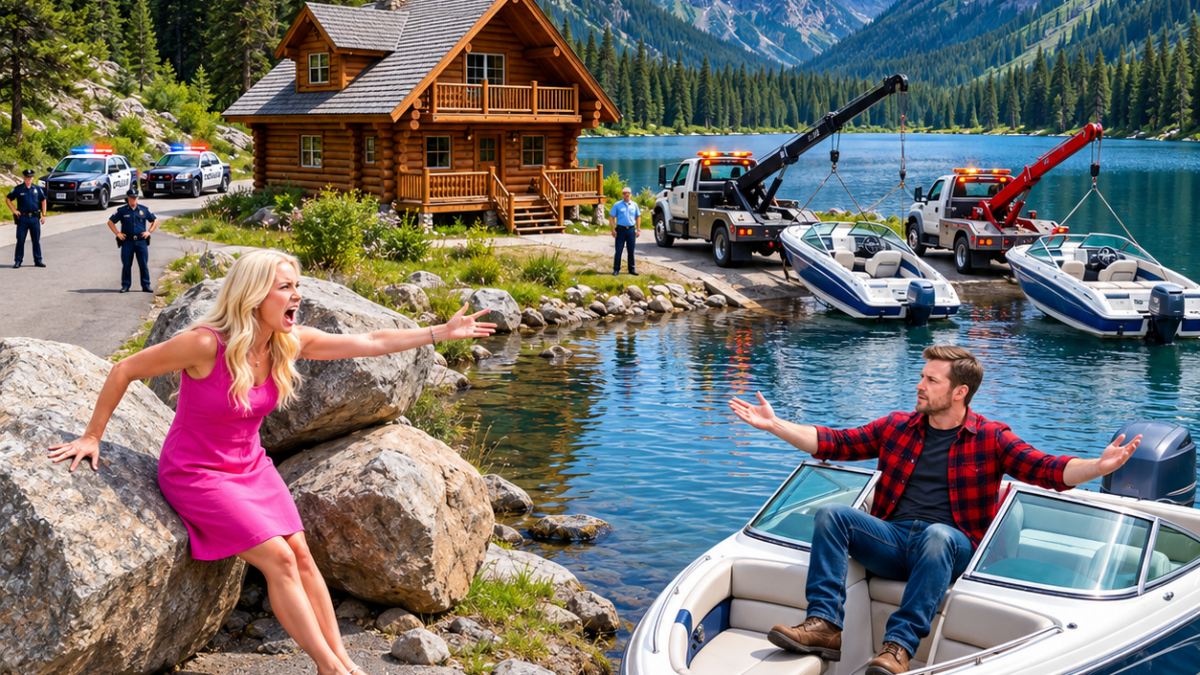
The boulders were not subtle.
Each one looked as though somebody had dropped a piece of a quarry into my driveway and then carefully arranged the pieces to make sure no normal vehicle could pass.
Greta stared at them through the windshield.
“Stephanie?”
“Almost certainly.”
Quinn asked again from the back seat.
“Why would somebody do that?”
I turned around.
“Because sometimes adults do dumb things when they think being angry makes them right.”
Esme held the remains of a melting popsicle in one hand.
“Can we still go home?”
“Yep.”
“How?”
I looked at Greta.
She knew what I was thinking.
“Cole.”
“What?”
“No improvising with the truck.”
“I wasn’t.”
“You were looking at the winch.”
“That is not the same thing.”
“Yes, it is.”
Twenty minutes later, Eric came up the gravel road pulling our equipment trailer.
He stopped.
Got out.
Looked at the rocks.
Looked at me.
Then looked at Greta.
“Am I allowed to ask?”
“No,” Greta said.
Eric nodded.
“Good.”
That was why we had worked together for nine years.
We did not need much conversation.
The boulders were moved carefully enough to clear the driveway without creating another problem.
Nothing was rolled downhill.
Nothing was dumped in a road.
Nothing was shoved onto Pinerest Bay property.
They went behind my equipment barn until lawyers and law enforcement could decide what happened next.
The county sheriff arrived before we finished.
Sheriff Boone Tedrow had known me long enough to skip pleasantries when something was obviously wrong.
He stepped out of his pickup.
Looked at the empty spots where the boulders had sat.
Then at the trailer.
“Where are they?”
“Behind the barn.”
“Good.”
He opened a notebook.
“Neighbor camera caught a dump truck here a little after four.”
“Stephanie?”
“Looks like her SUV was with it.”
He shook his head.
“She actually blocked your driveway.”
“With my kids in the truck when we got home.”
“That part she may not have known.”
“Doesn’t improve the rest.”
“No.”
Boone had already requested footage from a camera farther down the private road.
He explained that the obstruction would be documented separately from the lake dispute.
I told him that was exactly what I wanted.
No combining things emotionally.
Boulders were one issue.
Boats were another.
Trespass was another.
Any allegedly false lake documents were another.
Let each piece stand on its own evidence.
Then Boone asked the question.
“You still doing tomorrow?”
“Yes.”
“How many vessels?”
“Thirty-one as of tonight.”
His eyebrows rose.
“Thirty-one?”
“Maybe fewer by morning if they read the notice.”
“You expecting that?”
“No.”
He almost smiled.
“Officer Rasmussen coming?”
“Yes.”
“Your lawyer?”
“Yes.”
“Commercial yard ready?”
“Yes.”
“Insurance?”
“Verified.”
“Individual vessel logs?”
“Marne has them.”
He closed the notebook.
“All right.”
Then he pointed at me.
“You do this by the book.”
“I was planning to.”
“I mean painfully by the book.”
“Boone, you have met Marne.”
He sighed.
“Fair.”
The next morning began at 4:47.
Trout Lake looked like metal under the pre-dawn sky.
No wind.
No engines.
No music from Pinerest Bay.
The eastern shore was a dark row of expensive cabins with docks extending into water that did not belong to them.
Eric met me at the boathouse.
Officer Tatum Rasmussen arrived a few minutes later.
Marne came carrying folders.
Boone came with a deputy and enough coffee for a logging crew.
Before we launched anything, Marne gathered everyone together.
“We are documenting each vessel separately.”
She held up the forms.
“Registration.”
“Location.”
“Prior warning.”
“Photographs before movement.”
“Photographs after movement.”
“Condition.”
“Storage destination.”
“Owner notification.”
“No improvising.”
Eric raised a hand.
“Can I still drink coffee?”
Marne looked at him.
“Within reason.”
Eric lowered his hand.
“That seems subjective.”
Tatum laughed.
I did not.
I was nervous.
Not afraid of Stephanie.
Afraid of making one procedural mistake after spending months building a clean record.
That was the part people misunderstand about satisfying revenge stories.
Real leverage is fragile.
You can have ninety-nine clean documents and ruin everything with one stupid act.
So we treated each vessel like evidence.
The first boat was a twenty-foot runabout anchored offshore.
Registration photographed.
Hull photographed.
Anchor position recorded.
Prior notice checked.
No people aboard.
No emergency condition.
Tatum observed.
Marne signed.
Then Eric and I used our professional recovery equipment to relocate it to the commercial storage yard.
Slowly.
Carefully.
No damage.
The second was a pontoon.
Same process.
The third was a bass boat.
Same process.
No cheering.
No speeches.
Just work.
Before sunrise, our barge carried several vessels north.
We offloaded them into numbered storage spaces.
Condition photographs again.
Then we returned.
Boat five was the jet ski.
The same one that had buzzed Esme.
Eric looked at it.
Then at me.
I knew exactly what he was thinking.
“You good?”
“Yep.”
He nodded.
We handled it more carefully than anything else.
Not because its owner deserved special treatment.
Because professionalism means the difficult property gets the same care as everything else.
The eleventh vessel belonged to Stephanie’s household.
Large pontoon.
Fancy sound system.
Wet bar.
Polished lettering on the stern.
Eric read the name.
“Subtle.”
“Don’t.”
“I said one word.”
“Keep working.”
He lifted it into the recovery cradle.
No scratches.
No broken railings.
No missing property.
There were open champagne bottles inside.
We photographed them and left them exactly where they were.
By then the eastern sky was orange.
Tatum’s camera had documented the entire operation.
Boone watched from shore during each offload cycle.
Marne checked paperwork.
Then we reached the Pemberts’ Chris-Craft.
Older couple.
Quiet people.
They had anchored on Trout Lake several times.
Technically they were still violating the same boundary.
I idled beside the boat.
Eric waited.
“The Pemberts.”
“Yep.”
“They ever give you trouble?”
“No.”
“Signs?”
“They didn’t damage them.”
“Jet ski?”
“No.”
“Stephanie rallies?”
“No.”
We both knew what I was considering.
Marne’s boat came alongside.
I asked her.
“If we exercise discretion on this one, does it undermine the rest?”
She looked at the vessel.
Then at her file.
“They received notice.”
“Yes.”
“They’re still technically trespassing.”
“Yes.”
“Enforcement discretion is your call as long as you don’t discriminate for an unlawful reason.”
“I’m skipping it.”
Marne made a note.
“Document why.”
So we did.
No special favor hidden off the books.
A written exception based on conduct and proportionality.
Then we moved to the next boat.
By 8:30, the lake looked different.
Empty water spreads farther than crowded water.
At 8:45, every vessel we had elected to remove was off Trout Lake and in documented commercial storage.
No residents had been confronted on docks.
No one had been endangered.
Nobody woke up to find people physically fighting over boats.
They simply woke up to a lake that looked the way it had before Stephanie decided ownership could be voted into existence.
Stephanie woke around nine.
I know that because she arrived at my cabin a little after ten.
White Range Rover.
Fast.
She drove up my now-clear driveway and stopped near the porch.
Greta was inside making waffles.
Quinn was reading another shark book.
Esme sat beside me drawing in a notebook.
Stephanie got out.
“Where are my boats?”
Not hello.
Not good morning.
Not:
Why did this happen?
Just:
“Where are my boats?”
I set down my coffee.
“Commercial storage yard north of here.”
She stared.
“What?”
“Your vessels were removed from Trout Lake after the notice period expired.”
“You stole my yacht.”
“No.”
“You took it.”
“Yes.”
“That is stealing.”
“No.”
“You cannot just take someone’s private property.”
I looked at her.
“That is an interesting position.”
Her jaw tightened.
“Where is it?”
I gave her the address.
“Available for release through the documented process.”
She pulled out her phone.
Started recording.
“Say that again.”
“Happy to.”
I stood.
“Your vessels were observed repeatedly on private property after written notice.”
She moved the phone closer.
“You are admitting you seized boats belonging to Pinerest Bay residents.”
“I am documenting that vessels remaining on Trout Lake after notice were professionally removed and stored under the process reviewed with my attorney and witnessed by state and county officers.”
She stopped moving the phone.
That was not the sentence she wanted.
Then I handed her the paperwork for her yacht.
Registration.
Photographs.
Dates.
Certified notice receipt.
Condition report.
Storage location.
Marne had made sure every line was boring.
Boring paperwork is devastating when somebody arrives expecting a shouting match.
Stephanie flipped pages.
“This is harassment.”
“No.”
“This is retaliation because I blocked your driveway.”
“The lake process started weeks before yesterday.”
That stopped her.
She looked up.
“You planned this?”
“We documented this.”
“You were waiting.”
“For the notice period to expire.”
Her phone lowered slightly.
Then I remembered the envelope.
The document inside mattered more than the boats.
For months, Stephanie had insisted Pinerest Bay possessed an old deed granting community access to Trout Lake.
She had shown photocopies at meetings.
Residents relied on it.
The board relied on it.
Money had been spent based on it.
Marne had spent weeks tracing it.
The county recorder had reviewed the supposed recording marks.
The seal did not match the historical record.
The signatures raised serious authenticity problems.
The document’s provenance did not line up with actual county records.
Rather than standing on my porch and declaring Stephanie guilty of forgery, we had sent the material to the proper authorities.
That distinction mattered.
I handed her the envelope.
“What is this?”
“Read it.”
She opened it.
Her expression changed slowly.
No screaming.
No dramatic fainting.
Just concentration.
Then disbelief.
Then the first real fear I had seen from her.
The letter explained that the supposed lake-access deed had serious authenticity problems.
The county recorder had supplied an affidavit.
The matter had been referred for investigation.
Stephanie read the first page.
Then the second.
Then went back to the first.
“This is wrong.”
“Then your attorney can address it.”
“This deed came from HOA records.”
“Then your attorney can explain where it came from.”
“It has a county seal.”
“The county says the seal is not consistent with their record.”
She looked at me.
“You’re accusing me of forgery.”
“No.”
That answer surprised her.
“I’m telling you the document you have been relying on is under investigation.”
“You think that makes a difference?”
“A very large one.”
She looked toward Trout Lake.
No yacht.
No pontoon.
No jet skis.
No line of boats along my eastern shore.
Then she looked at the boulder-free driveway.
For the first time, I think she understood that several separate things had happened.
Blocking my driveway did not cause the deed problem.
The deed problem existed already.
The boats were not removed because I got angry Friday night.
The notices had already been sent.
The logs had already been created.
The enforcement plan had already been reviewed.
The boulders simply revealed how far she was willing to escalate.
She picked up her phone.
“Who else knows about this?”
“My attorney.”
“The county recorder.”
“Investigators.”
“Pinerest Bay’s board will be notified formally.”
She swallowed.
Then turned toward her Range Rover.
Esme watched her leave.
“Daddy?”
“Yeah?”
“Is she getting her boat back?”
“Eventually, if the proper owner follows the release process.”
Esme considered that.
“Can I still paint the rocks?”
I looked toward the barn.
“We’ll ask Mom.”
“Mom said maybe.”
“Then you’ve already gone over my head.”
She smiled.
By lunchtime, Pinerest Bay’s internal social page was exploding.
Residents had awakened to empty docks.
Some immediately blamed me.
Fair enough.
If you wake up Saturday and your pontoon is six miles away, anger probably comes before legal analysis.
Then copies of the notices began circulating.
People realized they had received warnings.
Some admitted they had ignored them because Stephanie told everyone the notices were meaningless.
Then somebody posted the county-recorder affidavit concerning the alleged lake-access document.
The conversation changed.
Where did the deed come from?
Who verified it?
Why had HOA money been spent based on it?
Why had residents been told the lake was shared when the adjacent landowner had repeatedly objected?
Why had Stephanie said my attorney’s letters were bluffing?
Then:
Why were boulders placed across my driveway?
An emergency meeting was called that evening.
Stephanie did not attend.
Her husband did not attend either.
Nearly the entire association showed up.
Lucas Helm, a retired Coast Guard captain living in one of the older cabins, invited Marne to explain the property dispute.
Marne agreed on one condition.
“I will explain documents.”
Lucas nodded.
“Not personalities.”
“Correct.”
“No guessing about criminal guilt.”
“Correct.”
“Just documents.”
“Exactly.”
That was the meeting Pinerest Bay should have held months earlier.
Marne walked everyone through the timeline.
My deed.
Lake surveys.
No recorded HOA easement identified in the title work.
Stephanie’s claimed document.
Problems with the recording marks.
Formal trespass notices.
Vessel logs.
Removal process.
Storage documentation.
The county investigation.
Then financial records surfaced.
Pinerest Bay had spent a significant amount of money developing its “lake access initiative.”
Consultants.
Design work.
Legal work.
Marketing.
Some contracts had connections to businesses associated with Stephanie’s husband.
That created additional questions.
Again, questions.
Not instant convictions.
Residents demanded an independent audit.
The board suspended Stephanie pending investigation.
Lucas became interim president.
His first call was to me.
“Cole.”
“Lucas.”
“We need to get people their boats.”
“Yes.”
“What do you need from them?”
“Proof of ownership.”
“Signed acknowledgment that Trout Lake is private and future access requires permission.”
“Storage and handling costs.”
“Anything else?”
“An apology would be nice.”
He laughed.
“Legally required?”
“No.”
“Good.”
Then he got serious.
“Can we avoid hammering people with late fees if they come tomorrow?”
“Yes.”
“You serious?”
“They were misled.”
“Some knew better.”
“I know.”
“How do you separate them?”
“Documentation.”
Lucas paused.
“You and Marne really like that word.”
“Best word in the English language after ‘coffee.’”
Sunday morning, the salvage yard opened at six.
The first resident arrived at 6:07.
Older man.
Cabin 19.
He brought his registration.
Signed the acknowledgment.
Paid the documented handling cost.
Then stood there.
“Cole.”
“Yeah?”
“I owe you an apology.”
“You don’t owe me a speech.”
“Stephanie told us your attorney was bluffing.”
“I figured.”
“She said the lake deed was bulletproof.”
“I figured that too.”
“I should have checked.”
“Yes.”
He nodded.
“Fair.”
Then drove away with his boat.
The next family brought two jet skis.
The owner looked embarrassed.
“My kids were on these more than I was.”
“Then make sure they understand the boundary too.”
“We will.”
A woman from Cabin 27 cried.
Not because of money.
Because she had told visiting relatives Trout Lake was part of their HOA amenities.
“I feel stupid.”
“You were given official-looking information.”
“I still should have asked.”
“Next time you will.”
She nodded.
That was enough.
Carter Ashland showed up carrying proof of ownership and a six-pack of Spotted Cow.
“I assume this does not count toward storage.”
“No.”
“Peace offering?”
“Accepted.”
He handed it over.
“I had absolutely no idea.”
“I know.”
“How?”
“You waved every time you saw me.”
“That means you knew I saw you.”
He winced.
“Fair.”
He looked toward his boat.
“I’m sorry.”
“Don’t anchor there again.”
“I won’t.”
We shook hands.
Then the Pemberts arrived.
Their Chris-Craft was not in the yard.
Mrs. Pembert looked confused.
“Mr. Vandermir?”
“Yes?”
“Is our boat somewhere else?”
“No.”
“Then where is it?”
“Still on Trout Lake.”
She looked at her husband.
Then back at me.
“You didn’t remove it?”
“No.”
“Why?”
“Because enforcement can have judgment.”
She seemed uncomfortable with that answer.
“We were wrong too.”
“You were.”
“We knew there was a dispute.”
“Yes.”
“We believed Stephanie.”
“Most people did.”
Mr. Pembert spoke.
“We also knew you had asked people to stay off.”
“That is why you’re still wrong.”
He nodded.
“We won’t anchor there again.”
“Thank you.”
Mrs. Pembert reached into her purse.
“Do we owe you anything?”
“No.”
“We received the notice.”
“I know.”
“Then why—”
“Because I made the decision.”
She stared at me for a second.
Then held out her hand.
“Thank you.”
I shook it.
They never anchored on Trout Lake again.
By noon, most boats had gone home.
Three remained.
Stephanie’s yacht.
Her husband’s personal watercraft.
And one vessel belonging to a board loyalist who refused to sign the trespass acknowledgment.
Those stayed in storage while the legal process continued.
Monday morning brought investigators.
The driveway obstruction was documented from video.
The disputed lake-access document went through forensic review.
Financial records were subpoenaed.
Stephanie and her husband retained attorneys.
That was exactly what should happen.
No porch justice.
No predetermined ending.
Evidence.
Counsel.
Court.
The HOA cooperated.
For the first time since the dispute began, Pinerest Bay stopped claiming Trout Lake as an amenity.
Lucas mailed every household a new letter.
TRAILER STORAGE UPDATE.
POOL HOURS.
COMMUNITY MAINTENANCE.
And, in bold:
TROUT LAKE IS PRIVATE PROPERTY AND IS NOT A PINEREST BAY HOA AMENITY.
Greta put the letter on our refrigerator.
“Better than BOAT FAN MAIL.”
“Different story.”
“Same genre.”
The investigation took months.
That surprised some residents.
People expected the forged-looking deed to create instant arrests.
Real life is slower.
Investigators compared digital files.
County records.
Signatures.
Emails.
Invoices.
Board minutes.
Consulting contracts.
They interviewed the recorder.
Developers.
Board members.
Stephanie.
Her husband.
The deeper financial review found that HOA funds associated with the lake-access project had flowed through consulting arrangements connected to her husband’s business relationships.
Some work had been performed legitimately.
Some invoices raised harder questions.
Prosecutors eventually brought charges tied to documents, financial conduct, and the driveway obstruction.
I stayed away from predicting outcomes.
That was not my job.
My job had been to protect my property and stop unauthorized use.
The court system handled everything else.
Stephanie later entered pleas resolving several charges.
Her husband resolved separate financial counts.
Restitution was ordered.
Certain business entities were dissolved.
The HOA spent more than a year under outside financial supervision while residents rebuilt trust and fixed its books.
No wild television ending.
No federal helicopter landing.
Just expensive consequences produced by months of documentation.
Stephanie’s yacht remained in storage throughout much of that process because ownership and payment issues were tangled in the broader case.
Eventually a court-approved sale resolved it.
I received only the documented costs that had been properly awarded to the salvage operation.
Anything beyond that went where the court directed.
I did not want her yacht.
I already had boats.
Too many boats, according to Greta.
One night, Quinn asked:
“Dad?”
“What?”
“Why did you take everybody’s boats if Stephanie was the bad one?”
Good question.
We were sitting on the porch.
The lake was dark.
I thought before answering.
“I didn’t take everybody’s.”
“The Pemberts.”
“Right.”
“Why?”
“Because rules matter.”
He frowned.
“That doesn’t answer it.”
“Fair.”
I tried again.
“The boats were on our property after people had been told not to be there.”
“Even if Stephanie lied?”
“Yes.”
“So they were wrong.”
“Yes.”
“But not all the same amount wrong.”
I smiled.
“Exactly.”
He thought about that.
“So you moved most of them because people still ignored the notice.”
“Yes.”
“And you didn’t punish people forever.”
“No.”
“Because they stopped.”
“Yes.”
He returned to his book.
Ten seconds later:
“Stephanie is still really annoying.”
Greta laughed from inside.
I decided not to answer.
Pinerest Bay held new elections the following spring.
Lucas Helm ran reluctantly.
He said he would serve only if the association changed its governing documents.
No future officer could advertise Trout Lake as HOA property.
No HOA funds could be used to pursue access claims without independent title review and full board approval.
Major property disputes required outside counsel.
Residents approved the amendments overwhelmingly.
Lucas called me afterward.
“We’ve legally admitted we do not own your lake.”
“Congratulations.”
“Feels strange congratulating myself.”
“You’re improving.”
“Don’t get used to it.”
Relations improved slowly.
Not friendship.
Boundaries.
That distinction is underrated.
Some Pinerest residents waved.
We waved back.
Some avoided us.
Fine.
Carter occasionally stopped near the property line to talk.
One afternoon he called from the road.
Not walked in.
Called.
That made me smile.
“Cole?”
“Yeah?”
“My son wants to know if Esme can show him how she catches bluegill from your dock.”
I looked toward the lake.
Then at Esme.
She was eight now.
She overheard.
“Can he?”
I covered the phone.
“Your decision.”
She thought.
“Does he have to ask?”
“He just did.”
“Then yes.”
I told Carter.
“Tomorrow at ten.”
“Thanks.”
“Bring life jackets.”
“We will.”
His son came.
Caught nothing.
Lost one worm.
Dropped a shoe in the lake.
Eric retrieved the shoe with a net.
Progress.
The boulders stayed behind my equipment barn for months.
They became a running family argument.
Eric wanted to break them into ramp fill.
Quinn wanted to place them on the shoreline as fishing structure.
Greta wanted landscaping.
Esme wanted paint.
Esme won.
She painted one blue.
One green.
One purple.
Then added fish.
The purple one got a giant orange trout with a crown.
“What is that?”
“The queen.”
“Why is the trout queen?”
“She owns the lake.”
I stared at her.
Greta laughed so hard she had to sit down.
We eventually put the painted rocks near our garden.
Not across anyone’s driveway.
That part mattered.
Months after the legal case ended, Marne drove out to the cabin.
Sunday afternoon.
Manila folder.
Coffee.
She brought final paperwork and a reimbursement check covering documented expenses associated with the recovery operation.
Fuel.
Storage equipment.
Legal costs.
Commercial yard time.
I looked at the amount.
Then at her.
“What happens if I don’t keep this?”
“It is your money.”
“That wasn’t my question.”
She sighed.
“What are you thinking?”
“Pinerest reserve fund.”
“Cole.”
“The residents didn’t create the fake paperwork.”
“Some of them did knowingly trespass.”
“They paid their costs.”
“You are impossible.”
“Known issue.”
I endorsed the check to the HOA emergency reserve with instructions that it be used only for legitimate common expenses under the new board.
Marne stared at the check.
“You enjoy making my job weird.”
“Keeps you sharp.”
She put it in the folder.
Before leaving, she stopped at the porch.
“You know you could have made this much uglier.”
“I know.”
“You could have demanded damages from every household.”
“I know.”
“You could have kept fighting after the lake was clear.”
“I know.”
“Why didn’t you?”
I looked across Trout Lake.
“Because I wanted my lake back.”
“That’s it?”
“That’s it.”
She nodded.
“Surprisingly healthy.”
“Get off my porch.”
She laughed and left.
The lake returned to what it had been.
Loons.
Bass.
Wind in the reeds.
Quinn reading on the dock.
Esme fishing.
Greta bringing iced tea outside at sunset.
Eric showing up uninvited whenever he could smell grilled food from the road.
One Sunday, we bought our own pontoon.
Nothing fancy.
Forty-horsepower motor.
Enough seats for the family.
The kids named it Mary Anne after a book they loved when they were younger.
We took it onto Trout Lake after dinner.
No other boats.
Halfway across, Greta looked at me.
“You know what’s strange?”
“What?”
“I thought empty would feel better.”
“It doesn’t?”
“It feels too empty.”
I knew what she meant.
We never wanted isolation.
We wanted permission to matter.
The difference between community and entitlement is consent.
If Carter called and asked whether his family could fish with us?
Maybe.
If the Pemberts asked permission for an afternoon cruise?
Probably.
If somebody showed up because an HOA newsletter told them my lake was theirs?
No.
The boundary was not designed to eliminate neighbors.
It was designed to make asking necessary.
That was all.
One afternoon, Lucas stopped at the edge of the access road.
He held a folder.
“Don’t panic.”
“You’re carrying HOA paperwork.”
“Fair.”
He handed it to me.
The association had commissioned an independent survey and title review of every property line touching Pinerest Bay.
No assumptions.
No old marketing maps.
No “historical community patterns.”
Recorded facts.
“The board voted unanimously.”
“For what?”
“To pay for it before we accidentally annex Canada.”
“That seems prudent.”
He smiled.
Then he looked toward Trout Lake.
“You know residents still call it your lake.”
“It is my lake.”
“No, I mean they actually say ‘Cole’s lake.’”
“That sounds healthy.”
“Somebody suggested putting that on the community map.”
“No.”
“I already vetoed it.”
“Good.”
He laughed.
“Private lake. No ownership nickname.”
“Exactly.”
Then he looked at the painted boulders.
“What happened to those?”
“Evidence became art.”
“Is that a crowned fish?”
“Don’t ask.”
He drove home.
Stephanie moved away after her legal case was resolved.
I did not see her again.
I heard from people at Pinerest that she blamed me for a long time.
Maybe she still does.
I can live with that.
I did not block her driveway.
I did not create the disputed deed.
I did not tell residents they could use someone else’s lake.
I did not direct jet skis toward children.
I did not make her sign questionable contracts.
I simply stopped cooperating with the idea that confidence could replace consent.
That was the real conflict.
Stephanie believed authority accumulated through repetition.
Say “community lake” enough times.
Put it in newsletters.
Show it at meetings.
Let boats use it for months.
Eventually, people stop asking whether the phrase is true.
Then the lie begins to feel normal.
That is dangerous.
Not just in HOA disputes.
Anywhere.
The hardest rights to defend are often the ones other people have gotten comfortable ignoring.
By the time you object, they call you unreasonable.
Why change things now?
Why ruin the tradition?
Why make a big deal out of it?
Because using something for a while does not automatically mean you own it.
Because politeness is not permission.
Because silence is not a deed.
The Pinerest situation taught residents that too.
Several later admitted they had assumed Stephanie must be correct because no HOA president would publicly claim lake ownership without proof.
I understood.
People trust official-looking things.
Letterhead.
Maps.
Board votes.
Announcements.
But an HOA vote cannot create ownership over land outside the HOA.
A newsletter cannot create an easement.
Sixty-four households agreeing with each other cannot replace the signature of the person who owns the property.
One morning, Esme asked to take the pontoon out.
She was older by then.
Still too young to operate it alone.
I sat beside her.
She steered slowly.
We crossed the same eastern section where twenty-three boats had once anchored.
She pointed toward Pinerest.
“That’s where the bad jet ski kid lived.”
“Probably.”
“Do you still hate him?”
“I never hated him.”
“He laughed at me.”
“I remember.”
“That was mean.”
“Yes.”
She thought.
“Do you hate Stephanie?”
“No.”
She looked at me as though I had given the wrong answer.
“Why?”
“Hating people takes too much maintenance.”
“That sounds like Mom.”
“It probably came from Mom.”
She steered another thirty yards.
Then:
“Do you forgive her?”
I looked toward the shore.
“That’s different.”
“How?”
“You can stop being angry without pretending something was okay.”
She nodded slowly.
“I think I get it.”
“You’re ahead of most adults.”
“Can I go faster?”
“No.”
“Then adults are still annoying.”
Fair.
Eric and I continued working marine recovery.
Our business got unexpectedly busy after the Trout Lake dispute because people heard about the salvage operation.
For months, callers began conversations with:
“Are you the guy who took thirty boats?”
I corrected them every time.
“No.”
“How many?”
“Enough.”
That became easier than explaining.
The story grew online.
Some versions said I dragged boats onto rocks.
False.
Some said I sank them.
Ridiculous.
One version said I chained every vessel together and pulled them across the lake with an F-350.
That would have required physics to resign.
The reality was less spectacular.
Individual documentation.
Professional equipment.
Controlled handling.
Witnesses.
Storage.
Paperwork.
Hours of work.
That was the point.
People want revenge to be dramatic.
The best version usually isn’t.
It is organized.
The moment Stephanie dropped boulders across my driveway did not make me reckless.
It made me certain that informal requests were over.
That distinction saved us later.
Her attorneys argued the boat removals were retaliation.
Our timeline showed otherwise.
Notice issued before the boulders.
Vessel logs before the boulders.
Officer consultation before the boulders.
Attorney preparation before the boulders.
Commercial storage arranged before the boulders.
The rocks did not create the plan.
They confirmed we needed to execute the lawful one.
A judge later described the timeline more politely.
I liked my version better.
Lucas eventually invited Greta and me to a Pinerest community cookout.
I said no.
Greta said yes.
We went.
Marriage.
People were awkward for the first fifteen minutes.
Then food arrived.
Awkwardness rarely survives bratwurst.
Carter handed me a beer.
The Pemberts were there.
Mrs. Pembert walked over.
“I still think you should have charged us.”
“For what?”
“The boat.”
“You apologized.”
“That does not pay your lawyer.”
“My lawyer has found many other ways to make me pay her.”
Marne, standing ten feet away, raised one hand.
“I heard that.”
Mrs. Pembert laughed.
Stephanie’s name barely came up.
That surprised me.
People assume communities revolve forever around whoever caused the biggest scandal.
They don’t.
Eventually someone needs to repair the dock.
Somebody needs to organize snow removal.
The pool filter breaks.
A child loses a bicycle.
Life reduces former tyrants back to footnotes.
That is probably healthier.
Lucas later won a full term as HOA president.
His campaign slogan, if you could call it that, was:
READ IT BEFORE YOU VOTE ON IT.
I told him it was terrible.
“It worked.”
“Doesn’t make it good.”
He won overwhelmingly.
During his first year, Pinerest meetings got shorter.
No social-media speeches.
No “community vision” committees trying to acquire other people’s property.
No lake initiatives.
At one meeting, a resident suggested approaching me about purchasing seasonal fishing access.
Lucas called me.
Not because the HOA believed it had rights.
Because somebody wanted to ask.
I considered it.
Then declined.
He said:
“Okay.”
That was the entire conversation.
Beautiful.
No lawyer.
No sheriff.
No boulders.
Just no.
Then everyone moved on.
That was the ending I wanted all along.
The three painted boulders remain near the garden.
Grass grows around them.
Esme adds paint every summer.
The crowned trout now has sunglasses.
Quinn says the rocks should become a family monument.
“To what?”
“Dad winning.”
“I didn’t win rocks.”
“You know what I mean.”
“No monuments.”
“Mom likes it.”
I looked at Greta.
She shrugged.
“I like the fish.”
I was outnumbered.
Again.
Years later, when people ask me about Pinerest Bay, they usually ask the same question first.
“Did you really tow every boat off the lake?”
I tell them:
“Not exactly.”
Then I explain.
The point was never to take boats.
The point was to stop an HOA from manufacturing ownership through repetition.
The vessels were evidence of that repetition.
Boat after boat.
Weekend after weekend.
Each one making the lake feel a little more communal.
Each one making my objection seem slightly stranger.
That is how boundaries disappear.
Not always with a bulldozer.
Sometimes with a pontoon boat and a wave.
Then another.
Then another.
Until somebody says:
“We’ve always done this.”
That sentence can be more dangerous than any threat.
So we documented every boat.
We sent notices.
We waited.
And when the deadline arrived, we enforced the boundary through a process designed to survive scrutiny.
That is why the lake stayed mine.
Not because I owned a bigger truck.
Not because Eric had a crane.
Not because Boone wore a badge.
Not because Marne knew property law.
Those things helped.
But the foundation was the deed.
The same boring document Stephanie wanted everyone to ignore.
The one that said Trout Lake belonged to the Vandermir property.
No community-share language.
No Pinerest easement.
No HOA launch rights.
No marketing exception.
Just ownership.
One Friday evening, years after the fight, I came home from work.
Same road.
Same turn.
Same driveway.
For half a second, my brain remembered the boulders.
There was nothing there.
Only gravel.
I pulled up to the cabin.
Esme ran outside.
She was holding a paintbrush.
I looked toward the garden.
“Oh no.”
“Dad.”
“What?”
“The queen trout needed a castle.”
I walked over.
One of the boulders now had a purple castle painted behind the fish.
Greta came outside.
“Don’t say anything.”
“I wasn’t going to.”
“You were.”
“I was going to compliment the perspective.”
Esme beamed.
“Really?”
“No.”
Greta hit my arm.
I laughed.
Then I looked past them toward Trout Lake.
Smooth water.
Our pontoon at the dock.
A loon farther north.
And across the eastern shore, the Pinerest cabins.
Quiet.
Separate.
Nearby.
Exactly where they belonged.
The boulders had been intended to send a message.
You cannot enter your own property unless we allow it.
Stephanie never said those words.
She did not need to.
Three giant rocks said them for her.
Our answer was not another blockade.
Not property destruction.
Not retaliation.
It was something stronger.
Move the rocks lawfully.
Document the obstruction.
Enforce the existing notices.
Protect the lake.
Let investigators handle the documents.
Let the courts handle the money.
Then go back to living.
That is what we did.
The lesson was never that the person with the largest recovery barge wins.
The lesson was that preparation beats entitlement.
By the time Stephanie decided to escalate, we had already done the boring work.
The deed had been checked.
The lake status had been reviewed.
The notices had been sent.
The vessels had been logged.
The enforcement plan had been examined.
Witnesses were available.
Storage was arranged.
Nothing depended on anger.
So when three boulders appeared across my driveway, I did not need to invent revenge.
I only needed to follow through.
By sunrise, Trout Lake was becoming quiet again.
By breakfast, Pinerest residents were learning that their “community lake” had never been theirs.
By dinner, their own HOA board was asking how that lie had lasted so long.
And after everything was finished, my family still had exactly what we had before Stephanie arrived.
A cabin.
A driveway.
A private lake.
And the right to decide who uses all three.