Karen sent the same expensive dinner back three times without really tasting it, humiliating a young server louder with every replacement, until the chef finally walked out of the kitchen carrying something she couldn’t send back.
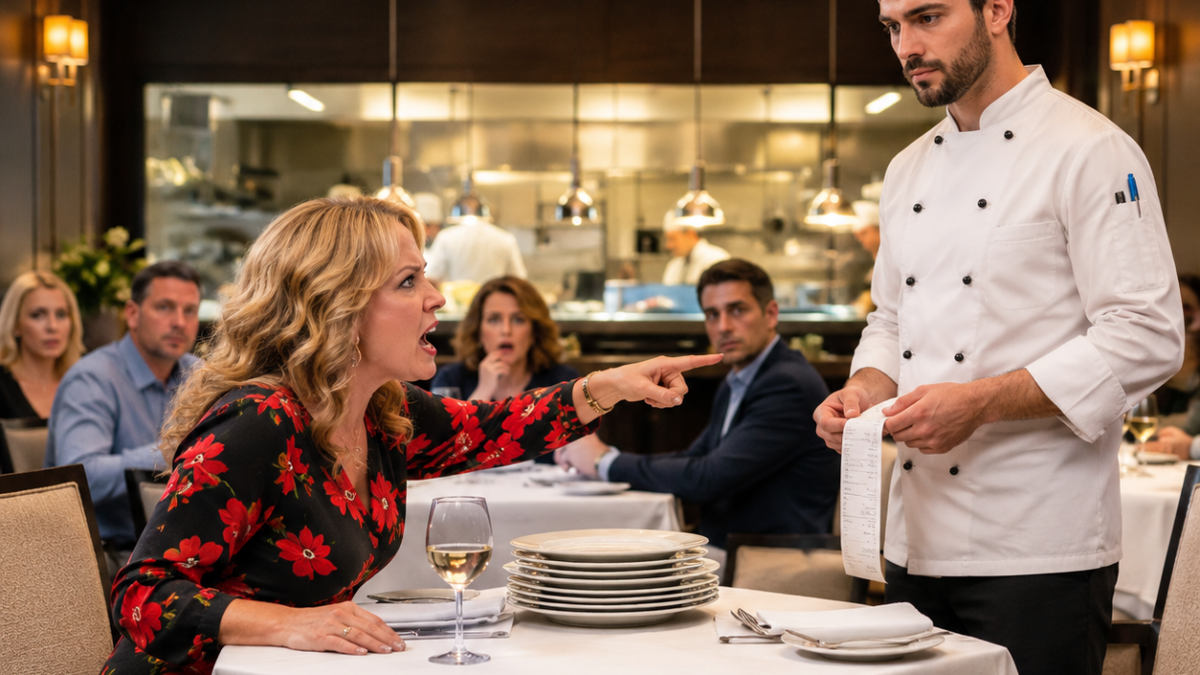
Karen sent the same expensive dinner back three times without really tasting it, humiliating a young server louder with every replacement, until the chef finally walked out of the kitchen carrying something she couldn’t send back.
By then, nearly every table inside Cedar and Glass had gone quiet, Jonah’s hands were shaking, and Mara Dinsworth was sitting beneath the soft jazz and candlelight looking completely certain that another complaint would make the restaurant apologize harder.
What Mara didn’t know was that Chef Rowan Marge wasn’t coming out to offer a fourth plate—he was the owner, the policy she had agreed to was printed on the menu she photographed when she arrived, and the leather folder in his hand contained charges for every dish his kitchen had prepared because she demanded each one be replaced.
Ellis Crane noticed Mara before the first plate ever reached her table.
It was difficult not to.
She wore a bright red blazer, spoke several volumes louder than the room, and had already complained that her sparkling water had “unenthusiastic bubbles.”
Ellis was sitting a few tables away hoping for a quiet dinner.
Instead, he watched Jonah carefully set down a plate of seared halibut with seasonal greens.
Mara barely examined it.
“Absolutely not.”
She said she had ordered the fish medium and insisted it was overcooked.
Jonah apologized and carried it away.
The second plate arrived.
She sent that one back too, loudly announcing that she had eaten better food at gas stations.
By the third attempt, conversations around the restaurant had begun stopping whenever Jonah approached her table.
Mara tasted the fish.
Her expression hardened.
She dropped her napkin onto the table.
“Manager.”
That was when Rowan stepped out of the kitchen.
He listened.
Then calmly explained Cedar and Glass’s house policy: repeated refusals that required multiple dishes to be prepared, combined with disruption of service, meant the guest remained responsible for the prepared meals and the restaurant’s standard disruption charge.
Mara stared at him.
“You expect me to pay for food I didn’t eat?”
Rowan’s expression never changed.
“No, ma’am.”
He placed the leather check folder in front of her.
“We expect you to pay for food we prepared.”
Mara opened it.
Her face changed.
Then she pushed back her chair and said the one word every table around her had been waiting to hear.
“Extortion.”
Rowan nodded toward the menu lying beside her phone.
“That policy is printed on the same menu you photographed when you arrived.”
Then Jonah quietly added:
“Ma’am, he isn’t the manager.”
Mara looked at him.
Jonah swallowed.
“He owns the restaurant.”
[END OF FACEBOOK CAPTION]
[FIRST COMMENT / FULL STORY CONTINUATION]
For several seconds, Mara did not move.
That was what Ellis remembered most.
Not the shouting.
Not the three returned plates.
Not even the bill.
Stillness.
A woman who had controlled the entire room through volume suddenly had nothing to say.
The leather folder remained open on the table.
Her phone rested beside it.
The menu lay underneath the phone, its lower corner still visible.
Exactly where Rowan had said the policy was printed.
Jonah stood slightly behind him.
The young server looked as if he wanted to disappear into the wall.
Rowan did not.
He simply waited.
No crossed arms.
No smirk.
No triumphant expression.
That somehow made the moment heavier.
Mara finally looked down at the menu.
Then back at Rowan.
“You’re telling me I’m being charged for all three plates?”
“Yes, ma’am.”
“I ate maybe two bites.”
Rowan nodded.
“That isn’t in dispute.”
“Then why would I pay for something I rejected?”
“Because each plate was prepared at your request.”
“The first was wrong.”
“You believed it was.”
“It was.”
“And we replaced it.”
“The second was worse.”
“We replaced that one too.”
“The third was unacceptable.”
Rowan paused.
Then:
“And after the third rejection, we stopped replacing the dish.”
Mara’s eyes narrowed.
“That doesn’t answer my question.”
Rowan’s voice stayed level.
“It does.”
“We prepared three separate entrées because you instructed us to.”
“Our policy addresses repeated remakes when the kitchen has fulfilled the requested preparation and the guest continues rejecting replacement dishes.”
“You were informed of that policy through the menu.”
“I was not informed of anything.”
Rowan glanced toward the menu.
Mara followed his eyes.
That irritated her.
“I don’t read every paragraph of restaurant fine print.”
“That is your choice.”
Ellis lowered his glass.
He had not meant to listen.
At that point, nobody in the room could avoid listening.
Cedar and Glass was not a large restaurant.
Thirty tables, maybe.
Muted amber lighting.
Tall windows facing the east side of Brookcom.
Polished stone bar.
Open shelving behind the host stand.
The kind of place designed to make conversations feel private even though the tables were not particularly far apart.
Until Mara arrived.
Then privacy disappeared.
A couple near the bar had stopped speaking entirely.
Two women at a corner table stared down at their plates while obviously listening.
One man had his fork halfway to his mouth and seemed to have forgotten what it was for.
The jazz continued softly.
Saxophone.
Piano.
Brush drums.
Absurdly calm.
Mara tapped the bill with one manicured fingernail.
“What is this additional fee?”
“The service-disruption charge.”
“That’s made up.”
“No, ma’am.”
“This is extortion.”
Again.
Louder this time.
Rowan said:
“No.”
“It’s a published house policy.”
“You can’t punish customers for complaining.”
“We don’t.”
“You’re punishing me.”
“We’re charging for food that was prepared and for the additional disruption caused by three consecutive remakes and prolonged interruption of service.”
She leaned backward.
“Do you hear yourself?”
“I do.”
“Your kitchen couldn’t cook one piece of fish correctly.”
Rowan glanced at Jonah.
Then toward the kitchen doors.
For the first time, there was something almost tired in his face.
Not anger.
Weariness.
“Ma’am, the first halibut was prepared to the requested temperature.”
“You didn’t even see it.”
“I did.”
That stopped her.
Rowan continued.
“I plated it.”
Mara blinked.
“The second?”
“I checked it personally.”
“The third?”
“I cooked it.”
That created another silence.
Even Ellis looked up fully now.
Mara’s expression shifted.
Not surrender.
Recalculation.
She said:
“So you’re admitting the chef kept sending out bad food.”
“I’m saying I personally checked all three dishes.”
“You think that proves something?”
“I think it means we have reached the end of what this kitchen can reasonably do for you tonight.”
Mara laughed.
Short.
Sharp.
“Unbelievable.”
Rowan nodded.
“I understand that you’re dissatisfied.”
“No, you don’t.”
“You want to embarrass me.”
“No.”
“Then waive the bill.”
“I won’t.”
“Remove the fee.”
“I won’t.”
“Comp the dinner.”
“I won’t.”
There it was.
The first clean no Mara had received all evening.
No apology attached.
No nervous smile.
No offer of free dessert.
No manager bending rules simply to make the problem leave.
Just no.
She looked around.
That was the moment she noticed how many people were watching.
Ellis saw it happen.
Her eyes moved table to table.
The younger couple by the window.
The man at the bar.
The two women near the center.
Ellis.
Several people immediately looked away.
One did not.
A gray-haired woman near the bar met Mara’s eyes directly.
No smile.
No mockery.
Just attention.
Mara turned back to Rowan.
“You’ve turned this into a public spectacle.”
Rowan’s eyebrows lifted slightly.
“I came to your table privately.”
“Everybody is staring.”
“I have not asked anyone to stare.”
Mara looked toward Jonah.
“You should have handled this better.”
Jonah stiffened.
Rowan answered before he could.
“Jonah handled your table professionally.”
“He brought me three unacceptable meals.”
“He carried the meals.”
“My kitchen prepared them.”
“That distinction does not excuse the service.”
“No.”
“But it means you should address your concern to me.”
Mara crossed her arms.
“Fine.”
“I am.”
“I think this place is pretentious.”
Rowan nodded once.
“I think the food is mediocre.”
Another nod.
“I think your policy is predatory.”
Rowan said:
“You’re entitled to think that.”
“And I will tell everyone I know.”
“That is also your choice.”
“You won’t have a restaurant for long if you treat paying customers this way.”
That sentence finally changed something in Jonah’s expression.
Ellis caught it.
A flicker.
Not fear this time.
Anger.
Rowan saw it too.
His voice remained calm.
“I built Cedar and Glass from a food truck.”
Mara’s face stayed cold.
“I worked six days a week out of a converted trailer with two burners and a refrigerator that failed every August.”
“I slept in the truck some nights because I couldn’t afford both staff and another employee to close.”
“I opened this dining room after years of saving.”
“My cooks work twelve-hour shifts.”
“My servers absorb every complaint before I ever hear about it.”
“Tonight you returned three dishes.”
“That is your right.”
“You also insulted the kitchen, insulted Jonah, spoke loudly enough to interrupt surrounding tables, and treated every attempt to resolve your complaint as another opportunity to humiliate somebody.”
Mara’s jaw tightened.
“I criticized the service.”
“No.”
“You criticized people.”
That landed.
Rowan continued.
“You don’t have to like my food.”
“You don’t have to come back.”
“You don’t have to recommend us.”
“But the people working here are not props in your evening.”
The room was completely silent now.
The source story had Rowan make the same central point: Mara was free to dislike the food, but she still had to respect that real people had prepared it and worked to serve her.
Mara looked down.
Only for a second.
Then back up.
“You’re giving me a lecture now?”
“No.”
“I’m explaining why I’m not asking Jonah to apologize again.”
Jonah looked at Rowan.
Something changed in the kid’s face.
Ellis recognized it.
Relief.
Not the loud kind.
The kind you feel when someone with more authority finally says:
You did enough.
Mara reached for the leather folder again.
“Give me the actual itemized bill.”
Rowan nodded toward it.
“It’s inside.”
She pulled out the receipt.
Read.
First entrée.
Second preparation.
Third preparation.
Service disruption.
Her lips pressed tighter with each line.
“This is outrageous.”
“You may dispute the charge through your card issuer if you believe it’s improper.”
That surprised everyone.
Mara too.
“You’re telling me to charge it back?”
“I’m telling you that you have ordinary consumer remedies.”
“But tonight the restaurant is presenting this bill.”
“You can pay it.”
“Or you can refuse and we can handle that through the appropriate process.”
Mara stared.
She had expected battle.
Rowan gave her procedure.
That left less room for drama.
She looked toward her purse.
Then stopped.
“No.”
Rowan waited.
“I want the real manager.”
Jonah swallowed.
Then said quietly:
“Ma’am.”
Mara turned.
Jonah’s voice shook.
But he kept going.
“He isn’t the manager.”
Mara frowned.
Jonah nodded toward Rowan.
“He’s the owner.”
The words moved through the room.
Not dramatically.
But you could feel them.
A small shift.
Like everyone had unknowingly been waiting for confirmation that Rowan actually had the authority to stand there and say no.
Mara looked at Rowan again.
“You own this place?”
“Yes.”
“All of it?”
“Yes.”
“You built this?”
“Yes.”
The anger did not disappear.
It changed.
That was the best way Ellis could describe it later.
Until then, Mara had behaved as if she were escalating through layers.
Server.
Manager.
Someone above the manager.
Corporate office.
Owner.
There was always supposed to be another person she could demand.
Another authority she could invoke.
Another level that would reverse the previous answer.
Rowan was the top of the ladder.
She had reached the end.
Mara said:
“You still answer to customers.”
“Of course.”
“Then act like it.”
Rowan’s expression stayed steady.
“I am.”
“I’m protecting the customers who are trying to eat in peace too.”
A man near the bar coughed to hide a laugh.
Mara heard.
She spun toward him.
“Something funny?”
The man immediately looked at his drink.
Rowan said:
“Please keep this conversation with me.”
She turned back.
“You see?”
“Everyone here is enjoying this.”
“No.”
Ellis almost spoke.
He did not.
Because Rowan was right.
At first, maybe people had enjoyed the spectacle.
By now the emotion was different.
Discomfort.
Sympathy for Jonah.
A little fascination.
A little embarrassment on Mara’s behalf.
Nobody wanted the confrontation to become cruel.
At least not most of them.
One younger diner did have his phone raised.
Then another.
Mara noticed.
“Put your phones down.”
Nobody responded.
“Are you recording me?”
A woman near the window lowered hers immediately.
Another man did not.
Rowan looked around.
Then said:
“Please don’t record other guests.”
That surprised Ellis.
Rowan could have let the room turn Mara into entertainment.
Instead, he tried to stop it.
“Thank you,” Mara said bitterly.
“That isn’t for you.”
“It’s for everyone.”
Mara stared at him.
Then grabbed her purse.
She emptied half its contents onto the table while searching.
Lipstick.
Receipts.
Small perfume bottle.
A charger.
Two credit cards.
A pen.
She muttered something Ellis could not hear.
Jonah stood very still.
Finally Mara found her wallet.
She pulled out a card.
Dropped it on the table.
“Run it.”
Jonah hesitated.
Rowan nodded once.
Jonah took the card.
Mara pointed at him.
“And if there is one additional cent—”
Rowan interrupted gently.
“The total will match the presented bill.”
Jonah walked toward the terminal.
Ellis watched him go.
The kid’s shoulders were still tense.
But he was walking differently.
Five minutes earlier he had looked one insult away from quitting.
Now he looked like he could finish the shift.
That mattered more than Mara understood.
Rowan remained at the table.
Mara said:
“You’re enjoying this.”
“No.”
“Don’t lie.”
“I’m not.”
“You think you’ve proven something.”
Rowan thought before answering.
“I think dinner should have ended forty minutes ago.”
A couple nearby laughed despite themselves.
Mara’s face went red.
Rowan did not smile.
That made it worse.
Jonah returned with the receipt.
“Approved.”
He placed it carefully beside Mara.
She signed quickly.
Not looking at anyone.
Then pushed the folder away.
Rowan said:
“Thank you for settling your account.”
Mara stood.
She picked up her purse.
Shoved the scattered items back inside.
Her hands moved too quickly.
Lipstick fell.
Rolled under the table.
Jonah bent automatically to pick it up.
Mara grabbed it before he could.
“I’ve got it.”
Her voice was quieter now.
She straightened.
Looked at Rowan.
“You’ll hear from my lawyer.”
Rowan nodded.
“He can contact the restaurant.”
“I’ll post about this.”
“That is your choice.”
“I have a large following.”
“I understand.”
“You’ll regret this.”
Rowan’s expression finally changed.
Only slightly.
Not fear.
Not anger.
Sadness perhaps.
He said:
“I hope tomorrow is better for you than tonight was.”
Mara looked genuinely stunned.
A threat would have been easier.
Sarcasm she could fight.
Politeness left nothing to push against.
She turned.
Walked toward the entrance.
No one applauded.
That detail mattered.
The internet version of moments like this always adds applause.
The room did not erupt.
People watched.
Then looked away.
Mara pushed through the glass doors.
They closed behind her.
For perhaps three seconds, Cedar and Glass remained silent.
Then someone picked up a fork.
Someone else started talking again.
The saxophone became audible.
Glassware clinked.
Dinner resumed.
Human beings are astonishingly good at returning to normal.
Rowan stood where Mara had left him.
He exhaled.
Then looked at Jonah.
“You okay?”
Jonah nodded too quickly.
Rowan waited.
Jonah tried again.
“Yeah.”
“Go drink water.”
“I have table twelve.”
“Melissa can cover it.”
“I’m okay.”
“Jonah.”
The kid stopped.
Rowan pointed toward the kitchen.
“Water.”
“Two minutes.”
Jonah nodded.
Went.
Rowan gathered the three rejected plates.
Two had been moved to a side service station.
The third still sat at Mara’s table.
Ellis watched him look at the fish.
That was the first time Rowan seemed angry.
Not at Mara.
At waste.
Three halibut portions.
Three plates of vegetables.
Sauce.
Labor.
Time.
All because one dinner turned into a contest.
The kitchen door opened.
Rowan carried the plates inside.
Ellis expected that to be the end.
It wasn’t.
Because once the adrenaline left the room, the staff still had to work.
There were tickets waiting.
Desserts.
Entrées.
Wine service.
Table fourteen had a birthday.
Table seven wanted another bottle.
Somebody near the window had been waiting too long for coffee.
A restaurant does not stop because one guest becomes memorable.
Rowan returned to the line.
Jonah drank water.
Then came back out.
The restaurant kept moving.
Ellis looked at his own plate.
He had ordered short ribs.
They were probably cooler than Rowan intended.
He ate them anyway.
Still excellent.
The gray-haired woman at the bar leaned toward her husband.
Ellis heard:
“That poor boy.”
Her husband said:
“The waiter?”
“Yes.”
“He did fine.”
“I know.”
That distinction mattered.
Jonah had done fine.
He simply had not been treated as if he had.
Near the windows, one of the younger diners who had briefly filmed deleted the video.
Ellis noticed because she showed her companion.
He nodded.
Not everything needed to become content.
Ellis liked that.
He had spent much of his career photographing architecture and commercial spaces.
He knew the instinct to capture a scene.
He also knew cameras change people.
Sometimes a moment is better allowed to end.
His server came by.
Not Jonah.
A woman named Melissa.
“Everything okay?”
Ellis smiled.
“Very.”
She looked relieved.
“Good.”
Then almost whispered:
“Sorry about the noise.”
“Not your fault.”
She nodded.
Started away.
Ellis asked:
“Does that happen often?”
She thought.
“Not exactly like that.”
“That sounded diplomatic.”
She smiled.
“Hospitality teaches diplomacy.”
Then she left.
Twenty minutes passed.
Dinner settled completely.
A new party arrived.
They had no idea what had happened.
They walked in laughing.
Host greeted them.
Coats checked.
Menus delivered.
Normal.
Ellis found himself thinking about that.
Mara had behaved as if the entire building existed inside her evening.
Within twenty minutes of her leaving, new people were eating at her old table.
Life is very efficient at reminding you how temporary your importance is.
He ordered coffee.
Then dessert.
Not because he needed it.
Because he had nowhere to be.
Cedar and Glass felt quieter now.
More human.
Rowan passed his table later.
Ellis looked up.
Their eyes met.
Rowan nodded.
Ellis nodded back.
No conversation.
The source described exactly that kind of brief acknowledgment between them—nothing theatrical, simply an understanding after the room had settled.
Ellis paid.
Added a generous tip.
Then another line beneath it:
For the whole team.
He knew pooled tipping rules varied.
He did not care who ultimately received it.
He wanted the gesture visible.
Outside, the night was cooler than he expected.
Brookcom’s east side reflected restaurant lights across damp pavement.
Traffic moved slowly.
Cedar and Glass glowed behind him.
Mara’s car sat across the street.
Black sedan.
Engine running.
She was inside.
Both hands on the steering wheel.
Ellis could see her through the windshield.
Not crying.
Not yelling.
Just sitting.
He looked away quickly.
That felt private.
He walked toward his car.
Then stopped.
For the first time all night, he wondered what Mara’s story was.
Not as an excuse.
Just curiosity.
People rarely wake up and decide:
Tonight I will humiliate a waiter over fish.
Entitlement accumulates.
Maybe she had spent years learning that enough pressure produced concessions.
Maybe every manager before Rowan had comped the meal.
Maybe people apologized because it was easier.
Maybe power had trained her badly.
Or maybe she was simply having a terrible night and chose to make it everybody else’s problem.
The explanation did not change what she did.
Still, Ellis resisted turning her into a monster.
Monsters are easy.
People are harder.
He drove home.
By morning, the restaurant had returned to ordinary life.
Prep began at nine.
Fish delivery.
Produce.
Bread.
Inventory.
Rowan arrived early.
He always did.
Jonah came in for lunch service even though he had not been scheduled until dinner.
Rowan found him near the employee lockers.
“What are you doing here?”
Jonah looked embarrassed.
“Wanted to talk.”
“About last night?”
“Yes.”
Rowan leaned against the wall.
Jonah said:
“I almost quit.”
“I know.”
“You knew?”
“I have eyes.”
Jonah laughed weakly.
Then:
“Why didn’t you come out sooner?”
Fair question.
Rowan thought.
“Because I wanted to give you space to solve it.”
Jonah nodded.
“That was stupid.”
Rowan laughed.
“Maybe.”
Then:
“I should have stepped in after the second dish.”
“Yes.”
Rowan accepted that.
No defensiveness.
Jonah continued.
“I kept thinking if I apologized the right way, she’d stop.”
Rowan looked at him.
“That’s the trap.”
“What?”
“Believing another person’s behavior is proof you haven’t served them correctly yet.”
Jonah looked down.
“You’ll meet guests you can help.”
“Guests you can’t.”
“Guests who want resolution.”
“Guests who want control.”
“Learn the difference.”
Jonah nodded.
Then:
“Was the fee really policy?”
Rowan stared at him.
“You work here.”
“I know.”
“But nobody ever uses it.”
“Correct.”
“Why have it?”
Rowan thought.
“Because repeated remakes cost food, labor, and time.”
“Also because staff need a point where the restaurant says enough.”
Jonah asked:
“Would you charge it again?”
Rowan did not answer immediately.
“Maybe.”
That surprised Jonah.
“Why maybe?”
“Because policies are tools.”
“Not automatic weapons.”
Jonah laughed.
Rowan continued.
“If someone genuinely receives three bad plates, that’s our failure.”
“We shouldn’t charge them for our mistakes.”
“Last night was different.”
“You tasted the dishes?”
“Yes.”
“All of them?”
“Yes.”
“Why?”
“Because after the first came back, I checked.”
“And?”
“First was medium.”
“Second was slightly less cooked because that seemed to be what she wanted.”
“Third was exactly what she described after rejecting the second.”
Jonah shook his head.
“So she wasn’t actually complaining about the fish.”
“Maybe she believed she was.”
That was the strange part.
Rowan did not say:
She was lying.
He had run restaurants long enough to know perception is messy.
Maybe Mara genuinely experienced every plate as wrong.
But once dissatisfaction became humiliation of staff, the food stopped being the main issue.
Jonah said:
“People online are talking about it.”
Rowan’s face changed.
“Online?”
“One person posted.”
Rowan closed his eyes.
Of course.
Even though several guests had lowered their phones, somebody had recorded enough.
A short clip.
Rowan placing the bill.
Mara saying:
“This is extortion.”
Jonah saying:
“He’s the owner.”
That was all.
Without the three returned dishes.
Without the preceding forty minutes.
Without context.
By noon, the clip had spread locally.
Some commenters loved Rowan.
Some called Mara a nightmare.
Some said Cedar and Glass was committing fraud.
Some said customers had the right to return anything.
Some said people like Mara deserved public humiliation.
Rowan hated all of it.
He told staff:
“Do not respond.”
Melissa asked:
“Even positive comments?”
“Especially positive comments.”
“Why?”
“Because we are a restaurant.”
“Not a courtroom.”
The restaurant posted one statement that afternoon.
Cedar and Glass does not discuss individual guests or payment matters publicly.
Our policies regarding repeated remakes and disruptive conduct are printed on our menu and available upon request.
We remain committed to resolving concerns respectfully while protecting both guests and staff.
No names.
No victory lap.
No:
Karen gets what she deserves.
Rowan refused.
That irritated some people.
They wanted him to enjoy winning.
He did not feel like he had won.
Three fish portions wasted.
A server nearly quit.
A dining room disrupted.
A guest left furious.
That is not a victory.
It is a failure managed as fairly as possible.
By evening, Mara’s name was being circulated online because someone recognized her.
Rowan asked the restaurant’s social-media manager to delete any comments identifying her from their own pages.
“You’re protecting her?”
Melissa asked.
“No.”
“Then why?”
“Because we served dinner.”
“We are not entitled to manage her reputation afterward.”
Good answer.
Mara did contact an attorney.
Rowan found out two days later.
A letter arrived.
Professional.
Not threatening in the way Mara had been.
It disputed the service-disruption charge and requested:
Menu version.
Policy language.
Itemized bill.
Record of authorization.
Any incident documentation.
Rowan handed it to his own attorney.
No panic.
No battle.
Records.
Menu.
Photographs.
POS transaction.
Staff statements.
Three kitchen tickets.
Times.
The policy.
Mara’s attorney replied.
Negotiation followed.
The source story ended with Mara paying the bill that night.
That remained true.
No refund was issued at the restaurant.
Whether she later disputed the charge through her card issuer did not change what Ellis witnessed.
And Ellis never learned the final administrative details.
That was appropriate.
Not every consequence needs an epilogue.
What Ellis did learn happened by accident.
Three weeks later, he returned to Cedar and Glass.
Same window area.
Different table.
Jonah recognized him.
“Hey.”
“Hey.”
“You survived.”
Jonah laughed.
“Barely.”
“You still work here.”
“Apparently.”
He seemed more comfortable now.
Less nervous.
Ellis asked:
“How’s the halibut?”
Jonah stared.
Then laughed hard enough another server looked over.
“Honestly?”
“Yes.”
“I never want to see halibut again.”
Ellis ordered it anyway.
Medium.
Jonah said:
“You’re doing this on purpose.”
“Little.”
The dish arrived.
Beautiful.
Ellis tasted it.
Jonah hovered a second.
“Well?”
Ellis put on a serious face.
“I can practically hear it begging for water.”
Jonah froze.
Then realized.
“Sir.”
Ellis smiled.
“It’s excellent.”
“You’re terrible.”
“Sorry.”
“Do not ever do that to me again.”
Fair.
Rowan passed later.
Recognized Ellis.
“Everything okay?”
Ellis said:
“Fish seems unenthusiastic.”
Jonah nearly dropped a glass.
Rowan stared at Ellis for one second.
Then laughed.
First time Ellis had seen him do it.
The tension around the old memory changed.
That is what time does when nobody keeps feeding conflict.
The restaurant kept the policy.
But Rowan changed staff training.
After a second remake, a manager or chef had to visit the table before a third preparation.
Not because Mara had been right.
Because the process could have been better.
That mattered.
Good leadership can defend staff and still ask:
What should we change?
The next staff meeting included role-play.
Melissa hated it.
Jonah loved watching other people suffer through imaginary difficult guests.
Rowan told everyone:
“Your job is hospitality.”
“Not surrender.”
“Guests can dislike things.”
“Guests can complain.”
“Guests can ask for correction.”
“But if a conversation becomes personal abuse, call someone.”
“No employee gets paid enough to be somebody’s emotional punching bag.”
That line became unofficial policy too.
Months passed.
The viral clip disappeared beneath new outrage.
Nobody remembers anything forever online despite what people say.
Cedar and Glass remained open.
Mara did not destroy it.
Rowan did not become a celebrity chef.
Jonah did not quit hospitality.
Ellis continued eating there occasionally.
Ordinary outcomes.
Better than dramatic ones.
The most surprising part came almost a year later.
Ellis was sitting at the bar on a Thursday.
Not busy.
Rain outside.
A woman came through the door wearing a dark coat.
Ellis recognized her.
Mara.
Not red blazer.
No clipboard.
No dramatic entrance.
She paused near the host stand.
The hostess smiled.
“Good evening.”
Mara said something too quiet to hear.
The hostess disappeared toward the kitchen.
Ellis looked away.
He did not want to stare.
A few minutes later, Rowan came out.
He and Mara stood near the entrance.
Private enough that Ellis caught only fragments.
“I wanted…”
“…not here to…”
“…last time…”
Rowan listened.
Mara spoke for perhaps two minutes.
Then Rowan answered.
Quietly.
No audience.
Eventually she nodded.
They shook hands.
She left.
No dinner.
No scene.
Ellis waited until Rowan passed the bar later.
He did not ask.
Not his business.
Rowan stopped anyway.
“You remember her.”
“Yes.”
“She apologized.”
Ellis looked up.
“For everything?”
“No.”
Rowan smiled.
“People rarely apologize for everything.”
“What did she say?”
“That she was rude to Jonah.”
“That she had been angry about something unrelated before she arrived.”
“That once she started complaining, she felt embarrassed backing down.”
“So she kept going.”
“Basically.”
Ellis nodded.
“That sounds human.”
“Unfortunately.”
“Did you apologize?”
Rowan thought.
“I told her I should’ve stepped in earlier.”
“For Jonah?”
“And for her.”
Ellis looked surprised.
Rowan explained.
“If I had come out after the second plate, maybe the night ends with a bad meal instead of a public confrontation.”
“That doesn’t excuse her.”
“I didn’t say it did.”
That was the thing about Rowan.
He refused simple categories.
Mara wrong.
Restaurant perfect.
Not quite.
She had behaved terribly.
He could still improve his response.
Both.
Ellis asked:
“Did you refund her?”
Rowan laughed.
“No.”
Fair.
Then he went back to the kitchen.
Ellis sat with that.
Consequences and forgiveness are not opposites.
Mara could apologize.
Rowan could accept.
The bill could still stand.
That felt more satisfying than humiliation ever had.
Jonah eventually left Cedar and Glass.
Not dramatically.
Two years later.
Graduate school.
Hospitality had been temporary work while he figured things out.
On his final night, Rowan gave him dinner.
No charge.
Halibut.
Jonah looked at the plate.
“You’re kidding.”
Rowan said:
“Send it back.”
Jonah laughed.
“Three times?”
“Try.”
He ate everything.
When he left, Rowan gave him a small card.
Not a speech.
Inside:
You did enough.
Jonah kept it.
Ellis never knew that part.
But Rowan remembered the night Mara came in every time a young employee apologized too many times for something they had not done wrong.
That became the lasting consequence for him.
Not the bill.
A manager notices what a bad night reveals.
Mara revealed that Cedar and Glass had trained servers extremely well in politeness.
Maybe too well.
They knew how to absorb.
Not how to escalate.
That changed.
Staff now had permission to say:
“I’m sorry we weren’t able to resolve this to your satisfaction. I’m going to get my manager.”
Small sentence.
Huge difference.
No repeated humiliation.
No endless loop.
Guests got faster resolution too.
Better system.
The service-disruption charge was used only twice more over the next several years.
One bachelor party that intentionally smashed glassware.
One guest who repeatedly ordered and rejected dishes as part of what appeared to be an online stunt.
Most nights?
Nobody knew the policy existed.
That was ideal.
Policies should sit quietly until needed.
Mara’s story became restaurant folklore.
New employees heard versions.
Each version got more ridiculous.
“She sent back five steaks.”
“No, seven fish.”
“She threw wine.”
“She called the mayor.”
“She got arrested.”
None true.
Rowan corrected anyone he heard.
“Three halibut.”
“No arrest.”
“She paid.”
“That’s it.”
Jonah once joked:
“You’re ruining the legend.”
Rowan said:
“Legends make people stupid.”
Also fair.
Ellis thought about the night occasionally.
Mostly when somebody asked:
“What is the worst restaurant behavior you’ve ever seen?”
He never told the exaggerated version.
He would say:
“A woman returned the same entrée three times, insulted the server, then discovered the owner had a policy charging for repeated prepared dishes.”
People inevitably asked:
“Did everyone clap?”
“No.”
“Did she freak out?”
“She was angry.”
“Did she refuse to pay?”
“She threatened to.”
“Did the chef destroy her?”
“No.”
“He gave her the bill.”
Some listeners looked disappointed.
They wanted justice with fireworks.
Ellis had been there.
The quietness was what made it powerful.
Rowan did not shout.
Jonah did not get revenge.
Mara did not get dragged out.
Nobody threw anything.
A boundary was simply enforced.
That is harder to dramatize.
It is also more useful.
Years later, Cedar and Glass changed menus.
Halibut disappeared seasonally.
Returned again.
Rowan expanded the restaurant.
Not because of Mara.
Business was good.
He bought the adjoining storefront and opened a smaller wine-and-small-plates room.
The original food truck sat behind the restaurant for years.
Rusting slightly.
Rowan refused to sell it.
Melissa joked:
“You’ll be buried in that thing.”
“Cheaper than a coffin.”
Then one anniversary, the staff convinced him to restore it.
They parked it outside for a community event.
Rowan cooked the first menu he had ever sold from it.
Three items.
One was fish.
Jonah came back for the event.
So did Ellis.
Mara did not.
That was okay.
Nobody needed every thread tied.
Ellis stood beside Jonah near the truck.
“You still hate halibut?”
“Yes.”
“You’re a liar.”
“Absolutely.”
Rowan handed Jonah a plate.
“Medium.”
Jonah inspected it dramatically.
“Unacceptable.”
Rowan reached for it.
Jonah pulled it away.
“I’m kidding.”
“Too late.”
“House policy.”
Everyone laughed.
Not at Mara.
At memory.
There is a difference.
Humiliation freezes a person at their worst moment.
Memory can eventually become something softer.
The night had hurt Jonah.
Later it became a story he controlled.
That mattered.
When Ellis left the event, he passed the restaurant window.
A new server was setting a table.
Napkin folded precisely.
Water glasses aligned.
Jazz inside.
For one second, he remembered Mara sitting there.
Bright red blazer.
Anger.
Rowan placing the bill.
Then he remembered something else.
Her sitting alone in the car afterward.
Hands on the wheel.
Silent.
That image had stayed with him longer than the confrontation.
Because consequences often look exciting from the outside.
Inside the person receiving them?
Usually quieter.
Maybe that was the first time Mara had been told no in years.
Maybe not.
Maybe she changed.
Maybe only a little.
She did come back and apologize.
That counted.
Rowan stayed the same in one important way.
He never believed owning the restaurant gave him permission to humiliate guests.
Even difficult ones.
His authority was limited.
Protect staff.
Set prices.
Enforce published rules.
Ask someone to leave if necessary.
Not turn a person into entertainment.
That was why he asked diners not to record.
It would have been easy to let the internet punish Mara harder than the bill ever could.
He chose not to participate.
That was probably the most decent thing anyone did that night.
And the least visible.
The source story ends with Mara paying, leaving Cedar and Glass in silence, and Ellis walking away with the sense that sometimes consequences arrive without shouting—sometimes they are simply printed on the check.
That is still the right ending.
Not because customers should never complain.
They should.
Restaurants make mistakes.
Food arrives cold.
Orders get missed.
Steaks are overcooked.
Fish is underdone.
Servers forget things.
Managers should fix problems.
Guests should speak up.
The lesson was never:
Shut up and eat whatever you’re served.
The lesson was smaller.
Dissatisfaction does not erase dignity.
You can send back a meal without humiliating the person carrying it.
You can dispute a bill without turning an entire room into your courtroom.
You can be correct about food and wrong about behavior.
And businesses can say no without becoming cruel.
That was Rowan’s line.
No fourth plate.
No more apologies from Jonah.
No free performance for a guest who had turned service into submission.
Just a bill.
Mara believed the restaurant had failed because nobody could satisfy her.
Rowan understood something she did not.
There are situations where satisfying the customer is no longer the same thing as serving them well.
Sometimes the responsible answer is:
We have tried.
This is where the service ends.
That night at Cedar and Glass, three plates of halibut reached that line before Mara did.
The kitchen knew it.
Jonah felt it.
Rowan finally said it.
And a room full of strangers watched the balance shift.
Not because a chef embarrassed a difficult customer.
Because for the first time all evening, someone refused to let her embarrassment become everybody else’s responsibility.
The next morning, the restaurant opened again.
Tables polished.
Glasses set.
Kitchen hot.
Jonah tied his apron.
Rowan sharpened a knife.
Customers arrived.
Some complained.
Most did not.
Nobody mentioned Mara.
And somewhere else in Brookcom, Mara woke up with the same receipt she had signed the night before.
Three prepared dishes.
One disruption fee.
One expensive reminder that sending something back is easy.
Taking back the way you treated people is harder.