They towed my father’s old Chevy Silverado while I was out of town for one weekend, charged me $3,640 cash to get it back, and apparently expected me to be too exhausted to notice the new towing signs had appeared after I left.
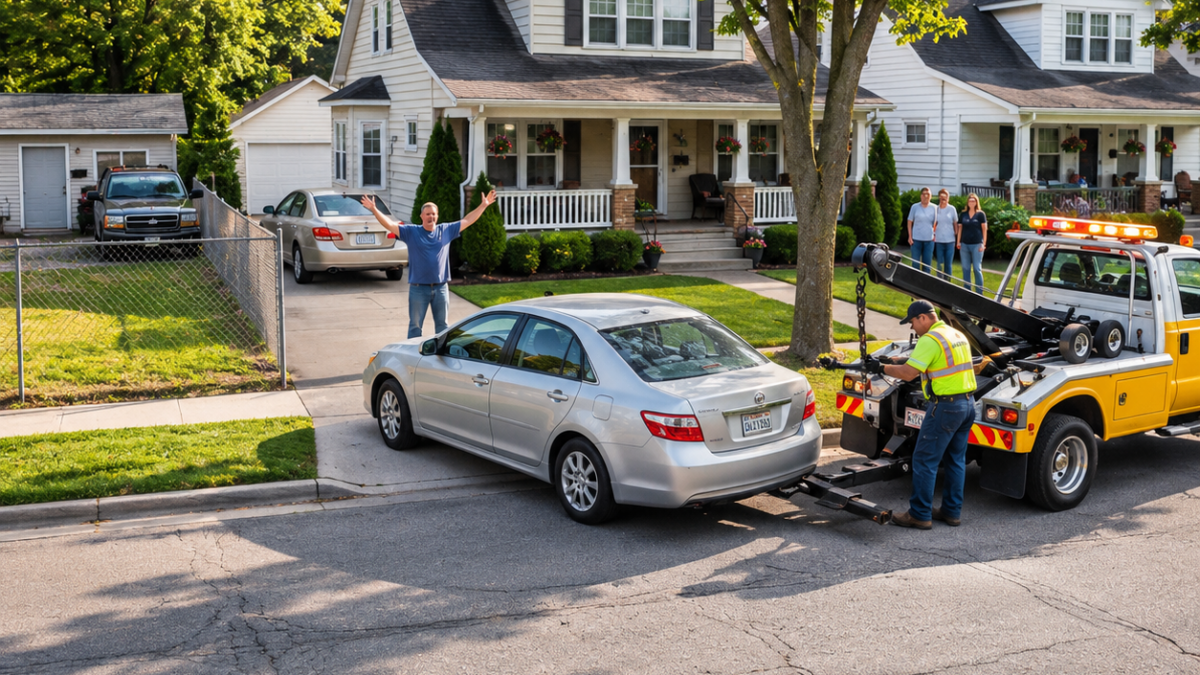
They towed my father’s old Chevy Silverado while I was out of town for one weekend, charged me $3,640 cash to get it back, and apparently expected me to be too exhausted to notice the new towing signs had appeared after I left.
When I came home around 6:30 Monday morning and saw the empty space beneath the crooked sycamore tree where I had parked for almost four years, an upstairs neighbor told me tow trucks had swept through Saturday morning taking every vehicle the HOA “didn’t recognize.”
What HOA president Randall Pierce didn’t know was that the authorization carrying his signature would lead me from one illegal-looking tow to a stack of prior consumer complaints, a lease clause requiring thirty days’ notice, newly installed signs that had been posted for less than twelve hours, and a towing company already attracting official scrutiny.
My name is Ethan Carter, and until that weekend I was the kind of tenant nobody had a reason to notice.
I paid rent early, kept quiet, and parked the same faded Silverado in the same unassigned community lot every night.
Dad had bought that truck in 1998 and handed it down to me before he died.
When I moved in, manager Denise had told me, “As long as your vehicle runs and you’re not blocking anybody, nobody cares.”
Randall cared.
He had moved into the neighboring townhouse about six months earlier and immediately started acting like older vehicles were an insult to property values.
A couple of months before the tow, he had even stopped me while I was washing the Silverado and asked whether I planned to “upgrade.”
Monday morning, I discovered exactly how far he was willing to go.
Cactus Valley Recovery demanded $3,640 in cash, plus another $80 at midnight if I didn’t retrieve the truck.
I paid, then asked for an itemized invoice and the tow authorization.
The paperwork showed Randall personally requested the tow Saturday at 7:00 a.m.
That afternoon, I found the thirty-day notice requirement buried in my lease.
Tuesday, municipal records showed prior complaints against the towing company for illegal towing, predatory storage charges, and inadequate notice.
Then maintenance records showed the new towing signs had gone up Friday night.
By Tuesday evening, I had photographs, statutes, complaint records, my lease, the tow invoice, and Randall’s signature inside one thick folder.
I carried it into the HOA meeting, took a seat nobody had invited me to take, and waited until Randall looked me in the eye and said, “The board has already acted within community guidelines.”
That was when I put the folder on the table.
[END OF FACEBOOK CAPTION]
[FIRST COMMENT / FULL STORY CONTINUATION]
“No, Randall,” I said.
“You acted within what you thought people would tolerate.”
The room went so quiet I could hear the vending machine humming in the hallway.
There were maybe twenty residents sitting in folding chairs around the clubhouse, most of them holding paper cups or small plates with stale cookies from the refreshment table.
Randall stood near the projector screen in the same kind of golf-club outfit he always wore when he wanted to look like neighborhood governance was a Fortune 500 operation.
Loafers.
Blazer.
Expensive polo.
Stainless steel tumbler in one hand.
He had started the meeting with the usual calm voice, the one that made every personal preference sound like something reviewed by a team of lawyers.
Then I walked in carrying the folder.
I had not been invited.
I was not on the agenda.
I did not care.
The moment Randall saw the paperwork, his expression shifted just enough for me to notice.
He recovered quickly.
“This meeting is for residents listed on the agenda.”
I pulled out a chair.
“Good thing I live here then.”
Someone near the back snorted.
Randall did not smile.
He adjusted his blazer.
“Mr. Carter, if this concerns your vehicle situation, the board has already acted within community guidelines.”
That was when I gave him the answer.
Then I set the folder on the table.
Hard.
Not hard enough to make some heroic movie moment out of it.
Hard enough that several sheets slid free and spread across the polished surface.
Photographs.
My lease.
The towing invoice.
The authorization.
Complaint records.
State towing rules.
Maintenance records.
Dates.
Times.
All the boring things Randall had apparently assumed nobody would ever assemble in one place.
One of the older board members leaned forward.
Another woman on the board looked down at the scattered documents and then back at Randall.
I pulled out the tow authorization first.
“This is the form Cactus Valley Recovery gave me when I picked up my truck.”
Randall’s jaw tightened.
I pointed at the signature.
“You requested the tow.”
His voice stayed controlled.
“I authorized enforcement of new parking standards.”
“Saturday morning at seven.”
“Yes.”
I pulled the photograph of the new sign.
“This sign wasn’t there Friday afternoon when I left town.”
“The signs were installed as part of the new policy.”
“I know.”
I put the maintenance record beside it.
“They went up Friday night.”
Nobody said anything.
I looked around the room.
“My truck was towed less than twelve hours later.”
The older board member picked up the maintenance record.
Randall raised one hand.
“The community has been discussing vehicle standards for months.”
“My lease doesn’t say discussing something changes parking rules.”
I opened Section 8.
I had marked the sentence.
“Residents are entitled to unrestricted use of community parking unless otherwise stated in writing with thirty days’ notice.”
The woman on the board took the lease from me.
She read the line.
Then read it again.
Randall said, “That provision doesn’t prevent us from enforcing community standards.”
“It prevents you from changing my parking rights overnight.”
He started to answer.
I held up another page.
“And state towing requirements don’t let you post new towing enforcement signs Friday night and start removing vehicles Saturday morning.”
That changed the room.
Not dramatically.
Nobody gasped.
Nobody jumped out of a chair.
But several residents leaned forward at once.
One board member stopped looking at me and started looking at Randall.
That was important.
Until then, I was the angry truck owner.
The guy who had shown up uninvited.
The guy carrying a folder because he was mad about paying a tow bill.
Once the dates came out, the shape of the problem changed.
Randall saw it too.
He took a slow drink from the tumbler.
Then said, “You need to understand that older vehicles have become a legitimate concern.”
There it was.
Not blocked access.
Not abandoned vehicles.
Not safety.
Older vehicles.
I stared at him.
“My Silverado runs.”
Nobody answered.
“It has current registration.”
Still nothing.
“It wasn’t blocking anyone.”
Randall shifted.
“The appearance of vehicles affects community value.”
A resident near the wall whispered something to the woman beside him.
I could not hear all of it.
I heard the word ridiculous.
I pulled out the tow invoice.
“Then explain this.”
Randall did not take it.
I read the amount aloud.
“Three thousand six hundred forty dollars.”
A few heads turned.
One resident actually said, “What?”
“Cash only.”
I tapped the page.
“Plus another eighty dollars at midnight.”
The woman on the board looked at Randall again.
He said, “Those are the towing company’s charges.”
“You hired them.”
“The HOA has a contract.”
“Exactly.”
I opened the municipal complaint records.
“That company already has complaints for illegal towing, predatory storage fees, and improper notice.”
The older board member started flipping through the copies.
Randall’s expression finally changed.
Not fear yet.
Irritation.
“You went digging through public records over one tow?”
“Yes.”
“Why?”
“Because you had my father’s truck taken from a lot I had legally used for almost four years.”
The word father changed nothing legally.
I knew that.
The truck would have deserved proper process even if I had bought it last week from a used-car lot.
But I could not separate the law from what the Silverado meant to me emotionally.
Dad had bought it in 1998.
He had handed it down to me before he died.
That old truck had followed me through layoffs, breakups, bad apartments, cheap jobs, long jobs, and every other stretch of life where almost nothing felt permanent.
Then I left for one weekend to visit Melanie after knee surgery.
I came home.
And the one constant I expected to see beneath that crooked sycamore was gone.
Randall had treated that as parking enforcement.
To me, it felt like someone had decided an ordinary part of my life could be removed because it did not fit his picture of what the neighborhood should look like.
Still, emotion was not what I wanted the meeting to rest on.
So I put the complaint records down.
“This stopped being about sentiment when I found these.”
One complaint.
Then another.
Illegal towing.
Notice failures.
Storage charges.
A disabled veteran’s van towed while he was hospitalized.
I did not know that man.
I did not know everything that had happened in his case.
I did know somebody had filed a formal complaint.
That was enough to make me ask whether my tow belonged to a pattern.
Randall glanced at the board members.
Then back at me.
“Complaints do not prove wrongdoing.”
He was right about that.
I nodded.
“No, they don’t.”
That answer seemed to surprise him.
“But they’re enough to make regulators look closer.”
His eyes narrowed.
I continued.
“I’ve already prepared complaints for the Attorney General’s office and the city housing department.”
Someone shifted a chair.
“And I’ve contacted a local investigative reporter.”
At that exact moment, I had sent the email.
I did not yet have a commitment.
But the contact was real, and I intended to follow through.
Randall looked toward the board member holding my lease.
The woman whispered, “This should have been reviewed before the tow.”
He heard her.
So did I.
Randall tried to regain control of the room.
“The community has standards.”
I cut him off.
“No.”
My voice came out sharper than I intended.
“Communities have standards.”
I looked directly at him.
“Petty little control freaks abuse them.”
That one landed.
Randall’s face turned red.
Instantly.
A couple residents stared at their laps trying not to react.
The woman on the board closed her eyes for half a second.
Maybe she agreed.
Maybe she just knew the meeting was gone.
Randall put both hands on the table.
“You will not speak to the president of this board that way.”
I almost laughed.
Not because he was funny.
Because he had just revealed exactly what mattered most to him.
Not the lease.
Not the notice requirement.
Not the $3,640.
Not the complaints.
The title.
President.
As if the title changed the documents.
I leaned forward.
“Then act like the president of a board.”
Silence again.
“Explain why new towing signs went up Friday night and you personally authorized my tow Saturday morning.”
He said nothing.
“Explain why my lease requires thirty days’ written notice.”
Nothing.
“Explain why your towing contractor already has complaint records involving the exact kind of enforcement you just used.”
Randall looked around the table.
His eyes landed on each board member as though waiting for someone to save him.
Nobody did.
That was the moment I saw fear.
Not panic.
Not collapse.
Just the first recognition that the board might no longer be standing behind him automatically.
He had spent months making decisions in a community where most people treated resistance as more exhausting than compliance.
Now the people beside him were reading the paperwork themselves.
That is a dangerous moment for anyone whose authority depends on nobody comparing notes.
The rest of the meeting stumbled forward.
Randall tried to return to the agenda.
Nobody cared.
Residents kept glancing at me.
At the documents.
At each other.
A man two rows back asked whether other vehicles had been towed Saturday.
Someone else said yes.
Another resident asked whether they had received thirty days’ notice.
No one had.
The meeting did not turn into some dramatic uprising.
It became something more threatening to Randall.
Questions.
Specific questions.
He could control a speech.
Questions were harder.
I stayed until the meeting ended.
Then I gathered my folder.
The older board member who had been flipping through the complaint records stopped me near the door.
“Can I get copies of these?”
“Yes.”
“All of them?”
“Yes.”
He glanced back toward Randall.
“Thanks.”
I walked home.
The Silverado sat beneath the sycamore again.
Faded.
Ugly by Randall’s standards.
Perfectly ordinary by mine.
I put my hand on the hood.
The metal was still warm from the drive.
Dad’s advice came back to me.
“When somebody wants you emotional, don’t give them the satisfaction.”
I had failed a little with the control-freak line.
But overall?
I thought he would have approved.
The next morning, my phone rang before I had poured coffee.
Denise.
She sounded different.
Not scared exactly.
Careful.
Very careful.
“Ethan, good morning.”
I looked at the time.
“Morning.”
“I heard there was some discussion at the HOA meeting last night.”
“That’s one way to describe it.”
A small pause.
“I was hoping maybe there’s been a misunderstanding we can clear up privately.”
That phrase made me look out the kitchen window.
The Silverado was still there.
“No misunderstanding.”
“Ethan—”
“Somebody changed parking enforcement without proper notice.”
“We’re still reviewing that.”
“Randall’s name is on the tow authorization.”
“Yes, I understand.”
“My lease says thirty days.”
“We’re looking into the lease language.”
“The signs went up Friday.”
Another pause.
“My truck left Saturday.”
“I understand.”
“Then what part are we misunderstanding?”
Denise breathed out slowly.
I could almost hear her choosing each word.
“We obviously want residents to feel heard.”
That was new.
Monday morning, nobody had answered the apartment office.
The emergency maintenance line had dumped me into a full voicemail box.
Now I needed to feel heard.
Funny what a folder could accomplish.
I said, “I paid $3,640 cash.”
“I know.”
“And the tow company told me another eighty dollars would hit at midnight.”
“Yes.”
“For a parking space that had never been restricted during almost four years I’ve lived here.”
“I understand your frustration.”
“No.”
I kept my voice even.
“You understand liability now.”
Silence.
That was probably harsher than necessary.
But it was also the truth.
She asked whether I would be willing to meet.
I said I would consider anything in writing.
That ended the call.
Around noon, Randall called.
If Denise had sounded careful, Randall sounded tired.
The difference from Tuesday night was almost uncomfortable.
“Ethan.”
“Yes.”
“I think this situation has escalated unnecessarily.”
For a second, I honestly thought I might have misheard him.
“Unnecessarily?”
“I think both sides are reacting emotionally.”
That almost did it.
I stood up from the table.
Walked toward the window.
Looked at the Silverado.
Then forced myself to sit back down.
“You took my truck, Randall.”
“I authorized enforcement of a community policy.”
“You personally signed the tow form.”
“The board had concerns.”
“My lease says thirty days.”
“We may need to clarify the lease.”
“The state rule says seven days on new signage.”
“That’s being reviewed.”
“The signs had been up less than twelve hours.”
Silence.
“You did not clarify anything before the tow.”
He exhaled.
“This is exactly the kind of hostility that makes community management impossible.”
I closed my eyes.
There are people who, when confronted with the consequences of their own aggression, immediately become offended by the other person’s tone.
Randall was excellent at that.
I decided not to play.
“That truck belonged to my dad.”
Long silence.
When he finally answered, his voice softened slightly.
“Well, nobody knew there was sentimental value attached.”
That sentence removed the last part of me that had been considering taking a quick refund and walking away.
I looked at the Silverado.
Then back at nothing.
“Sentimental value isn’t what made the tow wrong.”
Randall said nothing.
“If Dad had never touched that truck, you still needed proper notice.”
“I’m just saying—”
“You don’t get to decide whether somebody’s property matters based on whether there’s a sad story attached.”
Another silence.
“That truck gets me to work.”
He stayed quiet.
“It carries my tools.”
Nothing.
“It runs.”
Nothing.
“It wasn’t blocking anybody.”
I waited.
“You had it taken because you didn’t like how it looked.”
“That’s not fair.”
“You asked me months ago when I planned to upgrade it because older vehicles lowered community value.”
“I was discussing general standards.”
“And Saturday you had it towed.”
“Ethan—”
“No.”
My voice stayed low.
“This isn’t about the truck having sentimental value.”
I looked at Dad’s old hood again.
“It’s about you believing you could take it first and explain later.”
That finally shut him up.
Then he asked:
“What do you want?”
I should have had an answer ready.
I didn’t.
Monday morning, I had wanted my truck.
Tuesday, I wanted documents.
Wednesday, I wanted the HOA to admit the tow was improper.
Now?
The problem had grown.
I thought about the municipal complaint records.
The veteran’s van.
The towing company’s fees.
The board members reading my lease.
The residents asking questions.
“I’ll get back to you.”
Randall sounded surprised.
“You don’t want to resolve this?”
“I do.”
“Then let’s resolve it.”
“I need to decide what resolution actually means.”
I hung up.
Thursday afternoon, property management made the first offer.
Full reimbursement of the towing charges.
$3,640.
Everything I had paid.
If that offer had arrived Monday morning, maybe the whole story would have stopped there.
I cannot know.
Monday I was furious.
I was tired.
I had just come back from seeing Melanie after knee surgery.
Work had been chewing me alive for months.
My back hurt constantly.
I had already spent part of the weekend driving.
Then I had to borrow a vehicle, find my Silverado, pay cash, retrieve paperwork, lose sleep, take time off work, drive to municipal records, read regulations, and walk into an HOA meeting because one man decided my truck did not belong under a tree.
By Thursday, a refund did not feel like resolution.
It felt like resetting the board to zero while everybody else kept the ability to repeat the same thing.
I said no.
Then came another offer.
Reimbursement plus “reasonable inconvenience compensation.”
Still no.
Nate thought I had lost perspective.
We were sitting outside his shop after closing.
He handed me a beer.
Then leaned against the wall and stared at me.
“Take the money.”
“No.”
“Ethan.”
“No.”
“You got the truck back.”
“Yes.”
“They’re offering the tow money.”
“Yes.”
“And more.”
“Yes.”
“So take it.”
I looked toward the road.
Cars moved past.
Normal evening.
Nothing dramatic.
“Can’t.”
“You can.”
“I don’t want to.”
“There you go.”
Nate took a drink.
“That’s a completely different sentence.”
I laughed despite myself.
Then he said, “What exactly are you trying to accomplish?”
That was the right question.
Nate had worked insurance investigations before opening the shop.
He had a habit of stripping emotion away until only the actual claim remained.
I thought about Monday morning.
The empty space.
The new red sign.
The college kid saying tow trucks had taken every vehicle they did not recognize.
I thought about Cactus Valley Recovery.
Cash only.
Administrative processing.
Private-property enforcement.
Another $80 at midnight.
The woman behind bulletproof glass asking why I wanted paperwork.
Then the consumer complaints.
The veteran’s van.
The HOA contracts.
Randall.
The basketball hoop.
Three months earlier, a single mother at the community barbecue had argued with him because he insisted her son’s hoop did not fit neighborhood aesthetics.
A basketball hoop.
That incident had seemed ridiculous at the time.
Now it looked like part of something.
Not a criminal conspiracy.
Not some secret empire.
A style of control.
Randall saw harmless things and asked whether they matched the image he wanted.
Old truck.
Basketball hoop.
Garage doors.
Wind chimes, as I would later learn.
He had become comfortable converting taste into enforcement.
The towing company gave him a powerful tool.
Remove the thing.
Charge the owner.
Let inconvenience teach obedience.
I looked at Nate.
“I want the towing contract gone.”
He stared.
“And?”
“A written notice policy.”
“What kind?”
“No surprise enforcement.”
He nodded slowly.
“And?”
I thought.
“Compensation.”
“Now you’re speaking English.”
“Not just the $3,640.”
“Okay.”
“I lost time.”
“Yes.”
“Work.”
“Yes.”
“Had to borrow a vehicle.”
“Yes.”
“Spent days dealing with something they created in twelve hours.”
Nate nodded.
“Now you have a list.”
He took another drink.
“Make the list.”
Friday morning, I did.
Term one.
$1,000 compensation for every day my truck had been held in impound.
Term two.
Terminate the HOA’s towing contract immediately.
Term three.
Create a written policy prohibiting towing enforcement without proper advance written notice and direct resident communication.
Simple.
Specific.
Every demand connected directly to what had happened.
I sent it.
Denise called twenty minutes later.
“You can’t seriously expect us to agree to this.”
“I do.”
“One thousand dollars per day?”
“You kept my vehicle behind a fence while your contractor charged storage.”
“The HOA didn’t keep the vehicle.”
“Your president signed the authorization.”
“The amount is excessive.”
“Then say no.”
Silence.
“You’re willing to drag this out?”
“No.”
I looked at the folder on my table.
“I expect you’re scared enough to settle it.”
That was probably the least generous thing I said to Denise.
She had not personally signed the tow order.
But by then I had spent four days listening to people suddenly discover nuance only after the paperwork became dangerous.
I was done pretending the power balance had not changed.
By Friday morning, the local news station had answered my email.
The reporter wanted to know more.
Apparently HOA towing disputes in Arizona were the kind of story people paid attention to.
I sent the relevant documents.
Not gossip.
Not my theory about Randall.
Documents.
The tow authorization.
The sign timing.
The lease.
The invoice.
The complaint records already publicly available.
I wanted the dates to speak before I did.
Friday afternoon, Randall and two board members asked for an in-person meeting.
Same clubhouse.
Same folding-chair smell.
Same table.
Completely different room.
Nobody stood near the projector pretending to run the Senate.
Randall sat down.
Tie loosened.
Dark circles under his eyes.
No tumbler.
One of the board members had a legal pad filled with notes.
The other had copies of my documents.
Denise was there too.
She looked at me and gave a small nod.
No fake smile.
No speech.
Randall pushed settlement papers across the table.
I did not touch them immediately.
He said, “We’ve agreed to resolve the matter.”
I looked at the first page.
Then the second.
Then the third.
Total payment:
$9,500.
I kept reading.
Tow reimbursement.
Additional damages and compensation.
Then I found the clause I actually cared about.
Termination of the HOA towing contract.
I looked up.
“So the towing company is done here?”
Randall stared at the table.
One board member answered first.
“Effective immediately.”
I looked at Randall.
He nodded.
“Effective immediately.”
I went back to the papers.
The new enforcement language was there too.
Advance written notice.
Direct communication with residents.
No overnight surprise system like the one that had taken my Silverado.
I read the settlement again.
Slowly.
Partly because I wanted to understand it.
Partly because nobody in the room had given me a reason to rush.
Then I signed.
The $9,500 felt good.
I would be lying if I claimed it did not.
Money matters.
Especially after you have paid $3,640 in cash for a problem somebody else created.
But the number was not the moment that gave me relief.
The towing-contract clause did.
That meant the structure behind the tow changed.
Somebody else would not walk out Monday morning to discover their car missing because Randall decided the vehicle did not fit his idea of the neighborhood.
At least not through that same arrangement.
That mattered.
I stood.
Randall finally looked at me.
“You know, this whole thing has created a lot of tension in the community.”
There it was.
One last attempt to make accountability feel like the disruption.
I looked at him.
“No, Randall.”
He waited.
“Accountability created tension for the people benefiting from the lack of it.”
Nobody spoke.
I picked up my copy of the settlement.
Walked out.
And found residents waiting near the clubhouse.
That was not something I expected.
A couple people clapped.
Then more joined.
I stopped.
Mrs. Alvarez came straight toward me.
She was older, small, and somehow capable of hugging with enough force to injure a grown man.
She wrapped both arms around me.
I laughed.
“Mrs. Alvarez, I still need these ribs.”
“You leave that truck alone,” she said.
“As far as I know, I’m not the problem.”
Behind her, the college kid from upstairs raised both hands.
“Save the Chevy!”
That broke everybody.
People laughed.
Even Denise, standing behind me near the doorway, smiled.
For the first time all week, the Silverado story stopped feeling like something that was happening to me and started feeling like something the whole community could finally laugh about.
Dad would have loved that.
He had never treated the truck like anything special.
It was a truck.
Useful.
Reliable enough.
Ugly in the honest way old working vehicles become ugly.
He would have been baffled by the idea that it had become a symbol.
The settlement should have ended the story.
Instead, it opened everybody else’s.
Once residents saw that one person had pushed back and survived, they started talking.
At first, quietly.
Then all at once.
A man told me Randall had threatened him with penalties because his garage door stayed open too long during a football game.
I thought he was joking.
He wasn’t.
Another woman had been fined over wind chimes.
Wind chimes.
She had paid because fighting the violation felt like more trouble than removing them.
Someone else described selective warnings.
Another talked about towing threats.
People compared dates.
Letters.
Conversations.
The common detail was not that every enforcement action had been illegal.
I did not know that.
The common detail was fear.
Low-level fear.
The kind that does not look dramatic enough to call fear when you are living inside it.
People changed harmless routines because they did not want another notice.
They avoided arguing because Randall could make life annoying.
They removed things rather than ask whether a rule actually applied.
They told themselves:
Not worth it.
That phrase is powerful.
A controlling person does not need unlimited authority.
They only need each individual disagreement to feel slightly more exhausting than obedience.
Twenty dollars.
One afternoon.
One letter.
One phone call.
One basketball hoop.
One wind chime.
One ugly truck.
Everybody chooses peace individually.
Then one person controls the whole atmosphere collectively.
That was what had happened at Canyon Ridge.
None of us had seen the whole pattern because we had experienced it separately.
Monday morning, I thought my truck was the problem.
By Friday night, I understood the truck was only the event that finally caused people to compare notes.
Within a month, Randall resigned from the HOA board.
Official reason:
Personal reasons.
I did not need more.
People love adding dramatic explanations after someone resigns.
“He was forced out.”
“He was exposed.”
“He was about to be sued.”
Maybe people said all of those things.
The fact I could verify was simple.
He resigned.
The community changed.
That was enough.
I did not chase him afterward.
Did not ask where he went.
Did not demand a public apology.
Did not need a final confrontation.
The Friday settlement had given me closure.
His resignation removed the leadership problem.
Anything beyond that would have turned accountability into appetite.
I had no interest.
The towing company’s story lasted longer.
Our HOA contract was gone immediately.
Then three other HOA contracts disappeared over the following period.
That was when I learned county investigators had already been looking into the company before my complaint ever landed.
That fact mattered to me.
Because people later said things like:
“You shut down an entire towing company.”
Not exactly.
One complaint does not normally dissolve a legitimate company.
One Silverado does not erase a healthy business.
My case became another record inside something already being examined.
Other residents had complained.
Other communities had problems.
Investigators were already paying attention.
Our contract termination removed one relationship.
Then three more HOAs ended theirs.
Six months later, the company was gone.
Business dissolved.
That sequence was real enough.
I did not need to turn myself into the man who single-handedly destroyed a towing empire.
The company had built its own history.
I simply refused to let Canyon Ridge continue contributing to it.
That distinction kept me honest.
Nate, naturally, had a different version.
“You nuked them.”
“No.”
“You absolutely nuked them.”
“They already had investigations.”
“Still.”
“Other HOAs canceled contracts.”
“After you.”
“Because they had their own reasons.”
He grinned.
“You’re no fun.”
“I’m accurate.”
“You’re a guy driving a twenty-eight-year-old truck.”
“It still runs.”
“It rattles at forty-five.”
“Separate issue.”
He laughed.
That conversation happened outside his shop not long after I heard the company had dissolved.
I had expected to feel pure satisfaction.
I did feel some.
I would be lying otherwise.
The same business that had charged me $3,640 cash and another $80 at midnight was no longer doing the same thing to somebody else.
That mattered.
But the feeling was more complicated than victory.
Businesses employ people.
Drivers.
Receptionists.
Office workers.
Maybe mechanics.
Not everybody inside a bad system designs the system.
When a company collapses, consequences travel farther than the people who created the worst practices.
That did not mean the company should be protected from accountability.
It meant accountability is rarely as clean as stories make it look.
Nate said, “They did it to themselves.”
Mostly.
The complaints existed.
Investigators were already looking.
Other contracts disappeared.
Those facts belonged to the company’s conduct, not my anger.
Still, I could acknowledge that people who had not signed my tow authorization probably lost work when the business dissolved.
Consequences spread.
That thought stayed with me.
It made me more careful about celebrating destruction.
I was glad the predatory pattern ended.
I was not glad every ordinary person connected to it had a bad day.
Both things could be true.
The same was true inside Canyon Ridge.
Randall had created the conflict.
But other board members had to clean it up.
Denise had to repair trust.
Residents split into arguments for a while.
Some thought I had done exactly what needed doing.
Others thought I had turned one tow into a neighborhood war.
A few believed both.
One man told me outside the mailboxes:
“Ethan, I agree Randall was out of line.”
“Okay.”
“But you pushed this hard.”
“I did.”
“The news?”
“Yes.”
“The regulators?”
“Yes.”
“Demanding the contract end?”
“Yes.”
He shook his head.
“I don’t know if I’d have gone that far.”
“That’s fair.”
He looked surprised.
“You’re not going to argue?”
“No.”
That was one thing I learned.
Winning your own case does not require converting everybody to your methods.
He could believe I went too far.
I could believe the contract needed to end.
We could still share a mailbox area.
Community does not require unanimity.
It requires being able to disagree without somebody using authority to punish the disagreement.
That was exactly what had been missing under Randall.
The new towing policy helped calm things down.
Not because everyone suddenly loved each other.
Because rules became predictable.
Advance notice.
Direct communication.
No new red sign appearing Friday night followed by a Saturday morning tow sweep.
That sounds basic because it is basic.
Predictability is one of the invisible things that makes people feel safe.
You know what happens before something expensive is taken from you.
You know the rule.
You know the notice period.
You know whom to call.
Without that, every ordinary choice becomes vulnerable to whoever makes the next decision.
Randall had removed predictability.
The settlement restored some of it.
That was the real structural win.
I did not want towing abolished.
That would have been ridiculous.
Fire lanes need enforcement.
Accessible parking needs protection.
Abandoned vehicles can become problems.
Cars blocking people need to be moved.
A community has legitimate reasons to tow under legitimate circumstances.
My argument had never been:
No one can tow anything.
It was:
You cannot create a restriction overnight, fail to provide the notice my lease requires, ignore the required signage period, and then take my vehicle because you dislike how it looks.
That distinction mattered.
Reasonable residents understood it.
Even people who thought I was aggressive agreed surprise enforcement had been wrong.
The more specific the reform became, the less the community fight felt like Ethan versus the HOA.
Good.
I never wanted that identity.
I did not run for the board after Randall resigned.
People suggested it.
I laughed.
Absolutely not.
I wanted the person sitting in that chair to have limits.
I did not want the chair.
That difference mattered to me.
There is a temptation after successfully challenging power.
People suddenly ask your opinion.
They treat you like the expert.
They assume because you won one fight, you should lead the system.
That is how people accidentally become versions of what they opposed.
I was not interested.
I paid rent.
Went to work.
Visited Nate.
Called Melanie.
Parked my Silverado under the sycamore.
That was enough.
Mrs. Alvarez appointed herself guardian of the truck anyway.
Every time she saw me, she looked toward the spot.
“Still there.”
“Still there.”
“Good.”
That was our entire policy platform.
The college kid continued yelling “Save the Chevy” for weeks.
Eventually I told him:
“The Chevy needs saving from its transmission more than the HOA.”
He said:
“Not as catchy.”
Fair.
The truck stayed faded.
I did not repaint it to celebrate.
Did not restore it into some shiny showpiece.
That would have missed the point.
Randall had believed older vehicles lowered community value.
The resolution was not making my truck prettier.
The resolution was proving harmless difference did not automatically become a violation because one man disliked it.
The truck still had faded paint.
Still had the little oil stain underneath.
Still rattled.
Still ran.
Still belonged there under the same parking rules as everyone else.
That was enough.
The old sycamore kept dropping leaves on it.
Nobody fined the tree.
Lucky tree.
I began thinking differently about my father’s truck too.
At the impound yard, I had touched the hood like I was apologizing.
That moment embarrassed me at first.
A vehicle is metal.
Rubber.
Glass.
A machine.
But objects can carry continuity.
Dad bought that Silverado in 1998.
He handed it to me before he died.
The truck had existed through phases of my life where jobs, relationships, apartments, and plans all changed.
It was not valuable because some collector wanted it.
It was valuable because it remained.
That is why the empty parking spot hit so hard Monday morning.
For a second, I thought the truck had been stolen.
My stomach dropped before I even knew towing was involved.
Then the new sign appeared.
The sign converted fear into anger.
And Randall’s signature later converted anger into focus.
But something he said on Thursday remained wrong in a way that mattered beyond the case.
“Nobody knew there was sentimental value attached.”
As though the sentimental value created the right to proper treatment.
It didn’t.
If Dad had never owned the Silverado, I still deserved notice.
If the truck meant nothing emotionally, I still deserved a lawful process.
If I hated the truck and planned to sell it next week, Randall still did not get to remove it because he disliked old vehicles.
Rights do not need a sentimental backstory.
That became one of my strongest takeaways.
We often become more sympathetic when we learn an object belonged to someone’s dead father.
That is human.
But fairness should exist before the sad story.
An ordinary person’s ordinary property is enough.
A commuter car.
A work truck.
A wheelchair van.
Whatever.
People should not need to prove emotional value before institutions treat their property carefully.
The disabled veteran’s complaint kept returning to me for that reason.
I did not know him.
I did not know the details beyond what appeared in the complaint record.
I did not invent them.
I did not need to.
The fact that such a complaint existed widened my understanding.
People before me had already said something was wrong.
That mattered.
The municipal clerk found those records because somebody filed them.
Those complaints became evidence available to the next person.
Me.
My complaint would become one more piece available to someone else.
That is how mundane systems improve.
Not heroic speeches.
Forms.
Dates.
Records.
Paperwork.
Dad would have appreciated that.
He was the one who taught me not to give angry people the satisfaction of making me stupid.
I had mostly listened.
Mostly.
The “petty little control freaks” line was not exactly calm investigative technique.
Nate reminded me of that regularly.
“You insulted the president of your HOA in public.”
“He earned it.”
“That’s not Dad’s advice.”
“Dad wasn’t there.”
“He would’ve laughed.”
Probably.
The important part was that the insult had not been my case.
The documents were.
That distinction saved me.
If all I had brought to the meeting was anger, Randall could have made the whole story about my behavior.
Hostile resident.
Unreasonable tenant.
Old truck.
Bad attitude.
Instead, every time he tried to return to community standards, there was another date.
Thirty-day lease notice.
Seven-day sign requirement.
Less than twelve hours before towing.
$3,640 cash.
Another $80 at midnight.
Signed authorization.
Existing complaint records.
Specific facts narrow the space where authority can hide.
That is why I began telling residents something afterward.
Ask for the paper.
Not because every rule is invalid.
Most are not.
If management says your vehicle violates a rule, ask where the rule is.
If parking is changing, ask when notice was given.
If a tow occurs, ask who authorized it.
If fees look strange, ask for itemization.
Sometimes the paperwork will prove you are wrong.
Good.
Better to know.
Sometimes it proves the system is wrong.
Also good.
Either way, clarity beats rumor.
One resident later told me:
“I would never have thought to ask the tow yard for the authorization.”
Neither would I have, a week earlier.
I asked because I was angry enough to want the name attached to the decision.
That one request changed everything.
The woman behind bulletproof glass had rolled her eyes.
“Why?”
“Because I like paperwork.”
I had said it mostly to irritate her.
Turns out it was the smartest sentence of the week.
Randall’s signature gave the conflict a center.
Without it, property management could have blamed the tow company.
The towing company could have said it was following instructions.
The HOA could have said enforcement was outsourced.
Everybody could have pointed sideways.
The authorization stopped that.
This person requested this vehicle’s removal at this time.
Specificity.
That is powerful.
Maintenance records provided the other half.
The signs went up Friday night.
The authorization came Saturday at 7:00 a.m.
The new restriction existed for less than half a day before punishment.
No amount of community-value language could change the timing.
That is why timestamps matter so much.
Stories become fuzzy.
Dates do not.
People later say:
Everyone knew.
The signs had been there.
Residents were warned.
Maybe.
Show me when.
That habit stayed with me.
Nate had a line from his investigation days.
“People lie better about stories than timestamps.”
I never forgot it.
He was right.
The public-record search also taught me something about patterns.
One complaint proves one person complained.
It does not prove a company committed every accusation.
That distinction matters.
I never wanted to claim more than the documents supported.
The disabled veteran’s complaint was serious.
Other illegal-towing complaints were serious.
Predatory-fee allegations were serious.
But allegations and findings are not identical.
The reason they mattered was not that I could declare the company guilty from a file.
They showed enough smoke to justify scrutiny.
Then county investigators were already looking.
Then contracts disappeared.
Then six months later the business dissolved.
That sequence speaks for itself.
No need to manufacture criminal charges.
No need to invent arrests.
No need to say Randall was getting a secret kickback.
I never saw proof of that.
The system was troubling enough without imaginary envelopes of cash.
Aggressive HOA enforcement gave the towing company vehicles.
Vehicles produced fees.
That incentive relationship existed openly.
You do not need bribery for a bad incentive to become dangerous.
If a contractor earns money when more cars are removed, the person authorizing removals needs strong checks.
Notice.
Verification.
Clear rules.
Documentation.
Randall supplied almost none of that.
He disliked the truck.
The sign went up.
The truck disappeared.
The contractor got paid.
That was enough to show why safeguards mattered.
The $3,640 cash-only fee bothered people whenever I told them.
It bothered me too.
Most people do not have nearly four thousand dollars sitting around in cash.
If I had not been able to pay?
The truck stays.
Another $80 at midnight.
Then another storage day.
The vehicle you need to get to work becomes more expensive every night you cannot retrieve it.
That creates a nasty cycle.
You need work to earn money.
You need the vehicle to reach work.
The vehicle is being held while fees accumulate.
Again, I did not need to decide whether every part of the company’s fee policy violated every law.
The practical pressure was obvious.
That is why towing should be surrounded by clear process.
Taking someone’s vehicle is a severe enforcement tool.
Treat it like one.
Randall treated it like neighborhood housekeeping.
That was his mistake.
A basketball hoop annoyed him.
He said something.
An old truck annoyed him.
He used a tow contractor.
Different scale.
Same mindset.
That is what residents recognized after he lost the board position.
They had all seen pieces.
Nobody had assembled them.
Once they did, some people were furious.
Others embarrassed.
A few defensive.
One resident told me:
“Randall was trying to protect property values.”
“Maybe.”
That answer surprised him.
“You think he was?”
“I think it’s possible he believed that.”
The resident stared.
“Then why did you fight him?”
“Because believing your goal is good doesn’t make every method legitimate.”
That conversation mattered to me.
I did not need Randall to be secretly evil.
People can become dangerous through certainty.
He may genuinely have believed uniform appearance protected property value.
He may genuinely have believed strict enforcement made the community better.
That does not excuse ignoring notice requirements.
Intent does not create authority.
Good motive plus bad process is still bad process.
Sometimes that is harder to accept than villainy.
Villains are easy.
Confident people who believe they are helping can do enormous damage because they interpret resistance as proof more control is needed.
I had seen a small version.
The new red sign.
My truck.
The board meeting.
The settlement.
The resignation.
That was enough.
Denise changed afterward too.
Not into some heroic ally.
Just more careful.
Resident questions received answers faster.
Parking issues involved communication.
Maybe the settlement created that.
Maybe the whole scandal did.
Motivation mattered less than behavior.
That became another lesson.
You do not need everyone to confess morally.
You need systems to operate better.
If the new policy worked because management feared another complaint, fine.
If it worked because Denise sincerely learned something, also fine.
The resident still gets notice.
Practical improvement counts.
One month after Randall resigned, the community felt strange.
Lighter in some ways.
More argumentative in others.
People who had been quiet suddenly discovered opinions.
Meetings were messier.
That was probably healthy.
Silence under one dominant person looks orderly.
It is not necessarily peace.
Sometimes it is exhaustion.
Once people believe speaking is safe, the room gets louder.
That can feel like decline.
It may actually be recovery.
I thought about that when residents disagreed over what parking rules should replace the old system.
Some wanted almost no towing.
Others worried about abandoned cars and visitors taking spaces.
Both concerns were reasonable.
The point was not that Ethan had won and therefore Ethan’s preferences became law.
I said that openly.
“I don’t want to design the parking policy.”
Someone laughed.
“After all this?”
“Especially after all this.”
I had spent a week fighting one person’s belief that his personal preference should become community enforcement.
The dumbest possible ending would have been using my new social capital to impose mine.
So I stayed out of the details.
Advance notice.
Direct communication.
Follow the lease and applicable rules.
Beyond that, let the board and residents do their work.
That felt right.
I went back to being the guy with the old Silverado.
That identity suited me better.
My job was still stressful.
My back still hurt.
None of the settlement money fixed that.
Real life remains rude enough to continue after dramatic moments.
Monday still arrives.
Bills still arrive.
Melanie’s knee still needed recovery.
The Silverado still made that awful noise at freeway speed.
The HOA scandal did not transform me into a millionaire activist with a podcast.
Good.
I did not want a new life.
I wanted my old life without somebody towing pieces of it away.
The $9,500 helped.
I deposited it.
No dramatic purchase.
No new truck.
That was another thing people expected.
“You’re buying a new Silverado now, right?”
“No.”
“Why not?”
“Because this one works.”
“Randall would love that.”
“Randall no longer gets a vote.”
That became my answer.
Replacing Dad’s truck immediately after fighting to get it back would have felt strange.
Someday the vehicle would stop being practical.
Everything does.
Then I would make the decision.
Not an HOA president.
That was the point.
Ownership means responsibility too.
I could not keep an unsafe vehicle forever just because it had sentimental meaning.
But at that moment, it ran.
It was registered.
It did not block anyone.
It met the actual rules.
Done.
That standard was enough.
Mrs. Alvarez agreed enthusiastically.
Her daily Silverado check continued.
One morning, I saw her outside before work.
She pointed.
“Still there.”
“Yes, ma’am.”
“You better not sell it.”
“That seems outside your jurisdiction.”
She stared at me.
Then laughed.
Fair.
The college kid overheard later and said:
“Mrs. Alvarez HOA is worse.”
He was probably right.
No appeals process.
The towing company’s dissolution happened quietly from my perspective.
No dramatic final day.
No news crew filming the gate.
I heard the business was gone.
That was it.
Six months after the original tow.
A company that had seemed powerful enough to demand $3,640 through bulletproof glass was simply no longer operating.
That contrast fascinated me.
Power can feel permanent when you are standing at the counter needing your vehicle.
Then months later the whole business disappears.
Institutions are often more fragile than the people dealing with them realize.
That does not mean challenge always wins.
It means appearances can exaggerate permanence.
The chain-link fence.
Barbed wire.
Cash-only policy.
Scripted fees.
All of it had made me feel small at first.
The records made the system smaller.
One question at a time.
Who authorized the tow?
What notice was required?
When was the sign installed?
What rules applied?
What complaints already existed?
That is how intimidating systems become understandable.
Not easy.
Understandable.
Once understandable, they become challengeable.
That does not guarantee victory.
It creates the possibility.
People at Canyon Ridge started asking more questions after that.
Not just towing.
Fees.
Rules.
Notice.
People wanted to see documents.
That made some board members uncomfortable initially.
Good.
Healthy discomfort.
Authority should survive reasonable questions.
If someone asks:
Where is that rule written?
the answer should not be:
Why are you challenging us?
It should be:
Here.
And if “here” does not exist, stop enforcing it.
Simple.
Randall had interpreted questions as disrespect.
That is a dangerous habit for anyone in leadership.
Questions are often maintenance.
They reveal weak bolts before the structure fails.
He ignored them until the structure failed around him.
I had become the question he could not dismiss.
That felt satisfying.
It also made me watch myself.
Every time somebody praised me too much, I tried to remember the first reason I kept going was anger.
Cold anger.
Dad’s advice helped channel it.
But anger was there.
I was not some perfectly calm civic reformer.
I wanted Randall to feel consequences.
That mattered.
The challenge was making sure consequences remained connected to the conduct rather than growing into revenge.
My Friday terms helped because they were specific.
Compensate the loss.
End the bad contract.
Fix notice.
Then stop.
When the settlement included those things, I signed.
I did not keep adding demands because I had leverage.
That is important.
Power changes sides quickly during disputes.
The person who was bullied can become the person with the upper hand.
What you do then says as much about you as the first conflict said about them.
I could have insisted Randall resign as part of the settlement.
I did not.
He resigned later because the community and board situation changed.
I could have demanded some ridiculous six-figure payout.
I did not.
$9,500 closed my individual claim.
I could have demanded the HOA abolish every rule I disliked.
I did not.
We fixed towing enforcement.
That proportionality helps me answer Nate when he says I scorched the earth.
“Not really.”
“Company died.”
“Because it had other problems.”
“Randall resigned.”
“Residents lost trust.”
“News got involved.”
“Because documents existed.”
He grins.
“Scorched.”
Maybe from the outside.
From inside, it felt like each step followed the previous one.
Truck missing.
Retrieve paperwork.
Find lease rule.
Find sign timing.
Find complaints.
Challenge board.
Board offers refund.
Refuse because system remains.
Demand structural change.
Settlement.
Residents speak.
Randall resigns.
Other HOAs terminate contracts.
Company dissolves.
Nothing required a secret master plan.
That is important.
People retelling stories often make outcomes sound inevitable.
They were not.
Monday morning, I did not know whether I would get any money back.
Tuesday morning, I did not know the municipal clerk would point me toward complaints.
Tuesday night, I did not know board members would become nervous.
Thursday, I did not know management would settle.
Friday, I did not know residents would clap outside.
A month later, I did not know Randall would resign.
Six months later, I did not know the towing company would be gone.
Each step created the next possibility.
That is more realistic than pretending I saw the entire path from the empty parking space.
I didn’t.
I just refused to stop asking the next obvious question.
Maybe that is the real skill.
Not courage.
Not expertise.
Persistence guided by evidence.
People often quit because the next question requires another phone call.
Another office.
Another form.
Another day off work.
I understand.
I almost did.
Predatory systems rely on that.
Not because victims are weak.
Because friction works.
Make fairness expensive enough and most people choose survival.
That is why regulation should reduce the burden on individuals.
If a towing company repeatedly generates complaints, officials should not wait forever for one heroic tenant to build the perfect folder.
The system should respond.
In this case, investigators were already looking.
Good.
My complaint added another piece.
That made me feel less like I had personally carried the entire thing.
No citizen should have to.
The records office employee did something small but important.
“You may want to search under consumer complaints too.”
She did not solve my problem.
She gave me the next doorway.
Public servants do that sometimes.
One useful sentence changes the direction.
I remember her because of that.
The towing receptionist did something useful too, despite the eye roll.
She gave me the authorization.
Maybe she had to.
Maybe she did not care.
Still.
The document mattered.
Not everyone inside an unpleasant system is the system.
That nuance became easier to see after my anger cooled.
The tow driver who physically removed the Silverado probably did not know my lease.
The receptionist did not choose the HOA policy.
Denise did not sign Randall’s authorization.
Board members may not have known the sign timing.
Responsibility spreads differently.
That does not mean nobody is responsible.
It means assign it carefully.
Randall signed.
The towing company charged.
Management had contractual obligations.
The board had oversight responsibilities.
Investigators had enforcement authority.
Residents had voices.
Different roles.
Good analysis keeps them separate.
I had no interest in turning every person connected to the event into an enemy.
That would have poisoned the community long after the settlement.
Instead, once the contract ended and Randall resigned, normal relationships had room to return.
Denise could laugh at “Save the Chevy.”
Board members could talk to residents without every interaction becoming combat.
People who had once stayed quiet could complain without feeling like they were declaring war.
That mattered.
The community did not become perfect.
No place does.
But the weird cloud lifted.
People stopped behaving like every harmless choice might generate a fine.
That is hard to quantify.
I noticed it anyway.
Garage doors stayed open sometimes.
Nobody panicked.
Wind chimes appeared.
Children’s things existed outside.
Cars of different ages parked together.
Normal visual mess.
That looked like community to me.
Randall had preferred controlled appearance.
I preferred signs of life.
Again, preference is not law.
The point was not that my aesthetic should win.
The point was nobody’s personal taste should become severe enforcement without legitimate authority.
That principle protected the next Randall too.
Maybe someday another board president genuinely hates my truck.
Fine.
They can hate it.
If there is a lawful, properly noticed rule that applies to it, show me.
Then we deal with the rule.
If not, dislike remains dislike.
That is how mature systems separate people.
You do not need shared taste.
You need shared process.
I thought about moving once.
Not seriously.
Just after the worst week.
Why stay somewhere that had turned an old truck into a battle?
Then I realized leaving would give the conflict too much authority over my life.
I had liked the apartment before Randall’s towing obsession.
Mrs. Alvarez lived there.
Nate was nearby.
Work route made sense.
The sycamore spot felt like mine through habit even though parking was unassigned.
Why should I move because somebody else misused a rule?
So I stayed.
That choice felt good.
Not defiant.
Stable.
The first morning after everything felt settled, I walked outside carrying coffee.
The Silverado was where it belonged.
No new sign.
No tow truck.
No neighbor waiting with news.
Nothing happened.
I stood there appreciating nothing.
That is a strange reward.
Uneventful morning.
People underestimate those.
Conflict makes ordinary life visible by removing it.
Then when ordinary returns, you notice.
Truck.
Tree.
Coffee.
Work.
Perfect.
Melanie called later.
“How’s the revolution?”
“There was no revolution.”
“Mom says Mrs. Alvarez hugged you.”
“That does not make it a revolution.”
“Did people clap?”
“A few.”
“Did the towing company lose the contract?”
“Yes.”
“Did Randall resign?”
“Later.”
“Sounds revolutionary.”
“You just want credit because I was visiting you when this started.”
“Obviously.”
Her knee was doing better.
That mattered more.
The whole story had begun because family needed me.
That context kept things in proportion.
Life is larger than whichever conflict is currently loudest.
I did not want Randall or the towing company to become the central event of my year.
Melanie’s surgery.
Work.
Dad’s memory.
Nate’s shop.
Mrs. Alvarez.
Those things mattered too.
Conflict tries to consume narrative space.
You have to give some back.
I stopped checking HOA emails obsessively.
Stopped refreshing news.
Stopped wondering whether Cactus Valley had lost another contract.
When information reached me, fine.
Otherwise, I lived.
That was the healthiest ending.
Six months later, when I learned the towing business had dissolved, the news did not send me running around celebrating.
I sat with it.
Thought about the impound yard.
The woman behind glass.
The $3,640.
The veteran complaint.
The other HOA contracts.
Then I looked at the Silverado.
I felt relief.
No more people paying that company through the same kind of arrangement.
At least not there.
Then I went inside.
Dinner.
That was it.
Sometimes the right ending is proportional attention.
Accountability happened.
Move on.
The title people later gave the story made it sound like I had designed the collapse.
They towed my truck.
So I made their towing racket collapse.
I understand why that phrasing works.
Emotionally, yes.
One tow started my involvement.
My refusal to settle quietly contributed to exposing a wider problem.
But the company collapsed under a history larger than me.
That truth matters.
Otherwise, the lesson becomes:
Be angry enough and you can destroy a company.
Wrong lesson.
The better lesson is:
Document your own case accurately, use the correct channels, refuse to let a bad system buy silence cheaply, and let broader evidence determine broader consequences.
Less dramatic.
More useful.
The same with Randall.
I did not destroy him.
Residents stopped accepting his version of authority.
Board members saw risk.
His pattern became visible.
He resigned.
That is community accountability, not personal conquest.
I prefer that framing.
It keeps me from imagining the story made me powerful.
I was never powerful.
I was organized.
Those are different things.
Organization can challenge power because it makes denial harder.
Folder on the table.
Dates.
Signatures.
Rules.
That was my leverage.
Anyone can learn that, at least partly.
You do not need to be wealthy.
You do not need connections.
You need access to the relevant records and enough persistence to assemble them.
Of course, even that requires time.
Again, not everyone has it.
Which is why institutions matter.
I had the luxury of taking Tuesday off.
Many people do not.
That fact made me angrier at systems that count on exhaustion.
If fairness requires missing a day’s pay, driving across town, reading regulations, and preparing complaints, the people most likely to be abused are often the least able to fight.
That is not accidental in effect even when no one designed it consciously.
Friction sorts winners.
Randall probably never sat at home thinking:
I will exploit tired working people.
He did not need to.
The system already favored the person with time and authority.
He used it.
I pushed back because I happened to have enough flexibility that week.
That made me think about the single mother with the basketball hoop.
Maybe she had no spare Tuesday.
Maybe removing the hoop was cheaper.
That does not make her less brave.
It means she had priorities.
People sometimes romanticize fighting every injustice.
Life does not allow that.
Choose battles.
Sometimes let it go.
Sometimes document and move on.
Sometimes push.
My truck became the battle I could not let go.
Partly because of Dad.
Partly because of money.
Mostly because the records made the unfairness so clear that walking away would have felt like consenting to repetition.
That combination was enough.
The settlement gave me the line I needed.
The contract termination confirmed Canyon Ridge would not repeat the same arrangement immediately.
The new policy created notice.
Randall eventually left.
The company eventually dissolved.
No more was required from me.
I think that is where people get into trouble after winning.
They keep pushing because momentum feels good.
The opponent is weakened.
The audience is supportive.
More demands become tempting.
I stopped.
Specific problem.
Specific remedy.
Done.
That is why I can look back without feeling like revenge swallowed the original principle.
Did I enjoy parts?
Absolutely.
Randall’s face when the folder hit the table.
The contract-termination clause.
Mrs. Alvarez’s hug.
“Save the Chevy.”
I am not pretending sainthood.
Satisfaction is human.
But satisfaction was not the policy.
The policy was notice.
That is a healthy distinction.
Nate remains unconvinced about the phrase scorched earth.
He brings it up whenever I complain about bureaucracy.
“You love bureaucracy.”
“I hate bureaucracy.”
“You took down a tow company with paperwork.”
“That is not the same.”
“You literally weaponized forms.”
“I used forms.”
“Weaponized.”
We never settle that argument.
Probably never will.
That is fine.
Friends are allowed to maintain irritating interpretations.
Melanie’s interpretation is simpler.
“Randall learned the hard way.”
Maybe.
I hope the more durable lesson belonged to the community.
Do not let one person’s taste become law.
Do not confuse silence with consent.
Do not assume official-looking decisions are valid just because they arrive on letterhead.
Ask.
Check.
Document.
And if you are in authority, do those things before using the severe tool.
That last part matters most.
The easiest way to avoid someone like me walking into a meeting with a folder is to run a fair process in the first place.
Give notice.
Explain rules.
Listen.
Correct mistakes.
If Randall had called Monday morning and said:
Ethan, we screwed this up, your tow will be reimbursed immediately, and we are suspending the contractor until we review the policy,
I do not know what I would have done.
Probably not what happened.
That sentence would have cost the HOA much less.
Pride made the expensive path possible.
Randall kept treating every challenge as disrespect.
By the time he asked what I wanted, the problem had become structural.
That is a leadership lesson I carried away.
Bad decisions happen.
The second decision matters enormously.
Defend the mistake?
Or correct it?
Randall defended.
The cost grew.
Management eventually corrected.
Then the conflict could end.
Simple.
I think about the towing receptionist sometimes.
The gum.
Courtroom reruns on the television.
Bulletproof glass.
Her eye roll when I asked for the itemized invoice.
Why?
“Because I like paperwork.”
If she had refused?
Maybe another fight.
Instead, she handed it over.
That authorization did more damage to Randall’s authority than anything I could have yelled.
There is poetry in that, if you like boring poetry.
The system produced the document that exposed the system’s weakness.
Records can do that.
They are created to justify actions.
Later, those same records can test them.
That is why transparency matters.
If a decision cannot survive the records it generates, it was probably a bad decision.
The board learned.
The community learned.
I learned.
I now read lease updates.
Every page.
I take pictures of signs when they change.
Not obsessively.
Mostly.
Nate calls it trauma.
I call it experience.
Maybe both.
The Silverado keeps collecting years.
The paint fades more.
The engine rattles.
The oil spot remains small enough that I keep pretending I will handle it later.
New residents occasionally look at the truck.
Sometimes they look toward the clubhouse afterward.
Maybe they heard the story.
Maybe someone told them the old Chevy once caused the towing company to collapse.
That version makes me laugh.
The truck did nothing.
It sat under a tree.
That was enough to offend Randall.
Then it sat behind a chain-link fence.
That was enough to offend me.
Everything else was people, paper, and consequences.
I prefer the quieter truth.
One ordinary tenant came home.
Found his property gone.
Asked who authorized it.
Read his lease.
Checked the rules.
Found prior complaints.
Showed the board.
Refused to accept a refund that left the same system in place.
Demanded a specific fix.
Then stepped back when the fix arrived.
Other residents spoke for themselves.
Other HOA boards made their own decisions.
Investigators continued their own work.
The towing company eventually dissolved under the weight of its broader problems.
That is the story.
No superpowers.
No secret revenge plan.
No magical court order.
Just persistence.
That is why the outcome still feels possible when I think about it.
Real.
Messy.
A little funny.
A little uncomfortable.
I still wonder whether I went too far.
That question did not disappear when Randall resigned.
Nate says yes.
Melanie says no.
Some neighbors probably still think I created unnecessary drama.
Others think I should have pushed harder.
I do not have a perfect answer.
Maybe the uncertainty is healthy.
People who never question whether they pushed too far can become dangerous.
Randall never seemed to question whether he had gone too far until consequences arrived.
I do not want that.
So I keep asking.
Was the $9,500 proportional?
I think so.
Was ending the towing contract justified?
Yes.
Was contacting regulators justified?
Given the records, yes.
Was contacting media necessary?
Maybe.
Useful?
Definitely.
Did the company deserve to collapse because of my truck?
That is the wrong question.
The company collapsed after multiple complaints, investigation, contract losses, and the wider pattern surrounding its practices.
My truck was one piece.
Did I enjoy seeing consequences?
Yes.
Do I regret standing up?
No.
Do I wish the whole thing could have ended Monday morning with an apology and a refund before anybody else got dragged into it?
Absolutely.
Those answers coexist.
That is where I landed.
Accountability should not require pretending conflict feels pure.
It does not.
People get embarrassed.
Jobs can be affected.
Communities argue.
Friendships get strained.
But avoiding every consequence because consequences are uncomfortable means bad systems remain comfortable for the people benefiting from them.
That is not peace either.
The goal is proportion.
Evidence.
Correction.
Then stop.
I think I did that.
Mostly.
Dad’s advice helped more than anything.
Do not give people the satisfaction of making you emotional.
He did not mean never feel.
He meant do not let anger choose the dumbest next move.
Monday morning, the dumbest move would have been screaming at the office.
Or threatening the tow yard.
Or confronting Randall before I knew anything.
Instead, I paid.
Asked for paperwork.
Slept.
Read.
Checked.
Then acted.
Cold anger has dangers too.
It can become obsession.
Nate probably prevented some of that by making me explain what I actually wanted.
What exactly are we doing?
Great question.
Every conflict needs it.
If you cannot answer, you may be acting only to continue the fight.
By Friday morning, I could answer.
Compensation.
End the contract.
Fix future notice.
Three things.
Once I got them, the fight was over for me.
That is the part I am most comfortable with.
The rest happened because other people had their own choices to make.
Residents spoke.
Randall resigned.
Other HOAs ended contracts.
Investigators kept working.
Company dissolved.
Their actions.
Their consequences.
Not mine to own completely.
The only thing I fully own is that first request through the slot at Cactus Valley Recovery.
“Itemized invoice.”
“And the tow authorization.”
The woman stopped chewing for a second.
“Why?”
“Because I like paperwork.”
If I had known where that sentence would lead, I might have laughed before saying it.
I didn’t.
I was tired.
Angry.
Three thousand six hundred forty dollars poorer.
And staring through bulletproof glass at Dad’s Silverado trapped behind a fence.
I only wanted a record of what they had done.
Turns out that was enough.
Because once the record existed, I could compare it to the lease.
Once I compared it to the lease, I could compare it to the notice rule.
Once I checked the notice rule, I found the timing problem.
Once I looked at the company, I found the complaints.
Once I brought the complaints to the board, residents started comparing their own experiences.
Once that happened, Randall’s authority stopped looking inevitable.
And once enough people and agencies looked at the towing contractor’s practices, the business had to answer for more than my Silverado.
That is how a small thing becomes large.
Not because the small thing was secretly huge from the beginning.
Because it connects to other things.
Parking space.
Warning sign.
Tow form.
Fee schedule.
Lease clause.
Complaint file.
Contract.
Board.
Community.
Company.
Each piece ordinary.
Together, a system.
Randall thought he was moving one ugly truck.
He touched the whole system without realizing it.
So did I.
The difference was I kept asking what each part actually allowed.
That is the lesson I trust most.
Not:
Fight everyone.
Not:
Never pay.
Not:
Every HOA is corrupt.
Not:
Every towing company is predatory.
Ask what the rule is.
Ask who has authority.
Ask what notice was required.
Ask what record exists.
Then decide what the facts justify.
Sometimes the answer will be:
You were wrong.
Accept it.
Sometimes the answer will be:
They were wrong.
Then decide whether a refund is enough.
Sometimes the answer will reveal a pattern larger than your own problem.
If that happens, you still do not have to become a crusader.
But at least you are choosing with open eyes.
I chose to keep going.
That week, I had the energy.
The documents.
The anger.
And Dad’s voice in my head telling me not to waste any of them by losing control.
Six months later, the Silverado was still under the sycamore.
The towing company was gone.
Randall was no longer on the board.
The new policy required the notice residents should have received from the beginning.
Canyon Ridge had not collapsed.
People still lived there.
Still argued.
Still parked badly sometimes.
Still put up basketball hoops and wind chimes.
Normal community.
That was the best outcome.
Not perfect order.
Not total victory.
Normal.
Sometimes I come home late and see the truck from the far end of the lot.
Faded hood under the tree.
For a second, I remember that Monday morning when the space was empty.
Then I remember everything that followed.
The impound yard.
The cash.
The folder.
The board meeting.
Randall’s call.
Nate telling me to take the money.
The Friday settlement.
Mrs. Alvarez nearly crushing me.
“Save the Chevy.”
The resignation.
The other contracts disappearing.
The towing company dissolving.
All of it because somebody believed a quiet tenant with an old truck would be easier to push than to talk to.
Maybe that was Randall’s biggest mistake.
Not towing the wrong vehicle.
Underestimating how much patience an ordinary person can have once anger turns into documentation.
The Silverado still rattles at forty-five.
The paint is still faded.
There is still a little oil stain beneath it.
And nobody says a word about it anymore.
Not because the truck suddenly became beautiful.
Because the people making the rules finally learned that community standards do not give anyone permission to skip fairness.
That is enough for me.
I got Dad’s truck back.
I got my money back.
I got the towing contract terminated.
The community got a notice policy.
Randall eventually stepped down.
And the towing company, already carrying more complaints than I ever knew about when this started, eventually disappeared under the weight of a much larger record than mine.
Would all of that have happened if they had simply left my truck alone?
Probably not.
That is still the crazy part.
One quiet weekend.
One old Chevy.
One fresh red sign.
One signature at seven in the morning.
And one request for the paperwork.
Sometimes that is all it takes for people who have gotten comfortable with a little bit of power to discover that regular people can read the rules too.