I came back to my private island after almost four years overseas expecting weeds, a weathered dock, and a long weekend of cleanup, but instead I found paved streets, luxury homes, a marina, a clubhouse, and twenty-eight families living on land I had never sold.
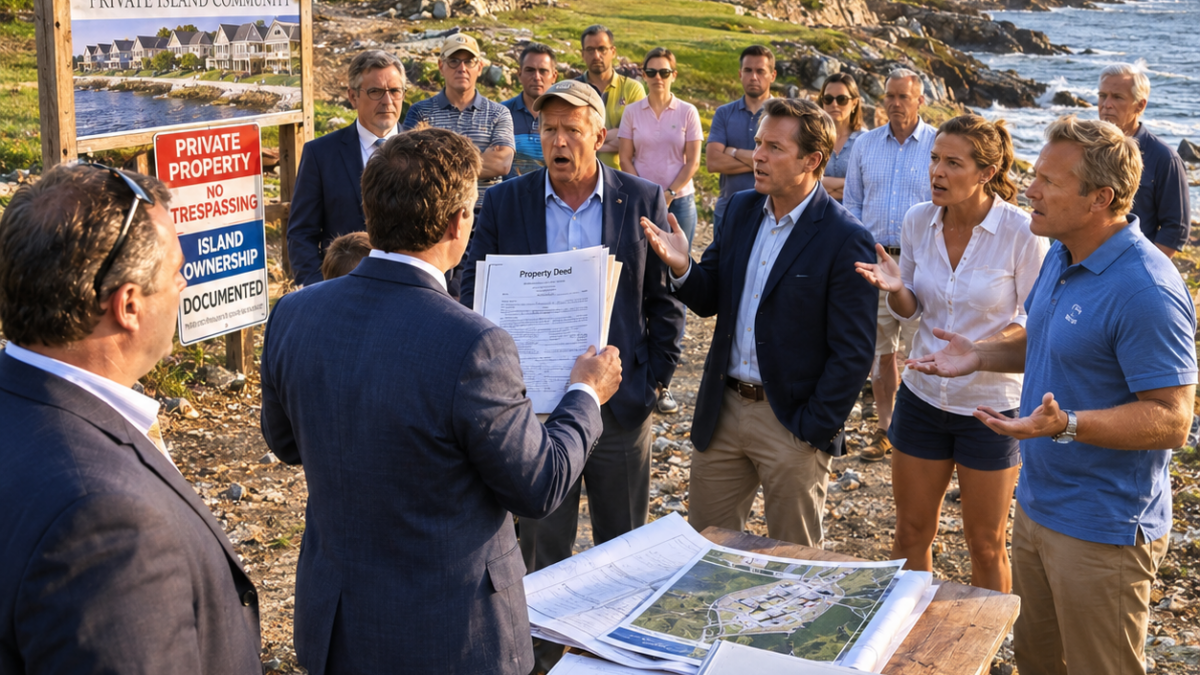
I came back to my private island after almost four years overseas expecting weeds, a weathered dock, and a long weekend of cleanup, but instead I found paved streets, luxury homes, a marina, a clubhouse, and twenty-eight families living on land I had never sold.
At the guarded entrance to something called Seer Point Estates, a man in a navy blazer looked at my faded work jacket and old jeans, told me homes started around $700,000, and suggested I was probably on the wrong side of the bridge if I wanted affordable housing.
What he had no idea about was that I had bought all thirty-six acres in 2017, spent nearly $1.5 million installing the bridge, wells, utilities, surveys, and permits, paid every property-tax bill while working in London, and still had the recorded deed sitting safely in my files.
My name is Daniel Carter.
I’m fifty-nine years old, and I spent most of my career managing investment portfolios in Minneapolis.
My rule was simple.
Buy what everybody else overlooks.
That was how I ended up with a forgotten island off the Washington coast.
It had no real roads, no reliable utilities, and a dock that looked ready to surrender to the next storm.
I loved it anyway.
Then work took me to London in early 2020.
Eighteen months became nearly four years.
When I finally returned, I crossed my own bridge and saw custom homes, landscaped yards, expensive SUVs, and children riding bicycles.
I actually wondered if I had reached the wrong island.
Then I saw the old oak tree I had refused to remove.
I knew exactly where I was.
I walked into the sales office without revealing my identity.
The man in the blazer, Gregory Whitmore, treated me like I was wasting his time.
When I asked to see the ownership records, he laughed.
“We don’t hand confidential paperwork to random people wearing clothes from a yard sale.”
I thanked him and drove straight to attorney Richard Lawson.
For two hours we compared my warranty deed, surveys, permits, tax receipts, utility easements, and county records.
Finally Richard leaned back.
“Dan, you never sold this property.”
“I know.”
“You never transferred it.”
“I know.”
“As far as the county is concerned, you still own the entire island.”
I stared at him.
“Then how are twenty-eight families living there?”
Richard turned his monitor toward me.
And that was when we discovered somebody had created an entirely different paper trail.
[END OF FACEBOOK CAPTION]
[FIRST COMMENT / FULL STORY CONTINUATION]
The first name that appeared was Pacific Horizon Communities.
I had never heard of them.
Richard had.
Not because they were famous.
Because they had become visible in county filings about two years after I left for London.
He pulled up incorporation records.
Development applications.
Construction financing references.
Marketing materials.
Then he sat very still.
“That company showed up after you left.”
I looked at the screen.
“And?”
“And somehow they convinced a remarkable number of people they had development rights on your island.”
I leaned closer.
“What people?”
“Investors.”
“Contractors.”
“Lenders.”
“Architects.”
“Buyers.”
“Apparently everybody except the actual owner.”
I did not laugh.
Richard kept going.
Pacific Horizon had formed an HOA.
They had hired design firms.
Secured construction loans.
Built roads.
Installed landscaping.
Improved the marina.
Marketed waterfront homes.
Sold twenty-eight of them.
Every one.
I looked at him.
“How?”
“That is what we need to find out.”
He began pulling documents.
Some referenced agreements that did not exist in my records.
Others simply behaved as if title had already transferred.
There were references to development authority that did not match anything recorded under my name.
Utility agreements I had never approved.
Property descriptions that looked like they had been built around assumptions rather than ownership.
Richard shook his head.
“I’ve handled real-estate litigation for thirty-five years.”
“I have never seen anything like this.”
“Can they fix it?”
He looked directly at me.
“No.”
That answer was too fast.
“What do you mean no?”
“Legally speaking?”
He turned the monitor back toward himself.
“They built an entire neighborhood on someone else’s front yard.”
The sentence sat between us.
Someone else’s front yard.
Mine.
I had bought that island because everybody else saw nothing.
Thirty-six acres.
Unimproved.
Difficult access.
No utilities.
I had seen possibility.
So I paid for surveys.
Permits.
Bridge work.
Deep wells.
Electrical installation.
Engineering.
Nearly $1.5 million over eighteen months.
Not because I expected to flip the island.
Because I intended to own it properly.
I had learned early in finance that paper can matter more than appearance.
Concrete can be moved.
Buildings can be rebuilt.
A recorded ownership chain is another matter.
That was why I had paid property taxes from London every year.
Renewed insurance.
Maintained digital files.
Kept original documents.
I had assumed the boring paperwork meant I could come home whenever I wanted and find my island waiting.
Instead, twenty-eight houses were sitting on it.
Richard closed one file and opened another.
“Dan.”
“Yeah?”
“We need to move quickly.”
“Why?”
“Because the longer this continues, the more people rely on a false ownership structure.”
“What do we file?”
He started listing claims.
Quiet title.
Fraud.
Civil conspiracy.
Trespass.
Unjust enrichment.
Whatever else the facts supported after review.
The complaint would name Pacific Horizon.
Its officers.
The HOA board.
The title company involved in the closings.
Other entities connected to the development.
Even the marketing operation still advertising homes.
I listened.
Then asked:
“What about the homeowners?”
Richard’s answer surprised me.
“They need to know immediately.”
“They didn’t do this.”
“Exactly.”
“They’re victims too.”
That distinction mattered.
I thought about the homes I had driven past.
Children on bikes.
Couples walking dogs.
A retired-looking man watering flowers.
Someone grilling near a patio.
Those people had not stolen my island.
They had paid professionals.
Signed contracts.
Taken loans.
Bought homes.
Maybe sold other houses to get there.
Maybe used retirement savings.
Trusting title companies and developers to know what they were selling.
The legal problem did not become smaller because they were innocent.
But innocence changed what responsibility felt like.
Richard said:
“If we hide this from them while the developer tries to fix its position, we become part of the uncertainty.”
“So we serve everyone?”
“Formal notice.”
“Yes.”
Three days later, Seer Point Estates exploded.
Process servers went door to door.
One house.
Then another.
Then another.
By midday, social-media groups were full of photographs of court papers.
People were confused.
Angry.
Terrified.
One woman wrote that there had to be a mistake because she had paid cash for her retirement home.
Another said her bank had verified title.
A retired firefighter wrote that he had used his life savings to move there because he wanted a peaceful place where his grandchildren could visit.
I read those posts sitting at Richard’s office.
They bothered me more than I expected.
None of those people knew me.
I did not know them.
Yet suddenly I was the person whose name appeared at the center of the lawsuit threatening everything they believed they owned.
I told Richard:
“They’re going to hate me.”
“Some will.”
“I don’t blame them.”
“Good.”
He looked at me.
“Just remember who created the problem.”
That was easy to say.
Harder when you imagined twenty-eight families reading legal language at kitchen tables.
Meanwhile, HOA leadership acted as if nothing serious had happened.
Two days after filing suit, I drove back to the island.
I did not tell Richard.
That was probably a mistake.
He would have objected.
I parked outside the clubhouse.
Residents had gathered.
Some held copies of the lawsuit.
Others stood with arms crossed.
At the front was Gregory Whitmore.
Same navy blazer.
Same posture.
He stood on the clubhouse steps telling everyone the lawsuit was a nuisance.
A disgruntled outsider.
No real threat.
Their lawyers would handle it.
A resident asked:
“Do we own our homes?”
Gregory answered immediately.
“Absolutely.”
That was the moment I decided to step forward.
Not because I wanted drama.
Because people were being reassured by a man who had already treated me like I did not belong on my own property.
I walked toward the group.
Gregory saw me.
Rolled his eyes.
“Well, look who’s back.”
A few residents recognized me from the sales office.
He crossed his arms.
“Still shopping?”
“No.”
“Just checking on my property.”
Someone chuckled.
They thought I was joking.
Gregory smiled.
“Sir, I think it’s time you move along.”
I reached into my jacket.
Richard had prepared a certified copy of the recorded deed that morning.
I did not hand it to Gregory.
I handed it to the nearest homeowner.
Older man.
Glasses.
He accepted it uncertainly.
“I’d appreciate it if you read the legal description.”
He started.
Parcel references.
Boundary description.
Recording information.
Then stopped.
His face changed.
“Wait.”
Another resident leaned over.
“What?”
He pointed.
“That’s this island.”
Gregory stepped forward.
“Give me that.”
The homeowner handed him the document.
Gregory scanned the first page.
Then the recording stamp.
Then the attached survey.
The color left his face.
That was the first time I saw him without a response prepared.
“Where did you get this?”
“The county clerk’s office.”
I paused.
“Same place you probably should have gone before selling twenty-eight houses.”
Nobody laughed.
This time the silence was different.
People were mentally doing math.
Mortgage balances.
Cash purchases.
Renovations.
Moving expenses.
Retirement savings.
Years.
Someone asked:
“What does this mean?”
Another:
“Are we losing our homes?”
“Is this real?”
Gregory tried to interrupt.
“Please don’t panic.”
A woman cut him off.
“Answer the question.”
Another man pointed toward me.
“Who are you?”
I looked around.
“My name is Daniel Carter.”
“I bought this island in 2017.”
“I never sold it.”
The realization moved through the group.
Not all at once.
Face by face.
Shock.
Confusion.
Fear.
One couple stepped away from Gregory.
A woman started crying.
Somebody called a real-estate agent.
No answer.
Gregory finally spoke.
“You’re lying.”
I looked at him.
“Am I?”
“Then let the judge decide.”
By sunset, local media had the story.
I do not know who contacted them.
Maybe a homeowner.
Maybe someone in the court system.
Maybe a lawyer.
The next morning, helicopters were circling near the bridge.
Reporters lined the mainland approach.
Microphones.
Cameras.
Satellite trucks.
People wanted to call it one of the largest real-estate fraud stories in the state.
Financial analysts estimated nearly $20 million in home sales were tied to the disputed title.
National outlets began requesting interviews.
I declined most.
Richard told me:
“Do not litigate this on television.”
“I wasn’t planning to.”
“Good.”
“Also stop going to the island alone.”
“That one I was planning to ignore.”
He glared.
I stopped joking.
Gregory disappeared.
His phone went to voicemail.
HOA board members suddenly said they had relied on Pacific Horizon.
Pacific Horizon blamed outside consultants.
Consultants pointed at title insurers.
Title representatives said they relied on documents presented during closing.
Everybody started moving away from responsibility.
Richard said:
“Watch carefully.”
“This is what happens when a paper trail becomes dangerous.”
Discovery began.
That was where the case stopped being strange and became ugly.
Internal emails surfaced.
Corporate communications.
Development discussions.
Title questions.
Survey problems.
Someone inside Pacific Horizon had asked about unresolved ownership before construction began.
Months before.
Not after.
Not when I returned.
Before.
Then Richard showed me one email.
I read the sentence once.
Then again.
“By the time anyone notices, the community will be complete.”
I felt my jaw tighten.
That was the moment sympathy for the developers disappeared.
They had not stumbled blindly into a title mistake.
At least somebody knew there was a serious ownership question.
And the strategy was apparently to build fast enough that completion itself became leverage.
Twenty-eight houses.
Roads.
Utilities.
Families.
A clubhouse.
A marina.
Then what?
Come back and say:
Too late now, Daniel.
Look how much everyone invested.
You cannot undo this.
Maybe they assumed I would take money.
Maybe they assumed I would never return.
Maybe they believed possession and construction would become stronger than recorded ownership.
I did not know.
Richard did not let me speculate beyond the evidence.
“Facts,” he reminded me.
“Facts win lawsuits.”
“Emotions don’t.”
So I stayed quiet.
Surveyors confirmed boundaries.
County officials produced records.
Tax receipts.
Permits.
Every original filing connected ownership back to me.
The bridge permits listed Daniel Carter.
The utility easements listed Daniel Carter.
The original surveys listed Daniel Carter.
The warranty deed listed Daniel Carter.
No recorded transfer.
No recorded sale.
No valid development conveyance.
Nothing.
Every document made the defense’s position smaller.
Three months after filing, the court scheduled an expedited hearing.
Too many families were living under uncertainty.
Banks were asking questions.
Insurers were nervous.
Residents could not make normal decisions about refinancing or selling.
Everything depended on one issue.
Who legally owned the island?
The morning of the hearing, I felt strangely calm.
Maybe because after months of paper, there was nothing left for me to discover.
Richard had the records.
The defense had theirs.
A judge would decide.
Gregory sat across the aisle.
He looked ten years older.
Same man.
Different posture.
No polished sales-office confidence.
No smirk.
No comments about my clothes.
Wrinkled suit.
Tired eyes.
He never looked at me.
Richard leaned over.
“No matter what happens today, you kept every piece of paper.”
I nodded.
“Turns out boring paperwork has a use.”
He smiled.
“It usually does.”
The hearing moved faster than I expected.
Richard did not perform.
No dramatic speech.
He did not need one.
Warranty deed.
Recorded surveys.
Tax receipts.
Bridge permits.
Utility documents.
No sale.
No transfer.
No valid title out of my ownership.
The defense emphasized good-faith purchasers.
The judge agreed.
The homeowners had acted in good faith.
They had relied on professionals.
That did not solve title.
Then the judge said the sentence that ended the central dispute.
No one can sell property they never owned.
Everything after that felt almost quiet.
The court confirmed I remained legal owner of the island.
The land.
Roads.
Docks.
Common areas.
And the ground beneath every one of those homes.
Pacific Horizon and those responsible for the fraudulent development structure faced the consequences of the conduct.
Gregory sat staring at the table.
The man who had laughed at my old jeans could not look up.
I should have felt triumphant.
Instead, I thought about the twenty-eight families.
They were outside the courtroom.
Some crying.
Some silent.
Some angry.
One retired firefighter approached.
I recognized him from the online posts.
“Mr. Carter.”
“Yes.”
He stood straight.
“If we have to leave, we’ll leave.”
I did not know what to say.
He continued.
“We understand this isn’t your fault.”
That sentence decided more than he knew.
Because legally I had won.
That did not tell me what kind of owner I wanted to be next.
I looked at the families.
None of them created Pacific Horizon’s paper trail.
None wrote the email about finishing before anyone noticed.
None sold property they did not own.
They bought homes.
That was their mistake, if you could even call it one.
Trusting systems they were supposed to be able to trust.
I told them:
“I’m not interested in throwing innocent families out just to prove the court was right.”
People stopped talking.
I continued.
“I’ll offer each household a long-term lease at a reasonable monthly rate.”
“The roads, bridge, utilities, and shared infrastructure will be maintained.”
“You keep caring for your homes.”
“Every agreement gets recorded.”
“No handshake arrangements.”
“No vague authority.”
“No hidden ownership questions.”
“Paperwork.”
The firefighter looked at me.
“You’d let us stay?”
“Yes.”
A woman started crying again.
Different kind this time.
Within a week, all twenty-eight households signed.
The developer was collapsing financially.
Gregory was gone.
Nobody trusted the HOA.
The leases gave residents something they had not had from the beginning.
Certainty.
Recorded certainty.
That mattered to me.
Because I had spent four years assuming paperwork protected the island.
They had spent years assuming paperwork protected their homes.
Only one set had been real.
I wanted their next documents to be real too.
The HOA disappeared.
Not overnight.
But quickly.
It had been created as part of the development structure.
Once that structure collapsed, residents had little appetite for preserving the same organization.
We replaced it with straightforward property management.
Roads.
Bridge maintenance.
Utilities.
Shared infrastructure.
Common spaces.
Nothing about mailbox colors.
Nothing about decorative restrictions.
No board pretending governance was ownership.
The neighborhood slowly became what it should have been from the beginning.
A group of people living on the island under clear agreements.
I still owned the land.
They still lived in their houses.
Both facts could exist.
Some people thought I was too generous.
One friend in Minneapolis called.
“You could have cleared the whole island.”
“Why would I?”
“Start over.”
“With what?”
“Higher-end development.”
I laughed.
“There are already twenty-eight houses there.”
“Not your houses.”
“No.”
“But they’re people’s homes.”
That ended the conversation.
Another friend said I should have charged whatever the market could bear.
Maybe.
I had spent my career managing investments.
I understood maximizing returns.
This was different.
A stable long-term lease income from twenty-eight occupied homes had value.
So did not destroying families who were innocent.
Those were not mutually exclusive.
Every month, lease payments began arriving.
The same neighborhood that once tried to sell me my own island now paid rent to the actual landowner.
There was irony in that.
I did not need to rub it in.
Residents already knew.
The first time I drove across the bridge after the court ruling, the security gate was gone.
No guard looking at my clothes.
No questioning whether I belonged.
A few residents waved.
I waved back.
Someone had left the old stone monument.
SEER POINT ESTATES.
I considered changing it.
Then decided not to.
The name belonged to the place now.
Not to Pacific Horizon.
Places outlive the people who misuse them.
The clubhouse remained too.
Residents used it.
Why destroy a building because fraud helped create it?
The road network stayed.
Landscaping stayed.
The marina stayed.
The infrastructure was already there.
The smart thing was to manage it.
That became my role.
Not developer.
Not HOA president.
Landowner.
Property manager through professionals.
Maintenance became a real job.
The bridge needed inspections.
Salt exposure.
Concrete.
Steel.
Utilities required service.
Wells required testing.
Road surfaces needed repair.
The island I had once imagined as a quiet retreat had become a living community.
That was not what I planned in 2017.
But ownership sometimes means dealing with what exists rather than what you imagined.
The residents taught me that.
The retired firefighter became one of the people I trusted most.
His name was Harold.
He had paid nearly everything he had for his house.
One afternoon we stood near the marina.
He said:
“I still wake up sometimes thinking someone’s going to tell us we have to leave.”
“You have a recorded lease.”
“I know.”
“I keep a copy in the safe.”
“Good.”
He laughed.
“My wife keeps another.”
“Even better.”
He looked at the water.
“You must hate us.”
“No.”
“Why not?”
“You bought houses.”
“You didn’t sell my island.”
He nodded.
That distinction became important in every conversation.
The homeowners were victims.
The developer was responsible for the false development structure.
Conflating the two would have been easy.
It also would have been wrong.
Some residents had been angry at me initially.
Understandable.
The lawsuit arrived before they knew who I was.
One woman told me months later:
“I thought you were trying to steal my house.”
“I know.”
“I hated you.”
“I figured.”
She looked embarrassed.
“I’m sorry.”
“You had a lawsuit taped to your door telling you the ground under your house belonged to a stranger.”
“I would’ve hated me too.”
That made her laugh.
We moved on.
Gregory became a symbol residents liked discussing.
I resisted.
He had treated me badly.
Yes.
He had been president of the HOA and involved in the development’s presentation.
Yes.
But I did not know every fact about what he knew before litigation.
The case documents handled that.
I did not need to turn him into a cartoon villain.
What I knew personally was enough.
He judged me by clothes.
Assumed I could not afford the homes he was selling.
Refused to show ownership information.
Called me a random person.
Then stood in front of residents assuring them ownership was secure when litigation said otherwise.
Those were his choices.
His future belonged to whatever legal consequences followed.
I stopped caring where he went.
That felt healthier.
Pacific Horizon’s internal email stayed with me longer.
“By the time anyone notices, the community will be complete.”
That sentence explained something about bad business decisions.
People sometimes believe completion creates legitimacy.
Build enough.
Sell enough.
Borrow enough.
Involve enough innocent people.
Eventually reversing the mistake becomes too painful.
Then everyone will negotiate.
Maybe that was the gamble.
If so, it almost worked.
Had I returned later, maybe there would have been fifty houses.
A hotel.
A bigger marina.
More financing.
More families.
More leverage.
That thought made me grateful I came back when I did.
Four years had already been too long.
My London assignment was supposed to last eighteen months.
That still makes me laugh.
Jobs expand.
Life moves.
You postpone retirement plans.
One year becomes another.
Meanwhile, the island changed without me.
That taught me something too.
Ownership requires attention.
Paying taxes is not the same as monitoring property.
I had done everything legally.
Still, I had ignored the physical reality for years.
That did not give anyone the right to develop it.
But it made the fraud easier to continue unnoticed.
I changed my habits afterward.
Periodic inspections.
Local management.
Regular title monitoring.
Updated photographs.
Contact with county offices.
Not obsessive.
Responsible.
Richard approved.
“Finally.”
“You could have suggested this before.”
“You were an investment manager.”
“I assumed you understood monitoring.”
“Fair.”
He enjoyed that too much.
Richard became deeply involved in recording the new leases.
Each one had to be clear.
Property description.
Term.
Rent.
Transfer rights.
Maintenance responsibilities.
Default procedures.
Infrastructure obligations.
Nothing vague.
Nothing dependent on me staying reasonable forever.
I told him:
“If I get hit by a bus, these families shouldn’t have another title crisis.”
“Agreed.”
“If I sell the island someday, agreements survive.”
“They will.”
“If my heirs take over, same.”
“Yes.”
“Good.”
I had learned the hard way that trust needs documents when property is involved.
The residents appreciated that.
One couple hired their own lawyer to review everything.
I encouraged it.
Another asked why I was not offended.
“Because you should verify what you sign.”
That became almost a joke.
I was the man who kept saying:
Check the paperwork.
After what happened, nobody argued.
The bridge became meaningful to me again.
I had paid for it before leaving.
Small bridge connecting island to mainland.
At the time, it represented access to my future retreat.
Then it became the entrance to a fraudulent development.
After the case, it became something else.
Infrastructure I was responsible for.
Every time I crossed it, I remembered the original permits carrying my name.
That boring permit had become one of the cleanest pieces of evidence in court.
Daniel Carter.
Property owner.
Simple.
Powerful.
Paperwork is invisible until somebody disputes reality.
Then every stamp matters.
The wells also became part of community management.
Two deep wells I had paid for during development preparation.
Pacific Horizon had incorporated them into the neighborhood infrastructure.
That was one of the stranger parts.
They used improvements I had already funded as if they belonged to the development.
When I first learned that, I was furious.
Later, I became practical.
The wells served homes.
Keep them maintained.
Document ownership.
Allocate expenses correctly.
Move forward.
Anger is useful for discovering boundaries.
It is not good at maintaining water systems.
The roads were similar.
Some Pacific Horizon roads followed paths my original engineers had mapped.
Others were entirely new.
Surveyors documented everything after judgment.
No ambiguity.
The residents wanted confidence.
So did I.
Harold joked:
“You survey this place more than anyone in Washington.”
“Good.”
“No one’s selling it twice again.”
“Exactly.”
The management structure became simple.
No HOA fines.
No architectural police.
Shared costs for shared infrastructure.
Property-management meetings only when needed.
Residents took care of their homes.
Most people are capable of that without somebody measuring lawn ornaments.
One resident asked about forming another HOA voluntarily.
The room practically revolted.
I laughed.
“Maybe wait a few years.”
Nobody brought it up again.
The community still needed coordination.
That happened informally and through management.
A dock schedule.
Road repairs.
Snow and storm planning.
Well servicing.
Bridge inspections.
Practical things.
No one missed monthly arguments over decorative rules.
At least not openly.
Over time, residents stopped treating me like the man who might evict them.
I became Daniel.
The guy who owned the island.
Which still sounded strange.
One child asked:
“Do you own my bedroom?”
I crouched.
“No.”
“Your parents own your house.”
“I own the land under it.”
He thought about that.
“Like Minecraft?”
I had no useful answer.
“Something like that.”
His mother laughed.
He ran away.
Children simplify legal structures faster than lawyers.
The island itself became more beautiful than I remembered.
Not because of the luxury houses.
Though some were impressive.
Because people had created lives.
Gardens.
Dogs.
Kayaks.
Lights in windows at night.
Children riding bicycles.
When I bought the island in 2017, I saw potential value.
When I returned, I saw unintended community.
That changed my investment mindset.
Land value on paper is one thing.
Human value is different.
The court gave me a legal right to control the outcome.
I chose leases.
Some people called that mercy.
I did not.
It was practical and fair.
The residents stayed.
I earned income.
Infrastructure was maintained.
Nobody lost everything because a developer lied.
That was a better outcome than clearing the island and starting over.
The title companies and lenders had their own fights.
I stayed out of most of those details unless Richard needed me.
Homeowners pursued claims.
Insurers fought.
Banks reviewed files.
Pacific Horizon’s finances collapsed.
Those were separate from my ownership.
I learned not to absorb every conflict connected to the island.
Otherwise I would have spent the rest of my life litigating other people’s mistakes.
Richard handled what affected me.
I focused on land and residents.
That separation kept me sane.
The local media eventually lost interest.
Good.
Helicopters stopped.
Reporters left the bridge.
National requests faded.
Another scandal replaced ours.
Residents were grateful.
Nobody wants their home used as television background forever.
The stone clubhouse went back to being a clubhouse.
The marina became quiet again.
Kids rode bikes without cameras filming them.
Normality returned.
That was when I finally spent a full weekend on the island.
Not as plaintiff.
Not as owner reviewing damage.
Not meeting lawyers.
Just staying.
I sat near the water with coffee.
The retirement morning I had imagined years earlier.
Except twenty-eight houses were behind me.
I laughed.
Not exactly the plan.
Still peaceful.
Harold walked by.
“Enjoying your private island?”
I looked around.
“Very private.”
He laughed.
“Sorry.”
“No.”
“This is better than empty.”
I surprised myself saying it.
He nodded.
“I think so too.”
Maybe it was.
The old island had been mine alone.
The new one carried twenty-eight families.
That created obligations.
Also life.
I began thinking differently about retirement.
Maybe I would spend more time there.
Maybe not.
The lease income helped.
But money was never the interesting part after court.
The interesting part was how close I came to losing control despite doing everything properly.
Not through a valid sale.
Through a manufactured paper trail and the assumption that once construction was complete, reality would bend around it.
That frightened me more than the insult in Gregory’s sales office.
A rude person is annoying.
A false document system can destroy ownership.
That was why Richard’s advice stayed with me.
Keep every piece of paper.
People think organization is boring until they need to prove something happened years earlier.
My original warranty deed had sat untouched for years.
The bridge permit.
Utility easements.
Survey.
Tax receipts.
Insurance.
Nobody applauded when I filed them.
Nobody cared.
Then one afternoon those documents became the line between:
You own a forgotten island.
And:
Twenty-eight people have validly purchased all of it from somebody else.
Paper mattered.
A lot.
The old jeans became a running joke.
Residents mentioned them constantly.
One woman said:
“Never dress up.”
“Why?”
“Those clothes exposed Gregory faster than a lawyer would have.”
She had a point.
Had I walked into the sales office wearing an expensive suit, maybe he would have treated me differently.
Maybe shown records.
Maybe called someone.
Instead, he looked at faded work clothes and decided I was irrelevant.
That gave me information.
People reveal assumptions when they think you have no power.
Gregory did.
The receptionist did too.
I never blamed her much.
She laughed because her boss laughed.
Another lesson about hierarchy.
People mirror power.
The residents eventually replaced the sales office with a management office.
Same building.
Different sign.
No luxury brochures.
No promises about exclusivity.
Just notices about bridge maintenance and well testing.
I liked it better.
One day I stood inside that room.
Same place Gregory had said:
“If you’re not buying, you’re wasting everyone’s time.”
The new manager handed me a maintenance report.
I looked around.
Funny how rooms keep memories.
Then I left.
No speech.
No plaque.
No need.
Gregory’s words had already lost their power.
The rent payments arrived every month.
Twenty-eight.
Regular.
Recorded.
Taxed.
Managed.
The same neighborhood that once unknowingly bought pieces of my island now leased the ground beneath their homes from me.
Some outsiders thought that was the ultimate revenge.
It was not.
Revenge would have been making the leases punishing.
They were reasonable.
I wanted residents stable.
A stable tenant is better than an angry one.
Again, investment management teaches useful things.
Fairness and economics sometimes point in the same direction.
The leases were long enough to give people security.
Residents could plan.
Maintain homes.
Pass interests according to the agreements.
Nothing like the uncertainty that arrived with the lawsuit.
That was important.
One couple had been considering selling before the fraud emerged.
After the leases were recorded, they asked whether they could still transfer their home interest.
Richard walked them through the process.
They eventually sold.
The buyer reviewed the land lease openly.
No hidden ownership issue.
No pretending the house included land title it did not have.
Everything disclosed.
That closing felt symbolic.
A property changed hands correctly.
Boring.
Transparent.
Recorded.
Exactly what should have happened from the beginning.
I attended none of it.
Richard told me afterward.
“Successful closing.”
I said:
“No helicopters?”
“None.”
“Disappointing.”
He laughed.
The new residents introduced themselves later.
They knew the story.
Everybody did.
But they had bought with full knowledge.
That mattered.
Consent based on accurate information.
Simple concept.
Apparently worth millions.
I occasionally wondered what would have happened if Pacific Horizon had contacted me properly.
Suppose they had proposed development.
Twenty-eight luxury homes.
Roads.
Marina.
Clubhouse.
Maybe I would have said yes.
Maybe we would have negotiated a ground lease from the beginning.
Maybe they could have made money legally.
Maybe I could have earned development income without years of litigation.
That was the tragedy.
The opportunity existed.
They chose deception instead.
Why?
Maybe they thought I would say no.
Maybe acquiring ownership rights would cost too much.
Maybe someone believed they could get away with it.
The internal email suggested exactly that kind of gamble.
“By the time anyone notices, the community will be complete.”
That choice created the disaster.
Not development itself.
Shortcuts often cost more than doing things correctly.
I had seen that in finance for decades.
Still, watching it happen on my own land made the principle personal.
The residents eventually held a small summer gathering near the marina.
They invited me.
I nearly skipped.
Then Harold called.
“Dan.”
“Yes?”
“If you don’t show up, everyone’s going to think you hate us.”
“I don’t.”
“Then bring something.”
“What?”
“Food.”
I brought enough barbecue for too many people.
Terrible investment discipline.
Good day.
Children played near the water.
Neighbors talked.
No lawyers.
No media.
No HOA president in a blazer.
A woman raised a cup and said:
“To paperwork.”
Everyone laughed.
I raised mine.
“To reading it.”
Richard would have approved.
That evening, as people left, I stood near the bridge.
Lights from the houses came on one by one.
Twenty-eight homes.
Each sitting on ground legally mine.
That fact no longer felt threatening.
The leases made the relationship clear.
Ownership and occupancy can coexist when both are honest.
That was the lesson.
The developer had tried to erase the ownership part.
The court restored it.
I had chosen not to erase the families.
Balance.
I liked that ending.
My brother visited eventually.
The same one who joked in 2017 that I should become a pirate.
He crossed the bridge.
Looked at the houses.
Then at me.
“You bought a deserted island.”
“Yes.”
“You went to London.”
“Yes.”
“You came back and found a subdivision.”
“Yes.”
“And now they pay you rent.”
“Yes.”
He stared.
“You are the weirdest investor I know.”
“I did not plan any of this.”
“Still counts.”
We laughed.
Then he pointed toward the marina.
“Where’s your pirate ship?”
“Get out.”
He stayed all weekend.
Maybe owning an island did finally become something worth enjoying.
Not the way I imagined.
Better in some ways.
More complicated in others.
That is life.
I eventually reduced my London responsibilities.
Spent more time in Washington.
The island needed less crisis management once everything stabilized.
Property management handled daily issues.
I reviewed finances.
Bridge reports.
Infrastructure.
Nothing dramatic.
That was the goal.
I returned to investment work occasionally.
But the island changed my attitude.
I still believed in buying overlooked assets.
I added another rule.
Do not overlook the asset after you buy it.
My colleagues found that funny.
I meant it.
I had spent years believing recorded ownership plus taxes meant safety.
Legally, it did.
Practically, someone still built a neighborhood.
Monitoring matters.
I added alerts to property records.
Local oversight.
Regular inspections.
If anybody tried filing something strange again, I would know before twenty-eight roofs appeared.
Better late than never.
The story became neighborhood folklore.
New residents heard:
Daniel came back and discovered his island was gone.
Not exactly.
The island was still there.
That was the point.
The paperwork never stopped saying it was mine.
Physical appearance had changed.
Legal reality had not.
That distinction fascinated me.
People trust visible things.
Houses.
Roads.
Signs.
Guard gates.
Sales offices.
They seem permanent.
A deed is just paper.
Yet in court, the paper outranked all the concrete.
That is both strange and reassuring.
Systems of ownership only work if recorded rights mean something.
If building first were enough, nobody’s property would be safe.
The judge’s sentence stayed with me.
No one can sell property they never owned.
Simple.
Everything else followed.
The residents were innocent buyers.
Yes.
The homes existed.
Yes.
Lenders had financed them.
Yes.
The development looked legitimate.
Yes.
Still, the seller lacked title.
That was the foundation failure no amount of landscaping could hide.
Pacific Horizon had built on sand legally, even though the ground itself was solid.
The court fixed ownership.
The leases fixed human reality.
That combination mattered.
Either alone would have been incomplete.
If court recognized me and I evicted everyone, the law would be clear but the human cost enormous.
If I let everyone remain informally, uncertainty would continue.
So we documented the new arrangement.
Recorded leases.
Defined responsibilities.
Real ownership chain.
That was how the island finally became stable.
Not through trust alone.
Trust backed by records.
I still keep the original leather binder.
Weathered.
Old.
The same one I carried into Richard’s office after Gregory laughed at my clothes.
Inside:
Warranty deed.
Surveys.
Bridge permits.
Utility easements.
Tax records.
Engineering reports.
I added the court order.
Then copies of the lease framework.
The binder got heavier.
Good.
One day I may hand it to whoever inherits the island.
I plan to explain everything.
Do not assume.
Check.
Record.
Monitor.
And if someone in a navy blazer tells you history does not buy houses, maybe ask them to check the county records.
That part still makes me smile.
Gregory had asked:
Why does original ownership matter?
History doesn’t buy houses.
He was right in one narrow sense.
History does not buy houses.
Title does.
And title had my name on it.
Every month when lease payments arrive, I do not think:
I won.
I think:
This is what should have been arranged honestly from the beginning.
Pacific Horizon could have contacted me.
Negotiated.
Built with permission.
Sold homes under correct terms.
Everybody might have done well.
Instead, they gambled that completion would overwhelm ownership.
That gamble failed.
The twenty-eight families survived the failure.
That mattered more.
Harold’s grandchildren visit often.
I see them biking near the marina.
One of them once asked:
“Grandpa says you own the whole island.”
“Technically.”
“Can you make everyone leave?”
Children ask direct questions adults avoid.
I thought.
“I could have tried.”
“But I didn’t.”
“Why?”
“Because your grandpa didn’t do anything wrong.”
The child nodded.
Then rode away.
That answer was simpler than years of legal analysis.
They did not do anything wrong.
That was enough.
I still wear old jeans.
Faded work jacket too.
Not as some statement.
They are comfortable.
People occasionally joke that the clothes are worth millions.
I tell them:
“No.”
“The deed was.”
Appearances had almost nothing to do with who owned the island.
Gregory had confused wealth with presentation.
Maybe that was why he underestimated me.
But the larger mistake was not insulting me.
The larger mistake was participating in a system that treated legal ownership like something inconvenient enough to ignore.
The insult just made the story memorable.
The deed made the case.
Years later—or rather, after enough months that life had settled—I could cross the bridge without remembering the first shock every time.
At first, every trip replayed that day.
Luxury houses.
Old oak.
Sales office.
Gregory.
Now I saw neighbors.
Harold.
Kids.
Dogs.
Flowers.
The island had become real in a new way.
Not the quiet private retreat I imagined.
Something more complicated.
Something shared without being taken.
That distinction made all the difference.
I bought thirty-six overlooked acres in 2017 because I believed they could become valuable.
I was right.
Just not in the way I expected.
The greatest value turned out not to be luxury-home sales.
Not court victory.
Not rent.
It was discovering that ownership means more than having the power to remove people.
Sometimes it means deciding not to.
The court told me who owned the land.
The choice afterward told me what kind of owner I wanted to be.
And every time I open that old leather binder, I remember the simplest lesson of all.
Paperwork is boring right up until the day twenty-eight families are living on your island and somebody asks you to prove it was ever yours.