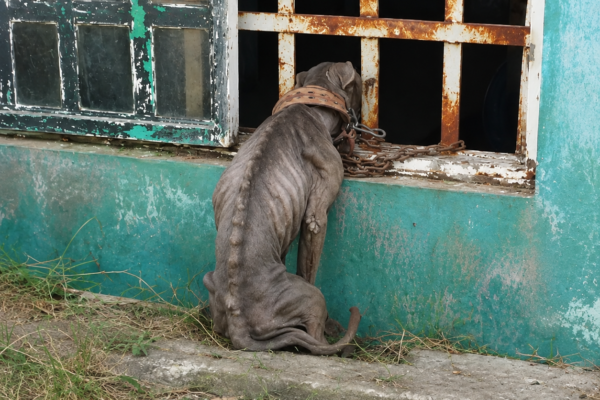
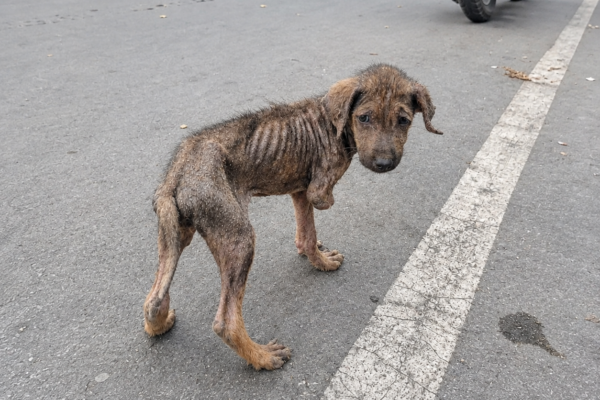
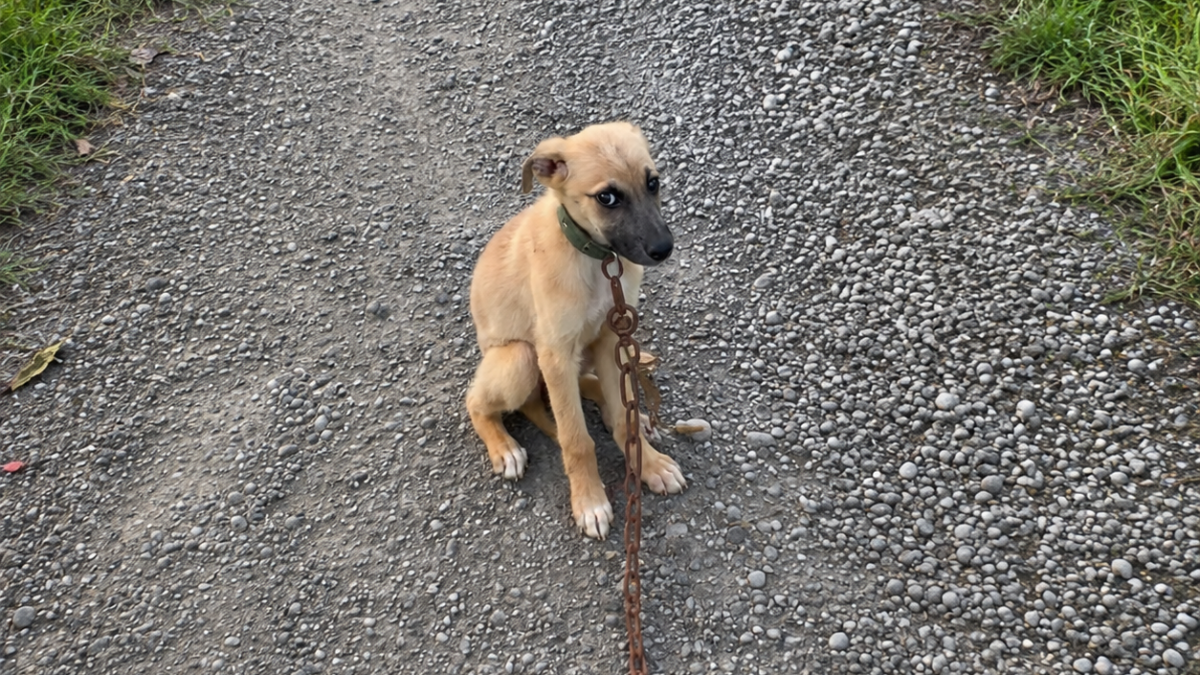
He spent what may have been days or even weeks dragging a heavy chain as he ran from his owner—until his strength finally gave out on an abandoned road.h
For a dog who had already been through so much, one bite should not have seemed extraordinary.
Dogs eat every day.
They lower their heads to a bowl, chew, swallow, look up, and often wait hopefully for more.
It is such an ordinary act that most people barely notice it.
But nothing about that first willing bite was ordinary for Bambi.
By the time it happened, food had become more than food.
It had become a question.
Would he accept what was being offered to him?
Would he respond to the hands trying to help him?
Would the little dog who had used nearly all of his strength getting away from the life behind him find enough strength to begin moving toward another one?
For days, the answer had seemed uncertain.
And to understand why that single bite meant so much, it is necessary to go back to the road where Victoria first found him.
Bambi had been carrying a chain so heavy that by the time Victoria saw him, he could no longer keep going.
The road was abandoned, the kind of place where a small exhausted animal could easily have gone unseen.
There were no crowds gathered around him.
No dramatic rescue team waiting nearby.
There was simply Bambi, the weight he had been dragging, and the last of his strength slipping away.
According to what Victoria understood, he had been running away from his owner.
How long he had been doing it was impossible to know for certain.
It may have been days.
It may even have been weeks.
That uncertainty made the image harder to forget.
There was no way to know how many times he had forced himself forward when his body wanted to stop.
No way to measure how far he had traveled while pulling that weight behind him.
No way to know how many moments had passed when he might have wanted to lie down but somehow continued.
The chain told part of the story simply by being there.
It was not light.
It was not something Bambi could forget he was carrying.
Every step required him to take the weight with him.
Every attempt to move forward meant dragging something from the life behind him.
By the time Victoria reached him, he had nothing left to prove.
He had already spent what strength he had.
He collapsed.
There are moments when rescue begins with action.
A door is opened.
A rope is cut.
An animal is pulled from danger.
But sometimes rescue begins with something much quieter.
Sometimes it begins when an animal who has been fighting for too long realizes that the person approaching is not asking him to fight anymore.
Victoria did not need Bambi to stand up for her.
She did not need him to walk toward her.
She did not need him to be brave for one more minute.
She simply picked him up.
Gently.
Carefully.
And Bambi let himself be carried.
He was completely shattered.
That was the impression he gave her from the beginning.
It was more than ordinary tiredness.
He did not simply look like a dog who needed a meal and a long sleep.
There was a stillness in him that felt deeper than physical exhaustion.
It was as though the effort of surviving had taken so much from him that there was little left for anything else.
He was quiet.
Remarkably quiet.
For some dogs, being picked up by a stranger would bring panic.
They might twist away, bark, growl, struggle, or try to put distance between themselves and unfamiliar hands.
Bambi did none of that.
His silence was not the easy silence of a relaxed dog settling into a comfortable lap.
It was the silence of an animal who seemed overwhelmed by everything that had already happened.
Victoria could not know exactly what he understood in those first moments.
She could not know what memories followed him from the life he had escaped.
She could not know whether he recognized that the chain would no longer be pulling at him once she took him away.
But she could see what was in front of her.
A dog who had reached the end of his strength.
A dog who needed help immediately.
A dog who, despite everything, still seemed to look for something gentle whenever he was near her.
That detail mattered.
Bambi sought touch.
Not loudly.
Not eagerly in the way a carefree dog might jump into someone’s lap or push a nose under a waiting hand.
His need for affection appeared quietly.
Whenever he was close to Victoria, he seemed to search for the reassurance of contact.
A hand.
An arm around him.
The simple feeling of another living being staying close.
It was one of the first signs that whatever had happened to him had not completely closed him off from people.
He was hurt in ways that could not be weighed on a scale, but he had not stopped reaching for tenderness.
So Victoria gave it to him.
She carried him home.
There was no grand plan attached to that decision.
At that point, the important thing was not what the next month would look like or what Bambi’s future might become.
The important thing was that he was no longer collapsed alone on that abandoned road.
He was being carried somewhere safe.
His exhausted body no longer had to pull the chain forward.
He did not have to decide where to go next.
Someone else was taking responsibility for that now.
At home, Victoria treated him with the gentleness she would have given someone precious.
The source story describes the way she held him in the simplest and most revealing terms: like her own son.
That night, Bambi stayed in her arms.
There is something almost painfully tender about that image when placed beside the one that came before it.
Only hours earlier, he had been dragging a heavy chain while trying to get away.
Now there was nothing he needed to drag.
Nothing he needed to outrun.
He could simply lie against someone who wanted nothing from him except for him to be safe.
His body was still depleted.
Whatever fear and confusion he carried had not disappeared because he had crossed a doorway.
Rescue does not always work that way.
A frightening experience can end before the fear created by it ends.
A dog can reach safety while still behaving as though safety might vanish.
A chain can be removed while the body remains tense from remembering its weight.
Bambi was physically inside a different life, but emotionally he was still far from being well.
Victoria understood enough to know that affection alone might not be enough.
The same day she found him, she called a veterinarian and made an urgent appointment.
There was no reason to delay.
Bambi’s condition was too fragile to treat as something that could simply be watched for a week and reconsidered later.
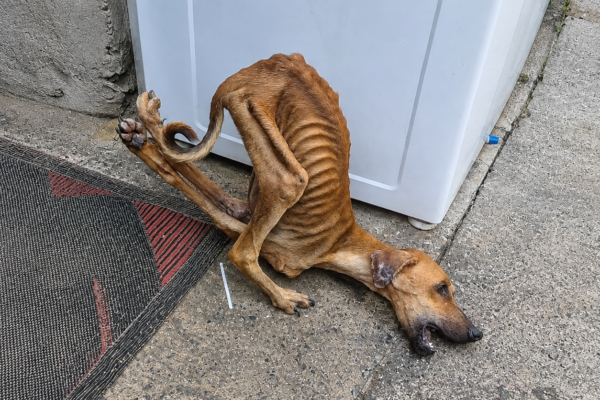
He was malnourished.
He had collapsed.
He seemed to be in shock.
And even though he was quiet, that quietness did not reassure her.
Sometimes the absence of protest can look like calm from a distance.
Up close, it can mean the opposite.
Victoria stayed with him through the night.
Bambi remained close.
The hours before a veterinary visit can feel long when an animal has been through something frightening.
There is little to do except keep watching.
You notice breathing.
You notice whether the eyes close fully or open at every movement.
You notice whether the body settles or stays tight.
You notice small changes that would normally seem meaningless.
A shift of the head.
A deeper breath.
A moment when the animal leans closer instead of pulling away.
For Victoria, simply having Bambi there must have made the reality of what she had found impossible to ignore.
He was not an image on a road anymore.
He was warm in her arms.
He had weight.
He breathed.
He depended on what happened next.
She did not know then how long his recovery would take.
She did not know how he would respond to treatment.
She did not know whether food, rest, and medical care would be enough to bring back the dog hidden beneath all that fear.
What she did know was that he would not face the next day alone.
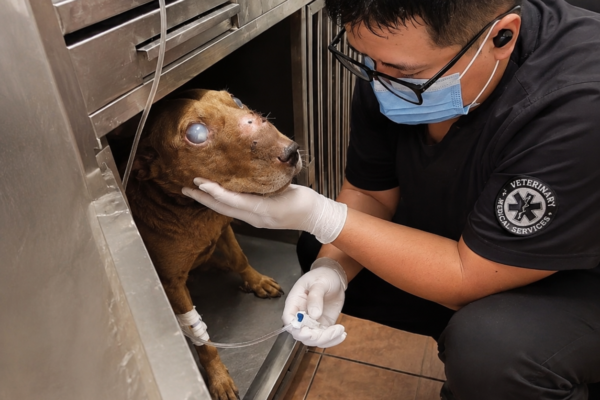
The following day, Victoria brought Bambi to the veterinarian.
The examination was careful.
For a dog who had looked so broken when he was found, the physical findings carried an important piece of good news.
Bambi was otherwise healthy.
His main physical problem was malnourishment.
His body needed proper food.
It needed recovery.
It needed time.
In one sense, that should have been comforting.
There was no need to invent another crisis.
No new physical disaster was discovered.
No dramatic hidden injury was necessary to explain why he had collapsed.
The heavy chain, the escape, the lack of nourishment, and the exhaustion had already taken enough out of him.
But the veterinary visit also confirmed what Victoria had sensed from the beginning.
The deeper problem was not only physical.
Bambi appeared psychologically traumatized.
The condition worried them.
The story describes the concern starkly: the trauma was so severe that there was fear he might not survive it.
That did not mean anyone could measure his will to live or place a scientific number on his emotions.
It meant that the people caring for him were looking at a dog who was barely participating in his own recovery.
He was not eating.
He was not barking.
He seemed withdrawn from the world around him.
A body can be given food, but it still has to accept it.
A bed can be made soft, but the animal lying in it still has to feel safe enough to rest.
Medicine can support a recovery, but there are moments when caregivers can do little more than offer what is needed and wait for some response.
Bambi’s response, at first, was almost nothing.
The decision was made to keep him at the clinic for several days.
That meant professional care.
Observation.
Repeated attempts to feed him.
A controlled place where his physical condition could be watched while he remained too fragile to simply go home and be treated like any ordinary dog.
It also meant money.
A great deal of it.
The costs would be high.
For many people, that realization would have created another difficult decision.
How far could they go for an animal they had only just found?
How much could they afford?
What would happen if the treatment lasted longer than expected?
Those questions were real.
The expenses were real.
But for Victoria, they did not become the deciding factor.
She did not care about the money.
What mattered to her was Bambi.
She wanted him to recover.
So she agreed immediately.
That choice did not guarantee an outcome.
It did not magically make him eat.
It did not erase what had happened to him.
It simply gave him the chance to remain where people could keep trying.
Sometimes love is dramatic.
Sometimes it is a person running into danger.
Sometimes it is a reunion after a long separation.
And sometimes it is a quiet yes spoken when the practical answer would be easier if it were no.
Yes, keep him.
Yes, treat him.
Yes, do what you can.
Yes, even if it costs more than expected.
Yes, even though no one can promise how quickly he will respond.
Victoria’s answer was yes.
Bambi stayed.
Then came the waiting.
At first, there was very little visible improvement.
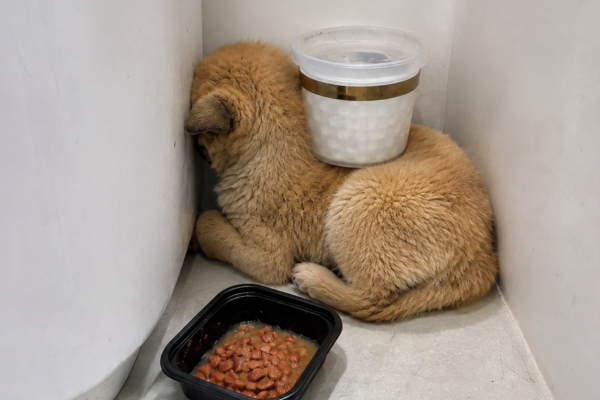
He would not eat.
Food could be placed near him, but he refused it.
For an animal already malnourished, every refusal mattered.
His body needed nourishment.
His body needed calories to recover its strength.
The simplest biological requirement had become a daily struggle.
Yet Bambi did not seem interested.
Again and again, food was offered.
Again and again, he turned away.
There was no angry rejection.
No dramatic scene.
He was simply withdrawn.
The lack of movement may have been one of the hardest things to witness.
A dog who is frightened can still be energetic.
A sick dog can still lift its head quickly at a familiar sound.
A hungry dog often responds immediately when food arrives.
Bambi seemed to have retreated somewhere inward.
He lay in his bed.
He did not bark.
He did not rush toward people.
He did not show the ordinary impatience of an animal waiting for the next meal.
His bed became the center of his tiny world.
Sometimes he would rise.
He would walk a little.
His steps were heavy.
He would move only a short distance before returning.
There was sadness in his eyes, the kind that made the people watching him wonder how much of the road he was still carrying inside himself.
Then he would settle back into the bed.
The same quiet body.
The same refusal.
The same waiting.
It would have been easier if recovery had begun immediately.
That is the version people often hope for in rescue stories.
The animal is found.
The animal is fed.
The animal sleeps.
By morning, the tail moves.
By the next day, trust begins.
Soon the past looks far away.
But Bambi’s recovery did not move at that speed.
Safety did not instantly turn into joy.
Being rescued did not instantly teach him that his life had changed.
He was physically free of the situation he had escaped, but emotionally he seemed unable to understand what freedom could mean yet.
Perhaps that is why the first days mattered so much.
They revealed that the rescue on the road had only been the beginning.
Victoria had saved Bambi from being left where he collapsed.
The clinic now had to help him survive what remained afterward.
Everyone could offer the conditions for healing.
No one could force healing to happen on command.
So they continued.
The doctors kept trying to treat him.
Food was offered.
Care continued.
Time passed.
For Bambi, the days must have been made up of sensations he could not explain in human language.
A bed beneath him instead of a road.
Hands approaching carefully.
Food arriving again even after he had refused it before.
People returning instead of disappearing.
No chain requiring him to move.
No need to run.
No need to spend his strength on escape.
Yet his behavior remained guarded.
The dog who had once pushed his body hard enough to drag a heavy chain now barely seemed willing to move at all.
That contrast is part of what makes his story so painful.
On the road, movement had meant survival.
At the clinic, stillness had taken over.
He had fought so hard to get away that, once he was finally safe, he seemed to have nothing left.
Victoria could not climb inside his mind.
She could not explain to him that the worst part was behind him.
Human beings rely on words when they want to reassure one another.
“It’s over.”
“You’re safe now.”
“You don’t have to be afraid.”
“Nobody is going to make you go back.”
But words are limited with an animal who does not understand them in the same way we do.
Meaning has to be built through repetition.
A hand that touches gently today has to touch gently tomorrow.
A bowl of food that appears without danger has to appear again.
A bed has to remain safe for another night.
A person who cares has to keep caring.
Trust often enters through routine long before it becomes visible in behavior.
Bambi’s first days at the clinic were filled with that kind of repetition.
Nothing spectacular.
Nothing that could be rushed.
Just care.
Again.
And again.
And again.
The sadness in his eyes did not vanish because someone wished it away.
His appetite did not return because everyone wanted it to.
His voice remained silent.
But the people caring for him did not interpret the absence of progress as a reason to stop.
They kept going.
Victoria kept caring.
The clinic kept treating.
Bambi kept breathing.
At that stage, even that continuity mattered.
There is a temptation, when looking back on a successful rescue, to read the ending into every earlier moment.
We know the dog eventually becomes happy, so we imagine that happiness was already inevitable.
It was not.
Standing beside Bambi’s bed during those first days, no one could skip ahead.
They could not see the future version of him who would gain weight.
They could not see the energy that would later return.
They could not see how quickly his body would eventually respond once he began eating.
All they had was the Bambi in front of them.
Quiet.
Thin.
Withdrawn.
Not barking.
Not eating.
Taking a few heavy steps before returning to bed.
That was the reality they had to work with.
Hope, in those days, had to exist without much evidence.
It lived in the fact that he had survived the road.
It lived in the fact that Victoria had found him.
It lived in the fact that he still seemed to seek affection when he was close to her.
It lived in the decision to keep trying.
Perhaps most of all, it lived in patience.
Bambi had spent an unknown amount of time pulling against a chain.
There was no reason to expect the effects of that experience to disappear in a few hours.
His body could be examined.
His weight could be monitored.
His food could be measured.
But emotional recovery had no clean schedule.
The doctors could not order trust from a pharmacy.
Victoria could not buy it with the money she was willing to spend.
All of them could only create a place where trust might eventually become possible.
So the food kept coming.
At first, Bambi kept refusing it.
A bowl placed near a malnourished dog carries a particular kind of tension when the dog refuses to eat.
You know the nourishment is there.
You know the body needs it.
You know eating should be the simplest thing in the world.
And yet the distance between the dog’s nose and the food can feel enormous.
Bambi would not cross it.
Not yet.
Maybe he smelled the food.
Maybe he looked at it.
Maybe he simply turned his face away.
The source does not tell us every movement, and there is no need to invent them.
The important truth is enough.
He refused.
Again and again.
Meanwhile, his silence continued.
A bark is such a small sound until you are waiting for one.
For a dog who has been completely withdrawn, even ordinary noise can feel like evidence that some part of his personality is returning.
But Bambi gave them no such sign at first.
His world remained quiet.
Victoria had already learned that his silence was not emptiness.
When he was near her, he sought affection.
There was still a connection there.
Still some desire to be held.
Still a small opening through which gentleness could reach him.
That mattered because it suggested that Bambi had not completely given up on contact.
He might not be ready to eat.
He might not be ready to bark.
He might not be ready to move with confidence.
But he had not rejected every form of care.
He still wanted touch.
That need became one of the quiet threads connecting the abandoned road to the life waiting for him.
On the road, Victoria had lifted him because he could no longer carry himself.
At home, she had held him through the night.
At the clinic, the work became broader than simply holding him, but the meaning was the same.
He was not going to be abandoned to his fear.
If he needed time, he would be given time.
If he needed treatment, he would receive treatment.
If the cost was high, Victoria had already made her decision.
Bambi mattered more.
There is something important in the fact that Victoria did not require Bambi to reward her immediately for saving him.
He did not have to become playful in order to deserve care.
He did not have to show gratitude in a way humans could easily recognize.
He did not have to eat just to make everyone feel that their efforts were working.
He did not have to perform recovery.
He was allowed to be broken for a while.
That may be one of the most compassionate parts of his story.
Rescue was not treated as a transaction.
Victoria did not save him so that he would instantly become the happy dog she wanted.
She saved him because he needed saving.
What came after would happen at Bambi’s pace.
And for several days, that pace was painfully slow.
Each time he stood, the heaviness of his steps showed how far he still had to go.
Each time he returned to bed, the stillness returned with him.
Each time food was refused, the question remained.
How long could this continue?
No one could answer it.
The story only tells us that the doctors kept trying.
That phrase can sound simple.
“The doctors continued trying to treat him.”
But continuing is its own kind of work.
Continuing means doing the same necessary things even when yesterday’s effort produced no dramatic result.
Continuing means not allowing disappointment to become impatience.
It means looking at a dog who is still not eating and offering food again.
It means watching him move only a little and still believing that a little movement is worth protecting.
It means caring for the animal in front of you rather than the animal you hope he will become tomorrow.
Days passed this way.
The road where Bambi had collapsed was no longer physically around him.
The chain was no longer the center of every step.
Yet the emotional weight seemed to remain.
That is why the moment of change was so small.
There was no sudden leap.
No dramatic bark that filled the clinic.
No instant transformation from frightened to joyful.
Bambi simply gave in to something his body had needed all along.
He ate.
One bite.
Willingly.
The first bite was small enough to disappear in seconds.
But emotionally, it filled the room.
For the people caring for him, it meant that after day after day of refusal, Bambi had finally accepted nourishment.
He had made a choice that moved in the direction of living.
The story calls it the bite of his freedom.
That phrase works because of everything that came before.
The chain had represented the weight he had dragged away from.
The food represented something entirely different.
No one was forcing him toward it.
No one was pulling him.
No one was demanding that he move.
The bowl waited.
The care waited.
The decision was his.
And finally, Bambi leaned toward life.
One bite.
Then the meaning of it began to grow.
The first bite was not a complete recovery.
It did not mean the trauma was gone.
It did not erase the days of refusal.
It did not suddenly rewrite whatever had happened before Victoria found him.
But it was a beginning.
For the first time since he entered the clinic, there was a visible sign that his body and his will were starting to respond.
A glimmer.
That was enough.
Hope does not always arrive as a miracle.
Sometimes it arrives as appetite.
Sometimes it is the quiet sound of a dog finally chewing.
Sometimes it is the sight of an empty space in a bowl that had remained untouched the day before.
Sometimes it is one ordinary biological act becoming extraordinary because of how long everyone waited for it.
Bambi’s first bite became that kind of moment.
The people around him could not know exactly what had changed inside him.
It would be easy to romanticize it and say that Bambi suddenly understood everything.
That he knew he was free.
That he knew Victoria would never leave him.
That he consciously decided his old life was over.
No one can know that.
What they could know was visible.
He ate.
He had refused before.
Now he accepted.
Something had shifted.
And after that shift, his recovery began to move differently.
From that day on, Bambi started regaining energy.
His body, which had seemed almost frozen in exhaustion and withdrawal, began responding quickly to treatment.
The difference between a dog who refuses nourishment and a dog who accepts it can be profound.
Food gave his body something to work with.
Treatment had something stronger to support.
The tiny reserves that had been exhausted by running, dragging the chain, and going without enough nourishment could finally begin to rebuild.
The change did not require a new crisis or a dramatic intervention.
The care had already been there.
What changed was Bambi’s ability to receive it.
That distinction matters.
Victoria had chosen him before he improved.
The doctors had treated him before he ate.
The food had been offered before he accepted it.
His recovery was not created in one magical moment.
The first bite simply revealed that all the patient work had finally found an opening.
Once Bambi began to respond, every small improvement carried a different feeling.
Before, movement had looked heavy.
Now energy was returning.
Before, his body had seemed like something he was barely carrying.
Now it was beginning to become his again.
Before, the clinic bed had looked almost like a place of retreat.
Now it could become what a bed should be: somewhere to rest while strength returned, not somewhere to disappear from the world.
The story does not give a list of daily milestones, and none are needed.
It tells us what matters.
Bambi began to regain his energy.
His body responded quickly to treatment.
His life changed completely.
Those simple facts contain the whole direction of the recovery.
He was no longer moving toward collapse.
He was moving away from it.
For Victoria, the transformation must have been visible not only in Bambi’s body but in the contrast between who he had been when she lifted him from the road and who he was becoming.
The first Bambi she held had no strength left to run.
He was crushed by exhaustion.
He seemed in shock.
He searched quietly for affection while otherwise remaining withdrawn.
The recovering Bambi was beginning to take food.
Beginning to regain energy.
Beginning to inhabit the safe life that had been offered to him.
There was no need to rush the story beyond that.
No need to invent a dramatic celebration.
No need to give him a sudden personality he had not yet shown.
Recovery itself was enough.
The dog who had been too overwhelmed to eat was eating.
The dog whose steps had been heavy was becoming stronger.
The dog who had collapsed beneath the weight of the chain was no longer defined by that weight.
And Victoria was still there.
That may be the most important continuity in the entire story.
Everything around Bambi changed.
The road disappeared behind him.
The chain no longer controlled his movement.
The clinic replaced abandonment with care.
Malnourishment was answered with proper food.
Isolation was answered with touch.
Fear was answered not with demands, but with patience.
Through all those changes, Victoria remained the person who had first decided that this exhausted dog mattered.
She had not known him before that road.
She had no long history with him to explain her devotion.
There was no obligation built from years together.
There was only the moment she saw him and understood that he needed help.
Then she acted.
First she carried him.
Then she brought him home.
Then she called the veterinarian.
Then she held him through the night.
Then she brought him for examination.
Then, when told that he needed several days of clinic care and that the cost would be high, she said yes.
Step by step, the relationship formed through decisions.
Bambi did not become “her dog” in the emotional sense because of one declaration.
He became hers through care.
And she became his person through consistency.
By the time he began recovering, that bond had already been created in the hardest part of the story.
Before he could offer playfulness.
Before he could show energy.
Before he had gained weight.
Before anyone could look at him and say that the rescue had worked.
Victoria loved the version of Bambi who was lying almost motionless in bed.
That kind of love is easy to overlook once a dog becomes happy.
The happier ending can make the painful middle feel like something to hurry through.
But the middle is where Victoria’s commitment mattered most.
Anyone can enjoy a healthy dog who eats eagerly and grows stronger.
Victoria stayed committed when Bambi would not eat at all.
Anyone can smile at a dog who is gaining weight and thriving.
Victoria cared when his body was malnourished and his eyes looked sad.
Anyone can celebrate a rescue after the outcome is known.
Victoria made her decision before she knew whether he would recover.
That is what gives the ending its weight.
Today, Bambi is living the best life he has known.
He is with the person the story now calls his mother.
Victoria.
The woman who found him when the chain had become too heavy.
The woman who bent down on an abandoned road and lifted him.
The woman whose arms became the first safe place in the story.
The woman who did not turn away when the veterinarian explained that Bambi’s physical condition was only one part of the problem.
The woman who did not let the cost of treatment decide whether he deserved a chance.
Today, the relationship that began with rescue has become home.
Victoria gives Bambi the attention he had been missing.
She gives him healthy food.
She gives him love.
And the dog who once refused every offering now lives in a world where nourishment is part of ordinary life.
That may be one of the most beautiful reversals in his story.
There was a time when a bowl of food could sit near Bambi and he would turn away.
Today, healthy food is simply part of the care surrounding him.
There was a time when his body was malnourished.
Today, he has gained weight.
There was a time when each step looked heavy.
Today, he is growing fast.
There was a time when Victoria could only hope that he would find enough strength to respond to treatment.
Today, his recovery is visible in the body that grew stronger once he began eating.
The contrast is not complicated.
It does not need embellishment.
The facts themselves carry the emotion.
Bambi was starving for more than food when Victoria found him.
He needed rest.
He needed safety.
He needed touch.
He needed care that did not disappear when he failed to respond immediately.
Most of all, he needed time to discover that the world around him had changed.
Victoria gave him that time.
The clinic gave him the treatment he needed.
And slowly, Bambi began doing the part no one else could do for him.
He began accepting life again.
When people say that an animal has been “saved,” they often mean the moment of physical rescue.
A dog is taken off a road.
A gate is opened.
A chain is removed.
A dangerous place is left behind.
That moment matters.
Without it, nothing else can happen.
But Bambi’s story shows why saving an animal can be more complicated than simply changing its location.
Victoria removed Bambi from the abandoned road in a single day.
The emotional distance between collapse and happiness took longer.
She could carry his body immediately.
She could not carry all his fear for him.
She could place him in a safe home.
She could not force him to believe that it was safe.
She could arrange veterinary care.
She could not make him eat.
She could pay for treatment.
She could not purchase trust.
All she could do was remain present while he discovered those things for himself.
That is why his first bite deserves to be remembered.
It was not just the moment hunger won.
It was the moment the wall around him seemed to open enough for care to get through.
The body that had been refusing began to accept.
The dog who had gone inward began, in the smallest way, to come back out.
His recovery moved forward from there.
Perhaps Bambi’s story is most powerful because nothing in the ending requires us to imagine a different dog.
The same quiet sensitivity that made him seek affection near Victoria is still part of what made the bond possible.
The same body that collapsed from exhaustion became the body that gained weight and grew stronger.
The same dog who could only manage heavy steps eventually had energy again.
He did not need to become a symbol larger than himself.
He did not need awards.
He did not need strangers to know his name.
He did not need his story to become famous in order for what happened to matter.
He needed one person to stop.
Victoria stopped.
He needed someone to lift him when he could not continue.
Victoria lifted him.
He needed urgent veterinary attention.
She arranged it.
He needed expensive clinic care.
She agreed.
He needed patience when he would not eat.
He received it.
He needed affection.
She gave it.
That sequence is enough.
There is a tendency in emotional stories to search for one enormous act of heroism.
Bambi’s story is built instead from several simple acts done at exactly the right time.
Finding.
Carrying.
Holding.
Calling.
Taking him to the veterinarian.
Saying yes to treatment.
Waiting.
Continuing.
Feeding.
Loving.
None of those actions by itself sounds impossible.
Together, they changed everything.
Imagine the difference between the weight Bambi carried before Victoria and the kind of weight he knows now.
Before, there was a literal chain.
Heavy.
Unavoidable.
Something he had to drag as he tried to move away.
Now, if he leans into Victoria, the weight around him is the weight of an arm holding him.
If he settles near her, he does not have to pull anything behind him.
He can simply rest.
The physical image is simple, but it captures the transformation.
Bambi once spent his strength trying to create distance from his past.
Now he can use that strength for living.
He does not need to save energy for escape.
He does not need to drag the evidence of where he came from.
The chain belongs to the beginning of his story, not the end.
The end is food.
Growth.
Attention.
Love.
Happiness.
It would be easy to make the ending more dramatic than it is.
But doing so would miss what makes it meaningful.
Bambi is alive.
Bambi is safe.
Bambi is loved.
Bambi is happy.
Those are not small things.
For the dog Victoria found collapsed on an abandoned road, they are everything.
His weight gain is not just a number on a scale.
It is evidence that the dog who once refused food now accepts nourishment.
His growth is not merely physical.
It stands beside the memory of a body that had been depleted.
His happiness matters because it comes after days when he seemed unable to respond to even the most basic care.
And Victoria’s role matters because she did not wait for the happy version of Bambi before choosing him.
She chose the shattered one.
The silent one.
The malnourished one.
The one who would not bark.
The one who would not eat.
The one whose heavy steps carried him only a short distance before he returned to bed.
That was the dog she decided was worth the cost.
That was the dog she held like her son.
That was the dog she loved before he knew how to live freely.
There is something deeply human in wanting immediate reassurance that a good act has worked.
We help and want to see relief.
We rescue and want to see joy.
We offer food and want to see it eaten.
We give affection and want to see a tail wag.
Bambi did not give Victoria those immediate rewards.
His condition demanded a different kind of kindness.
The kind that does not insist on being recognized.
The kind that keeps showing up while the animal is still too frightened or exhausted to respond.
The kind that can sit beside uncertainty without turning away.
When Bambi finally ate that first bite, the moment belonged not only to him, but to all those days when nobody gave up.
That is why the change afterward felt so dramatic even though it grew from something so small.
One bite became another possibility.
If he could eat, his body could strengthen.
If his body strengthened, treatment could do more.
If energy returned, movement could become easier.
If his world kept proving safe, perhaps the fear could begin loosening its hold.
None of those steps had to happen overnight.
They simply had to begin.
And they did.
From that day on, Bambi’s body responded quickly.
The dog who had looked emptied out began filling back up with life.
Energy returned.
Weight returned.
Growth followed.
The physical recovery became something Victoria could see.
Each improvement pushed the abandoned road a little farther into the background.
Not erased.
Never denied.
Just no longer the place where his life was headed.
There is an important difference between forgetting a painful beginning and no longer being controlled by it.
Bambi’s story does not tell us what he remembers.
We cannot know what images, sounds, or sensations remained with him.
We do not need to imagine them.
His behavior gives us the part that matters.
At first, the trauma seemed to dominate everything.
Later, it no longer defined his daily life.
That is recovery in the clearest form the story gives us.
Not a speech.
Not a diagnosis disappearing from a page.
A dog eating.
A dog gaining strength.
A dog growing.
A dog receiving affection.
A dog becoming happy.
Victoria’s home, which had first been the place where Bambi spent one fragile night in her arms, became something more permanent.
It became the place connected with safety.
The place where he had a mother.
The place where healthy food was available.
The place where attention was not something he had to earn.
The place where love was given freely.
That word—mother—may sound simple, but in the context of Bambi’s story it represents everything Victoria became after she found him.
She did not merely transport him to safety.
She took responsibility for what came next.
She cared about his recovery when recovery was uncertain.
She accepted the financial burden of keeping him in treatment.
She stayed emotionally invested while he was withdrawn.
And when he became stronger, she did not disappear from the story.
She remained his person.
His mother.
His home.
Bambi, for his part, changed in the ways that mattered most.
He ate.
He recovered.
He gained weight.
He grew.
He became happy.
The transformation did not require a new series of adventures.
There was no need for another rescue.
No need for a second crisis to prove their bond.
The ordinary life afterward was the reward.
That is worth emphasizing because ordinary life is often the most beautiful ending a rescued animal can receive.
A full bowl.
A familiar person.
A safe place to sleep.
Attention.
Affection.
A body that is no longer starving.
A day that does not require escape.
Nothing spectacular.
Everything essential.
For Bambi, the greatest change may have been that he no longer had to spend each moment reacting to danger.
He could simply exist.
A dog does not need every day to be dramatic in order for it to be good.
In fact, after what Bambi had endured, peace itself was extraordinary.
The road had demanded movement from him when he was already exhausted.
Home allowed him to stop.
The chain had forced him to carry weight.
Victoria’s arms carried him.
Malnourishment had emptied his body.
Healthy food restored it.
Trauma had made him withdraw.
Patient affection gave him room to return.
Each part of his new life answered something from the old one without needing to recreate it.
And perhaps that is why the story feels complete where it ends.
Not because every trace of the past can be measured as gone.
Not because anyone can guarantee what Bambi feels in every moment.
But because the direction of his life is no longer in doubt.
He is not running away now.
He is living with someone.
He is not collapsing beneath a chain.
He is growing stronger.
He is not turning away from every meal.
He is receiving healthy food.
He is not alone on an abandoned road.
He is with Victoria.
He is not waiting for someone to notice that he needs help.
He has someone who already notices him.
Today, Bambi is happy.
Those words are powerful because they would have been difficult to imagine during the first days.
When he lay motionless in the clinic bed, happiness was not the immediate goal.
Eating was.
When he refused food, nobody needed him to play.
They needed him to take a bite.
When his steps were heavy, nobody needed him to run.
They needed him to keep going.
Recovery was built from those smaller needs.
One after another.
That is often how the largest transformations happen.
Not through one enormous leap, but through a series of moments that look almost insignificant unless you know what came before.
Bambi’s first bite meant something because he had refused every one before it.
His later weight gain meant something because he had been malnourished.
His energy meant something because he had once collapsed.
His happiness meant something because his eyes had once been filled with sadness.
His attachment to Victoria meant something because their relationship began at the exact moment he could no longer save himself alone.
And Victoria’s devotion meant something because she did not know how the story would end when she first chose to help.
She saw a dog in need.
That was enough.
There is no indication that she paused to calculate whether Bambi would become easy to care for.
She did not know whether he would eat the next morning.
She did not know how many days the clinic would need.
She only knew that abandoning him was not an option she was willing to accept.
The financial cost became secondary.
The emotional commitment came first.
That is why the phrase “she didn’t care about the money” carries more meaning than it might seem to.
Money represents limits.
It represents the point at which compassion often collides with practical reality.
Victoria was told the clinic stay would be expensive.
She understood.
She agreed anyway.
Not because money had no value, but because in that moment Bambi’s chance to recover had greater value to her.
She had already watched him collapse under one kind of weight.
She was not going to allow another kind of weight—the cost of treatment—to decide his fate if she could help it.
So Bambi remained in care.
And the waiting continued until the waiting finally produced something.
A bite.
It is worth returning to that moment because the whole story turns there.
Before the bite, every major image points downward.
A heavy chain.
A collapsed body.
A dog carried because he cannot continue.
A night spent in someone’s arms.
A malnourished frame.
A clinic bed.
Heavy steps.
A head turning away from food.
After the bite, the direction changes.
Energy.
Treatment working.
Weight gain.
Growth.
Healthy food.
Attention.
Love.
Happiness.
One small act sits between those two halves.
Bambi ate.
That is why the story calls it the bite of freedom.
Freedom, in Bambi’s case, was not only being separated from the chain.
Physical freedom had come earlier.
Victoria had already removed him from the road.
But freedom had not yet reached the way he behaved.
Fear still seemed to govern him.
Withdrawal still held him.
The first bite was the moment when his behavior began moving toward the life already available to him.
He had escaped before he was ready to live again.
Now living was beginning.
That distinction makes his recovery feel more honest.
Rescue was not instant transformation.
It was opportunity.
Victoria gave Bambi the opportunity to stop running.
Veterinary care gave him the opportunity to recover physically.
Patience gave him the opportunity to trust without being forced.
Food gave him the opportunity to rebuild his body.
Love gave him a place to belong once the emergency was over.
Bambi had to meet those opportunities at his own pace.
Eventually, he did.
Today, there is no need to measure his life by the chain.
The chain belongs to the image of the dog Victoria first found.
The Bambi she knows now is defined by something else.
He is loved.
He receives attention.
He eats well.
He has gained weight.
He is growing.
He is happy.
For a dog whose story began in collapse, growth is a beautiful word.
It suggests movement without escape.
Change without fear.
A body developing because it is finally being nourished.
A life moving forward because it no longer has to spend all its energy getting away.
Victoria can look at him now and see a dog who is not merely surviving the next hour.
He is living.
The difference can be seen in everything the source tells us about the present.
“He’s gained so much weight.”
“He’s growing so fast.”
“His life has completely changed.”
“Today, Bambi is so happy.”
There is joy in the repetition because each statement answers an earlier fear.
Malnourished becomes gaining weight.
Collapsed becomes growing.
Withdrawn becomes happy.
Alone becomes with his mother.
Those pairs form the emotional structure of his entire journey.
Nothing extra is needed.
The truth of the change is enough.
Perhaps the strongest image to carry from Bambi’s story is not the abandoned road, though it is unforgettable.
It is not even the heavy chain.
It is the contrast between two kinds of surrender.
The first happened when his strength failed.
He collapsed because he could not keep dragging the chain.
His body surrendered to exhaustion.
The second came days later at the clinic.
He finally stopped refusing food.
He surrendered not to fear, but to care.
He took the bite.
One surrender was collapse.
The other was the beginning of recovery.
Between them stood Victoria.
At the road, she caught him when he had nothing left.
At the clinic, her commitment helped make it possible for him to reach the point where he could begin again.
That is the whole story in its simplest form.
Bambi ran until he could not.
Victoria carried him when he could no longer carry himself.
Then, when nobody could take the final step for him, Bambi found enough strength to take it on his own.
He ate.
From there, his body began following.
The energy returned.
Treatment began showing results.
His weight increased.
His growth continued.
The sadness that had filled his eyes stopped being the only thing his life could communicate.
Happiness entered.
Not as a dramatic event.
As a condition of everyday living.
There is a lesson in the way Victoria responded to Bambi’s silence.
She did not mistake silence for absence of need.
Bambi was quiet from the beginning.
He did not announce his suffering.
He could not explain where he had come from.
He could not describe how long he had been pulling the chain.
He could not tell her how hungry he was.
He could not explain why, even after being brought to safety, he still refused to eat.
Everything had to be understood through observation.
His body.
His eyes.
His steps.
His refusal.
His need for affection.
Animals often tell their stories this way.
Not through words, but through what they can and cannot do.
Bambi could not keep walking.
So Victoria carried him.
He could not eat.
So the clinic kept offering food.
He could not show joy yet.
So no one demanded joy.
When he was finally ready to give them something, it was not a bark or a wag.
It was one bite.
And they recognized its importance.
That recognition matters.
Healing can be missed when people look only for large signs.
Bambi’s recovery began in something small enough to overlook.
A mouthful of food.
But to Victoria and the people caring for him, it was the clearest sign they had seen.
The dog who had seemed to withdraw from everything was willing to receive one basic form of care.
That was enough to change the emotional atmosphere around him.
Now there was evidence.
Not certainty about every future day.
But evidence that Bambi was responding.
Evidence that his body had not given up.
Evidence that the patience surrounding him was reaching him somehow.
His treatment did not suddenly become effortless, but it became hopeful in a new way.
And once hope had something visible to hold onto, every improvement afterward felt connected to that first moment.
Bambi’s story also reminds us that the body and the emotions do not recover on identical schedules.
Physically, the veterinarian found him otherwise healthy apart from malnourishment.
Emotionally, he appeared deeply traumatized.
That contrast explains why his condition could look confusing from the outside.
Someone might ask: if his body was mostly healthy, why didn’t he simply eat?
Why didn’t he become active once he was safe?
Why did he lie in bed?
Why did his steps remain heavy?
The answer offered by the source is emotional trauma.
Whatever Bambi had experienced had left him shut down.
It is important not to turn that observation into a precise scientific explanation the story does not provide.
No one can know exactly what was happening in his mind.
But the behavior was unmistakable.
He was not acting like a dog who merely needed a large meal.
His fear and withdrawal had to be treated with patience alongside the malnourishment.
That is why Victoria’s affection mattered.
That is why several days at the clinic mattered.
That is why the first bite came to symbolize more than hunger.
Bambi needed his whole life to become safe, not merely his body.
And slowly, it did.
His new life was built around the opposite of what had broken him.
Where there had been weight, there was support.
Where there had been running, there was rest.
Where there had been uncertainty, there was consistency.
Where there had been lack of food, there was nourishment.
Where there had been emotional withdrawal, there was patient affection.
Where there had been an owner he was escaping, there was now a mother who loved him.
That final contrast is perhaps the deepest.
Bambi’s story begins with him running away from a human being.
It ends with him living happily beside another.
That means his future did not require him to stop needing people.
It required him to find a person worthy of his trust.
Victoria became that person.
She did not earn his trust through a single gesture.
She began earning it the moment she picked him up and continued earning it through everything that followed.
Holding him.
Taking him for care.
Accepting the cost.
Waiting through the refusals.
Welcoming him into a life where he would receive the attention he had missed.
Love became believable because it kept returning.
For an animal recovering from fear, consistency can speak more clearly than any human sentence.
A meal today.
Another tomorrow.
A gentle hand today.
Another tomorrow.
A safe place tonight.
The same safe place when morning comes.
No chain.
No running.
No abandonment.
Eventually, the body begins to learn what words cannot explain.
This place is different.
This person is different.
This life is different.
We cannot say exactly when Bambi understood any of that.
We can only see the result.
He is happy now.
His body has changed.
His weight has increased.
His energy has returned.
He is growing.
He receives love without having to search for it on an abandoned road.
What began as a rescue became a relationship.
What began as emergency care became home.
What began with collapse became a life.
That is why Victoria’s decision on the road matters so much.
Had she looked away, the story would have stopped there.
Had she decided he was too weak, too complicated, or too expensive, the story would have taken another direction.
Instead, she chose responsibility.
And because she did, Bambi was given the one thing he could not create for himself in that moment: a chance.
A chance is not a guarantee.
That is important.
Victoria could not promise that he would eat.
The doctors could not force him to recover emotionally.
Treatment could support him but not rewrite his past.
All anyone could offer was the possibility of a different future.
Bambi eventually stepped into that possibility.
First with one bite.
Then with returning energy.
Then with weight.
Growth.
Happiness.
It is tempting to say that Victoria “gave Bambi his life back.”
But perhaps the more accurate way to describe it is that she gave him a place where he could begin rebuilding it.
Bambi did the rest in the only ways a dog can.
He ate when he was ready.
He responded to treatment.
He grew stronger.
He accepted attention.
He allowed love to become part of his daily world.
And today, that world looks nothing like the abandoned road where Victoria found him.
The road was a place of exhaustion.
Home is a place of rest.
The road was a place where the chain followed every movement.
Home is a place where movement no longer requires escape.
The road was the place where his body finally failed.
Home is the place where that body gained weight and grew.
The road showed Victoria what Bambi had endured.
Home shows her who he can be when he is cared for.
That is the ending he deserved.
Not a dramatic ending.
A peaceful one.
For dogs like Bambi, peace is not the absence of a story.
Peace is the point of the story.
It means the emergency is over.
It means meals no longer have to be celebrated as proof of survival because eating has become normal.
It means affection no longer feels like a rare gift because it is available every day.
It means the person who once held him through one frightening night is still there when ordinary mornings arrive.
It means the dog who once spent every remaining ounce of strength getting away can finally spend his strength growing.
There is no need to imagine years into the future.
The present is enough.
Today, Bambi is with Victoria.
Today, he is loved.
Today, he is eating well.
Today, he has gained weight.
Today, he is growing.
Today, he is happy.
Those are the facts the story gives us, and they are more than enough to create an ending.
Because there was a time when none of them were guaranteed.
There was a time when Victoria looked at Bambi and saw a dog who had collapsed.
There was a time when the veterinarian looked at him and saw a malnourished animal whose emotional condition was deeply concerning.
There was a time when food was offered and left untouched.
There was a time when the most Bambi seemed willing to do was stand, take a few heavy steps, and return to bed.
Those moments still matter because they show the distance he traveled without anyone inventing a single extra mile.
His real journey was enough.
From road to arms.
From arms to home.
From home to the clinic.
From refusal to one bite.
From one bite to recovery.
From recovery to the life he has now.
Every step is already there.
Every step carries its own emotion.
And the center of them all remains the same: Victoria refused to give up on him.
Perhaps that is what Bambi felt when he sought affection near her from the beginning.
Not in words.
Not as a human thought.
But in the simple animal recognition that one touch felt different from what had come before.
He leaned toward tenderness because tenderness was what he needed.
Victoria responded by giving him more of it.
The bond began before either of them knew what the future would look like.
That is often how the most meaningful relationships begin.
Not with certainty.
With presence.
Victoria was present when Bambi collapsed.
She was present that night.
She was present when the veterinarian explained the seriousness of his emotional state.
She was present when the cost became clear.
She remained committed while Bambi remained withdrawn.
And today, she is still the person giving him the attention and love that now define his life.
Bambi does not need to drag anything toward her.
He does not need to run to earn safety.
He does not need to prove he deserves the bowl in front of him.
He is simply hers.
And she is his.
The first night, Victoria treated Bambi like her own son.
Today, the description has become reality in the language of the story.
She is his mother.
That continuity is beautiful.
The rescue did not create a temporary safe place.
It created belonging.
For Bambi, belonging may be the greatest freedom of all.
A chain controls where a dog can go.
Belonging gives a dog somewhere he wants to stay.
That difference is the heart of his transformation.
He once used all his strength trying to get away.
Now he no longer has anything to escape.
He has a person who wants him close.
He has food that helps his body grow.
He has attention instead of neglect.
He has affection instead of fear.
He has a life in which happiness is no longer a distant possibility.
It is the description of his present.
When Victoria first picked him up, she could not have known exactly what would bring him back.
She could only respond to what she saw.
A heavy chain.
An exhausted dog.
A body collapsing.
A need for help.
Sometimes that is all compassion requires.
You do not need the entire history before you act.
You do not need a guarantee that the ending will be beautiful.
You do not need the animal to understand what you are doing.
You only need to recognize that suffering is in front of you and choose not to walk past it.
Victoria chose not to walk past.
Everything afterward grew from that choice.
The urgent veterinary appointment.
The night in her arms.
The examination.
The clinic stay.
The financial commitment.
The waiting.
The first bite.
The recovery.
The new life.
The happiness.
One decision opened the door to all the others.
And yet Victoria never becomes the only hero of the story.
Bambi’s own strength is there from the first line.
He had been running away.
He dragged that chain until he could drag it no farther.
Even before Victoria arrived, he had been trying to change his circumstances with the only means available to him.
His body carried him until it couldn’t.
Then someone else carried him.
Later, in the clinic, his own strength appeared again in a different form.
Not as running.
As accepting.
He took the food.
He responded to treatment.
He allowed himself to recover.
The story begins with Bambi’s strength being spent and ends with his strength being restored.
That is a complete emotional arc without changing any of the facts.
At first, strength meant escape.
At the end, strength means growth.
That difference says everything.
Bambi no longer needs to be heroic.
He no longer needs to drag a chain for days or weeks.
He no longer needs to push until collapse.
He gets to be a dog.
That may be the gentlest gift Victoria gave him.
Not a dramatic destiny.
Not a life defined forever by what happened to him.
Simply the chance to become ordinary again.
To eat.
To grow.
To receive affection.
To live with someone who loves him.
To be happy.
For an animal who has experienced fear, ordinary can be extraordinary.
A normal meal can be a victory.
A quiet afternoon can be freedom.
A person reaching out a hand can become comfort instead of threat.
A bed can become a place to sleep rather than a place to withdraw.
A home can become somewhere the body finally relaxes.
Bambi’s story ends inside that kind of ordinary miracle.
No chain.
No abandoned road.
No clinic bed surrounded by unanswered questions.
Just Bambi, stronger now, beside the woman who would not leave him behind.
If there is one moment that contains the entire story, it may still be that first bite.
Not because food alone saved him.
But because it marked the moment Bambi began accepting what everyone around him had been trying to give.
Safety had already been offered.
Care had already been offered.
Love had already been offered.
Treatment had already been offered.
That day, Bambi finally took something back.
One bite.
Then another day could begin.
The body that had been surviving on almost nothing had a reason to work again.
The clinic’s efforts began producing visible progress.
Victoria’s hope was no longer supported only by faith.
There was proof in front of her.
Bambi was responding.
From there, the dog who had barely moved began recovering.
His story did not need to race.
It simply continued in the right direction.
His weight went up.
His body grew.
His energy returned.
And eventually, the image of Bambi lying motionless became harder to reconcile with the dog living beside Victoria now.
Yet both are the same dog.
That matters.
The happy Bambi is not a replacement for the traumatized one.
He is what became possible when the traumatized one was given enough care.
The frightened dog did not disappear because he was unworthy.
He was held through the fear.
Fed through the recovery.
Loved through the silence.
That is why the transformation feels earned.
Nothing in the story asks us to forget how bad things were.
The happiness at the end is powerful precisely because the sadness was real.
Bambi’s innocent eyes once carried so much of that sadness.
His body had no language for what happened except withdrawal.
But today, the story describes him with a word that once seemed far away.
Happy.
Not merely alive.
Not merely stable.
Happy.
That word closes the distance between the road and home better than anything else could.
It says that rescue became more than survival.
Bambi did not only get away.
He arrived somewhere.
He did not only leave an owner.
He found a mother.
He did not only lose a chain.
He gained a life.
There is no need to add anything beyond that.
No future anniversary.
No dramatic final scene.
No invented celebration.
Bambi’s present is the ending.
Victoria is there.
The food is there.
The attention is there.
The love is there.
The dog is stronger.
The dog is growing.
The dog is happy.
And somewhere behind all of that is the memory of the moment Victoria first saw him, completely exhausted, his strength gone, that heavy chain telling a story he could not tell for himself.
She bent down.
She picked him up.
He did not have to take another step.
Perhaps that is where his new life truly began.
Not when he reached the house.
Not when the veterinarian examined him.
Not even when he finally ate.
It began in the instant another person decided that he would no longer have to carry everything alone.
After spending so long dragging weight behind him, Bambi was finally the one being carried.
He had run as far as he could.
Victoria carried him the rest of the way.
Then she stayed long enough for him to learn that he would never have to run like that again.
Today, the heavy chain is no longer the thing that defines him.
Neither is the abandoned road.
Neither is the clinic bed.
Neither are the untouched meals.
Bambi’s life is defined by what came after.
A woman who chose him.
A home where he is loved.
Healthy food.
A stronger body.
The attention he had always been missing.
And the happiness that returned only after everyone around him was patient enough to wait for it.
God bless you, Bambi.
And God bless Victoria, the woman who found a shattered dog at the end of his strength and gave him a reason to begin again.