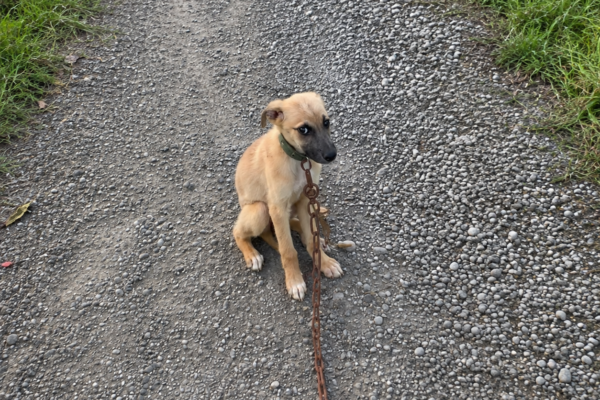
“Why do you waste time on me?” seemed to be written in PotPot’s frightened eyes, because almost everyone had already learned to look away from the little three-legged puppy.h
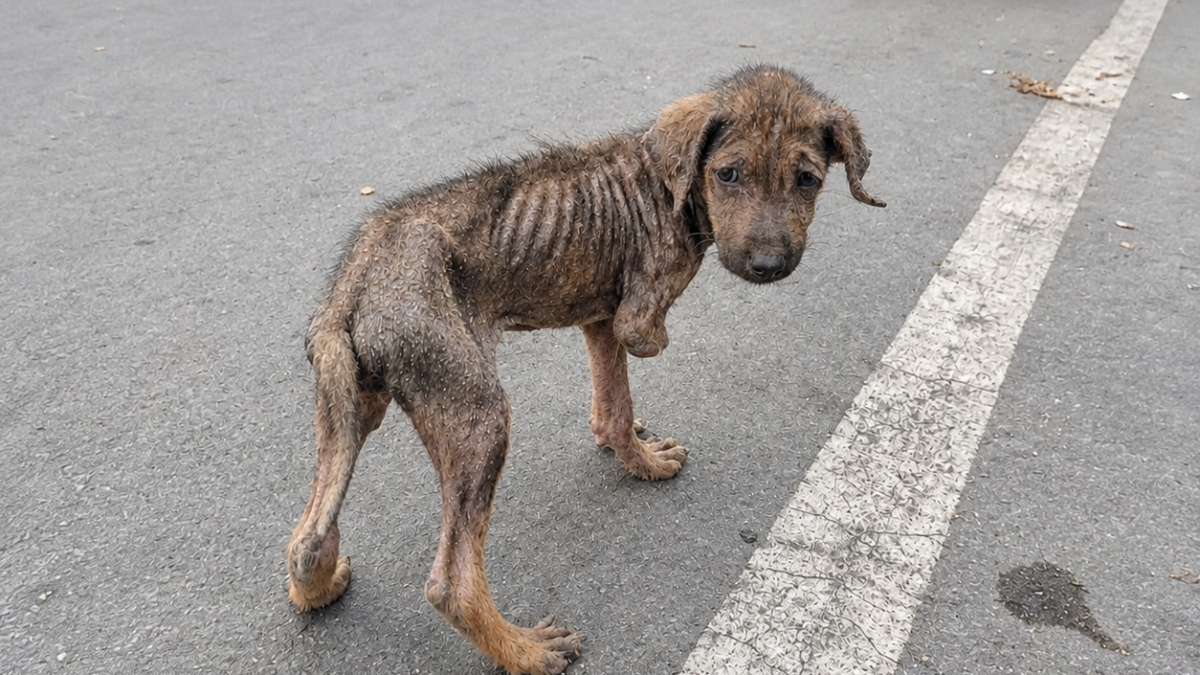
Before millions of people knew his face, before television channels wanted to show his story, before adoption requests began arriving one after another, PotPot was simply a tiny puppy trying to make it through another day on the street.
There was nothing glamorous about him then.
No one was competing for his attention.
No one was asking whether they could take him home.
Most people saw what was easiest to see.
A small dog with only three legs.
Skin damaged by mange.
Fur disappearing from his body.
A thin frame weakened by hunger.
A puppy who looked different.
For PotPot, however, being different was not an idea.
It was simply the body he had been given and the life he was trying to survive inside it.
Three legs had to do the work that four usually did.
An unhealthy body still had to search for food.
Sore skin still had to endure the outside world.
Hunger did not become gentler because he was small.
And the street did not make special allowances for a puppy who was already struggling.
So PotPot learned the only thing he could learn.
Keep moving.
Search.
Wait.
Approach when food might appear.
Pull back when people seemed unsafe.
Try again when hunger became stronger than fear.
His life depended on strangers he could not understand.
A person walking past might have food.
Another might ignore him.
Someone might glance at him and turn away.
Someone else might decide that a three-legged puppy with damaged skin was not something they wanted to touch.
PotPot could not know what any face meant until that person made a choice.
So he watched.
He waited.
He begged.
There is something especially painful about a puppy having to ask the world for enough food to remain alive.
Adult stray dogs often develop routines and instincts shaped by long experience.
PotPot was still young.
He should have been growing inside a life where meals came regularly and safety did not have to be negotiated.
Instead, he had to stand near the road and depend on the possibility that someone might notice.
Each day, hunger followed him.
His skin condition followed him.
Exhaustion followed him.
And because he looked unlike the healthy puppies people usually found easy to love, human attention did not always bring hope.
Sometimes being noticed only meant being examined for a moment before someone moved on.
Perhaps that was why, when one man finally stopped, PotPot did not immediately understand that his life had begun to change.
The man was accustomed to stray dogs.
Helping them was not new to him.
His home had gradually become something more than an ordinary house.
It had become a small shelter.
A place for animals who had nowhere else to go.
A place where a dog could arrive frightened, hungry, injured, neglected, or unwanted and at least be given a chance.
That did not mean every rescue was easy.
It did not mean every frightened dog immediately understood kindness.
It simply meant the man had made room in his life for animals other people had passed by.
When he saw PotPot, he saw what others had seen too.
The missing leg.
The mange.
The thinning fur.
The exhaustion.
The hunger.
But those details led him toward PotPot rather than away from him.
That difference changed everything.
The puppy did not need someone to decide he was beautiful.
He needed someone to stop.
He needed hands willing to lift him.
He needed food.
Water.
Treatment.
A safe place.
Someone who would look at his condition and think, “This can be helped,” instead of, “This is too much.”
The man picked him up.
For PotPot, that moment must have been confusing.
A puppy accustomed to the uncertainty of strangers could not know what was coming next.
Being lifted did not automatically mean safety simply because the person doing it intended kindness.
Fear does not disappear when circumstances change.
A frightened animal often learns about safety only through repetition.
The first gentle hand may still feel dangerous.
The first closed door may still feel like a trap.
The first bath may still feel strange.
The first bowl of food may be approached with uncertainty.
Trust usually comes later.
For now, all PotPot knew was that his feet were no longer carrying him down the same street.
Someone else was carrying him.
The man brought him home.
To a human being, the meaning of that action was obvious.
Rescue.
To PotPot, it was only another unfamiliar place.
Different smells.
Different sounds.
Different walls.
Other evidence of animals who had passed through or lived there.
A person moving around him with intentions he could not read.
His body had spent so much time responding to discomfort that comfort itself could feel strange.
The man did not expect PotPot to understand immediately.
He simply began with what the puppy needed.
A veterinary appointment was arranged.
That would happen soon.
Before then, PotPot needed basic care.
The man prepared a warm bath.
For a puppy with damaged skin and missing fur, warmth mattered.
The water could not erase the mange or instantly repair his body, but it could remove some of what street life had left on him.
It could make him cleaner.
It could become the first experience in a sequence of small experiences that said something PotPot had not yet learned to believe:
You are being cared for now.
The man washed him gently.
PotPot still did not understand.
His small body had no reason yet to trust the hands touching him.
Kindness has a history when you are human.
You can hear reassurance and understand language.
You can be told, “You are safe here.”
A dog does not receive safety that way.
A dog learns it from what happens next.
Does the hand hurt?
Does the food disappear?
Does the person shout?
Does the door open again?
Does the person come back?
Does pain increase or decrease?
Does fear lead to punishment or patience?
PotPot had to discover the answers one event at a time.
After the bath came water.
Then food.
Simple things.
Ordinary things.
But for a puppy who had been begging in the street, ordinary could feel enormous.
Food no longer depended on a stranger passing at exactly the right moment.
Water did not have to be searched for.
Someone had placed both within reach.
His body needed them even if his mind remained uncertain.
Hunger has a way of making decisions quickly.
A frightened animal may hesitate, but the body knows what it lacks.
PotPot ate.
He drank.
And still he looked confused by the world around him.
Nothing about the new environment made sense yet.
He did not know the man’s history of helping dogs.
He did not know that this house had become a small shelter.
He did not know that a veterinary appointment had already been made for him.
He did not know that the man had looked at his mange and missing fur and thought about treatment rather than rejection.
He only knew that the rules of his life had suddenly changed.
That can be frightening even when the new rules are better.
On the street, at least PotPot understood some things.
Hunger meant search.
People meant uncertainty.
Movement meant survival.
Rest could not always be trusted.
Now he was inside a home where hunger was answered before he begged.
A person came closer without demanding anything.
Water appeared.
Warmth appeared.
There was no immediate reason to run.
For a puppy used to instability, stability can feel suspicious.
So PotPot remained cautious.
The next day, the man took him to the veterinarian.
That trip marked the beginning of another part of his recovery.
The street could keep a dog alive for a while if the dog was lucky.
But luck could not treat mange.
Luck could not heal neglected wounds.
Luck could not explain whether a weakened puppy had a real chance of surviving.
PotPot needed medical care.
At the clinic, the veterinarian examined him.
His skin needed treatment.
His wounds needed attention.
His overall health reflected what his appearance had already suggested.
He was not in good condition.
The puppy who had spent his days asking strangers for food had been worn down by the life he had been forced to live.
The veterinarian treated his skin and wounds.
Then came the sentence the man most needed to hear.
Despite PotPot’s poor health, he could survive.
It was not a promise that everything would suddenly become easy.
It was not a declaration that PotPot was already well.
It was simply a possibility.
And sometimes possibility is the most important thing a rescuer can be given.
He can survive.
That meant medicine mattered.
Food mattered.
Rest mattered.
Patience mattered.
The work ahead had meaning because there was a future to work toward.
The man bought the medication PotPot needed.
Then he brought him back home.
There was no dramatic transformation on the way back.
PotPot was still PotPot.
Still three-legged.
Still recovering from mange.
Still thin.
Still uncertain.
Still carrying whatever fear street life had taught him.
The difference was that now he had someone carrying responsibility with him.
The man did not rescue PotPot only from one afternoon on the road.
He committed himself to what came after.
That is where many rescues truly begin.
Finding an animal is one act.
Helping the animal trust again can be hundreds of acts.
Giving medicine.
Providing food.
Cleaning.
Walking.
Waiting.
Trying to play.
Backing away when fear becomes too much.
Returning the next day.
Doing the same thing again.
The man began taking PotPot on walks.
For a three-legged puppy, walking already looked different from the movement of other dogs.
Balance had its own rhythm.
Running required adaptation.
Turning required confidence.
But the man did not treat PotPot as if his missing leg meant he should stop experiencing the world.
He took him outside.
He allowed him to move.
He gave him the opportunity to discover what his body could still do.
At first, those walks were not necessarily joyful.
PotPot was frightened.
His body could move, but his mind remained guarded.
The world had not given him enough reasons to believe that good things lasted.
The man also tried to play with him.
Play is one of the clearest expressions of safety in a young dog.
A puppy who plays is spending energy on something unnecessary for immediate survival.
He is not searching for food.
He is not escaping danger.
He is not calculating distance from a stranger.
He is simply engaging with the moment.
PotPot was not ready for that.
The man offered.
PotPot hesitated.
The man tried to earn his trust.
PotPot remained afraid.
The man returned.
PotPot remained uncertain.
Again and again, kindness seemed to reach a wall inside the puppy.
Nothing was wrong with the man’s effort.
Nothing was wrong with PotPot for not responding immediately.
Trust is not a switch.
A frightened dog does not owe instant affection to the person who rescues him.
Rescue changes the environment.
Healing changes the animal.
Those things happen at different speeds.
PotPot had already learned that people could pass him without helping.
He had already lived through hunger.
He had already lost enough physical security that his body showed the consequences.
Now a human being wanted closeness from him.
Wanted to play.
Wanted to walk beside him.
Wanted PotPot to believe that hands could mean comfort.
The puppy had no reason to accept that quickly.
So for a while, the man’s efforts appeared to accomplish very little.
He walked PotPot.
He played when PotPot allowed it.
He kept trying.
And PotPot remained hesitant, frightened, emotionally closed.
It was almost as though happiness itself looked suspicious to him.
That may sound strange to people who have always known safety.
Why would a dog resist affection?
Why would a puppy fail to become joyful as soon as hunger ended?
But survival creates habits.
A dog that expects disappointment protects himself by expecting less.
A dog that has not been able to rely on people may not know how to rest emotionally simply because one kind person appears.
PotPot did not know whether the man would still be kind tomorrow.
He did not know whether food would continue.
He did not know whether walks would end in abandonment.
He did not know whether play could become pain.
He had no language for those fears.
He only had behavior.
Distance.
Hesitation.
Watchfulness.
A reluctance to surrender control.
The man saw all of that and kept trying.
This was perhaps the first great test of their relationship.
It is easy to love an animal when the animal immediately loves you back.
A rescued puppy wagging his tail, climbing into your arms, and following you everywhere makes gratitude visible.
PotPot did not give the man that easy reward.
At first, he gave him fear.
The man had to offer care without knowing when affection would return.
That kind of patience is different from excitement.
It has less drama and more endurance.
Give the medicine.
Prepare the food.
Take the walk.
Offer play.
Speak gently.
Wait.
Repeat.
PotPot was not ready to receive happiness, but the man kept making happiness available.
That distinction mattered.
The puppy did not have to understand it yet.
He only had to live long enough inside it for his expectations to begin changing.
Time did what one perfect rescue moment could not.
It accumulated evidence.
Today, food came.
Tomorrow, food came again.
Today, the man touched him without harm.
Tomorrow, the same.
Today, the walk ended at home.
Tomorrow, he was taken out and brought back again.
Today, someone invited him to play.
Nothing terrible happened.
Tomorrow, the invitation came again.
Trust begins in repetitions like that.
One safe event can be luck.
Two can still feel uncertain.
But eventually a frightened animal begins to notice patterns.
The man was becoming a pattern.
He stayed.
That simple fact may have mattered more than anything else.
People on the street had passed by.
Some may have dropped food and disappeared.
Others may have avoided PotPot entirely.
The man was different because he returned.
Morning after morning.
Walk after walk.
Meal after meal.
Dose of medicine after dose of medicine.
He became predictable.
And predictability is one of the foundations of trust.
At first, the changes in PotPot were small.
So small they could easily have been missed by someone impatient.
A little more curiosity.
A little less tension.
A willingness to remain closer.
A moment of engagement that lasted longer than before.
The first signs did not announce themselves as transformation.
They simply appeared.
Then one day the puppy who seemed unable to accept happiness began to play.
That was the first clear ray of hope.
Play meant something had shifted.
Maybe only a little.
But enough.
PotPot was beginning to discover that life contained more than survival.
His body responded first.
He moved.
He engaged.
He tested the limits of his three-legged frame.
And then another part of him seemed to wake up.
He liked running.
That discovery changed the way people saw him and perhaps the way he experienced himself.
The missing leg was obvious to anyone looking at him.
But PotPot did not spend his days comparing himself with four-legged dogs.
He simply learned what his own body could do.
Three legs could move.
Three legs could chase.
Three legs could jump.
Three legs could carry him toward someone he trusted.
Three legs could carry him through a shelter that had become home.
Once confidence entered his movement, his difference stopped looking like the most important thing about him.
It was still there.
It would always be there.
But it no longer defined every moment.
PotPot began running freely.
He began jumping.
He began playing with people.
The joyful spirit that had seemed buried under hunger, fear, and illness began returning.
The man had not placed joy inside him.
He had simply created enough safety for joy to come back out.
That distinction made PotPot’s transformation more powerful.
The playful puppy had probably been there all along.
Street life had forced him into hiding.
Hunger had covered him.
Pain had covered him.
Fear had covered him.
Distrust had covered him.
Care began removing those layers.
Not all at once.
Slowly.
As his emotions changed, his body changed too.
The treatment began helping his skin.
His fur started growing back.
Where mange had left his body exposed, a coat gradually returned.
His small frame began filling out.
Regular food did what irregular scraps never could.
The puppy who had once looked exhausted grew quickly.
Day by day, he looked less like an animal standing at the edge of survival.
His physical recovery made the emotional transformation easier to see.
When he first arrived, anyone could have looked at him and noticed what was wrong.
Later, people began noticing what was alive.
His energy.
His curiosity.
His playfulness.
His courage.
The way he moved despite having only three legs.
The way he interacted with people once trust had finally begun to grow.
The man had been waiting for those signs.
Not because he needed PotPot to become a different dog.
Because he wanted the puppy to have the chance to become himself.
That chance had nearly been lost on the street.
Now it was unfolding in front of him.
PotPot began liking the man.
At first, the relationship had been almost entirely one-sided.
The man offered care.
PotPot accepted only what he could tolerate.
The man invited connection.
PotPot hesitated.
Now the puppy began moving toward him emotionally.
The person who had once been another uncertain human presence became familiar.
Then comforting.
Then important.
PotPot began to understand in the only way a dog can understand such things that this man was different.
He was the one who fed him.
The one who walked him.
The one who played with him.
The one who took him to the veterinarian and brought him back.
The one who gave medicine.
The one who remained nearby.
The one who did not disappear when PotPot stayed frightened.
The one who kept trying even when affection was not immediately returned.
Trust had grown from those ordinary acts.
And once it had grown enough, PotPot’s personality began expanding around it.
The puppy who once seemed afraid of happiness started behaving like happiness belonged to him.
He played more.
He ran more.
He jumped.
He interacted with people.
He became mischievous.
His body carried energy instead of exhaustion.
His eyes no longer had to watch every movement as though danger might arrive.
The transformation was visible not because someone trained him to perform joy but because safety changed what he had room to feel.
There is something deeply moving about watching a fearful animal become playful.
The movements may look simple.
A run across the floor.
A jump.
A quick turn.
A playful approach.
But behind each movement is a question that has been answered.
Is it safe enough to spend energy?
Yes.
Is it safe enough to get close?
Yes.
Is it safe enough to enjoy this moment instead of preparing for the next threat?
Yes.
PotPot’s body began saying yes before he could ever have said it in words.
The man watched him grow.
The tiny puppy became stronger.
His coat returned.
His movements became more confident.
His three-legged gait was simply part of who he was.
Anyone who had first seen only a damaged stray now had the chance to see a dog full of personality.
Yet even with all that progress, one problem remained.
Adoption.
The man’s home was a small shelter, not originally a promise that every rescued dog would stay with him forever.
The purpose of rescue often includes finding a permanent family.
A safe home.
Someone willing to continue the care that began at the shelter.
PotPot was improving enough that a future outside the shelter could be imagined.
But families did not respond to him the way they responded to other dogs.
At first, no one wanted him.
People avoided adopting him because he did not look like other dogs.
The reason was painfully simple.
He was different.
Three legs.
A history of mange.
A body still carrying visible evidence of where he had come from.
Even as his fur grew back and his health improved, the first impression remained difficult for some people to get past.
Potential families could look at PotPot and notice the missing leg before they noticed his courage.
They could see his unusual body before they saw his playfulness.
They could see complications before companionship.
Perhaps they imagined problems.
Perhaps they wanted a dog who looked more conventional.
Perhaps they simply did what people had done on the street.
They looked.
Then chose someone else.
PotPot remained.
Week after week.
The shelter continued to be his home.
The man continued to care for him.
And the strange thing was that rejection no longer destroyed him the way it might have earlier.
By then, PotPot had something he had never had on the street.
A safe place to remain while the world decided what it thought of him.
He did not have to beg for food because a family had not chosen him.
He did not have to return to wandering because another person preferred a four-legged dog.
He had the man.
He had the small shelter.
He had the routines that had taught him trust.
So the weeks passed.
No family stepped forward in a way that changed his life.
PotPot continued playing.
Continued healing.
Continued growing.
And without anyone realizing it at first, something else was happening.
The longer he stayed, the deeper his bond with the man became.
This was no longer simply a rescuer caring for a temporary animal.
They had history now.
The man had seen PotPot at his weakest.
He had carried him home.
He had washed the sick skin.
He had offered those first bowls of water and food.
He had taken him to the veterinarian.
He had listened when the veterinarian said PotPot could survive.
He had purchased the medicine.
He had walked beside the frightened puppy.
He had tried to play when PotPot wanted nothing to do with happiness.
He had accepted hesitation.
He had waited for trust.
Then he had witnessed the first signs of joy.
The first playful moments.
The return of energy.
The fur growing back.
The small body becoming strong.
The three-legged puppy running as if no one had ever told him he was supposed to be limited.
Those memories accumulated.
They created attachment.
A bond is often built through ordinary repetition long before anyone notices it has become permanent.
Perhaps the man still thought of PotPot as a dog who might eventually be adopted.
Perhaps part of him understood earlier than he admitted that saying goodbye would be difficult.
The source only tells us that he became deeply attached and could not bear to part with PotPot.
That feeling did not appear from nowhere.
It had been growing through every walk.
Every meal.
Every moment of patience.
PotPot had not only learned to trust the man.
The man had learned to love PotPot.
And that relationship existed before the world began paying attention.
For weeks, families had passed him over.
Then something happened almost by accident.
A photograph of PotPot began circulating.
There was no carefully planned campaign described in the story.
No strategy.
No expectation that millions of people would notice.
It simply happened.
The puppy who had struggled for attention in the street suddenly received more attention than anyone expected.
His photo gathered millions of likes.
The numbers were almost absurd compared with his earlier life.
A dog who once had to beg individual strangers for enough food to continue was now being seen by millions of people at once.
A puppy families had avoided because he looked different had become difficult to ignore precisely because his difference, survival, and transformation moved people.
The contrast was extraordinary.
Before, a passerby might have looked away.
Now people stopped scrolling.
Before, PotPot could stand in front of someone and still be overlooked.
Now one image of him could reach people he would never meet.
Before, his three legs made some families hesitate.
Now those same three legs became part of a story people found unforgettable.
The attention did not stop with social media.
Television channels began competing to invite PotPot onto their programs.
The little dog who had once been unwanted was suddenly wanted everywhere.
People who did not know him wanted to hear his story.
They wanted to see the puppy who had survived the street.
They wanted the transformation.
They wanted the unusual face behind the viral image.
Fame arrived without warning.
PotPot, of course, could not understand millions of likes.
A number on a screen meant nothing to him.
He did not know what television channels were.
He did not understand that people who had never touched him were discussing him.
He did not know that his photograph had turned into something enormous.
His world was still built from things a dog could understand.
The man.
Food.
Walks.
Play.
Safety.
Familiar smells.
The small shelter.
The other animals who needed help.
That made the sudden public attention almost ironic.
Humans had changed their opinion dramatically.
PotPot had not.
He was simply living the life he had finally learned to enjoy.
When people began wanting him, they were responding to the dog he had already become in the shelter.
The man had loved and cared for PotPot before that attention existed.
That distinction became important very quickly.
Adoption requests started arriving.
Not one.
Not two.
Dozens.
Families who might never have noticed PotPot before now wanted him.
Perhaps they had seen the viral photograph.
Perhaps they had heard the story of the three-legged puppy.
Perhaps they had watched his recovery and found themselves moved by what he represented.
Whatever the reason, the situation had completely reversed.
At first, no one wanted to adopt him.
Now many people did.
There is a powerful lesson in that reversal, but the man faced something more immediate than symbolism.
He had to decide whether PotPot would leave.
Technically, attention had solved the adoption problem.
There were people willing to take him.
The dog once rejected as different now had choices.
But the man discovered that he no longer wanted to let PotPot go.
The attachment between them had become too deep.
This was not the moment when he suddenly began caring.
He had cared long before millions of people did.
That was precisely why the decision mattered.
PotPot’s value had not increased because strangers clicked a button.
The man had already seen his value when PotPot was sick, frightened, hungry, and almost entirely unwanted.
He had already carried him.
Already cleaned him.
Already paid attention to his treatment.
Already taken him on walks.
Already played with him.
Already endured the long period when PotPot could not return his affection easily.
The viral moment changed public opinion.
It did not change the history between the man and the dog.
So when adoption requests came, the man refused them.
Again.
And again.
PotPot was staying.
The temporary rescue had become permanent family.
The man decided to adopt him himself.
In one sense, the decision changed PotPot’s status.
In another, it simply acknowledged what had already become true.
This was home.
The man was his person.
The small shelter was not a waiting room anymore.
It was where PotPot belonged.
There is something fitting about that outcome.
People first avoided PotPot because he was different.
Later, millions noticed him.
Then families wanted him.
But the person who ultimately kept him was the person who had wanted nothing from him when he had the least to offer.
The man did not choose PotPot after the puppy became famous.
He chose him when his fur was falling out.
When his body was weak.
When his skin needed treatment.
When trust seemed impossible.
When PotPot did not know how to play.
When no one could guarantee an easy future.
Public attention arrived later.
Love had already arrived.
That distinction transformed PotPot’s role in the shelter.
He was no longer simply one of the dogs who had been rescued.
He became a symbol of hope and love inside that small refuge.
The phrase could sound sentimental if separated from what happened.
But in PotPot’s case, the meaning was concrete.
Anyone looking at him could see a before and after.
Before, hunger.
Now, regular meals.
Before, mange.
Now, fur growing back.
Before, fear.
Now, play.
Before, wandering.
Now, home.
Before, rejection.
Now, belonging.
Before, people avoided him because of his missing leg.
Now, that same dog ran and jumped freely.
Hope did not have to be explained with abstract words.
PotPot’s body demonstrated it.
He had survived the life that once seemed to be consuming him.
Love did not have to be explained either.
The man’s actions demonstrated that.
He had stayed when PotPot did not trust.
He had refused to measure the puppy’s worth by his appearance.
He had turned down adoption requests because the bond between them had become permanent.
Together, they became something larger inside the shelter.
Not celebrities in the way humans think of celebrity.
Partners.
The man continued helping animals.
PotPot remained beside him.
The dog who had once needed rescue became part of the environment where other animals were rescued.
That change is perhaps the most beautiful part of his story.
He did not literally become a veterinarian.
He did not suddenly gain human understanding of rescue work.
The source simply says he became the man’s loyal friend and strong supporter in helping animals.
That support could exist through presence.
Through companionship.
Through the energy PotPot brought into the shelter.
Through the example of what recovery could look like.
A frightened dog arriving for the first time could not understand PotPot’s biography.
But humans could.
They could look at the healthy, playful three-legged dog moving through the shelter and remember that he too had once arrived afraid.
They could remember that his skin had once been damaged.
That he had once refused happiness.
That trust had once seemed far away.
PotPot became evidence.
Evidence that healing could happen slowly.
Evidence that a dog did not need four legs to live with joy.
Evidence that an animal rejected by many people could become irreplaceable to one.
Evidence that the appearance of a dog at the worst moment of his life tells you almost nothing about who he can become with care.
As PotPot grew older and stronger, his personality became even more obvious.
He was brave.
Mischievous.
Energetic.
The timid puppy who once mistrusted everyone became a dog who enjoyed people.
The body that had struggled through hunger became strong.
The fur that had fallen away returned.
The small puppy grew.
Yet some things never changed.
He still had three legs.
The condition that once caused people to avoid him remained part of his body.
What changed was the meaning people attached to it.
At first, three legs represented difference.
A reason to hesitate.
A reason some families chose another dog.
Later, three legs became part of PotPot’s identity without diminishing anything else about him.
He could run.
He could jump.
He could play.
He could love.
He could bond.
He could bring energy into the shelter.
He could remain close to the man who had saved him.
His missing leg did not need to be turned into something tragic or heroic every day.
It was simply part of PotPot.
That may be one of the deepest changes care brought him.
He no longer had to be understood primarily through what was missing.
People could see what was present.
Strength.
Courage.
Affection.
Playfulness.
Loyalty.
Life.
The same dog existed the entire time.
The world simply learned to look differently.
For the man, PotPot became more than a success story.
He became family.
The source refers to PotPot living happily in the arms of his father.
That word, father, captures the relationship better than rescuer eventually could.
A rescuer is someone who intervenes in danger.
A father stays after the danger has passed.
A rescuer carries you away from the street.
A father builds a life with you.
A rescuer buys the first medication.
A father watches you grow.
A rescuer hopes someone will eventually give you a home.
A father realizes the home is already here.
That progression happened between them.
The man had first stopped because PotPot needed help.
He stayed in PotPot’s life because love had grown out of that help.
And PotPot, who once seemed unable to trust anyone, returned that attachment completely.
Perhaps that is the real answer to the imagined question in his eyes.
Why do you waste time on me?
Because it was never wasted.
The walks that seemed useless when PotPot remained afraid were not wasted.
The attempts to play when he refused were not wasted.
The medicine was not wasted.
The warm bath was not wasted.
The patience was not wasted.
The weeks when families did not want him were not wasted.
The man was not investing in a perfect dog he expected to emerge later.
He was caring for the dog in front of him.
Even if PotPot had remained cautious longer.
Even if his photograph had never gone viral.
Even if television channels had never called.
Even if millions of people had never clicked “like.”
The care had already mattered because PotPot mattered.
Fame merely made other people notice what the man had understood at the beginning.
A damaged appearance was not a verdict.
A missing leg was not a measure of worth.
Fear was not a permanent personality.
Distrust was not ingratitude.
Healing required time.
And a puppy who looked hopeless to some people could still contain an entire joyful life waiting for enough safety to emerge.
There is an important difference between saving a life and giving that life room to become something.
The veterinarian helped confirm that PotPot could survive.
Medicine helped his body.
Food helped him grow.
But survival alone would not have created the dog people eventually loved.
Trust did that.
Routine did that.
Play did that.
Walks did that.
Patience did that.
The man’s refusal to give up did that.
PotPot needed physical healing and emotional permission.
Permission to stop watching every human being with suspicion.
Permission to enjoy movement.
Permission to be silly.
Permission to run even though his run looked different.
Permission to grow without having to prove anything.
Permission to belong before he became popular.
The shelter gave him those things one day at a time.
Nothing about that process required PotPot to become extraordinary.
He did not need to perform gratitude.
He did not need to understand what had been done for him.
He only needed to experience enough consistent care for his nervous little body to begin relaxing.
Eventually, joy did the rest.
Once PotPot discovered play, he seemed to want more of life.
The boyish, puppy-like energy returned.
He moved freely.
He engaged with people.
The man who had once struggled to earn a small amount of trust now had a dog who wanted to participate.
That change must have made every difficult early day feel worthwhile.
Not because PotPot now behaved in a way that pleased humans.
Because he finally seemed to feel safe enough to live.
Safety can look surprisingly energetic in a puppy.
It can look like running too fast.
Jumping awkwardly.
Getting playful when someone is trying to stay serious.
Turning ordinary shelter moments into games.
Becoming mischievous.
Taking up space in the world.
A fearful animal tries to become smaller.
A secure animal often becomes gloriously inconvenient.
PotPot began taking up space.
His personality filled the place once his fear stopped consuming so much of him.
That may be why he eventually became such a symbol within the small shelter.
He was impossible to separate from the idea of possibility.
A new rescue might arrive in terrible condition.
The man could look at PotPot and remember that first warm bath.
A frightened dog might refuse contact.
The man could remember how long PotPot had hesitated.
A dog might look different enough that people immediately assumed no family would want it.
PotPot stood nearby as proof that worth had nothing to do with conventional appearance.
He had become a living reminder of the philosophy behind the shelter.
Help first.
Judge later, if ever.
Give the animal a chance before deciding what kind of life is possible.
The man had done that for PotPot.
Now PotPot’s presence strengthened the meaning of every rescue that came after.
Again, this did not require PotPot to consciously understand himself as an ambassador.
Dogs do not wake up and decide to represent hope.
Humans give meaning to what they witness.
PotPot simply lived.
That was enough.
His life said what words struggled to say.
He survived.
He trusted.
He loved.
He stayed.
Sometimes a symbol is most powerful when it has no idea it is one.
PotPot did not care about the millions of likes.
He cared about the person who fed him.
He did not care that television channels wanted him.
He cared about the familiar home where he could run.
He did not care how many adoption requests came.
He cared that the man he trusted did not disappear.
The public saw a story.
PotPot experienced a relationship.
That relationship remained the center of everything.
The outside attention could rise and fall.
The man was still there.
That consistency protected PotPot from becoming only a viral moment.
Many stories receive attention briefly.
People click.
React.
Share.
Then move on.
PotPot’s life continued after the attention.
He still needed meals.
Still needed affection.
Still needed exercise.
Still needed the security of home.
The man’s decision to adopt him ensured that the ending of PotPot’s story would not depend on public interest lasting forever.
It depended on one person keeping a promise through action.
Stay.
That is perhaps the most meaningful word in the entire story.
PotPot had spent his early life without enough stability.
The man stayed.
PotPot spent the beginning of rescue distrusting him.
The man stayed.
Families avoided adoption.
The man stayed.
Then families suddenly wanted PotPot.
The man still stayed.
The world’s opinion changed completely.
The man’s commitment did not.
There is love in that consistency.
Not dramatic love.
Reliable love.
The kind that a frightened animal can actually build a life around.
By the time PotPot became known widely, the transformation was almost difficult to compare with his beginning.
The same small dog who once wandered hungry was now strong.
The puppy whose coat had been disappearing had fur again.
The animal who had hesitated around people enjoyed interacting with them.
The frightened three-legged stray had become playful and brave.
What had looked like a tragic beginning had not predicted the rest of his life.
That is why rescue stories like PotPot’s matter beyond the individual dog.
They expose how unreliable first impressions can be.
Someone seeing PotPot on the street might have thought only about difficulty.
Medical costs.
A missing leg.
Mange.
Fear.
Potential complications.
The man saw the same facts but interpreted them differently.
Need.
Treatment.
Time.
Possibility.
Neither view denied reality.
PotPot did need medical care.
He was frightened.
His skin was damaged.
He did have only three legs.
The difference was what conclusion followed.
For some people, those facts meant, “Not this dog.”
For the man, they meant, “This dog needs help.”
One interpretation left PotPot on the street.
The other carried him home.
That is the entire distance between neglect and rescue.
Not ignorance of problems.
A decision about what problems mean.
The man did not pretend PotPot was healthy.
He made a veterinary appointment.
He did not pretend the skin condition would disappear by itself.
He bought medication.
He did not pretend PotPot trusted him.
He worked for that trust.
He did not pretend adoption would be easy.
He continued sheltering PotPot while families passed him over.
Care was realistic.
That made it strong.
Hope did not mean believing nothing was wrong.
Hope meant believing what was wrong did not have to be permanent.
The veterinarian’s statement that PotPot could survive became the first medical expression of that hope.
The rest had to be built.
PotPot’s body answered the treatment.
His skin improved.
His coat returned.
His weight and size increased.
His energy came back.
Then his emotions followed their own slower path.
He began playing.
Began enjoying people.
Began attaching himself to the man.
Eventually, the life that had once narrowed to hunger expanded into relationships.
That expansion is one of the clearest signs of recovery.
When survival takes everything, there is little room for curiosity.
Once survival is secure, the world becomes interesting again.
PotPot could notice more than the next meal.
He could notice games.
Movement.
People.
The man.
Other animals.
The routines of the shelter.
His life developed layers.
Those layers are what make a home different from a place where food happens to exist.
Home is where the future becomes predictable enough to imagine another day without fear.
PotPot found that.
And when adoption requests later arrived, the man understood that PotPot had already formed his answer.
Home was here.
There is something almost poetic about the timing.
The world wanted PotPot most after PotPot no longer needed the world to choose him.
He had already been chosen.
When he was begging on the street, he needed strangers to stop.
Most did not.
When he was recovering, he needed a permanent place.
Families hesitated.
By the time everyone wanted him, the most important relationship had already become permanent.
The late attention was welcome in one sense.
It meant people were seeing value where they had once seen difference.
It brought awareness.
It turned PotPot into a hopeful image for the shelter.
But it could not replace the bond formed before attention arrived.
The man did not hand PotPot away simply because more impressive options appeared.
Dozens of requests could not outweigh history.
He declined them.
PotPot stayed.
That decision allowed his role in the shelter to deepen.
He was not merely a former rescue.
He became the man’s loyal companion in ongoing rescue work.
When the man helped another animal, PotPot was part of his life.
When another dog entered the little shelter, PotPot was already there.
His presence connected the past and present of the place.
He represented what might happen when someone gave an animal enough time.
He also gave the man companionship in work that could be emotionally demanding.
Helping stray animals means seeing neglect repeatedly.
Seeing hunger.
Fear.
Injury.
Rejection.
A rescuer can become exhausted by the number of lives that need help.
PotPot’s existence offered a counterweight.
There, in the same space, was one life that had changed.
One dog who had once looked hopeless and now behaved mischievously.
One reminder that effort could matter.
One reason to continue.
That may be part of what the source means when it says PotPot became a strong supporter in helping other animals.
His support did not require human tasks.
His life itself supported the work.
He was the result standing beside the process.
A success that breathed, ran, jumped, played, and loved.
For an animal rescuer, perhaps there is no stronger encouragement than that.
Today, PotPot is no longer the exhausted puppy from the street.
He has grown.
The word carries more meaning than physical size.
Yes, his body grew.
But so did everything around his life.
His trust grew.
His confidence grew.
His relationship with the man grew.
His place in the shelter grew.
The number of people who knew his story grew.
What began as one man stopping beside one unwanted puppy became something much larger.
Yet the heart of the story remained small.
A home.
A man.
A three-legged dog.
Other animals needing help.
That simplicity protected PotPot from becoming only a headline.
Millions of people might know the photograph.
The man knew the dog.
He knew PotPot’s fears.
He knew the early hesitation.
He knew what it looked like when the puppy finally began playing.
He knew the small physical changes.
The fur returning.
The body becoming stronger.
The increasing confidence on walks.
The mischievous personality emerging.
That knowledge was more intimate than public recognition.
It belonged only to someone who had been there.
PotPot, in return, knew the man not as “the kind rescuer” or “the owner of the shelter.”
He knew him through familiarity.
Voice.
Scent.
Movement.
Routine.
Presence.
The person associated with safety.
The person whose home became his.
The person who remained.
When the source describes PotPot living happily in his father’s arms, that image carries the entire story inside it.
The same dog once had to approach strangers in the street hoping for food.
Now he could rest against someone who had chosen him permanently.
The same dog once feared people.
Now he could seek closeness.
The same dog once seemed to ask, “Why do you waste time on me?”
Now there was no need for the question.
The answer had become his life.
Because you are mine.
Because you belong here.
Because three legs are enough.
Because damaged skin can heal.
Because fear can soften.
Because trust can return.
Because the puppy everyone overlooked can become the dog someone cannot imagine losing.
Those are human interpretations, of course.
PotPot does not need to think them in sentences.
He simply lives the result.
That is enough.
His courage appears most clearly in ordinary movement.
Running.
Jumping.
Playing.
A dog with three legs learns balance in a body built differently from most others.
What looks remarkable to a human observer may feel completely normal to the dog.
PotPot adapted.
He did not spend his time mourning a comparison he could not make.
He moved with what he had.
That became part of the inspiration people found in him.
Not because disability should be romanticized.
Not because having three legs made his life automatically meaningful.
But because people had initially treated that difference as a reason to reject him.
PotPot himself showed how incomplete that judgment was.
He could still enjoy the most important parts of being a dog.
Movement.
Connection.
Play.
Affection.
Curiosity.
Home.
His body was different.
His capacity for happiness was not.
That may be one reason his photograph resonated with so many people.
The image contained visible difference.
The story supplied context.
People saw a dog who had been through hardship but had not been reduced to hardship.
They saw survival without pretending the suffering had been necessary.
They saw transformation.
And perhaps some saw themselves in him.
Being different.
Being overlooked.
Being judged by appearance.
Needing someone to stay long enough to discover what fear had hidden.
Those meanings belong to the people reading his story.
PotPot simply continued being PotPot.
That innocence makes the public response feel almost secondary.
He did not recover for applause.
He recovered because someone treated him.
He did not learn to trust for millions of likes.
He learned because one man kept showing up.
He did not become playful because television channels wanted him.
He became playful because his home became safe.
He did not stay at the shelter because fame made him special.
He stayed because love made separation impossible.
Those differences matter.
They protect the story from becoming a lesson about popularity.
PotPot did not become worthy when people noticed him.
People finally noticed that he had always been worthy.
The man knew first.
Perhaps that is why his refusal of adoption requests feels so meaningful.
Public interest can be fickle.
A viral photograph can fade.
Television moves on.
Social media finds another story.
But a dog needs someone after attention ends.
The man had been there before it began.
He intended to be there afterward.
That is what family means in this story.
Not the most enthusiastic request.
Not the loudest audience.
The person who remains across changing circumstances.
PotPot found that person.
And the man found something too.
A loyal friend.
A companion.
A living reminder of why he kept helping stray dogs.
Their rescue worked in both directions eventually.
At first, the man gave PotPot almost everything.
Food.
Water.
Medical care.
Shelter.
Patience.
Trust.
Later, PotPot gave back what dogs often give in ways people never fully measure.
Companionship.
Loyalty.
Joy.
Presence.
Encouragement.
The energy of a mischievous animal refusing to let life stay solemn all the time.
That exchange turned rescue into relationship.
The man no longer saw only a dog he had saved.
He saw PotPot.
An individual.
A personality.
Family.
That is why he could not let him go.
The adoption requests were not rejected because the applicants were necessarily bad people.
The source gives no reason to judge them.
They may have been sincere.
They may have wanted to give PotPot wonderful homes.
But by then, the question was no longer whether PotPot could find a family.
He already had one.
Sending him away would have meant breaking something that had taken enormous patience to build.
The man chose not to do that.
PotPot stayed in the environment where his trust had grown.
That decision also meant he could continue playing his informal role in the shelter.
Every day he remained there, his presence added another layer to the place’s meaning.
A shelter can be understood as a collection of needs.
Animals needing food.
Treatment.
Temporary safety.
Adoption.
But PotPot embodied another part of rescue that is harder to quantify.
Hope.
Hope that the frightened dog will eventually approach.
Hope that the sick skin will heal.
Hope that the animal nobody chooses today may be loved deeply tomorrow.
Hope that the dog defined by one missing limb can eventually be seen as a whole personality.
Hope that patience has value even when progress cannot be forced.
That is why PotPot became a symbol of hope and love within the small shelter.
Not because someone gave him a title.
Because his story made the words visible.
A newcomer to the shelter could arrive looking terrible.
Humans might be discouraged.
Then PotPot could run past on three legs with his restored fur and playful attitude.
There was the answer.
Not every story would end exactly like his.
Not every recovery would follow the same timeline.
But improvement was possible.
That possibility could change the way someone looked at the next difficult case.
The man had known that before PotPot.
PotPot made it impossible to forget.
The small shelter therefore became more than the place where PotPot recovered.
It became the place where his recovery continued influencing other rescues.
His story stayed physically present.
He did not leave for another home and become only a photograph on a wall or memory on a phone.
He remained.
That gave his role special weight.
The man could see him every day.
People visiting or hearing about the shelter could see what care had done.
And PotPot could continue living without any burden of representing anything consciously.
He could simply be naughty.
Run.
Jump.
Play.
Rest.
Stay close to his father.
Sometimes the most powerful symbols are allowed to be ordinary after becoming meaningful.
PotPot did not need to behave heroically.
His ordinary happiness was the victory.
A full bowl.
A playful run.
A secure place to sleep.
A familiar person.
Those things would have seemed impossibly distant from the street.
Now they were routine.
Routine is underrated in rescue stories.
People remember dramatic moments.
The discovery.
The veterinary visit.
The viral photo.
The adoption decision.
But a good life is mostly built between those moments.
Breakfast.
A walk.
Medication when needed.
Play.
Rest.
Another walk.
A hand reaching down without fear.
The same home at night.
The same person in the morning.
PotPot’s healing happened inside those repetitions.
His happiness still lives there.
That makes the ending satisfying not because something spectacular happened to him every day but because nothing terrible had to.
He had finally earned the right to an ordinary life.
Not through effort.
Not through being inspirational.
Simply by being alive.
The man gave him that.
And PotPot filled that ordinary life with his own personality.
Strong.
Brave.
Mischievous.
Those are the words that describe him now.
Strength does not mean he never struggled.
It means he came through struggle into a body capable of living fully.
Bravery does not mean he never felt fear.
His early days in the shelter prove the opposite.
He was deeply afraid.
Bravery, in PotPot’s story, can be seen in what happened after fear.
He allowed himself to trust again.
And mischief may be the sweetest quality of all.
A mischievous dog has spare emotional energy.
He has enough safety to test limits.
Enough confidence to play.
Enough security to believe that a mistake will not send him back to the street.
For a puppy who once seemed unable to accept happiness, mischief is evidence of how completely his world changed.
The man did not merely keep PotPot alive.
He helped create a life in which PotPot could afford to be troublesome in harmless, joyful ways.
That is love made practical.
Perhaps somewhere in the shelter, another frightened dog watches PotPot move around.
We do not need to invent what that animal thinks.
Dogs do not need stories explained to them.
But familiarity with another calm or playful dog can shape an environment.
PotPot’s presence contributes simply because he is there.
The rescuer who once worked for PotPot’s trust now has PotPot beside him while helping others.
That creates a beautiful circle.
The saved dog becomes part of saving.
Not as a human rescuer.
Not through deliberate sacrifice.
Through companionship.
Through presence.
Through the living evidence of rehabilitation.
The man did not plan that outcome when he first stopped on the street.
He was responding to one puppy in need.
That is another reason the story feels true.
The biggest consequences often begin with a small decision.
Stop.
Look.
Pick him up.
Everything else followed.
Had the man kept walking, PotPot’s future might have been very different.
The source does not tell us what would have happened, and there is no need to invent tragedy.
The condition he was in already tells us enough.
He was exhausted.
Hungry.
Suffering from mange.
His fur was falling out.
He had only three legs.
He was begging for food.
Help was not optional if he was going to recover.
The man became that help.
One person cannot rescue every animal.
The source does not pretend otherwise.
But one person can change everything for the animal in front of him.
PotPot is the proof.
Millions of people later saw the result of one man stopping.
That public attention turned a private act of compassion into a story larger than the original moment.
But the moral center remains there on the street.
A dog needed help.
A man noticed.
Then he acted.
Compassion that does not move toward action may remain only a feeling.
The man transformed feeling into work.
He opened his home.
Scheduled the veterinarian.
Gave the bath.
Provided food and water.
Bought medicine.
Took the walks.
Attempted play.
Waited through fear.
Refused to give up.
Later, when everyone else wanted PotPot, he made another decision.
Keep him.
That consistency from beginning to end gives the story its emotional weight.
PotPot was not a charity project completed and passed along.
He became part of the man’s life.
And because the man’s life already centered partly around helping animals, PotPot became woven into that purpose.
Today, when people call PotPot a symbol of hope and love, the phrase carries history.
Hope is the veterinarian saying he can survive.
Hope is fur returning.
Hope is a frightened puppy playing for the first time.
Hope is a three-legged dog running.
Hope is weeks of rejection failing to become another abandonment.
Hope is a viral photograph changing the way strangers see him.
Hope is not the same as fame.
Fame simply made the hope visible to more people.
Love is different.
Love is the warm bath before anyone knew his name.
Love is the food when there were no cameras.
Love is medication.
Love is patience when PotPot refused connection.
Love is another walk.
Love is another attempt.
Love is allowing trust to develop at PotPot’s pace.
Love is refusing dozens of adoption requests because goodbye no longer feels possible.
Love is staying after the story has already become happy enough for everyone else.
Those are the acts that made PotPot what he is within the shelter.
A symbol, yes.
But first a dog.
A beloved dog.
A son in the language the source uses.
A loyal friend.
A companion in rescue work.
That order matters.
PotPot does not exist to inspire people.
He is simply living a life that happens to inspire them.
He is not obligated to make suffering meaningful.
The mange was not a gift.
The hunger was not necessary.
The abandonment was not something he needed in order to become special.
Those things were hardships he deserved to be spared.
What is meaningful is what happened in response.
Someone refused to let suffering remain the final fact.
That is where inspiration belongs.
Not in the pain.
In the care.
Not in the missing leg.
In the refusal to treat the missing leg as a reason for less love.
Not in rejection.
In the decision to keep choosing him anyway.
PotPot’s story might have been very different if he had immediately trusted the man.
It would have been easier.
Perhaps shorter.
But the difficult beginning revealed something important about both of them.
PotPot’s fear showed how deeply instability had affected him.
The man’s patience showed the depth of his commitment.
Love proved itself before PotPot could easily return it.
That may be why their eventual bond feels so strong.
The man did not fall in love only with the joyful dog.
He cared for the frightened one.
The sick one.
The hesitant one.
The puppy who seemed to reject every attempt at happiness.
When PotPot later became playful and affectionate, that was not a replacement dog.
It was the same dog finally feeling safe.
The man had waited long enough to meet that version of him.
And perhaps PotPot, in his own way, discovered something equally important.
A person could remain.
Not every hand disappeared.
Not every act of kindness had a hidden cost.
Not every home was temporary.
Not every relationship ended when he became inconvenient.
He did not need human words for those lessons.
His changing behavior showed that he had learned something.
He moved closer.
He played.
He trusted.
He stayed.
The puppy who once had to ask strangers for food eventually stopped asking the world whether he was allowed to exist.
He simply lived.
That is one of the most powerful transformations any rescue can produce.
From permission-seeking survival to confident presence.
PotPot took his place.
In the home.
In the shelter.
Beside his father.
In the larger story of the animals they continued helping.
And, unexpectedly, in the hearts of millions of strangers who saw his photograph.
The public response could be understood as an apology of sorts, though no single person represented the whole world that had once ignored him.
At first, difference made people withdraw.
Later, difference made people pay attention.
But PotPot himself did not become more complete between those moments.
He became healthier.
He became safer.
He became more confident.
Yet he had always been a whole living being deserving care.
That is perhaps what his story teaches most clearly.
Condition is not identity.
Circumstance is not destiny.
Fear is not personality.
Appearance is not value.
Popularity is not worth.
A dog can be unwanted by many and deeply loved by one.
And sometimes one is enough to change everything.
For PotPot, one was enough.
One man stopped.
Then a veterinarian helped.
Then many people eventually cared.
But the chain began with one person refusing to walk away.
That is why the title’s imagined question carries so much emotion.
“Why do you waste time on me?”
Because from PotPot’s perspective, time spent on him may once have seemed impossible to understand.
People had avoided him.
Families later declined him.
His own behavior did not immediately reward affection.
He was sick.
Different.
Afraid.
A practical mind could have made a list of difficulties.
The man made a different calculation.
There is a life here.
So time was not waste.
Time was treatment.
Time was trust.
Time was transformation.
Weeks that seemed uneventful from the outside were doing enormous work.
His skin healed across time.
His fur grew across time.
His body strengthened across time.
His fear softened across time.
His relationship with the man deepened across time.
Even the weeks when no family wanted him contributed something.
They gave PotPot and the man longer together.
The period that looked like failure from an adoption perspective became the period in which they became inseparable.
Sometimes a closed door redirects a story.
If PotPot had been adopted immediately, he would have had a different ending.
Not necessarily a bad one.
Simply different.
Instead, people hesitated.
PotPot stayed.
The man grew more attached.
Then fame came.
Then adoption requests came.
By then, the decision had already ripened in the heart before it became official.
PotPot belonged.
So the man adopted him.
The shelter’s symbol of hope became the shelter keeper’s own dog.
And PotPot gained something no viral statistic could give.
Permanence.
Millions of likes are temporary.
A home is lived every day.
Television attention is temporary.
A bond is lived every day.
Adoption requests are possibilities.
Commitment is a decision.
PotPot ended up with the thing that mattered most.
The decision.
You stay.
Those two words, whether spoken or simply lived, changed everything.
Today, PotPot can run through the same small shelter that once received him as a frightened stranger.
That image contains layers of memory.
The first arrival.
The bath.
The food.
The veterinary appointment.
The medicine.
The difficult walks.
The failed attempts to play.
The first signs of trust.
The return of joy.
The growing coat.
The strengthening body.
The weeks of being passed over.
The unexpected explosion of attention.
The requests.
The decision.
Every stage remains part of him, even if only humans remember.
PotPot himself gets to live in the present.
That may be the greatest mercy.
Dogs do not need to narrate their trauma forever.
They can simply enjoy the bowl in front of them.
The person beside them.
The game beginning now.
The open space to run.
The affection being offered.
PotPot’s past matters because it shows the distance he traveled.
His present matters more because it is where he finally gets to be happy.
He is strong now.
Brave.
Playful.
Mischievous.
Loved.
He has grown from the puppy who begged in the street into a dog who belongs at the center of a small world built around care.
The man still helps animals.
PotPot remains beside him.
That companionship turns every new rescue into a quiet continuation of PotPot’s own story.
The man sees another dog in trouble.
He helps.
PotPot is there.
Perhaps the cycle repeats in different forms.
Fear meets patience.
Hunger meets food.
Sickness meets treatment.
Loneliness meets presence.
Not every animal becomes famous.
Most never will.
That does not make their rescue smaller.
PotPot’s fame may have brought attention, but the values of the shelter existed before the millions of likes.
The man helped because help was needed.
That is the standard PotPot’s story now represents.
Care before recognition.
Compassion before applause.
Commitment before reward.
When people see PotPot today, they may first notice the three legs.
But the missing limb no longer tells the whole story.
Perhaps it never did.
The fuller picture requires looking longer.
A strong body adapted to movement.
A coat restored after mange.
A playful personality.
A loyal relationship.
A dog comfortable enough to be mischievous.
A permanent home.
A role in a place where other vulnerable animals are given chances.
The lesson is built into the act of looking longer.
If people had looked longer at PotPot when he was on the street, perhaps they would have seen more than sickness.
If families had looked longer during those early adoption weeks, perhaps they would have seen more than difference.
Millions eventually looked because a photograph forced them to pause.
The kind man had paused before anyone else.
That is why he remained the most important person in the story.
Not the audiences.
Not the television channels.
Not the people sending adoption requests.
The man whose name the source does not even give.
That anonymity makes his role more powerful in a way.
He did not need fame for himself.
The story remembers him simply as the kind man.
His actions are his identity.
He helps stray dogs.
He turned his home into a small shelter.
He stopped for PotPot.
He cared for him.
He stayed.
Sometimes that is enough of a name.
Kindness becomes recognizable through repetition.
PotPot recognized it eventually.
And once he did, the frightened puppy disappeared slowly beneath the confident dog he was always capable of becoming.
Not erased.
Transformed.
The fear was part of the journey.
It just no longer controlled the destination.
There is a photograph somewhere in the history of this story that changed public attention.
Millions of people reacted to it.
But perhaps the most important images were never viral at all.
A wet puppy during a warm bath.
A small body leaning toward a bowl of food.
A three-legged dog being examined by a veterinarian.
Medicine coming home in the man’s hands.
A hesitant walk.
An unsuccessful attempt at play.
Another attempt the next day.
A first playful movement.
A patch of fur returning.
A stronger body running.
A dog beginning to enjoy people.
A man realizing he could not imagine saying goodbye.
Those images may not have millions of likes.
They are still the true architecture of PotPot’s recovery.
Viral moments are visible peaks.
Love is mostly built below them.
Quietly.
Repeatedly.
Without an audience.
That is what makes the ending feel earned.
PotPot did not leap from street to celebrity.
There was a long middle.
A middle filled with fear.
Treatment.
Patience.
Rejection.
Growth.
Relationship.
The middle is where the story actually changed.
Without it, the viral photo would have meant nothing.
There would have been no transformation to admire.
Without the man’s persistence, PotPot might never have become the joyful dog millions eventually noticed.
So whenever his fame is mentioned, it should be placed in the correct order.
First came rescue.
Then recovery.
Then trust.
Then attachment.
Then public attention.
Then the adoption decision.
Love came before fame.
That is the truth that keeps PotPot’s story grounded.
And today, fame is no longer the most interesting part.
The interesting part is that he remains where he belongs.
His father did not hand him over when the world suddenly wanted him.
The world’s change of heart could not compete with a bond already built.
PotPot stays in the small shelter as family and companion.
He helps create the emotional environment in which other dogs receive chances.
He lives strongly in the body that once worried everyone.
He runs.
Jumps.
Plays.
His fur covers the skin that once suffered.
His personality covers the fear that once dominated him.
And his home covers the loneliness of the street.
Nothing can change the fact that his beginning was difficult.
There is no need to pretend the suffering vanished from history.
But suffering does not have to own the final sentence.
PotPot’s final sentence belongs to happiness.
Not perfect happiness.
Not magical happiness.
The grounded happiness of belonging.
Being wanted by the person who matters most.
Having enough food.
Having care.
Being able to move freely.
Having someone who understands the history behind every confident step.
Living among the rescue work that gave him a second chance.
That is a full life.
And perhaps that is why PotPot became such a powerful symbol in the shelter.
Hope is not pretending pain never happened.
Hope is seeing a three-legged puppy with mange and believing his current condition is not the limit of his future.
Love is not demanding immediate trust.
Love is staying long enough for trust to become possible.
The man gave PotPot both.
Hope first.
Then love every day after.
PotPot returned them in the way dogs do.
By staying close.
By becoming loyal.
By bringing life into the home.
By giving the man one more reason to continue helping.
By being himself without apology.
A dog does not need four legs to fill a house.
PotPot proved that.
Three were enough to run into his new life.
Three were enough to chase joy.
Three were enough to follow the man who had once carried him because he was too weak and sick to face the world alone.
Three were enough to stand beside other rescued animals.
Three were enough to carry a story that millions of people eventually noticed.
And even now, after all the attention, the most important part remains wonderfully small.
PotPot has his father.
His father has PotPot.
The little shelter has both of them.
Other animals still need help.
Life continues.
No dramatic final ceremony is required.
No invented future is necessary.
The ending already exists in the present.
PotPot grew up.
He became strong.
He became brave.
He became playful and mischievous.
He stayed with the man who had rescued him.
He became the loyal friend at his side and a hopeful presence in the small shelter where other animals are given a chance.
The puppy everyone once avoided is no longer waiting for strangers to decide whether he deserves attention.
He is home.
And the man who refused to waste even one day on him was right from the beginning.
None of that time was ever wasted.
Not the bath.
Not the veterinary visit.
Not the medicine.
Not the walks.
Not the games PotPot initially refused.
Not the weeks of fear.
Not the weeks of rejection.
Not the patience.
Every one of those moments carried him toward the dog he is now.
And maybe that is the simplest way to understand PotPot’s entire story.
The world first saw what he lacked.
One man saw what he needed.
Then, given enough care, PotPot showed everyone what had been there all along.
A life worth saving.
A heart capable of trust.
A loyal friend.
A joyful dog.
A small, three-legged symbol of hope living happily in the arms of the person who became his father.
God bless you, PotPot.