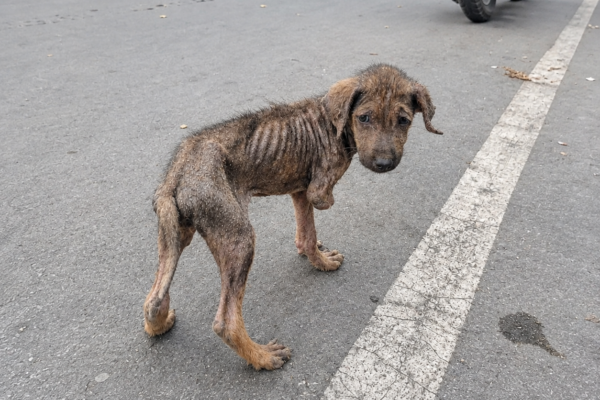
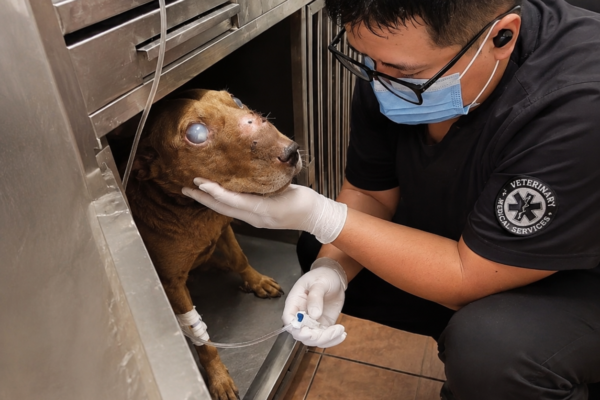
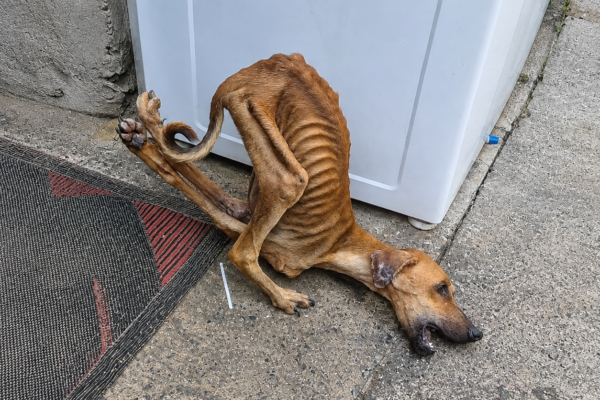
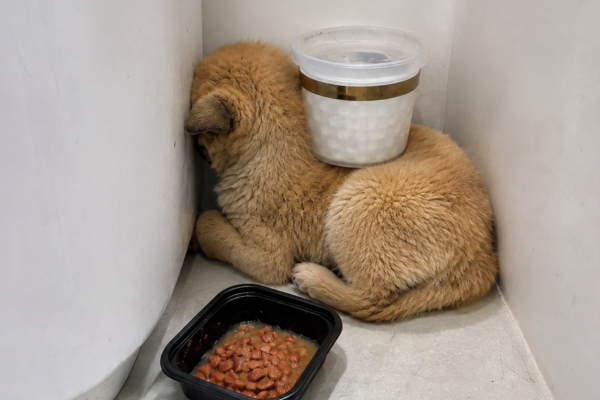
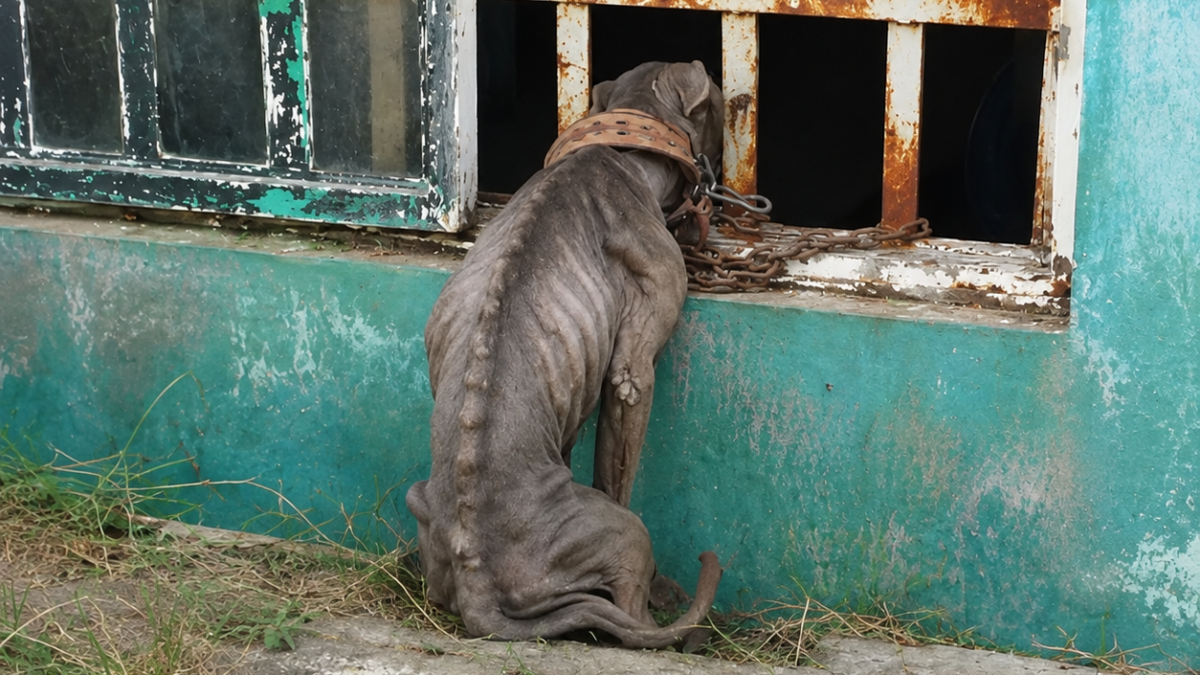
Chained outside and starving, Kiki could only rest her head against the window and watch her owner eat on the other side.h
There are photographs you look at once and understand immediately.
Then there are photographs that become more painful the longer you look.
The picture of Kiki was like that.
At first, you saw a dog outside a window.
Then you noticed the chain.
Then the thinness of her body.
Then the way her head rested against the glass.
And finally, you understood what she was looking at.
Her owner was inside.
Eating.
Kiki was outside.
Watching.
There was no dramatic movement in that moment.
No struggle.
No barking.
No desperate attempt to break free.
Just a weak dog standing where she had been tied, her face close to the window, looking through the glass at a life taking place on the other side.
That stillness was what made it so difficult to forget.
Kiki did not look angry.
She did not look demanding.
She looked tired.
Her body was frail enough that there was no hiding what prolonged neglect had done to her.
Her frame seemed to carry the evidence in every line.
She needed food.
She needed care.
She needed someone to notice that simply remaining alive was taking more from her than it should have.
But the thing that stayed with us was not only how thin she was.
It was the distance created by that single pane of glass.
The people inside could eat.
Kiki could see them.
She was close enough to watch.
Close enough to know that warmth and food existed.
But she was still outside.
Still tied.
Still waiting.
We could not know exactly what Kiki thought as she looked through that window.
We could not place human sentences into her mind and pretend they were hers.
Maybe she understood far less than we imagined.
Maybe she understood far more.
What we could see was enough.
A dog with a weak body had been left outside while the ordinary comforts of a home existed just beyond the glass.
That was the reality in front of us.
And once our rescue team arrived, there was no reason to leave her in it.
We moved quickly.
Sometimes rescue begins with careful negotiation.
Sometimes an animal is so frightened that approaching takes time.
Sometimes trust must be built before a leash can be attached or a frightened body can be lifted.
Kiki was different.
She did not resist.
That might sound like it made the rescue easier.
In one sense, it did.
But emotionally, her complete submission was difficult to witness.
A healthy, confident dog often has opinions about being handled.
She may pull back.
She may sniff.
She may hesitate.
She may turn away from unfamiliar hands before deciding whether they are safe.
Kiki seemed to have very little of that left.
When we took her, she did not fight us.
She did not make us earn the right to touch her.
She did not seem to believe she had much say in what happened next.
She simply allowed herself to be moved.
There was something heartbreaking about how easy it was.
It did not feel like trust.
Not yet.
Trust has a different quality.
Trust contains choice.
Kiki’s behavior felt closer to surrender.
As though she had become accustomed to the idea that people would decide what happened to her and her role was simply to endure it.
So we did not confuse her silence with comfort.
We did not assume that because she came with us quietly, she understood that we were helping.
All we knew was that we had her.
She was away from the chain.
Away from the window.
Away from the place where we found her.
We carried her toward the vehicle.
Her body felt as fragile as it looked.
There are times when picking up a dog reminds you immediately of how much the body should weigh and how much strength should be beneath your hands.
With Kiki, everything about her condition drew attention to what was missing.
Nutrition.
Strength.
Muscle.
The ordinary physical reserve that allows a dog to move through the world with energy.
She had been living without enough.
And now, as we moved her away from the place where she had been tied, she seemed almost absent from the rescue happening around her.
Her head stayed down.
That posture became one of the first things we associated with Kiki.
She rarely lifted her face toward us.
Eye contact seemed difficult.
Again, we could not know exactly what she associated with looking directly at people.
We could only respect what her behavior was telling us.
She was uncomfortable.
She was afraid.
She was not ready to meet us in the open, curious way a secure dog might.
So we did not force her.
We placed her in the car.
The door closed.
For the first time in that part of her story, there was physical distance between Kiki and the chain.
She was no longer standing outside that window.
She was no longer watching someone else eat.
She was moving away.
The strange thing about rescue is that humans often understand the meaning of that moment before the animal does.
To us, leaving meant safety.
To Kiki, leaving may simply have meant another unfamiliar thing was happening.
A different space.
Different smells.
Different voices.
Movement beneath her feet.
People she did not know.
She could not read the future.
She could not know where the car was taking her.
She could not know that doctors were already waiting.
She could not know that food would begin appearing regularly.
She could not know that no one in our care intended to tie her outside and forget her.
So the drive was quiet.
Kiki did not suddenly brighten the moment the property disappeared behind us.
There was no magical transformation in the back seat.
She remained withdrawn.
Her head stayed lowered.
She barely looked at us.
She was quiet the entire way.
For us, the silence created room for thoughts we could not avoid.
We had seen dogs bark from fear.
We had seen them shake.
We had seen them become defensive because defense was the only way they knew how to protect themselves.
Kiki’s fear looked different.
It folded inward.
She made herself small.
She seemed to disappear inside her own body.
There is a kind of sadness in seeing an animal act as if being unnoticed is safer than being seen.
We wanted to reach her.
But wanting connection does not give you the right to demand it.
Kiki had just been removed from everything familiar to her, even if what was familiar had been painful.
The best thing we could offer during that drive was calm.
No expectations.
No pressure.
No insistence that she prove she understood our intentions.
Just transportation from one place to another.
One mile farther from the chain.
Then another.
Then another.
The clinic was waiting for us.
By the time we arrived, there was already a clear understanding that Kiki needed immediate medical attention.
Her body had made that obvious before any examination began.
We took her straight inside.
There was no reason for unnecessary delay.
The examination room was another unfamiliar environment.
New smells.
New surfaces.
New hands.
New sounds.
For a frightened dog, a clinic can be overwhelming even when the dog comes from a loving home.
For Kiki, who already seemed afraid of almost everything around her, the stimulation could only add to the uncertainty.
The doctors began carefully.
Her condition needed to be assessed.
Her body needed answers.
How severe was the malnutrition?
What else was happening physically?
What kind of care would she need?
We stayed close as the examination continued.
The conclusion about her nutrition was clear.
Kiki was severely malnourished.
Those words sounded clinical.
Her body made them real.
Severe malnutrition is not simply “being skinny.”
It means the body has been deprived of what it needs to maintain itself properly.
In Kiki’s case, the source of her story also tells us that there were other health problems.
We do not need to invent names for them.
The facts we were given are enough.
She was severely malnourished.
She had additional medical issues.
She needed comprehensive evaluation and care.
The doctors examined her thoroughly.
And while they worked, Kiki remained what she had been in the car.
Withdrawn.
Afraid.
Small in the emotional sense as much as the physical one.
There were moments when even her own shadow seemed to frighten her.
That detail told us something no medical chart could fully capture.
Kiki was not simply underweight.
She did not simply need calories.
Her experience had shaped the way she responded to the world.
A movement near her could matter.
A sound could matter.
A shift in light could matter.
The shape cast beside her could become another thing to fear.
Again, we resisted the temptation to pretend we knew exactly why.
We did not need to create a history beyond what we had seen.
We had enough evidence in the present.
Kiki was afraid.
Our responsibility was not to interrogate that fear.
It was to give her reasons, slowly and repeatedly, to feel something else.
The examination was only the beginning.
Medical care can address the body with remarkable precision.
Weight can be monitored.
Food can be measured.
Physical problems can be evaluated.
But confidence is more difficult.
Confidence does not return because someone writes an instruction for it.
It does not appear because a room is safe for one afternoon.
For a dog like Kiki, confidence would have to be rebuilt through experience.
That meant our work with her could not be limited to feeding and treatment.
Of course, those things came first.
Her body needed support.
She needed proper nutrition.
She needed attention for the other health problems the doctors identified.
But she also needed people who would behave predictably around her.
People whose hands did not hurt.
People whose voices did not frighten her.
People who approached without forcing.
People who stayed long enough for patterns to form.
Safety, repeated often enough, can become a new expectation.
At first, Kiki had no reason to expect it.
She had the opposite.
When we reached toward her, she did not know what the hand meant.
When someone walked into the room, she did not know what would happen next.
When something moved in her peripheral vision, her body reacted before trust had time to intervene.
So we started with the only pace that made sense.
Her pace.
Little by little.
That phrase became the shape of Kiki’s recovery.
Little by little, she began to tolerate our presence differently.
Little by little, being near people stopped carrying the same tension.
Little by little, curiosity began competing with fear.
Nothing dramatic announced these changes.
There was no single morning when Kiki woke up and became a completely different dog.
Recovery rarely respects the clean lines we want to draw around it.
One day may look better.
The next may look uncertain again.
A dog may accept touch and later retreat.
She may show curiosity, then become startled.
She may take one brave step and need time before taking another.
What matters is direction.
Kiki’s direction began to change.
At first, when we entered her space, she seemed to shrink away.
Over time, she began watching us.
Watching became tolerating.
Tolerating became allowing closeness.
And allowing closeness slowly became something more.
Friendship.
That word may sound almost too simple after everything Kiki had experienced.
But it captures the change beautifully.
Kiki began to befriend the kind people around her.
She did not remain the dog who saw every person as something to fear.
She started recognizing that some people brought comfort.
Some brought food.
Some brought gentle touch.
Some simply sat nearby and asked for nothing.
The world that had once seemed full of threats began developing exceptions.
Then those exceptions became familiar.
And familiar kindness is one of the foundations of trust.
We noticed changes in the way Kiki held herself.
At the beginning, her lowered head had seemed almost permanent.
She avoided our eyes.
Her posture carried the emotional weight of submission.
As she became more comfortable, there were moments when that weight lifted.
Not completely.
Not all at once.
But enough that we could see the dog underneath the fear.
That discovery was one of the most moving parts of caring for her.
Because beneath the withdrawal, Kiki was not empty.
She had a personality waiting.
She had curiosity.
She had playfulness.
She had cheerfulness.
Those qualities had not been erased.
They had been buried.
And as safety accumulated around her, they began appearing again.
The first time Kiki truly started playing with us felt extraordinary.
Play is ordinary in the life of a happy dog.
That is exactly why it mattered so much.
A dog who feels secure enough to play is doing something very different from a dog who spends every moment monitoring danger.
Play requires a certain amount of freedom inside the body.
The muscles can move for joy rather than escape.
Attention can settle on something unnecessary.
A dog can chase, respond, investigate, or engage simply because it feels good.
Kiki had spent the beginning of our time together in survival mode.
Then, one day at a time, she began discovering that not every moment had to be about survival.
She could play.
We could see the difference immediately.
There was more life in her movements.
More interest.
More connection.
The distance between Kiki and the people around her began shrinking.
What had once seemed impossible suddenly appeared in small, unmistakable pieces.
A dog who had barely looked at us was choosing interaction.
A dog who had been frightened by almost everything was participating in something joyful.
We did not need a dramatic event to tell us she was healing.
Play told us.
Her body told us.
The expression on her face told us.
Her cheerfulness was returning.
So was what we described as her smile.
Of course, a dog’s expression is not identical to a human smile, and we did not need to pretend it was.
What we meant was something we could see clearly.
Her face changed when she felt safe.
The tension softened.
The withdrawn look became brighter.
She engaged.
She seemed happy to be with us.
The contrast was enormous.
We remembered the dog at the window.
Head resting against the glass.
Body weak.
Watching someone else eat.
We remembered the dog in the car.
Head down.
Silent.
Unable to meet our eyes.
And now that same dog was playing.
There are recoveries that look dramatic from the outside because they involve one enormous medical procedure or a sudden physical breakthrough.
Kiki’s recovery was powerful for another reason.
We watched her come back emotionally in pieces.
A little confidence.
A little curiosity.
A little play.
A little more comfort around people.
Each part looked small on its own.
Together, they gave us Kiki.
The real Kiki.
Not the version shaped only by hunger and fear.
The dog who could enjoy life when life finally gave her something to enjoy.
At the same time, her body was receiving the care it had needed.
Proper nutrition was no longer something visible through a window while she remained outside.
Food was for her now.
That difference may be one of the deepest emotional reversals in her story.
Before, she had been close enough to see someone eating while she remained thin and hungry.
Now meals were part of her own recovery.
She did not have to watch from a distance.
She did not have to wonder whether anything would be given to her.
Her body was being nourished intentionally.
The people around her were paying attention to what she needed.
And that attention extended beyond food.
Kiki was seen.
That sounds like a simple thing.
It is not.
Being seen means someone notices when you are frightened.
Someone notices when you are uncomfortable.
Someone notices when you become curious.
Someone notices when you play.
Someone notices when confidence begins returning.
Someone notices the difference between pushing too hard and encouraging gently.
Kiki had entered our care almost as if she were trying not to take up space.
Now we wanted her to understand that she was allowed to exist fully.
Allowed to move.
Allowed to explore.
Allowed to have preferences.
Allowed to enjoy affection.
Allowed to play.
Allowed to be a dog rather than a quiet figure outside a window.
This was not something we could explain to her in one conversation.
We had to demonstrate it.
Every day.
The consistency mattered.
Food kept coming.
Kind people kept coming.
No chain reappeared.
No one sent her back outside to watch.
No one punished her for being afraid.
No one asked her to earn her meals through obedience.
No one expected her to become confident fast enough to make us feel successful.
We let progress be progress.
However small.
Over time, those experiences began changing what Kiki expected from us.
The frightened glance did not disappear immediately.
But it became less dominant.
She began seeking engagement rather than simply tolerating it.
That was when her playfulness started feeling less like an isolated moment and more like part of who she was becoming.
We saw the cheerfulness return again and again.
It was almost as though someone had slowly turned the lights back on inside her.
Not with one switch.
With many.
A meal.
A safe interaction.
A gentle hand.
A game.
Another meal.
Another safe day.
Another person proving trustworthy.
Another moment when nothing bad happened.
Trust accumulated.
Confidence followed.
The more confident Kiki became, the more of her personality she showed.
That process mattered because confidence is not arrogance in a dog.
It is security.
It is the ability to move through a room without assuming every movement is dangerous.
It is the ability to look at a person instead of always looking away.
It is the ability to engage rather than disappear.
Kiki had once carried her head low.
Now there were moments when she seemed to forget that she had ever been required to make herself small.
Those moments were gifts.
We celebrated them quietly.
The source of her story says her self-confidence returned.
That is exactly what it felt like from our side.
Not that we gave her a personality she never had.
We simply created conditions where the personality that already existed could emerge.
That distinction is important.
Kiki did the growing.
We provided safety.
Kiki did the trusting.
We tried to become worthy of it.
Kiki did the playing.
We gave her room to enjoy it.
Kiki’s transformation belonged to her.
We were fortunate enough to witness it.
As the days passed, the original image of her at the window remained in our minds.
It was impossible to forget.
Not because we wanted to define Kiki forever by the worst moment we saw.
Quite the opposite.
The image mattered because it allowed us to understand the distance she had traveled.
Every time she played, we remembered the stillness.
Every time she approached someone willingly, we remembered the lowered head.
Every time her face brightened, we remembered the dog who could barely look at us.
Every time she ate, we remembered the window.
The past became a point of comparison, not a prison.
Kiki was more than what happened to her.
That became clearer with every week of care.
There is a danger in rescue stories of turning animals entirely into symbols of suffering.
A dog is found neglected, and from then on every sentence describes the neglect.
But a rescued animal deserves more than to remain forever frozen in the moment of rescue.
Kiki was not only the starving dog outside the window.
She was also the dog who learned to play.
The dog who befriended people.
The dog who discovered that attention could be gentle.
The dog whose cheerfulness returned.
The dog whose confidence grew.
The dog who could make us smile simply because she was finally enjoying herself.
That was the Kiki we wanted a future family to meet.
And eventually, the question of that family became the next part of her story.
Today, Kiki is available for adoption.
Those words represent a remarkable transition.
To become available for adoption meant she had reached a point where we could look beyond emergency rescue and immediate recovery.
The question was no longer only, “How do we help Kiki survive and heal?”
Now there was another question.
“Where will Kiki belong?”
That question carried enormous responsibility.
Because after everything she had experienced, we did not want to send her just anywhere.
Many adoption offers came.
People saw Kiki.
People wanted her.
That alone was a striking reversal.
Once, she had been tied outside, apparently forgotten while life continued beyond the window.
Now people were offering to bring her into their homes.
There were options.
Interest.
Possibilities.
But possibility is not the same as the right match.
We had learned too much about Kiki to treat adoption like a race.
The goal was not to move her out of our care as quickly as possible.
The goal was to find her the right home.
A warm home.
A loving home.
A family that understood that Kiki was not an object to rescue once and forget.
She was a living animal whose confidence had been rebuilt carefully.
She deserved people who would protect what she had regained.
That meant patience from us too.
It would have been emotionally satisfying to accept the first enthusiastic offer and announce that Kiki’s story had reached its happy ending.
But our responsibility was larger than creating a satisfying announcement.
Kiki needed a satisfying life.
So we stayed determined.
We looked beyond the excitement of someone saying, “I want her.”
Wanting a dog is only the beginning.
A forever home requires more.
Consistency.
Patience.
Affection.
Understanding.
The willingness to care on ordinary days, not just exciting ones.
A warm bed after the novelty of adoption has passed.
Meals long after the rescue story is no longer new.
Gentleness when Kiki feels uncertain.
Play when she wants to play.
Space when she needs space.
Love that is not temporary.
Those were the things we wanted for her.
We were determined to find the perfect family.
Not perfect in the sense that no human being makes mistakes.
Perfect for Kiki.
That was different.
We wanted a home where the lessons she had learned with us could continue.
A home where she would never again have to wonder whether she belonged inside.
A home where a window would simply be a window.
Not a barrier between her and food.
Not a place where she had to watch warmth from the outside.
Just glass looking out on a world she could explore and then return from.
We imagined the ordinary things the source of her story hoped she would receive.
Games.
A warm bed.
A warm bath.
Parents who loved her deeply.
None of these were extravagant.
That was what made them beautiful.
Kiki did not need luxury.
She needed belonging.
She did not need a dramatic life.
She needed a safe one.
She did not need to be admired by hundreds of people who had heard her story.
She needed a small number of people who would choose her every day.
The same dog who once stood hungry outside did not need the world.
She needed a home.
That was what we were trying to find.
There were moments when it was difficult not to look at Kiki playing and think ahead.
We could picture the kind of life she deserved without inventing the exact family that would provide it.
We could imagine a warm bed because that was part of what we wanted for her.
We could imagine regular meals because proper food was now essential to her life.
We could imagine games because we already knew how much she enjoyed playing.
We could imagine affection because we had watched her learn to accept it.
But we resisted filling in details that did not exist yet.
We did not know exactly who her future parents would be.
We did not know the shape of the home.
We did not know what room her bed would be in.
We did not know which game would become her favorite.
Those things belonged to the future.
Our job was to protect that future by choosing carefully.
Kiki had already experienced what happens when a dog is dependent on the wrong people.
We would not treat the next decision lightly.
That was why the number of adoption offers did not rush us.
In some ways, more offers meant more responsibility.
Each possibility had to be considered through one question.
Is this right for Kiki?
Not, “Is this person excited?”
Not, “Would this make a beautiful photograph?”
Not, “Can we announce an adoption today?”
Is this right for Kiki?
She had no human voice in the process.
So we had to pay attention for her.
We had to remember the dog she had been on the first day.
The one who was frightened of nearly everything.
The one who kept her head down.
The one who did not look us in the eye.
And we had to consider the dog she had become.
More playful.
More cheerful.
More confident.
More willing to connect.
The right home needed to make room for both.
Because healing does not mean the past never matters again.
A dog can become joyful and still benefit from patience.
A dog can grow confident and still deserve gentleness.
A dog can learn to play and still need people who understand that trust is precious.
Kiki’s future family would not be receiving a symbol.
They would be receiving Kiki.
A real dog.
With a real history.
A personality.
Needs.
Preferences.
Moments of courage.
Moments that might still require reassurance.
And an enormous capacity for joy that we had already begun to see.
That joy became one of the best parts of our days with her.
At first, everything around Kiki had felt heavy.
Her body.
Her silence.
The medical findings.
The fear.
The way she seemed to avoid our eyes.
As she healed, the emotional atmosphere changed.
We started looking forward to her playful moments.
Her interactions became less about what she could tolerate and more about what she enjoyed.
That is an important threshold in rescue.
Survival asks, “Can she endure this?”
Healing eventually asks, “Does she like this?”
The first question is necessary.
The second is where life begins expanding.
Kiki began having preferences that mattered.
She could enjoy games.
She could choose interaction.
She could experience comfort rather than merely absence of harm.
That was what we wanted to preserve forever.
We wanted her eventual home to give her more of what she had discovered.
More play.
More warmth.
More affection.
More ordinary happiness.
The source says that soon Kiki will leave us for her forever home.
There is hope inside that sentence.
Not a finished adoption we can describe in detail.
Not a family whose names we can invent.
Hope.
Expectation.
Confidence that after receiving so many offers, the right one will emerge.
And when it does, Kiki’s departure will be emotional for us.
That much can be understood without inventing a scene that has not happened yet.
We have watched her change.
We have been part of the period between the window and the future.
We met her when she could barely look at us.
We learned her fear.
We witnessed her first steps toward friendship.
We watched playfulness return.
We saw confidence begin replacing submission.
Of course letting her go will mean something.
But rescue is not about keeping every animal who touches your heart.
Sometimes loving an animal means preparing her to belong somewhere else.
Giving care without ownership.
Building confidence that another family will one day protect.
Helping a frightened dog become ready for a home you have not yet seen.
There is something both beautiful and difficult about that.
Kiki’s future happiness will eventually continue outside our daily view.
That is the goal.
We do not want her to need rescuers forever.
We want her to need only family.
The rescue team should become part of her past in the healthiest way.
Not forgotten.
But no longer necessary.
Her future people should become the ones who fill her bowl.
The ones who provide the bed.
The ones who play with her.
The ones whose footsteps she recognizes.
The ones she looks toward instead of away from.
The ones whose presence means home.
That transition will be proof that rescue succeeded.
Not because Kiki became dependent on us.
Because she became ready to build something beyond us.
Until then, we continue caring for her.
We continue enjoying the dog she has become.
We continue protecting the progress she has made.
And we continue refusing to settle for a home that is merely available.
Kiki deserves the right home.
The word “deserves” can be complicated when people talk about animals.
Dogs do not understand fairness the way humans do.
They do not keep moral accounts.
But from our perspective, after seeing where Kiki began, the idea of fairness is difficult to avoid.
She spent enough time outside.
Enough time hungry.
Enough time frightened.
Enough time making herself small.
If we have any influence over what comes next, we want the rest of her story to be built from the opposite.
Inside.
Fed.
Safe.
Confident.
Loved.
Those words are simple.
Together, they describe everything we hope to give her.
The change from “outside” to “inside” matters most when we remember the window.
That piece of glass became a symbol even though Kiki herself did not choose it.
On one side was food.
On the other side was hunger.
On one side was the owner.
On the other side was the dog.
On one side was the ordinary life of a home.
On the other side was Kiki, tied and watching.
Her future should not contain that division.
If she watches a family eating someday, she should be doing it from a place where she belongs.
Not because dogs need to share every human meal.
But because she should never again be excluded from basic care.
She should know that her own food is coming.
She should know there is a bed for her.
She should know the people in the room are her people.
She should know that when a door closes, she has not been forgotten outside.
That is the difference we want.
There is also another contrast that stays with us.
When Kiki first entered the car, her head was down.
She would not meet our gaze.
Later, as confidence returned, she began engaging with the people around her.
That change says something powerful about trust.
Eye contact is not required for love.
Some dogs naturally avoid sustained eye contact.
But in Kiki’s story, the lowered head was part of a larger pattern of fear and submission.
As that pattern softened, her relationship with people changed too.
She no longer seemed to be trying to vanish.
She participated.
She played.
She allowed herself to be noticed.
That may be one of the greatest freedoms Kiki regained.
The freedom to take up space.
The freedom to be visible without fear.
The freedom to have joy that others can see.
A dog should not need to apologize for existing.
Kiki seemed, in those first hours, almost as if she had learned to do exactly that.
We wanted her to unlearn it.
Not through force.
Through safety.
Every playful movement became a kind of refusal of her old posture.
Every moment of cheerfulness said, in its own way, “I am still here.”
Every time she approached a kind person, the past lost a little of its control.
Every time she enjoyed a game, her world grew larger.
That is why the process felt extraordinary.
The extraordinary thing was not that Kiki suddenly did something impossible.
It was that ordinary dog behavior returned.
Playing.
Connecting.
Enjoying attention.
Relaxing.
Those things had once been hidden behind fear.
Seeing them come back reminded us how much deprivation can suppress a living being’s personality.
And how much consistent care can reveal.
We never needed Kiki to become a different dog.
We needed her to feel safe enough to become herself.
That happened slowly.
Then unmistakably.
The transformation also changed how we thought about the photograph.
At first, the image seemed to define the story.
Kiki at the window.
Kiki tied outside.
Kiki starving.
But as she recovered, the photograph became only the beginning.
A beginning is not a destiny.
That matters in rescue work.
The condition in which an animal is found can feel total.
When a dog is severely malnourished, the thinness dominates what you see.
When a dog is terrified, the fear dominates behavior.
When a dog is submissive, the withdrawal shapes every interaction.
It can be difficult to imagine anything beyond that.
But the animal is not finished.
Kiki was not finished.
The body could be nourished.
The medical problems could be addressed.
The fear could be met with patience.
The lack of confidence could be answered with safe experiences.
The silence could eventually give way to playful energy.
The dog in the photograph could become the dog we knew later.
That possibility is why rescue matters.
Not every outcome can be guaranteed.
But change cannot happen if no one intervenes.
For Kiki, intervention came when the rescue team arrived.
That was the first major shift.
Before us, she was tied outside.
After we arrived, she was moving toward care.
The next shift came at the clinic.
Before the examination, we knew she looked dangerously thin.
Afterward, we had confirmation of severe malnutrition and other health concerns.
That information gave direction to her treatment.
Then came the emotional shifts.
Fear to tolerance.
Tolerance to friendship.
Withdrawal to play.
Submission to confidence.
Those transitions were not as easy to measure as weight.
But they were just as visible to those of us who spent time with her.
In some ways, they were even more moving.
A number on a scale can tell you the body is recovering.
A playful dog tells you something inside is changing too.
Kiki began enjoying life.
That sentence contains everything we hoped for when we first placed her in the car.
We could not know then whether she would trust us.
We could not know how quickly her body would respond.
We could not know when she would play.
We could not know how many people would eventually offer to adopt her.
All we had in that first moment was responsibility.
Take her out.
Get her medical care.
Keep her safe.
Everything else came later.
That is why it is important not to romanticize rescue as if love alone solves every problem instantly.
Love mattered.
But Kiki also needed doctors.
She needed examination.
She needed nutrition.
She needed attention to the health problems we were told she had.
She needed time.
She needed repeated safe contact.
She needed an environment where fear would not be punished.
The emotional ending grew out of practical care.
One meal is an act of kindness.
Reliable meals create recovery.
One gentle touch can be comforting.
A long pattern of gentle treatment creates trust.
One safe day is relief.
Many safe days can change expectation.
Kiki needed all of that.
And she received it.
That is why her smile meant so much when it appeared.
It was not just a cute expression.
To us, it represented accumulated evidence.
The dog was feeling better.
The dog was connecting.
The dog was discovering joy.
We knew where she had started.
That made every bright expression feel enormous.
If you had only met Kiki after the change, you might have seen a cheerful dog who liked to play.
You might not have guessed that the same animal once sat with her head lowered, afraid even of her own shadow.
That is one of the strange things about healing.
When it works, it can eventually hide the severity of what came before.
A healthy-looking body does not show every hungry day.
A playful movement does not show every frightened hour.
A dog approaching a person does not reveal every earlier moment of submission.
But we remembered.
Our memory did not make us pity Kiki constantly.
Instead, it made us appreciate her joy.
Pity looks backward and sees only suffering.
Love can look backward, acknowledge suffering, and still allow the animal to be happy now.
We did not want every interaction with Kiki to carry sadness forever.
That would make her past the center of her identity.
She deserved to be funny.
Playful.
Curious.
Cheerful.
She deserved ordinary affection that did not require someone to think about her trauma every time they touched her.
The future family we are seeking must be able to hold both truths.
Kiki has a history.
Kiki is also more than her history.
She may benefit from patience because of what she has been through.
But she should not spend the rest of her life being treated as permanently broken.
We have already seen that she is not.
She healed enough to play.
Enough to trust.
Enough to regain confidence.
Enough to be ready for adoption.
Those are not the characteristics of a dog without a future.
They are the evidence of one.
So we continue searching.
There is a temptation to call every interested adopter “an answer.”
We do not.
An offer is an opportunity.
The perfect family must still be found.
That carefulness comes from respect.
Kiki cannot interview people.
She cannot ask what their daily routine looks like.
She cannot explain what makes her nervous.
She cannot tell them how important consistent affection will be.
She cannot remind them that a dog’s needs continue after the first emotional weeks of adoption.
We have to do our best to protect those needs.
The source does not describe our exact adoption process, so there is no need to invent one.
The principle is enough.
Many people have offered.
We are determined to choose well.
That determination is part of the rescue too.
Saving Kiki did not end when we removed the chain.
It will not end when she leaves the clinic or rescue environment.
In a meaningful sense, the rescue reaches completion when she is placed somewhere that will not recreate the conditions she escaped.
A forever home must actually mean home.
Warmth.
Care.
Love.
Consistency.
A place where Kiki is wanted not because her story is sad, but because she is Kiki.
There is a difference.
Sad stories can create powerful first emotions.
Someone sees a photograph and feels immediate compassion.
But adoption cannot be sustained by compassion alone.
Eventually, the photograph becomes old.
The rescue story becomes something people have heard before.
Daily life begins.
There are bowls to fill.
Beds to clean.
Games to play.
Veterinary needs to manage.
Quiet days.
Busy days.
Days when Kiki wants attention.
Days when she may want rest.
The right family will love the dog, not only the story.
That is what we are waiting for.
And we believe she will find it.
The source says that soon Kiki will leave for her forever home.
We hold onto that expectation.
There is no need to rush beyond it and invent an adoption that has not yet happened.
The hope itself is beautiful enough.
Kiki stands at the edge of another transition.
The first took her away from the chain.
This one will take her toward belonging.
The first car ride was filled with silence and fear.
Her next journey, whenever it comes, will begin with a different Kiki.
A dog who knows people can be kind.
A dog who has learned to play.
A dog who has rediscovered cheerfulness.
A dog who has begun trusting her own place in the world.
We cannot know exactly how she will react when that day comes.
We do not need to write the scene before life does.
For now, it is enough to know she is ready for the possibility.
That readiness once seemed far away.
In the clinic, fear surrounded her.
She was frightened by the unfamiliar.
Sometimes by her own shadow.
Now, a family is what we are discussing.
That distance is remarkable.
It was crossed gradually.
One kind interaction at a time.
One safe day at a time.
One game at a time.
One piece of confidence at a time.
Kiki’s recovery never needed a dramatic miracle.
It needed consistency.
That may be one of the strongest lessons in her story.
People often imagine rescue as the moment someone runs in and carries an animal away.
That moment matters enormously.
Without it, Kiki would have remained outside.
But rescue is also what happens afterward.
The quiet work.
The repeated work.
The work that rarely becomes a single unforgettable photograph.
Doctors examining a weak dog.
Food being provided again and again.
People waiting for fear to soften.
Someone offering play and accepting that the dog may not respond immediately.
Someone noticing when she finally does.
A team refusing to confuse submission with trust.
A team refusing to place her in the first available home simply because many people want her.
These actions are less cinematic.
They are also where a life gets rebuilt.
Kiki’s story contains both.
The unforgettable image at the beginning.
The quieter labor afterward.
If we had only removed her from the chain and done nothing else, the rescue would have been incomplete.
If we had only fed her but ignored her fear, the healing would have been incomplete.
If we had restored her confidence and then sent her into an unsuitable home, the protection would have been incomplete.
Each stage matters.
Physical rescue.
Medical care.
Emotional recovery.
Responsible adoption.
Kiki has moved through the first three.
Now we are protecting the fourth.
While we wait, she continues enjoying what she has regained.
Play.
Attention.
People she trusts.
The simple pleasure of being treated as a living being whose happiness matters.
There is beauty in this waiting period because it is no longer desperate.
The first waiting we saw was Kiki outside the window.
That kind of waiting was passive.
Painful.
She could see what she needed but could not reach it.
The waiting now is different.
Now Kiki is safe while we wait for the right home.
She is cared for while we wait.
She is fed while we wait.
She is loved while we wait.
She can play while we wait.
The future is not being withheld from her as punishment.
It is being chosen carefully.
That is a profound reversal.
Before, humans decided her circumstances without protecting her needs.
Now, humans are delaying a decision precisely because her needs matter so much.
The difference is love expressed through responsibility.
Kiki may never understand that distinction in human terms.
She does not need to.
She only needs to experience the result.
A home where she is safe.
A family that chooses her.
A warm bed.
A warm bath.
Games.
Food.
Affection.
Parents who love her.
Those are the promises contained in our hope for her.
The word “parents” is naturally emotional when we talk about companion animals.
It does not mean replacing human relationships or pretending a dog is a person.
It means caregivers who take responsibility with love.
People who do not see Kiki as property to leave outside.
People who notice whether she has eaten.
People who care when she is frightened.
People who enjoy her playfulness.
People who are proud of her growing confidence.
That is what she needs.
And that is why we are willing to wait.
Every time we think about Kiki’s future, the old window returns as a reminder.
There should never again be a pane of glass dividing her from basic care.
If she rests her head near a window in the future, we hope it will be because she is comfortable.
Maybe she will be watching the world outside from the safety of a room.
Maybe light will fall across her face.
Maybe nothing special will be happening at all.
We do not know.
We do not need to invent it.
The emotional truth is enough.
A window should become ordinary for Kiki.
It should lose its painful meaning.
That is the kind of healing we want for her.
Not a life where every object reminds everyone of the past.
A life where the past becomes less powerful because the present is consistently good.
Food becomes ordinary.
Beds become ordinary.
Baths become ordinary.
Affection becomes ordinary.
Love becomes ordinary.
That may sound less dramatic than rescue.
But ordinary love is what makes rescue worth doing.
No dog should have to live forever inside an emergency.
The goal is normal life.
Kiki is moving toward it.
Her cheerfulness is evidence.
Her playfulness is evidence.
Her confidence is evidence.
Her readiness for adoption is evidence.
The dog who once looked through the window is becoming a dog who can step into a home and belong there.
We cannot erase what happened.
We would never claim we can.
But we can help make sure it is not repeated.
And we can refuse to let it become the only story people tell about her.
When people ask about Kiki now, yes, we tell them where she came from.
They should understand.
But we also want them to know who she is becoming.
A dog who enjoys playing.
A dog who has learned to trust kind people.
A dog who can show happiness.
A dog whose self-confidence has returned.
A dog with a future.
That balance matters.
If an adopter only feels sorry for Kiki, that may not be enough.
We want someone who genuinely loves being with her.
Someone who sees joy when she plays.
Someone who enjoys her personality.
Someone who respects her history without making every day about it.
Someone willing to give her the uncomplicated affection she should always have known.
Kiki’s life should become larger than the photograph that introduced her to us.
It already has.
The photograph is still powerful.
But it no longer contains all of her.
No photograph could.
It cannot show the sound and movement of her playing.
It cannot show the gradual change in the way she responds to kind people.
It cannot show confidence returning over time.
It cannot show the patience behind each improvement.
It cannot show the future opening in front of her.
That is why we tell the rest.
Not to make the beginning sadder.
The beginning was painful enough.
We tell the rest because transformation deserves to be remembered too.
When we first drove Kiki away, we did not know how long it would take before she trusted anyone.
Now we know she can.
When she entered the clinic, fear seemed to fill every unfamiliar space.
Now we know she can play inside those spaces.
When she kept her head lowered, we wondered when confidence might return.
Now we have seen it.
When her body showed severe malnutrition, the immediate concern was recovery.
Now we are discussing forever.
That word—forever—once had no place in the urgent first hours.
We were thinking about the next examination.
The next meal.
The next safe interaction.
Now it belongs naturally in the conversation.
Forever home.
Forever family.
Forever care.
Those words are hopeful because the shorter needs have been met well enough to think beyond them.
This is how recovery expands time.
At first, everything is immediate.
Get her out.
Get her to the clinic.
Examine her.
Feed her.
Keep her safe.
Then the horizon widens.
Help her trust.
Help her play.
Help her feel confident.
Then it widens again.
Where will she live?
Who will love her?
What kind of life will she have?
Kiki’s world has expanded with her recovery.
And we are determined not to shrink it again by choosing badly.
The many adoption offers are encouraging.
They tell us that people can see something in Kiki worth loving.
We already knew that.
We saw it before her confidence returned.
We saw it when she could barely lift her eyes.
There was never a point when Kiki had to become cheerful to earn care.
She did not have to become beautiful in a “before and after” sense to become worthy.
She was worthy when she was tied outside.
Worthy when she was weak.
Worthy when she was silent.
Worthy when fear made her withdraw.
Her recovery did not create her value.
It allowed her to experience the value she already had.
That distinction matters deeply.
Rescue should not say, “Look how lovable this dog became.”
It should say, “Look what became possible when this dog was finally treated as though she mattered.”
Kiki mattered before us.
We simply arrived when someone needed to act on that truth.
Now the future family will have the chance to continue doing so.
They will inherit none of the credit for the rescue.
They will inherit something better.
The daily privilege of living with Kiki.
They will get the playful moments.
The ordinary routines.
The growing bond.
The quiet times.
The trust that deepens because it is protected.
The chance to give her everything she was missing when we found her.
We hope they understand what a responsibility that is.
And what a gift.
Because Kiki’s story is not only about what humans failed to give her.
It is also about what she was still capable of giving after the failure.
Trust.
Playfulness.
Connection.
Joy.
She did not remain closed forever.
She opened again.
That takes nothing away from the seriousness of what happened to her.
It makes her recovery more moving.
The safest response would have been to fear everyone.
Yet little by little, Kiki allowed kind people to become friends.
That willingness is one of the most beautiful things about her.
We never demanded it.
She gave it when she was ready.
The same is true of her playfulness.
We could provide opportunity.
Kiki decided when to engage.
Then, once she did, the joy became unmistakable.
There was a lightness to her that had been completely absent in the car.
That lightness is what we hope her future family sees every day.
Not because every day will be perfect.
No life is.
But because the overall pattern should be safe enough for joy to remain.
Kiki should wake up without fear of being forgotten.
She should eat without staring through glass.
She should rest without a chain.
She should play without wondering what will happen next.
She should receive affection without lowering her head as if she has done something wrong.
Those hopes are not extravagant.
They are the minimum a loving home should provide.
For Kiki, they will feel like a completely different world.
In many ways, she is already living in that different world with us.
That is why she has changed.
The environment changed first.
Then behavior began following.
Safety came first.
Confidence came later.
Care came first.
Play came later.
Nutrition came first.
Strength followed.
That sequence is worth remembering because it prevents us from blaming frightened animals for acting frightened.
Kiki did not need to “try harder.”
She needed her world to become trustworthy.
Once it did, she showed us what was possible.
There were times in the early days when even small movement around her seemed capable of making her afraid.
We learned not to interpret that personally.
Fear often reacts before thought.
It is not an accusation.
It is protection.
We wanted Kiki’s protective system to discover that it could rest.
So our kindness had to be boringly consistent.
The same calm approach.
The same patience.
The same refusal to punish uncertainty.
The same willingness to let her decide when interaction felt manageable.
Consistency can look unremarkable from the outside.
Inside recovery, it is everything.
It gives the nervous system evidence.
Yesterday was safe.
Today was safe.
Maybe tomorrow will be safe too.
One day, the animal stops waiting for the pattern to break.
That is when confidence begins looking natural.
Kiki reached that point gradually.
Her cheerfulness returned.
Her smile returned.
She loved playing.
And with each of those changes, we could see that fear no longer occupied every part of her world.
There was room for joy now.
Room for relationships.
Room for curiosity.
Room for a future family.
That future family will eventually receive a Kiki we could barely imagine when we first lifted her away from the chain.
But we will know where the joy came from.
Not from nowhere.
From survival.
From care.
From patience.
From Kiki’s own willingness to keep opening.
There is strength in that.
Strength is not always loud.
Kiki’s strength did not look like fighting us during rescue.
She did not fight.
It did not look like barking or resistance.
Her strength appeared later.
In her ability to respond to care.
In her willingness to approach people again.
In her capacity to play after fear had become such a large part of her behavior.
In her growing confidence.
Sometimes surviving quietly is still survival.
Sometimes trusting after neglect is its own form of courage.
We saw that courage in Kiki.
We do not need to exaggerate it by giving her human thoughts.
Her actions say enough.
She changed.
She connected.
She played.
She became cheerful.
She became ready for adoption.
Those are observable facts.
They are powerful precisely because we do not have to decorate them.
The emotional truth lives in the contrast.
That contrast will probably stay with us long after Kiki leaves.
The first image.
The later dog.
The window.
The play.
The lowered head.
The confidence.
The silence in the car.
The warmth we hope fills her forever home.
We will remember both versions because together they show what care can do.
Not instantly.
Not magically.
But persistently.
There is a phrase people often use after a successful rescue: “She became a different dog.”
We understand why people say it.
The visual and behavioral change can be enormous.
But with Kiki, we prefer another way of thinking about it.
She became more fully herself.
The playful dog was probably always there.
The cheerful dog was probably always possible.
The ability to trust was damaged, not necessarily absent.
Fear had covered everything.
Hunger had consumed the body’s resources.
Neglect had narrowed her world.
Once those pressures began lifting, Kiki had room to emerge.
That is the dog her future family will meet.
Not a replacement.
A recovery.
This is why we are careful with the word “broken.”
Kiki was deeply harmed by her circumstances.
But she was not an object that had lost its value.
She did not need to be made worthy.
She needed care.
The difference is important.
A dog who is treated as broken can become an endless project in someone’s mind.
A dog who is treated as living can become a companion.
Kiki deserves companionship.
Mutual affection.
Fun.
Routine.
A relationship in which her history is known but not constantly used to define her.
We hope her future parents see that.
We hope they appreciate the rescue story without needing Kiki to remain the sad dog from the photograph.
We hope they laugh with her.
Play with her.
Care for her.
Let her personality keep expanding.
We hope the story becomes something they know about her, not something she has to reenact emotionally every day.
That would be healing.
And we believe she is ready for it.
The road from the window to adoption has already required so much.
Not in distance.
In change.
A few physical steps can move a dog from outside to a rescue vehicle.
The emotional journey is longer.
Kiki traveled it through experiences.
One person not hurting her.
Then another.
One meal arriving.
Then another.
One medical interaction handled carefully.
Then another.
One playful moment.
Then more.
Eventually, safety stopped feeling like a single event.
It became the environment.
That is what allowed her to change.
Her forever home must continue that environment.
This is why “warm” matters when we describe it.
Warmth is not only temperature.
It is emotional atmosphere.
A warm home is one where a dog is noticed.
Where people care how she feels.
Where needs are met before they become emergencies.
Where affection is available.
Where mistakes do not lead to cruelty.
Where fear is answered with patience.
Where the dog is part of the family, not an object outside it.
That is the warmth we want Kiki to have.
A warm bed represents rest.
A warm bath represents care.
Games represent joy.
Loving parents represent belonging.
Each image answers something from the beginning.
The bed answers exhaustion.
The bath answers neglect.
The games answer withdrawal.
The loving parents answer the loneliness of being outside.
The food answers starvation.
The home answers the window.
That is why the ending does not need more drama.
Kiki’s future is powerful because it is ordinary.
An ordinary home would have been an extraordinary gift to the dog we first saw.
Now it is what we are determined to find.
Until the right family comes, Kiki remains with people who care about her.
That means the waiting is safe.
There is no urgency born from danger now.
Only careful hope.
That difference allows us to breathe.
The first day, every decision felt immediate.
Now we can consider.
We can protect.
We can say no to an offer that does not feel right.
We can wait for better.
Kiki once had no choice about where she lived.
Now the people responsible for her are making choices with her well-being at the center.
That reversal may never appear in a single photograph.
But it is one of the most important parts of her rescue.
Her life is no longer organized around human convenience.
It is organized around her needs.
That is what care should have looked like from the beginning.
We cannot change the beginning.
We can change what follows.
And we already have.
Kiki is not tied outside today.
She is not watching someone else eat while she grows weaker.
She is not being ignored while her body becomes frail.
She is not riding silently toward an unknown future with her head lowered for the first time.
She has already crossed those moments.
Today, she has something she did not have then.
Options.
There are people who want her.
There is a team protecting her.
There is food.
There is medical care.
There is affection.
There is play.
There is confidence.
There is a future.
We do not know the exact address of that future yet.
That is okay.
A destination does not need to be named for hope to be real.
We know the kind of place it must be.
Warm.
Loving.
Safe.
Permanent.
Everything else will become clear when the right family appears.
And when that happens, we hope they understand the significance of what they are receiving.
Not a perfect dog.
Not a symbol.
Kiki.
A dog who has already survived enough.
A dog who can love playing.
A dog who has learned that people can be gentle.
A dog who once lowered her head and now has reasons to lift it.
A dog who deserves meals that belong to her.
A bed that belongs to her.
A family that claims her with affection rather than ownership alone.
A home she never has to watch from the outside.
Maybe that last idea is the one we return to most.
Inside.
The word seems so simple.
For Kiki, it contains everything.
Inside the home.
Inside the family.
Inside the circle of care.
Inside a life where her needs matter.
No barrier.
No chain.
No watching.
Belonging.
That is what we want for her.
It is also what her transformation has prepared her to receive.
Kiki is no longer only learning that people can be safe.
She is ready to build a bond with people who will remain.
There is a difference between rescue affection and family affection.
Our affection helped heal her.
Family affection will become the fabric of everyday life.
It will not be part of treatment.
It will simply be normal.
Someone greeting her.
Someone filling her bowl.
Someone noticing when she wants to play.
Someone preparing her bed.
Someone caring for her after a bath.
Someone saying her name because they love seeing her come closer.
Again, we cannot claim these exact scenes have happened.
They belong to the home we hope she will soon have.
But the source itself gives us the shape of that hope.
Games.
Warmth.
A bed.
A bath.
Parents who love her very much.
That is enough to picture emotionally without creating false events.
And every one of those things feels possible now because of who Kiki has become.
When she first arrived, even our own shadows seemed capable of frightening her.
Now we can imagine her in a family setting because she has learned to enjoy company.
That is an enormous change.
The girl who once withdrew from the world has begun participating in it.
She has learned that interaction can be fun.
That people can bring good things.
That touch can be gentle.
That a room can hold safety rather than danger.
That lesson will travel with her when she leaves us.
So will the confidence she has rebuilt.
We hope it keeps growing.
Confidence should not become something Kiki has to earn repeatedly.
A good home should protect it.
If she becomes frightened, she should be reassured.
If she is uncertain, she should be given time.
If she wants to play, someone should play.
If she wants to rest, she should be allowed.
That flexibility is part of loving an animal as an individual.
Kiki has already experienced enough control.
Her future should contain choices wherever possible.
Small choices.
Where to lie down.
Whether to approach.
When to engage.
What game interests her.
These small freedoms help make a life feel like one’s own.
For a dog, they matter.
And while the source does not list them specifically, the larger principle comes directly from what we witnessed: Kiki’s confidence improved when she was surrounded by kindness rather than pressure.
That is what should continue.
As we look toward her adoption, gratitude mixes with protectiveness.
We are grateful she was found.
Grateful she could be removed.
Grateful the clinic was ready.
Grateful her body could receive care.
Grateful fear was not the end of her story.
Grateful she gave people another chance.
And protective because all of that progress should mean something.
It should lead somewhere better.
Not simply somewhere different.
That distinction drives our decision.
We do not want a change of address.
We want a home.
We do not want ownership on paper.
We want commitment.
We do not want someone who loves Kiki’s rescue story for a week.
We want someone who loves Kiki for years.
That is what forever means.
The word gets used easily in animal rescue.
“Forever home.”
But for Kiki, we feel its weight.
She has already known what it means for a human home not to function as home for her.
So when we say forever, we mean reliability.
A place where she will not be pushed back outside emotionally or physically.
A place where she remains family even when the excitement of adoption fades.
A place where care is not conditional on perfect behavior.
A place where love does not disappear.
That is what we are searching for among the offers.
And because there are many offers, we can afford to be careful.
Kiki is worth that care.
She always was.
If the people who eventually adopt her ever see the photograph of her at the window, we hope they feel the same ache we felt.
But we also hope they can look away from it and see the dog in front of them.
The living Kiki.
The playful Kiki.
The Kiki who made it through.
The Kiki who trusts them.
The Kiki who may one day rest comfortably in their home without any idea that the photograph still makes strangers cry.
That would be the most satisfying ending.
Not Kiki spending her life symbolizing suffering.
Kiki simply living.
A dog at peace does not need to understand the story humans tell about her.
She only needs the life that story was meant to protect.
Kiki is getting closer to that life.
Every adoption offer brings the possibility nearer.
Every careful decision protects it.
Soon, we believe, she will leave us.
When she does, the chain will remain part of her past.
So will the clinic.
So will the fear.
Our time with her will become a bridge between what happened before and what comes next.
Bridges are not destinations.
They are how you cross.
That is what we have tried to be for Kiki.
A safe crossing.
From neglect to care.
From hunger to nourishment.
From fear to trust.
From submission to confidence.
From watching a family through glass to the possibility of belonging to one.
Kiki did the crossing herself, step by step.
We simply made sure the bridge held.
There were moments when those steps were almost invisible.
A little less fear.
A little more engagement.
A little interest in play.
Then one day the accumulation became undeniable.
She was cheerful.
She was playing.
She was connecting.
The progress that had once needed careful observation became part of her everyday behavior.
That is how healing often works.
It feels slow while you are inside it.
Then you look backward and realize how far someone has come.
We look backward at Kiki and see the window.
Then we look at her now.
The distance between those images is everything.
But we also remind ourselves not to turn recovery into pressure.
Kiki does not owe us permanent happiness because we rescued her.
She is allowed to have difficult days.
She is allowed to feel uncertain.
She is allowed to be a dog with a full range of responses.
Healing is not a contract requiring cheerfulness.
The reason her joy matters is because it is genuine, not because it is mandatory.
A good future family will understand that too.
Love means accepting the whole animal.
Not only the inspiring parts.
Not only the playful moments.
All of her.
That is another reason we choose carefully.
Kiki deserves people mature enough to understand that a rescue story does not end with adoption.
Adoption begins another relationship.
Trust continues developing.
Routines form.
The dog learns the household.
The humans learn the dog.
There is patience on both sides.
We cannot guarantee every detail.
We can only make the best match possible.
That is what we intend to do.
The source says that Kiki will have everything she ever dreamed of.
We cannot know a dog’s dreams in words.
But we understand the sentiment.
Everything she once lacked will be there.
Care.
Comfort.
Food.
Play.
Warmth.
Love.
That is the promise behind the phrase.
And after seeing Kiki’s beginning, it is difficult not to hope fiercely for that outcome.
We do.
We hope for a family who sees feeding her not as charity but routine.
Who sees a bed not as a luxury but a basic comfort.
Who sees play not as rehabilitation but fun.
Who sees affection not as a reward but part of the relationship.
Who sees Kiki not as a victim but as family.
When those people appear, we will know the story has reached the right next step.
Not because the past vanishes.
Because it loses authority over the future.
That is the ending Kiki is moving toward.
A future larger than the chain.
Larger than the window.
Larger than hunger.
Larger than fear.
The dog who could only watch will finally belong.
Until then, she is safe with us.
That fact deserves to be repeated because it changes the emotional meaning of waiting.
Kiki does not have to survive until someone chooses her.
She is already cared for.
She is already loved.
She is already being given what she needs.
Adoption will add permanence to a life that has already become kinder.
There is comfort in that.
No one has to look at her today and wonder whether she will eat.
No one has to wonder whether she is still tied outside.
No one has to wonder whether fear is the only thing she knows.
We have answers.
She has food.
She has safety.
She knows kind people.
She plays.
She has regained confidence.
The unresolved part is no longer survival.
It is belonging.
That is a beautiful unresolved question compared with the one we faced at the beginning.
At the beginning, we were looking at a severely neglected dog and asking what could be saved.
Now we are looking at a recovering, cheerful dog and asking which family deserves the privilege of taking her home.
Everything changed.
Kiki changed.
Her circumstances changed.
Our questions changed.
That is what rescue can do when it is followed through.
The first action breaks the immediate danger.
The next actions build a life.
We did not want to stop halfway.
Kiki had already been failed by people.
We did not want her next chapter to depend on luck alone.
So we will choose.
Carefully.
Lovingly.
With the memory of that window still in our minds.
If an offer looks good but not right, we will keep looking.
If someone wants the story more than the dog, we will keep looking.
If we believe Kiki needs something that a particular home cannot provide, we will keep looking.
Because waiting safely is better than rushing into the wrong forever.
Kiki has already waited for the wrong things.
Food.
Attention.
Care.
This time, waiting has a purpose.
We are waiting for love that lasts.
When it comes, we believe Kiki will be ready.
Maybe she will be cautious at first.
Maybe she will surprise everyone with how quickly she settles.
We do not know, and we will not invent it.
The future deserves to happen honestly.
What we can say is that Kiki has already shown an extraordinary ability to form new relationships.
She befriended us.
She learned to enjoy playing with us.
She rediscovered happiness around people.
Those facts give us confidence.
The foundation is there.
Her future family will not be starting with the same Kiki we met on rescue day.
They will meet a dog who has experienced safety.
That matters.
Safety creates a reference point.
Kiki now knows, in the only way dogs need to know, that some human relationships can feel good.
That experience can travel forward.
It does not guarantee instant trust.
But it gives trust a place to begin.
We are proud of her for that.
“Proud” may be a human word, but it captures our feeling.
We watched Kiki face a world she had every reason to fear.
She did not stay closed.
She opened.
She played.
She connected.
She grew in confidence.
Those were her achievements.
We supported them.
But she lived them.
Now she stands ready for what comes next.
And what comes next should be gentle.
There should be no more scenes like the one at the window.
No more hunger hidden in plain sight.
No more fragile body waiting for someone to care.
No more lowering her head because she expects nothing good from people.
We want the rest of her life to make those images feel distant.
Not erased.
Distant.
Distance can be healing.
A bad memory becomes something behind you rather than the world you are still standing inside.
Kiki is already building that distance.
Each safe day adds another layer.
Soon, a forever home will add more.
One day, perhaps the story of the window will feel like something that happened to a dog who now lives an entirely different life.
That is what we hope.
For now, however, the ending remains in the present.
Kiki is here.
Kiki is safe.
Kiki has recovered enough of herself that we can see joy again.
Kiki loves to play.
Kiki’s confidence has returned.
Kiki is available for adoption.
And many people have asked for the chance to bring her home.
We are grateful for every sincere offer.
But we are waiting for the right one.
Because there was a time when Kiki’s needs were treated as though they did not matter.
We will not repeat that by making the most important decision of her new life carelessly.
She deserves thought.
She deserves patience.
She deserves the family that fits.
When she finally leaves us, we want to know that the door opening in front of her leads to everything the old window denied.
Warmth she can enter.
Food she can eat.
People she can trust.
A bed where she can rest.
Games she can enjoy.
A bath given with care.
Parents who love her.
A home where no one has to remind themselves to include her because inclusion is automatic.
Family.
That is the word at the center of everything we want for Kiki.
Not the kind of family she watches through glass.
The kind that reaches for her.
The kind that makes room.
The kind that notices.
The kind that stays.
Kiki once had to lower her head and accept whatever happened.
Now we want her life to be full of gentle invitations.
Come inside.
Come eat.
Come rest.
Come play.
Come sit with us.
You belong here.
We cannot know which of those ideas she understands as language.
That does not matter.
She will understand the actions.
A door opened for her.
A bowl placed down for her.
A bed prepared for her.
Hands that touch gently.
People who return every day.
Love is often clearest in repetition.
Kiki has already learned that with us.
Her forever family will have the chance to keep teaching it.
And perhaps one day the most extraordinary thing about Kiki’s life will be how ordinary it becomes.
No rescue vehicle.
No emergency clinic visit.
No photograph that hurts to look at.
Just routines.
Meals.
Sleep.
Play.
Affection.
A dog growing comfortable in her own home.
That is not a smaller ending than a dramatic one.
For Kiki, it is the greatest possible ending.
Peace.
She has already fought enough battles without choosing them.
The rest of her life should not require heroism.
She should not have to be inspirational every day.
She should not have to overcome something new just so people can admire her.
She should get to live.
Simply.
Fully.
Loved.
That is what we are trying to protect when we say we will wait for the perfect family.
It is not perfection we are chasing.
It is peace.
The right home will give Kiki the chance to stop being rescued and start simply being someone’s dog.
Someone’s beloved dog.
That phrase contains a future the dog at the window could not have shown us.
Yet here we are.
Close enough to imagine it without inventing who provides it.
Close enough to know the direction.
Close enough to trust that the next door will open soon.
Until then, Kiki continues to remind us why rescue is about more than removing a chain.
The chain was visible.
The fear was not always visible.
The malnutrition was visible.
The loss of confidence was subtler.
Both needed care.
We removed one kind of restraint quickly.
The other loosened over time.
And when it did, Kiki began moving differently through the world.
More freely.
More playfully.
More like a dog who expected good things could happen.
That expectation may be the most precious thing she regained.
Hope in an animal does not look like a human speech.
It looks like engagement.
Approach.
Play.
Relaxation.
Appetite.
Curiosity.
The willingness to come close.
Kiki began showing us those things.
Her behavior said what words could not.
The world was becoming safe enough to join again.
And she joined it.
That is why we believe the next chapter will be beautiful.
Not because we know every detail.
Because we know Kiki.
We know what she has already done with the chance she was given.
She turned food into strength.
Kindness into trust.
Safety into confidence.
Time into healing.
Now we hope she will turn a home into belonging.
The family will matter.
But Kiki will bring something to them too.
Her presence.
Her playfulness.
The trust she has worked so hard to rebuild.
The simple joy of watching a once-frightened dog become comfortable enough to be herself.
Adoption is not one-directional charity.
The family gives care.
The dog gives companionship.
That relationship is what Kiki deserves.
Not pity.
Partnership.
Not an audience.
A family.
Not a temporary wave of emotion.
Commitment.
Our responsibility is to recognize the difference.
So we will keep protecting her until we do.
When we first saw Kiki with her head against that window, there was a cruel closeness to everything she lacked.
Food was close.
Shelter was close.
A human being was close.
Yet care itself felt far away.
Now the opposite is true.
Her forever home may not be physically here yet.
But care is already surrounding her.
Love is already close.
Safety is already close.
The life she needs is no longer something she can only see.
She is standing inside it.
The final piece is permanence.
And we believe permanence is coming.
Soon, Kiki will leave the rescue chapter behind.
Not because we forget it.
Because she no longer needs to remain in it.
She will go toward a home chosen with care.
A home where the ordinary things she was denied become part of every day.
Healthy food.
Warmth.
A bed.
Baths.
Games.
Affection.
Parents who love her.
The source ends with those hopes, and that is where Kiki’s story should end for now too.
Not years later.
Not with an invented family we have never met.
Not with a dramatic future scene.
Here.
At the moment between recovery and forever.
Kiki is no longer the dog who can only watch.
She has been seen.
She has been helped.
She has been cared for.
She has rediscovered play.
She has rediscovered confidence.
And now people are waiting for the privilege of loving her.
The hardest part of her story is behind her.
The most important decision still ahead of us is one we will make slowly.
Because Kiki deserves more than an available home.
She deserves the right one.
And when that right home finally opens its door, we hope the first thing Kiki learns there is something she should have known all along:
The warmth is not on the other side of the glass anymore.
It is hers.