For nearly a week, Diesel stole a blanket from his kennel every night, and none of us at the Pennsylvania shelter could understand why.
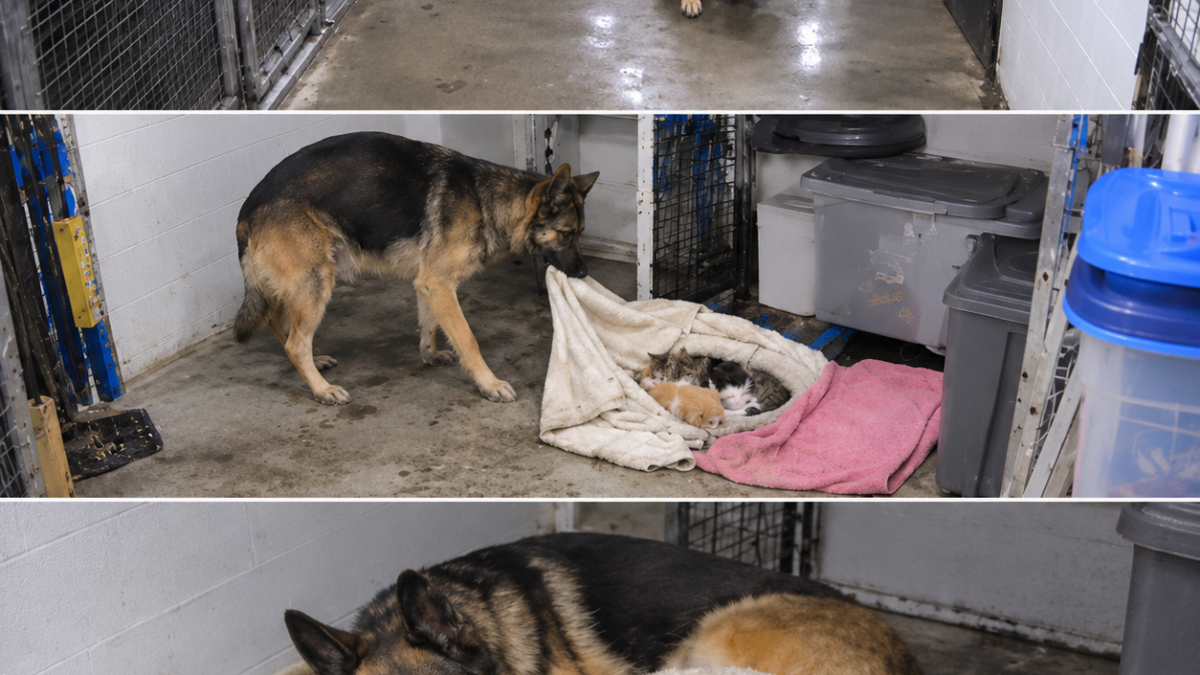
For nearly a week, Diesel stole a blanket from his kennel every night, and none of us at the Pennsylvania shelter could understand why.
We kept putting them back, only to find another one missing after the lights went down.
On the night I finally followed him into the old storage room, I expected to catch him making another harmless mess, but the moment I reached the doorway, I realized we had misunderstood him completely.
Diesel was a senior German Shepherd, the kind of dog whose face seemed to carry more years than anyone could count just by looking at him.
Gray had begun to soften the dark fur around his muzzle, and when he stood after lying down for a while, he moved with the careful stiffness of an older dog.
He was large enough to make first-time visitors hesitate, but those of us who worked around him knew how gentle he really was.
He never rushed the front of his kennel when people passed.
He rarely barked for attention.
Most days, he simply watched.
Families would come through looking for younger dogs, smaller dogs, energetic dogs, puppies that bounced against the kennel doors as if they could sell themselves with pure excitement.
Diesel usually remained farther back.
Sometimes he stood when someone stopped.
Sometimes his tail gave one slow sweep against the floor.
Then the visitors would move on.
After enough weeks of seeing that happen, you learn not to narrate disappointment for a dog, because you can never know exactly what he understands.
Still, there were moments when Diesel would look toward the hallway after a family disappeared around the corner, and something about the quiet way he settled back down always stayed with me.
Then the blankets started disappearing.
The first time, nobody thought much of it.
A folded blanket had been left in Diesel’s kennel before the evening rounds, and by the next morning it was gone.
We found it in an old storage room that was rarely used.
Someone carried it back, shook it out, and returned it to him.
The following night, another blanket disappeared.
Again, we found it in the storage room.
By the third time, it had become the strange little mystery of the week.
“Diesel did it again,” one of my coworkers said when we discovered another blanket missing.
We laughed because, compared with the difficult things that sometimes happened in a shelter, a senior German Shepherd secretly relocating blankets seemed almost charming.
We assumed he had decided the storage room belonged to him.
Maybe he liked the smell.
Maybe it was quieter.
Maybe he simply enjoyed carrying something soft in his mouth.
Whatever the reason, we kept returning the blankets to his kennel.
And every night, Diesel kept taking them back.
What began as funny slowly became puzzling.
He wasn’t shredding them.
He wasn’t dragging them around the hallway.
He wasn’t piling them in his own sleeping area.
He was taking them to one specific place.
That detail began bothering me.
Dogs can be wonderfully strange, but Diesel wasn’t acting random.
He moved with purpose.
One evening, after we finished most of our work and the shelter had grown quieter, I decided I wanted to see exactly what he was doing.
I didn’t announce it as some grand investigation.
I simply waited.
The lights in the main area had been dimmed, and the building settled into the familiar nighttime rhythm of soft paws shifting against kennel floors, distant water bowls moving, and an occasional sleepy bark.
Diesel stood.
He looked down at the blanket inside his kennel.
Then he gently took one edge between his teeth.
There was no frantic tugging.
No playfulness.
He lifted it carefully, almost as if he was trying not to drop something important.
Then he started walking.
I followed several steps behind him.
Diesel moved slowly through the corridor, the blanket dragging lightly along the floor behind his front paws.
He never looked back at me.
He seemed completely focused on where he was going.
When he reached the older part of the building, he turned toward the storage room.
I slowed down.
That room wasn’t comfortable.
It held things we rarely needed, and nobody had any reason to spend much time there.
Diesel stepped inside anyway.
For several seconds, I remained in the hallway.
Then I heard something.
It was so soft I almost convinced myself I had imagined it.
Not a bark.
Not Diesel moving the blanket.
A tiny, fragile sound from somewhere inside the darkness.
Diesel stopped.
Then his whole posture changed.
The large dog lowered his head, moved forward with extraordinary care, and carried the blanket deeper into the room.
I took another step toward the doorway.
At that moment, I could just make out Diesel bending toward something hidden in the corner.
And when I finally saw what he had been bringing those blankets to night after night, I couldn’t move.
[END OF FACEBOOK CAPTION]
[FIRST COMMENT / FULL STORY CONTINUATION]
There were three kittens in the corner.
For a moment, that was all my mind could understand.
Three.
Tiny.
Almost impossibly small beside Diesel.
They were pressed together in the narrow space near the wall, their little bodies so close that at first they looked like one trembling bundle of fur.
Diesel stood over them with the blanket still held gently between his teeth.
I remember staring at him and then staring at the kittens, trying to make the picture in front of me fit with everything we had assumed during the previous nights.
We had joked about the missing blankets.
We had called Diesel stubborn.
We had kept carrying the blankets back.
And all that time, he had been bringing them here for a reason.
Diesel lowered his head.
He released the blanket beside the kittens.
Then, with a movement so careful that it seemed almost impossible for a dog his size, he nudged part of the fabric closer to them.
One kitten shifted.
Another made the faint sound I had heard from the hallway.
Diesel immediately stopped moving.
He lowered himself.
Not quickly.
Not heavily.
He folded his large body down one careful piece at a time until he was lying beside them.
I stayed in the doorway because I was afraid that stepping forward too suddenly might break whatever fragile trust existed in that room.
Diesel’s ears moved when he heard me, but he didn’t get up.
He knew I was there.
He simply kept his attention on the kittens.
One of them crawled a little closer to him.
The movement was clumsy and uncertain.
Diesel lowered his head until his chin was almost level with the floor.
The kitten reached him.
Its tiny body disappeared against the fur near his chest.
And Diesel stayed completely still.
That was the moment the whole week rearranged itself in my mind.
He hadn’t been stealing blankets.
He had been collecting them.
He hadn’t been trying to claim the storage room.
He had been returning to three vulnerable little animals who needed warmth.
He hadn’t ignored us when we kept undoing his work.
He had simply started over every night.
I felt something tighten in my throat.
Behind me, I heard one of my coworkers approach.
I turned and lifted a hand, silently asking them to move slowly.
They came to the doorway beside me.
Their expression changed almost immediately.
Neither of us said anything at first.
There are discoveries that make people talk louder because they are excited.
This wasn’t one of them.
This made us whisper.
“Are those the kittens?” my coworker finally asked.
I nodded.
The question didn’t need more explanation.
The three kittens had been found only days earlier in a cardboard box outside the shelter.
They were young, fragile, and dependent on us for the warmth, comfort, and protection they could not provide for themselves.
We had known they were in the building.
What none of us had known was that Diesel knew too.
Somehow, he had found them.
I still don’t know exactly when he first became aware of their presence.
Maybe he heard them before we did from farther down the hallway.
Maybe he caught their scent.
Maybe he noticed someone carrying them.
Dogs understand their surroundings through senses we often underestimate, and Diesel had spent enough time in that shelter to know every familiar sound and smell around him.
The kittens were new.
Their cries were new.
Their scent was new.
Whatever had drawn him to that storage room, he had found them.
And once he did, he apparently made a decision of his own.
They were cold.
They were small.
He had a blanket.
So he brought it to them.
Then we took it back.
The next night, he brought another one.
We took that one back too.
Diesel never protested.
He never barked at us or tried to guard the room from us.
He simply waited until things were quiet and repeated the same act.
Standing there, I suddenly felt embarrassed by how easily we had interpreted his behavior through our own assumptions.
We saw a missing blanket and thought inconvenience.
Diesel seemed to see three little lives that needed something he could give.
One of the kittens began crying again.
It was a small sound, but Diesel reacted immediately.
His head lifted.
He shifted closer.
Then he settled with his body curved slightly toward them.
The kitten’s cry softened.
My coworker covered their mouth with one hand.
I could feel my own eyes burning.
Diesel was a large German Shepherd.
Even as a senior, he had the physical presence of a dog who could fill a room without trying.
The kittens beside him looked unbelievably delicate.
One of his paws seemed almost as large as one of their bodies.
Yet not once did he move carelessly around them.
When a kitten approached his face, Diesel didn’t lean forward suddenly to sniff.
He lowered his head.
When one climbed against his leg, he didn’t jerk away.
He waited.
When another pressed toward the warmth of his chest, he adjusted himself by inches.
Everything about him became slower around them.
Softer.
More deliberate.
We had known Diesel was gentle.
We hadn’t known how gentle.
Eventually, we stepped farther into the room.
Diesel watched us, but he showed no sign of anxiety.
I knelt several feet away.
“Hey, old man,” I whispered.
His ears shifted toward my voice.
“You’ve been busy.
”
His tail moved once against the floor.
That small thump almost broke me.
For months, Diesel had been the dog waiting in a shelter kennel while people passed him by.
Now he was lying in a storage room beside three abandoned kittens as if he had been given the most important responsibility in the world.
I looked at the blankets already there.
Suddenly, each one represented a different night.
Each one meant Diesel had gotten up after the shelter quieted down.
Each one meant he had carried warmth from his own kennel to the kittens.
Each one meant he had returned after we had unknowingly taken away what he was trying to provide.
There was something almost painful about realizing how quietly he had done it.
Diesel didn’t receive praise for the first blanket.
He didn’t receive praise for the second.
He wasn’t performing for anyone.
He had no audience.
He had no reason to believe a person would ever notice.
He simply kept doing it.
That may have been what moved me most.
People often talk about kindness when someone is watching.
Diesel had been kind in the dark.
The next part required us to think carefully.
The kittens were still tiny and needed proper care, and Diesel, no matter how gentle he seemed, was still a very large dog.
We couldn’t simply leave them together unsupervised because the scene was beautiful.
So after that night, we began arranging supervised visits.
That meant we could protect the kittens while also seeing whether the bond we had witnessed was real.
It was.
If anything, seeing them together in the light made the relationship even harder to forget.
The first supervised visit I watched, Diesel seemed almost solemn when he saw the kittens being brought toward him.
His whole body changed.
His attention narrowed.
His ears came forward.
His tail began moving slowly.
The kittens recognized him too.
They didn’t hesitate in the way I expected.
They moved toward him.
One came straight for his front paws.
Another approached the thick fur of his chest.
The third stayed close behind for only a moment before following.
Diesel lowered himself.
That became his habit around them.
He made himself smaller.
A German Shepherd cannot truly become small, of course, but Diesel seemed determined to try.
He bent his legs.
He lowered his shoulders.
He kept his head near the floor.
He allowed the kittens to decide how close they wanted to come.
One kitten climbed partly over his paw.
Diesel froze.
I almost laughed through the emotion of it because the expression on his face looked so serious.
He seemed terrified of moving the wrong way.
The kitten kept climbing.
Diesel looked toward me.
“You’re okay,” I said softly.
He stayed still.
The kitten settled.
Only then did Diesel relax again.
Another kitten pressed against his chest.
Its tiny body disappeared into the longer fur there.
Diesel lowered his muzzle near it, but not directly onto it.
He breathed slowly.
The kitten curled tighter.
Within minutes, it was asleep.
My coworker stood beside me.
“Look at him,” they whispered.
I was.
All of us were.
Diesel had spent months with shelter life organized around waiting.
Waiting for meals.
Waiting for walks.
Waiting for someone to stop at his kennel.
Waiting for a family to see past the gray around his muzzle and the fact that he wasn’t a puppy anymore.
But with the kittens, he wasn’t waiting.
He had something to do.
Something to protect.
Something that seemed to need him as much as he needed connection.
That difference showed in him.
Before the kittens, Diesel often carried himself with the quiet patience older shelter dogs sometimes develop.
He didn’t demand.
He didn’t push.
He accepted the rhythm of the place.
After the kittens entered his world, there was a new alertness in him.
When it was time for a supervised visit, he noticed.
When he heard those tiny cries, his head lifted.
When the kittens appeared, his tail moved.
For the first time in months, he seemed genuinely happy.
Not excited in the explosive way a puppy can be excited.
Diesel’s happiness was quieter than that.
It lived in the way his eyes followed the kittens.
It lived in the way he settled down near them without being asked.
It lived in the patience with which he tolerated tiny paws climbing over his legs.
It lived in the gentle wag of his tail when one of them approached.
Sometimes one kitten would crawl across his front legs as if Diesel were part dog and part mountain.
He would watch every movement.
If the kitten slipped, Diesel would turn his head.
If another began crying, he would shift closer.
If one curled against him, he would become still.
We began looking forward to those visits almost as much as Diesel did.
Shelter work can carry a strange mixture of emotions.
You see animals after they have been abandoned.
You see confusion.
You see fear.
You see people making heartbreaking decisions.
You also see recovery.
You see trust return.
You see connections form in places where nobody expected them.
Diesel and the kittens became one of those connections.
I found myself thinking about the cardboard box.
I hadn’t been there for whatever happened before the kittens arrived outside our shelter.
I didn’t know who had left them.
I didn’t know how long they had been there before they were discovered.
All I knew was what came afterward.
Three tiny animals had arrived needing warmth, comfort, and protection.
A senior dog waiting for a home somehow noticed.
Then he responded with the only resources available to him.
A blanket.
His body.
His presence.
It sounds simple when reduced to those things.
Watching it was different.
A blanket is only fabric until you see a dog carry it night after night to animals who are cold.
A body is only warmth until you see three kittens press against an older dog’s chest and finally relax.
Presence is easy to underestimate until you see how quickly a frightened little animal becomes quiet because another living creature has chosen to stay beside it.
Diesel understood none of the words we used to describe what he was doing.
He didn’t know we were calling him gentle.
He didn’t know the staff were talking about him.
He didn’t know that seeing him with those kittens was changing the way people looked at him.
He only knew that when the kittens made a sound, he wanted to be near them.
That seemed to be enough.
There was one afternoon when I watched the three kittens move around him with growing confidence.
They were still small, but they were no longer the trembling bundle I had first seen in the storage room.
They had begun exploring him as if he were familiar territory.
One climbed over the top of his paw.
Another pressed itself beneath his chin.
The third tried to get comfortable against his side.
Diesel remained patient through all of it.
“You realize they’re using you as furniture now, right?” I told him.
His tail tapped the floor.
I smiled.
“You don’t care at all.
”
He looked at me, then back at the kittens.
No.
He clearly did not.
One of my coworkers laughed quietly.
“He looks happier than I’ve ever seen him.
”
That sentence stayed with me because it was true.
We had all spent enough time around Diesel to recognize the change.
He wasn’t suddenly younger.
His muzzle was still gray.
He still rose slowly after resting.
His age had not disappeared.
But there was a new brightness in his attention.
He had become involved in something beyond the kennel door.
The kittens needed warmth.
They needed reassurance.
And Diesel, somehow, had decided he belonged in that role.
I began wondering whether the kittens had given him something too.
We tend to imagine rescue as a simple direction.
Person rescues animal.
Older animal protects younger animal.
Strong protects weak.
But relationships are rarely that simple.
Diesel had given the kittens comfort.
The kittens had given Diesel purpose.
They climbed over him without caring that he was old.
They didn’t know that families had walked past his kennel.
They didn’t know he had spent months waiting.
They didn’t compare him with younger dogs.
They didn’t see gray fur as a reason to choose someone else.
To them, Diesel was simply the warm, patient presence who came close whenever they cried.
Maybe that was why he seemed so content.
The kittens didn’t ask him to be younger.
They only needed him to be there.
And Diesel could do that perfectly.
As the days passed, the staff continued the supervised visits.
We stayed careful.
We stayed close.
We never forgot the difference in size between a German Shepherd and three tiny kittens.
But Diesel continued to prove how aware he was of that difference.
Whenever one approached his face, he lowered his head.
If a kitten moved beneath him, he waited before adjusting his paws.
He seemed to monitor himself constantly.
His strength was never the remarkable part.
His restraint was.
One afternoon, a kitten gave a sudden little cry.
Diesel had been lying with his head turned away.
The instant he heard it, he looked back.
The kitten was only a short distance from him.
Diesel shifted closer.
The kitten came to him.
Diesel settled again.
The crying stopped.
It happened so naturally that anyone who hadn’t known the story might have assumed they had always been together.
I thought about the first night I followed him.
I thought about how I had expected to uncover a silly habit.
Instead, I had watched an old dog reveal a part of himself none of us had known was there.
The blankets were no longer treated like a nuisance.
They became part of the story everyone in the shelter understood.
Somebody would see Diesel near the kittens and say, “That’s why he kept taking them.
”
Another person would shake their head and smile.
We all knew.
The mystery had been solved.
But knowing why he had collected the blankets only made the behavior more moving.
There was no complicated explanation.
Diesel had noticed something vulnerable.
He had tried to help.
That was it.
Sometimes the simplest motives are the hardest to forget.
The kittens, meanwhile, continued becoming more comfortable around him.
They followed him when they were together.
They climbed around his paws.
They curled against his chest to sleep.
Watching them sleep there was probably my favorite part.
When animals sleep deeply beside another living creature, they are giving away something precious.
They are saying, in the only way they can, that for this moment they feel safe enough to stop watching.
The kittens did that with Diesel.
They tucked themselves against him and rested.
Sometimes one tiny head would disappear into his fur.
Sometimes all I could see was the rise and fall of their bodies against his chest.
Diesel would remain still for long stretches.
I used to wonder whether he was uncomfortable.
Then I would see the relaxed position of his ears, the soft look in his eyes, and the occasional slow movement of his tail.
He wasn’t enduring them.
He wanted them there.
One evening, I sat nearby while Diesel lay with the kittens.
The shelter around us was busy enough that I could hear distant doors opening and closing and voices from another room.
Yet around Diesel, there was a pocket of calm.
One kitten was asleep near his front leg.
Another was curled against his chest.
The third was still awake, moving slowly through the fur near his shoulder.
Diesel watched it.
“You’re a good boy,” I said.
It was the sort of thing we had probably told him hundreds of times.
That evening, the words felt different.
Diesel looked at me.
Then he lowered his head again.
I had the strange thought that he did not need my approval.
He had already decided what kind of dog he was going to be.
He had chosen patience.
He had chosen gentleness.
He had chosen those kittens before any of us understood what he was doing.
What Diesel still didn’t have was what he had been waiting for all those months.
A family.
The kittens had changed his days, but at the end of shelter routines, Diesel was still a shelter dog.
Visitors still came through.
Kennel doors still opened and closed.
Adoption conversations still happened around him.
Some animals left with families.
Diesel remained.
That reality became harder for me after seeing him with the kittens.
Before, I had known he deserved a home in the abstract way you believe every good shelter animal deserves one.
After the storage room, I knew him differently.
I had seen what he did when nobody was watching.
I had seen how he responded to weakness with gentleness.
I had watched him make himself smaller for animals who were a fraction of his size.
It made the thought of him continuing to wait feel heavier.
Still, shelter workers learn not to force stories into endings before those endings arrive.
You can hope.
You can advocate.
You can tell visitors what an animal is like.
But you cannot manufacture the right connection.
So Diesel kept spending time with the kittens.
And we kept waiting.
Then a family came to the shelter looking for a kitten.
At first, that was all it was.
Another adoption visit.
Another family entering with an idea of the kind of animal they wanted to bring home.
They had come hoping to adopt one of the kittens.
By then, Diesel’s unusual relationship with the three little ones had become something the staff knew well.
It was impossible to talk about the kittens for long without eventually talking about the senior German Shepherd who had carried blankets to them.
Somebody told the family the story.
I watched their expressions change as they listened.
They heard about the missing blankets.
They heard how we had kept returning them to Diesel’s kennel.
They heard how he had carried them back night after night.
They heard about the old storage room.
They heard about the three kittens in the corner.
They heard about the night I followed him.
One member of the family looked toward me.
“He was covering them?”
I nodded.
“That was what we found.
”
They looked toward Diesel.
The senior shepherd was nearby, calm as usual.
He had no idea a conversation about his future was beginning several feet away.
“And he’s been with them since?”
“Supervised,” I explained.
“But yes.
”
The family watched him.
One of the kittens was near him.
Diesel lowered his head as it approached.
The movement was now so familiar to me that I almost took it for granted.
The family didn’t.
I saw them notice.
They saw the difference in size.
They saw the gray around Diesel’s muzzle.
They saw how deliberately he moved.
They saw the kitten come closer without fear.
They saw Diesel wait.
One of them asked if they could meet him.
That question changed the air around us.
“Of course,” I said.
I tried not to sound too hopeful.
Shelter staff become skilled at protecting their own expectations.
People ask to meet animals for many reasons.
A meeting is not an adoption.
Interest is not a decision.
We knew that.
Diesel knew none of it.
He simply greeted them as himself.
He wasn’t the kind of dog who exploded with excitement.
He approached with the same steady gentleness that defined him.
The family spent time with him.
They spoke to him.
They touched the older fur around his neck and shoulders.
They watched his face.
They watched how he responded to them.
And, most importantly, they watched him with the kitten.
Something happened during that meeting that couldn’t be reduced to a checklist.
The family had arrived expecting one story.
They had imagined themselves leaving with a kitten.
Now there was an old German Shepherd standing in front of them, and they knew what he had done when no one was paying attention.
I stayed nearby without crowding them.
I had learned long ago that some decisions need space.
One of the family members looked at Diesel for a long time.
Then they looked at the kitten.
Then back at Diesel.
“You said he’s been here for months?”
“Yes.
”
They reached down and rested a hand against Diesel.
He leaned slightly toward the touch.
It was not dramatic.
Diesel wasn’t dramatic.
That was part of who he was.
He accepted affection the same way he gave it.
Quietly.
One of them smiled.
Then another member of the family asked the question I had been trying not to hope for.
“What would it take to adopt him too?”
For a second, I genuinely thought I had misunderstood.
“Him too?”
They nodded.
“We came for one of the kittens.
”
Their hand remained on Diesel.
“But after hearing all of this.
.
.
”
They looked down at him.
“We can’t leave him behind.
”
I felt the words before I fully processed them.
There are moments in shelter work when you have to stay professional while every emotional part of you is doing something completely different.
That was one of those moments.
Diesel stood between us, completely unaware that the waiting which had defined so much of his life in the shelter might finally be ending.
The family had not come looking for a senior German Shepherd.
They had not walked through the door planning to adopt an older dog.
They had come for a kitten.
Diesel’s kindness had introduced him before he ever walked over to meet them.
The blankets had told part of his story.
The kittens had told the rest.
I looked at him and remembered the storage room.
I remembered him carrying that blanket through the dim hallway.
I remembered thinking he was simply making a mess.
I remembered the tiny cry from the darkness.
I remembered stepping through the doorway.
I remembered three kittens pressed together in the corner.
I remembered Diesel lowering the blanket beside them.
And now a family was standing in front of me saying they could not bear to leave him behind.
I wish I could say I responded immediately.
Instead, I had to blink several times and steady my voice.
“He’s been waiting a long time,” I finally said.
The family looked at him.
“Then maybe he doesn’t have to wait anymore.
”
Diesel’s tail moved.
Once.
Then again.
He could not understand the paperwork or the conversation.
He did not know what adoption meant in the human sense.
But he knew he was receiving attention.
He knew people were staying beside him instead of walking away.
He knew the kitten was nearby.
For that moment, that was enough.
The adoption process moved forward.
I kept expecting something to interrupt the feeling because shelter life trains you not to trust happiness too quickly.
But the decision remained.
They wanted the kitten.
And they wanted Diesel.
The senior dog who had watched families pass his kennel was finally being chosen.
Not despite his age.
Not as an act of pity.
They had met him after learning what kind of heart he carried into an empty storage room every night.
They wanted him because of who he was.
That distinction mattered to me.
Diesel had not become worthy of a home because he protected the kittens.
He had always been worthy of one.
But the kittens had given someone a chance to see what had been there all along.
His patience.
His tenderness.
His capacity for connection.
His instinct to move toward something vulnerable instead of away from it.
Those qualities had been difficult to see through the bars of a shelter kennel.
In the storage room, they became impossible to miss.
When the day came for Diesel to leave, I thought I would be prepared.
I wasn’t.
You spend enough time in rescue or shelter work, and goodbye becomes a complicated word.
There are goodbyes that hurt because you don’t know what will happen next.
Then there are goodbyes that hurt because you do know.
You know the animal is going somewhere better.
You know this is exactly what you wanted.
And still, some part of you wants one more day.
One more walk.
One more quiet moment.
One more chance to say, “You were loved here too.
”
Diesel stood near the people who had chosen him.
The kitten they had come for was part of that new beginning.
I looked at the difference between them again.
The tiny animal.
The enormous old dog.
It was the same contrast that had stopped me in the storage-room doorway.
Only now, the setting had changed.
They weren’t hidden in a dark corner.
They weren’t waiting for someone to understand what they were doing together.
They were leaving.
Together.
I crouched near Diesel.
He looked at me with those steady eyes.
“Do you remember all those blankets?” I whispered.
His ears moved.
I smiled even though my throat hurt.
“We thought you were causing trouble.
”
Diesel’s tail moved against the floor.
“You knew better than we did, didn’t you?”
He leaned his head toward me.
I placed both hands gently against the sides of his neck.
For a second, I closed my eyes.
There were so many things I wanted to tell him that would have meant nothing to him as words.
I wanted to tell him that the blankets mattered.
I wanted to tell him the staff had noticed.
I wanted to tell him that every night he had walked into that storage room, he had shown us something about him that no adoption profile ever could.
I wanted to tell him that he had not been invisible during all those months of waiting.
I wanted to tell him that his age had never made him less deserving.
I wanted to tell him that the family beside him had seen him.
Really seen him.
Instead, I said the only thing he needed to hear in that moment.
“Good boy, Diesel.
”
His tail moved again.
When he walked toward the exit with his new family, his steps still carried the careful stiffness of an older dog.
Nothing magical had happened to his body.
He had not become young again.
He was still the same senior German Shepherd who had spent months waiting in our shelter.
But now he was walking beside people who had chosen him.
The door opened.
Light came through.
Diesel stepped outside.
And I cried.
I wasn’t the only one.
The story had begun with a missing blanket.
That was almost funny to think about now.
A small mystery.
A minor inconvenience.
Something we had treated like another quirky shelter-dog habit.
Yet those blankets became the thread connecting everything that followed.
Without them, I might never have followed Diesel.
Without following him, we might not have understood what he was doing.
Without seeing what he was doing, the family might never have heard the story that made them ask to meet him.
Of course, Diesel hadn’t known any of that.
He wasn’t collecting blankets because he wanted to be adopted.
He wasn’t trying to impress anyone.
He had no idea his actions might change his own future.
He simply saw three fragile kittens and responded.
That was what made the ending feel so right.
Before someone finally chose him, Diesel had chosen someone else.
Three someones, actually.
They were tiny.
They had been abandoned in a cardboard box outside a shelter.
They needed warmth.
They needed comfort.
They needed to feel that they were not alone.
Diesel had spent months waiting for people to give him those same things in a permanent home.
Maybe that was why the image of him beside them affected me so deeply.
I cannot claim to know what he remembered about his own life.
I cannot claim he understood abandonment the way a person does.
I cannot put human thoughts into his head and call them fact.
What I can tell you is what I saw.
I saw a senior dog quietly remove a blanket from his kennel.
I saw him carry it down a hallway.
I saw him enter an old storage room.
I saw three tiny kittens huddled in the corner.
I saw Diesel lay the blanket beside them.
I saw him make himself smaller so they wouldn’t be afraid.
I saw him move closer when they cried.
I saw kittens climb over paws that were nearly as large as they were.
I saw them sleep against his chest.
I saw Diesel become happier than he had seemed in months.
And I saw a family who had entered our shelter looking for a kitten look at that old dog and decide they couldn’t leave him behind.
Those are the facts I need.
Everything else is interpretation.
After Diesel left, the shelter felt strange without him.
His kennel was empty.
For months, that space had held the same large, quiet figure.
You grow used to the presence of animals who stay longer than you hope they will.
Their routines become part of your routine.
You know how they stand when breakfast is coming.
You know which sounds make them lift their heads.
You know how they settle at night.
Then one day, the kennel is empty for the best possible reason.
You look into it and feel both loss and relief.
Diesel’s blanket was no longer disappearing.
No large German Shepherd was quietly walking toward the storage room after our rounds.
The mystery was over.
The waiting was over too.
All three kittens had a safe, loving place to grow up.
Diesel finally had the forever home he had been waiting for.
That sentence still gets to me.
For months, Diesel had been the one behind a kennel door while people searched for the animal they wanted.
Then three abandoned kittens appeared.
They had nothing to offer him in any practical sense.
They couldn’t adopt him.
They couldn’t speak for him.
They couldn’t promise him a home.
They were the ones who needed help.
And Diesel helped them anyway.
He did it quietly.
He did it repeatedly.
He did it after we unknowingly undid his work.
The first blanket was returned.
He brought another.
That one was returned.
He brought another.
No frustration.
No applause.
Just persistence.
In a shelter, you learn that animals often reveal themselves in small moments.
Not dramatic ones.
A frightened dog deciding to take one step closer.
A nervous animal finally sleeping deeply.
A tail that begins to wag after days of uncertainty.
Diesel revealed himself through blankets.
He could have kept the warmth in his own kennel.
Instead, night after night, he carried it somewhere else.
The kittens responded in their own way.
They followed him.
They climbed over him.
They curled against him.
They slept.
I think about that sleeping more than almost anything else.
They slept because they felt safe.
And Diesel, who had been waiting so long for a permanent place where he could feel secure himself, became that place for them.
Not a building.
Not a kennel.
Not a blanket.
A living place of safety.
A warm chest.
A patient body.
A dog who moved closer when they cried.
Sometimes people think older shelter dogs have already lived the important part of their lives.
They see gray fur and imagine a story that is almost finished.
Diesel reminded me how wrong that assumption can be.
His age did not mean he had nothing left to give.
His slower steps did not mean his heart had become smaller.
The most important thing we ever learned about him happened while he was a senior.
He still had tenderness to offer.
He still had bonds to form.
He still had a family to meet.
His story wasn’t over.
It was waiting for the right people to recognize it.
And strangely enough, three kittens helped them do that.
The family had come intending to choose one of those tiny lives.
Instead, they discovered a much bigger one standing nearby.
I sometimes imagine what they saw when they looked at Diesel.
Not because I know their private thoughts, but because I remember their faces.
They saw an old dog.
They saw a German Shepherd large enough to make the kittens look even smaller.
They saw gray around his muzzle.
Then they saw him lower his head when one of those kittens came close.
They saw restraint.
They saw patience.
They saw the tiny animal trust him.
That was enough to make them ask for a meeting.
Then Diesel did the rest by simply being himself.
He didn’t perform.
He didn’t need to.
The dog who had carried blankets in the dark didn’t suddenly become a different dog in front of potential adopters.
He remained quiet.
Gentle.
Steady.
Sometimes the right family doesn’t need to see a spectacular trick.
They need to see character.
Diesel had plenty of that.
The moment they said they couldn’t leave him behind is one I will always remember.
Not because it was loud.
It wasn’t.
There was no cheering.
There was no dramatic music.
Just people standing in a shelter beside an old German Shepherd and realizing their plan had changed.
They had come for one animal.
Their hearts had made room for another.
I looked at Diesel and thought of every family that had walked past him before.
I didn’t resent them.
People come to shelters with different needs, homes, abilities, and expectations.
Not every animal is right for every family.
But there was something deeply satisfying about knowing that after all that waiting, Diesel’s moment had finally arrived.
He did not have to chase it.
He did not have to become younger.
He did not have to become smaller.
He did not have to become anything other than the dog he had already been.
The right people saw him.
That was enough.
I also thought about how close we had come to missing the meaning of what he was doing.
If Diesel had given up after we returned the first blanket, we might never have followed him.
If he had stopped after the second, maybe the story would have remained a strange little shelter anecdote.
But he kept going.
His persistence forced us to pay attention.
Maybe that is another reason the story stayed with me.
So much of shelter work depends on noticing.
Noticing changes in behavior.
Noticing fear.
Noticing trust.
Noticing when something isn’t normal.
We noticed the blankets disappearing, but at first we noticed only the inconvenience.
Diesel made us look again.
When we did, we found compassion where we had expected mischief.
That humbled me.
It still does.
There are days when I remember walking behind him through that quiet corridor.
I can see the blanket dragging softly along the floor.
I can see the old dog’s deliberate steps.
I can remember how little urgency there seemed to be in his movement.
He wasn’t running.
He wasn’t sneaking in the frantic sense.
He was simply going somewhere he believed he needed to go.
I remember standing outside the storage room.
I remember the tiny sound.
I remember Diesel’s posture changing immediately.
That sound mattered to him.
He went deeper into the room.
I followed.
Then everything I thought I understood changed.
The kittens in the corner were so small beside him.
That contrast will never leave me.
Strength beside fragility.
Age beside new life.
A dog waiting for a home beside kittens who had only recently been abandoned.
Yet the emotional balance wasn’t what you might expect.
Diesel was not simply the strong one giving and the kittens the weak ones receiving.
They were giving him something too.
You could see it every time they approached.
His attention sharpened.
His tail moved.
His entire presence seemed to brighten.
He had spent months being evaluated.
Was he the right age?
The right size?
The right fit?
The kittens evaluated none of those things.
They climbed onto him.
They slept beside him.
They trusted him.
They needed him.
Maybe there is a kind of happiness in being needed without being judged.
Diesel seemed to find it with them.
That is why saying he “protected” the kittens tells only half the story.
They also brought something back into him.
Joy.
Purpose.
Connection.
For the first time in months, we saw it clearly.
An older dog who had been quietly waiting suddenly had companions who searched for him.
That matters.
A shelter can provide food, safety, care, and attention.
What it cannot always provide is the feeling of belonging to one particular group of beings who choose you every day.
For a while, those kittens gave Diesel a glimpse of that.
Then a family gave him the rest.
The ending did not erase the hard parts.
Diesel had still waited.
The kittens had still been abandoned.
There had still been a cardboard box outside our shelter.
There had still been nights when three vulnerable animals needed warmth.
But a satisfying ending doesn’t require pretending the difficult beginning never happened.
Sometimes it means watching kindness alter what happens next.
The kittens’ beginning could have been defined only by abandonment.
Instead, one of their earliest experiences in our shelter included the warmth of an enormous senior dog lying beside them.
Diesel’s shelter story could have been defined only by waiting.
Instead, part of it became the story of what he did while he waited.
That difference matters to me.
Waiting can make a life look passive from the outside.
Diesel showed us he wasn’t passive at all.
He was observing.
Responding.
Connecting.
Giving.
Even before anyone chose him, he was still capable of choosing kindness.
That is the part of the story I return to most.
Before finding his own home, Diesel created a kind of temporary home for three kittens in the only way he knew how.
He couldn’t open the shelter doors.
He couldn’t fill out adoption forms.
He couldn’t change what had happened to them before they arrived.
But he could carry a blanket.
So he carried one.
He could lie beside them.
So he did.
He could move closer when they cried.
So he did that too.
We often think love has to be enormous to matter.
Diesel’s love was made of small actions repeated.
Carry.
Lower.
Wait.
Stay.
Warm.
Protect.
Do it again tomorrow.
Maybe that is why the story reaches people so deeply.
There is nothing complicated about what he did.
The meaning comes from consistency.
He didn’t help once.
He returned.
He didn’t need recognition.
He returned.
We took away the blanket because we didn’t understand.
He returned with another.
That quiet determination said more about him than any description we could have written on his kennel card.
I wish every person who had walked past Diesel before could have seen him with the kittens.
Not so they would feel guilty.
That isn’t the point.
I wish they could have seen it because it revealed how much can remain hidden inside an animal you meet briefly through kennel bars.
A shelter gives you only fragments of an animal’s personality.
Noise can change behavior.
Stress can change behavior.
Waiting can make a normally expressive animal quiet.
Visitors often have minutes to make decisions about a life they barely know.
Diesel’s most extraordinary quality wasn’t obvious during a quick walk past his kennel.
It appeared late at night, when nobody was supposed to be watching.
That thought changed the way I looked at many animals afterward.
What kindness was hidden behind another quiet face?
What patience had not yet been tested?
What relationship might reveal something we couldn’t see in a kennel?
Diesel reminded me that an animal can be overlooked without being ordinary.
He had been there all along.
The heart everyone eventually talked about had been there all along too.
The kittens didn’t create his gentleness.
They revealed it.
The family didn’t create his worth.
They recognized it.
That difference is important.
When people hear a story like Diesel’s, it can be tempting to believe the happy ending makes the earlier waiting meaningful.
I don’t think an animal should have to suffer or wait in order to earn a meaningful ending.
Diesel deserved a home before the kittens arrived.
He deserved one before the first blanket disappeared.
He deserved one when he was simply an older German Shepherd sitting quietly while visitors passed.
The kittens didn’t make him deserving.
They simply helped us see him more clearly.
And they helped one family see him at exactly the right moment.
That is enough.
The family came for a kitten.
They heard about a dog.
They met him.
They stayed.
They changed their plan.
Sometimes a life changes through a chain of ordinary decisions like that.
A cardboard box is found.
Three kittens are brought inside.
An old dog notices.
A blanket disappears.
A staff member puts it back.
Another blanket disappears.
Someone becomes curious.
A doorway is crossed.
A hidden act of gentleness becomes visible.
A family hears the story.
They ask to meet the dog.
Then someone says, “We can’t leave him behind.
”
No single moment looked enormous while it was happening.
Together, they changed Diesel’s future.
That still amazes me.
I remember the family looking at him after making their decision.
There was a softness in the way they touched him then.
Before, they had been meeting a shelter dog.
Afterward, they were beginning to see him as their dog.
That transition is subtle.
Sometimes you can watch it happen.
A hand stays on the animal a little longer.
Someone stops asking general questions and starts imagining practical life.
Where will he sleep?
How will he settle?
What will tomorrow look like?
The language shifts from “the dog” to his name.
Diesel.
That is when a shelter worker begins to believe the adoption might truly happen.
With Diesel, the change seemed almost unbelievable because the family hadn’t walked in looking for him.
He was the unexpected part of their day.
Maybe the best part.
The kitten had brought them through the door.
Diesel’s character did the rest.
I sometimes wonder whether Diesel understood that something was different as the family prepared to leave with him.
Dogs read us better than we often realize.
They notice tone.
Movement.
Routine.
Excitement.
Maybe he sensed that everyone was acting unusually.
Maybe he simply knew there was affection around him.
I won’t pretend to know.
What I know is that he left beside people who had chosen him.
That image is enough.
The large shepherd walking away.
The gray muzzle.
The careful senior-dog steps.
The family beside him.
The kitten part of the new chapter that had brought their lives together.
For me, that was the answer to all those months of watching him wait.
Not because the wait became acceptable.
But because it finally ended.
The storage room became ordinary again after that.
No Diesel.
No blankets.
No tiny bodies pressed against his chest.
Just a room.
That felt strange too.
Places can become meaningful because of what happens in them.
For us, that old room would always be where a senior dog quietly showed us who he was.
I could walk past it later and still picture him there.
Head lowered.
Body curved around the kittens.
Blanket beside them.
The image had become permanent.
I know stories are often made more dramatic over time.
People add details.
They improve dialogue.
They turn quiet moments into cinematic scenes.
I don’t need to do that with Diesel.
The simple facts are powerful enough.
He carried blankets into a storage room.
Three abandoned kittens were there.
He covered them and stayed beside them.
He responded when they cried.
He treated them gently despite the enormous difference in size.
The staff began supervised visits.
The kittens followed him, climbed over his paws, and slept against his chest.
Diesel became happier than we had seen him in months.
A family came to adopt one of the kittens.
They heard about him.
They met him.
They decided they couldn’t leave him behind.
They adopted Diesel too.
And the old dog finally had a home.
Nothing needs to be added.
Even after all this time, those facts are enough to bring tears to my eyes.
Maybe it is because the story contains two kinds of rescue.
The obvious one is that Diesel eventually left the shelter with a family.
The less obvious one is what happened before that.
Three kittens arrived vulnerable and alone.
Diesel gave them warmth and comfort.
Then those kittens became the reason a family looked beyond their original plan and saw Diesel.
He helped them.
In a strange, beautiful way, they helped him.
Nobody arranged that.
Nobody planned it as some adoption strategy.
It happened because living beings connected.
That is why it felt so genuine.
The kittens didn’t know Diesel needed a family.
Diesel didn’t know the kittens might change his future.
They simply responded to one another.
The humans around them eventually caught up.
When I think about Diesel now, I don’t picture him behind the kennel door first.
I picture him in the storage room.
That is how completely the discovery changed my understanding of him.
Before, I saw an older dog with a calm temperament.
Afterward, I saw the same dog with context.
His quietness wasn’t emptiness.
There was a great deal happening behind those watchful eyes.
His slower movement wasn’t lack of interest.
He could move with incredible purpose when something mattered to him.
His age wasn’t the end of his story.
He still had love to give.
That lesson has stayed with me.
Older animals are often asked to compete with youth in shelters.
A puppy can make a person laugh within seconds.
A young dog may rush forward and demand attention.
An older dog like Diesel may wait.
If you don’t stop, you may never know what is behind that waiting.
Diesel never had a chance to explain himself.
The blankets did it for him.
Every one of them was evidence of a choice he had made in private.
Warmth belonged with the kittens.
He could provide it.
So he did.
Even now, I can see one of those blankets dragging along the corridor behind him.
The sight was almost comical before I understood.
After I understood, it became heartbreaking in a completely different way.
How many times had he done that while we were busy assuming he was simply being stubborn?
How many times had he reached the storage room and settled beside those kittens before morning came?
We only witnessed the truth because curiosity finally overcame assumption.
I am grateful it did.
I am grateful I followed him.
Not because Diesel needed us to validate what he was doing.
He would have kept doing it whether we understood or not.
I’m grateful because seeing it changed us.
It reminded us that care can appear in unexpected forms.
That a senior shelter dog can become a source of safety for newborn lives.
That an animal waiting for compassion can still be generous with compassion.
That being in need does not mean having nothing to give.
Diesel needed a home.
He still gave warmth.
Diesel needed a family.
He still created companionship.
Diesel was waiting to be chosen.
He still chose the kittens.
There is something profound in that.
Maybe the best measure of a heart is not how much it gives when life is easy.
Maybe it is what it gives while it is still waiting for something itself.
Diesel had been waiting a long time.
Yet when three tiny animals appeared, he did not hoard what little comfort he had.
He shared it.
Literally.
One blanket at a time.
I also think about the kittens’ perspective, as much as we can responsibly imagine it without pretending to know exactly what they felt.
Their world had changed abruptly.
They had been left in a cardboard box.
Then they were in a shelter filled with unfamiliar sounds and smells.
They were too young to understand any of it.
Then a massive warm animal began appearing beside them.
He did not crowd them.
He did not frighten them.
He lowered himself.
He stayed.
Soon they followed him.
That part tells us something real.
Animals do not need language to communicate safety.
They communicate through movement.
Distance.
Touch.
Stillness.
Diesel was exceptionally good at all four.
He waited for the kittens to approach.
He allowed them to climb.
He reduced his movements.
He offered his body as warmth.
The kittens responded with trust.
By the time they were curling against his chest, there was nothing accidental about their comfort.
They had learned him.
He had learned them.
That bond became one of the most peaceful things in our shelter.
It was also one of the strangest.
A senior German Shepherd and three abandoned kittens were not the pair anyone would have planned.
Maybe that was part of the beauty.
Affection does not always arrive in the shape we expect.
Family doesn’t always begin with matching species, matching ages, or matching circumstances.
Sometimes it begins because one living creature hears another cry and moves closer.
Diesel moved closer.
Again and again.
That was his language.
When the family finally did the same for him, it felt like the story folding back on itself.
Diesel had refused to leave the kittens alone.
Then a family looked at Diesel and decided they couldn’t leave him behind.
I remember realizing that connection after the adoption decision.
It was so simple that it almost hurt.
He had seen vulnerability and stayed.
They saw him and stayed.
He carried blankets to animals who needed warmth.
They opened their home to a dog who needed one.
Kindness had moved in a circle.
Not perfectly.
Not magically.
But unmistakably.
That is why the ending felt satisfying in a way shelter endings sometimes don’t.
Nobody “won.
”
Nobody was punished.
There was no villain we needed to see defeated.
There was just abandonment, waiting, care, and eventually connection.
Diesel’s reward wasn’t fame.
It wasn’t attention.
It was what he had needed from the beginning.
A home.
A family.
People who wanted him.
That was enough.
The kittens’ future was safe too.
Those tiny bodies that had once been pressed together in a corner had loving places to grow.
The contrast between where they started and where they ended was enormous.
Yet the part between those points remained my favorite.
The blankets.
The secret trips.
The old dog lying beside them.
Because that was where Diesel’s character lived.
Adoption gave his story a happy ending.
The storage room gave it meaning.
I sometimes hear people say shelter animals should be grateful when they are adopted.
I understand what they mean, but Diesel made me think about gratitude differently.
We were grateful too.
Grateful that we got to know him.
Grateful that he trusted us enough to reveal more of himself over time.
Grateful that his strange blanket habit made us curious.
Grateful that three kittens happened to enter his world.
Grateful that a family happened to enter ours at the right moment.
Grateful that when they heard his story, they chose to ask one more question.
“Can we meet him?”
Small question.
Life-changing answer.
If they had only looked at Diesel through the ordinary categories people often use, they might have missed him.
Senior.
Large.
German Shepherd.
Months in a shelter.
Those facts were true.
They simply weren’t complete.
Diesel was also the dog who carried his own blanket down a hallway because three kittens were cold.
He was the dog who lowered his head so something tiny would not be afraid.
He was the dog who moved closer when he heard a cry.
He was the dog who allowed kittens to climb across his paws.
He was the dog who stayed still so they could sleep against him.
He was the dog whose happiness returned when he was given someone to care for.
That was the whole picture.
The family saw enough of it to change their plan.
And Diesel’s life changed with it.
Months of waiting ended because someone looked at the dog in front of them instead of only the dog they had planned to adopt.
There is a lesson in that, but I hesitate to make Diesel’s story into a neat moral.
Real life rarely fits neatly.
Not every senior shelter dog finds a family because of one extraordinary moment.
Not every abandoned kitten finds a Diesel.
What happened to them was special precisely because it was unexpected.
Still, the story changed the way I think about being overlooked.
Being overlooked does not mean having less value.
Being unseen does not mean having nothing remarkable inside you.
Diesel was the same dog the night before I followed him as he was the night after.
The difference was our knowledge.
He had always been gentle.
We simply hadn’t seen the full depth of it.
He had always been capable of connection.
The kittens gave him someone to connect with.
He had always been worthy of a family.
The family finally recognized it.
That is why I cannot think of him as the dog who became special because he saved kittens.
He was already special.
The kittens gave us the privilege of seeing why.
And if I’m completely truthful, that night in the storage room taught me something about how easily humans can mistake quiet goodness for nothing at all.
Diesel did not announce what he was doing.
He did not seek attention.
He did not make the behavior convenient for us.
In fact, from our perspective, he made extra work.
We kept collecting blankets.
We kept wondering why they had moved.
We kept assuming we knew the answer.
Then reality turned out to be kinder than our assumptions.
I have thought about that many times.
How often do we see behavior without seeing motive?
How often do we correct something before understanding it?
How often does patience reveal a truth that speed would miss?
Diesel couldn’t explain himself.
So he repeated himself.
Night after night.
Blanket after blanket.
Until eventually I followed.
That may be the most beautiful part of persistence.
Sometimes it isn’t loud enough to force attention.
It simply continues until someone finally sees.
I saw.
Then the rest of the staff saw.
Then a family saw.
And Diesel went home.
If this story had ended only with the kittens becoming stronger and Diesel remaining at the shelter, it still would have meant something.
His gentleness would still have mattered.
The warmth he gave would still have been real.
But I won’t pretend I wasn’t relieved that his story continued.
I wanted him chosen.
All of us did.
Not because good deeds should purchase love.
But because after seeing the love he was capable of giving, it was impossible not to hope someone would give him a permanent place to put it.
That family did.
When they said they couldn’t leave him behind, it felt like the words were reaching backward through every night he had carried those blankets.
Every step down the hallway.
Every quiet return to the kittens.
Every moment he had lain beside them.
All of it led, indirectly and without intention, to someone seeing him clearly.
Diesel never asked us to tell his story.
The story told itself through what he did.
That is why I have never forgotten it.
If I close my eyes, I can still see the doorway.
I can still see that old storage room.
I can still see three tiny shapes against the wall.
I can still see Diesel lowering the blanket.
I can still see one kitten move toward him.
I can still see that enormous dog lowering his head as if the entire world had suddenly become fragile.
He treated them as if they mattered.
Maybe that is the most complete definition of love I have ever seen.
Not sentiment.
Not words.
Behavior.
The decision to notice.
The decision to approach gently.
The decision to share comfort.
The decision to stay.
Diesel did all of that.
Then, at the end of his long wait, someone did it for him.
They noticed.
They approached.
They made room.
They stayed.
When Diesel left the shelter, he was no longer the dog watching families disappear down the hallway.
He belonged to one.
The kitten that had brought the family through our doors was part of that new beginning.
The other kittens had safe, loving places to grow as well.
The three fragile lives Diesel had once protected no longer needed an old storage room and secretly collected blankets.
And Diesel no longer needed a shelter kennel.
Sometimes I think that is all a happy ending really is.
Not perfection.
Not the erasing of what came before.
Just the moment when nobody in the story has to keep waiting alone.
The kittens had Diesel when they needed warmth.
Diesel had the kittens when he needed connection.
Then all of them had the chance to move beyond the shelter.
I used to look at Diesel and feel sad that he had been waiting so long.
Now, when I remember him, the sadness is still there, but it isn’t the strongest feeling.
The strongest feeling is gratitude.
I am grateful I was there on the night he picked up that blanket.
I am grateful I decided to follow.
I am grateful I did not call him back before he reached the storage room.
I am grateful I heard the tiny cry.
I am grateful I stepped through the doorway.
Because inside that room, an old dog who had spent months being overlooked showed me that a heart can remain generous even while it is waiting to be loved.
Diesel could not control whether someone chose him.
He could control what he did with the warmth he already had.
So he gave it away.
And somehow, in the end, that warmth found its way back to him.
The dog who had once waited behind a kennel door became the protector of three helpless little lives.
The three kittens who needed him helped a family discover the dog they never knew they were looking for.
And the senior German Shepherd who had carried blankets through a dark shelter hallway finally walked out into the light beside people who refused to leave him behind.
Sometimes the biggest hearts really do belong to those who have been waiting the longest for someone to love them.