Every night, something was stealing my cat’s food from the porch, and at seventy-seven, I was certain I knew what kind of creature was doing it.
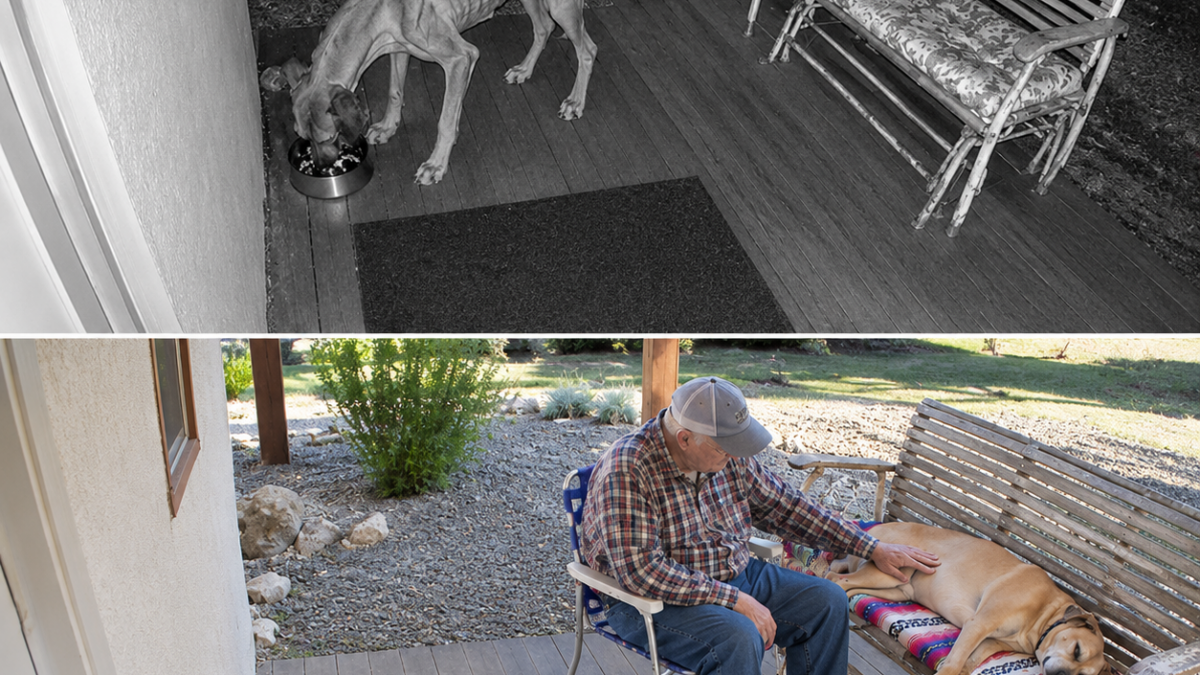
Every night, something was stealing my cat’s food from the porch, and at seventy-seven, I was certain I knew what kind of creature was doing it.
Then my grandson mounted a tiny camera above the front door, and just after two in the morning, the truth stepped out of the darkness on four trembling legs.
What I saw on that recording made me realize that the empty bowl outside my house was only the beginning of a story I was not prepared for.
For several nights, I had been waking up to the same strange little mystery.
I would step outside in the morning, look down at the bowl I had left for my elderly tabby, and find it completely clean.
Not almost empty.
Clean.
At first, I blamed a raccoon.
That seemed like the obvious answer, because animals wander through at night, and I had no reason to think anything unusual was happening.
I would refill the bowl, shake my head, and go on with my day.
But the food kept disappearing.
Night after night, the same thing happened.
My grandson noticed how curious I had become about it, and eventually he said the easiest way to stop guessing was to put up a small security camera.
So he mounted one above the front door, pointed toward the porch and the food bowl.
I expected the footage to show a raccoon, maybe an opossum, or some other hungry nighttime visitor helping itself while the house was quiet.
The next morning, my grandson pulled up the recording.
We watched the empty porch for a while as the timestamp moved deeper into the night.
Then, sometime around two in the morning, a shape appeared at the edge of the frame.
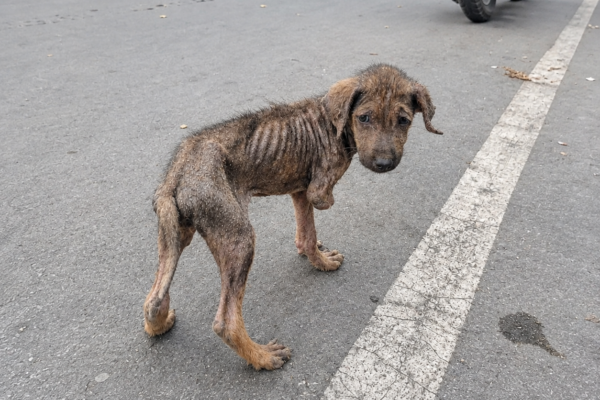
It was a dog.
He was brown, thin, and so cautious that for a few seconds he seemed unsure whether he was even allowed to step onto the porch.
Then he moved closer to the bowl.
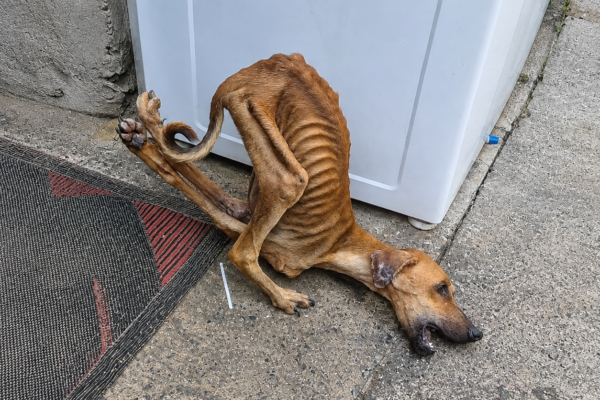
That was when I saw his ribs.
They stood out beneath his coat in a way that made me stop thinking about missing cat food entirely.
This was not an animal stealing a free meal because he had found an easy target.
This was a hungry dog trying to survive.
He lowered his head and ate every last piece of food.
He did not wander around looking for anything else.
He did not scratch at the door or knock things over.
He simply finished the meal and then did something that stayed with me long after the video ended.
He curled up on the welcome mat.
For nearly an hour, that thin stray dog rested right outside my front door as if the small patch of porch had given him something he had not found anywhere else that night.
Peace.
Safety.
Maybe just enough quiet to let his guard down.
I watched him lying there on the screen and felt something inside me change.
I kept thinking about how he had arrived only after the house was dark, how carefully he had approached, and how quickly he had eaten.
A dog does not become that cautious for no reason.
He did not know us.
He did not know whether the porch was safe.
He only knew there was food there, and hunger had finally become stronger than fear.
I could not change whatever had happened to him before he came to my house.
I could not ask him where he had been sleeping or how long he had been searching for meals.
But I could decide what would happen the next time he showed up.
That afternoon, I went to the local feed store.
I bought a thirty-pound bag of dog food and carried it home with a second bowl.
My tabby had been here first, and I had no intention of making him surrender his supper to a stranger, so the new bowl was for the dog alone.
I filled it and placed it on the porch.
Then I stepped back inside.
The sun went down.
The house grew quiet.
And for the first time, I was not wondering what had been eating the food.
I was wondering whether that frightened dog would trust my porch enough to come back.
[END OF FACEBOOK CAPTION]
[FIRST COMMENT / FULL STORY CONTINUATION]
I Thought a Raccoon Was Stealing My Cat’s Food—Then the Camera Showed Me a Dog Who Needed More Than a Meal
That evening, I found myself listening for sounds outside even though I knew the camera would catch whatever happened.
Every little noise made me look toward the front door.
I told myself I was being foolish.
The dog was a stray, and strays survive by moving.
He might have found another place to eat.
He might never come back to my porch.
I had no claim on him simply because I had watched a few minutes of his life through a security camera.
Still, I kept thinking about him.
It was strange how quickly that could happen.
One morning I had been mildly annoyed because somebody was emptying my cat’s bowl.
By that evening, I was worrying about whether a dog I had never touched would have enough to eat.
My grandson noticed.
“You think he’ll come back?” he asked.
“I don’t know,” I said.
That was the truth.
I hoped he would.
I also hated the reason I hoped he would.
If he returned, it probably meant he still had nowhere else to go.
The house settled into its usual nighttime quiet, but my mind did not.
I pictured the dog from the video moving through the dark somewhere beyond my porch.
I remembered the way his body had looked when he turned sideways to the camera.
His ribs had been impossible to ignore.
I remembered how he had approached the food as if he expected someone to stop him.
Most of all, I remembered what happened after he ate.
He had stayed.
That was the part I could not get out of my head.
A hungry animal eating available food made sense.
A frightened stray curling up on a stranger’s welcome mat for nearly an hour felt different.
He had not just needed calories.
For those few minutes, he seemed to have needed rest.
Maybe he had simply been exhausted.
Maybe the porch was warmer or quieter than wherever he usually slept.
Maybe there was no deeper meaning at all.
I knew better than to pretend I understood every thought in an animal’s head.
But I knew what I had seen.
For nearly an hour, he had stopped running.
That mattered to me.
The next morning, I looked at the bowl before I looked at the camera.
It was empty.
I smiled before I could stop myself.
“He came back,” I said.
My grandson checked the recording.
There he was again.
The same brown dog.
The same careful approach.
The same hesitation.
He paused outside the porch before stepping forward.
His head remained low.
His body seemed ready to reverse direction at the slightest disturbance.
Then he saw the bowl.
This time it contained dog food instead of whatever he had been stealing from my cat.
He moved toward it.
He sniffed.
Then he ate.
Fast.
Much too fast for an animal who believed another meal was guaranteed.
I watched every movement.
There was no leisurely chewing.
There was no stopping halfway because he was full and knew he could return later.
He ate with the urgency of a dog who had learned that food was temporary.
When the bowl was empty, he licked around it for whatever tiny pieces might remain.
I felt my throat tighten.
The thirty-pound bag sitting inside my house suddenly seemed like one of the best things I had purchased in a long time.
It did not solve his life.
It did not tell me where he came from.
It did not make him trust me.
But it meant one thing.
If he reached my porch hungry, there would be food waiting.
For the first few days, that became our entire relationship.
I put food outside.
He came when he thought the coast was clear.
He ate.
Then he left before anyone could get close.
Sometimes the camera was the only way I knew he had been there.
I would wake in the morning, see the empty bowl, and later watch his nighttime visit.
I began to recognize small details in his behavior.
He never walked onto the porch as though it belonged to him.
He tested the space first.
He paused.
He listened.
He looked toward the house.
Then he approached.
If the purpose of trust were simply food, I suppose the process would have been easier.
But food and trust are not the same thing.
A hungry dog can accept one while being terrified of the other.
I understood that quickly.
So I made a decision not to rush him.
I did not chase him.
I did not corner him.
I did not try to prove in one dramatic moment that I was a good person.
I simply kept the bowl filled.
That became the promise I could make without asking anything from him in return.
You come here hungry, I thought, and I will feed you.
If that is all you ever want from me, then that will be enough.
There was something humbling about letting him set the pace.
People often want affection immediately from animals.
We reach out because our intentions are good.
We call softly.
We crouch down.
We want the animal to understand what we already know about ourselves.
I wanted to tell him that he was safe.
But he did not know me.
Whatever my intentions were, he could judge me only by what I did.
So I let my actions repeat themselves.
Food.
Distance.
Quiet.
No sudden attempt to grab him.
No demand that he become grateful.
No expectation that because I had bought a bag of dog food, he now owed me his trust.
Some evenings I sat where he might be able to see me from a distance.
I did not move toward him.
If he appeared and seemed uncertain, I stayed where I was.
He could choose.
That choice was important.
At first, he usually chose distance.
I would catch a glimpse of brown near the edge of the porch, and then he would retreat.
Sometimes I wondered whether even seeing me was enough to keep him away until later.
So I went inside.
After a while, the bowl would be empty.
I never took it personally.
Fear is not an insult.
Fear is information.
His fear told me that somewhere along the way, caution had kept him alive.
I was not going to punish him for using the very instinct that had helped him survive.
My grandson and I continued checking the recordings.
We did not need the camera anymore to solve the mystery.
That mystery was over.
Now the camera showed us something else.
It showed us progress that was sometimes too small to notice in real time.
One night, the dog stood on the porch a little longer after eating.
Another time, he did not leave immediately when a light shifted inside the house.
Then there was a night when he sat down for a while before disappearing.
None of those moments looked dramatic.
There was no single instant when fear vanished.
Trust did not arrive like a switch being turned on.
It came in inches.
It came in seconds.
It came in choices so small that someone not paying attention might have missed them.
But I was paying attention.
Every extra second felt important.
Every time he returned, I understood that he had made another decision about our porch.
He could have gone somewhere else.
Yet he kept coming back.
I wondered where he spent the daylight hours.
The truth was that I did not know.
The source story never gave me an answer to that, and at the time neither did the dog.
He would disappear and then reappear according to his own quiet schedule.
That uncertainty made the evenings feel longer.
Sometimes I looked out toward the porch and found myself waiting without admitting that I was waiting.
My elderly tabby still had his own routine, of course.
He had lived his life according to rules that did not include suddenly sharing his porch with a hungry brown dog.
So I made sure one rule was clear from the beginning.
The cat ate first.
He had seniority.
The new visitor could have his own bowl and his own food.
There was no reason to turn kindness toward one animal into unfairness toward another.
That became one of the small, almost funny parts of the situation.
The dog had originally entered our lives by eating the cat’s food.
Now there was a thirty-pound bag purchased especially for him, yet the cat still held first place at mealtime.
I sometimes looked at the two bowls and smiled at how quickly my porch had changed.
Only days earlier, one empty bowl had been a mystery.
Now two bowls represented a strange little household arrangement nobody had planned.
The dog did not know it yet, but we were already making room for him.
Not forcing room.
Making it available.
There is a difference.
One evening, when I saw him near the porch while I was outside, I stayed very still.
His eyes fixed on me.
His body stopped.
For a moment neither of us moved.
I could feel the urge to call him closer.
I resisted it.
Instead, I turned slightly away.
It was my way of telling him that he did not have to defend himself from me.
The bowl was there.
The porch was there.
I was there.
He could decide what came next.
He stepped backward.
Then he stopped.
I waited.
He took another look at the food.
Then another at me.
Finally, he moved forward.
Not much.
Just enough.
I remember thinking that to anyone else, it would have looked like nothing.
To me, it felt enormous.
He was hungry, yes.
Hunger was still part of what pulled him toward the porch.
But he was beginning to weigh his hunger against his fear and decide that my presence did not automatically mean danger.
I kept my hands to myself.
He reached the bowl.
He ate while I remained at a distance.
I could hear him.
That was different from seeing him on a screen.
The sound of him eating made the situation feel more immediate.
He was no longer simply a figure in grainy nighttime footage.
He was a living animal only a short distance from me.
When he finished, he raised his head.
For one brief moment, he looked directly at me.
Then he left.
I did not follow.
That night I thought about that look for a long time.
There had been no wagging tail, no sudden display of affection, no dramatic transformation.
There did not need to be.
He had eaten while I was nearby.
That was enough.
The next day, I put the food out again.
And the day after that, I did the same.
Routine became our language.
I could not explain my intentions to him in words he understood, so I let repetition explain them.
The bowl would be there.
I would not hurt him.
If I was nearby, I would respect his space.
Nothing bad would happen simply because he came to eat.
Day after day, he received the same answer.
Eventually, his body began to respond to that consistency.
The hesitation did not disappear all at once, but it softened.
He did not always hover at the very edge of the porch.
He did not always seem prepared to sprint away.
Sometimes he remained after eating.
Sometimes he watched me instead of immediately vanishing.
Sometimes his posture looked less like survival and more like curiosity.
Those were tiny changes, but they mattered because they were his changes.
I had not dragged him into them.
He was choosing them.
My grandson could see it too.
“He stayed longer this time,” he said after one recording.
“I saw,” I answered.
We replayed a small section.
It was probably ridiculous how much satisfaction we took from a stray dog remaining on a porch for a few extra minutes.
But once you begin caring about an animal, the scale of what feels important changes.
A few feet can become a mile.
A few seconds can feel like an hour.
A dog choosing not to run can feel like an entire conversation.
I began to think less about the question of where he had come from and more about the question of what he needed from us now.
I still wondered about his past.
Of course I did.
His thin body and nervous behavior made it impossible not to wonder.
But I did not know the answers, and I did not want to invent them.
I knew only what was in front of me.
He had been hungry.
He had been cautious.
He had found our porch.
And he kept returning.
That was enough truth to work with.
As the days went on, something else slowly changed.
I stopped thinking of him as “the dog.
”
I had not named him yet, but emotionally he was becoming more specific.
I could recognize the way he moved.
I could recognize his shape before the camera showed him clearly.
I noticed the way he approached the bowl.
I noticed the places where he preferred to pause.
I noticed when he seemed calmer.
Without planning it, I had started learning him.
And I think, in his own way, he was learning me.
He was learning that the older man on the porch did not lunge.
He was learning that my presence did not make the food disappear.
He was learning that if I reached for the bowl, it was to fill it.
He was learning that the front door opening did not always mean he needed to run.
Most importantly, he was learning that tomorrow could resemble today.
For an animal living meal to meal, consistency can mean more than comfort.
It can change the way the next moment feels.
I could see that change happening slowly.
One afternoon, I sat quietly while he approached.
He stopped when he noticed me.
I stayed seated.
He looked toward the bowl.
Then back at me.
I spoke softly.
“There you are,” I said.
My voice was gentle, but I did not use it to pressure him.
He stood still.
I let the silence return.
Eventually he stepped closer.
Then closer again.
The distance between us shortened.
I could see his face more clearly than before.
I could see that he was watching every movement I made.
So I made almost none.
He reached the food.
He ate.
I remained where I was.
When he finished, he did not bolt.
He backed away several steps and stood there.
I kept my hands resting quietly.
“You’re all right,” I murmured.
He looked at me.
Then he left.
I smiled after he disappeared.
It might sound strange to feel proud of a dog simply for standing near you.
But I was not proud because he had obeyed me.
He had not.
I was proud because he had made one more choice that fear did not make for him.
That became the pattern.
A little closer.
A little longer.
A little less tension.
There were also moments when he seemed more cautious again.
Trust is not a straight road.
One good day does not erase every old instinct.
If he approached more slowly, I did not treat it as failure.
If he left quickly, I did not assume we had lost everything.
I simply started again with the same promise.
Food.
Patience.
Space.
Tomorrow.
At seventy-seven, I had lived long enough to understand that some things cannot be hurried without damaging them.
You cannot demand that another living creature feel safe because you are impatient to be loved.
You cannot tell fear to disappear simply because danger is no longer present.
Sometimes the kindest thing you can do is remain predictable long enough for the other heart to discover the difference on its own.
That was what I tried to give him.
Predictability.
The same porch.
The same bowl.
The same quiet man.
The same choice.
The more often he returned, the more natural his presence began to feel.
I would catch myself looking outside before it was time to put out his food.
I would wonder whether he had already come by.
I would notice when the porch seemed empty.
I had not invited this attachment.
It arrived the same way he had.
Quietly.
At first, just one nighttime visit.
Then another.
Then enough repetitions that suddenly I could not imagine ignoring him.
My grandson noticed that too.
One day he looked at the large bag of dog food and smiled.
“You bought thirty pounds for a dog who won’t let you touch him.
”
“Looks that way,” I said.
He laughed.
I did too.
But neither of us thought it was wasted.
The dog was eating.
His body was beginning to reflect that.
The extreme thinness that had frightened me on the first recording was slowly becoming less pronounced.
He looked stronger.
The change was gradual, just like the change in his behavior.
There was no magical overnight transformation.
There were simply meals.
One after another.
Enough food today.
Then enough food tomorrow.
Then another meal after that.
That is how many real changes happen.
Not through one grand gesture, but through ordinary care repeated until the result becomes visible.
I liked watching him eat more slowly as time passed.
Not always, and not immediately, but gradually.
The desperation seemed to ease.
Perhaps the most important thing the full bowl was teaching him was not that food existed.
He already knew food existed.
It was teaching him that food could still be there tomorrow.
That changed the feeling of every meal.
I wanted him to learn that lesson completely.
I wanted him to reach the bowl without expecting it to be taken away.
I wanted him to stop eating as though every bite might be his last.
I wanted him to rest after eating without believing that rest was dangerous.
Those wishes grew before I admitted how much I cared about him.
Then came the first time I truly felt the distance between us collapse.
He had been hanging around the porch longer by then.
I was outside, keeping my movements slow.
He was close enough that I could have reached toward him, but I did not.
He needed to make that final little decision himself.
I spoke softly.
He watched me.
I lowered my hand, not directly over him, but where he could see it.
He did not run.
That alone made my heart beat harder.
I waited.
He remained.
Then, carefully, I reached toward him.
My fingers touched the fur behind his ear.
For a fraction of a second, I expected him to jerk away.
He did not.
I scratched gently.
His body stayed beside me.
I cannot tell you that fireworks went off or that some dramatic music played in my mind.
The moment was quieter than that.
That is what made it powerful.
For days, this dog had treated every human movement as something to evaluate.
Now he was allowing my hand to rest against him.
I felt the warmth of his body beneath my fingers.
I felt the reality of him.
He was not a shadow at two in the morning anymore.
He was not a problem involving stolen cat food.
He was not a recording on my grandson’s phone.
He was right there beside me, letting an old man scratch behind his ear.
“You’re all right, boy,” I whispered.
He could have left.
He stayed.
I scratched behind his ear again.
The simple act almost broke my heart.
Not because it was sad.
Because it represented everything that had happened without either of us being able to explain it aloud.
The first time he had appeared on our camera, he would hardly step onto the porch.
Now he was close enough for me to touch.
There had been no trap.
No force.
No bargain.
Just a bowl that kept being filled and a little space in which he could decide what people meant to him.
That evening, I kept thinking about the feeling of his fur beneath my hand.
Trust can be invisible until the moment someone places it in your hands.
That dog had done exactly that.
He had given me permission to touch him.
It might seem like a small privilege.
I understood it as something larger.
From then on, affection became another part of our routine.
Still on his terms.
Sometimes I scratched behind his ears.
Sometimes he stayed near me without needing to be touched.
Sometimes his greatest comfort seemed to be simply knowing I was present.
I learned not to make every peaceful moment into an interaction.
Companionship does not always require activity.
Sometimes it is two living creatures sharing the same patch of quiet.
I was becoming familiar with his silence.
And he was becoming familiar with mine.
As he stayed longer, I started looking at the porch differently.
The welcome mat had been enough for him on that first night.
I still remembered the image of his thin body curled on it.
But now that he was returning regularly, I wanted him to have somewhere softer to rest.
So I put a blanket on the porch glider.
It was a simple thing.
No ceremony.
No grand announcement.
Just a soft place waiting where a frightened stray had once settled for a mat.
The first time he investigated it, I tried not to stare too obviously.
He sniffed around.
He took his time.
That was typical of him.
New things had to earn their place in his world.
Eventually, the glider became part of the territory he understood.
Then it became something more.
It became his place.
There was something almost unbelievable about watching him relax there.
The dog who had approached our porch like a trespasser began stretching out as if he knew he was allowed to stay.
His body language changed when he rested.
The constant readiness to move softened.
His muscles seemed less tight.
His head could lower.
His eyes could close.
Those moments affected me more than I expected.
Food had brought him to us.
Rest showed me that trust was keeping him there.
There is vulnerability in sleep.
An animal that believes danger is near does not surrender easily to it.
Whenever I saw him resting on that blanket, I remembered the nearly one-hour stretch on the welcome mat from the first recording.
Back then, the porch had offered a temporary pause.
Now it was beginning to offer familiarity.
The difference was not in the boards beneath his feet.
The difference was that he knew who lived behind the door.
And I knew who was waiting outside.
Eventually, we reached a point where calling him “the stray” felt wrong.
A stray is defined by having no place.
By then, he had a bowl.
He had a blanket.
He had a favorite place to rest.
He had an old man who looked for him every day.
He had a grandson checking camera footage because his progress mattered to the family.
He even had an elderly tabby whose meal schedule had indirectly brought him to us in the first place.
He needed a name.
I called him Chaco.
The name settled into place as naturally as he had begun settling onto the porch.
“Chaco,” I said when I saw him.
At first, I do not know whether the sound meant anything to him.
Names become meaningful through repetition too.
Chaco came to mean food.
Chaco came to mean the sound of my voice.
Chaco came to mean I was talking to him, not just speaking into the air.
But the name meant something immediate to me.
It meant he was no longer anonymous.
He was no longer just one more hungry dog moving through the night.
He was Chaco.
Once I started calling him that, it became difficult to remember how temporary his presence had once seemed.
I thought back to that first bag of dog food.
I had bought it because I could not bear the thought of him arriving hungry and finding nothing.
I had not bought it because I had a plan to bring a dog into my family.
There had been no plan.
That is one of the things that still moves me when I think about those days.
Some of the most important relationships begin before anybody understands what they are becoming.
You make one small choice.
Then another.
You put out a bowl.
You sit quietly.
You refuse to chase.
You wait.
One day, the animal who used to flee allows you to touch him.
Then one afternoon you are putting a blanket on a glider because you know where he likes to sleep.
Then you give him a name.
At some point, you look around and realize the question is no longer whether he belongs.
He already does.
The family had not officially gathered and voted on it.
There was no moment when I stood up and announced that Chaco was now one of us.
Real belonging does not always happen that way.
Sometimes it becomes true through a hundred ordinary acts before anyone says the words.
I filled his bowl.
He returned.
I scratched his ears.
He stayed.
I made him a comfortable place.
He slept there.
I called his name.
He learned the sound.
What else do you call that except family?
My grandson saw the change clearly.
The security camera that had been installed to identify a suspected raccoon had become a kind of record of Chaco’s transformation.
On the early recordings, he appeared like a nervous visitor who expected to disappear before sunrise.
Later footage showed him staying longer.
Then resting.
Then behaving less like someone passing through and more like someone who knew the porch.
I sometimes watched those earlier clips again.
The contrast was difficult to believe.
There was the same brown coat.
The same dog.
But almost everything about the way he carried himself had changed.
His body was filling out.
His movements had more strength.
The panic around food was fading.
His willingness to stay near us was growing.
The camera had captured something I could never have understood from a single photograph.
Change has a rhythm.
You see it most clearly when you can look backward.
Day by day, I often felt as though almost nothing was happening.
Then I compared the Chaco beside me with the dog from that first two-in-the-morning recording.
The difference took my breath away.
He had not only gained food.
He had gained certainty.
He knew where the next meal could come from.
He knew where he could lie down.
He knew the old man sitting nearby was not going to hurt him.
He knew the porch was not a trap.
He knew his name.
And slowly, I think he knew that when I looked at him, I was no longer seeing a stranger.
I was seeing him.
That mattered to me because animals can spend so much of their lives being noticed only as problems.
The dog in the road.
The dog near the trash.
The dog eating someone’s cat food.
The dog that does not belong.
Chaco had first appeared in my life under exactly that kind of description.
Something was stealing food.
Something had emptied the bowl.
I had wanted to discover the culprit.
Then the camera revealed not a culprit, but a need.
That changed the entire story.
There is a difference between asking, “Who took this?” and asking, “How hungry did he have to be to come here?”
The first question was about me.
The second was about him.
Once I asked the second question, I could not go back to the first.
I still laugh a little when I remember how convinced I was about the raccoon.
I had built the whole explanation in my head.
Nighttime visitor.
Missing food.
Case closed.
The camera was supposed to confirm what I already believed.
Instead, it challenged me to respond to something completely different.
I think life does that more often than we admit.
We make judgments from the evidence we can see.
Then one more piece of information arrives, and suddenly the same facts mean something else.
The empty bowl had seemed like evidence of a nuisance.
After I saw Chaco’s ribs, the empty bowl looked like evidence of hunger.
Nothing about the bowl changed.
I did.
Once Chaco was comfortable enough to remain around the porch, our days became quieter in a good way.
There was less suspense about whether he would return.
His presence became expected.
I would see him resting and feel a kind of contentment that is difficult to explain.
At seventy-seven, I did not need excitement for something to matter.
I had learned the value of ordinary company.
A dog lying nearby can change the atmosphere of a whole afternoon.
There is no need for conversation.
There is no need for a destination.
You simply share time.
Chaco became good at that.
I would sit.
He would settle.
Sometimes I rested my hand on him.
Sometimes I did not.
The porch that had once been a nighttime feeding stop became a place where we existed together.
I do not know exactly when I stopped worrying that he might disappear forever.
Maybe I never stopped completely.
There was always a part of me that remembered he had arrived as a stray.
He had been free to leave from the beginning.
But over time, his choices became reassuring.
Again and again, he chose to return.
Eventually, returning did not seem like a temporary habit.
It seemed like home.
That word carried weight for me.
Home is easy to take for granted when you know where you will sleep.
It means something different when you watch an animal discover security gradually.
For Chaco, home did not appear as an instant transformation.
It accumulated.
One meal.
One safe night.
One gentle touch.
One blanket.
One name.
One ordinary afternoon beside a person who had stopped being a stranger.
That was how home was built for him.
And without realizing it, he was changing my home too.
The porch had always been part of the house.
After Chaco, it became part of a story.
The welcome mat was no longer just a welcome mat.
It was the place where I had first watched him rest after eating.
The bowl was no longer just a bowl.
It was the first promise I had been able to give him.
The glider was no longer just a piece of porch furniture.
It was where a frightened animal eventually learned he could stretch out and sleep.
Even the camera above the door became something different.
It had been installed because we were suspicious.
It ended up recording trust.
That irony was not lost on me.
There were plenty of evenings when I thought about what would have happened if my grandson had never mounted it.
Maybe I would have continued blaming a raccoon.
Maybe I would have stopped leaving food outside.
Maybe Chaco would have come one more time and found an empty porch.
I do not know.
There is no point pretending we can know the lives we did not live.
But I do know what happened in this one.
A camera let me see what hunger looked like when nobody thought anyone was watching.
And once I had seen it, I could not unsee it.
That first recording asked something of me.
Not something huge.
Just something immediate.
Feed him.
So I did.
Everything else grew from that.
My grandson occasionally pulled up the old footage, and each time I felt the same ache seeing Chaco’s early body.
His ribs were so clear.
His approach was so guarded.
Then I would look at the dog resting near me and feel grateful for the difference.
I had not performed some heroic rescue.
That is not how I thought of it.
I had put food outside.
I had been patient.
I had allowed trust to take the time it required.
Chaco had done the harder part.
He had taken the risk of coming back.
He had tested us.
He had let fear loosen its grip little by little.
He had chosen to believe the evidence we gave him.
That mattered because trust after fear is an act of courage.
Every time he stepped closer, he was risking disappointment.
Every time he stayed, he was choosing not to run.
Every time he relaxed beneath my hand, he was accepting vulnerability.
I never wanted to forget that.
So even after he became comfortable, I tried to preserve the spirit of those early days.
I did not treat his affection as something I was entitled to.
I appreciated it.
There is a difference.
The first scratch behind his ear had been a gift.
Later scratches were gifts too.
Familiarity should not make gratitude disappear.
By then, Chaco had also begun looking healthier.
That change pleased me in a way few things could.
His body no longer told the same desperate story it had told on the first video.
Regular food was doing what regular food does when a starving body finally receives it.
He looked stronger.
His shape changed.
His posture changed.
Even rest looked different on him.
At first, exhaustion had seemed to pull him down.
Later, relaxation seemed to hold him.
Those two things can look similar from a distance, but they are not the same.
Exhaustion says, “I cannot go any farther.
”
Relaxation says, “I do not need to.
”
I wanted the second feeling for him.
I wanted him to lie on that glider because he knew there was nowhere else he needed to be.
Over time, that seemed to be exactly what happened.
My lawn chair became my usual place near him.
His glider became his.
That arrangement made me smile.
Two old fellows on the porch, I sometimes thought.
One of us had arrived seventy-seven years into human life.
The other had arrived out of the darkness looking for somebody else’s dinner.
Yet there we were.
No explanation needed.
There is a special comfort in a dog who has learned your presence well enough to sleep beside you.
When Chaco stretched out, I could place a hand on him without the old tension returning.
The contrast with that first attempted approach was enormous.
The same animal who once disappeared before anyone could come close now rested within arm’s reach.
I could feel his breathing beneath my palm.
Sometimes I sat there and thought about the distance he had traveled without knowing a single mile of it.
I did not know where his life had begun.
I did not know how long he had been alone.
I did not know what exact experiences had taught him to be cautious.
Those answers never became necessary for me to love him.
I knew the part of his story he had shared with us.
He arrived hungry.
He arrived afraid.
He kept coming back.
He learned we meant him no harm.
He let himself belong.
That was enough.
People sometimes think love requires knowing everything about someone’s past.
Chaco taught me something simpler.
Sometimes love begins by respecting what you do not know.
I could not explain his fear, so I did not demand that he justify it.
I could not repair days I had never witnessed.
I could only make this day safe.
Then I could wake up and try again tomorrow.
That became a quiet philosophy between us.
Today there is food.
Today there is a safe place.
Today my hand is gentle.
Today you are welcome.
Tomorrow we repeat it.
That repetition changed him.
It changed me too.
I became more attentive to the significance of small acts.
A bowl filled on schedule seems ordinary.
A blanket folded on a glider seems ordinary.
Sitting quietly so a frightened animal can choose whether to approach seems ordinary.
But when ordinary kindness is repeated, it can create extraordinary security.
Chaco was living proof of that right in front of me.
The calendar continued moving.
I did not mark every day as some milestone.
Most days were simply days.
That is another thing I appreciate when I think back on the story.
There was no need for every sunrise to contain a dramatic breakthrough.
Real belonging is built during the unremarkable hours.
The times you fill the bowl when nobody is photographing you.
The times you sit together without anything happening.
The times the dog sleeps and you let him sleep.
The times you look over and realize his presence feels as natural as your own furniture.
Those were the days that made Chaco family.
Then my grandson realized that sixty-one days had passed since the first heartbreaking recording.
Sixty-one days.
When he said the number, I had to sit with it for a moment.
It sounded both long and impossibly short.
In sixty-one days, a starving stranger had become part of the rhythm of our home.
In sixty-one days, the porch had changed from a place he visited secretly at two in the morning to a place where he could rest openly.
In sixty-one days, the man who had once wondered who was stealing cat food could place a hand on that same dog’s belly while he slept.
My grandson checked the security camera footage again.
The camera showed the porch.
It showed the glider.
It showed Chaco stretched out comfortably.
And beside him, it showed me sitting in my lawn chair.
One of my hands rested gently on his belly.
When I watched that recording, I became very quiet.
For anyone seeing only that clip, there was nothing particularly dramatic happening.
An old man sat in a chair.
A brown dog rested on a glider.
A hand lay against the dog’s belly.
That was it.
But my grandson and I knew what the first recording had looked like.
We remembered the ribs.
We remembered the cautious steps.
We remembered the desperate way Chaco had eaten.
We remembered the welcome mat.
We remembered how he had stayed for nearly an hour before disappearing again into the night.
Now look at him.
He was stretched out.
Comfortable.
Stronger.
Healthier-looking.
Peaceful.
I did not need the camera to tell me what had changed.
I had lived the change with him.
Still, seeing the two recordings in my mind felt almost overwhelming.
The first Chaco was surviving.
The Chaco beside me was resting.
The first Chaco came only after the world had gone quiet.
The Chaco beside me no longer needed darkness to feel safe enough to stay.
The first Chaco ate someone else’s cat food because hunger gave him little choice.
The Chaco beside me had his own bowl.
The first Chaco had no name to us.
The Chaco beside me was family.
I rested my hand against him and thought about how little either of us had understood on that first night.
He had probably been searching for food.
I had been trying to catch a raccoon.
Neither of us could have known that an empty cat bowl would become the beginning of a friendship.
That is the part that still makes me smile.
Life can be strange in the gentlest ways.
Sometimes the thing you believe is being taken from you is actually introducing you to something you will be grateful to receive.
I had lost a little cat food.
In return, I met Chaco.
That seemed like a very good trade.
Of course, the original owner of that cat food had opinions about household order.
My elderly tabby had not surrendered his status simply because Chaco’s story was touching.
The rule remained.
The cat ate first.
Chaco could wait.
And by then, waiting did not seem to bother him very much.
That was another sign of how far he had come.
The dog who once devoured every bite as if he might never see food again could now wait because he had learned something hunger had never allowed him to believe.
There would be more.
Another meal was coming.
His bowl was not a one-time miracle.
Food was part of his life now.
So was rest.
So was affection.
So was his name.
So was our porch.
So was I.
That may have been the greatest transformation of all.
At first, Chaco came because of what was in the bowl.
Eventually, he stayed even when the bowl was empty.
I would sit outside and he would remain nearby.
He did not need to be eating.
He did not need to be searching for crumbs.
He simply wanted to be where he had learned he was safe.
That realization reached deeper than anything else.
Food had introduced us.
Trust had made us friends.
Love had made the porch home.
I thought often about the nearly hour-long rest on the welcome mat that first night.
Looking back, it almost felt as though Chaco had been testing the possibility of belonging before any of us understood it.
He ate.
Then he lay down.
Maybe he was simply tired.
Maybe the porch felt protected.
I would never claim to know exactly what he was thinking.
But I knew what happened later.
He kept choosing that place.
The welcome mat became the glider.
A stolen meal became his own food.
A frightened glance became a relaxed body beneath my hand.
A nameless stray became Chaco.
There is no need to make the story bigger than that.
To me, it was already big enough.
A life does not have to contain dramatic rescues and impossible miracles to be transformed.
Sometimes transformation looks like a second bowl.
Sometimes it looks like a thirty-pound bag of dog food carried home by a seventy-seven-year-old man.
Sometimes it looks like refusing to reach too quickly.
Sometimes it looks like sitting still.
Sometimes it looks like scratching behind one ear after days of waiting.
Sometimes it looks like putting a blanket on an old porch glider.
Sometimes it looks like giving a name to someone who has already started becoming family.
And sometimes, sixty-one days later, it looks like an ordinary security-camera recording of an old man resting his hand on a dog who finally knows he does not have to leave.
That was Chaco’s miracle.
It was not loud.
It did not happen in a single instant.
It happened meal by meal.
Day by day.
Choice by choice.
His trust came back slowly enough that I had time to appreciate every piece of it.
I am grateful for that.
If Chaco had run into my arms on the first night, I might never have understood the value of the distance he eventually crossed.
Because I saw the fear first, I knew what his peace meant.
Because I saw the hunger first, I knew what his patience around food meant.
Because I saw him sleeping on a welcome mat like a traveler who could not stay, I knew what it meant when he later stretched out on the glider like he belonged there.
Every part of the beginning gave meaning to the ending.
And the ending, if I am honest, was not really an ending at all.
It was simply the point where I finally understood what had happened.
Chaco had stopped being a visitor long before I found the words for it.
He had stopped being “the stray.
”
He had stopped being the mystery on the camera.
He had stopped being the animal stealing my cat’s dinner.
He was the dog I looked for when I stepped outside.
He was the body stretched comfortably on the glider.
He was the head that accepted my hand behind his ears.
He was the quiet company beside my lawn chair.
He was Chaco.
He was ours.
And somehow, in the gentle way animals sometimes do, I had become his too.
I still think about that first night from his side of the porch.
A house he did not know.
A bowl that did not belong to him.
A door that could have opened at any moment.
A human scent everywhere.
Every instinct must have told him to be careful.
Yet hunger brought him closer.
He stepped onto the porch.
He ate.
Then, for reasons only Chaco fully knew, he decided to lie down.
That tiny decision gave my camera enough time to show me more than a hungry animal.
It showed me how tired he was.
If he had eaten and vanished immediately, perhaps I would still have bought dog food.
I cannot know.
But watching him curl up on that mat did something to me.
Food explained why he came.
Rest explained why I could not turn away.
He needed a meal, but the image of him sleeping suggested a deeper need I could understand without putting human words into his mind.
Every living creature needs somewhere to stop being afraid.
For Chaco, our porch slowly became that somewhere.
I do not claim that kindness solved every problem in the world.
It did not.
I do not claim that one bowl can rescue every stray.
It cannot.
I only know what happened between one dog and one porch.
A hungry animal found food.
A suspicious old man found the truth.
The truth asked for compassion.
Compassion became routine.
Routine became trust.
Trust became affection.
Affection became family.
And family turned a place to eat into a place to belong.
There were days during those sixty-one days when I probably did not realize anything important was happening.
I was simply living my life.
I was filling a bowl.
I was checking the porch.
I was sitting in my chair.
Chaco was eating.
Chaco was resting.
Chaco was watching.
Yet those ordinary days were accumulating.
That is what time does when we use it kindly.
It turns repetition into evidence.
By the time Chaco trusted me enough to relax beneath my hand, he had collected weeks of evidence that I would not hurt him.
By the time he could wait while the cat ate first, he had collected weeks of evidence that his own meal was not going to disappear forever.
By the time he stretched out on the glider, he had collected weeks of evidence that the porch was safe.
Safety is not always a feeling you can give someone directly.
Sometimes you give them evidence until the feeling grows by itself.
That was what Chaco taught me.
My job had never been to convince him with words.
My job had been to become trustworthy.
He would decide the rest.
And he did.
I could see it in the way he began to settle before I even touched him.
I could see it in how his attention shifted.
At first, he watched for threats.
Later, he watched me.
Eventually, he did not always need to watch at all.
He could close his eyes.
That may sound like the smallest thing in the world.
To me, it was one of the largest.
The first time you watch a fearful animal sleep peacefully in your presence, you understand that closing the eyes can be an act of faith.
Chaco no longer needed to monitor every movement.
He could rest.
I guarded nothing except that rest.
If I was sitting nearby while he slept, I had no desire to wake him for affection.
The fact that he felt safe enough to sleep was affection enough.
Sometimes I would look down at my hand on his belly and remember that there had once been several feet of invisible fear between us.
Now there was only touch.
I never got tired of noticing that.
There is a temptation, after something improves, to forget how fragile the beginning was.
The old recordings prevented me from doing that.
The camera had preserved the first Chaco for us.
Thin.
Careful.
Hungry.
Alone on the welcome mat.
Every time I remembered that image, the dog beside me felt like a gift.
Not because I owned him.
Because he trusted me.
Ownership and belonging are not the same thing.
Chaco belonged because he chose connection.
I belonged to his routine because I kept showing up for him.
We met in the middle.
Perhaps that is why the bond felt so strong despite beginning so quietly.
Neither of us had demanded it.
We had built it.
My grandson had been part of the story from the beginning too.
Without him, there might never have been a camera.
Without the camera, I might never have understood who was emptying the bowl.
I still smile at the simplicity of his suggestion.
Put up a camera.
Find out what is happening.
We did.
We just did not expect the answer to change the household.
I had wanted information.
What I got was Chaco.
Sometimes my grandson and I would look at the latest footage and compare it to the first.
There was no need to say much.
The pictures said enough.
The same porch appeared in both.
The same doorway.
The same camera angle.
But the meaning was entirely different.
In the first, Chaco looked like a creature passing through a world that did not belong to him.
In the later recording, he looked like part of the scene.
That difference affected me deeply.
Belonging changes the way a body occupies space.
At first, Chaco made himself small.
Later, he stretched out.
At first, he seemed ready to disappear.
Later, he settled.
At first, every inch of the porch was borrowed.
Later, the glider might as well have had his name on it.
I had never formally given him that piece of furniture.
He had simply claimed it by becoming comfortable there.
And I was happy to let him.
The blanket remained because he liked it.
That was reason enough.
If somebody had told me before all this that I would become emotionally invested in whether a brown stray dog found my porch glider comfortable, I might have laughed.
Then again, perhaps that is exactly how love works.
It rearranges priorities without asking permission.
One day you care about missing cat food.
A few weeks later, you care whether the dog who ate it is sleeping comfortably.
Nothing about that felt foolish anymore.
Chaco had reminded me that age does not close the door on new relationships.
At seventy-seven, I could still be surprised.
I could still meet someone unexpectedly.
I could still change my routine for another living creature.
I could still earn trust.
I could still find companionship in a place I had walked past thousands of times.
The porch had been there long before Chaco.
But I had never known it as the place where a friendship could begin.
He gave it that meaning.
In return, I gave him what I could.
Food.
Patience.
Gentleness.
A blanket.
A name.
A hand on his belly while he rested.
It did not feel like much when listed that way.
To Chaco, perhaps it was everything he needed from me.
And what he gave back could not be measured in bags of dog food.
He gave me his trust.
He gave me company.
He gave me the pleasure of watching fear soften.
He gave me a reason to smile at an empty bowl.
That still strikes me as funny.
At the beginning, an empty bowl irritated me.
Later, an empty bowl meant Chaco had eaten.
Same bowl.
Different heart.
The world had not changed.
My relationship to what I was seeing had.
That is why the story has stayed with me so strongly.
It reminds me how quickly annoyance can become compassion when we understand what is actually in front of us.
It is easy to call something a nuisance when we do not know the story behind it.
The camera gave me one glimpse behind Chaco’s behavior.
I saw hunger.
I saw caution.
I saw exhaustion.
That glimpse was enough.
I did not need his entire history to decide he deserved dinner.
I did not need a guarantee that he would stay to buy the thirty-pound bag.
I did not need him to love me first.
I simply needed to recognize the need in front of me.
The love came later.
That order matters.
I did not feed Chaco because he was already mine.
In a way, he became mine because I was willing to feed him before there was any reason to expect something back.
And even the word “mine” never felt possessive.
It felt relational.
My dog.
My friend.
My porch companion.
The animal whose breathing I could feel beneath my palm.
The brown shape I once watched appear at two in the morning had become part of my idea of home.
That transition happened so gradually that there was no exact moment I could point to and say, “There.
”
There was the first bowl of dog food.
There was the first time he ate with me nearby.
There was the first ear scratch.
There was the blanket.
There was the name.
There was the sixty-first-day recording.
Each one was a milestone.
But family had formed in the spaces between them.
It formed when nothing noteworthy happened and we simply kept showing up.
That is perhaps the most beautiful part of Chaco’s story to me.
The ending was created by repetition.
There was no heroic leap.
No dramatic rescue scene.
No instant transformation.
A frightened dog learned to trust because kindness remained in the same place long enough for him to believe it.
I think about that whenever I see people expecting frightened animals to respond immediately to love.
Love may be offered instantly.
Trust cannot always be.
Trust may need proof.
Chaco needed proof.
So I gave him the same proof again and again.
The food is still here.
The porch is still safe.
The old man is still gentle.
You may leave if you want.
You may return when you are ready.
Eventually, he stopped acting like he needed permission.
That was when I knew the porch had become his too.
He would stretch out on the glider and look so comfortable that I sometimes had to smile at the memory of the nervous dog from the camera.
“You’ve come a long way, Chaco,” I would tell him.
He did not need to understand the sentence.
My voice was enough.
I would scratch behind his ears.
He would remain beside me.
That was his answer.
Some stories are loud because the world notices them.
Ours was quiet because it happened mostly between a porch, a camera, a dog, an old man, a grandson, and a very senior cat who never surrendered first rights to dinner.
I liked it that way.
Chaco did not need an audience.
He needed a home.
And he found one.
Even the humor of the cat’s continued seniority felt important.
Our family did not become perfect or sentimental simply because Chaco joined it.
There were still house rules.
The tabby ate first.
Chaco waited.
And the fact that Chaco could wait peacefully was itself part of his happy ending.
A dog once ruled by hunger no longer had to panic when another animal ate before him.
He knew his turn was coming.
That knowledge is a kind of wealth when you have once known uncertainty.
Watching him wait made me feel proud in a very specific way.
Not proud that he had learned obedience.
Proud that he had learned abundance.
There is enough.
You are not forgotten.
Your bowl will be filled.
You do not need to fight for every bite.
Those truths had become part of his life.
I wish every frightened animal could learn them.
For Chaco, at least, they became real.
After the cat finished, Chaco got his meal.
Then the bowls could sit empty without frightening anyone.
Another meal would come later.
The night would come too.
But the night no longer meant Chaco had to sneak onto a stranger’s porch.
He could simply be home.
That word still gets me.
Home.
On the first recording, he had looked like a visitor who might disappear forever.
Sixty-one days later, the camera showed a dog whose entire posture seemed to say he had nowhere else he needed to be.
And there I sat beside him, my hand resting against his belly.
If someone had shown me that second recording without showing me the first, I would have thought it was an ordinary family scene.
That is exactly why it meant so much.
The extraordinary outcome was ordinariness.
Chaco did not need to keep being “the rescued stray” forever.
He got to become simply Chaco.
A dog relaxing beside his person.
A family member waiting for dinner.
A familiar body on the porch glider.
A companion who no longer had to earn the right to stay.
That ordinary life was the gift.
I never wanted his past hunger to become the only thing that defined him.
Yes, it was how our story began.
But the goal of helping a hungry animal should be to reach a point where hunger is no longer the most important thing about him.
By the end of those sixty-one days, the first thing I noticed was not Chaco’s ribs.
It was his comfort.
I noticed where he liked to lie.
I noticed how peaceful he looked.
I noticed the weight of his body beneath my hand.
I noticed that he was there.
He had become present rather than precarious.
There is a profound difference between wondering whether someone will survive and simply enjoying their company.
We had crossed into the second kind of relationship.
That was the happy ending I could not have imagined on the first morning.
Back then, I only knew somebody was stealing cat food.
I did not know I was about to learn patience from a stray.
I did not know I was about to carry home thirty pounds of dog food.
I did not know I would spend days measuring progress in feet and seconds.
I did not know how much the first touch behind his ear would mean.
I did not know I would put a blanket on the glider for him.
I did not know his name.
I certainly did not know that sixty-one days later, my grandson would check the camera and find the two of us sitting together as though we had always belonged in the same frame.
That image remains the simplest summary of everything.
Chaco resting.
Me beside him.
My hand on his belly.
No fear.
No urgency.
No stealing.
No running.
Just peace.
When I look back, I sometimes imagine that the security camera told two completely different stories using the same porch.
The first story said, “A starving dog has found food.
”
The second said, “A beloved dog has found home.
”
The distance between those stories was sixty-one days of ordinary kindness.
That is all.
And somehow, that was enough to change everything.
I still respect the mystery of Chaco’s earlier life.
I do not fill in the blanks with dramatic stories because they are not mine to invent.
His ribs told me he had been going without enough food.
His caution told me he had reasons to be careful.
Beyond that, I did not need assumptions.
What mattered was not creating a tragedy around him.
What mattered was ending the tragedy I could actually see.
He was hungry.
So I fed him.
He was frightened.
So I did not force him.
He needed rest.
So I gave him a soft place.
He needed time.
So I waited.
Eventually, he gave me trust.
That exchange was more meaningful than any invented explanation could have been.
Sometimes the truest story is also the simplest.
Chaco arrived because he was hungry.
He stayed because he found kindness.
He belonged because kindness did not disappear the next morning.
That is the whole heart of it.
When I think of him now, I do not first picture the thin dog from the security footage.
I picture the glider.
I picture the blanket.
I picture his body stretched comfortably across it.
I picture myself in the lawn chair.
I picture my hand resting on him.
I picture a scene so peaceful that nobody looking at it would guess how much courage it had taken him to reach it.
And then I remember.
I remember the two-in-the-morning shadow.
I remember the empty cat bowl.
I remember the ribs.
I remember him lowering himself onto the welcome mat.
I remember the realization that what I had called stealing was survival.
That memory makes the peaceful image even sweeter.
Chaco did not know, when he took that first meal, that anyone was watching.
He did not perform his hunger for sympathy.
He did not ask us to save him.
He simply did what he had to do.
Maybe that is why the footage affected me so much.
It showed his vulnerability when he believed himself alone.
There was no performance in it.
Only need.
I felt responsible once I knew.
Not responsible for everything that had happened to him.
Responsible for what I did next.
That distinction mattered.
I could not fix yesterday.
I could fill tomorrow’s bowl.
So that was what I did.
Tomorrow became another tomorrow.
Then another.
Eventually, sixty-one of them had passed.
That is how a future gets built.
One tomorrow at a time.
I like to think Chaco learned that too.
In the beginning, he seemed concerned only with the meal in front of him.
By the end, he could wait.
Waiting requires some belief in the future.
You wait because you expect the thing you need will still arrive.
Chaco could watch the old tabby eat first and remain calm because experience had taught him that his own bowl was coming.
To me, that was one of the quietest but most beautiful signs of healing.
The dog who had once raced against hunger had learned patience because he finally had something reliable to be patient for.
A meal.
A blanket.
A familiar hand.
A place.
A person.
Home.
And I had learned something too.
At seventy-seven, I thought I understood my routines.
Feed the cat.
Sit on the porch.
Go about the day.
Then Chaco entered one of those routines through an empty bowl and changed what the routine meant.
Feeding became caring for two.
Sitting became companionship.
The porch became shared territory.
Even waiting became something I did with purpose.
I waited for a stray to decide I was trustworthy.
It was worth every day.
If I had tried to hurry him, perhaps I would have frightened him away.
If I had become discouraged after the first few cautious visits, perhaps our bond would never have formed.
Instead, I allowed progress to look small.
That made room for the real thing.
The first night Chaco ate from his own bowl was progress.
The first time he stayed after eating was progress.
The first time he approached while I was nearby was progress.
The first time I touched him was progress.
The first time he rested on the glider was progress.
The first time “Chaco” felt less like a name I had chosen and more like the name of a family member was progress.
And that sixty-first-day recording was simply the moment all those tiny steps became visible at once.
I sat beside him and realized there was nothing left to prove.
He was home.
I was his person.
The porch was no longer somewhere he borrowed for an hour.
It was part of his life.
No certificate could have made the fact more real to me.
No announcement could have made him more family.
The evidence was sleeping beside my chair.
I think the best endings are sometimes the ones that do not feel like endings.
Chaco’s story did not conclude with a dramatic final scene.
It settled into normal life.
That was exactly what I wanted for him.
Normal meals.
Normal rest.
Normal affection.
Normal waiting behind an elderly tabby who had clearly established the household hierarchy long before Chaco arrived.
Normal afternoons beside me.
Normal nights without the uncertainty of searching for food.
After what I saw on that first recording, normal looked beautiful.
I could have watched that kind of ending forever.
Sometimes my hand would rest on Chaco and I would feel the slow rise and fall of his breathing.
Those were the moments when I understood most clearly what we had given each other.
I had given him a place where he could stop searching.
He had given me a reason to notice the beauty in simply being still.
There we were.
Neither of us doing anything remarkable.
And yet everything important had already happened.
He had trusted.
I had stayed patient.
He had come closer.
I had made room.
Now we could rest.
I often wondered whether Chaco remembered the first night the way I did.
Animals remember places and feelings in ways we cannot fully translate.
Maybe he remembered the smell of the cat food.
Maybe he remembered the mat.
Maybe he remembered fear more than details.
Maybe he did not think about it at all.
It did not matter.
I remembered for both of us.
Whenever I looked at him healthy-looking and comfortable, I carried the image of the dog he had been when the camera first caught him.
That memory kept gratitude alive.
It reminded me never to treat his trust casually.
He did not owe me his affection because I fed him.
His affection was something he chose after I proved myself safe.
That made it precious.
His love was not payment for food.
It was a relationship.
The distinction mattered.
If all he had ever done was eat and leave, I would still have been glad I fed him.
I mean that.
The goal on the afternoon I bought the thirty-pound bag had not been to earn myself a dog.
The goal had been to make sure a starving animal did not have to steal from my cat to eat.
Everything beyond that was a gift.
The fact that he stayed was a gift.
The first touch was a gift.
The glider naps were gifts.
His name becoming part of our household was a gift.
His trust was the largest gift of all.
And because I had not demanded it, I could appreciate it without confusing kindness with ownership.
Chaco belonged because there was mutual attachment.
He trusted the porch.
He trusted the food.
He trusted me.
And I cared enough that the sight of him sleeping peacefully could make my whole day better.
That is family.
Family does not always arrive through the front door.
Sometimes it appears on a security camera at two in the morning.
Sometimes it eats the cat’s dinner.
Sometimes it sleeps on the welcome mat.
Sometimes it runs away if you get too close.
Sometimes you have to wait while it decides whether your kindness is real.
Then one day you look over and realize the stranger has become part of the architecture of your heart.
That is what happened with Chaco.
The porch looked incomplete when he was not on it.
The glider looked as though it had been waiting for him.
The dog food bowl looked ordinary only because having his own bowl had become ordinary.
Even my lawn chair seemed to belong beside his resting place.
Two pieces of porch furniture became our little arrangement.
I sat.
He stretched out.
My hand found his belly.
Peace found both of us.
The same camera that once captured his desperation eventually captured that.
I could not have asked for a better final image.
If I had tried to stage it, it would not have meant as much.
The camera simply recorded what our life had become.
That was why the footage touched me.
There was no pose.
No special occasion.
No attempt to create an emotional moment.
It was just us.
And “just us” was the miracle.
Sixty-one days earlier, there had been no “us.
”
There had been a hungry dog and a suspicious homeowner.
Now there was Chaco and me.
Sometimes sixty-one days is enough for a whole vocabulary to change.
Stray became Chaco.
Trespassing became visiting.
Stealing became eating.
The porch became home.
The old man became his human.
Fear became rest.
That last one mattered most.
I could see it every time Chaco stretched out beside me.
Rest is what safety looks like after fear has finally loosened its grip.
I had watched him earn that rest one cautious step at a time.
Now I wanted him to enjoy every minute of it.
So I let him sleep.
I kept his bowl filled.
I kept the blanket where he liked it.
I kept scratching behind his ears when he wanted affection.
And, because some traditions are apparently sacred, I kept feeding the elderly tabby first.
Chaco learned to wait.
I sometimes imagined the cat would consider that the most important moral of the entire story.
The thought made me laugh.
There was room for laughter now.
That mattered too.
Chaco’s story had begun with an image that hurt to watch.
It did not have to remain sad forever.
The whole point was that sadness changed.
Hunger eased.
Fear eased.
Distance eased.
The ending deserved warmth.
It deserved the small humor of a dog waiting politely because an old cat still outranked him at supper.
It deserved a comfortable glider.
It deserved an old man with his hand resting on a rounder, healthier-looking belly.
It deserved peace.
Most of all, Chaco deserved to be known by what he had found, not only by what he had lacked.
He had found food.
He had found safety.
He had found a name.
He had found someone willing to wait for him.
He had found a place where his presence was expected.
He had found the luxury of knowing tomorrow’s meal existed.
He had found a soft blanket.
He had found a porch where he could close his eyes.
He had found family.
Those were the facts I wanted to remember.
The hunger mattered because it brought him to us.
The love mattered because it gave him a reason to stay.
That is why, when people focus on the first recording, I always think about the second.
Yes, the first image was heartbreaking.
But Chaco’s life on our porch was not frozen in that heartbreak.
Sixty-one days changed the picture.
The camera that first showed his ribs later showed his peace.
That is the image I choose to carry forward.
There he was on the glider, no longer trying to make himself small.
There I was beside him, no longer wondering whether he would run.
My hand rested on his belly.
He allowed it because trust had become ordinary between us.
Nothing about that scene shouted.
It did not need to.
Love does not always announce itself.
Sometimes love is simply the absence of fear where fear used to live.
I think that is what Chaco and I built.
Not perfection.
Not a fantasy.
Just a place where he no longer had to be afraid of the next meal disappearing or the next human hand reaching toward him.
The hand had become familiar.
The meal had become reliable.
The porch had become his.
What more could I have wanted for him?
What more could I have wanted for myself?
At my age, I understood that companionship does not need complicated explanations.
A quiet dog beside your chair can be enough.
A warm body beneath your hand can be enough.
The knowledge that someone who once feared you now sleeps peacefully next to you can be more than enough.
Chaco gave me those moments every day.
I hope, in return, I gave him the feeling I saw in that sixty-first-day recording.
The feeling of having nowhere else you need to be.
That is what home means to me.
Not ownership.
Not walls.
Not a specific address.
Home is where you stop preparing to run.
Chaco had arrived ready to disappear.
Then one day, he stopped.
He stayed.
He slept.
And we loved him.
The old tabby still ate first.
The dog bowl still waited.
The porch glider still held its blanket.
My lawn chair remained beside it.
Ordinary details.
Ordinary life.
Exactly the kind of ordinary life a hungry stray deserves to discover.
If you had asked me on the first morning what I wanted from whoever was stealing the cat food, I might have said I simply wanted the stealing to stop.
In a way, it did.
Chaco stopped stealing because he no longer needed to.
There was food meant for him.
There was a bowl that belonged to him.
There was a place that expected him.
Need had been replaced by belonging.
That is a much better solution than simply protecting the cat food.
I got my answer to the mystery.
Then the answer changed me.
Maybe that is why the story still feels beautiful to me.
I went looking for a culprit and found someone who needed compassion.
Chaco went looking for a meal and found people who wanted him to stay.
Neither of us found what we expected.
We found something better.
The cat, for his part, still got dinner first.
So perhaps everybody won.
When I picture Chaco now, I do not see him sneaking.
I see him resting.
I do not see a nameless animal.
I hear his name.
I do not see stolen food.
I see his own bowl.
I do not see ribs beneath a starving body.
I see the healthier, stronger dog recorded sixty-one days later.
I do not see distance.
I feel my hand on his belly.
And I do not see a stray.
I see family.
Maybe that is the greatest change a living creature can experience.
Not simply going from hungry to fed.
Going from unwanted uncertainty to expected presence.
Knowing there is a place where someone notices when you are missing.
Knowing someone has made room for you before you even fully understand that the room is yours.
Knowing the door, the porch, the bowl, the blanket, and the person beside you are not temporary accidents.
Chaco learned that slowly.
I learned it with him.
And because he learned it slowly, I had the privilege of watching belonging take shape.
I watched his feet carry him a little closer.
I watched his body remain a little longer.
I watched his fear loosen.
I watched him accept my touch.
I watched him settle into the blanket.
I watched a name become his.
I watched hunger lose its urgency.
I watched waiting become possible.
I watched a stray become family.
Sixty-one days can look small on a calendar.
They did not feel small when I looked back.
They contained an entire change in the meaning of one porch.
The first night, Chaco had borrowed it for nearly an hour.
By the sixty-first day, nobody needed to tell him he could stay.
He already knew.
And maybe that was the most satisfying moment of all.
Not when I decided Chaco belonged.
When Chaco finally behaved as though he believed it too.
That was what I saw in the later footage.
A dog stretched out without apology.
A dog who did not look ready to flee.
A dog whose belly could rest beneath a human hand.
A dog at peace.
The image still says more than I can.
If I could speak to the frightened Chaco from that first recording, I would not try to tell him the whole story.
He would not need promises he could not understand.
I would simply tell him to eat.
Take your time.
Rest if you need to.
Nobody is going to chase you from the mat tonight.
There will be another bowl tomorrow.
And the next day.
And the next.
One day, you will let the old man touch you.
One day, he will put a blanket on the glider because he knows you like to sleep there.
One day, you will have a name.
One day, you will no longer approach this porch as though you are stealing something.
One day, you will stretch out here like it has always been yours.
But perhaps it is better that Chaco did not receive all those promises at once.
He received something more convincing.
He received proof.
Day after day.
Meal after meal.
Gentle moment after gentle moment.
Proof is what turned my intentions into his trust.
And trust is what made the ending real.
There is no shortcut for that.
I am glad we did not take one.
I am glad I never chased him because I wanted affection faster.
I am glad the second bowl stayed full.
I am glad the cat still had his own meal and his own routine.
I am glad my grandson thought to point a camera toward the porch.
I am glad Chaco returned.
Most of all, I am glad that once he returned, he kept finding the same answer.
Yes, there is food for you.
Yes, you may rest.
Yes, I am still here.
Yes, you are safe.
Eventually, that answer became home.
People sometimes imagine home as the place where a journey ends.
For Chaco, I think home was the place where running ended.
The difference matters.
He did not arrive because someone carried him there.
He arrived on his own feet.
He chose the porch before he chose us.
Then he chose us slowly.
That makes me respect the bond even more.
The path from the darkness to the glider was only a few physical steps.
Emotionally, it took sixty-one days.
Every one of those days mattered.
Every meal mattered.
Every moment I resisted reaching too soon mattered.
Every time he returned mattered.
By the end, we had built something neither of us had been looking for.
A friendship.
A routine.
A family.
I sometimes wonder what my neighbors would have thought if they had seen me in the earliest days, sitting quietly and pretending not to pay too much attention to a skinny dog near a bowl.
Perhaps it would have looked uneventful.
That was fine with me.
The important part was happening inside Chaco.
He was deciding.
Can I eat here?
Can I stay?
Can I let this man remain nearby?
Can I allow that hand to touch me?
Can I sleep?
Can I come back tomorrow?
His answers changed one by one.
Yes.
Yes.
Yes.
Yes.
Yes.
And finally, yes.
That final yes was not spoken.
It was his body stretched across the glider.
It was the absence of tension.
It was his willingness to remain beside me.
It was home made visible.
I hope I never become too accustomed to that kind of trust.
It deserves to be noticed.
When a fearful animal relaxes around you, you are being given something delicate.
The correct response is not pride.
It is responsibility.
Be as safe tomorrow as you were today.
Keep the promise you taught him to believe.
That was what I wanted to do for Chaco.
There was no need to be perfect.
There was only a need to be consistent.
Consistency fed him before trust existed.
Consistency created trust.
Consistency made love possible.
By then, I loved the dog.
There was no point pretending otherwise.
I loved seeing him.
I loved his presence on the porch.
I loved scratching behind his ears.
I loved watching him rest.
I loved the absurd little household hierarchy in which the elderly cat still outranked him at the food bowls.
I loved knowing Chaco could wait because he no longer believed every meal was uncertain.
And I loved the fact that none of this had been planned.
A planned kindness can be beautiful.
An unexpected kindness can rearrange you.
Chaco rearranged me.
He made me pay attention to a mystery I thought I had already solved.
He made me examine the difference between taking and needing.
He made me practice patience.
He made me appreciate trust in tiny increments.
He made a seventy-seven-year-old man excited about an empty dog bowl.
He made my porch feel fuller.
He made ordinary afternoons feel companionable.
He gave my grandson and me a story we could watch unfold frame by frame.
And he did it simply by showing up hungry one night.
That is why I never think of the first meal as something Chaco stole anymore.
He took cat food.
But he gave us the opportunity to see him.
Once we truly saw him, the rest followed.
Seeing is sometimes the beginning of compassion.
Not looking.
Seeing.
Looking notices an empty bowl.
Seeing notices the ribs of the animal who emptied it.
Looking notices a stray.
Seeing notices fear.
Looking notices inconvenience.
Seeing notices need.
The camera helped me see.
After that, I had a choice.
I could protect the cat food.
Or I could feed Chaco.
The answer became obvious.
So I bought the thirty-pound bag.
That one ordinary purchase marked the moment our story changed direction.
I carried the food home thinking only about the next time he might be hungry.
I had no idea I was carrying home the beginning of a relationship.
But perhaps relationships often begin that way.
Not with declarations.
With provision.
With attention.
With one person saying through action, “I noticed what you needed.
”
Chaco noticed eventually.
That is what mattered.
His fear gradually made room for experience.
His experience made room for trust.
His trust made room for affection.
His affection made room for belonging.
Nothing was skipped.
That is why the ending felt solid.
It had been earned by time.
On the sixty-first day, when my grandson showed me that later camera view, I did not see an overnight miracle.
I saw sixty-one days compressed into one quiet picture.
Every bowl was in that picture.
Every cautious approach was in it.
Every moment of patience was in it.
The first ear scratch was in it.
The blanket was in it.
The name was in it.
The food was in it even though he was not eating.
The trust was in it even though nobody could photograph trust directly.
You could see its effect.
Chaco was lying down.
I was touching him.
Neither of us thought the situation was unusual anymore.
That was the evidence.
Love had become normal.
I think that may be the best thing love can become.
Not a performance.
Not an event.
A normal condition of life.
Chaco did not have to do anything special to deserve his place once he had it.
He could simply exist.
He could sleep.
He could wait for the cat.
He could enjoy the blanket.
He could accept a scratch.
He could be Chaco.
That is what I wanted for him.
A life in which he did not have to earn every meal through desperation.
A life in which he did not have to earn every moment of safety through vigilance.
A life in which someone knew his name.
He found that with us.
And we found him.
I still find it amazing that it began with suspicion.
Every morning I saw the empty bowl and wondered what animal was responsible.
I wanted evidence.
My grandson gave me evidence.
Then the evidence asked a moral question I had not expected.
Now that you know who he is, what are you going to do?
My answer was thirty pounds of dog food and a second bowl.
It was not eloquent.
It did not need to be.
Chaco understood food better than speeches.
Later, he understood gentleness.
Later still, he understood our presence.
Eventually, he understood enough to stay.
That was all the communication we needed.
There are times I wish humans could learn from animals how much can be said without talking.
Chaco’s early distance said, “I am not ready.
”
His return said, “I am willing to try again.
”
The first time he let me touch him said, “Maybe I believe you.
”
The first time he relaxed on the glider said, “I feel safe enough to stay.
”
And that sixty-first-day image said, “This is home.
”
My answers were equally simple.
The full bowl said, “You can eat.
”
My stillness said, “I will not chase you.
”
My hand behind his ear said, “I will be gentle.
”
The blanket said, “You can rest.
”
His name said, “You matter here.
”
My hand on his belly said, “You belong beside me.
”
That was our conversation.
It lasted sixty-one days.
Then it continued in the ordinary life that followed.
The most touching part is that Chaco never asked for anything complicated.
He wanted what every vulnerable creature needs first.
Food.
Safety.
Rest.
Once those needs were met consistently, affection had room to grow.
People sometimes try to begin with love while overlooking security.
Chaco taught me that security can be love in its most practical form.
Love was buying his own food.
Love was respecting the cat’s place too.
Love was letting Chaco approach instead of cornering him.
Love was putting a blanket where he liked to lie.
Love was sitting beside him without demanding attention.
Love was allowing his trust to belong to him.
The emotional part came naturally because the practical part remained reliable.
That is the kind of lesson a seventy-seven-year-old man can still learn.
Age does not make you finished.
There is always another way to become gentler.
Chaco made me gentler in my assumptions.
Before the camera footage, I had assumed I knew what was happening.
I was wrong.
Afterward, I tried to leave more room between what I saw and what I concluded.
An empty bowl can tell many stories.
That one told me about a hungry dog.
The same principle applies far beyond porches and pet food.
But I never needed to turn Chaco into a lesson every time I looked at him.
Mostly, I just enjoyed him.
That is important too.
He did not exist to teach me something.
He existed as himself.
A brown dog who loved the security of a porch where nobody chased him away.
A dog who learned the schedule of two bowls.
A dog who accepted ear scratches.
A dog who liked the glider enough that I put a blanket there for him.
A dog who eventually looked healthier and stronger.
A dog who became family.
Chaco did not need to symbolize anything more.
His happiness was enough.
My happiness beside him was enough.
On quiet days, I would sit in my lawn chair and watch him resting.
I sometimes thought back to how strange the beginning had been.
There was something almost comical about the chain of events.
Missing cat food led to suspicion.
Suspicion led to a camera.
The camera led to Chaco.
Chaco led to a thirty-pound bag of dog food.
The dog food led to repeated visits.
The visits led to trust.
Trust led to a blanket on the glider.
The glider led to the image of the two of us together.
A family relationship had grown from what began as a minor household mystery.
Life has a sense of humor that way.
The elderly tabby probably considered the entire chain of events an unnecessary complication caused by somebody eating his dinner.
But even he still got fed first.
Some compromises preserve peace.
Chaco did not seem to mind.
That was the part that made me happiest.
The dog who once had no confidence about his next meal had enough confidence to wait.
There is a story in that patience.
Hunger creates urgency.
Security creates time.
Chaco finally had time.
Time to wait.
Time to rest.
Time to sleep.
Time to enjoy being touched.
Time to become part of a family without having to prove anything.
Watching him acquire that luxury made me appreciate it myself.
Perhaps that was one reason we fit together so well.
At seventy-seven, I understood the beauty of an unhurried afternoon.
Chaco was learning it.
So we practiced together.
I sat.
He rested.
The world moved without us for a while.
Nothing needed fixing in those moments.
Nothing needed explaining.
His bowl would be filled later.
The cat would get his portion first.
The sun would move.
The evening would arrive.
Chaco would still know where he belonged.
Peace can be that simple.
That was the greatest thing waiting for him on our porch.
Not the cat food he discovered accidentally.
Not even the thirty-pound bag of dog food purchased for him.
The greatest thing was certainty.
The certainty that he could return.
The certainty that there would be food.
The certainty that the man sitting there was safe.
The certainty that the soft place was his to use.
The certainty that his name would be spoken kindly.
The certainty that nobody was counting the minutes until he left.
Food filled his stomach.
Certainty allowed him to rest.
Love grew inside that certainty.
That is why, when I think about the question of what Chaco found, I never answer with only one word.
He found a meal.
Then another.
He found patience.
He found gentleness.
He found a blanket.
He found companionship.
He found routine.
He found a name.
He found safety.
Finally, he found home.
And I found him.
That last part matters just as much.
It would be easy to tell the story as though I gave everything and Chaco simply received.
That would not be true.
He gave me a relationship I had not known I was missing.
He gave my days another small purpose.
He gave me something to look forward to when I went outside.
He gave me the satisfaction of seeing care make a visible difference.
He gave me his quiet presence.
He gave me affection that had not been easy for him to offer.
He gave me trust.
That is not a one-sided story.
We both received something.
Perhaps Chaco’s needs were more urgent at the beginning.
His ribs made that obvious.
But once those needs eased, the relationship became mutual.
I fed him because I loved him.
I also loved him because I had spent so much time learning who he was.
Care creates closeness.
Closeness creates its own rewards.
By the sixty-first day, I no longer thought in terms of rescuing Chaco.
We were simply living together.
That shift is important.
A rescue should not trap an animal forever in the identity of the one who needed saving.
Eventually, he should get to become family.
Chaco did.
He was not “that starving dog” when he lay beside me.
He was Chaco.
He had preferences.
He had routines.
He had his place on the glider.
He had a relationship with me that existed in the present, not only in the memory of his hunger.
His past explained the beginning.
It did not own the rest of his story.
The rest of his story was love.
And love looked surprisingly ordinary.
A porch.
A chair.
A glider.
A blanket.
Two bowls.
An old cat.
An old man.
A brown dog.
A camera above the door.
That was our world.
It was enough.
I have no grand explanation for why Chaco chose our porch on that first night.
Maybe he smelled the cat food.
That is the simplest answer.
Maybe he had passed nearby before.
Maybe he was simply hungry enough to investigate any promising scent.
Whatever brought him there, I am grateful it did.
A few feet in another direction and we might never have met.
A closed opportunity and he might have kept moving.
But the food was there.
Chaco found it.
The camera saw him.
And I saw the camera footage.
Sometimes a life changes because several small things happen in the right order.
There is no need to call it destiny to appreciate it.
Chance can be beautiful too.
What matters is what we do with the moment once it arrives.
My moment arrived as a thin dog on a screen.
I decided not to turn away.
That decision cost me a bag of dog food, a bowl, a blanket, and some patience.
What I received in return cannot be priced.
That is a bargain I would make every time.
Even now, the part that stays strongest in my mind is not the moment Chaco first let me touch him.
It is the first footage of him lying on the welcome mat.
Maybe because that was the moment I saw his exhaustion.
After eating, he could have left.
Instead, he curled up.
For nearly an hour, he allowed himself to stop.
That one hour became a preview of what I wanted his life to contain.
More stopping.
Less searching.
More rest.
Less fear.
More certainty.
Less hunger.
More belonging.
Sixty-one days later, the glider showed me that we had moved closer to that life.
He was not borrowing one hour anymore.
He was comfortable.
He was stronger.
He was beside me.
The transformation was not perfect because life is not perfect.
It did not need to be.
It was real.
That was better.
Real change is often slow enough to be overlooked.
The camera helped us notice.
On the first recording, every rib seemed to say something.
On the later recording, every relaxed muscle seemed to answer.
You are safe now.
You can rest.
Maybe that is what I would call the ending if someone insisted the story needed one.
Not adoption papers.
Not a dramatic announcement.
Not some theatrical moment.
Rest.
Chaco resting with my hand on him.
A dog who had been surviving finally allowing himself to live quietly.
That was enough of an ending for me.
And it was the beginning of something gentler.
He had become a beloved family member.
The phrase sounds large.
The reality was made of tiny things.
His bowl beside the cat’s.
His blanket on the glider.
His name in my mouth.
His body beside my chair.
The way I noticed whether he was comfortable.
The way he stopped fearing my hand.
The way he waited for his meal.
The way the porch felt like his space.
Family is built from those details.
No single one proves everything.
Together, they leave no doubt.
Chaco belonged.
I hope he felt that every time he settled down.
I hope the porch stopped reminding him of the first desperate meal and simply became familiar.
I hope the sound of my footsteps came to mean companionship.
I hope his name came to mean affection.
I hope waiting behind the tabby came to feel routine rather than frightening.
I could not ask him any of those questions.
I could only look at his body language.
The answer I saw was peace.
That was enough.
When an animal can stretch out with his belly exposed and allow a hand to rest there, he is not behaving like the terrified stranger he once was.
He is trusting.
The camera caught that trust for us.
Sixty-one days apart, two images told the whole arc.
First, a hungry dog alone in darkness.
Later, a cared-for dog beside his person.
The space between those images was filled with patience.
I am proud of that patience.
Not because it makes me special.
Because it was what Chaco needed.
There are times when helping means acting quickly.
There are other times when helping means refusing to rush.
Chaco needed both.
He needed the food immediately.
He needed the relationship slowly.
So I fed him quickly and loved him patiently.
That combination changed everything.
I think about that whenever I remember his cautious first visits.
If I had confused feeding him with earning access to him, I might have frightened him.
Instead, the food came without a demand.
That allowed trust to remain his decision.
And when he finally made that decision, it was real.
The first ear scratch meant so much precisely because I had waited.
The glider meant so much because the welcome mat came first.
The name meant so much because anonymity came first.
The later footage meant so much because the first recording existed.
The happy ending did not erase the beginning.
It transformed its meaning.
The starving dog in the first clip was not doomed to remain the starving dog.
He became Chaco.
That is the sentence I love most.
He became Chaco.
Not a category.
Not a problem.
Not a stray.
A specific member of a specific family who had his own place on a specific porch.
A dog whose dinner came after a stubborn elderly tabby’s because apparently even heartwarming rescues have household politics.
A dog who could afford to wait.
A dog who had learned that kindness would still be there when the waiting was over.
That is wealth.
Not money.
Not possessions.
Reliability.
For a dog who had once arrived desperate for leftovers, reliability was everything.
It gave him freedom from panic.
It allowed his personality to exist outside survival.
That might be one of the most important changes regular care gave him.
When every moment is about finding food, there is little room for anything else.
Once food became dependable, Chaco had room to form a bond.
Room to relax.
Room to become curious.
Room to enjoy touch.
Room to sleep.
Room to belong.
I watched that space open around him.
And I watched him fill it.
He did not become somebody else.
He became more able to be himself.
I like thinking of it that way.
Love did not manufacture a new dog.
It created enough safety for Chaco to stop living entirely through fear and hunger.
The dog on the glider had always existed inside the dog on the welcome mat.
He just needed circumstances that allowed him to appear.
That is why I resist the idea that I “made” him happy.
I gave him conditions.
He did the trusting.
He did the returning.
He did the relaxing.
He did the becoming.
I was fortunate enough to be there for it.
My grandson was fortunate enough to record parts of it.
And that old cat, whether he appreciated it or not, was indirectly responsible for the whole introduction.
Without his bowl, Chaco might never have stopped.
I sometimes looked at the tabby and thought, “You have no idea what you started.
”
He probably would have disagreed with my interpretation.
His dinner had been stolen.
That was his version of events.
So I kept his senior privilege intact.
He ate first.
Always.
Chaco learned the rule.
There was something beautiful about the normality of it.
A former stray was no longer treated as a desperate exception.
He was simply part of a household with routines and rules.
That is another form of belonging.
You are not always the special rescue.
Sometimes you are just the dog who has to wait until the cat finishes.
And somehow, that is even sweeter.
Chaco did not need pity forever.
He needed life.
Regular life.
Predictable life.
Loved life.
That is what we gave him.
That is what he gave us in return.
By the time the sixty-first day arrived, I no longer felt sorry for Chaco every time I looked at him.
I felt affection.
I felt gratitude.
I felt happiness.
The sadness belonged mostly to the old footage.
The present belonged to peace.
That emotional shift mattered to me.
Compassion had opened the door.
Love had changed the atmosphere.
I did not want to look at Chaco forever and see only suffering.
That would have denied the progress he had made.
So I celebrated the dog in front of me.
Stronger.
Healthier-looking.
Comfortable.
Loved.
Home.
Those words describe him better than “starving stray” ever could by then.
The old phrase was history.
Chaco was the present.
And the present looked very good on him.
Sometimes I sat beside him and thought about how close I had come to seeing the entire situation differently.
I could have treated the missing food as a problem to eliminate.
I could have removed the bowl at night.
I could have tried to scare away whatever was coming.
Before seeing the footage, those would not have seemed like cruel reactions.
They would have seemed practical.
But information creates responsibility.
Once I saw him, practicality changed.
The practical solution was no longer protecting cat food.
The practical solution was buying dog food.
That is one reason I am grateful my grandson installed the camera.
It replaced assumption with truth.
Truth made compassion easier.
And compassion gave Chaco a chance.
The camera did not save him.
The food alone did not save him.
My affection alone did not save him.
If the story has a hero, I think it is consistency.
Consistency carried everything.
Food one day would have helped his hunger for one night.
Food every day changed his expectation.
A gentle touch once might have been pleasant.
Gentleness every time changed his understanding of me.
A blanket once might have given him a comfortable nap.
A place that remained his changed his sense of belonging.
Love became believable because it repeated itself.
Chaco did not need a dramatic promise.
He needed tomorrow to match today.
We gave him that.
Then the day after tomorrow matched too.
Eventually, he stopped checking so carefully.
That is when I knew our work had become trust.
It is hard to describe the satisfaction of watching an animal stop expecting disappointment.
You notice it in the absence of things.
Less hesitation.
Less looking over the shoulder.
Less urgency.
Less distance.
Less tension.
Those absences can feel like victories.
Chaco’s story was full of them.
One day there was less fear between my chair and his bowl.
One day there was less fear beneath my hand.
One day there was less fear in the way he slept.
Finally, there was so little fear in that camera image that anyone could mistake us for an ordinary pair who had always been together.
I loved that.
I loved that our history had become invisible.
Not erased.
Integrated.
The frightened dog had not vanished.
He had learned enough safety that he no longer had to behave like him.
That is what healing looked like on our porch.
No speeches.
No ceremony.
A dog sleeping.
An old man sitting.
A hand resting.
If I ever needed proof that quiet things can contain enormous meaning, Chaco gave it to me.
There are moments when I still think about the first time I said his name and realized it fit.
Chaco.
Simple.
Warm.
His.
Naming him was not ownership.
It was recognition.
There is something powerful about moving from “that dog” to a name.
A name creates a place in language.
Once he had one, we could speak about him as someone known.
“Chaco came by.
”
“Chaco ate.
”
“Chaco is resting.
”
“Chaco is outside.
”
Little sentences.
Huge difference.
He had become a presence with continuity.
Yesterday’s dog and today’s dog were connected.
Tomorrow, we expected Chaco again.
That expectation was part of his belonging.
No stray can know he belongs until somebody expects him.
We did.
By then, if he was not immediately visible, I looked for him.
Not with panic.
With interest.
Where is Chaco?
That question alone proved how much had changed.
At first the question had been, “What is eating the cat’s food?”
Then it became, “Will the dog return?”
Then, “Will he come closer?”
Then, “Will he let me touch him?”
Finally, it became simply, “Where’s Chaco?”
That is the progression from mystery to family.
Each question contained less fear and more familiarity.
Eventually, there were almost no questions left.
There was routine.
He knew us.
We knew him.
The relationship no longer needed constant evaluation.
It could simply exist.
That is another gift trust gives.
It reduces the need to wonder.
Chaco no longer wondered whether my hand was dangerous.
I no longer wondered whether he would flee from every movement.
We had learned one another well enough to relax.
That mutual relaxation may be what I cherish most.
I was not only giving Chaco peace.
He was giving it back.
Sitting beside a relaxed animal can calm a person.
His stillness invited mine.
His trust made me careful in the best way.
His breathing gave the afternoon a rhythm.
I would rest my hand on his belly and feel no need to fill the silence.
At seventy-seven, silence had become a companion rather than an emptiness.
Chaco fit beautifully inside it.
Sometimes affection is noisy.
Ours was not.
Ours sounded like a porch.
A chair shifting.
A dog breathing.
Maybe the rustle of a blanket.
The small sounds of a home at peace.
Those were enough.
If Chaco could have understood every word I said, perhaps I would have told him thank you.
Thank you for coming back after the first meal.
Thank you for giving me another chance each time fear told you to run.
Thank you for allowing me to learn patience.
Thank you for trusting my hand.
Thank you for choosing the glider.
Thank you for accepting the ridiculous household rule that the cat eats first.
Thank you for making my porch feel alive.
Thank you for becoming Chaco.
But he did not need the speech.
A scratch behind the ear probably said it better.
Dogs are good that way.
They strip affection down to what matters.
Presence.
Touch.
Consistency.
Tone.
You can say “I love you” by filling a bowl.
You can say it by leaving space.
You can say it by sitting beside someone.
You can say it by waiting until fear is ready.
Chaco heard those versions first.
Later, I could say whatever words I wanted.
He already knew the language.
That makes the story feel complete to me.
We began without a shared language.
Hunger communicated enough.
Then behavior did the rest.
By the end, there was understanding.
Not the human kind that needs explanations.
The animal kind that recognizes safety.
That may be purer.
Chaco did not need to know my reasons.
He needed to know my pattern.
I did not need to know every chapter of his past.
I needed to respect what his behavior told me.
We met through evidence.
He showed me caution.
I showed him patience.
He showed me hunger.
I showed him food.
He showed me the smallest piece of trust.
I showed him I would protect it.
Then he gave me more.
That was our exchange.
It continued until the distance was gone.
When my grandson showed me the later footage, the absence of distance was the first thing I noticed.
Chaco and I occupied the same little area as though it were obvious.
My chair was beside the glider.
My hand was on him.
He was stretched out.
The image contained intimacy without effort.
I thought about the earliest days when I had to be careful not to move too close.
The contrast almost hurt.
Good hurt.
The kind of ache you feel when you realize how much something has improved.
I did not cry over a dramatic scene.
I became emotional over an ordinary one.
That seems appropriate for Chaco.
His whole story was the transformation of ordinary things.
Food.
A porch.
A blanket.
A chair.
A hand.
None of them extraordinary alone.
Together, they became home.
Perhaps that is why the story reaches people.
Most of us cannot perform grand rescues every day.
But many of us understand a bowl.
A little patience.
A choice not to frighten someone who is already afraid.
A willingness to make room.
Chaco’s life changed through things small enough to fit into an afternoon.
The first step took a trip to the feed store.
Thirty pounds of dog food.
One extra bowl.
That was the beginning.
I still remember carrying that bag home.
It was heavy enough for me to notice at seventy-seven.
But the decision behind it felt simple.
The dog was hungry.
Food solves hunger.
Everything else would have to wait.
That straightforwardness helped me.
I did not need to know whether Chaco would eventually love me.
I did not need to know whether he would stay.
I only needed to know he might come back hungry.
So the food waited for him.
Sometimes the healthiest kindness is the one that does not demand a guaranteed outcome.
You do the right thing because it is right in the moment.
If Chaco had eaten for a week and disappeared, feeding him would still have been worthwhile.
The happy ending makes the story sweeter.
It does not create the value of the first kindness.
That value existed before I knew the ending.
I like remembering that.
It keeps the story honest.
I was not investing in a future family dog.
I was feeding a hungry stranger.
Then the stranger kept returning.
Then trust grew.
Then love grew.
That is what made the relationship feel like grace rather than transaction.
Nothing was owed.
Everything was given.
And what a beautiful thing we received.
Chaco became part of the family without losing the freedom that allowed him to trust us in the first place.
He had chosen us.
I never forgot that.
Even after his place seemed obvious, I respected the fact that belonging had been his decision too.
He was not a possession acquired because I bought food.
He was a companion who responded to care.
That difference shaped the way I loved him.
Gentleness first.
Always.
I think he could feel that.
Animals are sensitive to consistency in ways people sometimes underestimate.
They know who moves too quickly.
They know who grabs.
They know who waits.
Chaco learned me through repetition.
I learned him the same way.
I learned when he was comfortable.
I learned how close I could be.
I learned what relaxation looked like on his body.
I learned that behind his caution was a dog capable of enormous peacefulness.
That dog had been there all along.
Fear had simply been speaking louder.
Once fear quieted, Chaco appeared.
I liked him very much.
I loved him even more.
The phrase “beloved family member” sounds almost inevitable when I say it now.
It was not inevitable at two in the morning.
That is what makes it beautiful.
There were many points when Chaco could have chosen not to return.
There were many points when impatience from us could have driven him away.
Instead, enough things went right.
He came.
We fed.
He watched.
We waited.
He approached.
We stayed gentle.
He rested.
We made him comfortable.
He trusted.
We loved.
Eventually, those verbs formed a home.
That is the whole story.
And still, when I think about it, the story feels larger than the individual actions.
Maybe because love is larger than the actions that build it.
You cannot hold trust in your hand.
You can hold a bowl.
You cannot photograph belonging directly.
You can photograph a dog sleeping on a glider beside the man he trusts.
You cannot measure peace.
You can compare ribs under a coat with a stronger body sixty-one days later.
You cannot record love as a number.
You can record the way a dog no longer runs when a hand reaches toward him.
The invisible becomes visible through ordinary evidence.
Chaco gave us plenty.
That is why the second camera footage meant so much.
It did not tell us anything we did not already know.
It confirmed everything we had felt.
He was home.
Sometimes confirmation is powerful even when the truth is already familiar.
I had watched Chaco grow comfortable.
I had felt him relax under my hand.
But seeing the scene from above, through the same kind of lens that captured his first desperate meal, gave the journey shape.
Beginning and present.
Fear and peace.
Stranger and family.
The camera became a witness to both.
My grandson and I did not need to say much.
We knew.
I looked at the dog in the later video and almost wanted to tell the dog in the first video, “Keep coming back.
”
Not because I wanted him to depend on us.
Because I knew what waited for him.
More than food.
He could not have understood that yet.
The first night, love would have meant nothing to him if the bowl were empty.
So love began as food.
Later, love became patience.
Then touch.
Then comfort.
Then companionship.
Love changed forms as his needs changed.
That is another thing Chaco taught me.
Real care pays attention.
It does not insist on giving only what the giver wants to give.
At first, I wanted to pet him.
He needed distance.
So distance was kindness.
Later, he accepted touch.
Then touch became kindness.
At first, the welcome mat was enough.
Later, I gave him the blanket.
At first, food was urgent.
Later, waiting became safe.
Care evolved because Chaco did.
That made our bond stronger.
I never wanted to make him fit a story faster than he was ready.
The story belonged to both of us.
He set much of the pace.
I followed.
And the pace turned out to be exactly right.
Sixty-one days is not very long in a human life.
At seventy-seven, I had lived through many sixty-one-day stretches that blurred together.
This one did not.
This one had a shape.
It began with missing cat food.
It contained a camera.
It contained a starving dog.
It contained a bag of food.
It contained hesitation.
It contained patience.
It contained a first touch.
It contained a blanket.
It contained a name.
It ended, or perhaps continued, with a peaceful dog beside my chair.
That is a full life chapter packed into two months.
I cherish it.
I cherish Chaco more.
If the story were only about what I did, I do not think it would move me nearly as much.
It is about what Chaco was willing to do too.
He was willing to try again.
That may have been the bravest part.
Fear told him humans or unfamiliar places might be dangerous.
Hunger told him he needed the bowl.
Then experience slowly taught him something new.
This porch is different.
This man is different.
You can stay a little longer.
You can come a little closer.
You can accept his hand.
You can sleep.
Every new belief required him to release an old caution, at least a little.
He did.
That courage deserves credit.
People often praise rescuers.
I think frightened animals deserve equal admiration for the trust they eventually extend.
Chaco did not know my heart.
He had to infer it from my behavior.
He watched.
He tested.
He waited.
Then he believed.
What a responsibility it is to be believed by someone who once had reasons to be afraid.
I wanted to deserve that belief every day.
So the bowl stayed.
The blanket stayed.
The gentleness stayed.
And, yes, the cat’s priority at dinner stayed too.
Some rules are apparently nonnegotiable.
That little detail always brings the story back down to earth for me.
Love did not turn our home into a sentimental fantasy.
It became part of normal family life.
The cat had his place.
Chaco had his.
I had mine.
We learned to coexist.
That is what families do.
They make room without erasing the people or animals already there.
The second bowl symbolized that perfectly.
I did not take the cat’s bowl away.
I added another.
Kindness expanded the circle.
It did not need to push anyone out.
That was important to me from the beginning.
The cat was old.
He deserved his routine.
Chaco was hungry.
He deserved food.
Both truths could exist.
So I bought another bowl.
Sometimes inclusion is exactly that simple.
Do not divide one bowl and create conflict.
Bring another bowl.
There is enough room for both.
That philosophy fit our porch and our hearts.
Chaco did not replace anyone.
He joined us.
That is why “family member” feels like the right phrase.
He became another presence in the household rhythm.
Another creature whose comfort mattered.
Another name that belonged in our conversations.
Another meal to remember.
Another body to notice on the porch.
Another source of affection.
There is abundance in that.
My life did not become smaller because Chaco needed something.
It became fuller because I responded.
The porch did not become crowded.
It became warm.
The feed bill got a little larger.
The heart got much larger.
That seems like a fair exchange.
And yet I do not want to romanticize hunger.
There was nothing beautiful about Chaco being thin.
Nothing beautiful about him needing to steal cat food.
Nothing beautiful about fear.
The beauty came from what happened next.
That distinction matters.
Suffering is not beautiful.
The response to it can be.
Chaco did not need to suffer in order to be worthy of love.
He was worthy of care because he was a living creature in need.
The happy part is that the need was noticed.
The happy part is that it was answered.
The happy part is that Chaco eventually no longer looked defined by it.
That is what I celebrate.
When I think of the first recording now, I let myself feel the sadness.
Then I always continue the story.
I do not freeze him on that mat.
I move forward.
There is the feed store.
There is the thirty-pound bag.
There is the second bowl.
There are the cautious visits.
There is patience.
There is the first scratch behind his ear.
There is the glider.
There is the blanket.
There is the name.
There is day sixty-one.
There is my lawn chair.
There is my hand on his belly.
There is peace.
A sad image becomes beautiful only because the story continued.
That is why stopping at heartbreak would feel unfair to Chaco.
He earned the rest of the story.
He earned the image of himself comfortable and loved.
He earned the right to be remembered as more than hungry.
So whenever I tell his story, I want the ending to receive as much attention as the beginning.
The ribs matter.
The stronger body matters too.
The fear matters.
The trust matters too.
The stolen food matters.
The patient waiting behind the cat matters too.
The welcome mat matters.
The glider matters too.
The stranger matters.
Chaco matters more.
That is the transformation.
And it happened right outside my front door.
Sometimes I stand there and think about how close important things can be without us recognizing them.
The first night, the entire beginning of this friendship was only a few feet beyond the door.
I slept inside.
Chaco ate outside.
A camera watched.
The next morning, everything changed because I finally knew.
Awareness is a strange threshold.
Before you know, you can continue as before.
After you know, continuing unchanged becomes a choice.
I did not want that choice.
I wanted the dog fed.
So I acted.
Looking back, I am glad the answer was so immediate.
There was no debate.
No complicated plan.
Buy food.
Put out bowl.
Let dog decide.
That simplicity preserved the relationship.
Chaco never had to understand my plan because I had almost no plan.
I simply responded to each stage as it came.
Hungry?
Feed him.
Afraid?
Give space.
Approaching?
Stay gentle.
Trusting?
Accept the trust.
Resting?
Make him comfortable.
Belonging?
Give him a name.
Loved?
Keep loving him.
That was enough.
I did not need a manual.
Chaco’s behavior told me what came next.
Maybe age helped.
At seventy-seven, I had learned to be less impressed by urgency.
Not everything has to happen today.
Some things become better because you let tomorrow participate.
Chaco needed many tomorrows.
He got them.
Each one made the next easier.
That is how his fear shrank.
Not because one day was perfect.
Because enough days were safe.
There is wisdom in accumulation.
One safe day can be luck.
Ten start to look like a pattern.
Dozens become a life.
By sixty-one days, Chaco had a pattern strong enough to rest inside.
I could see that in the camera footage.
He no longer looked like he was borrowing safety.
He looked like he owned his share of it.
I was happy to give him that share.
He had paid for it many times over in trust and companionship.
Not that payment was required.
Love does not need accounting.
Still, if it did, Chaco’s ledger would have been full.
One look from a dog who used to avoid you can repay a lot.
One peaceful nap can too.
A hand accepted behind an ear can feel priceless.
Chaco gave me countless small riches.
I hope the meals and the porch gave him the same feeling.
Maybe they did.
His body suggested they did.
He stayed.
That was his clearest answer.
He stayed when he no longer needed to be actively eating.
He stayed when I was present.
He stayed on the glider.
He stayed beneath my hand.
A stray dog’s decision to stay may be one of the purest definitions of home.
Nobody had to explain it.
Nobody had to announce it.
He was there.
And we were glad.
That is belonging.
When I think of him now, I hear my own voice saying his name softly.
“Chaco.
”
No command attached.
No request.
Sometimes a name spoken with affection is complete by itself.
He would look at me.
Maybe his ears would move.
Maybe he would remain exactly where he was.
Either response was fine.
I did not need obedience from him to feel connected.
I needed trust.
We had that.
The rest was decoration.
I think that is another reason our relationship felt peaceful.
I was not trying to make Chaco perform gratitude.
Animals do not owe us performances for helping them.
His healthier body was enough.
His comfort was enough.
The fact that he could sleep was enough.
If he wanted to come close, wonderful.
If he wanted a little distance on a particular day, that was his right.
Respect does not end when trust begins.
It should deepen.
Chaco’s trust made me more careful, not less.
I wanted every experience to confirm what he had learned about me.
Safe.
Gentle.
Predictable.
That was the person I wanted to be in his world.
He deserved that.
Everyone who has known fear deserves people who do not make them regret trusting again.
Chaco never needed those words.
He needed the behavior.
So behavior was what I gave him.
Over time, my grandson and I did not check the camera with the same nervous curiosity.
The footage became almost like a family album being created automatically.
There was Chaco.
There was the porch.
There was life unfolding.
The camera that once answered a question now preserved an answer.
Who belongs here?
Chaco does.
I like that interpretation.
The machine had no emotion.
But the images it recorded became emotional because we knew what preceded them.
Technology had helped us notice a dog.
Then it helped us see how far he had come.
There is something beautiful about that too.
A device installed to catch a nighttime thief ended up documenting love.
I doubt my grandson expected that when he mounted it above the door.
Neither did I.
We expected a raccoon.
We got a family member.
That sentence still makes me smile.
It contains the whole surprise.
And no, the cat probably did not consider Chaco’s arrival quite as poetic.
But the cat kept his place.
He kept eating first.
Chaco learned patience.
Peace prevailed.
I could not have written a better household compromise.
Sometimes I wondered whether Chaco understood that the original food had belonged to the cat.
Probably not in the way humans understand ownership.
He knew there had been food.
He had needed it.
That was enough.
I certainly never held it against him.
How could I?
If anything, I was grateful he found it.
That stolen meal was the bridge between us.
Without it, I might never have seen him.
So I never thought of him as a thief after that first recording.
Hunger does not make moral arguments.
It finds food.
My job, once I knew, was to replace desperation with provision.
The second bowl did that.
It told Chaco, in the most practical way possible, that he no longer had to take from someone else.
Something was now intended for him.
That is a powerful difference.
Not leftovers.
Not stolen bites.
His bowl.
His food.
His place.
His name.
Those possessive words changed from accusing to welcoming.
At first I had thought, “That is my cat’s food.
”
Later I thought, “That is Chaco’s bowl.
”
Eventually I thought, “That is Chaco’s glider.
”
And finally, “That is our porch.
”
Language followed love.
I like noticing that.
The story began with boundaries.
My cat’s food.
My porch.
A stray dog.
Then kindness softened the boundaries without erasing them.
The cat still had his food.
The porch was still mine legally, of course.
But emotionally, there was room for Chaco.
Room does not always require giving something up.
Sometimes it requires deciding that what you have can shelter one more life.
I was fortunate that I could do that.
I am grateful I did.
Chaco rewarded the decision simply by becoming comfortable.
There were no medals.
No public ceremony.
No need.
The reward was visible every time he slept.
A peaceful animal is its own thank-you.
I would watch him and think, “Good.
”
That one word held everything.
Good, you ate.
Good, you stayed.
Good, you are resting.
Good, you trust me.
Good, you are here.
At seventy-seven, I appreciated simple goodness.
Chaco brought a lot of it.
He made the porch feel like a place worth lingering.
He made my chair feel like part of a companionship rather than just furniture.
He made quiet feel full.
That is what beloved animals do.
They occupy space without making it smaller.
They somehow enlarge it.
A porch can become a whole world if the right dog is sleeping there.
Ours did.
The world included an elderly cat with dining priority, a grandson with a useful camera, an old man with a lawn chair, and Chaco on his glider.
It was not glamorous.
It was wonderful.
That is the ending I would choose every time.
Not dramatic.
Not tragic.
Wonderful in the ordinary sense.
Chaco belonged.
He knew where to eat.
He knew where to sleep.
He knew whose hand was touching him.
He could wait.
He could rest.
He could be loved.
I could not ask for more.
Sometimes I think about how different the word “waiting” felt at the beginning and end.
At first, I waited to discover who was taking the food.
Then I waited to see whether Chaco would return.
Then I waited for him to trust me.
Then I waited while he approached.
Later, Chaco waited for the cat to finish eating.
By then, waiting had changed sides.
And it had changed meaning.
My waiting had been patience.
His waiting became security.
Neither of us was afraid of what came after the wait anymore.
That feels like a small poetic symmetry in a story that never needed poetry to be beautiful.
The facts were beautiful enough.
A hungry dog.
A camera.
A man who saw him.
A bag of food.
A second bowl.
Time.
Trust.
A blanket.
A name.
Sixty-one days.
A hand on a belly.
Home.
I could tell the story with only those things and still feel everything.
The details between them simply show how slowly love can become inevitable.
Chaco did not wake up one morning transformed.
Neither did I.
We moved toward one another gradually.
That is probably why the bond felt so natural.
There was no forced moment.
No sudden decision that we were family.
We practiced being family until the description became obvious.
Feeding.
Waiting.
Touching.
Resting.
Sharing space.
Those are family actions.
The label came later.
By the time I used it, Chaco had already earned a place in every practical sense.
If the bowl was empty, I filled it.
If the blanket needed arranging, I arranged it.
If he wanted affection, my hand was there.
If he wanted sleep, I let him sleep.
His needs were part of the household.
That is family.
And my presence was part of his expectations.
That is family too.
The bond worked both ways.
I think that is why I never felt like a hero.
Heroes stand above stories.
I was inside this one.
Chaco changed me while I helped him.
He made me responsible for another routine.
He made me more patient.
He made me emotionally invested in a porch camera.
He gave me another companion.
That is not a one-directional rescue.
That is relationship.
Maybe all the best rescues eventually become that.
At first one side gives what the other urgently needs.
Then, if trust forms, both begin receiving.
Chaco needed food.
I needed nothing I could name.
Then he gave me something I had not asked for.
His company.
You do not know you need certain kinds of joy until they arrive.
Chaco was that kind of joy.
I would look at him resting and smile for no particular reason.
That is a gift.
He did not have to perform tricks.
He did not have to entertain me.
His existence nearby was enough.
There is profound tenderness in that.
To be loved not for what you do, but because your presence has become dear.
That is what Chaco became to me.
Dear.
Beloved.
Family.
The first recording could never have predicted those words.
It showed survival.
The later recording showed relationship.
Yet they were the same story.
That is what transformation means.
The beginning and ending seem almost incompatible until you trace the path between them.
I traced it one meal at a time.
And because I lived the path, the final image never felt unbelievable.
It felt earned.
Of course Chaco was resting on the glider.
He had rested there before.
Of course my hand was on him.
He had learned my touch.
Of course he looked stronger.
He had been eating regularly.
Of course he stayed.
He knew the place.
The remarkable thing was how ordinary all of those facts had become.
The extraordinary ending was that there was no longer anything extraordinary about Chaco being loved.
Love had become routine.
That is the ending I wanted.
If there is one moment I could hold onto forever, it would probably be that quiet porch scene.
Not because it was the most dramatic.
Because it was the least.
Drama belonged to uncertainty.
Peace belonged to home.
I would choose peace every time.
My lawn chair.
His glider.
The soft blanket.
His stronger body stretched out.
My hand resting gently against him.
No rush.
No hunger panic.
No fear.
The cat somewhere nearby with full confidence that his dinner rights remained protected.
A family.
That is enough.
I imagine someone seeing us from the road might not have looked twice.
That is fine.
Not every miracle needs to look unusual from the outside.
Some miracles are the things that finally look normal.
A formerly starving dog looking like he has always belonged on a porch is one of them.
The normality is the proof.
It means crisis has ended.
It means life has replaced survival.
It means the story no longer needs to shout.
Chaco’s story eventually became quiet.
I am grateful for that.
He had earned quiet.
He had earned the right to be boring in the most beautiful way.
To eat.
To sleep.
To wait.
To receive affection.
To exist without anyone turning his life into an emergency.
That is what being home gave him.
And that is why I never needed a more dramatic ending.
He did not need fireworks.
He needed tomorrow’s breakfast.
He needed the blanket.
He needed the same safe hand.
He needed to know that when he woke up, he still belonged.
That was enough.
It will always be enough.
I still smile when I think about the first assumption that started everything.
A raccoon.
I was so sure.
It made sense.
Food disappears overnight.
Blame the raccoon.
Then the camera revealed a thin brown dog, and certainty disappeared.
I am glad it did.
Sometimes being wrong is the doorway to something wonderful.
I was wrong about the nighttime visitor.
Because I was willing to look again, I met Chaco.
Because I was willing to change my response, Chaco met me.
That seems like a fair lesson for an old man.
Stay willing to be surprised.
Stay willing to revise what you think you know.
Sometimes the nuisance is a need you have not yet seen.
Sometimes the thief is hungry.
Sometimes the stranger on your porch is days away from having a name.
Sometimes the dog you think is passing through is sixty-one days away from sleeping beside you while your hand rests on his belly.
You cannot know the ending from the first empty bowl.
You can only decide what kind of person you will be once you know the truth.
I decided to buy dog food.
Everything else followed.
That simplicity still comforts me.
Big changes do not always require knowing the entire path.
Sometimes you only need to take the next kind step.
Mine was a feed store.
Thirty pounds.
One bowl.
Then wait.
Chaco took the next step after that.
He returned.
I answered.
He returned again.
I answered again.
That is how we reached home together.
The word “together” feels right.
Even though the house was mine first, home became something we created through repeated trust.
Chaco had to believe.
I had to be believable.
Both were necessary.
By day sixty-one, neither of us seemed to be working at it anymore.
That was the reward.
Trust had become habit.
Habit had become comfort.
Comfort had become love.
Love had become home.
I could spend another sixty-one days trying to find a better way to describe it and probably fail.
Maybe the camera described it best.
First image.
Second image.
Look at the difference.
Sometimes pictures understand before words do.
A dog alone.
A dog beside his person.
A dog eating desperately.
A dog resting comfortably.
A body showing hunger.
A body showing recovery.
A welcome mat.
A glider.
Fear.
Peace.
That is the story.
Everything I have said only fills the space between those pictures.
And every word comes back to the same truth.
Chaco found us because he needed food.
He stayed because he found kindness.
Then kindness repeated itself until it became something stronger.
Love.
There is a reason the final detail about the cat always makes me laugh.
After everything, one rule remained stubbornly unchanged.
The elderly tabby ate first.
Maybe that was our way of proving that Chaco had truly joined a family rather than replaced one.
Family means entering an existing world and finding your place inside it.
Chaco’s place was secure.
So secure that he could wait.
He no longer had to steal the cat’s meal.
He no longer had to race the night.
His own food was coming.
His own place was waiting.
His person was nearby.
I cannot imagine a better answer to the dog we saw on that first recording.
If I could put the two versions of Chaco side by side and let them communicate, I think the later one would say nothing dramatic.
He would simply lie down.
Perhaps that would be enough.
The first Chaco would see that relaxed body and understand there was no need to run.
He would see the bowl.
He would see the blanket.
He would see me.
He would understand that the porch was safe.
Then maybe he could rest sooner.
That thought makes me tender toward the first version of him.
He did not know what was waiting.
He had only hunger and instinct.
Still, he came.
That was the first act of courage.
The rest followed from it.
He came.
We noticed.
We cared.
He returned.
We remained consistent.
He trusted.
We became family.
Simple.
Beautiful.
True.
That is Chaco’s story.
And when I look at the empty bowl now, I no longer see something missing.
I see evidence that someone I love has eaten.
When I look at the glider, I no longer see porch furniture.
I see the place where a frightened dog learned to sleep without fear.
When I look at the camera, I no longer think about catching a thief.
I think about the little machine that introduced me to a friend.
When I look at my lawn chair, I remember my hand resting on Chaco’s belly sixty-one days after he first appeared.
And when I look at Chaco, I do not see the stray who came in darkness.
I see the family member who stayed in the light.
That is the image I want to end with.
Chaco stretched comfortably on the porch glider.
His body stronger than it had been on that first heartbreaking night.
My lawn chair beside him.
My hand resting gently against his belly.
The elderly tabby still confident that seniority means dinner comes first.
Two bowls waiting for two animals who both know they belong.
No one stealing.
No one running.
No one wondering whether there will be another meal.
Just a porch that once offered one exhausted stray nearly an hour of peace and eventually became the place where he could stop searching altogether.
Chaco first came to us because he was hungry.
What kept him with us was something no bag of food could provide by itself.
He learned that hands could be gentle.
He learned that waiting did not mean going without.
He learned that a porch could become a safe place to sleep.
He learned that a name could be spoken with affection.
He learned that tomorrow could be trusted.
And somewhere during those sixty-one days, without any of us announcing exactly when it happened, Chaco stopped being the dog who came for food.
He became the dog we looked for.
He became the dog whose comfort mattered.
He became the dog who had his own bowl and his own blanket.
He became the dog who could sleep beside me.
He became Chaco.
He became family.
The greatest gift waiting for him on that porch was never the cat food he stole on the first night.
It was never even the thirty-pound bag I bought after seeing him on the camera.
The greatest gift was the certainty that when he came back, kindness would still be there.
And the greatest gift he gave me was the privilege of watching a frightened animal finally believe it.
By the sixty-first day, he no longer looked like a visitor.
He looked like he had always belonged beside me.
Maybe, in the only way that really mattered, he did.
He had found food.
He had found safety.
He had found a human who loved him.
And at last, Chaco had found home.