By the time I saw the six dogs trapped behind that house, the floodwater was already so high they could barely keep their heads above it.
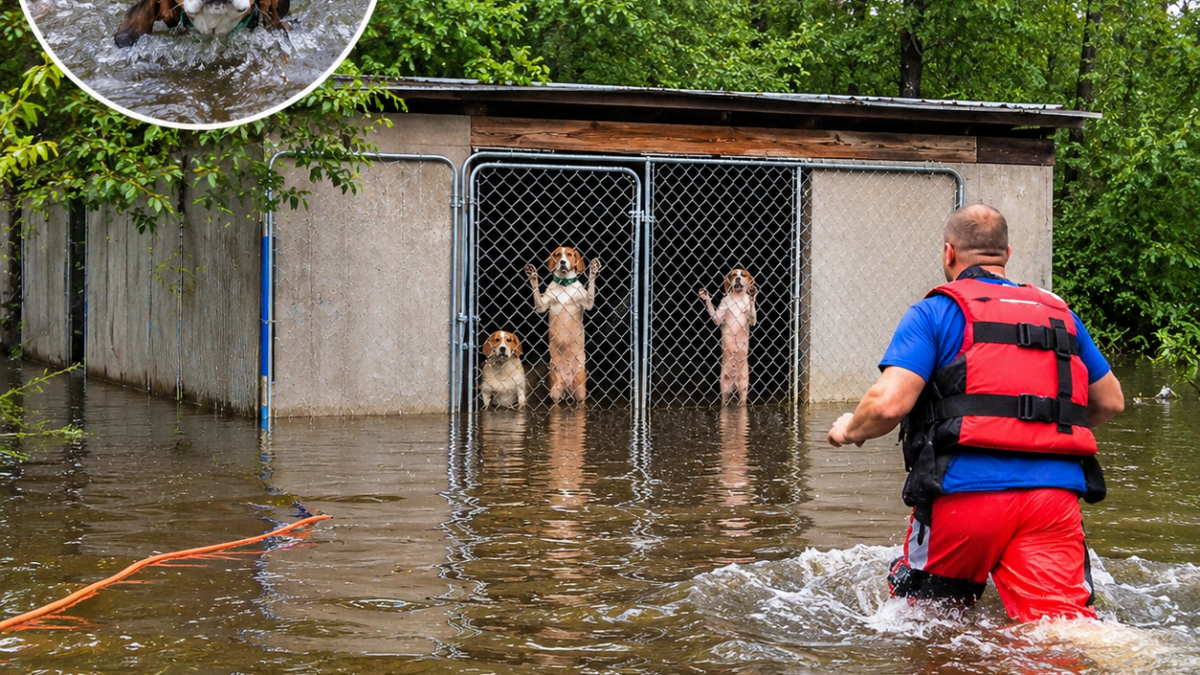
By the time I saw the six dogs trapped behind that house, the floodwater was already so high they could barely keep their heads above it.
They were locked inside a metal cage, standing on their hind legs and pressing against the bars while Hurricane Florence kept pushing more water into the neighborhood.
But what led us behind that house began with a sound I almost could have mistaken for something else.
It was Sunday afternoon, September 16, 2018, and Leland, North Carolina, no longer looked like an ordinary town.
Hurricane Florence had dumped enormous amounts of water across the area, turning streets into muddy channels and backyards into ponds.
Homes stood surrounded by floodwater.
Fences disappeared beneath the surface.
Everything familiar had been reduced to rooftops, trees, porch railings, and whatever else remained high enough to stay visible.
I had come from Texas with my friend David Rebollar because we knew what flooding could do to people.
A year earlier, Hurricane Harvey had flooded my own home and business.
I knew what it felt like to watch water enter a place you had believed was safe.
I knew how helpless people could feel when they had only minutes to make decisions about what mattered most.
So when Florence hit North Carolina, David and I wanted to help.
Freelance journalist Marcus DiPaola was with us that afternoon, documenting what was happening as we moved through the flooded area helping residents escape.
There was water everywhere.
Every movement had to be deliberate because you could not always tell where the road ended or how deep the next step would be.
We were focused on people who still needed help when a sound carried through the storm-damaged neighborhood.
At first, I could not immediately tell where it was coming from.
Then I heard it again.
Dogs.
Not barking the way dogs bark when someone walks past a fence.
Not the excited noise of animals seeing strangers.
They were howling.
There was something desperate in it.
David heard it too.
We stopped what we were doing and listened.
The cries came from somewhere behind a house.
We followed them.
As we moved closer, the sound became clearer, and then we saw the cage.
Six dogs were locked inside.
Floodwater had already filled the enclosure.
Whenever they dropped onto all four legs, the water rose dangerously close to their heads.
Some of them were stretching upward, balancing as best they could.
Others pressed their bodies against the metal.
There was nowhere inside that cage for them to climb.
There was no dry corner.
There was no platform above the water.
There were only six frightened dogs, metal bars, and water that was still rising.
The moment they saw us, everything changed.
They began pawing at the cage.
Their bodies pushed toward the gate.
And somehow, despite everything happening around them, their tails started wagging.
That detail has stayed with me.
They were terrified, but they seemed to understand that people had finally arrived.
For me, there was no decision to make.
We had to get them out.
We reached the gate and opened it.
But opening the cage did not instantly place them on dry ground.
The dogs still had to cross the floodwater themselves.
One by one, they came out.
One by one, they began swimming.
We watched every head moving through that muddy water, knowing that getting the gate open was only the first part.
They had to make it to the higher section of the backyard.
The first dog reached it.
Then another.
Then another.
Until all six were out.
All six made it.
On the higher ground, there was food available for them, and for the first time since we had heard those cries, I could look at the cage without seeing six lives trapped inside it.
Later, we learned why the dogs had been left behind.
Their owners said they had been forced to evacuate and had not been permitted to return for their pets.
Marcus had captured the rescue on video.
By the following morning, nearly three million people had watched what happened.
But at that moment, none of us knew how far those images would travel.
All we knew was that the water was continuing to rise.
And when I looked back at that cage before we left, one thought was impossible to escape.
If we had arrived later, there might not have been six dogs waiting for us at all.
[END OF FACEBOOK CAPTION]
[FIRST COMMENT / FULL STORY CONTINUATION]
The image of that cage stayed with me long after we opened the gate.
Even while I was standing there in the flooded backyard, watching the last of the six dogs reach the higher ground, part of my mind kept returning to what we had seen only moments earlier.
Six bodies pressed against metal bars.
Six pairs of eyes tracking our movement through the water.
Six animals trying to make themselves taller because standing normally had become dangerous.
There are moments during a disaster when the scale of everything happening becomes almost impossible to understand.
A hurricane affects thousands of people at once.
Whole neighborhoods disappear beneath water.
Roads close.
Homes flood.
Families evacuate.
Emergency crews move from one crisis to another.
The numbers become so large that it is easy to think of the disaster itself instead of the individual lives inside it.
But standing behind that house, the disaster had suddenly become very small.
It was one cage.
Six dogs.
One locked gate.
And water rising around them.
That was all that mattered.
David and I had come to North Carolina because Hurricane Harvey had taught me how quickly normal life could fall apart.
The year before, my own home and business had flooded.
Until you experience something like that, water can seem almost harmless.
You turn on a faucet and water comes out.
You watch rain fall against a window.
You drive past rivers without thinking much about them.
Then a storm arrives, and water becomes something completely different.
It enters places where it does not belong.
It covers roads you have driven hundreds of times.
It moves through rooms where your family has eaten, slept, worked, laughed, and lived.
It damages things that took years to build.
And it forces people into decisions they never expected to make.
That experience changed the way I looked at disasters.
When I saw reports of Hurricane Florence striking the Carolinas, I did not see only flooded streets on television.
I knew there were people standing somewhere inside those images wondering what they were going to lose.
I knew there were families trying to leave.
I knew there were people who might need someone from outside the disaster zone to show up and help.
David felt the same pull to do something.
So we came from Texas.
There was no grand plan behind it.
We were volunteers trying to be useful wherever people needed us.
Marcus DiPaola was there documenting the conditions and the rescue work.
His camera meant that people outside the flooded area would eventually see things those of us standing in the water were experiencing directly.
But while we were moving through Leland that Sunday, I was not thinking about cameras or how many people might someday see the footage.
The storm had reduced everything to immediate decisions.
Where could we move safely?
Who needed help?
Which route was still passable?
How high was the water getting?
Where should we go next?
Then came the howling.
There are sounds you hear and forget within minutes.
There are others that stay with you because of what they mean.
Those dogs were not simply making noise.
They were trying to be heard.
Maybe they had been howling for a long time before we reached that area.
Maybe the storm had swallowed some of their cries.
Maybe other noises had covered them.
I could not know.
What I did know was that when the sound finally reached us clearly, it was impossible to ignore.
I remember stopping.
David stopped too.
For a moment, we were both listening rather than moving.
The sound came again.
Dogs.
Somewhere nearby.
The neighborhood around us had been transformed by the flood.
Water had spread across properties until the usual boundaries between one yard and another seemed almost meaningless.
Things that normally helped you understand where you were had disappeared beneath the surface.
But the cries gave us a direction.
We followed them toward the back of a house.
With every step, I became more certain we were hearing animals in trouble.
Then the cage came into view.
I wish I could say I had been prepared for what we saw.
I was not.
Six dogs were inside an outdoor enclosure.
The gate was locked.
Water had filled the cage.
It had already climbed so high that the dogs could not simply stand normally and wait.
When they dropped onto all four paws, the water came dangerously close to their heads.
So they stretched themselves upward.
Some rose onto their hind legs.
Some pushed against the bars.
The metal enclosure that should have contained them safely had become a trap.
They could see the flooded yard outside.
They could see open space.
But they could not reach it.
The only thing separating them from a chance to survive was that gate.
And the water did not care.
It kept rising.
That was the part that made the situation so urgent.
If the water level had been stable, perhaps there would have been more time.
But this was the middle of catastrophic flooding from Hurricane Florence.
The conditions were getting worse.
Every extra inch inside that cage reduced the dogs’ ability to keep their mouths and noses above the surface.
Looking at them, I did not need anyone to explain what would eventually happen if the gate remained closed.
Marcus later said the same thing plainly.
They would have drowned.
When the dogs noticed us approaching, their behavior changed immediately.
The howling gave way to movement toward the bars.
Paws came up against the metal.
Bodies pressed forward.
Tails wagged.
I still think about those tails.
Fear and hope can exist together in an animal in a way that is difficult to describe.
Those dogs had no idea who we were.
They did not know we had come from Texas.
They did not know why we were in Leland.
They did not know Marcus was recording what was happening.
They only knew that people were moving toward their cage.
And that was enough for them to react.
It felt as though they understood one simple thing.
Someone had finally heard them.
There was no time for hesitation.
We moved to the gate.
The water around us made everything slower than it would have been on an ordinary day.
Nothing about that afternoon was ordinary.
I remember concentrating on the enclosure and on the dogs inside it.
When you see frightened animals trapped in rising floodwater, the rest of the world becomes very distant.
You are not thinking about what the rescue will look like later.
You are thinking about the next few seconds.
Get the gate open.
Give them a way out.
Make sure they move toward higher ground.
That was it.
When the gate finally opened, the dogs suddenly had something they had not had a moment earlier.
A choice.
They could leave the cage.
But leaving still meant entering the floodwater.
There was no dry path waiting outside.
The yard itself was flooded.
The dogs would have to swim.
For animals already exhausted from holding themselves up in a cage, that mattered.
The first dog moved out.
Then another.
Their bodies slipped into the water.
Their heads stayed above the surface as their legs began working beneath it.
We watched them carefully.
The distance to safety was not enormous, but in those conditions every yard of water seemed important.
One dog reached the higher section of the backyard.
Then the next followed.
I counted them almost instinctively.
One safe.
Another safe.
Another moving.
Another coming out of the cage.
The rescue was not finished because the gate was open.
It was finished only when every dog had made it across.
That became the focus.
Six had been trapped.
Six had to reach the higher ground.
The dogs swam.
Their ears flattened.
Their faces stayed just above the muddy surface.
Then paws found solid ground.
Bodies rose out of the water.
The number kept climbing.
Four.
Five.
Then the sixth dog made it.
All six were out.
I do not remember feeling triumphant.
Relief is a quieter emotion than people sometimes imagine.
It can arrive as a release of tension you did not realize you were carrying.
For the previous minutes, every part of the situation had been unfinished.
The cage was still filling.
The dogs were still trapped.
The gate was still closed.
Then, suddenly, those statements were no longer true.
The cage was empty.
The dogs were free.
Every one of them had survived.
On the higher part of the backyard, there was food available for them.
The detail may sound small compared with the rescue itself, but at the time it mattered.
The dogs had somewhere above the deepest water to gather.
They were no longer spending all their strength simply trying to keep their faces above the flood.
Their situation was still far from normal.
The neighborhood was still flooded.
The hurricane had not disappeared.
Their owners were not standing beside them.
But the immediate danger of the cage was gone.
I looked back toward the enclosure.
Without the dogs inside it, the metal bars seemed different.
A few minutes earlier, that cage had held six living animals in rising water.
Now it stood empty.
The water remained.
That contrast was difficult to shake.
The flood did not stop because we had opened the gate.
If anything, the conditions continued to show us how narrow the margin had been.
As we prepared to leave, the water had risen even higher.
That fact changed the way I understood the rescue.
It was not a case where the dogs might have been uncomfortable for a few more hours before someone returned.
The danger was immediate.
The cage was becoming more deadly by the minute.
Marcus later explained that if we had not found them, the dogs would have drowned.
Standing there and seeing the water level continue to climb, I believed it.
There simply was not enough height inside the enclosure to give them unlimited time.
Eventually they would have become tired.
Eventually they would no longer have been able to remain upright.
Eventually there would have been nowhere left for them to put their heads.
That possibility followed me even after we moved away from the backyard.
Disaster stories are often told through outcomes.
People hear that six dogs were rescued, and because they already know the ending, the moment can feel safer than it actually was.
But we did not know the ending when we first heard those cries.
When we approached the cage, six dogs were still in danger.
When we reached the gate, they were still trapped.
When the first dog entered the floodwater, we still had five more to get out.
The outcome only became certain after the last dog reached higher ground.
That is why I remember the rescue not as one dramatic moment but as a sequence of small moments that all had to go right.
First, we had to hear them.
Then we had to stop.
Then we had to find where the sound was coming from.
Then we had to reach the cage.
Then the gate had to open.
Then each dog had to leave.
Then every one of them had to swim.
If any part of that chain had been delayed too long, the story might have been different.
Later, information about the dogs’ owners added another layer to what had happened.
It would have been easy for people watching a short video to assume the animals had simply been abandoned without explanation.
The reality was more complicated.
Their owners said they had been forced to evacuate and had not been permitted to return to retrieve their pets.
That detail mattered.
Hurricanes force people into situations that look simple only from a distance.
When authorities tell residents to leave an area, decisions happen quickly.
Roads can become dangerous.
Return routes can be blocked.
Officials may prevent people from entering flooded neighborhoods because conditions are unsafe.
A family can leave believing there will be a chance to return and discover later that the water has removed that possibility.
Knowing what I knew from Hurricane Harvey, I understood how quickly circumstances could move beyond anyone’s control.
The flood did not ask whether people were ready.
It did not wait for every animal to be moved.
It simply kept coming.
Still, seeing those dogs in that cage made one thing impossible to ignore.
Animals depend completely on the decisions people make before a disaster becomes overwhelming.
A dog cannot read an evacuation order.
It cannot understand a weather forecast.
It cannot look at a hurricane track and decide that conditions may become dangerous tomorrow.
And a dog locked inside a cage cannot free itself when the water begins to rise.
That responsibility belongs to us.
Marcus’s camera captured what words alone would have struggled to communicate.
It showed the water.
It showed the cage.
It showed the dogs.
It showed how they had to rise onto their hind legs.
It showed their paws reaching toward the bars.
It showed their tails moving when we arrived.
And it showed them swimming out after the gate opened.
At the time, I was aware Marcus was there, but I was not thinking about the video as something that would travel far beyond that backyard.
For me, the rescue existed only in the place where it happened.
A flooded neighborhood in Leland.
A Sunday afternoon.
Six dogs.
David.
Marcus.
Me.
The water.
The cage.
But once the footage was shared, the scene stopped belonging only to us.
People everywhere could see what we had seen.
By the following morning, nearly three million people had watched the video.
That number was difficult to comprehend.
Only hours earlier, six dogs had been almost invisible behind a flooded house.
Their cries had been reaching whoever happened to be close enough to hear them.
Then suddenly millions of people were watching their rescue.
The same animals that had been trapped with no way out had become visible to people far beyond North Carolina.
I thought about how strange that was.
During the rescue, those dogs needed only a few people.
They did not need three million viewers.
They needed someone within hearing distance to respond.
But afterward, the millions of people watching gave the moment a different kind of importance.
The rescue could become a warning.
Someone preparing for the next hurricane might see those dogs and make a different choice.
Someone who had thought, “I’ll come back for my pets later,” might realize that later is not always available.
Someone might understand that once floodwater rises and authorities close an area, good intentions may no longer matter.
The time to protect animals is before the route home disappears.
I kept returning to what Hurricane Harvey had taught me.
When my own home and business flooded the year before, I learned how little control a person sometimes has once a major storm takes over.
People imagine disasters as dramatic events with clear beginnings.
A storm arrives.
Water rises.
Everyone reacts.
But inside the experience, it is much messier.
There are warnings.
There are decisions.
There is uncertainty.
One road is open and then it is not.
One neighborhood looks safe and then water begins entering it.
You think you have another hour.
Then you discover you do not.
You think you will return for something.
Then officials tell you the area is closed.
That is why preparation matters so much.
By the time a person is standing in deep floodwater, options have already disappeared.
The dogs behind that house had no options at all.
Their entire world had become the dimensions of the cage.
They could move only as far as the bars allowed.
They could stand.
They could stretch.
They could howl.
That was all.
I have wondered many times what they experienced before we arrived.
I cannot know, and I do not want to pretend I can.
But I know what we saw when we found them.
I know how urgently they were trying to remain above the water.
I know they came toward us when they realized we were there.
I know they pawed at the bars.
I know their tails wagged.
And I know that when the gate opened, they did not remain inside.
They swam toward safety.
There was trust in that moment.
Not the kind of trust built slowly between a dog and an owner over years, but the immediate trust of an animal recognizing an escape.
The gate opens.
There is water.
There are people outside.
There is higher ground ahead.
Move.
One dog followed that possibility.
Then another.
I watched their heads cutting through the floodwater.
I watched them find the higher part of the yard.
I watched the cage become emptier.
The fifth dog made it.
Then the sixth.
Six lives.
The phrase sounds almost too simple.
Every one of those animals had a personality.
Every one had habits, fears, and attachments we knew nothing about.
Every one mattered to someone.
In a disaster large enough to fill national news, saving six dogs might seem like a tiny act.
But to those six dogs, it was everything.
That is one of the lessons disasters had already taught me.
You cannot solve an entire hurricane.
No volunteer can.
You cannot personally reach every flooded home or rescue every stranded person or animal.
The scale is too large.
But you can help whoever is in front of you.
You can stop when you hear something.
You can look behind the house.
You can open one gate.
Sometimes that is what helping looks like.
Not changing the whole disaster.
Changing the outcome for whoever you can reach.
David and I had come to North Carolina because other people had helped communities in Texas after Harvey.
That mattered to us.
There is something powerful about people traveling into a place they do not call home simply because they know what the people there are facing.
A year earlier, I had been the one watching floodwater change my life.
Now I was standing in somebody else’s flooded neighborhood.
That connection made the experience intensely personal.
The houses were different.
The state was different.
The hurricane had a different name.
But the feeling was familiar.
Water does not care about state lines.
Loss feels the same whether it happens in Texas or North Carolina.
So does relief.
I cannot say what those six dogs understood about the people opening their cage.
But I know what I understood.
Helping them was part of the reason we had come.
Nobody had directed us to that exact backyard.
We had not arrived with a report saying there were six dogs behind a house.
We found them because we heard them.
That fact has always seemed important.
The sound could have been dismissed.
During a hurricane, neighborhoods are filled with unusual noises.
Wind.
Water.
Things shifting.
Animals.
People calling out.
Equipment.
Vehicles.
There are a hundred reasons to keep moving.
But we stopped.
We listened again.
That small decision led us behind the house.
Behind the house was the cage.
Inside the cage were six dogs whose time was running out.
Sometimes people imagine rescue as something performed by heroes who immediately know exactly what to do.
I did not feel like a hero.
I felt like a man standing in floodwater looking at animals who needed a gate opened.
The situation told us what needed to happen.
There was no mystery.
The dogs could not remain inside.
So we got them out.
David was right there.
Marcus was documenting it.
The dogs did the hardest part themselves once the gate opened.
They swam.
That matters to me too.
We gave them a path.
They took it.
Each one had to move through the water toward higher ground.
Each one made it.
When I picture the rescue now, I often see the transition between confinement and movement.
Inside the cage, the dogs could only react to the water.
Outside it, they could finally move away from danger.
That was the difference the open gate made.
Freedom alone did not remove the flood.
The water was still deep.
The yard was still damaged.
The hurricane was still creating danger across the region.
But freedom gave them a chance.
That chance was enough.
As the dogs gathered on the higher section of the property, the atmosphere felt different.
Their immediate panic had somewhere to go.
They could stand without having to stretch their bodies upward just to breathe.
Food was available there.
For a moment, the rescue became quiet.
I could observe what had just happened instead of trying to change it.
The cage remained partially submerged.
The gate that had separated the dogs from safety was open.
Water moved through the space where they had been trapped.
It kept rising.
That was the detail that made celebration difficult.
We had made it in time.
But not by an unlimited margin.
The flood was still advancing.
If we had passed through the area later, the dogs would have faced even deeper water.
If we had not heard them, no one standing nearby would have known exactly what was happening behind that house.
If the dogs had become too exhausted to howl, there might have been nothing to lead us toward them.
Those thoughts were not hypothetical in some distant sense.
They were visible in the waterline.
Marcus could see it too.
Later, he would explain publicly that the dogs would have drowned if they had remained in the cage.
It was not exaggeration.
The physical reality was right there.
A metal enclosure does not float away from danger.
A locked gate does not become easier to open because an animal is frightened.
The dogs’ ability to survive depended on keeping their noses and mouths above the surface.
The water level was steadily taking that space away.
The video would eventually let millions of people see the danger for themselves.
When Marcus shared the footage, people did not have to imagine what “dogs trapped in flooding” meant.
They could see animals standing upright against metal because ordinary standing had become unsafe.
They could watch the moment people approached.
They could watch paws reach for the gate.
They could watch the escape.
Images have a way of stripping away distance.
A person sitting safely in another state could suddenly feel how close those dogs had been to disaster.
That may be part of why the footage spread so quickly.
Nearly three million views by the following morning meant that in less than a day, an incident from one flooded backyard had become known around the country and beyond.
But I hope people saw more than a dramatic rescue.
I hope they saw the moment before the rescue.
That is where the lesson lives.
The safest version of this story would have been one in which the dogs were never trapped in rising water at all.
The best rescue is the one that never becomes necessary.
Their owners later said they had been forced to evacuate and were not allowed back to retrieve them.
I could imagine the helplessness in that situation.
You leave.
You expect to return.
Then conditions deteriorate.
The authorities close access.
The water rises.
Suddenly something you planned to do becomes impossible.
That is why disaster preparation has to begin before the final evacuation order.
Pets have to be part of the plan from the beginning.
Not after the car is packed.
Not after the road starts flooding.
Not after someone says residents cannot return.
Before.
The dogs behind that house became a painful example of what can happen when a storm outruns a family’s ability to go back.
I do not tell their story to condemn people whose evacuation happened under circumstances I did not personally experience.
I tell it because I saw the result.
Six dogs were almost lost.
That result is worth remembering.
As volunteers, David and I were focused on helping residents who were dealing with an immediate crisis.
We were not there to judge anyone.
Disasters create enough suffering without outsiders simplifying decisions made under pressure.
What mattered in that backyard was the fact that the dogs were alive and could still be saved.
Once we saw them, the past could wait.
The gate could not.
That distinction stayed with me.
There are questions you can ask later.
Why were they there?
How had the evacuation happened?
Who knew the water would rise that high?
Why could no one return?
Those questions matter.
But none of them mattered more than opening the cage.
In an emergency, priorities become brutally clear.
Life first.
Explanation later.
So we opened it.
All six dogs swam out.
All six reached higher ground.
That is the part of the story I remain grateful for.
There was no seventh dog we could not reach.
There was no animal lost in the cage before we arrived.
There was no moment where one disappeared beneath the water.
Every dog made it.
In rescue work, you learn not to take complete outcomes for granted.
Sometimes circumstances do not allow them.
This time they did.
That makes the memory easier to carry.
But it does not erase how close the situation had become.
I can still imagine the cage a little later, with the water higher.
The image is enough.
I do not need to imagine what would have happened after that.
Marcus said it clearly.
They would have drowned.
Sometimes five minutes matters.
Sometimes twenty minutes matters.
During a flood, a few inches of water can separate danger from catastrophe.
We had no way to calculate exactly how much time remained.
We only knew it was shrinking.
That urgency is part of why the dogs’ response affected me so much.
They did not know whether we would succeed.
They only saw us coming.
Their paws reached toward the bars.
Their tails wagged.
It was as if hope arrived before safety did.
For people who love dogs, that is difficult to forget.
Dogs often continue trusting humans even in situations where humans have failed to protect them.
These animals did not retreat from us.
They came closer.
They seemed to understand that whatever had happened before, the people approaching now represented a possibility.
Their reaction placed an emotional responsibility on us.
Once you see that kind of hope through metal bars, walking away does not feel like an option.
We did not walk away.
When the first dog entered the floodwater outside the enclosure, I watched closely.
Swimming is natural for many dogs, but this was not a clean pool.
It was hurricane floodwater moving through a property.
The dog had already been standing in water for who knew how long.
Still, it moved.
The next followed.
Then another.
There was purpose in their movement.
Get away from the cage.
Reach the high ground.
The water that had trapped them became the distance they had to cross to survive.
That transformation struck me.
Inside the cage, water was an enemy they could not escape.
Outside the cage, it became something they could move through.
The difference was choice.
The open gate created that choice.
I sometimes think about how many rescue situations work that way.
You cannot always carry someone completely out of danger.
Sometimes you can only remove the barrier preventing them from moving.
That afternoon, a metal gate was the barrier.
Once it opened, six dogs did the rest.
David and I watched until every one was clear.
There was no reason to count aloud.
We both knew the number.
Six.
You keep track naturally when lives are moving through danger.
If five had reached higher ground, the rescue would not have been complete.
There would still have been one to find.
But the sixth dog arrived.
Six out.
Six safe from the cage.
The relief I felt in that moment was mixed with anger at the flood itself, although anger at weather has nowhere useful to go.
Hurricanes are indifferent.
They destroy without intention.
They do not recognize pets, homes, memories, businesses, or boundaries.
Florence was doing what Harvey had done to Texas a year earlier.
Taking ordinary places and making them dangerous.
The best response people can offer is preparedness before the storm and compassion afterward.
I had been on the receiving end of that compassion.
That is one reason I wanted to give it back.
When my home and business flooded during Harvey, people helped one another everywhere.
Strangers showed up.
Communities worked together.
The disaster was terrible, but the response revealed something good about people.
Coming to North Carolina felt like continuing that chain.
Somebody helps you when your state is flooding.
Later, another state floods.
You go there.
Not because you can repay the exact person who helped you, but because kindness does not have to travel in a straight line.
The dogs behind that house became part of that chain too.
We had come to help people.
Then animals called us in another direction.
So we followed.
That was the right thing to do.
Marcus’s presence meant the moment would not disappear once we left the neighborhood.
Journalists often stand close to events most people only hear about later.
His camera preserved details memory eventually softens.
The position of the dogs.
The height of the water.
Their movement when we approached.
Their swim to safety.
People could look for themselves.
That mattered when the story spread.
No one needed an exaggerated description.
The footage was powerful because reality was enough.
Six dogs trapped in a flooding cage did not need embellishment.
The situation itself carried all the emotion.
That is something I have always believed about disasters.
The truth is usually dramatic enough.
You do not need to turn people into villains or rescuers into superheroes.
You need only show what happened.
A hurricane flooded Leland.
Owners evacuated.
Six dogs remained inside a locked outdoor cage.
Water rose until they had to stand upright.
David and I heard them.
We found them.
We opened the cage.
They swam out.
Every one survived.
The water continued rising.
That is the story.
Everything else grows from those facts.
When the video approached three million views, I wondered what people were taking from it.
Some probably watched because they loved animals.
Some because the rescue was dramatic.
Some because Hurricane Florence was major news.
Some may have watched because the footage appeared in their social feeds without any context.
But I hoped at least a few people watched differently.
I hoped someone with a dog living in a hurricane zone imagined their own pet behind those bars.
I hoped someone looked at the cage and decided they would never assume they could come back later.
I hoped emergency preparation lists gained one more item.
Food.
Water.
Documents.
Medication.
Pets.
Not as an afterthought.
As part of the family.
Because when evacuation begins, every minute can matter.
The owners of these six dogs learned that returning was not always possible.
Their experience should not be reduced to a simple accusation.
It should be understood as a warning.
Conditions can change after you leave.
Authorities may restrict access for safety.
Roads may disappear beneath water.
You may not get another chance.
If your dog is with you when you leave, those problems do not separate you.
If your dog remains behind, everything that happens next may be outside your control.
That is the reality Marcus eventually distilled into five words.
But before those five words traveled across social media, there was still the flooded backyard.
There was still the empty cage.
There were still six wet dogs on the higher ground.
I remember looking at them and feeling how small the distance between life and death sometimes is.
A few feet of water.
A metal gate.
A sound carried far enough for someone to hear.
That was the difference.
People sometimes ask what makes someone stop during a disaster.
I do not know that there is a complicated answer.
You hear distress.
You investigate.
If you can help, you help.
Had we continued past that area without listening, I would have carried that possibility with me forever once I learned what had happened.
Instead, we stopped.
The decision took seconds.
Its effect lasted much longer.
That is why the phrase “someone heard them” matters so much to me.
The dogs did everything available to them.
They howled.
They moved toward the bars.
They tried to stay above the water.
They could not unlock the gate.
Human beings had to do that part.
The responsibility was ours once we discovered them.
And afterward, the responsibility expanded to everyone who saw the footage.
Not responsibility for those specific six dogs, because they had already been rescued.
Responsibility for the next six.
The next storm.
The next evacuation.
The next family deciding whether to leave a dog behind because they expect to return.
Disasters repeat their patterns.
The names change.
Harvey.
Florence.
Another hurricane after that.
Another flood somewhere else.
But the vulnerable remain the same.
Children.
Older people.
People without transportation.
Animals dependent on their owners.
Preparedness exists because once the emergency is fully underway, choices become narrower.
I knew that from Harvey.
The owners of these dogs learned it through Florence.
Millions of viewers saw it through Marcus’s camera.
The dogs themselves lived it inside a cage.
That is why the ending of this story is both happy and uncomfortable.
The happy part is simple.
All six survived.
Every single dog escaped the cage.
Every single dog reached higher ground.
There is no hidden tragedy after that moment in the story I know.
Their rescue was complete.
But the uncomfortable part remains.
They came dangerously close to not surviving.
The water continued to rise after they were removed.
That means the difference between the outcome we got and the outcome we feared was not theoretical.
It was time.
Had the cries gone unheard longer, the water would still have risen.
Had we reached the house later, the dogs would have had less space to breathe.
Had exhaustion taken over before help arrived, standing on their hind legs would no longer have protected them.
Knowing that makes the successful rescue feel even more precious.
It also makes the lesson impossible to dismiss.
When people saw the footage, many focused on the emotion of the dogs wagging their tails.
I understood why.
That image captures the best part of the moment.
Hope.
But I also wanted people to notice the water around their bodies.
Hope should not have had to arrive that late.
Pets should not have to reach the point of standing against cage bars waiting for strangers.
The story should begin earlier.
It should begin when the weather forecast first becomes serious.
It should begin when a family prepares to evacuate.
It should begin with a leash placed beside the emergency bags.
A carrier ready for the cat.
Food packed.
Medication packed.
Identification checked.
A destination that accepts animals identified.
Those steps are less dramatic than a rescue video.
No millions of people watch someone calmly putting a dog’s food into a car before a storm.
But that quiet preparation is what prevents desperate scenes.
The rescue of the six dogs showed people what failure of timing can look like.
The fact that all six survived gave the story a merciful ending.
When I think back to September 16, 2018, I do not remember the day as a viral moment.
I remember the physical reality of it.
Floodwater around my body.
The damaged neighborhood.
David beside me.
Marcus nearby with his camera.
The sound of dogs somewhere we could not immediately see.
Then the cage.
Then paws against bars.
Then tails moving.
Then the gate opening.
Then six dogs swimming.
One.
Two.
Three.
Four.
Five.
Six.
Safe.
Those details matter more to me than any number on a screen.
Three million views could not make the rescue more successful.
Six survivors already did that.
But the views gave those six survivors a voice far louder than their original howling.
Their cries reached us in one North Carolina neighborhood.
Their story reached millions.
That transformation carried a responsibility.
If people were going to watch, the footage needed to mean something.
Marcus understood that.
When he shared it, he did not turn the rescue into a complicated speech.
He used five words.
Five words that summarized everything the cage had taught us.
Five words that were easier to remember than any long disaster-preparedness guide.
Five words that could fit into the mind of someone standing in their kitchen while a hurricane warning played on television.
I had seen what could happen when those words were not followed early enough.
I had watched six dogs stand upright because floodwater had taken away their ability to stand normally.
I had seen them press toward strangers because strangers were their only remaining path out.
I had watched the water continue rising after the cage was empty.
So when Marcus wrote those five words, they did not sound dramatic to me.
They sounded practical.
They sounded necessary.
They sounded like the lesson the six dogs had nearly paid for with their lives.
“Bring your pets with you!”
There was no better ending.
Not because every disaster can be controlled.
It cannot.
Not because evacuation is always simple.
It is not.
And not because people caught in hurricanes always get perfect choices.
They do not.
The message mattered precisely because disasters remove choices.
Taking your animals with you while you still can protects one choice before the storm takes it away.
The owners of the six dogs had been forced to evacuate and were not permitted to return.
That meant the moment to get the dogs out had already passed before they realized they would not be allowed back.
No amount of love for an animal can unlock a road authorities have closed.
No good intention can lower floodwater.
No promise to return can guarantee that conditions will allow it.
Preparation has to account for that uncertainty.
That is what I want people to remember from our rescue.
Not my name.
Not the fact that David and I came from Texas.
Not how many views Marcus’s video received.
Remember the dogs.
Remember how high the water was.
Remember that they were standing on their hind legs.
Remember their paws on the bars.
Remember their tails when they saw someone coming.
Remember that each dog had to swim.
Remember that all six made it because there was still enough time.
Then imagine the same cage a little later.
That image explains everything.
I was grateful we never had to see what would have happened.
We reached them.
We opened the gate.
They survived.
Sometimes a satisfying ending does not need anything more.
No miracle beyond the rescue.
No dramatic reward.
No grand ceremony.
Six animals who were in danger got to keep living.
For me, that was enough.
David and I eventually moved on because other people still needed help.
That is another reality of disaster response.
You do not remain forever at the place where one rescue succeeded.
There is always another road.
Another flooded home.
Another person trying to get out.
You take the relief with you and keep working.
But certain moments remain attached to you.
The six dogs became one of those moments for me.
Maybe because of how close they were to drowning.
Maybe because of the way they reacted when they saw us.
Maybe because Harvey had already made me understand what floodwater can take.
Or maybe because the entire rescue depended on something so simple.
Hearing them.
There was no sophisticated equipment that led us to the cage.
There was no detailed search operation.
There was a sound.
We listened.
That was the beginning.
People sometimes underestimate the value of paying attention.
During emergencies, everyone is overwhelmed.
There are alarms, warnings, urgent tasks, and fear.
It is easy to narrow your focus so much that everything outside the immediate mission disappears.
But help sometimes comes from noticing what was not on the plan.
We were helping residents.
Then we heard dogs.
The mission widened.
Six lives were added to the people and animals who mattered that afternoon.
That is what compassion does.
It notices.
It does not ask whether the need fits neatly into the schedule.
It responds.
I do not say that to make ourselves sound exceptional.
I say it because anyone nearby could have faced the same choice.
Hear the cries and keep moving.
Or hear the cries and look.
We looked.
That simple act changed the ending.
The dogs’ tails wagging when we approached is the detail that keeps bringing me back.
Animals do not understand rescue videos.
They do not know when their story will be shared online.
They do not know the word “volunteer.
”
But they understand attention.
They understand a person moving toward them instead of away.
They understand a hand reaching for a gate.
The dogs responded before they were actually safe.
They trusted the direction things were moving.
That trust felt like a promise.
Once we had approached the cage, we had to finish.
We did.
The last dog reaching higher ground gave us the only ending we wanted.
Six had been trapped.
Six were free.
When I think of the millions who watched afterward, I hope the video did not simply make them feel relieved.
Relief fades.
Preparation lasts.
I hope somebody bought a carrier after seeing it.
I hope somebody added pet food to an emergency kit.
I hope somebody called a hotel ahead of a storm and asked whether dogs were permitted.
I hope somebody put a leash by the door.
I hope somebody who once thought, “I’ll leave the dog here and come back,” remembered six wet faces behind metal bars and changed their mind.
Those are outcomes we could never measure.
The video view count was visible.
The decisions it changed were not.
But that was the real value of the footage.
A rescue can save the animals in front of you.
A lesson from that rescue can save animals you will never meet.
Marcus understood that when he added his five-word message.
The words traveled farther than any of us did that day.
They reached people who would never stand in Leland floodwater.
They reached people whose next hurricane had not happened yet.
That is how one frightening moment can become useful after the immediate danger ends.
For the six dogs, the story ended on higher ground.
For everyone watching, the warning began there.
I sometimes wish every disaster lesson could be learned without anyone coming close to dying.
Unfortunately, many of the lessons people remember most are attached to images like that cage.
Maybe that is because urgency becomes real when it has a face.
Six faces in this case.
Before seeing the video, “bring your pets during evacuation” might sound like obvious advice.
After seeing the video, the reason becomes unforgettable.
The owner may not be allowed back.
The road may close.
The water may rise faster than expected.
A cage may become a death trap.
A dog cannot solve any of those problems alone.
People have to act early.
That is the truth the storm exposed.
It is also why I resist turning the story into a simple tale of heroes and victims.
Real life is more useful than that.
The owners loved their pets and later explained they had been forced out and could not return.
David and I happened to be in a position to intervene.
Marcus happened to be there to document it.
The dogs happened to have enough strength left to swim.
Timing connected all of us.
No single piece of that should be taken for granted.
Change the timing and the ending changes.
That is what makes preparation more dependable than luck.
You cannot guarantee volunteers will hear your dogs.
You cannot guarantee someone will find a backyard cage.
You cannot guarantee a gate will still be reachable.
You cannot guarantee floodwater will pause.
You can make one decision before evacuation.
Take the animals.
The simplicity of that message is what gives it power.
After everything we had seen that afternoon, there was nothing more complicated to say.
The dogs were alive because strangers arrived at the right time.
The next family should not have to depend on strangers arriving at all.
I carried that thought with me as we moved on through the flooded area.
The sound of the dogs faded behind us.
The water did not.
Leland was still dealing with Hurricane Florence.
People still needed help.
The scale of the emergency remained enormous.
But somewhere behind us, on a higher piece of backyard, six dogs were no longer trapped.
In the middle of so much destruction, that mattered.
It mattered enough.
Disaster response is built from moments like that.
One family moved.
One person transported.
One animal freed.
One gate opened.
No single rescue ends the disaster.
Together they keep the disaster from taking everything.
That afternoon, Florence did not get those six dogs.
I remain grateful for that.
I am grateful we heard them.
I am grateful the gate opened.
I am grateful they had the strength to swim.
I am grateful all six reached safety.
And I am grateful Marcus recorded it, because memory belongs to the people who were there, but video can turn memory into warning.
Nearly three million people saw that warning by the next morning.
Maybe some watched only once and moved on.
Maybe some shared it.
Maybe some cried.
Maybe some became angry.
But somewhere among them, I hope there were pet owners who looked at their dogs differently the next time a storm appeared on the weather map.
I hope they imagined a locked gate.
I hope they imagined rising water.
Then I hope they clipped on the leash and said, “You’re coming with me.
”
That would be the best legacy those six dogs could have.
Their rescue would not only have saved them.
It would have prevented another cage from ever reaching the same point.
I cannot know whether that happened.
What I do know is what happened in front of me.
Six dogs were trapped.
They cried for help.
We heard them.
We found them.
We opened the gate.
They swam.
Every one survived.
Sometimes people search for complicated meaning in moments like that.
I do not think this one needs complication.
Listen when something is crying for help.
Act when you still have time.
And when disaster is coming, do not assume you will be able to return for those who depend on you.
Take them with you.
Because the water may rise.
The road may close.
The authorities may not let you back.
And the difference between rescue and tragedy may come down to whether somebody happens to hear a desperate sound from behind a house.
On September 16, 2018, somebody did.
That is why six dogs lived.
And that is why Marcus DiPaola’s five words still deserve to be remembered before the next storm arrives.
“Bring your pets with you!”