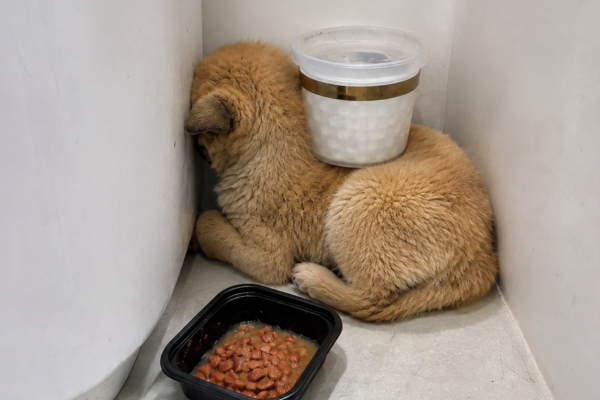
A Hungry Puppy Went to a Restaurant Begging for Food—Then He Was Found Badly Burned and Crying in Pain
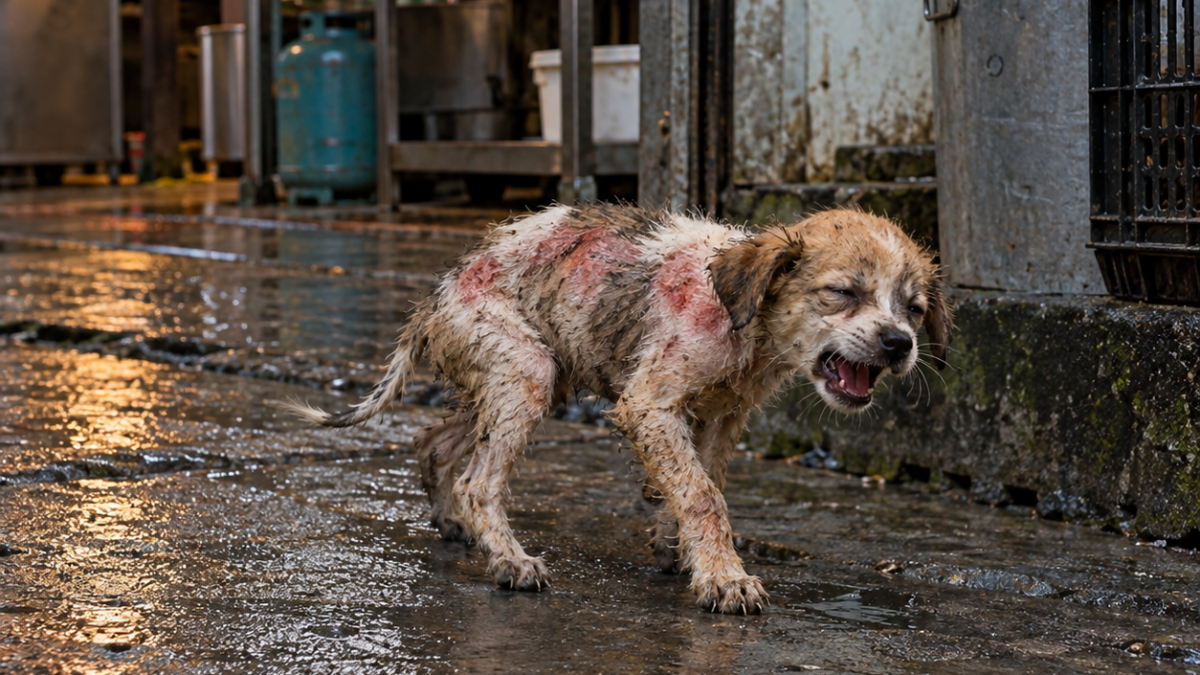
For two weeks, I had been waiting to see those eyes.
During the earliest days, his eyelids had remained closed so tightly from pain that every time I looked at his face, I wondered whether the burns had damaged more than his skin. We had too many immediate problems to pretend we knew the answer. His body was thin. Ticks had covered him. He had vomited several times. The worm infection was serious. The burns required careful treatment, and infection had to be controlled.
But his eyes stayed in the back of my mind.
When he finally opened them after two weeks, relief came before anything else.
Fortunately, there was no serious injury to the eyes.
That sentence felt enormous.
His face still had a long road ahead. The burns had not disappeared. The newly forming skin still irritated him. He was not suddenly a healthy puppy simply because he could see again.
But he could open his eyes.
And his eyes were still there for him.
He looked around the veterinary clinic with obvious fear.
For the first time, I could see how much information he had been missing while pain kept those eyes shut. The room must have seemed strange. People moved around him. Equipment made unfamiliar sounds. Hands approached to examine areas of his body that were tender.
He watched everything cautiously.
Yet something had changed during those two weeks.
He recognized our voices.
That mattered more than I expected.
We had been around him through the treatments, the cleaning, the medications, the uncomfortable examinations, and the long hours when he could not understand why his body hurt so badly. Sight had not been available to him in the way it was now, but sound had been there.
He knew the voices.
When he heard us, he became calmer.
That was when I began to believe he understood something very simple about the people surrounding him.
We were trying to help.
I did not imagine that he understood treatment, infection, burns, or veterinary medicine. He could not know why certain procedures were necessary. He could not know that Longacef had been used for three days as part of fighting infection. He could not know why we watched his skin so closely or why every episode of vomiting made us anxious.
But he could learn patterns.
A familiar voice came close.
A hand touched him carefully.
Painful treatment ended.
Food appeared.
Water appeared.
Someone stayed.
Night passed.
People returned.
Those patterns could mean safety even without words.
And slowly, he became calmer.
The puppy who had once run while crying in fear began allowing us near him.
It was not a sudden transformation.
His body still remembered pain.
Sleep showed us that.
There were moments when he became frightened in dreams.
Watching him then was difficult because there was nothing obvious we could remove from the room to stop it.
The danger was gone.
The burn had already happened.
The hot oil was not there.
No one was chasing him.
Yet his sleeping body sometimes reacted as though fear had followed him inside.
I would watch him and think about how strange recovery can be.
The skin can begin closing before fear does.
A wound can dry while the memory of pain still feels fresh.
A puppy can become medically safer while his body remains prepared for something bad to happen.
That was why his recognition of our voices meant so much.
We could not control his dreams.
But when he woke, we could make sure reality was different.
He would hear voices he knew.
He would see people trying to help.
He would not be sent back toward the place where he had been burned.
The veterinarian made it clear that treatment was still going to be long.
Opening his eyes was a victory, but it was not the end.
His face still needed time.
The burns had been severe.
The skin needed continued care.
Infection needed to remain controlled.
His body needed nutrition and rest.
His worm problem had added another burden to a puppy who was already too thin.
Every improvement had to be protected.
We were learning not to celebrate as though each good sign meant all danger had passed.
With Nemo, progress came in layers.
One problem would improve.
Then another problem would demand attention.
At that stage, however, we still had not given him the name Nemo.
He was simply the little burned puppy we were trying to save.
And while we concentrated on him, the question surrounding the restaurant remained.
The restaurant owner was called in.
We wanted an explanation.
According to him, what happened had been an accident.
He said that at the time, he had stumbled and fallen against a pan of oil.
That was his explanation.
But the camera did not show that happening.
From our perspective, his story felt like a clumsy attempt to explain what had occurred after the fact.
Still, our direct knowledge had limits.
We knew the puppy had gone to the restaurant because he was hungry and begging for food.
We knew he had suffered severe burns from hot cooking oil.
We knew the images had shown him frightened and running while he cried.
We knew the owner later said it had been accidental.
And we knew the camera did not show the stumble he described.
Those were the facts we had.
I was angry.
I could not help it.
Every time I looked at the puppy’s face, it was difficult not to return to the same thought.
There were other ways to make a hungry puppy leave.
A person could step outside.
A person could move the dog away.
A person could close a door.
Whatever happened in that moment, the result was a puppy with badly burned skin and eyes squeezed shut from pain.
But anger did not clean wounds.
Anger did not stop itching.
Anger did not help a frightened puppy sleep.
So once again, I had to bring my attention back to him.
His skin was becoming drier with each passing day.
That was visible progress.
The angry, wet appearance of the earliest injuries began changing.
The doctor told us there was real improvement.
Infection was tightly controlled.
Those words gave us room to breathe.
For so long, everything about his body had felt vulnerable to worsening.
Now the direction was beginning to change.
The surface was drying.
The infection was under control.
His eyes were open.
His awareness was clearer.
He knew the sounds of the people around him.
The puppy who had arrived looking overwhelmed by pain was starting to participate in his surroundings.
I watched him follow movement with his eyes.
At first, the expression remained cautious.
He had no reason to trust quickly.
Every time somebody approached, he seemed to assess whether something uncomfortable was about to happen.
Veterinary care often has that problem.
The same people who save an animal may also have to perform procedures the animal dislikes.
The puppy cannot understand the difference between pain caused by injury and discomfort caused by treatment.
We had to rely on consistency.
Gentle voice.
Careful handling.
Rest afterward.
Food when appropriate.
No unnecessary force.
And time.
Time did something we could not rush.
It allowed him to collect evidence.
Not every person approaching him caused harm.
Not every touch meant burning pain.
Not every room was dangerous.
He could close his eyes and sleep, even if dreams sometimes frightened him, and wake up in the same safe place.
The doctors were still there.
We were still there.
Nothing terrible had happened while he slept.
That repetition slowly began changing him.
One day, I realized he was no longer reacting to every approach with the same tension.
He watched.
But he did not always retreat.
He listened.
When he heard familiar voices, his body seemed to settle.
Those tiny changes meant as much to me as the drying skin.
Physical healing was necessary.
Emotional safety made the healing life worth returning to.
After a few more days, the doctors decided we could go home.
The sentence sounded almost unbelievable.
Home.
For so long, the clinic had been the center of our life with him.
Treatment schedules.
Checks.
Skin.
Infection.
Vomiting.
Worms.
Eyes.
Every conversation seemed medical.
Now the doctor was telling us we could leave with prescribed medications and continue care outside the clinic.
That did not mean treatment was finished.
It meant he was stable enough to continue elsewhere.
There were medications to follow.
Skin care would continue.
His face still needed healing.
But we could take him home.
I watched him during that transition and thought about how different his life had already become.
He had approached a restaurant because he was hungry.
Now there would be food.
He had run while crying in fear.
Now he would have somewhere he did not need to run from.
He had slept through frightening dreams in a clinic.
Now we could give him a bed.
The bed affected him immediately.
He was so happy to have it.
That reaction was one of the first moments when his personality appeared without pain dominating everything.
Until then, most of what we knew about him came through suffering.
He was frightened.
He hurt.
He itched.
He vomited.
He endured treatments.
He opened his eyes cautiously.
A bed gave us another version of him.
A puppy capable of enjoying something.
He settled into it with the kind of satisfaction that made me smile.
It was such a simple object.
Soft.
Safe.
His.
I began sending and giving him many little gifts.
After everything he had endured, I wanted him to have things that were connected only with happiness.
Our boy could not hide his joy.
That was the phrase that came naturally to us.
Our boy.
Somewhere during all those days, he had stopped being an unnamed suffering puppy.
He had become ours emotionally.
He thanked me in the sweetest way he knew.
With a little kiss.
That moment felt almost absurdly gentle compared with the images that had started this journey.
A puppy whose face had been badly burned was kissing me.
The same little dog who had once been running and crying was now expressing trust.
I knew animals do not frame gratitude exactly as people do.
I did not pretend the kiss was a sentence.
But to me, it felt like thanks.
It felt like connection.
And I accepted it that way.
He genuinely enjoyed the new place.
He explored what he could.
He rested.
He responded to attention.
The bed became one of his favorite comforts.
The atmosphere around him had changed.
At the clinic, even safe care carried the smells and sounds of medical treatment.
At home, there was room for ordinary puppy behavior.
He could sleep without a procedure waiting immediately afterward.
He could investigate gifts.
He could receive affection with no medical purpose attached.
That mattered.
We finally gave him a name.
Nemo.
Our brave boy.
The name fit him because by then we had seen how much he had tolerated without giving up.
The veterinarian had already commented on his resilience.
Nemo rarely cried even when he was hurting.
I did not interpret silence as absence of pain.
If anything, it made me more attentive.
Some animals do not announce their suffering loudly.
You have to notice posture.
Movement.
Appetite.
Sleep.
The way they protect part of the body.
The way they hesitate before contact.
Nemo taught us to watch those quieter signs.
His face remained our biggest visible concern.
Would it ever return to normal?
That question came up again and again.
The burns had been so severe that it was impossible not to wonder what permanent changes might remain.
Hair was missing.
The skin looked different.
Areas that had once been raw were now drying and rebuilding.
The itching showed that new skin was forming, but healing skin did not guarantee his face would eventually look exactly as it had before.
We asked the doctor.
There was still a chance.
That gave us hope.
Not certainty.
A chance.
We took it seriously.
A special moisturizing bath gel became part of his care.
He also received a vitamin-rich cream for the damaged skin.
We used them carefully.
The goal was to support the skin as it healed, keep it moisturized appropriately, and give his face every reasonable opportunity to recover.
Nemo cooperated remarkably well.
That made treatment easier.
I sometimes wondered whether he had learned that the strange routines usually led to feeling better afterward.
Again, I could not know what he understood.
But he tolerated us.
He allowed care.
He seemed to recognize that we were not trying to hurt him.
For a puppy whose introduction to people in this story involved pain at a place where he had gone asking for food, that trust felt enormous.
We tried everything the doctors recommended to help him.
Bathing.
Cream.
Medication.
Observation.
Nutrition.
Rest.
Patience.
There was no single magic step.
Healing was a collection of small actions repeated long enough for the body to respond.
I became used to examining his face every day.
At first, changes were difficult to see because I was looking too often.
When you watch healing hour by hour, progress can disappear into familiarity.
But photographs told the truth.
The skin looked different from one stage to the next.
Dryer.
Calmer.
Less inflamed.
The outline of his face became easier to see without the injury overwhelming everything.
That gave us hope.
At the same time, another question remained unresolved.
Where had Nemo come from?
We searched repeatedly for his family.
Because he had been found around the restaurant, we wondered whether he lived somewhere nearby.
Perhaps someone had lost him.
Perhaps there was a household looking for a puppy who never came home.
We did not want to assume abandonment when we did not know.
So we searched.
We went back to the area.
We looked for information.
We tried more than once.
But nothing worked.
No family appeared.
No clear history emerged.
Nemo’s life before the restaurant remained a mystery.
That uncertainty bothered me because I wanted to understand.
Was he born nearby?
Had he wandered far?
Had someone once cared for him?
How long had he been hungry enough to approach a restaurant and beg?
The source gave us no answers.
So we did not invent them.
His origin remained unknown.
What we did know was what happened after we met him.
And by then, Nemo was becoming more comfortable every day.
His happiness around gifts was impossible to miss.
He enjoyed attention.
He enjoyed the bed.
He enjoyed the safety of being indoors.
Our boy seemed to understand routine quickly.
Meals came regularly.
No need to beg outside a restaurant.
Water was available.
Hands approached gently.
Medication might not always be enjoyable, but nothing about it resembled the terror that had brought him to us.
We began allowing ourselves to think the worst might finally be behind him.
That was dangerous hope.
Not because hope itself was wrong.
Because Nemo’s body had already surprised us more than once.
Still, I wanted to believe.
The burns were healing.
The infection was controlled.
His eyes had escaped major injury.
His skin was improving.
He was home.
He had a bed.
He had a name.
We were treating him carefully.
Surely, I thought, we had reached the easier part.
Then he developed diarrhea.
Soon vomiting returned too.
The change frightened us immediately.
With another puppy, those symptoms would still have been concerning.
With Nemo, after everything his body had already endured, they felt terrifying.
I looked at him and thought, not again.
We genuinely believed the suffering had ended.
He had already been through severe burns.
Ticks.
Worms.
Vomiting.
Infection.
Pain.
Two weeks of uncertainty before he could even open his eyes normally.
Long skin treatment.
What more could his small body be expected to handle?
Yet there it was.
Diarrhea.
Vomiting.
Another storm moving toward us just as the sky had seemed to clear.
We went back to the doctor.
There was no hesitation.
Nemo needed a thorough examination.
The medical team began trying to understand what was happening.
I remember watching the process with a kind of dread that had become familiar.
Waiting for results can be worse than receiving information.
Your mind fills the silence.
You remember every serious possibility.
You look at the animal beside you and wonder which future is about to arrive.
Nemo seemed smaller again in that moment.
The confident little boy who had been enjoying gifts and a bed suddenly looked vulnerable.
I wanted the symptoms to be something simple.
Something temporary.
Something that would pass quickly.
But the result was what I had feared most.
Nemo tested positive for parvovirus.
Parvo.
The word hit us hard.
It is a serious disease for dogs, and for a puppy whose body had already spent so much energy healing from burns and infection, the diagnosis felt cruel.
We had barely allowed ourselves to breathe.
Now we were back inside fear.
Once again, we stood up and did what we had to do.
There was no other option.
Nemo needed us.
All the doctors tried to help him.
Treatment began.
Observation became constant again.
The home routine we had just started enjoying was replaced by another medical fight.
I felt angry at the timing, as though illness had waited until we finally believed Nemo was safe.
Of course, disease does not think that way.
Parvovirus was not punishing us.
It was simply another serious condition his body had to overcome.
But emotionally, it felt like another blow.
I remember looking at his recovering face and thinking about how unfair it was.
New skin had formed.
His eyes had opened.
Hair was still trying to return.
He had learned to trust.
And now the inside of his body was under attack again.
There was a time when his health declined badly.
The doctors worked.
We watched.
We waited.
Every small change mattered.
Hydration.
Vomiting.
Diarrhea.
Energy.
Response.
Nemo could not understand why he had been taken back into intensive care after finally discovering a comfortable bed.
He only knew he did not feel well.
That thought hurt.
When he had first come to us, pain had been visible on the outside.
Now much of the danger was internal.
There was no dramatic burn pattern to show us exactly how severe each hour was.
We relied on the doctors and on his body’s response.
There were moments when he seemed terribly weak.
And there was a time when we thought we might lose him.
That is not a sentence I use lightly.
We had already wondered at the beginning whether he would survive the burns.
Then he had surprised us.
He had opened his eyes.
He had gone home.
He had kissed me.
He had enjoyed his bed.
He had received gifts with obvious happiness.
Now I found myself looking at the same puppy and wondering whether all those moments might be all we ever had.
I did not want to think that way.
But fear does not always ask permission.
It entered anyway.
I remembered the first woman’s call.
Her crying.
The blurry image.
The red skin.
Nemo running while frightened.
I remembered his closed eyes.
The ticks.
The vomiting.
The worm infection.
I remembered the three days of Longacef.
The drying skin after ten days.
The itching.
The frightening dreams.
The moment he opened his eyes after two weeks.
I remembered bringing him home.
The bed.
The kiss.
The gifts.
And I thought, you have already fought through so much.
Please do not let this be where it ends.
Of course, Nemo could not hear that as a command to survive.
Recovery is not a moral choice.
A sick puppy is not stronger or weaker as a person depending on the outcome.
His body would respond however it could.
Our job was to give it every chance.
The doctors did that.
We did that.
We kept going.
Step by step.
That became the only way to think.
Not tomorrow.
Not the final outcome.
The next step.
Get through this hour.
Then the next.
Watch his response.
Follow the treatment.
Stay near.
Parvo can make a puppy look as though all energy has been drained away.
Seeing Nemo like that after he had recently been so joyful was especially painful.
I missed the boy who had been excited about gifts.
I missed the way he settled into his bed.
I missed the sweet kiss.
Those memories became reminders of what we were trying to return him to.
A life beyond illness.
A home beyond treatment.
A puppyhood beyond survival.
And slowly, Nemo began responding.
There was no single instant when everything changed.
His recovery came step by step.
That phrase became literal for us.
A little more stability.
A little more alertness.
A little more strength.
Then another day.
Then another improvement.
The boy who had looked dangerously low began coming back.
His eyes seemed more present.
His body held itself differently.
Energy returned in small amounts.
Every gain felt fragile.
We did not rush our expectations.
We had learned too much about setbacks to assume.
But we allowed ourselves hope again.
Nemo was overcoming parvo.
The same little body that had already survived serious burns was fighting through another severe illness.
I thought again about the veterinarian’s earlier comment that Nemo was extremely resilient.
At the time, the doctor had been talking about how little he cried even during pain.
Now the word resilience seemed to describe something larger.
Not because Nemo consciously decided to be brave.
But because his body kept finding a way forward when given care.
The burns healed.
The infection came under control.
The eyes opened.
The skin regenerated.
Now, slowly, the parvovirus illness began losing its hold.
One week later, Nemo was healthy.
Healthy.
After the fear of losing him, that word almost felt impossible to say.
But there he was.
The crisis had passed.
His strength had returned.
His behavior was brighter.
The doctors were satisfied enough for us to leave again.
It was time to go home together.
The second return home felt very different from the first.
The first time, I had been focused on his burns.
Could his face continue healing?
Would the skin recover?
Would hair grow again?
Would we manage the medications correctly?
The second time, I felt something almost protective toward ordinary life itself.
Please, I thought, let nothing else happen.
This puppy had been through enough.
More than enough.
I wanted boredom.
I wanted peaceful days.
I wanted meals without vomiting.
I wanted a bed without nightmares.
I wanted skin care to be the most complicated thing we had to think about.
I wanted Nemo to discover what it meant to be a puppy rather than a patient.
When we arrived home, the difference in him was obvious.
He was more active.
More cheerful.
He moved with an energy that had been missing during the parvo crisis.
Our boy was back.
Not exactly the same as before, because his body had continued changing through every stage of healing.
But the spark was there again.
He wanted to interact.
He wanted to move.
He wanted to participate in the life around him.
I looked at him and thought about the puppy in the first photographs.
The comparison was astonishing.
The original images had been dark and unclear.
His skin had looked terribly red.
His eyes had been closed.
His body had been painfully thin.
Now he was upright, aware, active, and safe.
His face was changing too.
Day after day, it looked better.
That question we had asked earlier—would his face ever return to normal?—was beginning to receive an answer through his own body.
Hair started growing back.
At first, the change was subtle.
Small areas.
Fine new growth.
Then enough to notice clearly.
I would look closely and feel excitement over something that might seem ordinary to anyone else.
Hair.
Just hair.
But for Nemo, every new patch meant the burned skin had traveled another step away from the injury.
His face no longer looked frozen in the moment of suffering.
It was becoming his face again.
That distinction meant everything to me.
An injury can dominate the way we see an animal.
People look first at the wound.
The missing hair.
The scar.
The damaged area.
I did that too at the beginning because the burns were impossible to ignore.
Over time, however, Nemo’s personality became stronger than the injury.
I started seeing him before I saw the burn.
His eyes.
His excitement.
His kiss.
His happiness about the bed.
His cooperation during treatment.
His growing energy.
The hair returning only strengthened that shift.
He was no longer “the burned puppy” in my mind.
He was Nemo.
Our brave boy.
The moisturizing bath gel remained part of his routine.
The vitamin-rich cream remained part of his routine too.
We did not stop treatment simply because things looked better.
The skin needed continued support.
Nemo cooperated.
He had become so used to our care that the process felt less frightening for everyone.
At first, handling his face had made me nervous because I knew how much pain he was carrying.
Later, the routines became gentle and familiar.
Apply what the doctor recommended.
Watch the skin.
Give medication.
Keep him comfortable.
Let time work.
There was no need to rush.
After everything Nemo had survived, patience seemed like the smallest thing we could give.
His activity increased as his health stabilized.
There was a lightness to him that had been absent before.
He seemed ready to explore.
Ready to move.
Ready to enjoy his body now that so much pain had passed.
Watching him become cheerful again changed the atmosphere of our days.
For weeks, every observation had been linked to concern.
Is that redness worse?
Is the skin too wet?
Is he scratching?
Has he vomited?
Can he open his eyes?
Is the infection controlled?
Why does he have diarrhea?
What will the parvo test show?
Is he getting weaker?
Now questions became simpler.
Does Nemo want to play?
Does he want to go outside?
Is he enjoying himself?
That shift felt like freedom.
A puppy should not spend his whole life being medically observed.
Eventually, treatment should make room for living.
Nemo was reaching that point.
He discovered activities he enjoyed.
Swimming became one of them.
Running on grass became another.
The image of him enjoying water and moving across grass felt almost unbelievable compared with the frightened puppy near the restaurant.
There was no hot cooking oil.
No desperate begging for food.
No running away while crying.
Just Nemo.
Moving because he wanted to.
Running because his body allowed it.
Swimming because he enjoyed it.
Those moments were the ones I had wanted for him without knowing exactly what they would look like.
Ordinary puppy happiness.
I did not need anything more dramatic.
He had already experienced enough drama.
The grass mattered because it represented freedom from clinical floors and painful pavement.
Water mattered because it was something he could enjoy rather than something connected to treatment.
Movement mattered because his body was no longer consumed by illness.
I watched him and felt grateful for every uncomplicated minute.
There was still a mystery behind him.
We never found the family he might have come from.
We had returned to the area around the restaurant.
We had searched multiple times.
Nothing gave us the answer.
Nemo’s earlier life remained unknown.
I stopped trying to fill the blank.
It was tempting to imagine a story.
Maybe he had been abandoned.
Maybe he had wandered away.
Maybe he had never had a family.
But none of those possibilities were facts.
The honest answer was simple.
We did not know where Nemo came from.
And eventually, I realized we did not need to know in order to care for the dog he was now.
Origins matter.
But they do not determine whether help is deserved.
Nemo needed care regardless of how he reached that restaurant.
He had been hungry.
That was enough to explain why he approached.
He was a puppy looking for food.
He found danger instead.
That part remained difficult for me to accept.
A hungry animal approaching humans is an act of vulnerability.
The puppy is already admitting, in his own way, that he cannot meet a need alone.
He goes where food smells strong.
He waits.
He hopes scraps might fall.
He does not understand property, business rules, or human frustration.
He only knows hunger.
Nemo’s hunger brought him to the restaurant.
What happened there changed his body.
For a long time, it changed his sleep too.
That contrast stayed with me.
All he wanted was food.
And yet he ended up needing emergency care.
I could not change that beginning.
But every meal we gave him afterward carried a different meaning.
He no longer had to beg.
He did not have to approach strangers hoping someone would show mercy.
Food became predictable.
A bowl appeared because it belonged to him.
That is one of the simplest gifts you can give a rescued animal.
Predictability.
Hunger becomes less frightening when the animal learns another meal will come.
Safety becomes real when the same bed remains in the same place.
Trust grows when the same gentle hands return.
Nemo learned those patterns.
The excitement he showed around his home told me he was settling deeply.
He enjoyed being there.
That happiness made me think about the woman who had first called us.
She had been crying.
At that moment, she could only see suffering.
I wondered what she would think if she could see Nemo now.
Not because the story needed a reunion with her.
It did not.
But emotionally, the contrast was powerful.
The puppy she had seen frightened and burned had become an active boy whose hair was returning.
A puppy who could swim.
A puppy who could run on grass.
A puppy who slept in a bed.
A puppy with a name.
Nemo.
There were times when I stood watching him and had to remind myself that this was the same dog.
The face changed daily.
That was one of the most satisfying parts.
Burn recovery is slow enough that improvement can hide inside routine.
If you look every day, it sometimes seems nothing is happening.
Then you compare one week with another.
The difference appears.
Skin tone.
Texture.
Hair.
Expression.
Nemo’s face moved steadily toward something softer and more familiar.
The doctor had told us there was still a chance it could recover well.
We held onto that chance without demanding perfection.
I did not need every trace of injury to disappear before calling him beautiful.
He was already beautiful to us.
The question was about comfort and function more than appearance.
Was his skin healthy?
Was the itching reducing?
Was hair returning?
Were there signs of infection?
Those mattered.
Cosmetic perfection did not.
Still, seeing the hair grow made me happy.
It was visible evidence of repair.
Nemo’s body was rebuilding what it could.
After parvo, the word recovery carried even more weight.
We had almost lost him.
That fear had changed the way I looked at every ordinary behavior afterward.
If Nemo ate normally, I noticed.
If he wanted to play, I smiled.
If his stool remained normal, I felt relief I might once have considered excessive.
If he ran, I watched longer.
If he slept peacefully, I checked him once and then let him rest.
Every ordinary thing had recently been uncertain.
That made ordinary life precious.
We did not need big milestones anymore.
The biggest milestone was that there was no crisis.
No vomiting.
No diarrhea.
No collapse in health.
No emergency diagnosis.
No new storm.
Just Nemo healing.
That was enough.
I remembered thinking during the parvo illness, please let nothing else happen.
Now each quiet day felt like that request being answered.
One day.
Then another.
Then another.
His face improved.
His strength improved.
His confidence improved.
The puppy began looking less like a survivor of something terrible and more like a young dog discovering what he liked.
Swimming.
Grass.
Attention.
His bed.
Gifts.
Food.
People.
These preferences filled out his personality.
They replaced the medical vocabulary that had once defined almost every conversation about him.
At first, Nemo was burns, ticks, worms, vomiting, infection.
Then he was skin healing, eyes opening, itching, medication.
Then parvo.
Eventually he became Nemo who likes to swim.
Nemo who runs on grass.
Nemo who gives sweet kisses.
Nemo who cannot hide his happiness.
That change is what rescue is supposed to create.
Not merely survival.
Identity beyond suffering.
I wanted people to look at him and see a dog, not an injury.
The injury mattered.
We would never deny it.
It explained why he needed us.
It shaped months of care.
But it did not deserve to own his entire future.
Nemo’s future belonged to Nemo.
As he became more active, I found myself wondering again whether his face would continue returning toward normal.
The hair answered little by little.
Yes, improvement was still happening.
His skin looked healthier.
The texture softened.
The stark difference between injured and uninjured areas became less overwhelming.
The moisturizing treatment and vitamin-rich cream remained part of our effort, but time became just as important.
Bodies heal on schedules we cannot command.
We can support them.
We cannot force them.
Nemo had already taught us that through the first ten days.
The skin dried when it was ready.
New growth itched.
His body moved from one stage into another.
Now hair followed.
I became patient enough to enjoy the process instead of constantly demanding the final result.
He was alive.
Healthy.
Happy.
The rest could take time.
That attitude felt almost impossible compared with the beginning.
At first, time had terrified me.
Would he survive another day?
Would infection spread?
Would his eyes be damaged?
Would treatment work?
During parvo, time became frightening again.
Would he make it through the night?
Would he stabilize?
Now time was our friend.
Another day meant more healing.
Another week meant more hair.
Another ordinary morning meant Nemo had another chance to play.
That was a beautiful reversal.
I thought about resilience again.
People sometimes talk about resilience as if suffering automatically makes someone stronger.
I do not believe that.
Nemo should never have been burned.
Parvo should never have happened.
His worm infection and ticks were not gifts.
Pain did not improve him morally.
What resilience meant in Nemo’s case was simply that, with treatment and support, his body kept recovering.
He tolerated more than a puppy should have needed to tolerate.
That fact deserved respect, not romanticization.
I would have chosen an easier path for him if I could.
No burn.
No vomiting.
No worms.
No parvo.
Just a healthy puppy growing normally.
But we did not get to choose the beginning.
We could only choose our response.
So we responded.
Again and again.
That became the heart of his story for me.
A woman saw suffering and called.
We went.
Doctors treated.
We stayed.
A setback came.
We returned.
Another disease appeared.
Doctors treated again.
We stayed again.
Nemo improved.
Care repeated until survival turned into life.
Nothing supernatural happened.
Yet watching him now could still feel miraculous.
The miracle was not that medicine stopped being necessary.
The miracle was what ordinary medicine, persistence, and care made possible.
A dog running on grass.
That image became one of my favorites.
Grass bends under paws.
It does not burn.
It does not demand.
Nemo could move across it without fear.
He could choose direction.
He could stop.
He could start again.
He could sniff.
He could run faster.
There was freedom in that.
I watched his face while he moved.
The healed and healing areas did not matter to him.
He was not worried about whether his hair looked perfect.
He cared about the experience.
That reminded me not to become too focused on appearance either.
We humans wanted his face to return to normal because we remembered the injury.
Nemo wanted to live.
Those goals could coexist, but living came first.
So we kept treating his skin and also let him enjoy his days.
Swimming showed me another side of him.
Water could have been uncomfortable for a dog whose skin had gone through so much, so we remained mindful of his condition and the care plan.
But as he healed, he genuinely enjoyed swimming.
Seeing him move through water with enthusiasm made me laugh.
This boy who had once hated every sensation around his injured face now had enough comfort to seek out new sensations.
Cool water.
Movement.
Play.
That was progress on a level no test result could fully capture.
He was confident enough to enjoy his body.
That mattered.
Fear had controlled him at the beginning.
He ran because he was terrified.
Now he ran because he wanted to.
Those are completely different kinds of movement.
One is escape.
The other is joy.
Nemo had traveled from one to the other.
I think that is why his running affected me so much.
The first image I had of him moving was a puppy fleeing while crying.
The later image was a puppy racing across grass happily.
Same legs.
Same dog.
Different world.
The difference was safety.
When we named him Nemo, we did not know exactly how much of this life he would get to enjoy.
We only knew he had already shown courage through treatment.
Then parvo challenged that hope again.
After he recovered, the name felt even more fitting.
But I still resisted turning him into some heroic symbol.
Nemo was a puppy.
He did not ask for battles.
He did not need to inspire anyone by suffering.
He deserved simply to be well.
That is what I wanted people to understand.
The best outcome was not that Nemo became famous for surviving.
The best outcome was that survival stopped being his daily job.
He could wake up and think only in the simple ways dogs do.
Food.
Play.
Smells.
People.
Rest.
Grass.
Water.
A bed.
Those ordinary concerns were a luxury compared with where he started.
I watched him enjoy them without needing to add anything else.
The restaurant story remained unresolved in some ways.
The owner had given his explanation.
He said he had stumbled and fallen against the oil pan.
The camera did not show what he described.
We had reported him.
Beyond that, Nemo’s healing became more important to us than endlessly repeating the accusation.
We could not change the past by arguing with it every day.
We could only make sure the puppy did not continue suffering because of it.
That became our priority.
Anger eventually softened into determination.
Treat the skin.
Control infection.
Help him eat.
Deal with the worms.
Watch the eyes.
Help the itching.
Follow the doctors.
Search for his family.
Treat parvo.
Bring him home.
Keep going.
Those actions had more value than any amount of rage.
I still thought about how unnecessary the entire injury seemed.
A hungry puppy should not have needed to learn fear at a restaurant.
But Nemo did not need me to stay angry forever.
He needed me present.
That lesson repeated through every part of his story.
When he scratched at healing skin, presence.
When he woke frightened from a dream, presence.
When he opened his eyes, presence.
When he came home, presence.
When diarrhea and vomiting started, presence.
When the parvo result came back positive, presence.
When his condition became so low we feared losing him, presence.
When he recovered, presence.
When hair grew back, presence.
Care is often less about knowing exactly what to say and more about not disappearing.
Nemo learned we did not disappear.
That may have been why he cooperated so well.
There was trust in his willingness to let us treat his face.
A frightened puppy does not naturally enjoy someone touching sensitive skin.
The fact that he allowed it showed how much our relationship had changed.
He recognized the pattern.
Hands came.
Treatment happened.
Then comfort returned.
No one hurt him intentionally.
No one abandoned him afterward.
He learned us.
We learned him.
That mutual familiarity made difficult care easier.
I knew the expression he made when he was uncomfortable.
I knew when he was tired.
I knew what real excitement looked like.
I knew the difference between restless itching and playful movement.
Those distinctions came from time.
Time had become another form of medicine.
Not because time alone cures everything.
Without treatment, his infections and parvo could have been disastrous.
But time allowed treatment to work.
Time allowed trust to form.
Time allowed hair to grow.
Time allowed a puppy who had known fear to collect enough safe experiences that fear no longer dominated every moment.
That is what our days became.
Safe experiences accumulating.
A meal without begging.
A nap without being disturbed.
A bath done gently.
Cream applied carefully.
A toy.
A bed.
A kiss.
A run.
A swim.
A day without vomiting.
A night without a frightening dream.
A morning where his face looked a little better.
Each one small.
Together enormous.
Sometimes I looked at the gifts around him and remembered how little he seemed to need emotionally at the beginning.
Safety first.
Then comfort.
Then joy.
Gifts were not what saved Nemo.
Medical care did that work.
Food helped rebuild him.
Consistent attention protected healing.
But gifts gave him something else.
Experiences connected only with pleasure.
After a life dominated by necessary handling, he deserved objects that asked nothing from him.
Something to investigate.
Something to enjoy.
Something that did not hurt.
His happiness made those simple gestures feel worthwhile.
Our boy could not hide what he enjoyed.
His body became expressive.
Tail.
Posture.
Eyes.
Movement.
The contrast with the closed-eyed puppy was profound.
At the beginning, his face could not show much because pain controlled it.
Now emotion moved freely across him.
Curiosity.
Excitement.
Contentment.
That was another kind of healing.
The return of expression.
One of the hardest memories remained the parvo period.
Even after he became healthy, I sometimes remembered how close we had felt to losing him.
Those memories could make me overly protective.
If he seemed quiet for a little too long, I noticed immediately.
If his appetite changed, I paid attention.
I had to remind myself not every pause was a crisis.
Recovery also means learning how to stop living inside emergency mode.
Nemo was healthy.
The doctor had said so after that week.
We could not treat him forever as if parvo were still happening.
We needed to let him live.
That took trust from us too.
Trust in his recovery.
Trust in the treatment that had worked.
Trust in our ability to notice real changes without turning every normal variation into panic.
In a way, Nemo and I were both learning safety.
He learned people could help.
I learned every quiet moment did not mean something was wrong.
We met in the middle.
Play helped.
When Nemo ran, fear had little room.
When he swam, I watched his body work and remembered how strong he had become.
When he ate, I felt relief.
When he slept comfortably, I let myself sleep too.
Our lives gradually moved away from crisis.
The medical supplies remained.
The skin routine remained.
But they no longer defined the day.
There is a moment in many recoveries when treatment stops being the story and becomes background.
We reached that moment.
Nemo’s personality took the foreground.
He was cheerful.
Active.
Affectionate.
Cooperative.
Happy.
That was who he was now.
I thought about the phrase “our son” because that was how we spoke about him affectionately.
Our boy.
He had entered our lives through emergency and stayed through relationship.
The bed he loved became a symbol of that.
A bed means you expect someone to sleep here again tomorrow.
It implies continuity.
Nemo had continuity now.
He could leave the bed to play and know it would still be there.
He could go outside and return.
He could go to the doctor and come home.
That last point mattered especially after parvo.
The veterinary clinic no longer represented disappearance.
Even when illness took him back there, home waited.
We returned together.
That pattern strengthened his trust.
I liked thinking about that.
The first terrible experience near the restaurant had shown him a human environment could be dangerous.
Our routine showed him another kind.
A place built around his safety.
We could not erase the first.
We could make the second larger.
Every passing day did that.
His face became more normal.
Hair grew.
The visual reminder of the burns softened.
His behavior also helped.
When a dog is joyful, people stop staring only at scars.
They notice the dog.
Nemo’s energy demanded that.
He ran past the injury.
Swam past it.
Played past it.
Not by forgetting.
Simply by living.
That was exactly what I wanted.
I stopped asking whether his face would ever look exactly as it had before the burn.
We never knew what it looked like before anyway.
There were no clear photographs of that life.
The only Nemo we truly knew was the one who came to us injured.
So perhaps “normal” was the wrong target.
Healthy was the target.
Comfortable.
Functional.
Happy.
Hair returning where it could.
Skin protected.
Those goals were enough.
Trying to recreate an unknown past would only make us miss the present.
Nemo looked better every day.
That was the truth.
I accepted it with gratitude.
His original family remained unknown too.
Eventually, that mystery became quieter.
We had tried.
We searched more than once.
We returned to the area.
Nothing.
At some point, searching without new information could not be the center of his life.
Nemo needed the people who were actually there.
We were.
That was enough for the present.
I did not invent an adoption or a reunion because none occurred in the source.
His journey ended with us caring for him, watching him heal, and seeing him ready for whatever came next.
That was already a complete emotional transformation.
Found in agony.
Treated.
Home.
Ill again.
Recovered.
Growing.
Playing.
Ready.
No additional event was necessary.
The strongest moment, to me, was not even one of the medical victories.
It was his sweet kiss.
That happened before parvo.
Before we knew another crisis was waiting.
The kiss represented something the later disease could not take away.
Trust had already formed.
Even when Nemo became sick again, he did not return emotionally to being the frightened puppy running from everyone.
He was sick inside a relationship.
That is different.
Illness is still frightening.
But being ill while someone stays beside you is different from being ill alone.
Nemo had us during parvo.
The doctors had him too.
Every person around him was trying to move him toward recovery.
That support did not guarantee survival.
But it meant he was not facing the disease without help.
When he became healthy after a week, I felt gratitude toward everyone who had tried.
All the doctors had helped him.
No one person could claim the recovery.
It was a collective effort surrounding one little dog.
That pattern had been there from the beginning.
A woman noticed.
She called.
We responded.
Veterinarians treated.
We continued care.
Nemo’s story depended on people choosing not to ignore suffering.
That was particularly meaningful because the first report had emphasized that no one seemed to care about his crying after the burn.
At the beginning, ignored.
Later, surrounded by people paying attention to every symptom.
That contrast stayed with me.
Attention saves lives.
The woman could have assumed someone else would call.
The doctors could have treated him as one more case.
We could have stopped once the burns improved.
Instead, people kept noticing.
That is what Nemo needed.
When diarrhea appeared after everything else, we noticed.
When vomiting returned, we noticed.
When the parvo test came back positive, treatment started.
If we had been careless because we thought the story was over, the outcome could have been different.
Recovery requires humility.
You do not declare victory too early.
You watch the animal you actually have in front of you.
Nemo reminded us of that.
Even after the parvo recovery, I continued watching without becoming obsessive.
The balance was difficult but necessary.
Let him be a puppy.
Remain responsible.
Both.
That balance gave him freedom.
He could run without us stopping him every few seconds.
He could swim.
He could explore grass.
He could enjoy his gifts.
And if something genuinely seemed wrong, we would respond.
That was a good life.
Not careless.
Not fearful.
Supported.
I thought sometimes about how the first woman’s tears had become our tears.
We cried when we saw the puppy.
Then later, during parvo, fear brought us close to tears again.
There had been so much emotion around one small dog.
But happiness eventually became the stronger one.
That was visible in Nemo himself.
Our boy could not hide his joy.
Neither could we.
When he became active after parvo, the house felt different.
A sick puppy makes a room quiet.
You listen for movement because there is so little of it.
A recovering puppy changes the sound.
Footsteps.
Play.
Movement.
Interest.
Life becomes audible again.
I loved that.
Nemo’s energy filled spaces that had once been filled by worry.
The first time he ran freely enough that I stopped thinking about his medical chart, I realized we had crossed another invisible threshold.
He was living.
Not demonstrating recovery.
Living.
That distinction gave me peace.
His face continued healing in the background.
Hair grew.
Cream continued.
Bath care continued.
But I no longer examined him first as a patient when I entered the room.
I greeted Nemo.
That may sound small.
It was huge.
A rescue succeeds when the animal stops being only the reason for an emergency.
Nemo became part of normal life.
He could annoy us with puppy energy.
Make us laugh.
Demand attention.
Enjoy things.
Those are privileges of health.
I wanted him to have all of them.
The restaurant was no longer the place defining each day.
We did not need to revisit it constantly.
Our search for his family had brought us back, but without results.
Eventually, the physical location became part of the past.
Nemo’s world grew beyond it.
Home.
Clinic when necessary.
Grass.
Water.
Places where people knew his name.
That expansion mattered.
Trauma can make a life feel reduced to one event.
Nemo’s life became larger than the burn.
That was perhaps the deepest recovery of all.
He had more experiences now.
Good ones.
Enough of them that the worst day no longer stood alone as the only important story.
The bed.
The gifts.
The kiss.
The eye-opening moment.
The first signs of hair.
The recovery from parvo.
The return home.
Swimming.
Running.
Each became another point on the map.
His life was no longer one terrible location.
It had movement.
I loved that idea.
Nemo kept moving forward, not in some symbolic human way he consciously understood, but literally through the world available to him.
Across floors.
Onto his bed.
Into water.
Across grass.
Toward people.
Movement had once been escape.
Now it was exploration.
That change was real.
Sometimes people asked whether his face would fully return to normal.
I understood the curiosity.
The burn had been dramatic.
But by then I was more interested in how Nemo felt than how strangers might judge appearance.
Was the skin healthy?
Was he comfortable?
Was hair returning?
Yes.
Good.
The rest could be whatever his body allowed.
If a scar remained, it would not reduce him.
If hair grew unevenly, he would still be Nemo.
We did what the veterinarian recommended because supporting recovery mattered.
But we were not trying to make him acceptable.
He was already accepted.
That was a powerful difference.
He did not have to become beautiful enough to deserve us.
He already deserved care when he was red, burned, thin, tick-covered, and sick.
Appearance never determined worth.
Watching his face improve was joyful because it reflected healing, not because we needed him to look perfect.
That perspective protected us from disappointment.
Every improvement became a gift.
Nothing became a demand.
Nemo seemed to thrive inside that environment.
Our cooperation during treatment became almost routine.
He understood positioning.
He tolerated the products.
He waited.
Then he was released to do something more interesting.
I smiled at his patience.
This was a puppy, after all.
Patience is not usually their favorite activity.
But Nemo had spent so much time being treated that he seemed to recognize the process.
I sometimes apologized to him even though I knew he did not understand the words.
“Almost done.”
“Good boy.”
“Just a little more.”
The tone was enough.
He listened.
Then came the reward.
Freedom.
Affection.
Rest.
Play.
These little cycles built our day.
They also strengthened connection.
Care was no longer something done to him by strangers.
It was something done with him by people he trusted.
That may be why his cooperation became so good.
Trust turns necessary discomfort into something tolerable.
Not painless.
Tolerable.
Nemo showed us that.
I remained amazed by how rarely he cried.
The doctor had remarked on it early.
Even in pain, he was usually quiet.
I never interpreted that as evidence the pain had been mild.
His closed eyes told another story.
His raw skin told another.
The frightening dreams told another.
Animals express suffering differently.
Nemo’s quietness was his way.
That knowledge stayed with me even after recovery.
A quiet dog can still need help.
A dog who does not scream can still hurt badly.
You have to look.
Maybe that was one reason the first images made us cry so quickly.
Even without clear sound, the body told the story.
Red skin.
Closed eyes.
Thin frame.
The puppy did not have to explain.
He needed help.
We were lucky the woman recognized that.
I remained grateful to her.
Her phone call started the chain that led to everything after.
Nemo’s bed existed because someone first said, this puppy cannot be left like this.
His recovered face existed because someone called.
His parvo treatment existed because we had already taken responsibility.
His runs through grass existed because intervention began when he was still a frightened burned puppy.
One decision can create many later possibilities.
That is not the same as saying one person saves everything alone.
No.
The rescue became a chain.
Woman.
Us.
Veterinarian.
Doctors.
Home care.
Nemo’s body’s own response.
Every link mattered.
That collaborative nature made his recovery feel even more precious.
We had all held one part.
And Nemo had lived through the whole.
When he became healthy after parvo, I wanted to protect the future fiercely.
No more storms, I thought.
Of course, nobody can command life that way.
But the wish was sincere.
This puppy had gone through enough.
I wanted his next difficulties to be ordinary puppy difficulties.
Being told not to chew something.
Getting wet.
Wanting more playtime.
Not another disease.
Not another injury.
Just life.
That is why seeing him ready for a new journey felt right.
Not because we knew exactly where every future day would lead.
We did not.
The source ends there.
Nemo today.
Healthier.
More active.
More cheerful.
Hair returning.
Enjoying swimming.
Running on grass.
Ready.
That word is important.
Ready does not mean his past vanished.
Ready means the past no longer prevented movement.
He had strength again.
Curiosity.
Trust.
A body that had recovered enough for play.
Those things allowed the next chapter to exist.
We did not need to write it before it happened.
Nemo’s present was enough.
I looked at him and thought about the long distance between two images.
The first: a blurry black-and-white picture of a badly burned puppy.
The second: Nemo now.
The difference cannot be captured only by skin.
In the first, there was fear.
In the second, confidence.
In the first, hunger.
In the second, regular care.
In the first, pain shutting his eyes.
In the second, eyes open to the world.
In the first, a nameless puppy.
In the second, Nemo.
In the first, running away.
In the second, running for joy.
That is transformation.
Not perfection.
Transformation.
His face told part of it.
His behavior told the rest.
I could see the hair returning.
But I could also see something less visible.
Trust.
A puppy does not kiss someone sweetly if that person represents only danger.
A puppy does not relax into a bed if he expects to be driven away.
A puppy does not cooperate through repeated skin care unless some level of safety has formed.
Nemo gave us those signs.
We did not need words.
His life answered.
I thought again about the restaurant owner’s explanation.
Accident, he said.
A stumble.
A fall involving the pan of oil.
The camera did not show the event he described.
For a long time, I wanted the story to provide a clean answer.
Intentional or accidental.
Truth or lie.
But the available information remained what it was.
We had our doubts.
We had reported him.
Beyond that, Nemo’s body carried the unquestionable part.
He had been burned severely.
Whatever argument people might have about how it happened, the puppy needed care.
I chose to let the uncertain details remain uncertain rather than inventing certainty.
That felt fairer to the story.
Nemo did not need exaggerated villains to make his suffering real.
The burns were real.
The pain was real.
The recovery was real.
That was enough.
Our anger had been real too.
“Why would anyone do this?”
We asked it.
But eventually, the better question became, “What does Nemo need next?”
That question always had an answer.
At first: emergency treatment.
Then infection control.
Then skin healing.
Then eye assessment.
Then home medication.
Then moisturizing care.
Then help through parvo.
Then rest.
Then a chance to live.
Step by step.
That sequence grounded us.
Whenever the story felt too large, we returned to the next need.
That is how we got through.
Nemo did too.
His days now felt almost unimaginably normal.
He could wake up without immediate medical crisis.
He could eat.
Move.
Play.
Rest.
He had a familiar environment.
His face improved in small increments.
His hair grew.
Every day with him became a happy day.
That sentence carried no exaggeration for me.
After wondering twice whether we might lose him—first through the burns and later through parvo—simply having him present felt joyful.
He did not need to perform.
Some days happiness meant he was energetic.
Other days it meant he rested comfortably.
Both counted.
I learned not to demand constant excitement from a dog who had already given us enough proof of life.
A calm Nemo was still a healthy Nemo.
A sleeping Nemo was still a victory.
Sleep had changed meaning too.
Early on, sleep could bring frightening dreams.
We saw him become scared even while resting.
Later, sleep became more peaceful.
That change was subtle, but it mattered deeply.
A body that can relax during sleep has begun trusting the environment.
I would watch him settle into his bed and remember the early nights.
The fear that followed him into dreams.
Now the bed seemed to anchor him.
Familiar smell.
Familiar texture.
Home.
There were fewer reasons to remain alert.
I could not know what he dreamed anymore.
I only knew the outward fear was no longer dominating every rest.
That was another quiet miracle.
The first dramatic improvements had been easy to identify.
Eyes opening.
Skin drying.
Parvo recovery.
The later improvements were softer.
Sleeping more comfortably.
Seeking play.
Enjoying water.
Moving confidently.
Those became my favorites because they belonged to life rather than medicine.
Medicine had made them possible.
But life was the purpose.
I wanted Nemo’s story remembered for that.
Not merely because he survived a burn.
Because survival opened into joy.
It would have been incomplete if all we did was keep him alive while he remained trapped in fear.
Healing trust mattered.
Giving him a place mattered.
Naming him mattered because a name transforms an unknown animal into someone people address directly.
“Nemo.”
Come here.
Good boy.
Time for treatment.
Let’s go.
His name became connected with ordinary interactions.
The burned puppy disappeared as a label.
Nemo remained.
That is how I wanted it.
I thought about his unknown family less often.
Not because I stopped caring about the mystery.
Because Nemo’s present family of caregivers was real.
We had searched.
No answer came.
The past remained silent.
The present was speaking loudly.
He trusted us.
He needed us.
He was healing with us.
That deserved priority.
If information had appeared, we would have dealt with it then.
It did not.
So we continued.
No invented reunion.
No imagined owner appearing at a gate.
Nothing like that belonged in his story.
The mystery remained a mystery.
Sometimes truth includes blank spaces.
We can leave them blank.
Nemo did not seem troubled by the lack of narrative completeness.
He cared about what was happening now.
I tried to learn from him again.
Today, grass.
Today, food.
Today, play.
Today, cream.
Today, sleep.
The simplicity was healing for me too.
After so much fear, I did not need to solve every unanswered question.
I only needed to care for the dog in front of me.
That was enough.
As his face improved, photographs became easier to look at.
Early pictures hurt.
Later pictures gave hope.
Then eventually, pictures made us smile.
You could see the change clearly.
That visual evidence mattered because memory can distort.
When you live through treatment day by day, you forget how far you’ve come.
A photograph restores perspective.
There was Nemo at the beginning.
And Nemo now.
The difference was undeniable.
More hair.
Healthier skin.
Open eyes.
Stronger body.
Different posture.
Different energy.
I would put the images side by side in my mind and feel astonished.
Not at magic.
At accumulation.
Thousands of small actions.
Medication doses.
Cleaning.
Meals.
Veterinary checks.
Cream applications.
Baths.
Hours of sleep.
Days of healing.
All stacked together until the result looked dramatic.
That is how many miracles are made.
Slowly.
The word “miracle” can hide work if we are not careful.
Nemo’s recovery was not effortless.
Doctors worked.
We worked.
His body worked.
The result looked extraordinary because the beginning had been so severe.
But there had been no single moment when everything transformed.
Even his eyes took two weeks to open.
His face took much longer.
Parvo interrupted the process.
Then recovery resumed.
That uneven path made the ending more meaningful.
Real healing is rarely straight.
Nemo went forward.
Then another crisis pulled him backward.
Then forward again.
We learned not to interpret setbacks as the end.
Parvo felt like the end for a while.
It was not.
One week later, he was healthy.
That memory strengthened us afterward.
If a difficult day came, I could remember that his story had already contained difficult days we once believed might be final.
We did not become careless.
We became patient.
There is a difference.
Patience says this moment is hard, but it is only this moment.
Do what is needed.
Then see what comes next.
Nemo taught us that rhythm.
He also taught us how much a puppy can change when fear is replaced by routine.
The first Nemo we saw ran away crying.
The later Nemo approached us willingly.
The first could not open his eyes.
The later watched us.
The first endured touch because there was no alternative.
The later cooperated.
The first begged for food.
The later expected meals.
The first slept with fear following him.
The later enjoyed his bed.
The first had no name in our story.
The later was our Nemo.
Each change was relational as much as physical.
We did not cure trust with medicine.
We built it through behavior.
That made me careful about how I handled him even after he seemed fully comfortable.
Trust can be strong and still deserve respect.
I avoided unnecessary roughness.
I gave him time.
I used familiar tone during care.
Those habits had started because he was injured.
They remained because gentleness is valuable even after injury heals.
Nemo did not need pain to justify being treated gently.
That lesson sounds obvious.
It should be.
But I wanted to live it deliberately.
He responded with affection.
The sweet kiss became one example.
There were others in his willingness to stay close.
Our boy enjoyed people.
That fact felt almost defiant in the face of what had happened.
Again, I did not claim he had made a philosophical decision to forgive humanity.
He simply learned that the people around him now were safe.
That was enough.
We did not need him to love everyone.
We needed him to feel secure with us.
He did.
His enjoyment of swimming surprised me in the best way.
Water had played a role in his skin care through special bathing products, but swimming was different.
This was not treatment.
This was recreation.
He controlled his movement.
The experience belonged to him.
Watching him enter water willingly told me his body no longer associated every wet sensation with discomfort.
That distinction was beautiful.
He could enjoy something that once might have been unbearable on burned skin.
Again, time had changed the meaning of sensation.
Grass too.
I imagined how painful rough contact would have been during the early days.
Now he could run over it freely.
The same world that would have hurt an injured dog became something a healthy dog could enjoy.
That is how recovery expands experience.
When pain decreases, more of the world becomes available.
Nemo’s world had expanded dramatically.
Home.
Bed.
Gifts.
Grass.
Water.
People.
Play.
Those were good things to fill a puppy’s days.
I found myself wanting less and less to talk about the restaurant.
That event would always matter because it started the rescue.
But I did not want Nemo emotionally trapped there in our retelling.
If every story about him began and ended with the burn, then the burn would still own him.
I wanted the ending to show where he was now.
Hair growing.
Body active.
Face improving.
Happy days.
Ready for a new journey.
That was the truth of the present.
And the present deserved more space than the injury.
He had earned that through nothing more complicated than continuing to live.
Sometimes I sat beside him while he rested after running and listened to his breathing.
Ordinary breathing.
Not the sounds of panic.
Not vomiting.
Not crying.
Just breath.
I realized how much our definition of happiness had changed.
Before Nemo, I might have thought happiness required something exciting.
With him, happiness could be a normal breath.
A normal meal.
A normal stool.
A peaceful nap.
Hair growing.
Eyes open.
Those ordinary signs carried enormous emotional weight because we had once feared losing them.
That gratitude stayed with me.
It did not make me anxious forever.
It made me attentive.
There is a difference between appreciating health and constantly fearing illness.
We moved slowly toward appreciation.
Nemo helped us.
His cheerfulness was contagious.
A puppy wants to live in the moment.
When he wanted to run, worrying about last month did not make sense.
So I watched him run.
When he wanted to swim, I watched him swim.
When he kissed me, I accepted it.
When he slept, I let the house be quiet.
His needs kept bringing us back to now.
That was good.
The doctors remained part of our gratitude.
Without them, this story might have ended very differently.
They treated infections.
Evaluated his eyes.
Monitored skin healing.
Helped us through parvo.
Provided medication.
Prescribed the products we continued using at home.
Their work allowed our home care to succeed.
I thought of the doctor who had called Nemo resilient.
That description proved accurate, but it never made professional treatment unnecessary.
Resilience works best when supported.
Nemo had support.
That was the key.
People sometimes use the word “fighter” for sick animals and then unintentionally place responsibility on them.
As if surviving proves virtue.
I never wanted to do that to Nemo.
He was brave in the way he tolerated care, yes.
But if his body had failed, he would not have been less worthy.
We were simply fortunate.
Treatment worked.
He responded.
We had him with us.
That gratitude felt more honest.
Nemo did not need to earn life through suffering.
He deserved help from the beginning.
That is why the restaurant event remained so upsetting.
A starving puppy was already vulnerable.
His hunger should have led to food or at least a harmless removal from the area.
Not severe burns.
Whatever the final interpretation of the owner’s explanation, the image of the injured puppy remained unacceptable to us.
That is why we reported what happened.
Then we turned our attention toward healing.
That sequence mattered.
Accountability where possible.
Care where necessary.
Do not let anger replace treatment.
Nemo benefited from that focus.
His body had no use for our rage.
It needed antibiotics.
Skin support.
Nutrition.
Parvo care.
Rest.
So that is what we gave.
The emotional processing came alongside.
There were nights I felt furious.
There were mornings I felt hopeful.
There were hours when fear dominated.
All of those feelings passed through while treatment continued.
That consistency may be the part of rescue people see least.
You do the job regardless of mood.
Nemo needed medicine whether I was hopeful or exhausted.
He needed observation whether I felt angry or calm.
He needed food whether I was thinking about the restaurant or not.
Care is practical that way.
It keeps you grounded.
I appreciated that.
During the parvo crisis especially, practical tasks protected us from despair.
There was always something to monitor.
Something the doctors were doing.
Something to wait for.
If we focused entirely on the possibility of losing him, we would have become overwhelmed.
Instead, next step.
Then next.
That approach carried us through.
When he became healthy after a week, relief came suddenly even though improvement had been gradual.
There was a moment when I realized the crisis was behind us.
Nemo was coming home.
Again.
The word “again” made me emotional.
Home had survived the interruption.
His bed was still there.
His things were still there.
The gifts remained.
His place remained.
Illness had not taken it away.
That is what security means.
You can leave for treatment and return.
Your place does not vanish because you became sick.
I wished every abandoned animal could learn that.
Nemo did.
When he settled back into home life, the recovery felt complete in a new way.
Not medically final, because his face continued improving.
But structurally complete.
He had a place.
He had people.
He had care.
Future treatment could happen without threatening those facts.
That stability allowed happiness to deepen.
Every day with Nemo became a good day in its own way.
Even skin-care days.
Even quiet days.
He was here.
That was the foundation.
I sometimes touched the new hair growing on his face very gently and felt amazed.
Skin that had once looked so damaged was supporting hair again.
The body is extraordinary when given the conditions to repair.
But I never forgot the role of prevention.
Healing is wonderful.
Not being injured would have been better.
That perspective kept the story grounded.
We were grateful for recovery without romanticizing the burn.
Nemo should never have needed to show us how resilient he was.
He simply did because circumstances forced him.
Now we wanted circumstances to ask less.
Let him be a puppy.
That became almost a mantra.
Let him be a puppy.
Not a symbol.
Not a patient forever.
Not evidence in an argument.
A puppy.
Let him run.
Let him swim.
Let him rest.
Let him enjoy his bed.
Let him grow.
That was the new purpose.
And Nemo embraced it.
His cheerful energy seemed to say he had been waiting for permission.
Not literally.
But that was how it felt.
Once pain loosened its grip, puppyhood rushed back in.
He wanted experiences.
He wanted movement.
He wanted attention.
Those desires were healthy.
We welcomed them.
There were times when his enthusiasm made it hard to remember the quiet, hurting dog from before.
Then I would see an old photograph.
The contrast returned instantly.
Closed eyes.
Raw face.
Thin body.
I would look back at Nemo and feel grateful all over again.
He did not need the old photo.
We did.
It reminded us.
Not to keep him in the past.
To appreciate the present.
One day, the photograph might be the only way someone could believe how severe the burns had been.
Because Nemo’s face continued changing.
That possibility filled me with hope.
The doctor had told us there was a chance.
We could now see that chance becoming real.
Hair.
Healthier skin.
Less visible damage.
Again, we did not promise perfection.
We celebrated improvement.
That became a healthy rule for the whole journey.
Do not demand perfect.
Recognize better.
Ten days: better.
Two weeks: better.
A few more days: home.
Parvo: worse.
One week: better again.
Every stage.
Recovery was not one line.
It was movement.
Nemo’s final state in the source is not a future fantasy.
It is now.
This is Nemo today.
That wording matters to me because it keeps us where the story truly ends.
He is here.
Active.
Cheerful.
Healing.
Hair returning.
Enjoying swimming and running on grass.
Ready for a new journey.
We do not need to say where that journey leads.
We do not need to invent an adoption years later, a perfect adult life, or a dramatic epilogue.
Nemo’s present already contains enough hope.
He has survived what happened.
He has survived parvo.
His face is improving.
His energy has returned.
He has learned to trust.
He has a name.
That is enough.
When I look at him today, I do not first see the puppy who begged for food.
I see Nemo.
But I remember that hungry puppy because remembering keeps the meaning intact.
He approached a restaurant because he needed something basic.
Food.
His request, if we can call a dog’s begging a request, was small.
He did not know he was entering the moment that would change his life.
We did not know either.
The woman who later called us did not know what the ending would be.
Everyone saw only one stage.
That is how rescue unfolds.
You rarely see the whole story at the beginning.
You see suffering.
Then you decide whether to enter it.
We entered.
The doctors entered.
And eventually Nemo walked out the other side.
Not untouched.
Changed.
But alive.
I think about his sweet kiss whenever the story feels too heavy.
That moment holds the whole transformation for me.
A hurt animal trusted enough to offer affection.
It happened before every difficulty was over.
That is important.
Joy did not wait for perfection.
Neither did love.
Nemo could be healing and happy at the same time.
He could still need cream and enjoy a bed.
He could still have an uncertain face and give a kiss.
Then even after parvo arrived, that earlier happiness proved the life we were fighting to return him to.
We knew what Nemo was like when comfortable.
That knowledge gave the struggle purpose.
After recovery, his personality returned stronger.
More active.
More joyful.
That made every frightening moment feel farther away.
Not forgotten.
Farther.
Distance is another form of healing.
The event remains behind you.
You can still turn around and see it.
But you are no longer standing inside it.
Nemo had reached that distance.
The restaurant was behind him.
The initial burn treatment was behind him.
The days with closed eyes were behind him.
The parvo crisis was behind him.
In front of him was grass.
Water.
Home.
The next day.
That was enough future.
I watched him move and thought, this is what all that treatment was for.
Not simply for survival as an abstract concept.
For this body to experience pleasure again.
For this dog to choose activity.
For this puppy to know comfort.
Medical success becomes meaningful when it returns an animal to life.
Nemo’s life was returning in every direction.
His face.
His energy.
His trust.
His curiosity.
That is why I call him our brave boy.
Not because he never felt fear.
He did.
He ran crying.
He looked around the clinic with fear after opening his eyes.
Dreams frightened him.
Parvo weakened him.
Bravery, to me, was not absence of fear.
It was the fact that fear did not become the only thing left.
With help, Nemo reopened himself to life.
That was beautiful.
We helped, but he gave us the opportunity by staying with us through every day.
I felt grateful simply to witness the change.
Every happy day with him now feels like something we almost did not get.
Maybe that is why I pay attention.
Nemo running.
Nemo swimming.
Nemo resting.
Nemo looking at me.
Ordinary moments can disappear quickly if you are always waiting for a larger one.
I stopped waiting.
The ordinary is the larger one.
A healed puppy enjoying grass is enough.
A face with new hair is enough.
A safe bed is enough.
A sweet kiss is enough.
Nemo is enough.
There is nothing more I need to add to make his story meaningful.
It already contains cruelty, uncertainty, medicine, setbacks, endurance, trust, and joy.
It already contains the mystery of where he came from.
It already contains the unresolved question around exactly how the burn occurred.
It already contains a life-threatening illness after we thought the worst was over.
It already contains recovery.
Anything more would only distract from what actually happened.
So I return to the image of Nemo today.
His face is changing for the better every day.
Hair is coming back.
The skin we once watched anxiously is becoming healthier.
The eyes that stayed closed from pain are open.
The thin puppy covered in ticks has strength.
The boy who vomited and later battled parvo can run.
The puppy who once had to beg near a restaurant now has people watching over him.
He swims.
He moves across grass.
He enjoys his life.
Every passing day with him is a happy one.
And after everything Nemo has already survived, that simple happiness feels like the best ending we could have hoped for.
This is Nemo today.
Our brave boy.
Healthy enough to play.
Safe enough to trust.
Loved enough to stop begging the world for mercy.
And ready for whatever new journey comes next.