Our Neighbor Called 911 on My Wife Because She Changed the Gate at Our Cabin.

Our Neighbor Called 911 on My Wife Because She Changed the Gate at Our Cabin.
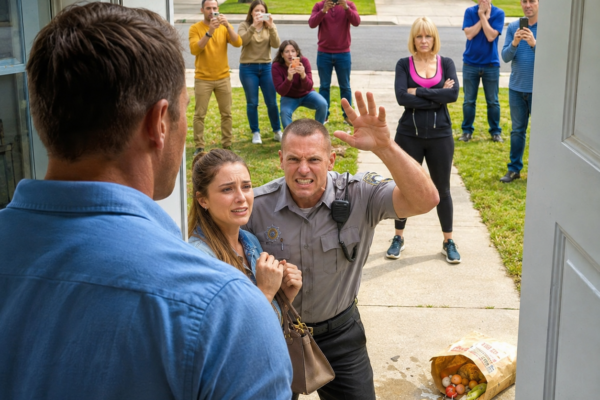
By the time the sheriff’s deputy arrived, Diana was standing in our gravel driveway with a property survey in one hand and a gate key in the other.
Across from her, a woman claiming to represent the homeowners association insisted we had blocked a community access road, even though the gate stood on land we had purchased just six weeks earlier.
“She has no right to change that gate,” the woman told the deputy.
Her name was Lorraine Kessler, and she had been visiting our cabin almost every day since we moved in.
She held a clipboard against her chest while her grown son recorded the conversation on his phone.
My wife looked exhausted.
That morning, she’d gotten up before sunrise to finish painting the new gate. There was still a small streak of blue paint on her wrist.
We hadn’t bought the cabin to fight with anyone.
I’m Marcus Patterson, a 52-year-old electrician with a bad back and thirty years of climbing into other people’s attics. Diana had spent most of her career working with financial records.
Our little cabin at Whispering Pines Lake was supposed to be the place where we finally slowed down.
Instead, someone kept leaving notices on our windshield, demanding payments for rules we’d never agreed to.
When we replaced the sagging wooden gate with a secure one, Lorraine announced that we’d violated community regulations.
Then she called 911.
“Mrs. Patterson,” the deputy said carefully, “I’m being told this gate prevents emergency vehicles from reaching the lake.”
Diana glanced toward our driveway.
The gate opened onto a private lane that ended at our cabin. The nearest public lake access was almost half a mile away.
“We already gave the fire department our access code,” she replied.
Lorraine stepped forward.
“Officer, these people don’t understand how things work around here.”
I felt my face getting hot.
Diana touched my elbow without looking at me.
It was the same quiet signal she’d used throughout our marriage whenever my temper threatened to make a difficult situation worse.
“Marcus, let me handle this.”
Lorraine opened her folder and produced an official-looking document bearing the words Whispering Pines Lake Homeowners Association.
She pointed to a paragraph highlighted in yellow.
The deputy studied it.
Then Diana unfolded the old property survey we’d received at closing.
Its edges were worn, and a faded county recording stamp sat in the corner.
She placed it beside Lorraine’s notice on the hood of the patrol car.
The deputy leaned closer, following the property line with his finger.
[END OF FACEBOOK CAPTION]
[FIRST COMMENT / FULL STORY CONTINUATION]
His finger stopped where the dotted line ended.
He looked at the survey, then at the gate, and finally back at the document Lorraine had handed him.
“Mrs. Kessler, where exactly is this community road supposed to be?”
Lorraine stepped closer.
“Right there. Everyone knows that.”
The deputy didn’t look up.
“I’m asking where it’s recorded.”
For the first time since she’d arrived, Lorraine hesitated.
She had spent the last twenty minutes speaking with such confidence that even I had begun to wonder whether we’d overlooked something important during closing. Now her eyes moved between the two documents, searching for an answer that wasn’t immediately available.
“The association has maintained access rights for years,” she said.
“That may be something for a court to sort out,” Deputy Hayes replied. “But this survey doesn’t establish what you’re claiming.”
Diana stood beside him, holding the corner of the paper against the breeze.
“The fire department has our gate code,” she said. “We confirmed that yesterday. We’re not preventing anyone from responding to an emergency.”
Deputy Hayes nodded.
Then he asked Lorraine for the recorded document supporting the easement she claimed.
She opened her folder.
There were newsletters. A printed list of neighborhood rules. A photocopied map with several lines drawn in red. There was even a page labeled Emergency Access Authorization.
But when the deputy asked for a recording number, Lorraine couldn’t provide one.
She insisted the county had everything on file.
Deputy Hayes explained that he couldn’t determine private property rights from conflicting documents on the side of a road. He also told us there was no apparent emergency requiring him to order the gate removed.
Lorraine’s son, Tyler, slowly lowered his phone.
“Officer,” Lorraine said, “are you really going to let these people ignore the rules?”
“I’m documenting the complaint, ma’am. If there’s a civil dispute, you’ll need to handle it through the proper process.”
Her jaw tightened.
She looked at Diana.
“This isn’t finished.”
Diana folded the survey carefully.
“No,” she said. “I don’t think it is.”
And that was how our first peaceful summer at Whispering Pines Lake turned into something neither of us had imagined.
Six weeks earlier, I had been standing on that same driveway with a cardboard box full of kitchen dishes, wondering whether we’d made the biggest mistake of our lives.
The cabin looked smaller in person than it had in the real estate photographs.
Its cedar siding had weathered to a soft gray. The porch leaned slightly toward the lake. One of the gutters hung loose, and the screen door dragged against the frame.
The listing had called it “rustic charm.”
I called it about six months of weekends with a tool belt.
Diana loved it immediately.
She walked past me carrying a box marked BEDROOM, stopped at the porch steps, and looked toward the water.
There was a little dock between two tall pines.
Beyond it, the lake stretched out under a pale blue Michigan sky.
A pair of ducks moved through the reeds.
“Marcus,” she said quietly, “listen.”
I listened.
Nothing.
No traffic. No sirens. No neighbor’s television coming through the wall of our old townhouse.
Just wind moving through pine needles.
Diana smiled.
“That’s what I wanted.”
I remember that smile because I hadn’t seen it very often during the year before we moved.
We had been married twenty-four years.
We’d survived layoffs, my father’s long illness, a miscarriage we rarely discussed, and the ordinary accumulation of bills that can make even a good marriage feel like a business partnership.
We had no children. For a long time, that fact had seemed like an empty room in our lives.
Eventually, we learned to build a different kind of family around nieces, nephews, old friends, and the people who found their way into our kitchen.
But we’d spent so many years being dependable for everyone else that we’d almost forgotten how to be happy without having somewhere to rush.
I was fifty-two.
Thirty years as an electrician had left me with a stiff back, aching knees, and a habit of noticing every poorly installed light fixture I passed.
Diana was forty-eight.
She had spent fifteen years in forensic accounting before leaving a large consulting firm and taking quieter bookkeeping work.
People sometimes underestimated her because she spoke softly.
That was usually their first mistake.
Her second great talent, after understanding complicated financial records, was remaining calm when everyone around her was losing their minds.
I had never mastered that skill.
We’d saved for years, sold the townhouse, and bought the cabin with a modest mortgage and enough money left for repairs.
Not enough for surprises.
Certainly not enough for the kind that were coming.
The first week was wonderful.
I fixed the kitchen faucet, replaced two damaged outlets, and discovered that the old refrigerator made a noise like a small airplane preparing for takeoff.
Diana hung white curtains in the living room and planted basil in a chipped ceramic pot beside the window.
At night we ate dinner on the porch.
Sometimes we talked.
Sometimes we simply sat together.
That was the luxury we’d worked thirty years to afford.
Then Lorraine Kessler appeared.
It was a Thursday morning.
I was splitting wood near the shed when a silver SUV stopped beside our driveway.
A woman in her late fifties stepped out wearing white sneakers, pressed slacks, and a navy polo shirt embroidered with the words Whispering Pines Lake Community Standards.
She carried a clipboard.
“Are you the new owners?”
I set down my splitting maul.
“That would be us.”
She smiled.
“I’m Lorraine Kessler. I coordinate neighborhood standards for the homeowners association.”
I wiped my hands on my jeans.
“Nice to meet you.”
She barely acknowledged that.
Instead, she looked past me toward the cabin.
“I see you’ve already started making changes.”
“Just repairs.”
“Repairs sometimes require approval.”
I glanced at the loose gutter I’d fixed the day before.
“Approval from whom?”
“The association.”
Diana came outside with two glasses of lemonade.
I could tell immediately that she’d heard enough to become interested.
“Is there an association?” she asked.
Lorraine turned toward her.
“Of course.”
“We didn’t see any association documents during closing.”
“Sometimes real estate agents don’t explain everything properly.”
Diana set the glasses on the porch railing.
“Do you have the recorded covenants?”
Lorraine blinked.
“The what?”
“The restrictions that apply to our property.”
Lorraine adjusted her clipboard.
“Everything is in the community handbook.”
She handed us three pages of rules.
Our gate had to be a certain color.
Firewood couldn’t be visible from the road.
Docks required approval.
Mailboxes had to match approved neighborhood styles.
And every household owed seventy-five dollars a month in association dues.
There was also a three-hundred-fifty-dollar “new owner compliance assessment.”
I looked at Diana.
She looked at the papers.
“Can you leave us a copy of the governing documents?” she asked.
Lorraine’s expression changed.
It wasn’t dramatic. The smile simply became smaller.
“Most neighbors don’t need that level of explanation.”
“We do,” Diana said.
Lorraine gave a little laugh.
“Well. I can see you two are going to be particular.”
Then she returned to her SUV.
I watched the vehicle disappear between the trees.
“What was that about?”
Diana studied the papers.
“I’m not sure.”
“Think she’s legitimate?”
“I think we should check.”
That was all.
No speech.
No declaration of war.
Just my wife carrying a three-page notice inside and placing it beside the closing documents on our kitchen table.
Two days later, she found the first problem.
Our title documents contained no recorded declaration requiring our lot to belong to an HOA.
The county property records showed an old lake maintenance agreement involving a handful of owners, but our parcel wasn’t listed among those subject to its restrictions.
The agreement was voluntary.
It covered shared contributions toward shoreline cleanup and maintenance of a small public picnic area.
It didn’t authorize fines.
It didn’t give anybody control over private gates.
And it certainly didn’t allow someone to collect mandatory monthly dues from every home around the lake.
Diana printed the information and arranged the pages in a folder.
“Maybe she’s confused,” I said.
Diana shook her head.
“Maybe. Let’s give her a chance to explain.”
She wrote Lorraine a polite letter asking for the legal basis of the fees and restrictions.
She even thanked her for taking an interest in the neighborhood.
I remember teasing Diana about being too diplomatic.
She looked at me over her reading glasses.
“Being polite doesn’t cost us anything.”
Three days later, we received a violation notice.
It was tucked beneath the windshield wiper of my truck.
The paper had a blue letterhead and a block of text warning that failure to comply could result in additional penalties.
Our offenses included improper firewood storage, unauthorized exterior improvements, and a “nonconforming entry gate.”
The total was six hundred and twenty-five dollars.
I stood in the driveway staring at the paper.
“She’s charging us because the gate needs paint?”
Diana read the notice.
“Apparently.”
“She can take that bill and—”
“Marcus.”
I stopped.
“Let’s make sure we’re right before we get angry.”
That sentence became the most repeated advice in our marriage over the next several months.
I didn’t always appreciate it.
But I eventually understood why she kept saying it.
Anger made me feel like I was doing something.
Evidence actually changed things.
The gate became a problem because it had never worked properly.
It was an old wooden structure mounted between two stone posts.
The lower hinge had pulled loose, leaving the gate hanging at an angle.
Every time the wind blew hard, the latch slipped open.
Twice, we found it standing wide in the morning.
The second time, there were tire tracks along our private drive that neither of us recognized.
We didn’t know whether someone had turned around, approached the cabin, or simply gotten lost.
There was no reason to assume anything sinister.
Still, Diana felt uncomfortable.
Our cabin sat far enough from the road that we couldn’t see passing vehicles.
At night, the nearest occupied house was several hundred yards away.
One evening, as we were preparing for bed, she stood at the kitchen window looking toward the gate.
“I don’t like not knowing whether it stays shut.”
I walked over.
“I’ll fix it tomorrow.”
“You’ve been fixing things all week.”
“That’s what happens when you marry an electrician who thinks he can do carpentry.”
She smiled, but only briefly.
“Could we replace it with something that actually locks?”
I put my arm around her.
“Of course.”
We chose a simple steel-framed gate with cedar panels and an electronic keypad.
It wasn’t fancy.
The hinges were sturdy, the opening was wide enough for emergency vehicles, and we coordinated an access code with the local fire department.
Diana painted the panels the same dark blue as the cabin’s window trim.
She liked things that looked as though they’d always belonged.
The morning we finished installing it, she stepped back and admired our work.
“It looks like home,” she said.
Six hours later, Lorraine drove up.
She didn’t ask whether we needed help.
She didn’t ask why we’d replaced it.
She stood beside the road and photographed the gate.
Then she called 911.
After Deputy Hayes left, I expected Lorraine to disappear for at least a few days.
I was wrong.
By evening, a new notice had appeared on our gate.
This one said we had deliberately interfered with community access and were required to restore the original structure within forty-eight hours.
I pulled it loose and carried it inside.
Diana was making chicken soup.
She read the paper, sighed, and placed it in her folder.
“Another one?”
“Another one.”
“Did she leave it in person?”
“I didn’t see.”
She reached for her notebook.
“Write down when you found it.”
I watched her enter the date and time.
There was something almost peaceful about the way she documented the harassment.
She didn’t swear.
She didn’t slam a drawer.
She simply wrote.
“Doesn’t this bother you?” I asked.
She looked up.
“Of course.”
“You act like it’s another spreadsheet.”
“That’s how I keep it from becoming something else.”
I didn’t understand what she meant.
Not then.
At dinner, we barely spoke.
The soup got cold in our bowls.
I kept looking toward the window, half-expecting headlights to appear again.
Finally, Diana reached across the table.
“We’re not letting one woman make us regret buying this place.”
“I know.”
“Do you?”
I looked down.
The truth was, I was already regretting it.
Not because of the cabin.
Because I’d spent decades working so we could stop worrying, and now I couldn’t even guarantee that my wife could paint a gate without someone calling the police.
The following morning, Diana called the previous owner.
Her name was Betty Armstrong.
She was seventy-six and had moved to a small apartment near her daughter in Grand Rapids after her husband’s death.
Betty had been kind during the sale.
She’d left handwritten notes explaining which window stuck in humid weather, where the spare plumbing parts were stored, and which kitchen cabinet had a shelf that needed a gentle push.
Diana put the call on speaker.
“Betty, it’s Diana Patterson.”
“Oh, honey. How’s the cabin?”
“We love it.”
“Did Marcus find the extra porch boards behind the shed?”
“He did.”
“Good. Harold saved everything. Drove me crazy.”
Diana hesitated.
“Can I ask you something about Lorraine Kessler?”
There was a long silence.
Then Betty exhaled.
“Oh, dear.”
I leaned forward.
“You know her?”
“Everyone knows Lorraine.”
“Is there really an HOA?” Diana asked.
“There was a lake committee years ago. We used to collect money for trash pickup after holiday weekends and repair the picnic tables.”
“Was Lorraine involved?”
“Eventually.”
Betty paused.
“After that bad storm, she became the person who organized everything. At first, people were grateful.”
“What happened?”
“She started acting like the committee owned the whole lake.”
Betty explained that Lorraine had gradually introduced fees, inspection notices, and what she called compliance standards.
Some owners paid to avoid arguments.
Others ignored her.
A few moved away.
“Why didn’t anyone stop her?” I asked.
Betty sounded tired.
“Because most people came to the lake to rest, Marcus. Nobody wanted to spend their retirement fighting over a mailbox.”
Diana wrote something down.
“Did she ever threaten you?”
“She told me Harold’s workshop violated shoreline rules. Said I’d need to pay for an inspection before I could sell.”
“Did you?”
“No. My daughter found a lawyer.”
Another silence.
Then Betty said something that stayed with me.
“Harold built that gate with his brother. He was so proud of it. I know it wasn’t much to look at by the end.”
Diana glanced through the window.
“I hope you don’t mind that we replaced it.”
“Oh, honey. Harold would’ve replaced it himself years ago if his hands had let him.”
Betty laughed softly.
“Just promise me you kept the little brass bell.”
I looked at Diana.
We hadn’t.
The bell was still attached to the old gate, which I’d leaned against the shed.
“I’ll save it,” I said.
“Good.”
Then Betty’s voice grew serious.
“And be careful with Lorraine. She doesn’t like people asking questions.”
The first neighbor to visit us after the police came was Mrs. Kowalski.
Her first name was Evelyn, although everyone called her Mrs. K.
She lived in a green cottage just beyond the curve in the road.
She was seventy-three, wore gardening gloves with tiny yellow flowers, and had an old golden retriever named Cooper who moved at roughly the speed of a shopping cart with one bad wheel.
She appeared on our porch carrying a blueberry pie.
“I thought you might need something sweet,” she said.
Diana invited her inside.
Mrs. K set the pie on the counter and looked at the folder on the kitchen table.
Her face changed.
“You’re having trouble with Lorraine.”
It wasn’t a question.
I pulled out a chair.
“Apparently, we’re the newest criminals at Whispering Pines.”
Mrs. K smiled, but her hands were shaking.
“She told me you’d blocked emergency access.”
“We haven’t.”
“I thought so.”
Diana poured coffee.
“Has she been bothering you too?”
Mrs. K looked toward the window.
Then she reached into her purse and removed a small envelope.
Inside were twelve receipts.
Each was marked Monthly Community Compliance Contribution.
Fifty dollars.
Fifty dollars.
Fifty dollars.
Month after month.
“She told me I had to pay,” Mrs. K said.
Diana examined one.
“For what?”
“My husband’s workshop.”
She swallowed.
“Frank built it himself. It’s where he kept his woodworking tools. After he passed, I couldn’t bring myself to change anything.”
Her eyes moved toward the window.
“Lorraine said the building didn’t meet association standards. She told me if I stopped paying, she’d make sure the county required me to tear it down.”
I felt something hard settle in my chest.
“Did the county ever send you a notice?”
Mrs. K shook her head.
“No.”
“Did she show you any actual rule?”
“She showed me a booklet.”
Diana placed the receipts back in the envelope.
“Would you let us make copies?”
Mrs. K looked frightened.
“Will Lorraine know?”
“Not unless you choose to tell her.”
For a moment, the older woman seemed unsure what to do.
Then she nodded.
“I’ve been ashamed.”
Diana reached across the table.
“There’s nothing shameful about trying to protect something you love.”
Mrs. K’s eyes filled.
She pressed a napkin against them.
“Frank made little wooden trains in that workshop. Every Christmas, he’d give them to children at the church.”
She looked down at her hands.
“I kept paying because I couldn’t bear to lose the last place I can still picture him.”
That evening, after she left, I walked to the shed and found Harold Armstrong’s old gate.
The little brass bell was still there.
I removed it carefully.
For the first time, I began to understand that this wasn’t really about a gate.
Over the next week, Diana learned that Lorraine had been collecting money from more than a few neighbors.
The Hendersons, Ray and Linda, lived on the western shore.
They’d bought their cabin three years earlier.
Ray was a retired mechanic with a deep voice and a habit of rubbing his forehead whenever he was angry.
Linda had worked as a school secretary for thirty-one years.
They invited us over on Saturday afternoon.
Their home was immaculate.
The porch railing had fresh paint. The flower beds were edged perfectly. Even the bird feeders seemed arranged according to some invisible plan.
Ray noticed me looking around.
“Don’t admire it too much,” he said. “Half of this is because of Lorraine.”
Linda gave him a warning look.
He ignored it.
“First she said the railing was the wrong height. Then the mailbox was too close to the road. Then the dock needed a special inspection.”
“Did you pay her?” Diana asked.
Linda looked embarrassed.
“We paid the first few bills.”
Ray shook his head.
“Almost two thousand dollars.”
“We didn’t know,” Linda said.
“We should’ve known.”
Diana leaned forward.
“What did she tell you would happen if you refused?”
Linda looked at her husband.
“She said she could put a lien on our property.”
“Did she?”
“No.”
“But you believed her?”
Linda’s eyes filled.
“We’d just spent everything we had on the house. Ray had retired early after his heart surgery. We couldn’t afford to lose it.”
Ray stared at the floor.
“I should’ve told her to get lost.”
Linda put her hand over his.
“You were trying to protect us.”
He looked away.
I recognized the expression on his face.
It was the same one I’d seen in my own reflection after Lorraine called the police.
A man who wanted to solve a problem with his hands, only to discover that the problem was made of paperwork, fear, and uncertainty.
Before we left, Linda brought out a folder of notices.
Diana asked permission to copy them.
Ray watched her arrange the documents by date.
“You’re pretty good at this.”
“Old habits.”
“What did you do before bookkeeping?”
She hesitated.
“Forensic accounting.”
Ray frowned.
“What’s that?”
“I spent years investigating financial irregularities for companies and their attorneys.”
Ray gave a low whistle.
“Well, I’ll be.”
Diana smiled faintly.
“Mostly, it involved reading things other people hoped nobody would read.”
By the middle of August, our kitchen table had become a filing station.
Not because Diana enjoyed conflict.
Because she wanted to understand what was happening before it got worse.
She created a spreadsheet listing each notice we received, the date, what it demanded, and whether it referred to any recorded restriction.
She saved photographs of every letter.
She kept copies of the deputy’s incident report.
And she began comparing the documents Lorraine distributed to different neighbors.
That was when the inconsistencies appeared.
Mrs. K’s notices identified the organization as Whispering Pines Lake Homeowners Association.
The Hendersons’ documents called it Whispering Pines Property Management Authority.
Our notices used Whispering Pines Community Standards Office.
All three carried the same mailing address.
Lorraine’s house.
And all three directed payments to an account under the name Whispering Pines Community Services.
Diana sat at the kitchen table with her reading glasses halfway down her nose.
“Marcus, come look at this.”
I came over.
She had three notices spread in front of her.
“Same signature,” I said.
“Yes.”
“Different names.”
“Yes.”
I waited.
She tapped the payment instructions.
“Look at the bank information.”
It was identical on every notice.
“So?”
“So whatever these groups are called, people are being directed to pay the same operation.”
I pulled out a chair.
“Is that illegal?”
“Not automatically. But it matters.”
She turned her laptop toward me.
“There’s a business filing for Whispering Pines Community Services. Lorraine registered it several years ago.”
“Then she’s legitimate?”
“A business can legally exist without having authority over someone else’s property.”
She said it gently, like a teacher correcting a student.
I frowned.
“Why register a business if you’re pretending to be an HOA?”
“We don’t know what she intended.”
“You’re giving her a lot of credit.”
“No. I’m trying not to assume facts we can’t prove.”
That was Diana.
Even after weeks of harassment, she refused to confuse suspicion with evidence.
I admired it.
I also found it infuriating.
The next escalation came from a utility complaint.
On Monday morning, a representative from the local electric cooperative appeared at our cabin.
He said they’d received a report that our gate was interfering with access to equipment near the road.
I walked him to the meter.
He examined the installation.
Then he checked the cooperative’s service records.
The meter was on our side of the gate.
The equipment was accessible.
There was no problem.
“Sorry to bother you,” he said.
“Can I ask who made the complaint?”
He shook his head.
“I can’t give you that information.”
I understood.
But I suspected.
On Wednesday, a county environmental inspector visited after receiving a report about our septic system.
The inspector was courteous.
He looked at the existing permit, checked the tank location, and explained that routine maintenance was our responsibility.
Nothing suggested an immediate issue.
When he left, Diana closed the door and leaned against it.
She looked worn out.
I’d grown accustomed to her calm face.
Seeing it disappear frightened me.
“You okay?”
She nodded.
But she didn’t move.
I went to her.
“Di?”
She pressed her fingers against her eyes.
“I can’t keep missing work for this.”
She handled accounts for a small medical supply business three mornings a week.
Every unexpected visit meant rescheduling something.
Every phone call from an inspector meant another interruption.
“We’ll figure it out,” I said.
She looked at me.
“That’s what I keep telling myself.”
I reached for her hand.
It felt cold.
That night, she put away the paperwork without finishing her notes.
We sat on the porch.
Across the lake, lights glowed in the windows of homes we barely knew.
Somewhere in the trees, an owl called.
“I thought this place would make us feel safe,” Diana said.
I didn’t have an answer.
I could repair a circuit.
I could replace a faulty breaker.
I could trace a hidden electrical problem through an entire house.
But I couldn’t fix the fear that had settled over our kitchen table.
A few days later, I went into Cedar Fork to buy plumbing fittings.
The town was small enough that the hardware store also sold fishing bait, birthday cards, and locally made maple syrup.
Pete Martinez owned the place.
He was sixty-one, had a thick silver mustache, and knew more about old cabins than any building inspector I’d ever met.
I was studying a shelf of pipe connectors when a man approached.
“Marcus Patterson?”
I turned.
“That’s me.”
“I’m Jim.”
He didn’t offer a last name.
I recognized him from Lorraine’s porch.
He lived with her.
“Can I help you?”
He looked uncomfortable.
“Just thought we should talk.”
“About?”
“All this trouble around the lake.”
I returned the fitting to its hook.
“Seems like Lorraine’s the one creating it.”
Jim gave a tired smile.
“She takes the neighborhood seriously.”
“So do we.”
“Look, I’m not here to argue. But she’s put a lot into that lake committee.”
“That doesn’t give her the right to bill people for rules that don’t exist.”
His expression tightened.
“Maybe there’s more history here than you understand.”
“Then explain it.”
He looked toward the front counter.
Pete was watching us while pretending to rearrange a display of work gloves.
Jim lowered his voice.
“Lorraine’s been here twenty-two years. She helped after the big storm. Organized cleanups. Got people to donate money. Back then, everyone thanked her.”
“I’d thank her for cleaning up a shoreline too.”
“She’s worried about what happens when new owners arrive and start changing everything.”
I thought about our gate.
“Changing a broken gate?”
“You know what I mean.”
“No. I really don’t.”
Jim rubbed his jaw.
For a moment, he looked less like a threatening neighbor and more like someone who’d been asked to deliver a message he didn’t believe.
“She’s just asking you to work with her.”
“We’ve been asking for the documents since the day we met her.”
He had no response.
I picked up my fittings.
“Jim, I don’t want trouble. But I’m not going to hand over money just because someone printed a letter.”
He looked at me for a long moment.
Then he said, “You should understand that people around here remember who makes life difficult.”
He walked away.
Pete came from behind the counter.
“You all right?”
“Fine.”
Pete glanced toward the door.
“Jim’s usually a decent guy.”
“Could’ve fooled me.”
“He wasn’t always like this.”
I placed the fittings on the counter.
“What changed?”
Pete sighed.
“Lorraine used to have people around her all the time. After her husband left, that committee became her whole world.”
He rang up my purchase.
“Sometimes people hold on so tight to being in charge that they forget what they’re supposed to be taking care of.”
I drove home thinking about that sentence.
The following Sunday, Diana and I visited a real estate attorney named Sarah Chen.
Her office was in a brick building near the county courthouse.
There were framed photographs of her children on the windowsill and a large, slightly neglected fern beside the filing cabinet.
Sarah was in her early forties, wore simple black glasses, and had the kind of patient expression that made me want to explain everything at once.
I nearly did.
Diana stopped me after about five minutes.
“Marcus, let her ask questions.”
Sarah smiled.
“Actually, I’m glad you’re both here. I need to understand what each of you has experienced.”
We spent two hours reviewing documents.
Sarah examined our deed, title commitment, survey, and the notices from Lorraine.
Then she looked at the old lake maintenance agreement.
“This is important,” she said.
She explained that neighborhood organizations could take several forms.
Some were voluntary associations.
Others had authority based on properly recorded restrictions attached to specific properties.
An incorporated business or association name alone didn’t establish that every nearby owner was obligated to pay dues.
And a handwritten policy couldn’t create an easement across somebody’s land.
“Does Lorraine have any authority over our gate?” I asked.
“Based on what you’ve shown me, I don’t see a recorded restriction giving her that authority.”
Diana leaned forward.
“What about the other owners?”
“I’d have to review their individual property records. We can’t assume every lot is identical.”
That was exactly the kind of answer Diana liked.
Specific.
Careful.
Honest.
Sarah recommended we stop discussing the dispute directly with Lorraine.
She would send a letter requesting the documents Lorraine claimed supported her demands.
She would also contact the county recorder to verify the relevant property filings.
Meanwhile, we were to preserve the notices and avoid escalating any confrontations.
I asked whether we could sue immediately.
Sarah folded her hands.
“You may have civil options, but litigation is expensive. I’d rather establish the facts and see whether a formal demand resolves this.”
“She called the police on my wife.”
“I understand.”
“She frightened an elderly widow into paying fees.”
Sarah’s expression softened.
“Then that needs to be documented too.”
I looked at Diana.
She was sitting perfectly still.
For the first time in weeks, I felt as though someone else understood what we’d been carrying.
Before we left, Sarah asked Diana a question.
“Have you done investigative accounting work before?”
Diana nodded.
“Years ago.”
“I thought so. Your timeline is unusually thorough.”
Diana looked down at her folder.
“I wasn’t sure how much would be useful.”
Sarah tapped it.
“All of it helps.”
The next letter from Lorraine arrived by certified mail.
Sarah had already sent her formal request.
Instead of providing recorded covenants, Lorraine demanded an additional twelve hundred dollars for what she called “willful noncompliance and professional enforcement expenses.”
The letter warned that unpaid charges might result in a lien against our cabin.
I found Diana sitting at the kitchen table when I came home from the lumberyard.
The letter lay open beside her coffee.
She wasn’t crying.
But her face was pale.
“What’s wrong?”
She handed it to me.
I read it twice.
“She can’t do this.”
“We need Sarah to confirm that.”
“She’s trying to scare us.”
“Yes.”
I waited.
Diana looked toward the window.
“Marcus, what if this affects the mortgage?”
I sat down.
“We’ve got the deed.”
“I know.”
“We’ve got a lawyer.”
“I know.”
“Then why are you scared?”
She stared at me.
“Because I’ve seen how much damage someone can do with a false document before anybody proves it’s false.”
That was the first time she spoke about her old career in a way that sounded personal.
I had always known Diana worked on fraud investigations.
I knew she had once testified in a complicated corporate case.
But she’d rarely talked about the last investigation before she left.
When I asked, she would say she’d had enough of airports and late nights.
I hadn’t pushed.
Now I wondered whether there was more to it.
She folded the letter.
“Please call Sarah.”
I did.
Sarah reassured us that a threat to file a lien wasn’t the same as having a valid claim.
But she also took the matter seriously.
She requested a title update and told us she’d review any document Lorraine attempted to record.
That afternoon, Diana moved our closing documents from the kitchen drawer into a fireproof file box.
She carried it into the bedroom and placed it under the bed.
I watched her.
“Di, it’s just paperwork.”
She stopped.
“No, Marcus.”
Her voice was barely above a whisper.
“Sometimes paperwork is how people take away things that matter.”
That evening, I asked her about the investigation she’d never discussed.
We were sitting on the porch.
The sky had turned lavender over the lake.
Diana was holding a mug of tea that had already gone cold.
“You don’t have to tell me,” I said.
She looked at me.
“Tell you what?”
“Why you left your old job.”
She stared out at the water.
For a while, I thought she wouldn’t answer.
Then she spoke.
“I found something I wasn’t supposed to find.”
She had worked for a consulting firm hired to review financial records after a manufacturing company reported unusual vendor payments.
At first, the discrepancies were small.
A duplicated invoice.
An unfamiliar account.
A vendor whose address matched that of an employee.
Diana kept looking.
Eventually, she traced the payments to a senior executive who’d been moving company money into businesses connected to his relatives.
Her findings led to a wider investigation.
But before the company acknowledged what had happened, someone leaked her name.
The executive accused her of misinterpreting records.
A colleague who’d approved part of the audit refused to back her up.
And for several weeks, Diana found herself being discussed in meetings she wasn’t allowed to attend.
“They said I was trying to make a name for myself,” she told me.
I remembered those weeks.
She’d come home exhausted.
She’d stopped answering work calls after dinner.
Once, I’d found her crying in the laundry room.
She’d told me it was just stress.
“What happened?” I asked.
“The evidence held up. The investigation eventually proved what I’d found.”
“So you were right.”
She looked down.
“That didn’t make the experience disappear.”
She explained that one colleague had apologized privately but never publicly corrected the story.
The firm eventually supported her conclusions.
The executive lost his position.
No one ever gave Diana back the months she spent wondering whether telling the truth had ruined her career.
“I was tired,” she said. “I didn’t want to be the person everybody called when something was wrong.”
I reached for her hand.
“Is that why this bothers you so much?”
She nodded.
“When Lorraine looks at me, I can see she’s already decided what kind of person I am.”
I rubbed my thumb across her knuckles.
“Then she doesn’t know you.”
Diana gave a sad little smile.
“Neither did those people at work.”
I didn’t have a clever response.
So I sat beside her until the light faded.
The following week brought another complication.
Mrs. K called on Thursday morning.
Her voice shook so badly that Diana put the phone on speaker.
“Lorraine came by.”
“What happened?”
“She said I’d been telling lies about her.”
Diana sat up.
“Did she threaten you?”
“She said the workshop inspection couldn’t be postponed anymore.”
Mrs. K began to cry.
“I’m sorry. I shouldn’t have shown you those receipts.”
Diana’s expression changed.
Not to anger.
To something much more determined.
“Mrs. K, listen to me. You haven’t done anything wrong.”
“I don’t want trouble.”
“I understand.”
“I just want to live in my house.”
Diana looked at me.
Then she said, “Would you be comfortable having Sarah review the notices? You wouldn’t have to confront Lorraine.”
Mrs. K hesitated.
“Would it cost much?”
“We’ll ask before anything happens.”
After the call, Diana sat quietly.
I went to make coffee.
When I returned, she was staring at the old photograph Mrs. K had given us.
It showed Frank Kowalski standing beside a row of wooden toy trains.
He was grinning, with sawdust on the front of his sweater.
“She thinks she’s going to lose that workshop,” Diana said.
“I know.”
“No one should have to live like that.”
I put the coffee in front of her.
“What do you want to do?”
She took a breath.
“Not what I did last time.”
I waited.
“Last time, I found the truth and hoped the people in charge would do the right thing.”
“And this time?”
“This time, we’re going to make sure the people affected aren’t left standing alone.”
We began with a simple invitation.
No accusations.
No neighborhood campaign.
Just coffee and sandwiches at our cabin on Saturday afternoon.
Diana called Mrs. K and the Hendersons.
They invited two other couples who had received notices.
By three o’clock, eight people were sitting on our porch and around the kitchen table.
I made sandwiches.
Diana laid out blank notepads.
We didn’t record anyone without permission.
We didn’t ask people to sign statements.
We simply listened.
The stories were painfully similar.
One couple had paid a dock inspection fee after Lorraine warned that their insurance might be affected.
Another had received monthly invoices for landscaping services that had never been performed on their property.
A retired teacher named Samuel Petrov brought a stack of letters tied with string.
He was seventy-nine, tall and thin, with neatly combed white hair.
He sat near the window and listened while others spoke.
When it was his turn, he untied the string.
“I know this is probably a small thing,” he said.
Diana shook her head.
“Take your time.”
Mr. Petrov placed a photograph on the table.
It showed a little dock with two wooden chairs.
“My wife and I built that the summer after we retired.”
He smiled faintly.
“Well, she supervised. I did most of the lifting.”
Several people chuckled.
His wife had died five years earlier.
Since then, he had come to the lake every morning with coffee.
Lorraine had sent him repeated notices claiming the dock violated community standards.
She demanded payment for a structural review.
When he couldn’t afford it, she warned that the dock could be ordered removed.
“I stopped going down there,” he said.
His voice broke.
“Not because I believed her. Because every time I sat there, I worried about what letter would come next.”
No one spoke.
Outside, Cooper barked once and settled beneath the porch steps.
Mr. Petrov looked at the photograph.
“My wife loved that dock.”
Diana reached across the table.
“Would it be all right if we helped you find out what rules actually apply to it?”
He nodded.
“That would be kind.”
I looked around the room.
Ray was staring at his hands.
Linda had moved her chair closer to Mrs. K.
Everyone had arrived feeling embarrassed about their own situation.
Now they were discovering that the person beside them had been carrying the same fear.
It didn’t solve anything that afternoon.
But something changed.
For the first time since we moved to Whispering Pines, the cabin felt like a place where people belonged.
Lorraine heard about the gathering within two days.
I don’t know who told her.
In a neighborhood that small, keeping a barbecue private was probably impossible.
She arrived Tuesday evening.
This time, she came alone.
I was replacing a screen when her SUV stopped near the gate.
She didn’t enter.
She stood beside the road and called toward the porch.
“Marcus, I’d like to speak with your wife.”
Diana stepped outside.
“Hello, Lorraine.”
Lorraine held a folded paper.
“I understand you’ve been encouraging people to withhold community payments.”
“We’ve been helping neighbors review documents.”
“You’re interfering with association business.”
Diana kept her voice even.
“If there are recorded restrictions, our attorney has requested copies.”
Lorraine looked at me.
“Your husband seems to think he can intimidate people because he’s bigger than they are.”
I nearly laughed.
Then I saw what she was doing.
She wasn’t talking to me.
She was trying to make Diana defend me.
Diana didn’t take the bait.
“Is there something specific you came to discuss?”
Lorraine’s face tightened.
“You don’t understand this community.”
“Then help me understand it.”
Lorraine stared at her.
Diana continued.
“Why are you sending invoices under three different organization names?”
For a moment, Lorraine seemed genuinely surprised.
Then she drew herself up.
“We’ve had to adapt our administrative structure over time.”
“Can you explain how?”
“I don’t owe you an accounting lesson.”
“No. But people paying mandatory fees are entitled to know what gives the organization authority to collect them.”
Lorraine stepped closer to the gate.
“You think because you worked in an office somewhere, you know more than people who’ve lived here their whole lives?”
Diana said nothing.
Lorraine’s eyes moved toward the cabin.
“I helped build this neighborhood.”
I saw a flash of something beneath her anger.
Hurt, perhaps.
Or fear.
Then it disappeared.
“You newcomers show up, change everything, and expect the rest of us to adjust.”
Diana looked at the gate.
“We changed a broken gate, Lorraine.”
“You changed what it represented.”
There it was.
The first honest sentence I’d heard her say.
Diana seemed to recognize it too.
She softened her voice.
“Then let’s talk about that.”
But Lorraine shook her head.
“There’s nothing to discuss.”
She walked back to her SUV.
As she drove away, I turned to Diana.
“Did that make any sense to you?”
Diana watched the taillights disappear.
“More than she intended.”
A week later, Sarah found an important piece of the association’s history.
The original lake maintenance committee had been formed after a severe storm damaged a shared picnic area and washed debris into the shoreline.
A handful of owners had contributed money to repair the area.
The committee’s early records were straightforward.
Small voluntary donations.
Receipts for lumber.
Payments for gravel.
A list of who had helped clean up.
Lorraine’s name appeared in the records several years later.
At first, she had organized volunteer days and collected contributions for shared projects.
Some of the older neighbors remembered being grateful.
Mrs. K told us Lorraine had once brought groceries to her house after Frank’s surgery.
Mr. Petrov remembered her arranging help after a tree fell across the road.
That surprised me.
I’d built a picture of Lorraine in my mind that left no room for kindness.
It was easier to hate someone when you imagined they’d always been cruel.
But people rarely become difficult all at once.
Sarah found records showing that, over time, the voluntary committee had stopped holding regular meetings.
A few members moved away.
Others grew older.
No formal election records appeared after a certain year.
Lorraine began using the committee name to issue instructions.
Eventually, the documents referred to dues and penalties.
But Sarah couldn’t find a recorded declaration extending those powers to our property.
She also couldn’t find evidence that the old committee had validly authorized the newer enforcement program.
“She may believe she has authority,” Sarah said during our next meeting.
“Does that matter?” I asked.
“It matters when assessing intent. But belief doesn’t automatically create legal rights.”
Diana studied the documents.
“Is there any evidence the neighbors agreed to these changes?”
“Not in what we’ve found.”
Sarah tapped the oldest meeting record.
“The thing we need to establish is where legitimate community work ended and misrepresentation began.”
I thought about Lorraine saying she’d built the neighborhood.
Maybe, once, she really had helped.
The question was what she’d done after people stopped questioning her.
September arrived with cool mornings and the smell of wet leaves.
Our cabin should have been beautiful.
The lake reflected the first yellow trees.
The old woodstove made the living room warm.
I finished repairing the porch, and Diana planted mums beside the steps.
But our peace was fragile.
Every time a car slowed near the gate, she looked up.
Every time the mail arrived, I felt my stomach tighten.
One afternoon, our lender called.
A document referencing an alleged association assessment had appeared in a routine property record check.
Sarah was already reviewing it.
The filing was not proof that Lorraine had a valid lien, but it created another problem we had to address.
Our mortgage wasn’t suddenly in danger.
Still, the idea that an unsupported claim could become part of our property records frightened us.
Sarah advised us on challenging the filing.
She also preserved the document for the larger dispute.
I spent the evening pacing.
“This is ridiculous.”
Diana sat at the table.
“I know.”
“We can’t spend the rest of our lives hiring lawyers every time she invents something.”
“I know.”
“Then what are we supposed to do?”
She closed her laptop.
“We keep going through the proper channels.”
I turned toward her.
“You always say that.”
“Because it’s still the best option.”
“What if it isn’t enough?”
She looked hurt.
“Marcus—”
“No, I’m serious. What if being calm and organized just gives her more time to make our lives miserable?”
Her face went still.
“Are you saying this is my fault?”
“That’s not what I said.”
“It sounded like it.”
I rubbed my forehead.
“I just want my wife back.”
The words came out before I could stop them.
Diana stared at me.
For a moment, neither of us moved.
Then she stood and carried her coffee mug to the sink.
“I’m right here,” she said.
She went into the bedroom and closed the door.
I remained in the kitchen.
The silence felt worse than shouting.
I slept on the couch that night.
Not because Diana told me to.
Because I was too ashamed to walk into the bedroom.
Around five in the morning, I heard the front door.
I sat up.
Diana was standing on the porch wrapped in an old gray sweater.
The sky was still dark.
I joined her.
She didn’t look at me.
“I’m sorry,” I said.
She kept her eyes on the lake.
“I know you’re tired.”
“That doesn’t excuse what I said.”
“No.”
I waited.
A bird called from somewhere beyond the trees.
Finally, Diana spoke.
“I thought if I kept everything organized, I’d feel in control.”
I leaned against the railing.
“Does it help?”
“Sometimes.”
She pulled the sweater tighter around herself.
“I didn’t leave my old job because I stopped caring about the truth.”
“I know.”
“I left because I couldn’t keep living as though every mistake in the world was mine to uncover.”
Her voice trembled.
“When Lorraine started sending those letters, I told myself I could handle it. I knew what to look for. I knew how to keep records.”
She wiped beneath one eye.
“But I didn’t expect to feel like I was back in that office, waiting for someone to accuse me of lying.”
I turned toward her.
“I’m sorry I made it harder.”
She nodded.
“I know you’re scared too.”
“I am.”
“Of what?”
I stared at the dark water.
“That I spent thirty years promising you we’d have a good life, and now I’ve brought you somewhere you can’t even feel safe.”
She reached for my hand.
“Marcus, you didn’t bring me here.”
I looked at her.
“We chose this place together.”
Her grip tightened.
“And we’re going to decide together what happens next.”
We stood on the porch until the sun rose.
The lake slowly turned silver.
Then Diana looked at me.
“Could we agree on something?”
“Anything.”
“No more pretending we’re fine when we’re not.”
I nodded.
“Deal.”
“And maybe one evening a week without talking about Lorraine.”
I laughed softly.
“That sounds harder.”
“It probably will be.”
She rested her head against my shoulder.
For the first time in days, I felt some of the weight lift.
The next important discovery came from someone we hadn’t expected.
Tyler Kessler.
Lorraine’s thirty-two-year-old son.
He had spent most of the summer following his mother around with a phone and a clipboard.
I assumed he agreed with everything she did.
Then one afternoon, he appeared at Pete’s hardware store while I was buying screws.
He waited until I reached my truck.
“Mr. Patterson?”
I turned.
Tyler stood several feet away, hands shoved into his jacket pockets.
“What do you want?”
He swallowed.
“I need to ask you something.”
I stayed beside my truck.
“Go ahead.”
“Did your lawyer really say Mom doesn’t have authority over your property?”
“She reviewed our documents.”
Tyler looked toward the road.
“Mom says you’re trying to destroy the association.”
“We’re asking her to prove what she’s charging people for.”
He rubbed his hands together.
“She says you’re going to sue us for everything we’ve got.”
“That’s not what we’re trying to do.”
He looked at me then.
Really looked.
And I noticed how tired he seemed.
There were dark circles beneath his eyes.
His work boots were worn.
He looked nothing like the confident man who’d filmed Diana at the gate.
“Can I ask you something?” I said.
He nodded.
“Why do you help her?”
His face reddened.
“She’s my mother.”
“I understand that.”
“No, I don’t think you do.”
He looked away.
He’d lost his construction job the previous winter.
A knee injury had kept him out of work for months.
After his marriage ended, he’d moved back into Lorraine’s house.
She’d offered him paid work helping with the lake association.
“At first, it was just collecting notices,” he said.
“Then?”
“Then she said people weren’t paying because they didn’t respect her.”
I waited.
He looked at the pavement.
“I didn’t know what to think.”
I could’ve told him exactly what I thought.
But something in his face stopped me.
“Tyler, if you believe something is wrong, you can talk to a lawyer.”
He nodded without answering.
Then he walked away.
I told Diana everything when I got home.
She listened carefully.
“Did he offer you documents?”
“No.”
“Did you ask him to?”
“No.”
“Good.”
“Why?”
“Because he needs to make his own decision. We don’t want anyone saying we pressured him.”
I looked at her.
“You think he’ll come around?”
She closed her notebook.
“I think he’s starting to ask questions.”
By October, the dispute had spread beyond our property.
Sarah and another attorney were helping several neighbors review their individual circumstances.
Some had stronger documentation than others.
A few had made voluntary contributions to legitimate lake projects.
Others had been paying invoices they believed were mandatory.
The differences mattered.
We didn’t want to accuse Lorraine of stealing every dollar ever collected for the lake.
There had been real cleanup work.
There had been legitimate expenses.
But the records raised serious questions about payments demanded under threats of fines or liens.
Sarah advised affected residents to make formal complaints through appropriate consumer protection and law enforcement channels.
She also helped us challenge the unsupported claim against our property.
Diana worked with the neighbors to organize copies of their own records.
She never attempted to access private bank information.
People brought the statements and canceled checks they were comfortable sharing.
She compared dates, payment descriptions, and amounts.
What emerged wasn’t a complete accounting of Lorraine’s operation.
That would require proper investigative authority.
But it was enough to show a troubling pattern.
Some residents had paid much more than others for the same supposed monthly dues.
Fees seemed to change depending on who received the notice.
Late charges appeared without any clear schedule.
And several invoices described services that residents said had not been provided.
One evening, Diana spread the documents across our table.
“Marcus, look at Mrs. K’s payments.”
I sat beside her.
She pointed to the dates.
“She paid fifty dollars every month.”
“Right.”
“Now look at the Hendersons.”
Their invoices demanded seventy-five dollars.
“And ours?”
Seventy-five dollars plus assessments.
“Maybe the amounts changed over time,” I said.
“Maybe. But there’s no explanation.”
She looked at the pile of papers.
“People were afraid to question bills they didn’t understand.”
I thought about Mrs. K counting out fifty dollars from her retirement check.
Ray and Linda worrying about losing their home.
Mr. Petrov sitting inside instead of enjoying the dock he’d built with his wife.
The amount of money mattered.
But so did the way it had changed their lives.
Lorraine responded with a neighborhood letter.
It appeared in mailboxes across Whispering Pines on a rainy Friday.
The letter accused a small group of homeowners of spreading misinformation and undermining years of community improvement.
It didn’t name us.
It didn’t need to.
Everyone knew who she meant.
She wrote about maintaining property values, protecting the lake, and preserving standards for future generations.
Some of those concerns were reasonable.
The lake did need care.
Boats could damage the shoreline.
Poorly maintained septic systems could create environmental problems.
People had legitimate reasons to want shared rules for shared property.
But the letter made no distinction between voluntary cooperation and compulsory authority over private homes.
It warned that anyone refusing to participate in the association could face consequences.
And at the bottom was another demand for payment.
I read the letter standing beside our mailbox.
Then I carried it inside.
Diana was peeling potatoes.
She dried her hands before reading it.
“She really believes we’re the problem,” I said.
“She may.”
“How can she?”
Diana folded the paper.
“Because if she admits the rules don’t apply the way she says they do, she has to explain everything else.”
I looked at her.
“Do you feel sorry for her?”
Diana thought for a moment.
“I feel sorry for the person she might have been before all this.”
Then she placed the letter in the folder.
“That doesn’t excuse what she’s doing now.”
The hardest conversation happened with Mrs. K.
She came to our cabin on a cold afternoon carrying a small paper bag.
Inside was a wooden train.
Frank had made it years earlier.
It had red wheels, a green engine, and a tiny brass bell on top.
“I found this when I was cleaning the workshop,” she said.
She set it on our table.
“I thought you might like it.”
Diana picked it up carefully.
“It’s beautiful.”
Mrs. K smiled.
“Frank made dozens.”
Then her expression changed.
“I need to tell you something.”
We sat down.
She twisted a tissue between her fingers.
“Lorraine used to be my friend.”
Diana waited.
“After Frank died, she brought me dinner every Sunday for a month.”
Her voice grew softer.
“She sat with me when I couldn’t stand being alone in the house.”
I watched her struggle with the memory.
“When she first asked for money for lake maintenance, I didn’t mind. I thought I was helping.”
“What changed?” Diana asked.
“She started telling me what I had to do.”
Mrs. K looked toward the window.
“Then she started saying Frank’s workshop was a problem.”
Her eyes filled.
“I kept thinking about that woman who brought me casseroles when I couldn’t cook for myself.”
She pressed the tissue against her lips.
“I didn’t want to believe she’d use his memory to make me pay.”
Diana moved her chair closer.
“People can do kind things and still hurt us.”
Mrs. K nodded.
“I know that now.”
She looked down at the little train.
“I don’t hate her.”
Neither of us spoke.
“I just want her to leave me alone.”
There was something powerful about that sentence.
Not revenge.
Not punishment.
Just the simple wish to live without fear.
After Mrs. K went home, Diana placed the wooden train on our mantel.
Beside it, I hung Harold’s old brass gate bell.
Two small things saved from lives that had been here long before ours.
A few days later, Sarah called with news.
The county recorder’s office had confirmed that the document Lorraine relied upon to support her claimed gate access did not create an easement over our parcel.
It described a different route serving another part of the lake.
The old map had been copied and marked in a way that made the route appear to continue across our land.
Sarah couldn’t yet establish who had altered the copy or when.
But the discrepancy was significant.
She sent a formal notice explaining the issue and demanding that Lorraine stop asserting unsupported rights over our gate.
She also advised us to keep the recorded copy and the version Lorraine had distributed.
I should’ve felt relieved.
Instead, I felt furious.
Weeks of arguments.
Police involvement.
Inspections.
Legal fees.
And the road Lorraine insisted we were blocking wasn’t the road described in the recorded document.
Diana took the news quietly.
Then she went outside.
I found her by the gate.
She was standing beside the stone post, looking at the dark blue panels.
“Hey.”
She didn’t answer right away.
I stepped beside her.
“You okay?”
She nodded.
Then she said, “Do you remember when I painted this?”
“Of course.”
“I was so happy.”
I looked at the gate.
“I remember.”
She ran her fingers over the wood.
“I thought we’d spend the rest of the summer fixing up the cabin.”
“We still can.”
She shook her head.
“Not that summer.”
Her voice was calm, but I heard the grief in it.
It wasn’t just the money we’d spent.
It was the summer we’d lost.
The dinners we’d eaten while worrying.
The mornings ruined by envelopes.
The way we’d stopped looking forward to weekends because weekends were when Lorraine tended to appear.
I took her hand.
“We can’t get August back.”
“No.”
“But we can make sure she doesn’t take every August after it.”
Diana turned toward me.
For the first time in weeks, she smiled without forcing it.
The county scheduled a public informational meeting about the lake association dispute.
It wasn’t a trial.
No one would be found guilty.
No commissioner could simply declare criminal charges from the front of the room.
The county’s role was to explain its records, hear residents’ concerns, and refer appropriate complaints to the agencies responsible for investigating them.
Sarah told us not to expect a dramatic ending.
“These matters move through evidence and procedure,” she said. “A public meeting can clarify the facts, but it won’t replace an investigation.”
Diana understood.
I was disappointed.
Part of me wanted Lorraine to stand in front of everyone and admit she’d been wrong.
I wanted the neighbors to hear it.
I wanted Mrs. K to be able to walk out of that room knowing she’d never receive another threatening invoice.
Sarah looked at me across her desk.
“Marcus, you need to decide what you want most.”
“I want her stopped.”
“Then focus on that.”
She paused.
“Don’t confuse making someone feel humiliated with making the situation right.”
I carried that sentence home.
It wasn’t easy to accept.
But it changed how I approached the meeting.
I stopped imagining a confrontation.
Instead, I helped Diana prepare a clear timeline.
Not accusations.
Facts.
What the notices said.
What the recorded documents showed.
Which complaints had been made.
What the neighbors had actually paid.
Sarah reviewed everything before it was submitted.
Sensitive personal information stayed out of the public presentation.
Mrs. K chose to share her experience in her own words.
Mr. Petrov agreed to speak.
Ray and Linda wanted to attend but were nervous about being publicly identified.
We told them that was their choice.
No one owed us their courage.
They had already endured enough.
The week before the meeting, Tyler came to our cabin.
It was nearly six in the evening.
A cold rain had been falling all day.
I saw him through the kitchen window, standing outside the gate without an umbrella.
I went down the driveway.
“Tyler?”
He looked miserable.
“Can we talk?”
I opened the pedestrian latch.
He stepped through.
He was holding a large envelope beneath his jacket.
Diana met us on the porch.
Tyler stopped when he saw her.
“Mrs. Patterson, I’m sorry about the police call.”
She looked at him.
“Why are you here?”
He held out the envelope.
“I think you should see these.”
Diana didn’t take it immediately.
“What are they?”
“Copies of records from Mom’s office.”
She exchanged a glance with me.
“Tyler, are these documents you’re authorized to share?”
He swallowed.
“I helped prepare them.”
She took a breath.
“Before we look at anything, I think you should speak with your own attorney.”
Tyler seemed surprised.
“Your lawyer?”
“Your own. Someone who represents your interests.”
He lowered the envelope.
“You’re not going to take it?”
“Not like this.”
He looked as though he might cry.
“I don’t know what to do.”
Diana’s expression softened.
“Sit down.”
We sat beneath the porch roof while rain dripped from the gutters.
Tyler told us he’d been helping his mother prepare invoices for almost a year.
At first, she asked him to print notices from templates.
Later, she had him change payment amounts and add charges.
Sometimes she told him to label expenses as community improvements.
He didn’t question everything.
He admitted that.
He needed money.
He needed somewhere to live.
And he wanted his mother to be proud of him.
Then he’d begun hearing residents explain what the payments meant to them.
Mrs. K’s workshop.
Mr. Petrov’s dock.
Our gate.
“I thought she was just making people follow the rules,” he said.
Diana listened.
“When did you realize something might be wrong?”
Tyler stared at his hands.
“When you asked for the recorded documents.”
He gave a shaky laugh.
“Mom got so angry. She told me to stop answering questions.”
He looked toward our gate.
“Then I saw the paperwork she’d been using. Some of it didn’t match.”
I felt a rush of anger.
“You knew?”
He nodded.
“Not at first.”
“But later?”
He closed his eyes.
“Yeah.”
For a moment, I wanted to send him away.
Instead, I thought about the way he’d stood behind his mother while she called Diana a trespasser.
He’d looked certain.
Now he looked broken.
Diana spoke quietly.
“Tyler, if you believe records were altered, you need to tell the truth to the proper people. And you need legal advice before deciding what to provide.”
He nodded.
“I don’t want to lie for her anymore.”
That sentence changed the direction of the case.
Not because Tyler handed us a magical piece of evidence.
Because he was finally willing to stop pretending.
Tyler consulted an attorney.
Later, through the appropriate channels, he provided information to investigators reviewing complaints about the association.
We weren’t part of those interviews.
We didn’t know exactly what he said.
We learned only that the authorities were taking the concerns seriously and that several residents had been contacted for additional statements.
The waiting was difficult.
Days passed.
Then weeks.
Lorraine stopped coming to our gate, but notices continued appearing in some neighbors’ mailboxes.
Sarah sent another demand to stop unsupported enforcement claims.
The public meeting remained on the calendar.
Meanwhile, life went on in strange little fragments.
I repaired a rotten porch step.
Diana started making soup every Sunday.
Mrs. K brought Cooper over when she visited, and the dog developed a habit of sleeping directly in front of our refrigerator.
Mr. Petrov asked me to look at a loose board on his dock.
I brought my tools.
He stood beside me holding screws in a coffee can.
“You don’t have to do all this,” he said.
“It’s two boards.”
“Still.”
I removed the damaged plank.
“Marcus,” he said after a while, “can I tell you something?”
“Of course.”
“My wife used to say I apologized too much.”
I smiled.
“Mine says I talk too much.”
He chuckled.
Then his face grew serious.
“After she died, I tried not to bother anyone. I thought that’s what being independent meant.”
He looked toward the lake.
“But I got so used to being alone that I forgot people might want to help.”
I set down my drill.
“You’re not bothering me.”
He nodded.
Then he handed me another screw.
When we finished, he brought out two folding chairs.
We sat on the dock with coffee.
The water was cold and clear.
He told me about teaching eighth-grade history.
About the first time he’d met his wife at a church picnic.
About the way she’d insist on opening every window in the house on the first warm day of spring.
I told him about the first apartment Diana and I rented.
It had a heater that only worked when it felt like it.
He laughed so hard he nearly spilled his coffee.
For the first time since buying the cabin, I spent an entire afternoon beside the lake without thinking about Lorraine.
The public meeting took place on a Thursday evening in the county administration building.
The room was plain.
Fluorescent lights.
Gray chairs.
A long table at the front.
A coffee urn that had clearly seen better days.
Yet nearly every seat was filled.
Some people had come because they were concerned about the association.
Others wanted information about how neighborhood restrictions worked.
A few were simply curious.
Lorraine arrived with Jim.
She wore a dark green jacket and carried the same black folder we’d seen on the morning she called 911.
When she saw us, her face tightened.
Diana sat beside me with a thin binder.
Only one.
I remembered the stacks of paper that had covered our kitchen.
“Where’s everything else?” I whispered.
“Sarah has it.”
“You’re not nervous?”
She looked at me.
“Terrified.”
I took her hand.
“You don’t look it.”
“I’ve had practice.”
Across the aisle, Mrs. K sat between Linda Henderson and Mr. Petrov.
Ray was at the end of their row.
He gave me a small nod.
At seven o’clock, a county official opened the meeting.
A representative from the recorder’s office explained the distinction between recorded property restrictions and voluntary neighborhood arrangements.
Another official addressed public access routes and the county’s records.
A fire department representative clarified that emergency access arrangements were handled through the proper response agencies.
Then residents were invited to speak.
Diana went first.
She stood slowly.
I could see the slight tremor in her hand as she adjusted the microphone.
“My name is Diana Patterson,” she began. “My husband and I bought a cabin at Whispering Pines Lake earlier this summer.”
Her voice was quiet.
Not weak.
Just careful.
She explained that our first contact with the association involved a demand for fees and compliance assessments.
She described the replacement gate, the emergency access arrangements, and the 911 call.
Then she placed a copy of our recorded survey beside the map Lorraine had distributed.
“The documents we’ve reviewed do not show an easement across our property supporting the claim that our gate blocks a community road.”
She paused.
“We’ve repeatedly asked for the recorded restrictions and authorization supporting these demands. We haven’t received documents that establish those powers over our lot.”
Someone in the back shifted in their chair.
Diana continued.
“Our concern isn’t whether neighbors should cooperate to care for the lake. We support that. Our concern is whether people have been led to believe they face legally enforceable penalties when the necessary authority hasn’t been established.”
She looked toward Mrs. K.
“And whether that belief has caused people to make payments they couldn’t afford.”
The room was very quiet.
Diana didn’t raise her voice.
She didn’t accuse Lorraine of every terrible thing we’d suspected.
She explained what we knew.
What we didn’t know.
And what needed to be examined by people with the proper authority.
Then she sat down.
I squeezed her hand.
“You did good.”
She let out a breath.
“I know.”
I smiled.
That was my wife.
Lorraine spoke next.
She approached the microphone stiffly.
For a moment, she seemed older than I remembered.
She began by describing the storm that had damaged the lake years earlier.
She talked about neighbors coming together with chainsaws and wheelbarrows.
She remembered organizing volunteers to clear debris and repair the shared picnic area.
Those stories were real.
People nodded.
Then she turned toward us.
“Everything I’ve done has been to protect this community.”
She looked directly at Diana.
“Some people arrive here and think they understand twenty years of history because they found a few papers online.”
I felt Diana’s fingers tighten around mine.
Lorraine continued.
“They don’t know what it takes to keep a neighborhood safe and respectable.”
A county official reminded her to address the questions about specific records.
Lorraine opened her folder.
She held up the same community handbook we’d received.
She said the rules had been accepted for years.
Then the official asked whether the document was a recorded restriction applying to our parcel.
Lorraine hesitated.
“It’s the association’s handbook.”
“That’s understood. The question is whether it establishes the authority being asserted.”
Her expression hardened.
“Are you saying all the work I’ve done means nothing?”
“No, ma’am. We’re asking about the legal basis for the fees and enforcement claims.”
Lorraine looked around the room.
For the first time, I saw her realize that the conversation wasn’t happening on her porch.
She couldn’t end it by telling everyone she’d lived there longer.
She couldn’t make a document official by raising her voice.
She had to answer the question.
And she couldn’t.
Mrs. K stood next.
Her hands shook as she unfolded her statement.
“I’ve known Lorraine a long time,” she began.
Lorraine turned toward her.
Mrs. K looked down at the page.
“She was kind to me when my husband died.”
I saw Lorraine’s expression soften.
Then Mrs. K continued.
“But for more than a year, I’ve paid fifty dollars a month because I was afraid I’d lose the workshop my husband built.”
Her voice trembled.
“I don’t know everything about property law. I just know I was told I had to pay, and I was scared.”
She stopped.
Linda rose halfway from her chair, then sat again when Mrs. K steadied herself.
“I don’t want to hurt anyone,” Mrs. K said.
She looked directly at Lorraine.
“I just want to stop being afraid of my mailbox.”
I heard a small sound from across the aisle.
Lorraine had lowered her eyes.
After Mrs. K finished, Mr. Petrov spoke.
He didn’t bring a thick folder.
Only the photograph of his dock.
He placed it on the table beside the microphone.
“My name is Samuel Petrov. I’ve lived at Whispering Pines since 1998.”
He described building the dock with his wife.
He described the inspection notices and the fees he’d been asked to pay.
Then he looked toward the front of the room.
“I understand why people want to protect the lake.”
He paused.
“I want to protect it too. It’s where my wife and I spent most of our happiest years.”
His voice caught.
He waited until he could continue.
“But I don’t think protecting a place should mean making the people who live there afraid.”
No one interrupted him.
He took the photograph and returned to his seat.
By the time Ray Henderson spoke, several people were quietly wiping their eyes.
Ray wasn’t eloquent.
He didn’t try to be.
He simply said he and Linda had paid assessments they believed were mandatory because they feared their home could be affected.
“We should’ve asked more questions,” he admitted.
Then he looked at Lorraine.
“But we shouldn’t have had to be afraid to ask.”
When residents finished speaking, the county officials explained the next steps.
The recorder’s office would provide available public records.
Affected homeowners could pursue civil remedies through counsel.
Complaints suggesting deceptive financial practices had been referred to the appropriate authorities.
There would be no instant verdict.
No dramatic arrest.
No announcement that every problem had disappeared.
Lorraine remained seated while people began gathering their coats.
Diana and I stayed where we were.
Then Lorraine walked toward us.
I stood.
She stopped a few feet away.
For a moment, I thought she would start another argument.
Instead, she looked at Diana.
“I didn’t know you used to investigate financial fraud.”
Diana nodded.
“That was part of my work.”
Lorraine glanced at the binder.
“And you used to testify in court?”
“Sometimes.”
Her face changed.
Not into the exaggerated panic I’d imagined during all those sleepless nights.
Something quieter.
She looked down at the papers she was holding.
Then she said, “I suppose you’ve already decided what I am.”
Diana considered her answer.
“No, Lorraine.”
She paused.
“I’ve decided what the documents say. What you choose to do about them is up to you.”
Lorraine didn’t answer.
She stood there for several seconds.
Then she turned away.
That was the moment I understood what had truly unsettled her.
It wasn’t that we’d turned out to be important people.
We weren’t.
I was an electrician.
Diana was an accountant.
We were two people trying to enjoy the home we’d worked hard to buy.
What Lorraine hadn’t expected was that we would take her claims seriously enough to check them.
And that we wouldn’t stop asking questions just because she disliked the answers.
I wish I could say the meeting ended everything.
It didn’t.
The next morning, life looked almost exactly the same.
The gate still needed a fresh coat of paint around one hinge.
The cabin refrigerator still sounded like a tractor.
Our attorney still had work to do.
And Lorraine’s house still stood across the lake, its windows reflecting the morning sun.
But the silence around Whispering Pines had changed.
Neighbors began speaking more openly.
People who had paid questionable fees came forward with documents.
Several volunteered to help restore the original lake maintenance committee as a genuinely voluntary group.
Sarah reminded everyone that the legal questions remained separate from the social ones.
A new committee couldn’t simply erase previous claims.
And goodwill couldn’t substitute for proper records.
Still, the old fear was loosening.
Mrs. K told us she hadn’t sent another payment.
Ray and Linda stopped dreading every envelope.
Mr. Petrov began drinking coffee on his dock again.
I watched him one morning from our porch.
He was sitting in the chair his wife had painted white years earlier.
The sight made me happier than I expected.
About three weeks after the meeting, Diana received a call from the investigator handling several of the financial complaints.
The investigator asked for clarification about some payment records residents had voluntarily provided.
Diana answered the questions and explained how she’d organized the information.
She didn’t speculate about private accounts or transactions she hadn’t seen.
She knew the difference between a suspicious pattern and proof of a crime.
When she hung up, I asked whether it was good news.
“It’s progress.”
“That’s all?”
“That’s all I know.”
She smiled at my disappointed expression.
“Marcus, investigations don’t work like television.”
“I know.”
“Do you?”
“Not really.”
She laughed.
It was the first time we’d laughed about the situation in weeks.
Then she grew serious.
“There’s something else.”
“What?”
“The investigator asked whether I’d be willing to explain my analysis if necessary.”
“Of course you will.”
She looked down.
“I’m thinking about it.”
I remembered what she’d told me about her old job.
The accusations.
The lost trust.
The months of feeling as though speaking up had made everything worse.
I sat beside her.
“You don’t have to prove anything.”
She nodded.
“I know.”
We sat quietly.
Then she looked at the wooden train on the mantel.
“I keep thinking about Mrs. K.”
I followed her eyes.
“Me too.”
Diana folded her hands.
“I don’t want to spend the rest of my life being afraid of what happens when I tell the truth.”
I reached for her.
“Then don’t.”
She leaned against me.
It wasn’t a grand moment.
No music.
No dramatic speech.
Just my wife deciding that something painful in her past didn’t have to make every decision about her future.
In November, the first snow fell.
It came overnight, covering the porch railing and settling softly on the dock.
I woke to find Diana standing at the kitchen window.
She was smiling.
“What?”
“Look.”
The lake was almost perfectly still.
Snow rested on the branches of the tall pines.
The cabin looked like a Christmas card.
I put my arms around her.
“Still glad we bought it?”
She leaned back against me.
“Ask me after you fix the kitchen window.”
I laughed.
“It’s on the list.”
“Everything’s on the list.”
We made pancakes.
Then I went outside to shovel the porch steps.
Halfway through, a truck pulled into the driveway.
It was Pete Martinez.
He climbed out carrying two bags of rock salt.
“Thought you might need this.”
I looked at the bags.
“Pete, I can buy salt.”
“Sure you can.”
He set them on the porch.
“Mrs. K mentioned you’re helping Samuel repair his dock in spring.”
“That’s the plan.”
“I’ve got a few boards at the store that might work.”
I smiled.
“You trying to get rid of old inventory?”
“Absolutely.”
He looked toward the lake.
“Nice place you’ve got here.”
“Thanks.”
He hesitated.
“People are talking about starting a real neighborhood group. Something where everyone gets a say.”
“I heard.”
“You and Diana interested?”
I looked at our cabin.
Then at the gate.
“Maybe. As long as nobody appoints me mailbox inspector.”
Pete laughed.
“Fair enough.”
He drove away, leaving two bags of salt and a reminder that most people weren’t looking for a fight.
They were looking for a way to help.
The formal investigation continued through the winter.
Sarah kept us informed of developments relevant to our civil matter.
Eventually, the unsupported property claim against our cabin was withdrawn and the record corrected through the appropriate process.
That was a significant relief.
The financial investigation took longer.
Authorities reviewed records, interviewed residents, and examined how the community business had represented its authority.
We weren’t given access to everything.
We didn’t need to be.
The people responsible for the investigation had to do their work independently.
What we learned later was that the evidence showed more than poor bookkeeping.
There were documented instances in which Lorraine had represented certain assessments as mandatory despite lacking the authority she claimed.
Some payments had been demanded using threats of enforcement that could not be supported by the recorded property documents.
Investigators also found discrepancies between the financial records residents had received and the underlying records they obtained lawfully.
Not every payment was improper.
Some funds had gone toward actual lake projects.
That distinction mattered.
But some money had been collected under misleading representations, and the investigators treated those findings seriously.
Eventually, the county prosecutor filed charges connected to the deceptive collection practices and a false property filing.
I remember the afternoon Sarah called to tell us.
Diana was at the kitchen counter cutting apples.
I was repairing a cabinet hinge.
When the call ended, she stood silently for a moment.
“Well?” I asked.
She told me.
I expected to feel triumphant.
Instead, I sat down.
All I could think about was how much time had passed since the morning Lorraine called 911.
How many nights we’d spent worrying.
How many mornings Mrs. K had approached her mailbox with dread.
Diana placed the knife on the counter.
“You okay?”
I nodded.
“Just tired.”
She crossed the kitchen and put her arms around me.
“So am I.”
We stood there for a long time.
Lorraine entered a negotiated plea the following spring.
The final agreement addressed the conduct investigators could prove, not every accusation that had circulated around the neighborhood.
She acknowledged responsibility for deceptive payment demands and the improper property claim.
The court imposed a sentence that included supervised probation, restitution obligations, and restrictions on soliciting or collecting neighborhood fees.
The judge also ordered her to comply with the financial terms of the judgment.
It wasn’t the spectacle some people expected.
There were no cameras crowding the courtroom.
No shouting.
No dramatic speech from Diana.
Just a judge, attorneys, records, and people living with the consequences of what had happened.
Lorraine stood quietly beside her lawyer.
I hadn’t seen her in months.
She looked thinner.
Her hair was shorter.
She wore a plain gray sweater and held her hands together in front of her.
When the judge asked whether she understood the agreement, she said yes.
Her voice was barely audible.
At one point, the judge discussed the financial harm suffered by residents.
Mrs. K sat beside us.
She was holding a tissue.
I glanced at her.
She wasn’t smiling.
Neither was Diana.
It surprised me how little victory felt like the scene I’d imagined.
For months, I’d wanted to see Lorraine forced to admit she’d done wrong.
Now that she had, I mostly wanted to go home.
After the hearing, we walked outside into the spring sunshine.
Sarah joined us on the courthouse steps.
“You did well,” she told Diana.
Diana shook her head.
“I didn’t do much today.”
“You helped establish a clear record. That matters.”
I shook Sarah’s hand.
“Thank you.”
She smiled.
“You’re welcome.”
Mrs. K stood beside the railing, looking toward the street.
I went to her.
“Are you okay?”
She nodded.
“I think so.”
Then she looked at me.
“I kept thinking she’d turn around and apologize.”
I didn’t know what to say.
Mrs. K smiled sadly.
“Funny, isn’t it? After everything, I still wanted that.”
Diana joined us.
“It’s not funny,” she said.
Mrs. K looked at her.
“It’s human.”
The older woman nodded.
Then she reached for Diana’s hand.
“Thank you for helping me get my house back.”
Diana’s eyes filled.
“You never lost it.”
Mrs. K squeezed her hand.
“Some days, it felt like I had.”
The restitution process took time.
Not everyone recovered every dollar.
Some payments couldn’t be documented clearly enough.
Other expenses involved questions that were outside the criminal case.
A few neighbors pursued separate civil claims.
Others decided the cost and stress weren’t worth continuing.
We respected those choices.
Ray and Linda eventually recovered part of what they’d paid.
Mrs. K received restitution for documented improper fees.
Mr. Petrov received confirmation that Lorraine’s association had no established authority to demand the dock charges she’d imposed.
For him, that mattered more than the money.
He called us the day he received the final letter.
“Marcus?”
“Hey, Samuel.”
“I got the paperwork.”
“Good news?”
He laughed.
“I think my dock and I are officially allowed to enjoy each other’s company.”
I laughed with him.
“That’s excellent news.”
Then his voice grew quiet.
“I wish Helen had been here.”
I leaned against the kitchen counter.
“I know.”
He cleared his throat.
“Would you and Diana come over Sunday? I’d like to make lunch.”
“We’d love to.”
After I hung up, Diana asked who’d called.
I told her.
She smiled.
Then she put Sunday on the calendar.
Not under legal appointments.
Not under association business.
Just lunch with Samuel.
There was another change that mattered more than I’d expected.
Tyler moved out of Lorraine’s house.
He found work with a small construction company in a neighboring town.
At first, I only heard about it through Pete.
Then one Saturday morning, Tyler drove up to our gate.
He stayed in his truck.
I walked down the driveway.
“Morning.”
“Morning, Mr. Patterson.”
He looked nervous.
“Can I talk to you for a minute?”
I nodded.
He climbed out.
His knee still bothered him, and he moved carefully on the gravel.
“I wanted to apologize.”
I crossed my arms.
He looked at the gate.
“For filming your wife that day. And helping Mom with the notices.”
I waited.
“I told myself I was just doing a job.”
He swallowed.
“But I knew people were upset. I saw it.”
He looked at me.
“I should’ve stopped.”
There wasn’t much to argue with.
“Yeah,” I said. “You should have.”
He nodded.
“I know.”
For a moment, we stood in silence.
Then he said, “I don’t expect you to forgive me.”
I looked toward the cabin.
Diana was visible through the kitchen window, washing dishes.
I thought about how much that day had frightened her.
How helpless I’d felt.
How easily anger had taken over everything.
“Tyler, what you did was wrong.”
He nodded again.
“But you can decide what kind of man you’re going to be from here.”
His eyes grew wet.
“That’s what I’m trying to do.”
I held out my hand.
He looked at it, surprised.
Then he shook it.
We didn’t become friends that morning.
Forgiveness isn’t a switch someone else gets to flip.
But I no longer wanted to carry him around in my anger.
That was enough.
By May, the neighbors had established a new lake stewardship group.
They deliberately avoided the language of mandatory enforcement.
It was voluntary.
There were written rules about how contributions would be collected and used.
Meetings were open to participants.
Financial reports would be available.
Any project involving private property required the owner’s permission.
And the group had no power to invent fees, fines, or property restrictions.
Diana helped create a simple bookkeeping system.
She insisted that at least two people review expenditures.
Ray volunteered to manage equipment for cleanup days.
Pete offered discounted materials.
Mrs. K said she could handle refreshments.
Mr. Petrov volunteered to keep meeting minutes.
“Thirty years of teaching eighth graders,” he told us, “ought to qualify me for something.”
I declined the position of neighborhood maintenance coordinator.
Mostly because I knew what would happen.
Every broken light fixture within three miles would become my problem.
Instead, I agreed to help with occasional repair projects.
The first was rebuilding the old picnic area.
The same place Lorraine had helped restore after the storm years earlier.
It seemed fitting.
We didn’t erase what she’d once done well.
We simply made sure no one person could claim ownership over everyone’s efforts again.
On the first cleanup morning, twenty-three neighbors arrived.
Some brought rakes.
Some brought shovels.
One family brought a trailer for hauling branches.
The Hendersons showed up with a cooler full of sandwiches.
Mrs. K carried two enormous trays of brownies.
And Samuel arrived with a toolbox that looked older than I was.
I took one look at it.
“Samuel, how long have you had that thing?”
“Since 1972.”
“Does it still work?”
He grinned.
“Better than most of the new stuff.”
We spent the morning clearing brush and repairing picnic tables.
Diana helped paint a weathered sign.
It read:
Whispering Pines Lake — Shared With Care.
Nothing about fines.
Nothing about penalties.
Nothing about authority.
Just a reminder of what we were trying to do.
The most surprising change happened to Diana.
In June, Sarah invited her to speak at a small consumer protection workshop.
It wasn’t a glamorous event.
About forty people attended in a community college classroom.
There were folding tables, coffee cups, and a projector that took ten minutes to connect.
Diana nearly declined.
“I don’t want to become known as the woman who fought the lake association,” she told me.
“You don’t have to.”
“Sarah thinks the documentation process could help people.”
“Then maybe talk about that.”
She looked uncertain.
I thought about our conversation on the porch the previous September.
About her old job.
The shame she’d carried.
The way she’d been made to feel that finding a problem was somehow her fault.
“Di, you don’t have to tell everyone the whole story.”
She sat beside me.
“What would you say?”
I thought for a moment.
“That you kept asking for the papers.”
She laughed.
“That’s it?”
“Pretty much.”
“Not very inspiring.”
“Maybe not. But it’s true.”
She looked at me for a long time.
Then she nodded.
“I can do that.”
At the workshop, she explained the importance of understanding the documents that govern a property.
She talked about preserving notices, checking recorded restrictions, and seeking qualified advice when someone asserted legal authority.
She emphasized that not every disagreement involved fraud.
Some neighbors genuinely misunderstood their rights.
Some associations were legitimate and performed valuable work.
The key was to distinguish what someone claimed from what the records actually established.
Then she spoke briefly about our experience.
Her voice trembled at first.
I sat in the back row.
Halfway through, she looked up and found me.
I smiled.
She smiled back.
And she kept going.
Afterward, a woman approached her with a question about a property dispute.
Diana listened and suggested that she consult a local attorney who could review her documents.
She didn’t pretend to know the answer.
She didn’t promise a victory.
She simply helped the woman understand what information she needed.
On the drive home, Diana looked out the window.
“That felt good.”
I glanced at her.
“Yeah?”
She nodded.
“I’d forgotten that this work could feel good.”
I reached across the console and took her hand.
One evening in late July, almost a year after we bought the cabin, Diana and I went down to the dock.
The lake was smooth and darkening beneath the sunset.
A few lights glowed from cabins along the shore.
Someone was grilling dinner.
We could hear laughter drifting over the water.
I brought two mugs of coffee.
Diana had a blanket folded over her knees.
We sat without speaking for a while.
Then she said, “Do you ever think about selling?”
The question surprised me.
“Sometimes.”
She looked over.
“Really?”
“Back in September, I thought about it every day.”
“Me too.”
I stared at the water.
“I even looked at a couple of listings.”
She laughed softly.
“I did too.”
We turned toward each other.
“You never told me.”
“Neither did you.”
I shook my head.
“Guess we weren’t as good at talking as we thought.”
She smiled.
“We’re getting better.”
We sat quietly.
A loon called from the far side of the lake.
Then Diana said, “I’m glad we stayed.”
“Me too.”
She leaned against my shoulder.
“I don’t think I realized how much I needed this place.”
I looked toward the cabin.
The porch lights were glowing.
Her basil plant was enormous.
The old screen door no longer dragged.
The gutter stayed where it belonged.
And the gate, which had started so much trouble, stood straight between its stone posts.
“I thought we came here to be alone,” I said.
Diana looked up.
“What?”
“We wanted peace and quiet. No one needing anything from us.”
She nodded.
“That’s true.”
I looked across the lake toward the Hendersons’ porch.
Then toward Mrs. K’s cottage.
Then toward Samuel’s dock.
“But somehow we ended up with more people in our lives than we had before.”
Diana smiled.
“Good people.”
“Mostly.”
She laughed.
And I knew exactly what she meant.
Lorraine eventually sold her house.
We heard about it through the neighborhood grapevine.
I didn’t see her move.
I didn’t know where she went.
Some people said she moved closer to relatives.
Others claimed she’d left the state.
I never tried to find out.
There had been a time when I wanted to know everything about her.
Where she went.
What she was doing.
Whether she regretted what had happened.
Eventually, I realized I didn’t need those answers.
The court had addressed the conduct that could be proved.
The neighbors had regained a measure of security.
And Diana and I had a life to get on with.
One afternoon, I was repairing a shelf in the shed when I found the old wooden gate leaning behind a stack of lumber.
I’d forgotten it was there.
The hinges were rusted.
The bottom rail had rotted.
The dark green paint Harold had used decades earlier was peeling away.
I ran my hand across the wood.
Then I carried it outside.
Diana saw me from the porch.
“What are you doing with that?”
“I think it’s time.”
She came down the steps.
We looked at the gate together.
“Betty said Harold built it with his brother,” she said.
“Yeah.”
“Seems wrong to just throw it away.”
I nodded.
Then I looked at the better boards.
“I might be able to make something.”
Diana smiled.
“What kind of something?”
“Not sure yet.”
I spent the next two weekends cleaning and cutting the usable wood.
Some pieces were too damaged.
Others were still solid.
I sanded them carefully, filled old screw holes, and built a narrow bench for the porch.
It wasn’t perfect.
One board had a knot near the edge.
Another was slightly darker than the others.
But the bench was sturdy.
I attached Harold’s brass bell to the side.
Diana watched while I carried it onto the porch.
She ran her hand along the seat.
“Marcus.”
“What?”
“It’s beautiful.”
I sat down.
“Not bad for an electrician.”
She laughed.
Then she sat beside me.
The bench faced the lake.
Right where we’d stood the first afternoon we saw the cabin.
In August, we invited the neighbors over for dinner.
It had been one year since the police came to our gate.
We didn’t call it an anniversary.
There was nothing about that morning worth celebrating.
But it felt important to mark the fact that we were still there.
I grilled chicken.
Diana made potato salad.
Linda brought corn.
Ray carried over folding chairs.
Pete arrived with enough lemonade for a small wedding.
Mrs. K brought blueberry pie.
And Samuel appeared with a framed photograph.
He handed it to us before dinner.
“What’s this?” I asked.
“Open it.”
Inside was a photograph of our cabin from the lake.
The porch.
The pines.
The dock.
The new blue gate just visible through the trees.
The picture had been taken on a bright spring morning.
At the bottom, in Samuel’s careful handwriting, were the words:
Home is where you can put down your worries.
I stared at it.
For a moment, I couldn’t speak.
Diana touched the frame.
“Samuel, this is wonderful.”
He looked embarrassed.
“I thought you might like to remember how the place looked after everything settled down.”
I put an arm around him.
“Thank you.”
He cleared his throat.
“Now, I believe someone mentioned dinner.”
We laughed.
As the evening went on, people moved between the porch and the yard.
Children played near the picnic table.
Cooper slept beneath Mrs. K’s chair.
Someone put music on a small speaker.
Diana sat beside Linda, listening to a story that had them both laughing so hard they could barely breathe.
I watched her from across the yard.
That was when I realized something.
For nearly a year, I’d been measuring our progress by what Lorraine could no longer do.
She couldn’t demand payments from us.
She couldn’t claim control over our gate.
She couldn’t frighten Mrs. K with invented workshop fees.
But standing there, watching Diana laugh, I understood that peace was more than the absence of trouble.
It was having something worth returning to after the trouble ended.
Later, when most of the guests had left, Mrs. K stayed behind to help wash dishes.
Diana tried to stop her.
“You brought the pie. That’s enough.”
Mrs. K waved a hand.
“Nonsense. Let me help.”
I carried plates to the kitchen.
As I set them beside the sink, I heard Mrs. K speaking quietly.
“You know, Diana, I almost sold my house last year.”
Diana stopped rinsing a plate.
“You did?”
Mrs. K nodded.
“I called a real estate agent. Had her come look at it.”
I leaned against the doorway.
“I didn’t know that.”
Mrs. K dried her hands.
“I couldn’t stand the letters anymore.”
She looked down.
“Frank and I lived there thirty-eight years. I thought I was going to have to leave.”
Diana reached for her hand.
“Why didn’t you?”
Mrs. K smiled.
“Because you invited me for coffee.”
Diana blinked.
“Coffee?”
“That afternoon I brought you the pie.”
She nodded toward the table.
“I came over thinking I’d tell you to give Lorraine what she wanted. I thought you were making things harder for everybody.”
Her smile grew warmer.
“Then you asked how I was doing.”
Diana’s eyes filled.
Mrs. K squeezed her hand.
“Nobody had asked me that in a long time.”
For a moment, the kitchen was silent.
Then Mrs. K stepped forward and hugged her.
Diana held her tightly.
I looked away, giving them a little privacy.
Outside, the porch bell rang softly in the breeze.
After everyone left, I walked down to the gate.
The night was warm.
Crickets sang in the grass.
The keypad glowed faintly.
I rested my hand on the cedar panel.
A year earlier, standing in that exact spot, I had watched a sheriff’s deputy examine our property documents while a stranger insisted my wife was breaking the law.
I’d felt angry, helpless, and ashamed that I couldn’t protect her from being treated that way.
I remembered Lorraine’s voice.
The clipboard.
The phone in Tyler’s hand.
Diana’s steady expression.
And the way she’d touched my elbow when I was about to lose my temper.
Let me handle this.
I smiled to myself.
She had.
Not by shouting louder.
Not by humiliating anyone.
Not by pretending to know things she couldn’t prove.
She’d handled it the way she handled everything that mattered.
She asked questions.
She paid attention.
She admitted what she didn’t know.
She kept going when it would’ve been easier to give up.
And eventually, other people found the courage to stand beside her.
I turned toward the cabin.
Diana was standing on the porch.
“Marcus?”
“Yeah?”
“Everything okay?”
I looked at the gate one last time.
Then I walked toward her.
“Everything’s good.”
She waited until I reached the steps.
“Want some coffee?”
“Thought you’d never ask.”
We sat on the bench I’d made from Harold’s old gate.
The brass bell moved gently in the night air.
Across the lake, lights went out one by one.
Diana rested her head on my shoulder.
After a while, she spoke.
“Do you remember what Betty said about this place?”
“Which part?”
“That Harold used to sit out here every morning, even when he was too sick to do much else.”
I nodded.
“Yeah.”
“She said he liked watching the lake wake up.”
I looked toward the dark water.
“Sounds like he had the right idea.”
Diana smiled.
“We should do that tomorrow.”
“Sit out here?”
“Before breakfast. Just us.”
“No folders?”
“No folders.”
“No phone calls?”
“No phone calls.”
“No discussions about HOA rules?”
She laughed.
“Absolutely not.”
I put my arm around her.
“Deal.”
The next morning, I woke before sunrise.
For once, my back wasn’t bothering me much.
I made coffee and carried two mugs to the porch.
Diana joined me wearing her old gray sweater.
Her hair was still messy from sleep.
She sat down beside me and tucked her feet beneath the blanket.
Neither of us spoke.
The sky slowly changed from charcoal to pale blue.
Mist lifted from the lake.
A pair of ducks moved through the reeds near the dock.
Somewhere beyond the pines, a loon called.
I looked at Diana.
She was smiling.
Not the careful smile she’d worn for strangers during those terrible months.
Not the forced smile she used when she didn’t want me to worry.
A real smile.
The kind I’d seen when we first walked into the cabin and heard nothing but wind in the trees.
She caught me looking.
“What?”
“Nothing.”
“Marcus.”
I laughed.
“I was just thinking.”
“About?”
“How much I love you.”
She shook her head, smiling.
“You’re getting sentimental in your old age.”
“Probably.”
She reached for my hand.
We sat together as the first sunlight touched the water.
Then, from somewhere down the road, a car passed.
I heard its tires on the gravel.
For a moment, an old habit made me glance toward the gate.
Diana noticed.
She squeezed my hand.
“You’re home,” she said.
I looked back at the lake.
At the little dock.
At the trees moving gently in the morning breeze.
At the woman I’d spent almost half my life loving.
And finally, I understood what we’d really bought when we signed those closing papers.
Not perfect neighbors.
Not a life without problems.
Not a promise that nobody would ever challenge us.
We’d bought a place where we could build the next chapter of our lives together.
And after everything that happened, we’d learned that a home wasn’t made safe by a locked gate alone.
It became safe when the people inside trusted one another, when neighbors looked out for each other, and when nobody had to surrender their dignity just to keep the peace.
I lifted my coffee.
The brass bell beside the porch bench gave a soft ring in the morning breeze.
Diana leaned against me.
And for the first time since we’d moved to Whispering Pines Lake, neither of us felt the need to look over our shoulder.
We just watched the sunrise.
Together.