The HOA Karen’s Son Broke Into My House and Told Me His Mother’s Position Gave Him the Right.
The HOA Karen’s Son Broke Into My House and Told Me His Mother’s Position Gave Him the Right.
It was nearly two in the morning when I pulled into my driveway and found my front door standing open.
My first thought was my sixteen-year-old daughter, and for one terrible second, I forgot she was spending the night at a friend’s house.
The kitchen lights were on. From the driveway, I could hear drawers opening and closing.
I stepped away from the entrance and reached for my phone.
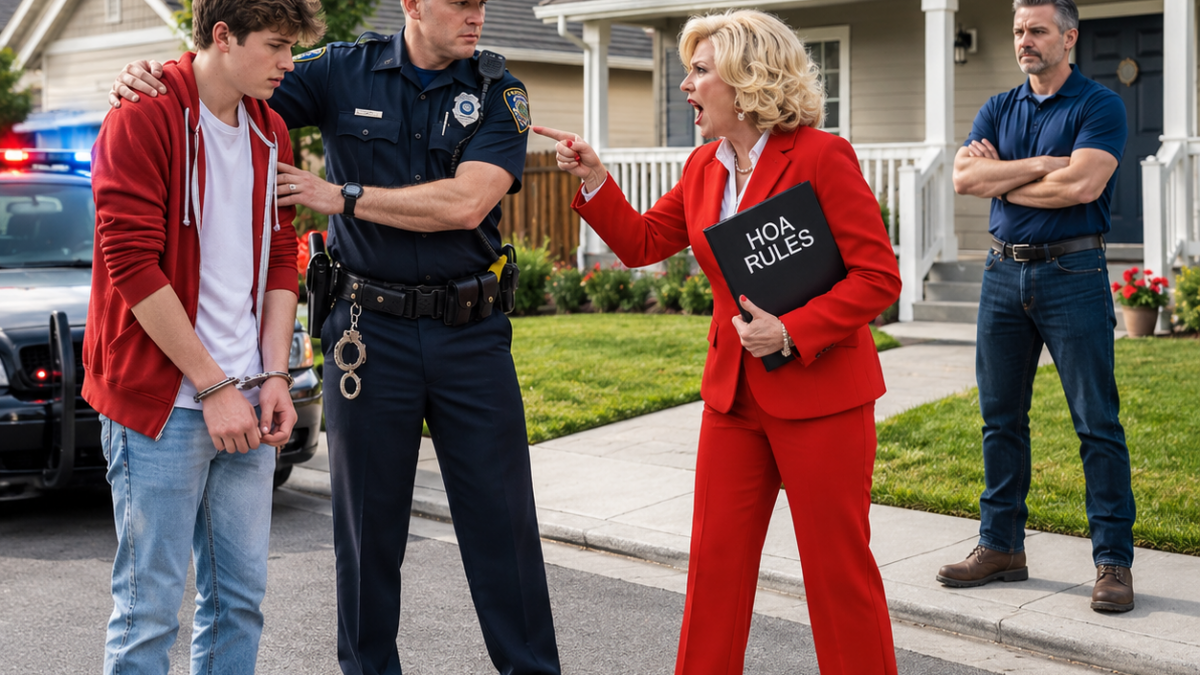
That’s when Trevor Ashworth appeared in the doorway, holding a blue folder I’d left on my kitchen table.
He was nineteen years old, wearing an expensive sweatshirt and looking more annoyed than embarrassed.
“Trevor, what are you doing in my house?”
He glanced down at the folder.
“Mom runs the HOA. I can go wherever I need to.”
I stared at him.
Three months earlier, I’d moved into Willowbrook Estates hoping to give my daughter, Zoe, a peaceful home after my divorce. I worked as an electrician, paid my bills on time, and wanted nothing more complicated than a quiet neighborhood where my daughter could feel settled again.
Instead, Vivian Ashworth, the woman everyone privately called the HOA Karen, had sent me violation notices over everything from my mailbox to a little garden gnome Zoe had bought with her allowance.
When I questioned the fines, Vivian threatened to pursue a lien against my home.
Then several neighbors quietly began bringing me their own paperwork.
An elderly widow had paid hundreds of dollars in questionable penalties. A young couple had moved away after receiving dozens of violations.
The blue folder in Trevor’s hands contained financial records we intended to discuss at the next neighborhood meeting.
“Put that down and leave,” I said.
Trevor gave me a tired smile.
“You’re making a big deal out of nothing.”
I backed farther down the driveway and called 911.
His smile disappeared.
“Seriously? You’re calling the police?”
I gave the dispatcher my address.
Across the street, my elderly neighbor Dolores switched on her porch light. I could see her standing behind the screen door, clutching her robe around her shoulders.
Trevor pulled out his phone.
“Mom’s going to straighten this out.”
A few minutes later, blue lights reflected against the windows of our sleeping neighborhood.
An officer approached me while her partner spoke to Trevor.
Then she looked at my damaged front door, the folder in his hands, and the security camera above my garage.
“Mr. Rodriguez,” she asked, opening her notebook, “has anything like this happened before?”
I looked toward Dolores’s house and began telling her about the previous three months.
[END OF FACEBOOK CAPTION]
[FIRST COMMENT / FULL STORY CONTINUATION]
The officer’s name was Elena Martinez.
She had been to my house once before, after I’d reported someone walking around my backyard late at night.
She remembered the address.
More importantly, she remembered Trevor.
“Is this the same young man you reported in September?” she asked.
“Yes.”
“And you’ve previously told him he isn’t allowed on your property?”
“More than once.”
She made a note.
“Stay here with me.”
Her partner was speaking to Trevor near the front steps. Trevor kept looking down at his phone, apparently waiting for someone to answer.
I could hear pieces of their conversation.
“It’s an HOA matter.”
“Do you live at this address?”
“No, but—”
“Did the homeowner give you permission to enter?”
Trevor looked toward me.
“He’s being ridiculous.”
The officer repeated the question.
Trevor didn’t answer.
Instead, he lifted his phone.
“Can I call my mom?”
The officer told him to put the phone away for the moment.
Trevor looked genuinely confused.
For three months, I had watched him follow his mother around our neighborhood, carrying her clipboard, photographing people’s houses, and speaking to homeowners as though he had some official position.
Now, standing beneath the porch light of a house he had entered without permission, he seemed unable to understand why that explanation wasn’t enough.
Officer Martinez asked whether I had a security camera covering the entrance.
I showed her the app on my phone.
There were several recorded clips.
She watched the relevant footage, asked a few questions, and stepped aside to speak with her partner.
I stood on the driveway in my work boots, suddenly aware of how cold it was.
I’d spent fourteen hours working at a commercial renovation site downtown.
My shoulders hurt.
My hands smelled faintly of electrical conduit and the coffee I’d spilled on myself earlier that evening.
All I had wanted was to come home, take a shower, and sleep.
Instead, I was watching a nineteen-year-old explain to two police officers why he believed my front door was his to open.
A few minutes later, Trevor was placed under arrest.
The moment was quieter than I expected.
He didn’t put up a fight.
He simply looked stunned.
“Wait,” he said. “You’re actually taking me somewhere?”
The officer explained what was happening.
Trevor looked toward his mother’s house at the far end of Maple Street.
“But she doesn’t know.”
Officer Martinez told him he would have an opportunity to contact someone.
As they escorted him toward the patrol car, he looked at me.
For the first time since I’d met him, he wasn’t smiling.
I didn’t feel the satisfaction I’d imagined I might feel if he were ever held accountable.
I felt sick.
Nineteen was old enough to know better.
It was also young enough to have a great deal of life left to ruin.
I watched the patrol car pull away.
Then I turned toward my house.
My front door wouldn’t close properly.
And tomorrow morning, I would have to tell my daughter why.
Dolores came across the street carrying a blanket.
She was seventy-two, barely five feet tall, and always seemed to have something useful in her hands.
Tonight, it was a knitted blue blanket that smelled of laundry detergent.
“Here, mijo.”
“I’m okay, Dolores.”
“Then you can be okay without freezing.”
She wrapped it around my shoulders before I could argue.
Officer Martinez was inside documenting the damage with another officer who had arrived to assist.
Dolores looked at the front door.
“I heard something earlier,” she said. “I thought maybe you were moving furniture.”
“You didn’t know.”
“I should have looked.”
“Dolores, you couldn’t have known.”
She shook her head.
Her eyes were wet.
“I’ve lived on this street twenty-three years. I never thought I’d see something like this.”
I didn’t know what to say.
She touched my arm.
“Where’s Zoe?”
“At Ava’s house.”
“Thank goodness.”
I nodded.
We stood together while the police finished their work.
When Officer Martinez returned, she asked if anything appeared to be missing.
I followed her into the kitchen.
The sight stopped me.
Papers covered the floor. A drawer containing spare batteries, receipts, and old keys had been emptied onto the counter.
The filing cabinet beside my refrigerator stood open.
A family photograph had fallen from the shelf.
It was a picture of Zoe and me at a county fair when she was nine. She had a missing front tooth and a pink cloud of cotton candy nearly as large as her head.
I picked it up.
The frame was cracked.
The photograph itself was fine.
That shouldn’t have mattered more than everything else in the room.
But it did.
Officer Martinez waited while I placed it carefully on the counter.
“Take your time,” she said.
I checked the filing cabinet.
My passport was there.
So were the house documents and insurance papers.
The blue folder Trevor had been carrying contained copies of association correspondence, financial summaries prepared by a neighbor, and notes from several residents.
There were no original bank records in it.
We had already made secure copies of everything important.
I explained that to Officer Martinez.
“Why would he be looking for these?”
“There’s a neighborhood meeting tomorrow. We’re planning to discuss some irregularities in the HOA finances.”
“Does his mother know?”
“Yes.”
“Does he?”
“He’s delivered several notices telling us the meeting was canceled.”
She wrote that down.
I told her about the questionable fines, the attempted inspections, and the late-night visit I’d reported in September.
I also told her about the photographs, emails, and other incidents we’d documented.
She listened without making promises.
Some matters, she explained, would need to be reviewed separately. The association’s financial problems weren’t automatically connected to Trevor’s actions simply because Vivian was his mother.
But his possession of the folder was relevant.
So was what he had said about protecting community interests.
Before leaving, she gave me a case number and explained how to submit the recordings.
“Don’t clean up anything we haven’t documented yet,” she said. “And if anyone comes here making threats, contact us. You don’t need to handle it yourself.”
I nodded.
She looked toward the broken door.
“Do you have somewhere else you can stay tonight?”
“I can secure it temporarily.”
Dolores immediately spoke.
“He can stay at my house.”
I smiled despite myself.
“I appreciate that.”
“You can argue with me tomorrow,” she said.
Officer Martinez almost smiled.
When the police finally left, Dolores waited while I gathered a few things.
I took my wallet, phone charger, work clothes, and Zoe’s framed photograph.
I didn’t take the blue folder.
The officers had retained it as potential evidence.
For the first time since the dispute began, the paperwork wasn’t my responsibility.
And yet I couldn’t stop thinking about it.
At three thirty in the morning, I sat at Dolores’s kitchen table while she made scrambled eggs.
“You don’t have to feed me,” I told her.
“I know.”
“I’m not hungry.”
“I know that too.”
She put a plate in front of me anyway.
Her kitchen reminded me of my mother’s house.
There were decorative plates on the walls, a calendar from the local Catholic church, and a plastic container filled with sewing supplies that had probably once held cookies.
A small television sat on the counter.
The clock above the refrigerator was seven minutes fast.
Dolores poured herself coffee.
“Have you called Zoe’s mother?”
I looked at my phone.
“No.”
“You should.”
“It’s the middle of the night.”
“Then text her. She needs to know before somebody tells Zoe at school.”
I knew she was right.
My ex-wife, Elena, and I had spent much of the previous year learning how to speak to each other without reopening old arguments.
We weren’t enemies.
But we weren’t particularly good at being friends either.
The divorce had been difficult.
There hadn’t been some dramatic betrayal or explosive secret.
We’d simply spent years becoming people who were exhausted by each other.
I worked too much.
She felt alone.
I thought providing for the family was the same as being present.
She disagreed.
By the time I understood what she meant, she’d stopped wanting to explain it.
Zoe had been caught in the middle of our quiet deterioration.
When I bought the house in Willowbrook Estates, I wanted it to be proof that something could still go right.
I wanted her to have a bedroom she loved, a neighborhood where she could ride her bike, and a place where she didn’t feel like a temporary visitor in her father’s life.
Now somebody had broken into that house.
I opened my messages.
Zoe is safe at Ava’s. There was an incident at my house tonight. Someone entered without permission. Police responded and made an arrest. I’ll explain in the morning.
I stared at the message before sending it.
Dolores sat across from me.
“Marcus.”
I looked up.
“You don’t have to make everything sound better than it is.”
I pressed send.
Then I put the phone down.
For several minutes, neither of us spoke.
Finally, Dolores said, “Do you remember what I told you when you moved in?”
“About Vivian?”
She nodded.
“About the family who lived in your house before you.”
I did remember.
I remembered thinking she was probably exaggerating.
I remembered assuming that whatever problems the previous owners had experienced, I could avoid them by keeping my lawn short and paying my dues.
I remembered believing that reasonable people could resolve reasonable disagreements.
What I hadn’t understood was how long Dolores had been waiting for someone to listen.
My first morning in Willowbrook Estates had been beautiful.
Early September.
Cool enough to leave the windows open, warm enough to drink coffee on the porch.
The moving truck was gone.
Half the boxes remained unpacked.
Zoe and I ate breakfast sitting on the living room floor because the dining table hadn’t been assembled.
“It’s weird,” she said.
“What is?”
“Having a whole new house.”
I looked around.
“Good weird or bad weird?”
She thought about it.
“Both.”
That seemed fair.
She had lived in the same house since she was three.
Now her parents occupied separate addresses, and she carried a backpack between them.
I couldn’t undo that.
But I could give her something permanent here.
Her bedroom was upstairs, facing the backyard. We’d painted the walls a soft green she’d chosen herself.
I’d installed shelves for her books and a little reading light beside the bed.
She had made me promise not to buy matching furniture.
“I’m sixteen, Dad. I don’t want my room looking like a hotel.”
So we’d visited thrift stores and found an old dresser she wanted to paint.
She chose a desk from a garage sale.
Then, at a hardware store, she bought a small garden gnome with a crooked red hat.
It was an ordinary, slightly ridiculous little thing.
She named him Walter.
“He looks judgmental,” she said.
“He’s a gnome.”
“Exactly.”
We put Walter beside the front steps.
It was the first decoration in our new home that wasn’t something I’d chosen.
Three weeks later, Vivian sent us a violation notice about him.
By then, she had already complained about my mailbox.
The mailbox post was brown.
Apparently, she wanted it black.
I’d read the association’s forty-seven-page declaration and rules when we bought the house. There were provisions about fences, parking, exterior paint, common-area maintenance, and other familiar restrictions.
There was no specific requirement that my mailbox post be black.
When I called Vivian to ask about it, she told me that maintaining a consistent appearance was part of her responsibilities.
I asked where the requirement appeared in writing.
She ended the call.
I assumed that was the end of the matter.
The gnome notice arrived the next morning.
Unapproved ornamental display — $50.
Zoe found it before I did.
“Dad?”
I was loading the dishwasher.
“What’s up?”
“Are we getting fined because of Walter?”
I dried my hands and took the paper.
The notice actually included a photograph of the gnome.
Somebody had stood near the sidewalk and zoomed in on it.
I laughed.
I couldn’t help it.
Then I saw Zoe’s expression.
“Hey, don’t worry about this.”
“Should I take him inside?”
“No.”
“It’s just a stupid decoration.”
“You like him.”
She looked down.
“Yeah, but if it’s going to cost money…”
I folded the notice.
“Leave Walter where he is.”
She gave me a hesitant smile.
“Okay.”
At the time, I thought I was protecting her from a minor inconvenience.
I had no idea that she would eventually begin checking the mailbox with the same nervousness other teenagers reserved for exam results.
Vivian Ashworth was fifty-two and had lived in Willowbrook Estates since shortly after the subdivision was built.
She knew which houses had changed owners.
She knew who had installed a new fence, whose teenagers parked overnight on the street, and which residents were behind on their dues.
She also knew the names of most contractors working in the neighborhood.
That knowledge could have made her a remarkably useful person.
Instead, over the years, it had given her a kind of influence nobody had thought to question.
The association had an elected board.
Vivian served as its chair.
But she increasingly used a title she’d invented for herself: community standards coordinator.
When residents needed permission for a project, they contacted Vivian.
When they had questions about their dues, they contacted Vivian.
When they wanted to dispute a violation, they were told to contact Vivian.
The management company was supposed to handle much of the administrative work, but correspondence routinely went through her first.
She made herself indispensable.
Then she began treating indispensability as authority.
Our first serious disagreement happened on a Saturday morning.
Zoe was upstairs getting ready for a friend’s birthday party.
I was making coffee when the doorbell rang.
Vivian stood on my porch with a clipboard.
Trevor was behind her, holding a phone.
“Good morning, Mr. Rodriguez,” she said.
“Morning.”
“We’re conducting property compliance assessments.”
“What’s that?”
“A routine inspection of exterior conditions.”
She glanced toward the side yard.
“This shouldn’t take long.”
I stepped onto the porch.
“Do I need to schedule something?”
“No. We conduct inspections as necessary.”
She started walking toward my gate.
I called after her.
“Hold on.”
She turned.
“Is there a problem?”
“I haven’t agreed to an inspection inside my yard.”
Her expression suggested I’d misunderstood something elementary.
“It’s an association inspection.”
“I’m aware of that.”
Trevor gave a small laugh.
“Dude, just let her do her job.”
I looked at him.
“And you are?”
“Trevor.”
“Are you on the board?”
He shrugged.
“I help out.”
Vivian seemed impatient.
“Mr. Rodriguez, we’ve conducted these inspections for years.”
“Then there should be something in the rules explaining how they work.”
“There is a general maintenance provision.”
“Does it allow access to fenced private areas without notice?”
She didn’t answer directly.
Instead, she pointed toward my driveway.
“Your property has already accumulated several concerns.”
She mentioned the mailbox.
The gnome.
A small oil stain left by the previous owner’s car.
A garden hose she considered improperly stored.
I listened.
Somewhere behind me, the front door opened.
Zoe had come downstairs.
“Dad?”
“Everything’s fine, sweetheart.”
Trevor looked at her.
“Your dad’s getting a little worked up.”
I turned toward him.
“Don’t involve my daughter.”
His smile faded.
Vivian folded her clipboard against her chest.
“You’re setting a very poor example, Marcus.”
I felt my face grow warm.
But Zoe was watching.
So I kept my voice level.
“If the association has legitimate maintenance concerns, send them to me in writing with the applicable rule. I’ll review them.”
Vivian stood there for a moment.
Then she turned and walked back toward her car.
Trevor followed.
He looked over his shoulder before leaving.
“You’re making this harder than it needs to be.”
I closed the front door.
Zoe was standing near the stairs.
“Was that Walter’s lady?”
I almost laughed.
“Apparently.”
She didn’t laugh with me.
“Are we in trouble?”
“No.”
“Then why did she say you were setting a bad example?”
I looked through the window as Vivian’s car disappeared.
“Because sometimes people get upset when you ask them to explain themselves.”
I thought that was a good answer.
A fatherly answer.
I didn’t see how much uncertainty it left in my daughter’s mind.
The following Monday, a city inspector arrived at my house.
Someone had submitted a complaint alleging unauthorized electrical work.
I’d been replacing aging outlets and installing a new ceiling fan. The work was appropriate for my qualifications and had been handled in accordance with the applicable requirements.
I still had the relevant records.
The inspector reviewed them and examined the work.
Everything checked out.
As he was packing up, he mentioned that his department had received more than one complaint concerning my address.
“Someone seems particularly interested in this house,” he said.
“Can you tell me who?”
“I can’t identify an anonymous complainant.”
I nodded.
He handed me his report.
“You’re all right on our end.”
I thanked him.
Afterward, I stood in the garage staring at the paperwork.
I’d worked as an electrician for nearly twenty years.
My professional reputation mattered.
People trusted me inside their homes, businesses, and schools.
A careless complaint could mean an inconvenient inspection.
Repeated complaints could cause problems with clients who didn’t understand the circumstances.
I didn’t know who had submitted them.
I suspected Vivian.
But suspicion wasn’t evidence.
I kept the report and went to work.
That afternoon, a customer handed me a cup of coffee while I finished repairing a lighting circuit in her kitchen.
She asked how my daughter was adjusting to the new neighborhood.
“Pretty well,” I said.
It was what I wanted to believe.
When I got home, Walter was gone.
I found him on the windowsill inside Zoe’s bedroom.
“Sweetheart?”
She looked up from her homework.
“Yeah?”
“Why’d you move him?”
She shrugged.
“He looks better up here.”
I knew she was lying.
But I didn’t make her say it.
At Dolores’s kitchen table, hours after Trevor’s arrest, those memories seemed painfully obvious.
I should have understood earlier that Zoe wasn’t simply annoyed by the HOA.
She was worried about losing another home.
Dolores poured more coffee into my cup.
“You’ve been carrying too much by yourself,” she said.
“I thought I could handle it.”
“You did handle a lot.”
“Not very well, apparently.”
She gave me a stern look.
“Don’t take responsibility for a grown young man walking into your house.”
I stared at my hands.
“I should have done something sooner.”
“What?”
I didn’t have an answer.
She reached across the table.
“You reported what happened. You asked for help. You kept records. You didn’t make him do this.”
My phone vibrated.
It was Elena.
Call me when you can.
I stepped into Dolores’s living room.
Elena answered before the second ring.
“Marcus, what happened?”
I told her.
Not the entire three-month history.
Just what I’d found when I arrived home and what the police had done.
For several seconds, she was silent.
Then she asked, “Was Zoe supposed to be there tonight?”
“No. The sleepover was planned.”
“But she could have been.”
“Yes.”
I heard Elena take a long breath.
“I’m coming over.”
“You don’t have to.”
“Marcus.”
I stopped.
She continued more quietly.
“We need to figure out what we’re telling her.”
I looked through Dolores’s curtains toward my dark house.
For once, I didn’t argue.
“Okay,” I said.
And when Elena arrived an hour later, she found me sitting on the couch with my head in my hands.
She sat beside me.
Neither of us mentioned the divorce.
Neither of us discussed whose weekend it was.
We were simply two parents trying to decide how to tell our daughter that something frightening had happened in a place we’d promised would be safe.
Zoe called at seven fifteen.
Her voice was sleepy.
“Hey, Dad. Can you pick me up around ten?”
“Of course.”
“Is Mom there?”
I looked at Elena, who was sitting across the kitchen table.
“Why?”
“She texted me to see how I was doing. She sounded weird.”
I closed my eyes.
There was no perfect way to begin.
“Something happened at the house last night, sweetheart.”
“What?”
“Someone went inside without permission. The police came, and nobody was hurt.”
Her voice changed.
“Inside our house?”
“Yes.”
“Who?”
I hesitated.
“Trevor Ashworth.”
The silence lasted long enough that I checked whether the call was still connected.
“Zoe?”
“Was he in my room?”
I hadn’t expected that to be her first question.
“I don’t think so. The damage appears to be in the kitchen and near the entrance.”
“Appear?”
I looked at Elena.
She mouthed, Tell her the truth.
“I haven’t checked every room carefully yet,” I said. “But I’ll do that before you come home.”
Zoe’s voice became very small.
“Why would he do that?”
“I don’t know exactly.”
“Because of those papers?”
I stared at the table.
She knew more than I’d realized.
“Possibly.”
Another pause.
Then she asked, “Are we going to have to move?”
There it was again.
The question beneath every other question.
“No, sweetheart.”
I stopped myself.
I wanted to give her an absolute promise.
Instead, I chose words I could stand behind.
“We have no plans to move. Your home is still your home. And your mom and I are going to make sure you’re comfortable before you come back.”
“Can I stay with Mom tonight?”
“Of course.”
She started crying.
“I’m sorry.”
“For what?”
“I don’t know.”
Elena reached for the phone.
“Zoe, honey, it’s Mom.”
I handed it over.
She spoke to our daughter for several minutes, reassuring her, answering questions, and arranging to pick her up.
I sat quietly.
When Elena finished, she looked at me.
“She wants to come get some clothes first.”
“Okay.”
“She also wants us both there.”
I nodded.
Dolores brought another plate of eggs to the table.
Nobody had asked her to.
Nobody turned it down.
By nine o’clock, a locksmith had repaired the damaged entrance and installed replacement hardware.
I arranged for a carpenter I knew to assess the doorframe.
The police had finished documenting the immediate damage, and I was permitted to begin cleaning.
Elena helped me gather the papers from the kitchen floor.
We worked quietly.
At one point, she held up a stack of violation notices.
“Are all of these yours?”
“Yes.”
She flipped through them.
“Marcus, there must be thirty here.”
“Thirty-four.”
“Thirty-four?”
I nodded.
She read one alleging that the garden hose was visible from a neighboring property.
Then another concerning a decorative item on the porch.
Then the notice threatening collection of $1,247 in outstanding penalties, plus administrative fees.
Her face changed.
“Why didn’t you tell me about this?”
“I thought it would get resolved.”
“By whom?”
“I’ve been working with some neighbors.”
She set the papers down.
“Does Zoe know they threatened a lien?”
“I didn’t tell her.”
Elena stared at me.
“Marcus.”
“I didn’t want her worrying.”
“She was already worrying.”
I looked away.
Elena lowered her voice.
“This is exactly what you used to do.”
I knew immediately what she meant.
During our marriage, I had a habit of keeping difficult things to myself.
If a customer was late paying me, I didn’t mention it until the bills were due.
If my truck needed an expensive repair, I tried to figure out how to cover it before telling Elena.
If I was worried about something, I went quiet.
I thought I was protecting my family.
She experienced it as being shut out.
“You can’t decide what information affects other people,” she said. “Especially not when it affects our daughter.”
“I know.”
“Do you?”
I looked at the damaged door.
“Yes.”
She watched me for a moment.
Then she picked up another stack of papers.
“Okay. Let’s start there.”
We didn’t have a dramatic reconciliation.
There were still reasons we had divorced.
But that morning, in a kitchen full of scattered documents, I began to understand that I didn’t have to repeat every mistake I’d made simply because I’d made it before.
When Zoe arrived, she stood in the driveway for almost a minute before approaching the house.
Her mother was beside her.
I waited near the front steps.
“Hey, sweetheart.”
She hugged me.
Then she looked at the new lock.
“Does it work?”
“Yes.”
“Are you sure?”
I demonstrated that the door closed properly.
She watched carefully.
Then we went inside together.
The kitchen had been cleaned, though some scratches remained on the filing cabinet and the broken picture frame was still on the counter.
Zoe noticed it immediately.
“Oh.”
She picked up the photograph.
“That was the fair.”
“Remember the cotton candy?”
“Yeah.”
She touched the cracked frame.
Then she set it down.
“Can we go upstairs?”
We followed her.
Her bedroom looked untouched.
Books on the shelves.
Homework on the desk.
A sweatshirt draped over the chair.
Walter sat on the windowsill, looking as judgmental as ever.
Zoe checked the closet.
Then she checked the space beneath her bed.
She knew Trevor wasn’t there.
That wasn’t really what she was checking.
She was trying to feel that her room belonged to her again.
Elena sat on the edge of the bed.
“Take whatever you need, honey.”
Zoe opened a drawer and began packing clothes.
I stood in the doorway.
I wanted to tell her everything was fine.
But clearly it wasn’t.
“Dad?”
“Yeah?”
“Was he trying to steal something?”
“Some paperwork, we think.”
“Why?”
“There’s a disagreement about how the neighborhood association has been spending money.”
She looked confused.
“That’s worth breaking into somebody’s house?”
“No.”
“Then why would he?”
I leaned against the doorframe.
“I think he believed he could solve a problem for his mother.”
“By doing that?”
“People make bad decisions sometimes.”
Zoe zipped her overnight bag.
“That’s a really bad decision.”
“Yes,” I said. “It is.”
She sat down beside Elena.
Then she asked me a question I had no good answer for.
“Did you know he might come back?”
I thought about the camera footage of Trevor wandering around my property.
The previous report I’d filed.
The way he’d spoken to me.
I’d known he was crossing boundaries.
I’d worried he might cause more trouble.
But I hadn’t believed he would actually enter my house.
“I knew he’d been coming around,” I said. “I didn’t know he’d do this.”
“Did the police know?”
“They knew about some of the earlier incidents.”
She nodded slowly.
“Okay.”
I crouched beside her.
“I’m sorry you have to deal with this.”
She looked at me.
“It’s not your fault he came inside.”
I swallowed.
“No. But I wish I’d told you more about what was happening.”
She leaned forward and hugged me.
“Please don’t make me find out things from other people.”
I held her carefully.
“I won’t.”
That was the promise I needed to make.
Not that nothing bad would ever happen.
Not that I could control every person around us.
Just that she wouldn’t have to face frightening news without knowing her father was willing to talk about it.
At noon, Vivian called.
Her name appeared on my phone while I was washing dishes.
I considered letting it ring.
Then I answered.
“Hello?”
“Marcus, I need you to listen to me.”
There was no greeting.
No apology.
Her voice sounded different.
Tight.
Unsteady.
“Trevor has been arrested,” she said.
“I know.”
“He’s at the county detention center.”
“I understand.”
“He has never been in jail before.”
I waited.
She continued.
“This has gotten completely out of proportion.”
I put the dish towel down.
“Vivian, he was inside my house without permission.”
“He was concerned about the meeting.”
“What does that have to do with entering my home?”
“He thought there were documents there that belonged to the association.”
“Then he should have asked.”
“He’s nineteen, Marcus.”
“Yes.”
“He made a mistake.”
I looked toward the front door.
The carpenter’s temporary repair was still visible.
“He made a serious mistake.”
Vivian exhaled sharply.
“I can pay for the door. Whatever it costs.”
“That’s not the only issue.”
“What else do you want?”
The question surprised me.
For a moment, I wasn’t sure she understood why I had called the police.
“I wanted him out of my house.”
“Fine. He’s out.”
“Vivian.”
“My son spent the night in a detention center. He’s frightened. He’s never experienced anything like this.”
I believed her.
I also remembered Zoe standing in her bedroom, checking beneath her bed.
“My daughter was frightened this morning,” I said.
Vivian went quiet.
“She wanted to know whether he’d been in her room.”
There was another pause.
Then Vivian said, “Trevor wouldn’t hurt your daughter.”
“You don’t know what it feels like for her to have somebody enter her home.”
“He wasn’t there for her.”
“That doesn’t make her feel any safer.”
I could hear Vivian moving around.
Possibly pacing.
Finally, she said, “Can you tell the police this was a misunderstanding?”
“No.”
“Marcus, please.”
I closed my eyes.
“I’ll tell them exactly what happened. Nothing more and nothing less.”
“You could destroy his future.”
“He entered my home, Vivian. I didn’t make that decision for him.”
Her voice hardened.
“Don’t pretend you haven’t been encouraging this conflict.”
I felt the familiar anger rising.
This was how our conversations always went.
Somehow, questioning a fine became causing trouble.
Asking for records became spreading rumors.
Calling the police became an attack on her family.
I took a breath.
“I’m ending this conversation now.”
“Marcus—”
“If you need to contact me about the association, please do it in writing.”
I hung up.
Then I stood beside the sink.
My coffee had gone cold.
On the counter, Zoe’s broken picture frame waited to be repaired.
I wanted to call Vivian back and tell her everything I thought about the way she’d raised her son.
I wanted to say something that would hurt her as much as her actions had hurt my family.
Instead, I went into the garage and found the small screwdriver I needed to remove the damaged frame.
It was a better use of my hands.
The neighborhood meeting was scheduled for seven that evening.
Under other circumstances, I might have canceled my involvement.
I hadn’t slept.
My daughter was upset.
I had repairs to arrange and a police report to complete.
But the meeting wasn’t just about Trevor.
And it wasn’t really mine to cancel.
Over the previous several weeks, a small group of residents had been collecting records and comparing experiences.
Dolores was part of it.
So was Bernard Fletcher, a retired postal worker who lived two doors down.
Janet Ellis, a retired legal aid attorney, had helped us understand the association’s governing documents.
And Philip Grant, an accountant who specialized in nonprofit organizations and small businesses, had volunteered to review the financial records available to homeowners.
They were ordinary people.
They weren’t looking for a fight.
Most of them would rather have spent Friday evening watching television or eating dinner with their families.
But they had reached a point where doing nothing felt more exhausting than getting involved.
At one o’clock, Janet arrived at my house.
She looked at the repaired entrance.
“How are you?”
“Tired.”
“That’s a good answer. Better than telling me you’re fine.”
She placed a folder on the kitchen table.
“Have the police taken what they need?”
“So far.”
“Good.”
She sat down.
“We need to discuss tonight.”
I expected her to tell me the break-in made our case stronger.
Instead, she said something else.
“We are not playing the footage of Trevor’s arrest at the meeting.”
I looked at her.
“I wasn’t planning to.”
“I’m glad. We also aren’t making accusations about Vivian directing him unless we have evidence.”
I nodded.
Janet took off her glasses.
“Marcus, what happened to you is serious. But the criminal investigation belongs to the police. The financial review belongs to the association and, if necessary, the relevant authorities.”
She tapped the folder.
“Tonight’s purpose is to establish proper oversight. Not to put somebody on trial in a community center.”
I appreciated the reminder.
A few weeks earlier, when we’d first begun preparing our presentation, I had imagined standing in front of Vivian and reading every suspicious payment aloud.
I had imagined her trying to explain herself while the room turned against her.
There was something appealing about that picture after months of feeling powerless.
But now my front door was damaged.
A young man was in custody.
My daughter was afraid to sleep in her own room.
The situation no longer felt like an argument I wanted to win.
It felt like something that needed to stop.
Janet opened the folder.
“Phil’s updated the financial summary. He wants to emphasize that the amount identified is a preliminary estimate of unsupported or questionable spending.”
“How much?”
“Approximately seventy-three thousand dollars over three years.”
I looked down.
Even after seeing earlier estimates, the number was difficult to absorb.
Seventy-three thousand dollars was more than many people in our neighborhood earned in a year.
Janet continued.
“We need an independent audit. Some of these transactions may have legitimate explanations. Others may not. We don’t have all the underlying documents.”
“Will Vivian be there?”
“She was notified, along with every other homeowner.”
“Has she tried to cancel?”
“Of course.”
I smiled faintly.
Janet smiled back.
“But the meeting was requested under the member petition provision. We’ve followed the required procedures.”
She stood.
“Would you like somebody else to handle your part?”
I thought about it.
“No.”
“Are you sure?”
I nodded.
“I want to explain why I started asking questions.”
“Then explain that.”
She picked up her folder.
“You don’t have to be the person who fixes everything else.”
I looked at her.
“People keep telling me that.”
“Maybe you should consider listening.”
Then she walked toward the door.
Our investigation had begun with a much smaller number.
Fifty dollars.
The mailbox fine.
Then another fifty dollars for Walter.
Then penalties for a garden hose, visible trash containers, and a brief period of weekend construction noise.
Individually, none of them would have ruined me.
That was part of the problem.
Each fine was small enough that paying it seemed easier than challenging it.
The time required to dispute fifty dollars could be worth more than fifty dollars.
I understood why people gave in.
I nearly did.
One evening, after opening my fourth violation notice in a week, I found Dolores standing near the sidewalk.
She was holding a bag of tomatoes.
“Come here a minute,” she said.
I walked over.
She handed me the bag.
“From my garden.”
“Thank you.”
Then she nodded toward the paper in my hand.
“Another one?”
“Apparently.”
“What now?”
“An unapproved flag display.”
She looked at the small American flag attached to my porch.
“That?”
“That’s the one.”
Dolores shook her head.
“Come inside.”
Her house was warm and smelled of roasted peppers.
She opened a kitchen drawer and removed a thick envelope.
Inside were violation notices dating back almost five years.
Some were for ordinary matters.
An overgrown hedge.
A damaged fence panel.
A trash container left near the curb.
Others were considerably less clear.
A flowerpot in an unauthorized location.
A bird feeder that allegedly affected the neighborhood’s appearance.
A temporary ramp installed to help her husband reach the front porch after knee surgery.
I looked at the ramp notice.
“They fined you for this?”
“Seventy-five dollars.”
“Did you dispute it?”
“Three times.”
“What happened?”
“Nothing.”
She showed me copies of letters she had mailed to the association.
“I kept sending them. Then they told me they’d never received anything.”
I studied the dates.
“Did you keep proof of delivery?”
“Not at first.”
She sighed.
“I didn’t know I needed to. I thought these people were my neighbors.”
That sentence stayed with me.
I asked how much she’d paid altogether.
She couldn’t remember exactly.
Somewhere around six hundred dollars.
Maybe more.
Her husband had died two years earlier.
During his final illness, she had received three notices concerning the condition of her lawn.
“I couldn’t keep up with everything,” she said.
“Did anybody offer to help?”
She smiled sadly.
“People were busy.”
I looked at the stack of papers.
“Can I make copies of these?”
She hesitated.
“Are you going to get yourself into trouble?”
“I just want to understand what’s happening.”
She looked toward the window.
“That’s what the people who lived in your house used to say.”
Then she told me about the previous owners.
Daniel and Emma Foster.
A young couple with an infant.
Daniel worked in logistics. Emma was a dental assistant who had reduced her hours after their daughter was born.
They’d received repeated violations concerning sprinkler schedules, temporary parking, landscaping, and exterior items stored near their garage.
When they disputed several notices, the correspondence dragged on for months.
Eventually, they sold the house.
Dolores didn’t know whether the association was the only reason.
But she remembered Emma crying on moving day.
“She said they couldn’t afford to keep fighting,” Dolores told me.
I looked across the street at the house I’d just purchased.
It had seemed like a fresh start.
For another family, it had been something they needed to escape.
Bernard joined us the following week.
He was sixty-eight and had the meticulous habits of someone who had spent decades handling mail and maintaining records.
His garage contained labeled plastic containers for nearly everything.
Christmas lights.
Extension cords.
Garden equipment.
Even old newspapers.
When Dolores told him about my violation notices, he came over with a spreadsheet he’d created for his own disputes.
“Never throw away the envelope,” he said.
I looked at him.
“The envelope?”
“Postmark, delivery information, return address. Sometimes that’s the only way you can establish when a notice was actually sent.”
He showed me two letters.
Both had been dated the same day.
One had been mailed almost three weeks later.
The deadline for disputing the alleged violation had nearly passed by the time he received it.
“That happened to me too,” I said.
Bernard nodded.
“Thought it might have.”
He had been keeping records for years.
He wasn’t claiming every association decision was wrong.
He’d served on committees himself and understood that rules were necessary.
But the paperwork had become increasingly inconsistent.
Some homeowners received reminders.
Others received immediate monetary penalties.
Some disputes appeared in board records.
Others disappeared into an administrative process nobody could explain.
Bernard had begun helping neighbors send important correspondence through methods that produced reliable delivery records.
What concerned him most wasn’t an occasional mistake.
It was the repeated pattern.
“People send appeals,” he said. “The association tells them nothing arrived. Then the fines accumulate.”
I mentioned that Dolores had experienced the same problem.
“Exactly.”
He leaned forward.
“If two people have the same problem, it might be a coincidence. If twenty people have it, you’d better look at the process.”
We started comparing dates.
By the end of the evening, my dining table was covered with documents.
Zoe came downstairs.
She looked at the papers.
“Are you guys starting a business?”
Bernard laughed.
“Trying to finish someone else’s paperwork.”
I introduced him properly.
He offered her one of the cookies Dolores had brought.
Zoe took it and returned upstairs.
I thought she was amused by the strange gathering at our kitchen table.
I didn’t realize she had begun associating visitors with more problems.
Janet became involved after Bernard mentioned the growing stack of notices.
She insisted we start with the actual governing documents.
“No rumors,” she said during our first meeting. “No neighborhood gossip. If we’re going to challenge anything, it needs to be based on the rules and the facts.”
She read the declaration and bylaws carefully.
Then she reviewed the enforcement policy that had been distributed to residents several years earlier.
She identified provisions requiring notice, reasonable time to correct certain conditions, and an opportunity to dispute monetary penalties through a defined association process.
In my case, the violations had moved to fines without several of those procedural steps being completed.
The documents also described how board decisions were supposed to be recorded.
And they gave homeowners access to certain association records, subject to appropriate procedures and privacy protections.
“Have you requested the meeting minutes?” she asked.
“Yes.”
“What did they send?”
“An email saying they’d be made available after approval.”
“Have you received any?”
“No.”
She wrote something down.
“Financial statements?”
“Nothing beyond the annual dues notice.”
Janet looked toward Bernard.
“When was the last annual meeting?”
He thought about it.
“Fourteen months ago.”
I stared at him.
“Fourteen?”
“There was supposed to be one in the spring. Vivian postponed it.”
Janet leaned back.
“Well, that’s an excellent place to start.”
She helped us prepare a formal request for records.
We asked for budgets, approved minutes, enforcement procedures, and relevant contracts.
We addressed the request to the association rather than Vivian personally.
We kept copies.
When the initial response was incomplete, we followed up.
The process took weeks.
Some records came directly from the management company.
Others were provided by former board members who had retained copies of approved reports.
There were gaps.
There were missing invoices.
There were several explanations that didn’t match the dates on the documents.
Eventually, Phil offered to help.
He arrived at my house one evening carrying a laptop and a bag of peanut brittle his wife had made.
“I’m not a detective,” he announced.
“Neither are we,” Dolores said.
“Good. Then let’s behave like accountants.”
He opened the financial statements.
Willowbrook Estates consisted of seventy-eight homes.
At seventy-five dollars in regular monthly dues, the association received approximately $5,850 each month, before fines, assessments, or other income.
That meant roughly $70,200 annually in regular dues.
Phil explained that a healthy association might legitimately set aside money for long-term repairs and unexpected expenses.
Not every dollar left over after routine bills was suspicious.
Reserve accounts mattered.
Insurance mattered.
Maintenance costs fluctuated.
We listened.
Then he pointed to a series of recurring payments.
Two thousand dollars per month.
The recipient was listed as Ashworth Property Management Services.
“Does anybody recognize this company?” he asked.
Bernard leaned closer.
“That’s Vivian’s name.”
Phil nodded.
“That’s why I’ve flagged it.”
We looked through the available board minutes.
There was no clearly documented approval of a continuing consulting agreement at that amount.
There were also no regular reports explaining what services had been performed.
Another series of payments went to a landscaping company connected to one of Vivian’s relatives.
Again, there could have been legitimate work.
Family relationships alone didn’t prove misconduct.
But the pricing and approval records raised questions.
Finally, Phil identified several large repair expenses that appeared to involve work residents couldn’t remember seeing.
An irrigation replacement.
Pavement repairs.
Mail station improvements.
The supporting documentation was thin.
I looked at Bernard.
“Was the parking area resurfaced?”
“No.”
“Are you sure?”
“There’s a pothole out there I’ve been complaining about since 2019.”
Dolores laughed.
Phil didn’t.
He took another note.
“We’ll need to verify each of these.”
By midnight, he had identified tens of thousands of dollars in payments requiring further explanation.
He refused to call it stolen money.
Not yet.
That caution frustrated me at first.
Now, sitting in my kitchen after Trevor’s arrest, I was grateful for it.
Phil had taught us to make room for facts before anger filled every available space.
Three days before Trevor entered my house, Vivian had come to my front door without her clipboard.
She was carrying a white envelope.
“Do you have a minute?”
I stepped outside.
“Sure.”
She handed me the envelope.
Inside was a proposed resolution of my outstanding violations.
If I signed it, the association would remove the disputed penalties and consider the enforcement matter closed.
No more mailbox complaints.
No more arguments about garden decorations.
No more threatened collection action.
I looked up.
“What’s the catch?”
She smiled.
“There doesn’t need to be one.”
“Then why does it say I agree to withdraw my complaints concerning association administration?”
Her smile faded slightly.
“It’s a mutual resolution. We both move forward.”
I read the paragraph again.
The language was broad enough that I might have been agreeing to abandon the financial records requests I’d helped organize.
“Did the board approve this?”
“We’ve discussed it.”
“Can I have the minutes?”
She sighed.
“Marcus, we’re trying to solve your problem.”
“My problem isn’t the only one.”
“Other homeowners aren’t making these kinds of demands.”
“They’re the ones bringing me their records.”
She folded her arms.
“You’ve stirred up a lot of unnecessary concern.”
“Then release the financial records and clear it up.”
For a moment, she looked almost hurt.
“I’ve given fifteen years of my life to this neighborhood.”
“I understand.”
“You don’t. You moved here three months ago.”
She pointed toward the entrance road.
“Do you know what this place looked like when we bought our house? Do you know how much work it took to establish standards?”
“No.”
“I organized the landscaping. I helped with snow removal. I negotiated insurance renewals when nobody else wanted to deal with them.”
“Those things matter, Vivian.”
“Then why are you treating me like some kind of criminal?”
I looked down at the proposed agreement.
“Because you’re asking me to stop asking questions in exchange for getting rid of fines that should never have been issued.”
Her face tightened.
“I’m offering you peace.”
I handed the envelope back.
“I’d rather have an explanation.”
She took it.
For a few seconds, she stood there looking at me.
Then she said, “You’re going to regret making everything so difficult.”
She walked away.
I watched her return to her car.
What unsettled me wasn’t the sentence itself.
It was how sincerely she seemed to believe that questioning her authority was an offense against the community.
Somewhere along the way, Vivian had stopped distinguishing between the neighborhood’s interests and her own.
And Trevor had grown up watching that happen.
At six thirty on Friday evening, I parked outside the Willowbrook Community Center.
The building had seen better days.
Its gutters needed replacing, the parking lot was uneven, and a faded banner advertising a summer barbecue still hung near the entrance.
Cars filled the available spaces.
People stood outside talking in small groups.
Several carried folders.
One elderly man had brought a grocery bag full of old notices.
I recognized him as Arthur Mills, a retired bus driver who lived near the entrance.
He nodded when he saw me.
“Glad you’re here.”
“Thanks, Arthur.”
He lifted the bag.
“Been saving these for somebody who might care.”
Inside, Bernard was arranging sign-in sheets.
Janet was checking the meeting agenda.
Phil had connected his laptop to a projector that appeared to be older than Zoe.
Dolores was pouring coffee into paper cups.
“Eat something,” she told me.
She handed me a sandwich wrapped in foil.
I smiled.
“I’m starting to think you only invite me places so you can feed me.”
“Then you’re finally figuring it out.”
I took the sandwich.
People continued arriving.
Some had come because they were angry about their dues.
Others because they’d heard about Trevor.
A few seemed uncomfortable, as though attending the meeting meant choosing sides in a personal dispute.
I understood that feeling.
For years, many residents had relied on Vivian to manage the association.
She had arranged maintenance, answered questions, and organized neighborhood events.
They had trusted her.
Admitting that trust might have been misplaced was difficult.
Near the front, a woman named Clara Jennings sat with her husband, holding a folder on her lap.
She’d been one of the first residents to share her notices with us.
Her husband used a walker.
She noticed me and waved.
“Is your daughter all right?”
“She will be.”
“Tell her we’re thinking about her.”
I thanked her.
Then I noticed two people standing near the entrance.
Daniel and Emma Foster.
The previous owners of my house.
Dolores had invited them after obtaining their permission to share some of their old association correspondence.
They had driven nearly an hour to attend.
Emma carried a canvas bag. Daniel stood close beside her.
I approached them.
“I’m Marcus.”
Daniel shook my hand.
“Good to meet you.”
Emma looked at me with an expression I couldn’t quite identify.
“I’m sorry,” she said.
“For what?”
“That you’re dealing with this.”
I glanced toward the meeting room.
“We bought your house because it seemed like a good place to start over.”
Her eyes filled.
“We thought the same thing.”
Before either of us could say more, the room grew quieter.
Vivian had arrived.
She wore a gray coat and carried a leather portfolio.
Her husband, Richard, walked beside her.
I’d seen him occasionally, usually leaving early for work or washing his car on Sunday afternoons.
He had never participated much in neighborhood affairs.
Tonight, he looked deeply uncomfortable.
Vivian scanned the room.
Her eyes stopped on me.
Then they moved toward Janet and Phil.
She took a seat near the front.
Richard sat beside her.
No one applauded.
No one booed.
People simply watched.
And for the first time since I’d lived in Willowbrook Estates, Vivian had entered a neighborhood meeting without automatically becoming the person in charge.
Janet opened the session by explaining its purpose.
The meeting had been requested by members under the association’s petition procedures.
Enough eligible owners were present or represented to conduct the business identified in the notice.
A neutral homeowner had agreed to preside over the discussion.
The required minutes would be kept.
Everyone would have an opportunity to speak.
“This is not a criminal proceeding,” Janet said. “We are here to review association governance, discuss documented concerns, and determine what steps the membership wants to take.”
Vivian raised her hand before Janet finished.
“I object to the characterization of this meeting.”
The temporary chair, a retired principal named Robert Lawson, acknowledged her.
“You’ll have time to respond, Vivian.”
“This entire process has been organized by people with a personal grievance against me.”
Robert adjusted his glasses.
“That’s a concern you can raise during your remarks.”
Vivian looked around.
Nobody intervened.
She lowered her hand.
Phil began with the financial overview.
He displayed the annual dues income, ordinary operating expenses, and reported reserve balances.
He explained the difference between an expense that appeared unusual and an expense that could actually be demonstrated to be improper.
He spoke slowly.
No dramatic music.
No embarrassing photographs.
Just numbers and records.
Then he displayed the recurring payments to Ashworth Property Management Services.
The room stirred.
Robert looked toward Vivian.
“Could you explain the nature of these payments?”
Vivian opened her portfolio.
“I performed administrative services that would otherwise have required hiring an outside professional.”
Phil nodded.
“What services specifically?”
“Compliance monitoring, resident correspondence, contractor coordination.”
“Was there a written agreement?”
“Yes.”
“Could we see it?”
Vivian looked through her papers.
“I didn’t bring every document tonight.”
“That’s understandable. We requested a copy three weeks ago.”
She looked at him.
“I have been extremely busy.”
Phil made a note.
“We’ll include that in the outstanding requests.”
A woman near the back raised her hand.
“Were we paying Vivian two thousand dollars a month?”
Phil looked at the records.
“The statements show recurring payments in that amount during several periods.”
The woman frowned.
“I thought the board positions were voluntary.”
Vivian spoke quickly.
“They are. The consulting services were separate.”
“Who approved the consulting services?”
Vivian looked toward a former board member seated near the aisle.
His name was Glenn Parker.
He had stepped down the previous year.
Glenn cleared his throat.
“I remember discussing administrative support. I don’t remember approving a continuing contract at that rate.”
“You were at the meeting, Glenn,” Vivian said.
“I know.”
“Then you know we discussed it.”
“Discussing isn’t the same as authorizing.”
Vivian stared at him.
Glenn looked down at his hands.
Phil continued.
He presented the landscaping expenses.
Then the large repair payments.
Residents asked questions.
Had irrigation equipment actually been replaced?
Where had the paving work occurred?
Why did the mailbox repair invoice describe new installations when the existing equipment appeared unchanged?
Vivian gave explanations for some of the items.
She said there had been preliminary work.
Contractors had incurred costs.
Some projects had changed scope.
Records were being maintained elsewhere.
Phil didn’t argue.
He wrote down each answer.
Then he displayed the summary.
Approximately $73,000 in transactions required further review, based on the incomplete documentation available to homeowners.
A silence settled across the room.
It wasn’t the dramatic silence of a courtroom.
It was the silence of people doing arithmetic in their heads.
Seventy-eight families.
Monthly dues paid year after year.
Money that was supposed to maintain their shared neighborhood.
Clara Jennings raised her hand.
“My husband and I have postponed replacing our washing machine for nearly a year,” she said. “We always made sure our association dues were paid.”
She looked toward Vivian.
“I’d just like to know where the money went.”
Vivian opened her mouth.
Then closed it.
Richard, sitting beside her, stared at the projected numbers.
He looked as though he were seeing some of them for the first time.
When it was my turn to speak, I carried only a few pages to the front.
I looked at the audience.
Then I began.
“My name is Marcus Rodriguez. Most of you know me as the guy who moved into the old Foster house.”
A few people nodded.
“I have a sixteen-year-old daughter. We came here after my divorce because I wanted her to have a place where she could feel comfortable and settled.”
I paused.
“Within three weeks, I received a fine for the color of my mailbox post.”
I held up the notice.
“I asked for the rule. I never received a specific written provision supporting it.”
Then I displayed the notice concerning Walter.
There was a little laughter.
I waited.
“I know a garden gnome sounds like a ridiculous thing to argue about. But this was something my daughter bought because she liked it. She eventually moved it into her bedroom because she thought it was causing trouble.”
The laughter faded.
I continued.
“Over the following weeks, the penalties accumulated. I filed disputes. I requested hearings. Then I received a notice threatening further collection action over more than twelve hundred dollars in fines.”
I held up the letter.
“By that point, I wasn’t just worried about fifty dollars. I was worried about whether the association was following its own rules.”
I looked toward Dolores.
“Then my neighbors began showing me their experiences.”
Bernard displayed a summary of documented notices and unanswered disputes.
Names had been removed unless residents had given permission to identify them.
The figures showed an inconsistent enforcement process.
Repeated penalties.
Delayed responses.
Deadlines that were difficult to meet because notices sometimes arrived late.
I explained that reasonable maintenance standards weren’t the problem.
I had agreed to maintain my property.
I had paid my regular dues.
I wasn’t asking to park abandoned vehicles on my lawn or ignore legitimate safety concerns.
I was asking for rules to be applied consistently and with the procedures homeowners had been promised.
When I finished, Emma Foster raised her hand.
Robert invited her to speak.
She stood with the canvas bag.
“My husband and I used to own Marcus’s house.”
A few longtime residents recognized her.
Dolores smiled gently.
Emma removed several papers.
“We moved there when our daughter was six months old. It was our first house.”
She looked toward Vivian.
“We received forty-seven violation notices over a period of roughly six months.”
Several people turned toward each other.
Emma continued.
“Some were legitimate. I’ll admit that. We had a baby, and we weren’t always perfect about the lawn or the trash bins.”
Daniel stood beside her.
“But other notices contradicted each other. We were told to water the lawn more often, then fined for watering outside a designated schedule we hadn’t been given.”
She unfolded another paper.
“I requested an accommodation for a temporary parking arrangement while my mother helped with childcare. We never received a clear answer.”
Her voice began to shake.
“We paid approximately thirty-four hundred dollars in disputed fines before we sold the house.”
Someone gasped softly.
Vivian leaned forward.
“You repeatedly failed to maintain your property.”
Emma looked at her.
“We were trying.”
Those three words seemed to change the atmosphere.
Not because they proved anything by themselves.
Because almost everyone in the room understood what it was like to be trying.
Trying to get children to school.
Trying to pay medical bills.
Trying to maintain a home while working full-time.
Trying to look after a parent.
Trying to keep a marriage together.
Emma wiped her cheek.
“I didn’t come tonight because I want to embarrass anyone. We have another home now. We’re doing all right.”
She looked around.
“I came because I don’t want another young family spending six months afraid to open their mailbox.”
She sat down.
Daniel took her hand.
For a long moment, nobody spoke.
Vivian requested the opportunity to respond.
Robert gave her the microphone.
She stood.
“I believe many things have been taken out of context tonight.”
She looked at the projected documents.
“The association has been facing rising expenses for years. Contractors are more expensive. Insurance costs have increased. Maintaining neighborhood appearance requires attention.”
She paused.
“I have done work that other board members weren’t willing to do.”
Some residents nodded.
That part was probably true.
She continued.
“I’ve answered calls at all hours. I’ve dealt with disputes between neighbors. I’ve arranged emergency repairs during storms.”
Her voice softened briefly.
“People don’t appreciate that work until nobody’s doing it.”
I found myself thinking about how much unpaid work Dolores did for people.
The meals she prepared.
The rides she gave older neighbors.
The children she watched when parents were running late.
She had never presented any of them with a bill they didn’t know they’d agreed to.
Vivian looked toward Phil.
“I can account for these expenditures.”
Phil answered evenly.
“Then we welcome the documentation.”
She turned toward me.
“And I want it understood that the recent incident involving my son is being used to create a misleading impression of my family.”
The room grew still.
Robert spoke.
“We aren’t here to discuss a pending criminal case.”
“But everyone’s thinking about it.”
Vivian’s voice cracked.
“My son is nineteen years old. He made a mistake. Now people are treating him like a dangerous criminal.”
I could have interrupted.
I could have told everyone exactly what Trevor had said in my doorway.
I could have described my daughter’s tears that morning.
Instead, I waited.
Vivian looked directly at me.
“Marcus knows Trevor didn’t go there to hurt anyone.”
I stood.
“I don’t know everything Trevor intended.”
“He wanted documents.”
“Then he should have requested them.”
She stared at me.
“You could have handled it without involving the police.”
A quiet voice came from the front row.
It was Dolores.
“How?”
Vivian turned.
Dolores repeated herself.
“How was Marcus supposed to handle a stranger inside his house in the middle of the night?”
Vivian seemed startled.
“Trevor isn’t a stranger.”
“He wasn’t invited.”
Dolores stood slowly.
Her cane rested against her chair.
“If my grandson did what your son did, I would love him. I would help him get a lawyer. I would visit him wherever I could.”
Her voice was calm.
“But I would not go to the person whose home he entered and tell them they were wrong for asking the police to help.”
Vivian looked away.
Richard lowered his head.
Dolores sat back down.
I didn’t add anything.
She had said enough.
The membership voted to authorize an independent financial audit.
Then it considered a properly noticed motion to remove Vivian from her elected board position.
The governing documents established the procedure.
Janet explained it.
Ballots were distributed.
Homeowners voted privately.
Nobody was required to announce how they voted.
While the ballots were being counted, Vivian sat motionless in her chair.
Richard whispered something to her.
She shook her head.
He tried again.
She closed her portfolio.
When Robert returned to the microphone, he read the result.
The motion had passed by a substantial majority.
Vivian was no longer a member of the board.
A temporary replacement was elected to fill the vacancy until the next regular election.
The remaining board members would cooperate with the auditor and the management company.
All disputed penalties would be reviewed.
New collection actions arising from the disputed enforcement practices would be paused pending that review.
The room stayed quiet.
Vivian stood.
She looked around at people she had known for more than a decade.
Some wouldn’t meet her eyes.
Others looked sad.
She gathered her things.
Richard remained seated for a moment.
Then he stood too.
As they walked toward the exit, Vivian stopped beside my chair.
“You got what you wanted,” she said.
I looked at her.
I thought about the numbers.
The fines.
The break-in.
Zoe’s empty bedroom.
“No,” I said quietly. “I wanted a peaceful place to live.”
She looked at me as though she hadn’t expected that answer.
Then she walked out.
The meeting continued for almost another hour.
People asked about the audit, the cost of professional management, and the overdue maintenance projects.
Bernard volunteered to help organize records.
Phil offered to assist the independent auditor without directing the findings.
Dolores suggested that the new board schedule regular opportunities for residents who couldn’t attend evening meetings.
Ordinary concerns returned.
The things a neighborhood association was supposed to address.
When the meeting finally ended, Emma Foster came over.
“Can I ask you something?”
“Of course.”
“Did you keep the little flowerbed near the front steps?”
“Yes.”
She smiled.
“My daughter used to sit there with me while I planted tulips.”
I thought about the place where Zoe had put Walter.
“It’s still there.”
Emma looked relieved.
“Good.”
Daniel shook my hand again.
As they left, Emma turned back.
“I hope you get to stay there a long time.”
“So do I,” I said.
And I meant it.
The following weeks were not nearly as dramatic as the neighborhood meeting.
They were mostly paperwork.
The independent auditor requested documents.
The management company reviewed its procedures.
The new board discovered that several important records were incomplete.
Some had been kept in Vivian’s personal office rather than the association’s files.
Others existed only as summary entries without adequate supporting documentation.
The transition was difficult.
Not every homeowner was patient.
At the grocery store one afternoon, a man stopped me near the produce section.
“Now that Vivian’s gone, who do I call about my neighbor’s fence?”
“The management company.”
“They haven’t called me back.”
“Give them a little time.”
He shook his head.
“At least Vivian answered the phone.”
He wasn’t wrong.
Removing somebody who had concentrated too much authority in one position didn’t immediately create a better organization.
It created an opportunity to build one.
There was a difference.
Meanwhile, my daughter continued staying with her mother.
I called her every evening.
Sometimes we talked about school.
Sometimes she told me about the college programs she was beginning to consider.
Sometimes the conversations lasted only a few minutes.
I tried not to make her feel guilty for staying away.
But the house was painfully quiet without her.
Her bedroom door stood open.
Her schoolbooks remained on the desk.
There was a little pile of earrings beside her lamp.
I would walk upstairs to put away laundry and find myself standing outside her room.
I wanted her home.
I also understood why she wasn’t ready.
One Saturday afternoon, I asked whether she wanted to come over and help me paint the dresser we’d bought at the thrift store.
She agreed.
When Elena dropped her off, Zoe stood on the porch.
“Everything’s fixed?”
“Everything that needed repairing.”
“Can I see?”
I showed her the entrance, the repaired frame, and the camera recordings she could access with her own account.
We talked about what she should do if she ever felt unsafe.
We agreed that she didn’t need to confront anybody or investigate suspicious noises herself.
She could call me, her mother, a trusted neighbor, or emergency services when appropriate.
Most importantly, I told her she wasn’t responsible for monitoring the house.
She was sixteen.
Her job wasn’t security.
Her job was being sixteen.
She seemed relieved by that.
Then we went upstairs and brought the old dresser into the garage.
She had chosen a muted blue paint.
I thought it looked a little gray.
She told me that was because I had the artistic judgment of a middle-aged electrician.
“That’s a highly respected artistic tradition,” I said.
She laughed.
We spent three hours sanding and painting.
By the end, we had paint on our clothes and more paint on the driveway than I’d intended.
Zoe looked at the dresser.
“It’s pretty.”
“It is.”
She hesitated.
“Can we put it in my room when it’s dry?”
“Absolutely.”
She looked toward the house.
“Maybe I’ll stay tonight.”
I tried not to react too strongly.
“Your mom know?”
“I’ll call her.”
“Okay.”
She smiled.
It was such a small decision.
One night.
One suitcase upstairs.
But after several weeks of an empty bedroom, it felt enormous.
The first night Zoe stayed over, she left the hallway light on.
I noticed it around eleven.
Usually, I would have turned it off.
This time, I left it.
At midnight, I heard her bedroom door open.
She came downstairs wearing pajama pants and one of my old sweatshirts.
I was on the couch watching a late basketball game.
“Can’t sleep?”
She shook her head.
“Want to sit?”
She sat beside me.
For a while, we watched the game without talking.
Then she said, “I keep thinking about what would’ve happened if I wasn’t at Ava’s.”
I muted the television.
“I know.”
“Would he have come upstairs?”
“I don’t know.”
“Would he have left if he’d seen me?”
“I don’t know that either.”
She looked frustrated.
I understood.
She wanted certainty.
So did I.
“I’m sorry,” I said. “I wish I had better answers.”
She pulled her knees up against her chest.
“I know it’s over. I just don’t feel like it’s over.”
I nodded.
“That makes sense.”
She looked toward the kitchen.
“Every time the house makes a noise, I think someone’s here.”
I moved a little closer.
“Would you like to talk to somebody about that? Somebody who knows how to help when something frightening keeps bothering you?”
“Like a counselor?”
“Yeah.”
She thought about it.
“Maybe.”
“We can figure it out together.”
She leaned against my shoulder.
“Dad?”
“Yeah?”
“Can you promise me one thing?”
“What’s that?”
“If anything happens with this HOA stuff again, you won’t try to handle everything yourself.”
I smiled faintly.
“Your mom put you up to that?”
“No.”
She looked at me.
“I just don’t want to keep wondering what you’re not telling me.”
I felt the weight of those words.
“Okay.”
She settled against my shoulder.
We watched the rest of the game.
She fell asleep before it ended.
I covered her with a blanket.
When I finally went upstairs, I left the hallway light on again.
About a month after the break-in, Detective Aaron Williams contacted me.
He worked with the county’s financial crimes investigators.
The independent auditor had identified enough significant discrepancies for the association’s new board to authorize a formal referral.
Detective Williams wanted to understand how the concerns had first come to light.
I met him at the police department.
He was a quiet man in his forties who asked precise questions and rarely interrupted.
I explained the fines.
The unanswered records requests.
The documents residents had provided.
The proposed settlement Vivian had offered me.
Then he asked about Trevor.
“Did his mother ever tell you he was authorized to act on the association’s behalf?”
“She introduced him as helping with inspections.”
“Was he a board member or employee?”
“Not that I know of.”
“Did he ever explain why he was looking for the folder?”
“He said he was protecting community interests. He mentioned the upcoming meeting.”
Detective Williams wrote something down.
“Have you had contact with either of them since the incident?”
“Vivian called the following morning. Trevor hasn’t contacted me.”
“What did she say?”
I described the conversation.
When I finished, the detective closed his notebook.
“Thank you. We may have additional questions.”
“Do you think Vivian sent him?”
He looked at me.
“I can’t discuss the evidence we’ve obtained from other people.”
I nodded.
He continued.
“I understand why you’d want to know. But we’re going to establish what the evidence supports rather than work backward from an assumption.”
That was frustrating.
It was also exactly what I’d wanted the association to do when it accused me of violating its rules.
I thanked him and left.
Outside, I sat in my truck for several minutes.
I had imagined that discovering the truth would feel like opening a door.
Instead, it felt more like standing in a long hallway, waiting for someone to check each room carefully.
It took patience.
And patience had never been my strongest quality.
In December, the auditor released an initial report to the association.
The findings were serious.
Several recurring payments to Vivian’s consulting business lacked adequate evidence of authorization.
Certain invoices were unsupported by records showing the work had actually been performed.
Payments to connected contractors raised additional conflict-of-interest concerns.
The report identified approximately $78,000 in questioned transactions over the review period.
That figure was higher than Phil’s initial estimate.
But even then, the auditors distinguished between transactions that appeared improper and those that required further documentation.
The board retained counsel to pursue recovery where appropriate and cooperate with investigators.
Homeowners received a detailed financial summary, with private information appropriately protected.
For many residents, it was the first meaningful explanation of their association’s finances in years.
The reaction wasn’t celebration.
It was disappointment.
I saw Arthur Mills outside the community center the day after the report arrived.
He was leaning on his cane, reading a printed copy.
“Seventy-eight thousand dollars,” he said.
I nodded.
“That’s a lot of money.”
He looked toward the neglected landscaping near the entrance.
“My wife used to complain about that broken bench. We kept asking them to fix it.”
He folded the report.
“She died last February. Bench is still broken.”
I didn’t know what to say.
He slipped the paper into his coat pocket.
“I know a bench isn’t much.”
“It mattered to her.”
“Yeah.”
He looked across the parking lot.
“It did.”
A few days later, I mentioned the bench at a maintenance planning meeting.
The new board added it to the list of necessary common-area repairs.
Not because it would make a good photograph.
Not because fixing one bench could compensate for years of mismanagement.
Because Arthur had asked for something reasonable, and his request deserved an answer.
That became the standard we tried to establish.
When someone raised a concern, somebody needed to listen.
Trevor was released from detention pending further proceedings, subject to conditions that included restrictions on contacting me and entering my property.
He moved temporarily to another address.
I occasionally wondered where he was staying.
Then I would remind myself that I didn’t need to know.
The legal process was moving forward.
My family’s safety mattered more than keeping track of him.
One afternoon, Richard Ashworth approached me at a gas station outside the subdivision.
I was filling my work truck.
He stood beside his car for a moment before walking over.
“Marcus?”
I recognized him.
“Richard.”
He looked tired.
His hair was uncombed, and there were shadows beneath his eyes.
“Do you have a minute?”
I nodded.
He stood beside the pump.
“I won’t keep you long.”
“Okay.”
He looked down at the pavement.
“I wanted to apologize for what Trevor did.”
I waited.
“I know it’s not my apology to make. He’s responsible for himself.”
Richard rubbed the back of his neck.
“But I’m his father. And I’ve been doing a lot of thinking.”
I put the nozzle back and closed my fuel cap.
He continued.
“I wasn’t involved much in the association. Vivian handled it. I used to tell people she was better at that kind of thing than I was.”
He smiled briefly.
“Convenient excuse.”
I didn’t respond.
“I traveled a lot for work. When Trevor had problems at school, Vivian handled those too. If he had an argument with a teacher, she’d call. If he got in trouble, she’d negotiate.”
Richard shook his head.
“I thought she was being protective.”
He looked at me.
“I should have paid more attention.”
I remembered all the times Elena had asked me to attend school meetings or spend an evening helping Zoe with something instead of taking another job.
I’d had my own convenient explanations.
Work.
Bills.
Responsibility.
Doing what needed to be done.
I understood more of Richard’s regret than I wanted to.
“It’s difficult,” I said.
He nodded.
“I keep thinking he’s only nineteen.”
“He’s young.”
Richard looked relieved that I’d acknowledged it.
Then I added, “But what happened really frightened my daughter.”
His expression changed.
“I’m sorry.”
“She hasn’t been comfortable at the house since.”
He closed his eyes briefly.
“I didn’t think about that.”
“I know.”
Richard looked toward the road.
“I’m trying to get him to understand that this isn’t something his mother can sort out for him.”
I nodded.
“I hope he does.”
He reached into his coat pocket, then stopped.
“I was going to give you my number, but I don’t want to put you in an awkward position. The lawyers can handle anything that needs to be handled.”
“That’s probably best.”
He agreed.
Before returning to his car, he said, “You did what you needed to do that night.”
I looked at him.
“Thank you.”
He walked away.
I watched him drive out of the station.
For the first time, I understood that accountability wasn’t only changing my family.
It was forcing another family to examine things they had avoided for years.
I didn’t know what would come of that.
But I hoped something good might eventually come from their willingness to face it.
By February, the investigation had progressed considerably.
Authorities had obtained additional financial records through the appropriate legal process.
The documentation supported allegations involving unauthorized association payments and false or misleading invoices.
Vivian was charged with financial offenses connected to her handling of HOA funds.
She also faced an allegation related to encouraging Trevor’s effort to retrieve documents before the neighborhood meeting.
The precise nature of her involvement was still being addressed through the legal proceedings.
I didn’t know every detail.
I made a point of not pretending that I did.
There were neighborhood rumors, of course.
Someone claimed Vivian had been planning to leave the state.
Someone else insisted investigators had uncovered millions of dollars.
Neither claim was supported by anything I’d seen.
When people asked me, I gave them the same answer.
“The court documents will establish what’s actually being alleged. Beyond that, I don’t know.”
It was amazing how disappointed some people looked when you refused to give them a more dramatic version.
Maya Bennett, a reporter for the county newspaper, contacted me about the case.
She asked whether I would agree to an interview.
I told her I was willing to discuss the association governance concerns, but I didn’t want Zoe identified or photographed.
She agreed.
We met at a coffee shop.
Maya listened while I explained how the dispute had begun.
“A mailbox,” she said, smiling.
“That’s right.”
“And a garden gnome.”
“His name is Walter.”
She laughed.
Then she became serious.
“What do you think allowed the situation to continue for so long?”
I thought about Dolores’s unanswered letters.
Bernard’s records.
The former board members who’d stopped attending meetings.
The homeowners who’d paid fines because disputing them seemed too difficult.
“People were busy,” I said. “They trusted somebody to handle things. And once they started having problems, they thought they were the only ones.”
Maya took notes.
“Do you consider this a victory?”
I looked out the window.
A father was helping his little girl put on her coat.
“I’ll consider it a victory when my daughter stops asking whether we’re going to have to move.”
Maya nodded.
She didn’t push for anything more.
When the article appeared, it focused on the audit, the association’s new oversight measures, and the importance of residents receiving clear financial information.
The break-in was mentioned briefly, with the pending criminal case described accurately.
Zoe’s name wasn’t included.
I was grateful.
She had never volunteered to become part of a public dispute.
She deserved the ordinary life we’d moved there to find.
The first genuine improvement in Willowbrook Estates came in March.
Not the audit.
Not the legal proceedings.
A Saturday morning cleanup.
The new board announced that the common-area paths needed attention after winter.
Volunteers were welcome.
Professional contractors would handle the work requiring specialized skills.
Bernard showed up wearing a bright orange safety vest he’d owned since his postal days.
Dolores brought breakfast burritos.
Phil arrived with work gloves and complained that outdoor labor was not included in his accounting qualifications.
A dozen residents came.
Then twenty.
Then almost thirty.
I repaired several malfunctioning light fixtures through an arrangement approved by the board, documenting the work and the materials like any other job.
I didn’t charge for my labor.
But I insisted the material costs be recorded.
Phil laughed when I handed him the receipts.
“Trying to make my life difficult?”
“Trying to make it boring.”
“Excellent.”
Near the playground, Arthur watched two volunteers remove the old damaged bench.
A replacement had been ordered from the approved maintenance budget.
When it was installed the following week, he brought a photograph of his late wife.
He sat on the new bench for almost an hour.
Nobody disturbed him.
Zoe came to the cleanup with a friend.
She helped paint flowerpots near the clubhouse.
At lunchtime, I found her sitting on the grass with several other teenagers.
She was laughing.
Not the polite laugh she sometimes gave me when I tried too hard to cheer her up.
A real laugh.
Her head tilted back.
Her shoulders were relaxed.
I stood there watching for a moment.
Then Dolores appeared beside me.
“She’s doing better.”
“Yeah.”
“You are too.”
I looked at her.
She smiled.
“You don’t look at every car that drives past anymore.”
I hadn’t noticed.
She was right.
For months, I’d automatically turned toward the street whenever I heard an engine slow down.
Now I was beginning to hear ordinary neighborhood sounds again.
A car arriving home.
A dog barking.
Somebody bringing in groceries.
Not every sound needed an explanation.
That was a kind of peace I’d forgotten how to enjoy.
Trevor’s case was resolved the following spring.
He accepted a plea agreement involving the burglary and related property damage.
His attorney contacted the appropriate parties about submitting restitution information and a statement describing the impact of what had happened.
I spent three evenings trying to write mine.
The first version was angry.
I wrote about the damaged door, the previous incidents, the way Trevor had spoken to me, and his apparent belief that his mother’s position gave him authority over my property.
I wrote that he needed to experience consequences.
Then I read the statement again.
Something was missing.
So I started over.
This time, I wrote about Zoe.
About the little girl who had once fallen asleep in the backseat of my truck while I drove home from the county fair.
About the sixteen-year-old who had stood outside her bedroom wondering whether somebody had gone through her belongings.
I wrote about the hallway light.
The nights she couldn’t sleep.
The weeks she chose to stay with her mother.
I explained that repairing a door had been straightforward.
Restoring my daughter’s sense of security had taken considerably longer.
I also wrote that I understood Trevor was young.
I didn’t want him to spend the rest of his life defined by one terrible decision.
But I wanted him to understand that other people had lives, families, fears, and boundaries that mattered just as much as his own.
When I finished, I asked Zoe whether she was comfortable with what I’d written.
She read it at the kitchen table.
Her eyes filled when she reached the part about the hallway light.
“Is this okay?” I asked.
She nodded.
“Yeah.”
“Anything you want me to remove?”
She thought about it.
“No.”
Then she looked at me.
“Can you tell them I’m doing better?”
I smiled.
“Of course.”
“I don’t want him thinking I’m going to be scared forever.”
I added that sentence.
It became the last line of my statement.
My daughter is doing better, and she deserves the opportunity to move forward without this incident defining her life.
At Trevor’s sentencing, Richard sat behind his son’s attorney.
Vivian wasn’t there.
Her own legal proceedings were continuing, and the relationship between her case and Trevor’s had complicated matters.
Trevor wore a plain shirt and dark trousers.
Without the expensive clothes and practiced smile, he looked remarkably young.
He didn’t look at me when he entered.
The court reviewed the plea agreement and the relevant circumstances.
His attorney discussed his age, limited prior criminal history, and willingness to accept responsibility.
The prosecution described the unauthorized entry, the purpose of retrieving the documents, the property damage, and the impact on my family.
Then Trevor was given an opportunity to speak.
He stood slowly.
“I thought I was helping my mom,” he said.
His voice was quiet.
“I knew Marcus didn’t want me at his house. I knew I didn’t have permission to go inside.”
He swallowed.
“I told myself it didn’t matter because I was doing something important.”
For the first time, he looked toward me.
“I was wrong.”
I waited.
He continued.
“I didn’t think about your daughter. I didn’t think about anybody being afraid afterward.”
He looked down.
“I just thought about getting those papers.”
Richard pressed his lips together.
Trevor took another breath.
“I’m sorry.”
There was no sudden forgiveness in my heart.
No overwhelming moment when everything he’d done became understandable.
But there was something I’d never heard from him before.
An acknowledgment that he had made a choice.
Not that there had been a misunderstanding.
Not that his mother was responsible.
Not that I had overreacted.
He had known he wasn’t permitted to enter.
He had done it anyway.
And now he was admitting it.
The court imposed an eighteen-month custodial sentence, along with the applicable restitution and supervision requirements.
When the proceedings ended, Richard remained seated for a long time.
I considered approaching him.
Then I decided he needed his own space.
Outside the courthouse, the sky was clear.
People walked past carrying briefcases and grocery bags.
A bus stopped at the intersection.
Somebody laughed into a phone.
The world continued moving.
I called Zoe.
“Hey, sweetheart.”
“Hey. How did it go?”
I told her the result.
She was quiet.
“Did he say anything?”
“He apologized.”
“Really?”
“Really.”
She thought about that.
“Do you think he meant it?”
I looked toward the courthouse entrance.
“I hope so.”
She seemed satisfied with the answer.
“Okay.”
Then she asked whether we could order pizza that evening.
I laughed.
“Absolutely.”
And that was how we marked the end of a chapter that had occupied so much of our lives.
Pizza on the couch.
A terrible movie.
My daughter stealing the last piece of garlic bread.
Exactly the kind of ordinary evening I’d wanted all along.
Vivian’s case took longer.
Investigators obtained records showing that a significant portion of the questioned association payments had been diverted through arrangements she controlled.
There were invoices for services that weren’t performed as described.
There were transfers unsupported by legitimate association business.
There was also evidence that she had encouraged Trevor to obtain documents connected to the financial review.
When the full picture became clearer, I finally understood why the situation had escalated so sharply before the neighborhood meeting.
Vivian wasn’t merely worried that residents might disagree with her management decisions.
She was worried that financial records would expose conduct she had concealed.
Her position gave her access to money.
Her control over communications made questions difficult to pursue.
And the inconsistent enforcement system kept many residents occupied with their own disputes.
That didn’t mean every violation she’d ever issued had been improper.
It didn’t mean every contractor who worked for the association was dishonest.
It meant the safeguards that should have protected homeowners had gradually stopped functioning.
And she had taken advantage of that.
Vivian eventually entered a plea agreement resolving the financial charges and her related involvement in Trevor’s actions.
At sentencing, the court heard from the association’s representatives and considered the documented financial losses.
Several residents submitted statements.
Dolores wrote about paying disputed penalties while caring for her sick husband.
Clara Jennings described the sacrifices she and her husband had made to keep up with household expenses.
Arthur wrote about the maintenance requests that went unanswered while association funds were being improperly spent.
I attended the hearing but didn’t speak in person.
I had already said what I needed to say through the legal process.
When Vivian stood, she looked at the people seated behind the prosecution.
For a moment, I thought she might return to the argument that she’d worked tirelessly for an ungrateful neighborhood.
Instead, she lowered her eyes.
“I convinced myself that the work I was doing entitled me to compensation,” she said.
She paused.
“I stopped asking whether the association had actually approved what I was doing.”
The courtroom remained quiet.
“I know that’s not an excuse.”
Her attorney stood beside her.
Vivian continued.
“I was afraid of losing everything when people started questioning the records.”
She looked toward Richard, who was sitting near the back.
“And I involved my son in something I should never have asked him to do.”
Her voice cracked.
She stopped speaking for a moment.
Then she finished.
“I can’t change what happened. I’m sorry for the damage I’ve caused.”
The court imposed a three-year prison sentence and ordered restitution in accordance with the proven financial losses.
Vivian was escorted from the courtroom.
Nobody from Willowbrook Estates applauded.
Dolores sat beside me, holding her purse against her chest.
Afterward, we walked slowly toward the parking lot.
“Well,” she said.
I looked at her.
“Well.”
She shook her head.
“What a terrible waste.”
I knew what she meant.
Vivian had been intelligent.
Organized.
Capable of managing difficult projects.
She could have used those abilities to build a stronger community.
Instead, she had allowed her position to become something she believed she personally owned.
Now her son was serving a sentence.
She was serving one too.
Her marriage was under tremendous strain.
And the neighborhood she had spent years claiming to protect was moving forward without her.
I didn’t feel sorry for the consequences themselves.
They were necessary.
But standing beside Dolores beneath the courthouse steps, I couldn’t help thinking about how many chances there had been for Vivian to make a different decision.
Every one of those chances was gone.
The association recovered approximately $52,000 during the initial restitution and settlement process.
The remaining obligations were addressed through court-ordered arrangements.
The recovered money didn’t become a prize for the residents who had organized the financial review.
It was association money.
It went through properly documented accounts and was used according to approved budgets, reserve needs, and lawful obligations.
Separately, the new board completed a review of disputed fines.
Where penalties had been imposed without the required authorization or procedure, they were rescinded.
Where appropriate, refunds or credits were arranged.
Legitimate maintenance concerns were addressed through clear notices and reasonable opportunities to respond.
My outstanding assessment was canceled.
The lien threat was withdrawn.
The association corrected its records.
I received an official letter confirming that my account was current.
I carried it home and placed it on the kitchen table.
Zoe picked it up.
“What’s this?”
“Remember those fines?”
She nodded.
“They’re gone.”
“All of them?”
“All the disputed ones.”
She read the letter.
Then she smiled.
“Does this mean Walter’s innocent?”
I laughed.
“Completely exonerated.”
She raised the paper.
“I think he deserves an apology.”
“We’ll notify his attorney.”
She laughed so hard she had to sit down.
It was the first time the violation notices had become something we could joke about without either of us feeling uncomfortable.
I took the letter upstairs and filed it with the house documents.
Then I went back downstairs.
There was dinner to make.
Homework to discuss.
A squeaking cabinet hinge I’d been meaning to repair.
I was glad to have ordinary problems again.
That summer, the association held a regular election.
For the first time in several years, homeowners received timely notice, candidate information, and a clear explanation of the voting process.
Several residents encouraged me to run for a board position.
I resisted.
I already had a job.
I had a daughter.
And I’d spent enough evenings reading association documents to last a lifetime.
Bernard told me I didn’t have to agree.
Janet reminded me that participating in community life didn’t require holding an official title.
Dolores, however, had a different approach.
“You complain about the lighting schedule every week anyway,” she said.
“Because it’s inefficient.”
“Then help fix it.”
“I can fix lights without joining a board.”
“True.”
She sipped her coffee.
“But you also know what it’s like when nobody answers questions.”
I thought about that.
Eventually, I agreed to serve for one term.
After the election, the other board members selected me as chair.
My first priority wasn’t changing the landscaping standards.
It was making sure nobody could exercise the kind of unchecked authority Vivian had accumulated.
Financial reports would be distributed regularly.
Contracts would require proper authorization.
Related-party transactions would receive appropriate review and disclosure.
Board decisions would be recorded.
Homeowners would have an established process for disputes.
The management company would maintain official records.
We also adopted term limits through the required amendment process.
I insisted that important responsibilities be shared.
If I was unavailable, someone else needed to know how things worked.
If I left the board tomorrow, the next person should be able to take over without depending on private files or undocumented arrangements.
Phil helped establish straightforward financial reporting.
Janet assisted the board in reviewing procedural changes.
Bernard volunteered to help make meeting notices accessible to residents who weren’t comfortable using online systems.
Dolores organized a group of volunteers willing to assist neighbors with minor yard maintenance when illness, age, or temporary hardship made it difficult.
No one received compensation without disclosure and appropriate approval.
No one could invent a new fine on the way home from the grocery store.
And if a homeowner asked where a rule was written, we were expected to show them.
It wasn’t glamorous.
Most meetings were incredibly boring.
I considered that a sign things were improving.
By the end of summer, the neighborhood looked noticeably better.
The common-area lighting had been repaired.
Several dangerous pavement defects were addressed.
The playground received necessary maintenance, including replacement of worn equipment that had been identified during an independent inspection.
The entrance landscaping was simplified to reduce recurring expenses.
After reviewing operating needs and reserve requirements, the association adopted a lower regular dues amount for the following budget year.
Not because we had suddenly become wealthy.
Because the financial review had helped eliminate unsupported expenses and establish more reasonable contracts.
There was also a small community garden beside the clubhouse.
Dolores had been asking for one for years.
The project was approved after residents reviewed the proposal and its modest costs.
Volunteers built raised beds.
Local businesses donated some materials.
Neighbors contributed seeds and tools.
Zoe designed little wooden signs identifying the different vegetables.
She painted them in bright colors.
Tomatoes.
Peppers.
Basil.
Sunflowers.
One afternoon, I found her kneeling beside a group of younger children.
She was showing them how to plant sunflower seeds.
“Not too deep,” she told a little boy.
He held up a seed.
“Like this?”
“Perfect.”
He smiled.
She helped him cover it.
I stood beside the fence watching.
When we first moved into Willowbrook Estates, she’d been hesitant to go anywhere without me.
She worried about being noticed.
She worried about bringing friends home.
She worried that something she did might create another problem.
Now she was teaching neighborhood children how to grow flowers.
Dolores walked up carrying a basket of tomatoes.
“She’s good with them.”
“She always has been.”
“Maybe she’ll be a teacher.”
“She wants to study environmental science.”
Dolores nodded approvingly.
“Then she can teach us how to stop killing our tomato plants.”
I laughed.
She handed me a tomato.
“From my grandmother’s seeds.”
I looked at it.
“Really?”
“My mother brought them from Mexico. I’ve been saving seeds for years.”
She smiled.
“Now everybody gets some.”
I watched her carry the basket toward the children.
For the first time, I thought I understood why she had fought so hard to remain in this neighborhood.
It wasn’t the architecture.
It wasn’t property values.
It was the people.
And she had refused to let one person’s misuse of authority take that away from her.
In late August, Willowbrook Estates held its first neighborhood summer picnic under the new board.
There were no grand speeches.
No banners celebrating Vivian’s removal.
No photographs of Trevor’s arrest.
Nobody wanted to turn another family’s downfall into entertainment.
We wanted an afternoon where children could play, neighbors could eat together, and the only disagreement was whether Bernard had overcooked the hamburgers.
He insisted he hadn’t.
His wife disagreed.
Dolores brought tamales.
Clara made two large trays of macaroni and cheese.
Arthur brought his folding chair and sat near the playground.
I noticed he had invited his daughter and grandchildren.
They spent most of the afternoon beside him.
At one point, Janet approached me carrying a paper plate.
“You look different,” she said.
“Better or worse?”
“Less tired.”
“I’ve been sleeping.”
“That’s a good habit.”
We watched the families near the garden.
Then she said, “You know, Marcus, you don’t need to run for another term when this one ends.”
“I know.”
“Good.”
She smiled.
“Sometimes the best thing a responsible person can do is make room for another responsible person.”
I nodded.
I intended to remember that.
Across the lawn, Zoe waved at me.
She was helping organize a game for the younger children.
I waved back.
There was something beautiful about seeing her comfortable enough to be silly in public again.
She wasn’t scanning the street for Vivian’s car.
She wasn’t asking whether she could put a decoration in the yard.
She wasn’t worrying that a stranger might photograph our house.
She was a teenager enjoying a summer afternoon.
That was enough.
We went home just before sunset.
Zoe carried a container of leftover brownies.
I carried two folding chairs.
When we reached the porch, she stopped.
“Dad?”
“Yeah?”
She looked toward the little flowerbed beside the steps.
“Do you think Walter should come back outside?”
I smiled.
“I think Walter can live wherever you want him to.”
She disappeared upstairs.
A minute later, she returned carrying the little garden gnome.
His red hat was slightly chipped.
One cheek had a spot where the paint had worn away.
She crouched beside the flowerbed and placed him between two marigolds.
Then she adjusted him so he faced the sidewalk.
“There.”
I looked at him.
“Very dignified.”
“He looks like he’s judging the neighborhood.”
“He probably has some legitimate concerns.”
She laughed.
For a while, we stood together on the porch.
The evening air was warm.
Somebody down the street was mowing a lawn.
A family rode bicycles past the house.
Bernard waved from his driveway.
Dolores was watering her flowers.
There was nothing remarkable about any of it.
But after the previous year, I had learned to appreciate how much ordinary peace was worth.
Zoe looked at me.
“I’m glad we didn’t move.”
I swallowed.
“Me too, sweetheart.”
She leaned against my arm.
“I really like our house now.”
I looked through the open front door.
At the kitchen table where we’d eaten breakfast, argued over homework, organized paperwork, and talked through some of the most difficult months of our lives.
At the staircase leading to her bedroom.
At the photograph from the county fair, now sitting inside a new wooden frame I’d made myself.
For a long time, I’d believed protecting my daughter meant keeping every problem away from her.
I knew better now.
I couldn’t guarantee that nothing difficult would ever happen.
But I could listen when she was afraid.
I could tell her the truth.
I could ask for help.
And I could make sure she never felt she had to carry a problem alone simply because her father was too proud to admit he needed someone.
“Want pizza?” I asked.
She grinned.
“Can we get garlic bread?”
“Only if you leave me some this time.”
“No promises.”
She went inside.
I stayed on the porch for another minute.
Then I looked down at Walter.
The little garden gnome stood beside the marigolds exactly where Zoe had wanted him a year earlier.
Nobody had been fined.
Nobody had been ordered to remove him.
And nobody needed to ask permission to enjoy that quiet evening.
Trevor had learned that his mother’s position could not grant him access to another person’s home.
Vivian had learned that being trusted with responsibility did not make the neighborhood her personal property.
And I had learned that a good community wasn’t built by one person demanding obedience.
It was built by ordinary people who understood that the family next door deserved the same dignity, security, and peace they wanted for themselves.
I went inside and closed the front door.
Zoe was already searching for a movie.
“Dad, hurry up!”
“I’m coming.”
I grabbed two plates from the cupboard.
Outside, the porch light came on.
Inside, my daughter was laughing.
We were home.