The HOA President’s Son Crashed Into My Fence, and She Told the Police I Should Pay for His BMW.
The HOA President’s Son Crashed Into My Fence, and She Told the Police I Should Pay for His BMW.
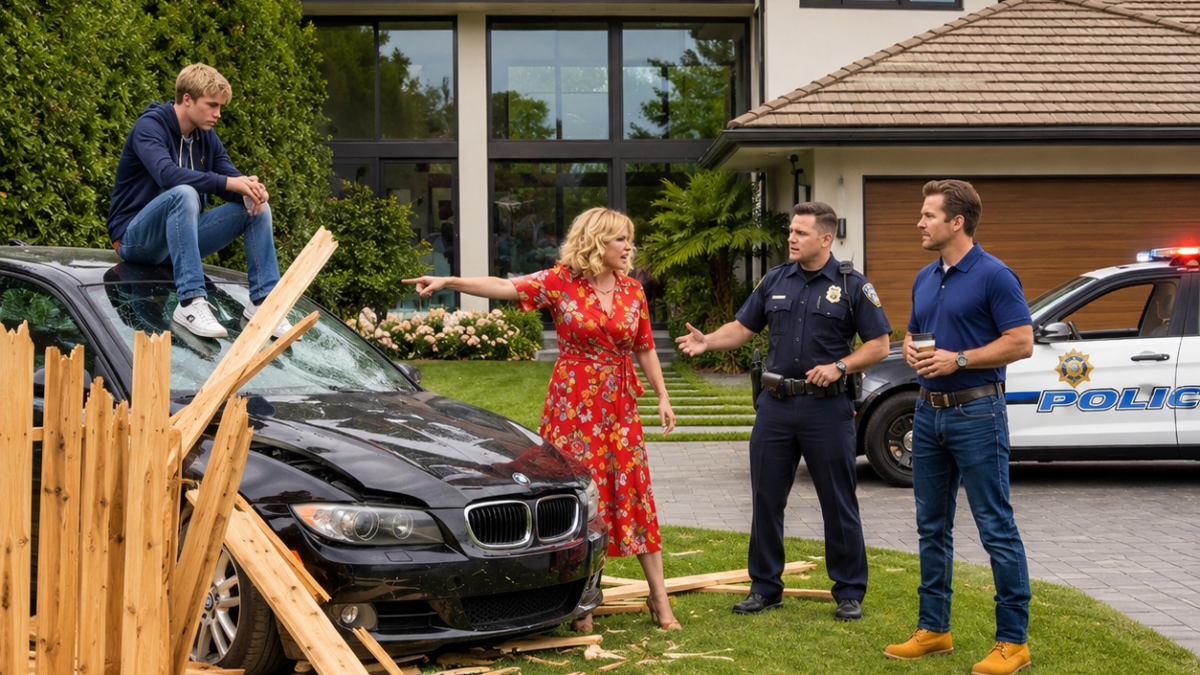
At 2:17 on a cold December morning, I stood in my driveway wearing slippers, staring at a blue BMW lodged in the cedar fence I had spent three weekends building.
Before anyone had even finished checking on the driver, Patricia Westmont, our HOA president, was standing beside the responding officer with a folder of complaints about my property.
“That fence has been a safety problem for months,” she said. “My son could have been seriously hurt.”
Her son, Brandon, was twenty years old. He was sitting on the curb with his head between his hands while another officer spoke to him. The smell of alcohol hung around the open driver’s door.
I looked at Patricia, waiting for her to ask whether I was okay.
She never did.
Instead, she opened her folder and pointed to a photograph of my fence.
“Derek has been warned about this structure,” she told the officer. “He should be responsible for the repairs to Brandon’s car.”
For a moment, I couldn’t find my voice.
Six months earlier, I had moved into Maple Ridge Estates outside Mesa, Arizona, hoping to start over after losing my wife, Sarah, to cancer.
I was fifty-six, retired after thirty years as an electrician, and the house was supposed to be a quiet place where I could finally learn how to live alone.
Sarah had always wanted a garden.
So I planted roses, built raised beds, and put up a cedar fence around the backyard. I even left a little gate where she would have wanted one.
Patricia had disliked that fence almost from the day it went up.
First came a warning about its color. Then a complaint about its height. Then a claim that it crossed the property line, even though I had submitted a survey and received written architectural approval.
By December, my mailbox seemed to hold more HOA notices than regular mail.
And now her son’s car had destroyed twenty feet of the fence.
Officer Ruiz listened without interrupting. Then she asked Patricia to step aside while she photographed the road, the tire marks, and the broken posts.
“Are you saying his car hit a stationary fence?” she asked.
Patricia’s expression tightened.
“I’m saying this could have been prevented.”
I stood beside the splintered cedar, rubbing my thumb over the wedding ring I still wore.
A tow truck arrived, its amber lights washing across my front windows.
As the driver backed toward the BMW, Patricia reached for his arm, and Officer Ruiz quietly stepped between them.
[END OF FACEBOOK CAPTION]
[FIRST COMMENT / FULL STORY CONTINUATION]
“Ma’am, please don’t interfere with the tow operator,” Officer Ruiz said.
Patricia pulled her hand back as though she’d been insulted.
“That’s my son’s car.”
“I understand.”
“He’s a college student. Do you know what something like this will do to his insurance?”
Officer Ruiz glanced toward Brandon, who was now sitting in the back of a patrol car while another officer completed paperwork.
“Right now, I’m concerned about what happened on this road.”
Patricia’s mouth opened, but the officer continued.
“The vehicle is disabled, and it can’t stay where it is. The tow operator needs room to work.”
I watched the tow truck’s winch cable stretch across the pavement.
The BMW’s front bumper had separated from the car. One headlight hung by its wiring. The front passenger-side wheel pointed in a direction that didn’t match the other three.
My fence was worse.
Three posts were broken at their bases. The cedar boards I had sanded by hand lay scattered across the flower bed. One of the raised garden boxes had collapsed beneath the front tire.
Brandon had missed my bedroom window by about fifteen feet.
That was the part I couldn’t stop looking at.
I slept with that window cracked most nights because Sarah had always liked fresh air, even in winter. I could have been standing outside watering the plants. I could have been carrying out the trash.
Instead, I’d been asleep when a car came through my property.
And Patricia was arguing about repair bills.
“Officer,” she said, lowering her voice, “I have documentation that this fence was installed incorrectly.”
Ruiz held up one hand.
“Mrs. Westmont, you’re welcome to provide whatever documents you believe are relevant. But I’m not going to determine civil responsibility on the side of the road.”
Patricia looked at me.
“You hear that, Derek? This isn’t settled.”
I nodded.
“No, it isn’t.”
I didn’t say anything else.
At fifty-six, I’d learned that anger could make a difficult situation worse in less time than it took to regret a sentence.
I had also learned that silence was sometimes the only thing keeping me from saying exactly what I thought.
The tow operator secured the BMW and began pulling it onto the flatbed.
Patricia stood beside her white Escalade, making calls.
I recognized the expression on her face.
It was the same expression she’d worn when she handed me my first violation notice.
Not frightened.
Not even especially angry.
Certain.
Certain that if she talked long enough, and firmly enough, the world would eventually arrange itself around her wishes.
Officer Ruiz finished speaking with Brandon and approached me.
“Mr. Morrison?”
“Yes, ma’am.”
“Did you see the crash?”
“No. Heard it. Sounded like somebody dropped a refrigerator off a roof.”
“Any cameras facing the street?”
“One above the garage. It mostly covers the driveway.”
“Would you be willing to preserve the footage?”
“Of course.”
She handed me a card with the incident number.
“Please don’t move any of the damaged pieces until you’ve photographed everything. Your insurance company will want to see it.”
I looked at the broken fence.
“Did he say what happened?”
She hesitated.
“We’re still documenting that. I can tell you the investigation will include whether he was impaired.”
Behind her, Patricia was watching us.
“She keeps saying my fence caused this.”
Ruiz followed my eyes.
“Sir, a driver’s responsibility doesn’t disappear because someone has a complaint about a fence.”
It wasn’t a ruling.
It wasn’t a promise.
But it was the first sensible thing anyone had said to me that morning.
By four o’clock, the BMW was gone.
Patricia had driven Brandon home after his release from the scene, and the neighborhood was quiet again.
I stood in my front yard holding a trash bag, collecting pieces of cedar that were too small to save.
A woman in a red bathrobe appeared on the sidewalk.
Mrs. Stella Lin lived three houses down.
She was seventy-three, walked every morning before sunrise, and had introduced herself when I moved in by handing me a container of homemade soup.
She stopped beside the broken fence.
“Oh, Mr. Derek.”
Her face changed.
“Are you hurt?”
It was such a simple question.
But after listening to Patricia for nearly two hours, I hadn’t realized how badly I needed someone to ask it.
“No, Mrs. Lin. I’m okay.”
She studied the damaged posts.
“Your poor garden.”
I looked away.
“Yeah.”
She reached for one of the fallen rose stems and gently lifted it out of the debris.
“These can come back,” she said.
I wanted to believe her.
By daylight, the damage looked even worse.
The December sun came up over the low roofs of Maple Ridge Estates, turning the broken fence a pale gold.
My driveway was littered with tiny pieces of headlight plastic. The ground beneath the BMW’s former resting place was dark with fluid.
I took photographs from every angle.
Then I went into the kitchen and made coffee.
Sarah’s favorite mug was still hanging on its hook beside the sink.
Blue ceramic.
A small chip near the handle.
The words Good things take time printed across the front.
I had never liked that saying.
Sarah thought it was funny because I was the kind of man who checked a level three times and wanted every project finished before lunch.
After she died, I began using the mug whenever I had a particularly bad day.
I filled it, sat at the kitchen table, and looked out toward the garden.
The empty space where my fence had stood seemed larger than it should have.
My phone rang.
It was my daughter, Molly.
“Hey, Dad.”
“Morning, sweetheart.”
She was twenty-eight and worked as a physical therapist in Tucson. We talked every Sunday, usually about work, the weather, and whether I was eating properly.
It was Tuesday.
“What’s wrong?” she asked immediately.
I almost smiled.
“Why does something have to be wrong?”
“Because you never call me at seven in the morning unless something’s happened.”
“I didn’t call you.”
“You sent me a picture of a car in your fence at five-thirty.”
I looked at my phone.
I had forgotten.
“Oh. Right.”
“Dad.”
“I’m okay.”
“That’s not what I asked.”
I told her about the crash.
I tried to keep my voice calm. I explained the police visit, the tow truck, and Patricia’s demands.
When I finished, Molly was quiet.
Then she said, “I want you to get a lawyer.”
“Sweetheart, it’s a fence.”
“No. A fence is what broke. The problem is that woman thinks she can make you pay for her son’s mistakes.”
I rubbed my forehead.
“Insurance will handle it.”
“Maybe. But please don’t try to handle Patricia by yourself.”
I stared into my coffee.
“I’ve been handling things by myself for a while.”
The silence that followed was heavier than I intended.
Molly spoke carefully.
“I know, Dad.”
I closed my eyes.
She hadn’t meant anything hurtful. Neither had I.
But grief has a way of finding the sharp edges in ordinary conversations.
“Sorry,” I said.
“It’s okay.”
“No, it wasn’t.”
She let me sit with that for a moment.
“Mom would have hated that woman,” she finally said.
I laughed despite myself.
“Your mother could’ve talked her into helping rebuild the fence.”
“Probably.”
“And made her bring lemonade.”
“Definitely.”
For a few seconds, the house didn’t feel quite so empty.
Then Molly said, “Send me the police report when you get it.”
I promised I would.
After we hung up, I sat at the table until my coffee went cold.
I had bought the Maple Ridge house in June.
It wasn’t big.
Three bedrooms, two bathrooms, an attached garage, and a backyard with enough space for the kind of garden Sarah had talked about for years.
We had spent most of our marriage in a modest ranch house closer to Phoenix.
I worked long hours wiring commercial buildings. Sarah taught fourth grade at a public elementary school.
We were going to travel after I retired.
Maybe buy a little trailer.
Maybe spend a month driving up the California coast.
But when Sarah got sick, our plans changed.
At first, we talked about treatment.
Then we talked about specialists.
Eventually, we talked about how to make her comfortable.
We were married thirty-one years.
In the last six months of her life, I learned more about love than I had in the previous thirty.
I learned how to wash sheets without waking someone.
How to measure medication.
How to hold a person’s hand when neither of you has anything left to say.
And how unbearably quiet a house can become after the funeral guests leave.
Molly wanted me to move closer to her.
I almost did.
But Tucson didn’t feel like home.
The old house didn’t either.
So I sold it and bought the little place in Maple Ridge.
I told everyone I liked the neighborhood.
That was true.
I also liked that nobody there knew me as the man whose wife had died.
Nobody had watched me fall apart at the hospital.
Nobody knew that some mornings I still reached across the bed before remembering she wasn’t there.
I thought a new address might help.
The first thing I built was the fence.
It wasn’t supposed to keep neighbors out. It was meant to give the backyard some privacy and a clear edge for the garden.
I had hired a licensed surveyor before beginning.
The existing property markers were difficult to see, and I wasn’t about to argue over inches with someone I’d just met.
The survey showed I had plenty of room.
I placed the fence four feet inside my property line, leaving space for maintenance and drainage along the outer edge.
Then I submitted drawings to the HOA architectural committee.
Cedar boards.
Six-foot height.
Natural stain.
A simple gate on the east side.
The approval arrived by email on July 19.
I printed it and put it in a blue folder with my house documents.
Sarah used to tease me about keeping everything.
“One day,” she’d say, “somebody is going to ask for a receipt from 1994, and you’ll be ready.”
She wasn’t wrong.
Patricia introduced herself three days after I finished the fence.
She arrived on a Saturday morning while I was planting tomatoes.
White Escalade.
Pressed linen pants.
Sunglasses that probably cost more than my first truck.
She stood at the gate without calling out.
“Mr. Morrison?”
I straightened up.
“That’s me.”
“I’m Patricia Westmont. HOA president.”
I wiped my hands on a towel.
“Nice to meet you.”
She looked beyond me at the garden.
“You’ve been busy.”
“Trying to be.”
“That fence is quite prominent.”
I glanced at the cedar boards.
“Well, it is a fence.”
She didn’t smile.
“I don’t remember approving that particular shade.”
I pointed toward the house.
“I have the architectural committee’s approval inside.”
“I know what the committee approved.”
Something about her tone made me stop smiling, too.
“I followed the drawings I submitted.”
Patricia took off her sunglasses.
“We’ve worked very hard to maintain a consistent appearance in this community, Derek.”
“I understand.”
“Some homeowners come here and think they can do whatever they want.”
I waited.
She put her sunglasses back on.
“I’m sure that’s not you.”
It sounded friendly enough if you ignored the way she said it.
Three days later, I received a notice about the stain.
The letter claimed the fence color did not conform to community standards.
I replied with a copy of the approval.
A week later, the HOA acknowledged the mistake.
That should have been the end of it.
Instead, another notice arrived about the height.
Then one about vegetation growing too close to the fence.
Then one claiming the gate might interfere with emergency access, even though it opened into my own yard.
Each time, I responded.
Each time, the complaint disappeared or changed.
I began to recognize Patricia’s handwriting on the envelopes.
I could also recognize her Escalade from the sound of its engine.
Most afternoons, she’d drive slowly past my house, occasionally stopping to photograph something.
At first, I found it irritating.
Then it became exhausting.
I was trying to build a place where I could enjoy being alive again.
Instead, I was checking my mailbox with the same sick feeling I’d once had opening hospital bills.
I didn’t tell Molly how much it bothered me.
That was another mistake I would understand later.
Two days after the crash, a woman named Maria Santos came to inspect the property.
Maria worked for my homeowners insurance company.
She wore jeans, work boots, and a navy windbreaker. She carried a measuring wheel and a tablet covered in scratches.
She introduced herself, looked at the broken fence, and said, “Well, somebody had a very bad night.”
“That’s one way to describe it.”
“Are you the only person living here?”
“Yes.”
“Anyone injured?”
“Not that I’m aware of.”
She walked the damage slowly.
She photographed the posts, checked the foundation anchors, and examined the collapsed garden bed.
When she reached the edge of the driveway, she stopped.
“Do you have your survey?”
I went inside and returned with the blue folder.
She spread the pages across the hood of her car.
“Good,” she said. “You kept the paperwork.”
“My wife trained me.”
Maria smiled.
“Smart woman.”
She compared the survey to the remaining boundary markers and the damaged fence’s position.
After another twenty minutes, she looked at me.
“Your fence wasn’t on the roadway.”
“I know.”
“It wasn’t on the sidewalk.”
“I know that, too.”
“And according to these measurements, it wasn’t even particularly close to your property boundary.”
I folded my arms.
“Could you explain that to Patricia Westmont?”
Maria looked up.
“The HOA president?”
“You’ve heard of her?”
“I’ve spoken to her twice already.”
My stomach tightened.
“About what?”
“She called asking whether your homeowners policy would cover damage to her son’s vehicle.”
I stared at her.
“She called my insurance company?”
“Apparently she obtained the company name from an HOA records file. I haven’t discussed your coverage with her.”
“What did you tell her?”
“That she should make any claim through the appropriate process and provide supporting information.”
Maria looked back at the damaged fence.
“Mr. Morrison, a claim isn’t the same thing as proof. We determine responsibility based on facts.”
That sounded like a reasonable system.
I wanted very badly to live in a reasonable system.
Maria continued photographing the damage.
Before she left, she explained that my insurer would review the fence repair under my policy and pursue recovery from the responsible driver’s insurance company if the evidence supported it.
It could take time.
I would need estimates.
I might have to pay a deductible before reimbursement was resolved.
And if Patricia or Brandon formally accused me of causing the crash, the insurer would review that claim separately.
Nothing about it was immediate.
But for the first time since the accident, I felt as though somebody was dealing with the actual problem.
At least until I opened my email that afternoon.
The message came from Patricia.
Subject: NOTICE OF CONTINUING SAFETY VIOLATION
It began politely enough.
Then I reached the third paragraph.
The HOA was demanding that I remove the remaining fence sections because the structure had supposedly created a dangerous obstruction near the street.
I was also being assessed a $1,200 fine for failing to correct earlier violations.
At the bottom, Patricia had added a personal note.
Given the substantial damage to Brandon’s vehicle, I strongly encourage you to cooperate rather than force everyone into an expensive dispute.
I read the sentence three times.
Then I printed the email.
I put it in the blue folder.
And I called her.
She answered on the second ring.
“Derek.”
“Patricia, I received your notice.”
“Good.”
“My fence was approved.”
“We’ve been over that.”
“It’s four feet inside my property line.”
“That isn’t the only consideration.”
“Your son drove through it.”
Her voice sharpened.
“I don’t appreciate your tone.”
“I don’t appreciate being told to pay for a car that hit my house.”
For a moment, neither of us spoke.
Then she said, “You might want to remember that the HOA has enforcement authority.”
I looked out at my ruined garden.
“Authority over what?”
“Architectural compliance. Community safety. Property standards.”
“And your son’s driving?”
Another silence.
“You have thirty days to address the violation,” she said.
Then she hung up.
I stood in my kitchen with the phone against my ear until the call ended.
That was the first time I understood this might not go away by itself.
The emergency board meeting took place five days later.
Maple Ridge had a small clubhouse near the community pool.
Nothing fancy.
A rectangular room with folding chairs, a coffee machine, and a bulletin board covered in notices about pool maintenance and neighborhood events.
I had only attended one meeting before.
Patricia sat at the front behind a folding table.
Beside her were four other board members.
Lou Grant, the vice president, was a real estate agent who agreed with almost everything Patricia said.
Nina Wallace, the treasurer, was a quiet woman in her forties who worked in payroll.
Owen Bell, the secretary, was a retired school principal.
And Stella Lin sat at the far end of the table, looking unusually tense.
Patricia called the meeting to order.
Then she introduced the agenda item.
“Safety concerns involving the Morrison property.”
I stood near the back with my blue folder.
There were eleven other homeowners in the room.
Patricia had prepared a slide presentation.
The first photograph showed my fence from the street.
The second showed the BMW inside the yard.
The third showed a close-up of the broken boards.
She pointed toward the screen.
“This incident demonstrates the consequences of allowing nonconforming structures to remain in place.”
I raised my hand.
“Patricia, the car hit the fence.”
She ignored me.
“Visibility and safe setbacks are essential in a residential community.”
Owen leaned toward his microphone.
“Do we have an engineering assessment supporting the visibility concern?”
Patricia looked at him.
“We have photographic evidence.”
“That isn’t what I asked.”
Lou shifted in his chair.
Nina looked down at her notes.
Patricia clicked to the next slide.
“We also have a history of warnings issued to Mr. Morrison.”
I opened my folder.
“I have the approval letter and survey.”
“You’ll have a chance to speak.”
I waited.
When my turn finally came, Patricia told me I had five minutes.
I walked to the front.
My hands weren’t shaking.
I was surprised by that.
I’d spent thirty years working around electrical systems where a wrong connection could cost someone their life.
You learned to slow down.
You learned to look carefully.
And you learned that being loud didn’t make you right.
I placed the survey on the table.
“This is my property boundary. My fence is four feet inside it.”
I put down the approval letter.
“This is the architectural committee’s written approval.”
Then I placed a photograph of Brandon’s car beside them.
“This is what happened when a vehicle left the street and entered my yard.”
Patricia leaned forward.
“That doesn’t address whether the fence contributed to the accident.”
I looked at her.
“Your son wasn’t supposed to be driving in my yard.”
A few people shifted in their chairs.
Someone near the back cleared his throat.
Stella looked down, hiding what might have been a smile.
Patricia’s face grew stiff.
“Mr. Morrison, please keep your remarks professional.”
“They are professional.”
“You’re making this personal.”
I glanced at the photograph of the BMW.
“Your son is the driver. You’re his mother. And you’re presiding over a board decision about the fence he hit.”
Stella raised her head.
“Patricia,” she said quietly, “perhaps you should excuse yourself from this vote.”
Patricia turned.
“Why?”
“Because your family has a direct interest in the outcome.”
Lou immediately shook his head.
“That doesn’t mean she can’t participate.”
Owen opened a binder.
“Actually, our governing documents require board members to disclose personal conflicts and abstain from related decisions.”
Patricia’s jaw tightened.
“I am not voting on Brandon’s insurance claim. I am voting on architectural compliance.”
The distinction sounded convenient.
I waited for someone else to challenge it.
Nobody did.
When the vote came, Patricia voted to uphold the violation.
Lou voted with her.
After a long hesitation, Nina did, too.
Owen and Stella voted against it.
Three to two.
The HOA ordered me to remove the remaining fence within thirty days and pay the $1,200 fine, with an additional $500 assessment for the alleged continuing violation.
Patricia closed her binder.
“That concludes the matter.”
I gathered my papers.
“No,” I said.
She looked up.
“Excuse me?”
“That concludes the meeting.”
I walked out before I said anything else.
Outside, the night air was cold enough to make me button my jacket.
I stood beside my truck, trying to decide whether I wanted to shout or throw something.
Instead, I heard footsteps.
Stella came out carrying her purse.
“I’m sorry,” she said.
I shook my head.
“You tried.”
“Not enough.”
She looked through the clubhouse window.
Patricia was laughing with Lou.
Stella’s expression changed.
“Mr. Derek, I need to tell you something.”
I waited.
She adjusted the strap of her purse.
“You are not the first person she has treated this way.”
Stella didn’t tell me everything that night.
She said there were other homeowners who had received questionable fines.
Some had paid.
Some had argued.
A few had moved.
She mentioned a couple named the Hendersons who had dismantled a backyard deck after months of notices about setbacks.
She told me about a nurse named Janet Rodriguez, who had received complaints over decorations outside her home.
And she showed me a photograph on her phone.
It was a bird feeder hanging from a small tree in her front yard.
“Patricia says it attracts pigeons.”
“Does it?”
“Sometimes.”
“Is that against the rules?”
Stella gave a tired smile.
“Depends on whether Patricia likes you.”
I didn’t know what to say.
She put the phone away.
“People have been afraid to challenge her. She knows the rules better than most of us, and she knows how to make everything expensive.”
“Why haven’t you voted her out?”
Stella looked embarrassed.
“Most people don’t attend meetings. They think things are fine until they receive a letter.”
She glanced toward her house.
“And some of us are old enough to value quiet more than arguments.”
I understood that better than she knew.
Before leaving, she touched my arm.
“Please don’t let her make you leave.”
I watched her walk away.
Then I got into my truck and sat there for a long time.
I had spent years saving money for retirement.
I hadn’t planned to spend it fighting over a fence.
But the alternative was beginning to feel worse.
That night, I took out Sarah’s old photograph.
It had been sitting on the dresser since the day I moved.
She was standing in our previous backyard, wearing gardening gloves and laughing at something outside the frame.
I remembered the day.
Molly had been trying to take a family picture, and I had accidentally turned on the sprinkler behind her.
Sarah laughed so hard she had to sit down.
I set the photograph on my workbench.
Then I opened my laptop.
I created a folder called Maple Ridge Fence.
Inside it, I made separate folders for the approval documents, survey, damage photographs, insurance correspondence, HOA notices, and meeting records.
I downloaded the security footage from the night of the crash.
Most of it showed my empty driveway.
Then headlights appeared.
A blue BMW came down the street too fast, drifted toward the curb, corrected sharply, and disappeared beyond the camera’s view.
The impact shook the image.
The camera’s microphone captured the sound of cedar breaking.
I watched it once.
Then again.
The second time, I paused the video just before the car left the street.
It wasn’t even close to my fence when the driver lost control.
I saved three copies.
One on the laptop.
One on an external drive.
One in secure cloud storage.
Then I opened the HOA bylaws.
I hadn’t read all forty-two pages when I bought the house.
Now I did.
At 11:40 p.m., I found the conflict-of-interest provision Owen had mentioned.
A board member with a direct personal or family interest in a matter was required to disclose it and abstain from the decision.
I printed the page.
At midnight, I found the section explaining how homeowners could request association records.
I printed that, too.
By one in the morning, I had a list of questions.
Who had actually approved the new fence complaint?
Who decided the penalty?
Why was Patricia permitted to vote?
And why had no one asked Brandon how fast he had been driving?
For the first time since Sarah’s death, I was wide awake for a reason that had nothing to do with missing her.
I wasn’t enjoying the fight.
But I finally knew where to begin.
The following morning, I called a lawyer.
Her name was Leah Sandoval.
She practiced in Mesa and handled property disputes, construction issues, and homeowners association matters.
Her office was above a small accounting firm in a two-story building with faded brick and an elevator that sounded older than I was.
I arrived carrying my blue folder.
Leah was in her early forties.
She wore a charcoal blazer, practical shoes, and no visible jewelry except a wedding band.
She listened without interrupting while I explained the crash, the citations, and the board meeting.
Then she asked to see my documents.
She took her time.
She read the approval letter twice.
She examined the survey.
She watched the garage video.
When she finished, she folded her hands.
“Mr. Morrison, there are two separate issues here.”
I leaned forward.
“The crash and the HOA?”
“Exactly. We shouldn’t let Patricia combine them just because it benefits her.”
She explained that the car accident would primarily be handled through the insurers and, if necessary, a civil claim.
The HOA dispute required a different approach.
“Your board has procedures it must follow,” she said. “Those procedures matter even when board members think they’re doing the right thing.”
“Patricia doesn’t think she’s doing anything wrong.”
“That may be true.”
“She’s doing it on purpose.”
Leah met my eyes.
“Maybe. But what we can prove is more useful than what we believe.”
I didn’t particularly like that answer.
It was also the kind of answer I probably needed.
She turned to the meeting minutes I’d requested but hadn’t yet received.
“Did they give you written notice that your fine would be considered at that meeting?”
“Three days before.”
“Did they explain the evidence supporting the violation?”
“Just photographs.”
“And the board president voted?”
“Yes.”
“Even though her son was involved?”
“She said it was a different issue.”
Leah made a note.
“We’ll challenge the fine and the removal order. We’ll request the underlying records, the architectural committee’s history, and the materials the board relied upon.”
“Can we sue her?”
“We can discuss litigation if necessary. But before we do that, I’d rather give the association a documented opportunity to correct itself.”
I looked out her window at the parking lot.
“What if they refuse?”
She smiled slightly.
“Then we’ll know exactly what we’re dealing with.”
I signed an engagement agreement and paid the initial retainer.
It was more money than I wanted to spend before Christmas.
As I stood to leave, Leah asked one more question.
“Mr. Morrison, why is the fence so important to you?”
I almost said because it was mine.
Because I had a survey.
Because I followed the rules.
All those things were true.
Instead, I looked at the photograph of the damaged garden sitting on her desk.
“My wife wanted that garden,” I said.
Leah waited.
“She died two years ago. I built it because I didn’t know what else to do with all the time I suddenly had.”
Leah closed the folder gently.
“Then we’ll make sure the people making decisions understand what’s actually at stake.”
I drove home without turning on the radio.
Christmas arrived under a gray sky.
Molly came from Tucson on Christmas Eve carrying two grocery bags, a suitcase, and a small artificial tree she insisted belonged on my kitchen counter.
She stood in the doorway looking past me toward the backyard.
“Oh, Dad.”
“Yeah.”
The damaged fence was still covered with a temporary safety barrier.
Insurance had authorized emergency cleanup, but the permanent repairs were waiting on estimates and the dispute over responsibility.
I had stacked the salvageable cedar boards beside the garage.
Some could be reused.
Most couldn’t.
Molly set down her bags.
“Have you been sleeping?”
“Enough.”
She looked at me.
“That’s not an answer.”
I stepped aside.
“Come in before you start sounding like your mother.”
She kissed my cheek.
“Somebody has to.”
We made dinner together.
Nothing elaborate.
Baked chicken, potatoes, green beans, and the rolls Sarah used to buy from a bakery in Tempe.
I burned the first batch of rolls.
Molly laughed.
Then she started crying.
It happened so quickly that neither of us knew what to do.
She stood in front of the oven holding a dish towel, looking embarrassed.
“I’m sorry.”
I turned off the oven.
“For what?”
“I just remembered Mom doing that.”
I stared at her.
“Burning rolls?”
“No. Pretending she meant to.”
We both laughed.
Then I put my arms around her.
For a minute, we stood in the kitchen without speaking.
Later, while we washed the dishes, Molly asked about Patricia.
I explained the lawyer’s plan.
She listened carefully.
Then she said something I hadn’t expected.
“I’m glad you’re doing something about it.”
I looked up.
“I thought you wanted me to avoid a fight.”
“I want you to stop being alone in one.”
I dried a plate.
“That’s different.”
“Yes.”
She turned off the faucet.
“Dad, when Mom died, you stopped answering people. You stopped going to dinner with your friends. You stopped coming down to Tucson unless I begged you.”
I wanted to defend myself.
Instead, I looked at the towel in my hands.
“I know.”
“You built a beautiful house. But sometimes it feels like you’re using it to hide.”
The words stung.
Maybe because they were true.
I set the plate in the cabinet.
“I don’t know how to do this anymore, Molly.”
“Do what?”
“Be a person after being somebody’s husband for thirty-one years.”
She moved closer.
“You’re still my dad.”
I swallowed hard.
“I know.”
“And you’re still you.”
I shook my head.
“Not always.”
Molly reached for my hand.
“Then maybe you get to figure out who you are now.”
Outside, the damaged gate shifted in the wind.
I had been so busy trying to protect what remained of my life that I hadn’t noticed how much of it I was keeping out of reach.
That Christmas, Molly and I ate dinner at the same table without either of us pretending things were normal.
It was the best Christmas I’d had in two years.
And the next morning, while we were drinking coffee, someone knocked at the front door.
It was Frank Kowalski from across the street.
He was holding a thermos and a stack of papers.
“Morning, Derek,” he said.
“Morning, Frank.”
He glanced at Molly, introduced himself, then looked back at me.
“Mrs. Lin says you’ve hired a lawyer.”
“Word travels fast.”
“Especially when the HOA president’s son parks a BMW in somebody else’s yard.”
I managed a smile.
Frank didn’t.
“I’ve been watching what’s been happening around here,” he said. “And I think there are some people you need to meet.”
Frank had been a traffic investigator with the Phoenix Police Department before retiring.
He was sixty-eight, broad-shouldered, with silver hair and a habit of speaking slowly when he wanted someone to pay attention.
I’d met him during my first week in Maple Ridge.
He’d offered to help me unload a table saw.
Afterward, we’d shared a beer in the driveway and discovered we both liked old pickup trucks, baseball, and sitting outside without having to entertain anybody.
He hadn’t said much about the HOA.
Now I was beginning to understand why.
“People around here have learned to keep their heads down,” Frank told me.
We sat at the kitchen table while Molly made another pot of coffee.
“Patricia’s good at making a disagreement feel like a personal failure,” he continued. “She’ll tell people they’re hurting the neighborhood, putting property values at risk, being selfish.”
“Sounds familiar.”
“Some of the complaints are legitimate. That’s what makes it complicated. Nobody wants abandoned cars or unsafe buildings. But a rule only works if you apply it fairly.”
He placed the papers on the table.
They were copies of violation notices.
One belonged to Stella.
Another belonged to Janet Rodriguez.
The third had been issued to Mike Brennan, a retired mechanic who lived near the community pool.
I flipped through them.
Stella had been fined for a bird feeder.
Janet had received a warning about decorations placed near her front walkway.
Mike had been ordered to remove Christmas lights because they were supposedly visible from the street after the permitted holiday period.
“What’s wrong with that?” I asked, pointing to Mike’s notice.
“His lights were down before the deadline.”
“Then why was he fined?”
“Because Patricia said she saw them up the next morning.”
“Did she?”
“Mike has a video from his doorbell camera showing him taking them down the night before.”
I stared at the papers.
“Why didn’t he appeal?”
Frank shrugged.
“Fifty dollars. He figured fighting it would cost more than paying.”
That was the problem.
One person paid fifty dollars.
Another paid a hundred.
Someone else paid several hundred because they couldn’t afford to take a day off work to attend a hearing.
Individually, the amounts weren’t worth a legal fight.
Together, they were becoming something larger.
“Can we get these people together?” I asked.
Frank nodded.
“I was hoping you’d say that.”
Molly stood in the doorway holding two coffee mugs.
“Then maybe start by feeding them,” she said.
I looked at her.
“What?”
“Invite them over. People are more likely to talk when they’re sitting at a table instead of standing around a broken fence.”
Frank grinned.
“Your daughter sounds like she should be running this operation.”
“She’s been running me for twenty-eight years.”
Molly handed him a mug.
“Somebody has to.”
The first gathering happened on December 28.
I cleared space in the garage, brought out folding chairs, and set a pot of chili on a small table.
Frank arrived with cornbread.
Stella brought dumplings.
Mike brought a case of bottled water.
Janet Rodriguez arrived fifteen minutes late, still wearing her hospital scrubs.
She was forty-two, a single mother with two teenagers, and worked long shifts as an emergency department nurse.
She apologized for being late before she’d even taken off her coat.
“Long day,” she said.
“Have some chili,” I told her.
“That sounds better than what I was going to make for dinner.”
We began awkwardly.
Nobody wanted to sound like the neighborhood troublemaker.
Mike started with the Christmas lights.
Then Stella talked about her bird feeder.
Janet sat quietly until Frank asked whether she wanted to share anything.
She looked around the garage.
“Patricia sent me three notices over my Día de los Muertos display.”
“What was wrong with it?” Molly asked.
“According to her, it wasn’t an approved seasonal decoration.”
Janet gave a tired laugh.
“I had a little table by the front door. Photographs of my parents, flowers, and some battery-operated candles.”
“Was it blocking anything?” I asked.
“No.”
“Did the rules prohibit it?”
“Not specifically. That’s what I said.”
She took a drink of water.
“Patricia told me some neighbors found it inappropriate.”
“Did she say which neighbors?”
“No.”
Janet looked down at her hands.
“My kids helped me set it up. My daughter spent two hours making paper flowers. Then she came home from school and saw the violation notice taped to our door.”
Her voice became quieter.
“She asked me if we weren’t allowed to remember Grandma anymore.”
Nobody spoke.
I thought about Sarah’s photograph on my dresser.
About the way I still kept her mug by the sink.
About how much a small object could mean when it was all you had left of someone.
Janet cleared her throat.
“I appealed. They withdrew the fine. But my daughter took the decorations down anyway.”
Stella reached across the table and squeezed her hand.
Mike spoke next.
“Patricia cited my neighbor for a trash can that was out too long.”
“Was it?” Frank asked.
“No. The garbage truck was late because of a mechanical problem. Half the street still had cans outside. Only he got a notice.”
We spent nearly three hours talking.
I learned that one woman had been charged for an allegedly unapproved mailbox replacement, even though the new mailbox matched the old one.
A retired couple had received repeated warnings about a drainage issue that was actually caused by runoff from common property.
A young father had been told to repaint his garage trim after using a shade approved by the architectural committee.
None of these stories alone proved corruption.
Some might have been honest mistakes.
But the repeated pattern of complaints, selective enforcement, and dismissive appeals was difficult to ignore.
At the end of the evening, Frank spread a notebook across my workbench.
“I suggest we document everything,” he said. “Dates, notices, responses, photos. No guesses. No rumors.”
Mike raised his hand jokingly.
“Are we forming a neighborhood detective agency?”
“No,” Frank said. “We’re trying to figure out whether the same rules apply to everyone.”
Stella spoke softly.
“And whether we can make that happen again.”
I looked around the garage.
Seven people.
A pot of cold chili.
A stack of papers.
It wasn’t a rebellion.
It was a room full of neighbors who had finally stopped assuming they were the only ones having trouble.
For the first time, Maple Ridge felt less like a neighborhood I had moved into and more like a place where I might belong.
The first real setback came on January 3.
Brandon’s family attorney sent a letter demanding $26,400 for damage to the BMW.
The letter claimed my fence had created an unreasonable roadside hazard.
It included photographs taken the morning of the crash and referenced the HOA’s removal order.
The attorney didn’t accuse me of driving the car or causing Brandon to lose control.
Instead, the argument was that the fence’s placement and construction had contributed to the severity of the collision.
I forwarded everything to Maria and Leah.
Maria called that afternoon.
“Don’t respond directly,” she advised. “Let the insurers review it.”
“Can they actually make me pay?”
“They can make a claim. Whether the facts support it is another question.”
Leah was more specific.
“The location of the fence matters. So does its construction and the driver’s conduct. But Patricia’s HOA vote doesn’t establish that you’re legally responsible.”
She paused.
“I’m also concerned that they are using the association’s enforcement process to strengthen a private claim.”
“Can we stop them?”
“We can challenge it. And we can ask them to preserve the records showing how that decision was made.”
Two days later, Leah sent a formal letter disputing the HOA action.
She requested a hearing before an impartial decision-maker, preservation of board communications relating to my fence, and copies of the architectural records.
She also asked that fines and removal deadlines be suspended while the dispute was reviewed.
The HOA’s management company acknowledged receipt.
Patricia didn’t respond.
Instead, another notice appeared in my mailbox.
This one claimed the temporary safety barrier around my broken fence did not meet community appearance standards.
I stood in the driveway reading it.
Behind me, a section of cedar was still leaning against a broken post.
I looked at the orange temporary barrier the insurance contractor had installed.
Then I looked at the notice.
I started laughing.
Not because it was funny.
Because I couldn’t think of another reasonable response.
A city code inspector arrived on January 8.
His name was Daniel Lyons.
He was a heavyset man in a tan work shirt who carried a clipboard and seemed embarrassed before he even introduced himself.
“Mr. Morrison? I’m following up on a complaint about an unpermitted fence near a street intersection.”
I looked past him toward Patricia’s house.
“Let me guess.”
He smiled politely.
“I don’t get into who files complaints.”
I handed him my survey, construction drawings, and the HOA approval.
He examined the fence, measured the remaining structure, and checked the property location.
Then he photographed the broken posts.
“Was it this height before the accident?”
“Yes.”
“Same location?”
“Every post.”
He made notes.
After about forty minutes, he returned to the driveway.
“I don’t see a city code violation based on what I’ve inspected.”
I exhaled.
“Can I get that in writing?”
“Yes. You’ll receive the inspection result through the city portal.”
He looked toward the damaged garden.
“Sorry you’re dealing with this.”
I thanked him.
As he walked to his truck, Patricia’s Escalade rolled slowly past.
She didn’t stop.
She didn’t wave.
She just looked straight ahead.
The inspector waited until she’d gone.
“Was that the HOA president?” he asked.
“Yes.”
He nodded thoughtfully.
“I’ve heard there’s a dispute.”
“Something like that.”
He climbed into his truck.
“Keep your paperwork.”
“I intend to.”
That afternoon, I learned that the complaint had been submitted through the city’s public reporting system.
The person listed as the contact was Craig Westmont.
Patricia’s husband.
He worked in the city’s planning department, although my complaint was handled by a separate inspection division.
I asked Leah whether his job meant he’d done something improper.
“Not necessarily,” she said. “Public employees can report concerns like anyone else. But using an official position to influence a private dispute would be a different matter.”
“Can we find out if he did?”
“We can request the communication records.”
I was starting to understand Leah’s approach.
She didn’t begin with accusations.
She began with questions the documents could answer.
The weeks after Christmas were harder than I expected.
I thought that once I had a lawyer, an insurance claim, and some neighbors willing to help, the situation would feel manageable.
It didn’t.
Every morning, I checked the mailbox.
Every afternoon, I checked the security cameras.
Every time an unfamiliar car slowed outside my house, I found myself looking through the window.
I had retired because I was tired of living by deadlines.
Now my calendar was full of them.
Insurance estimates.
HOA responses.
Records requests.
Attorney appointments.
Photographs.
Repair appointments that had to be rescheduled because the fence dispute remained unresolved.
I stopped working on the garden.
The tomato plants turned yellow.
The rosebush nearest the damaged corner lost most of its leaves.
The house began to feel less like a refuge and more like a place I was defending.
One afternoon, Molly called while I was sorting receipts.
“How’s the garden?”
“Fine.”
“Dad.”
“What?”
“You always say fine when things aren’t fine.”
I looked at the dead tomato plants outside.
“It’s been better.”
“Have you been outside?”
“Of course.”
“I mean for something other than checking the fence.”
I didn’t answer.
She sighed.
“You need to do something you enjoy.”
“I’m trying to keep from losing a legal fight.”
“I know. But don’t let that become everything.”
I wanted to tell her she didn’t understand.
Then I remembered that she had lost her mother, too.
And that she had done it while trying to finish graduate school, start a career, and keep an eye on a father who wouldn’t tell her when he was struggling.
“You’re right,” I said.
She sounded surprised.
“Can you say that again? I want to record it.”
I laughed.
After we hung up, I went into the backyard.
I pulled the dead tomato plants.
I cleaned the raised bed that hadn’t been destroyed.
And I planted lettuce.
It wasn’t much.
But I slept better that night.
On January 12, the HOA finally produced some of the records Leah had requested.
The package included board minutes, violation logs, architectural approvals, and financial summaries.
I sat at the kitchen table with Leah’s paralegal on the phone, going through the documents one page at a time.
The July architectural approval was there.
So was my original fence drawing.
Patricia’s signature appeared on the approval as the committee chair.
I stared at it.
She had personally signed the document she was now using the HOA to challenge.
That was important.
But Leah warned me not to get ahead of myself.
“An approval doesn’t mean an association can never address a genuine safety issue,” she explained. “We still need to establish that this particular safety concern lacked a factual basis.”
“Which the city inspection helps establish.”
“Yes. And the survey. And the crash evidence.”
The documents contained something else.
The December meeting minutes listed Patricia as participating in the vote.
They also recorded Stella’s request that she abstain.
The minutes showed that Patricia had declined.
No explanation from independent counsel appeared in the record.
I forwarded the page to Leah.
She called fifteen minutes later.
“This is useful.”
“Useful enough?”
“It’s a strong procedural issue.”
I looked at the blue folder, now too thick to close properly.
“Patricia keeps saying the board has final authority.”
“Boards have authority within their governing documents,” Leah said. “They don’t get to ignore their own procedures.”
That distinction was becoming the center of our case.
Not whether Patricia was unpleasant.
Not whether Brandon was irresponsible.
Whether a group of people entrusted with community rules had applied those rules fairly.
The financial records were less straightforward.
At first, they looked ordinary.
Pool cleaning.
Common-area electricity.
Insurance.
Landscaping.
Trash service.
Management fees.
Then Stella asked to see them.
She came over the next afternoon with her reading glasses and a yellow notebook.
I had learned that she’d worked as a bookkeeper for a regional grocery distributor for nearly thirty years.
She was usually quiet in meetings.
At my kitchen table, with numbers in front of her, she became an entirely different person.
“Mr. Derek,” she said, tapping a line item, “what is this?”
I leaned closer.
“Community enhancement consulting. Six thousand four hundred dollars.”
“Why does a neighborhood this size need that much consulting?”
I shrugged.
“Maybe they hired someone to redesign the landscaping.”
She turned the page.
“Then why is the regular landscaping contract still being paid?”
We examined the entry.
The vendor was listed as Westmont Property Services.
I frowned.
“Westmont?”
Stella removed her glasses.
“Patricia’s family?”
“I don’t know.”
“Then let’s find out.”
I searched the business registration records.
The company belonged to a relative of Craig Westmont.
That didn’t automatically mean the payment was improper.
Associations sometimes hired businesses connected to residents.
But it raised a reasonable question.
Had the relationship been disclosed?
Had the board approved the contract?
Had the work actually been done?
Stella continued reading.
There were other entries.
A $2,800 payment for landscape design.
A $1,150 payment for irrigation consultation.
A $900 payment for seasonal decoration services.
All paid to the same company over eighteen months.
“Maybe this is legitimate,” I said.
“Maybe,” Stella replied.
Then she pointed toward my front window.
“Do you remember when Patricia had all those new plants installed near her house?”
I did.
Her property bordered a narrow strip of HOA-maintained common landscaping.
The work had been extensive.
New desert plants.
Decorative gravel.
An irrigation system.
A low retaining wall.
It might have been legitimate common-area work.
But the association hadn’t provided the plans, invoices, or approval records explaining the payments.
Stella closed the binder.
“Let’s not accuse anyone of stealing,” she said.
I looked at her.
“That’s exactly what I was thinking.”
She gave me a stern look.
“Numbers first. Accusations later.”
I smiled.
“You’re starting to sound like my lawyer.”
“Your lawyer sounds sensible.”
She put her glasses back on.
“And I want the invoices.”
Patricia’s first direct confrontation after the meeting happened in the grocery store.
I was standing near the produce section, trying to choose avocados, when I heard her voice behind me.
“Derek.”
I turned.
She was pushing a cart containing sparkling water, flowers, and an expensive-looking bottle of olive oil.
“Patricia.”
She glanced around.
“I’d hoped we could speak like adults.”
I put an avocado back.
“All right.”
“Your attorney has made this unnecessarily adversarial.”
“My attorney asked for records.”
“She implied misconduct.”
“She asked whether you should have voted on a matter involving your son.”
Patricia’s expression tightened.
“Brandon made a mistake.”
I said nothing.
“Young people make mistakes, Derek.”
“Yes, they do.”
“He’s twenty. His entire future shouldn’t be destroyed over one bad night.”
For the first time, I heard something in her voice besides irritation.
Fear.
Real fear.
I thought about Molly at twenty.
About the mistakes I’d made when I was young.
About how quickly a parent’s concern could turn into panic.
“I hope Brandon gets help,” I said.
Patricia blinked.
I continued.
“But he drove into my yard. I didn’t cause that.”
She looked away.
“There’s more to it than you understand.”
“Then tell me.”
She adjusted the flowers in her cart.
“Craig and I have worked very hard for our family.”
“I believe that.”
“We didn’t get where we are by letting people walk all over us.”
I looked at her carefully.
“Is that what you think I’m doing?”
She didn’t answer.
Instead, she reached for her cart.
“If you withdraw the complaints and agree to modify the fence, I think we can resolve this.”
“Resolve what?”
“Everything.”
“Will Brandon’s insurance cover my damage?”
“That depends.”
“On what?”
“On whether you’re willing to be reasonable.”
I felt something tighten in my chest.
For a moment, I had almost understood her.
Then she brought us straight back to the same place.
“My fence was approved, Patricia.”
“People can change their minds.”
“Not about what happened that night.”
Her eyes hardened.
“You have a very stubborn streak.”
I picked up two avocados.
“My wife used to say that.”
Patricia pushed her cart away.
I watched her go.
The encounter left me troubled.
Not because I thought she was right.
Because I’d seen how frightened she was of letting Brandon face consequences, and I knew what it felt like to want desperately to protect someone you loved.
The difference was that protecting Brandon had somehow become an excuse to hurt other people.
A week later, Brandon came to my house.
It was late afternoon.
I was repairing a loose shelf in the garage when I heard footsteps in the driveway.
He stood near the open door wearing a gray sweatshirt and jeans.
Without the BMW, without his mother beside him, he looked much younger than he had on the morning of the crash.
“Mr. Morrison?”
I set down my screwdriver.
“Brandon.”
He shoved his hands into his pockets.
“Can I talk to you?”
“Sure.”
He glanced at the workbench.
I could tell he was uncomfortable.
“Mom doesn’t know I’m here.”
I waited.
He looked toward the street.
“She’s pretty upset about everything.”
“Your mother and I have different opinions about what happened.”
“Yeah.”
He shifted his weight.
“Listen, I know the car messed up your fence.”
I looked at him.
“The car didn’t decide where to go.”
He swallowed.
“Right.”
For several seconds, neither of us spoke.
Then he said, “I wasn’t trying to hit anything.”
“I believe you.”
He looked relieved.
“But you shouldn’t have been driving like that,” I added.
His eyes dropped.
“I know.”
“Did you get hurt?”
“Just bruises. My shoulder was sore for a few days.”
“You’re fortunate.”
He nodded.
I wanted to ask him whether he had been drinking.
Whether he had been speeding.
Whether his mother had told him to blame my fence.
Instead, I asked, “What do you want, Brandon?”
He looked genuinely uncertain.
Finally, he said, “I guess I wanted to see what I did.”
I stepped aside.
He walked toward the damaged section of the garden.
He stood there looking at the splintered posts.
His face changed when he saw the raised bed.
“Was that there before?”
“Yes.”
“All those plants?”
“Most of them.”
He rubbed the back of his neck.
“I’m sorry about that.”
It wasn’t a full apology.
It didn’t settle anything.
But it was the first time anyone in his family had acknowledged that I had lost something.
I nodded.
“Thank you.”
He looked toward the house.
“You live here alone?”
“Yes.”
He hesitated.
“My dad said your wife died.”
I felt myself go still.
“She did.”
“I’m sorry.”
“Thank you.”
He stared at the garden for another moment.
Then he turned toward the street.
“I should go.”
“Brandon?”
He stopped.
I considered saying something about his mother.
About taking responsibility.
About how his life could get away from him if he kept waiting for someone else to solve his problems.
But the young man standing in my driveway looked miserable enough.
“Get some help if you need it,” I said.
He nodded without meeting my eyes.
Then he walked home.
I watched him disappear around the corner.
I didn’t tell Patricia he’d come by.
That was his conversation to tell her about.
By the end of January, our group had grown.
Stella invited two neighbors.
Janet invited three.
Mike knew a couple who had dealt with the HOA over their driveway.
Frank spoke to residents he’d known for years.
Some people wanted nothing to do with it.
One woman told me Patricia had saved the neighborhood from serious financial trouble after a pool repair several years earlier.
“She may be difficult,” the woman said, “but somebody has to keep this place running.”
I couldn’t argue with that.
Patricia had worked hard for Maple Ridge.
Even her critics admitted it.
She organized cleanups.
She negotiated maintenance contracts.
She remembered every homeowner’s name.
After a flash flood damaged several common walkways, she’d spent weeks coordinating repairs.
Those things mattered.
But the fact that someone had done good work didn’t mean they could stop being accountable.
I started telling people that instead of describing Patricia as a bully.
It made the conversations less heated.
It also made them more honest.
One evening, a retired teacher named Evelyn Harper invited me inside after I knocked on her door.
She listened while I explained the records request and proposed independent review.
Then she said, “I don’t like what happened to your fence.”
“Thank you.”
“But I’m afraid you’re going to tear the whole association apart.”
I sat down across from her.
“I don’t want that.”
“What do you want?”
I thought about it.
“A fair process. Accurate records. Rules that apply to everyone.”
She studied me.
“And what happens if the president did nothing wrong?”
“Then the records should show that.”
She nodded slowly.
“That’s a better answer than I expected.”
I smiled.
“Probably a better answer than I would’ve given a month ago.”
She didn’t sign our petition that night.
But she asked for a copy.
Three days later, she brought it to my house with her signature at the bottom.
The petition itself was simple.
Under the association’s governing documents, a specified portion of homeowners could request a special membership meeting to consider the removal of directors.
Maple Ridge had eighty-eight homes.
We needed twenty-two valid signatures.
At first, collecting them felt impossible.
People were busy.
They were skeptical.
They didn’t want to be dragged into a lawsuit.
Some worried that changing leadership would make their dues go up.
Others had lived through HOA disagreements that turned into years of personal hostility.
I understood all of it.
I had moved to Maple Ridge to avoid exactly that kind of trouble.
But every time I looked at my broken fence, I remembered what happened when nobody challenged an unfair decision.
We reached twenty-two signatures in ten days.
By the following weekend, we had thirty-one.
Janet made sure everyone understood what the petition actually requested.
A membership meeting.
A vote.
A review of the disputed enforcement practices.
Nothing about declaring anyone guilty of a crime.
Nothing about canceling everyone’s dues or dissolving the association.
We wanted the community to decide whether it still trusted its leadership.
That was all.
Stella delivered the petition to the management company herself.
She wore a blue cardigan and carried the signed pages in a neat manila envelope.
When she returned, she came straight to my house.
“Thirty-one,” she said proudly.
I smiled.
“Thirty-one.”
She looked toward my backyard.
“You know, my husband used to say people are like plants.”
I raised an eyebrow.
“He sounds like he liked gardening.”
“He did.”
“What did he say?”
She smiled at the memory.
“Some need a little room before they’ll grow.”
She looked back at me.
“I think we have been crowded for too long.”
Two days after the petition was submitted, a new problem appeared.
A section of the temporary barrier around my damaged fence had been pulled loose overnight.
At first, I assumed the wind had done it.
Then I checked the camera.
The footage showed a figure approaching from the street shortly after midnight.
The person wore a hooded jacket.
They stopped beside the damaged fence, tugged at the barrier, and walked away.
The camera angle wasn’t good enough to identify them.
I watched the clip three times.
Then I called Frank.
He came over before breakfast.
We stood in the garage looking at my laptop.
“Could be somebody fooling around,” he said.
“Could be.”
“Could also be somebody trying to aggravate the situation.”
“Patricia?”
Frank looked at me.
“We don’t know.”
I nodded.
He was right.
We saved the footage and reported the damage through the police department’s nonemergency number.
The officer who took the report advised me to improve the lighting near the fence and avoid confronting anyone if it happened again.
I installed another camera.
I added a motion-activated light.
And I put the barrier back exactly where the insurance contractor had placed it.
That evening, Patricia emailed me another warning about its appearance.
I forwarded the message to Leah.
Then I went outside and watered the lettuce.
I wasn’t going to let her decide whether I could enjoy my own backyard.
The following Friday, Nina Wallace knocked on my door.
Of all the people I expected to see, the HOA treasurer was near the bottom of the list.
She stood on the porch holding a leather tote bag.
“Mr. Morrison?”
“Derek is fine.”
“Could we talk?”
I invited her inside.
She declined coffee.
That worried me more than it should have.
Nina sat at my kitchen table, took a folder from her bag, and looked uncomfortable.
“I know you probably don’t think very highly of me.”
I said nothing.
She glanced at the stack of HOA papers on the counter.
“I voted for the fine.”
“Yes, you did.”
“I thought Patricia had better information than the rest of us.”
I waited.
“She said the architectural approval was conditional. She said the fence was built differently from the drawings.”
“It wasn’t.”
“I know that now.”
Nina opened her folder.
“I went back and checked.”
She showed me a copy of the original application.
Same location.
Same dimensions.
Same cedar boards.
Same gate.
Then she pointed to a handwritten notation near the bottom.
Approved as submitted.
Patricia’s initials were beside it.
I looked up.
“You could’ve checked that before the vote.”
Nina lowered her eyes.
“I should have.”
I sat back.
It wasn’t what I expected to hear.
She continued.
“I’ve served as treasurer for two years. Patricia has always handled the vendor contracts. I reviewed summaries and reconciliations, but I trusted that the underlying invoices had been approved properly.”
I looked at the folder.
“What changed?”
“Your attorney requested records. Stella asked questions about some payments. I realized I couldn’t answer them.”
She slid a page toward me.
It was a list of payments to Westmont Property Services.
“I asked Patricia for the contracts and supporting invoices.”
“Did she give them to you?”
“Some.”
“And?”
Nina rubbed her forehead.
“I can’t match two of the charges to any work I can verify.”
I studied her face.
“Are you saying money was stolen?”
“No.”
Her answer was immediate.
“I’m saying I’m the treasurer, and I can’t explain several payments made from association funds. That’s not acceptable.”
For a moment, I thought about all the times I’d imagined confronting the people who voted against me.
In my head, I’d delivered speeches.
Made them admit everything.
Watched them apologize.
Now one of them was sitting across from me looking genuinely ashamed.
I found I didn’t want a speech.
I wanted her to fix what she could.
“Have you told the other board members?”
“Yes.”
“What did they say?”
“Owen wants an independent review. Stella agrees. Lou says we’re overreacting.”
“And Patricia?”
Nina took a breath.
“Patricia said I’m allowing you to undermine the association.”
I almost laughed.
“Of course she did.”
Nina stood.
“I came because I owed you an apology.”
I looked at her.
“Then I accept it.”
She seemed surprised.
I continued.
“But I hope you’ll do more than apologize.”
She nodded.
“I intend to.”
After she left, I called Leah.
For the first time in weeks, my lawyer sounded genuinely encouraged.
“An independent review from inside the board could make a significant difference,” she said.
“Do you think Nina will follow through?”
“I don’t know.”
I looked at the empty chair across from me.
“Neither do I.”
The next few weeks brought a different kind of pressure.
Not from fines.
From people taking sides.
Some homeowners supported the petition.
Others believed we were unfairly attacking a president who had volunteered years of her life to the community.
A few stopped waving when I drove past.
One neighbor I’d spoken to almost every morning began walking his dog on the opposite side of the street.
I told myself it didn’t matter.
But it did.
I had moved there hoping for peace.
Now I sometimes felt responsible for every uncomfortable conversation in the neighborhood.
One afternoon, Evelyn Harper stopped me near the mailboxes.
“Derek, can I tell you something?”
“Of course.”
“My sister lives in a community where a board dispute lasted almost two years. They spent so much on attorneys that everybody got a special assessment.”
I nodded.
“I’ve heard stories like that.”
“Are you sure this is worth it?”
I looked across the street at the clubhouse.
Children were playing near the pool fence.
A maintenance worker was replacing a broken light.
People still needed the association to function.
“I don’t know what the final cost will be,” I admitted. “But I know doing nothing has a cost, too.”
Evelyn sighed.
“I wish there were an easier answer.”
“So do I.”
She patted my shoulder.
“Then please don’t forget that we’re still neighbors when this is over.”
I carried that sentence home with me.
It was the first warning I’d heard that wasn’t trying to frighten me into silence.
It was reminding me what I could lose if I let the fight change me.
That evening, Molly called.
“How’s everything?”
“Complicated.”
“That sounds more honest than fine.”
I smiled.
I told her about Nina, the petition, and the growing tension.
Molly listened.
Then she asked, “Have you thought about what happens after Patricia?”
“What do you mean?”
“Say she gets voted out. Say the fence gets fixed. What do you want your life to look like?”
I glanced toward the garden.
“Pretty much what it was supposed to look like before somebody drove a BMW through it.”
She laughed.
“Very specific.”
“Tomatoes. Roses. Maybe a little shade tree.”
“And people?”
I frowned.
“What about people?”
“Do you want any in your life?”
I looked at the photograph of Sarah on the bookshelf.
“You’re in my life.”
“I know. And I love you. But Tucson is two hours away.”
I didn’t answer.
Molly continued.
“Mom wasn’t the only person who loved having people over. You used to host cookouts. You helped every neighbor who had an electrical problem. You taught kids how to use tools without losing fingers.”
I smiled at that.
“Most of them kept all ten.”
“You were good at being part of a community, Dad.”
I looked toward the garage where we’d held our first neighborhood meeting.
“Maybe I’m remembering how.”
“Good.”
She paused.
“Because I think Mom would have wanted that more than a perfectly straight fence.”
I looked down at my hands.
For once, I didn’t argue.
The special membership meeting was scheduled for March 14.
The notice went out to every homeowner.
It included the removal petition, the procedures for voting, and a summary of the concerns raised about enforcement decisions and association spending.
Patricia responded with a letter of her own.
She defended her years of service, accused a small group of residents of creating unnecessary conflict, and warned that removing experienced leadership could put the community’s finances at risk.
I read it twice.
Some of her concerns were reasonable.
A neighborhood did need responsible leadership.
Replacing board members wouldn’t magically resolve every problem.
But one paragraph stayed with me.
The association cannot function if every homeowner believes personal preference should override established rules.
I took out my pen and underlined it.
Then I wrote in the margin:
Agreed. Including the president.
I almost sent her a copy.
Instead, I put the letter in the folder.
Leah had taught me that not every satisfying response needed to be delivered.
Four days before the meeting, I received a call from Maria Santos.
“Mr. Morrison, I have an update.”
I sat down at the kitchen table.
“Good news, I hope.”
“We’ve reviewed the collision documentation, the photographs, the survey, and the materials provided by the other side.”
I held my breath.
“Our position is that you were not responsible for causing this collision. We’ve rejected the demand made against you.”
I closed my eyes.
For several seconds, I didn’t speak.
“Mr. Morrison?”
“I’m here.”
“The other party can still dispute our position, but we don’t see evidence that your fence created the hazard they’ve alleged.”
I looked toward the garden.
“Thank you.”
“There’s more. We’re continuing to coordinate the property damage claim with Brandon’s insurer. Based on the information available, we expect the driver-liability portion to be resolved in your favor.”
“When?”
“I can’t promise an exact date. But we’re making progress.”
After we hung up, I sat quietly.
I had imagined what this call would feel like.
Relief.
Victory.
Maybe the urge to call Patricia and tell her what the insurance company had decided.
Instead, I felt tired.
For nearly three months, I’d been defending something that should never have been in question.
A car had left the road and struck my fence.
That fact hadn’t changed.
Only the number of people who now had to examine it.
I called Molly.
“Hey, Dad.”
“I’ve got some good news.”
She listened.
Then she said, “So you can finally start rebuilding?”
“Looks that way.”
“Good.”
I smiled.
“That’s all you’ve got?”
“What do you want me to do? Throw a parade?”
“Wouldn’t hurt.”
She laughed.
Then her voice softened.
“I’m really glad, Dad.”
“Me, too.”
She hesitated.
“Can I come help?”
I looked outside at the broken cedar.
“Sure, sweetheart.”
I paused.
“Bring work gloves.”
That same afternoon, Brandon returned to my house.
He looked different.
His hair was shorter.
He wasn’t wearing the expensive sneakers I’d seen him in before.
He carried a plain white envelope.
I was standing near the garage when he approached.
“Mr. Morrison?”
“Hello, Brandon.”
“Can we talk?”
I nodded toward the porch.
He sat on the edge of a chair, leaning forward with his elbows on his knees.
For a long moment, he stared at the envelope.
Then he said, “I need to apologize.”
I waited.
“Not just about the garden.”
He swallowed.
“About all of it.”
I sat across from him.
“All right.”
He opened the envelope.
Inside was a signed statement.
He didn’t hand it to me yet.
“I’ve been talking to a counselor,” he said.
I nodded.
“Good.”
“And a lawyer. Because of the driving charge.”
I stayed quiet.
He took a breath.
“I drank that night. I knew I shouldn’t drive. I did anyway.”
He stared at his hands.
“I was looking at my phone. I was going too fast. I lost control before I even got near your fence.”
Outside, a car passed slowly.
Neither of us looked up.
Brandon continued.
“I told my mom the fence was too close to the road.”
“Why?”
“Because I was scared.”
He rubbed his palms together.
“I thought she’d be furious with me. And she was. But then she started talking about how the fence was against the rules.”
He looked directly at me.
“And I let her.”
That was the part that mattered.
He hadn’t just made a mistake on the road.
He had stood by while somebody else was blamed for it.
I could see he knew that now.
“My lawyer said I shouldn’t get involved in the HOA dispute,” he continued. “But I told him I wanted to correct what I said about the fence.”
He handed me the statement.
It described the circumstances of the crash and acknowledged that his earlier suggestion about the fence’s location had been inaccurate.
He had also provided the corrected account to the people handling the accident investigation and insurance claim.
I read it carefully.
Then I looked up.
“Does your mother know?”
He shook his head.
“Not yet.”
“She isn’t going to like it.”
“I know.”
I folded the paper.
“Why now?”
His eyes filled.
“Because I watched her go after you for something I did.”
He wiped his face quickly, embarrassed.
“At first, I kept telling myself she was just trying to protect me.”
He looked toward the damaged garden.
“Then I came here that day and saw what I’d done.”
His voice cracked.
“And you were nicer to me than I deserved.”
I didn’t know what to say.
Brandon stared down at his shoes.
“I can’t fix what I did that night. But I don’t want you paying for it.”
I thought about Sarah.
About all the times I’d told Molly that being an adult wasn’t about never making mistakes.
It was about what you did after you made one.
“Brandon,” I said, “I appreciate you telling the truth.”
He nodded.
“But you need to follow through. With your lawyer. With whatever the court requires. With getting help.”
“I will.”
“Because this isn’t really about a BMW.”
He looked up.
“No, sir.”
“It’s about making sure you never put yourself or somebody else in that kind of danger again.”
His eyes filled a second time.
“I know.”
He stood to leave.
At the steps, he stopped.
“Mr. Morrison?”
“Yeah?”
“Was your wife the one who wanted the flowers?”
I looked toward the yard.
“She was.”
He nodded.
“I’m sorry I ruined them.”
I held the statement in my hand.
“Some of them are still alive.”
He gave a small, uncertain smile.
Then he walked away.
I watched him go, hoping he would keep doing the difficult work he’d finally begun.
The night before the membership meeting, I couldn’t sleep.
I went into the kitchen around eleven.
Sarah’s blue mug hung beside the sink.
I filled it with tea and sat at the table.
The house was quiet except for the refrigerator.
I opened the folder Leah had helped me prepare.
Property survey.
Architectural approval.
City inspection.
Insurance correspondence.
Meeting minutes.
Financial questions.
A copy of Brandon’s corrected statement.
Everything was organized.
Everything had been checked.
And I was still nervous.
Not because I doubted the facts.
Because I knew the meeting would affect people who had to keep living beside one another after the chairs were folded and the arguments ended.
Patricia wasn’t going to disappear.
Neither were the neighbors who supported her.
We still had to share streets, sidewalks, and a community pool.
A neighborhood couldn’t survive if every disagreement became a permanent grudge.
I looked at Sarah’s photograph.
She was smiling in the old backyard, one hand raised to shield her eyes from the sun.
I could almost hear what she would have said.
Derek, don’t go in there looking for somebody to hate.
I smiled sadly.
That sounded like her.
She had been the patient one.
The person who remembered birthdays, dropped off casseroles when neighbors were sick, and somehow made a new family on the block feel welcome within a week.
I had always been better at fixing things than understanding people.
Maybe that was why the fence had mattered so much.
It was something I could measure.
Something I could build.
Something that would stand where I put it, provided nobody drove a car through it.
People were more complicated.
I closed the folder.
Then I took out a blank sheet of paper.
At the top, I wrote three words.
What comes next?
Below them, I wrote:
Fair rules.
Honest records.
Better neighbors.
I stared at the page.
Then I added one more line.
Come home and live.
I left it beside Sarah’s mug.
The clubhouse was full when I arrived the next evening.
Not dangerously crowded.
The management company had arranged extra chairs and made sure voting procedures were posted clearly.
But there were more residents than I’d ever seen at an HOA meeting.
Some stood talking near the entrance.
Others sat quietly, reading the agenda.
Frank was near the back.
Janet sat beside him.
Mike waved from the second row.
Stella stood by the refreshments table with Nina, checking that the voting materials were in order.
Molly had driven up that afternoon.
She sat beside me.
“You okay?” she whispered.
“Ask me again in an hour.”
She squeezed my hand.
Patricia arrived shortly before the meeting began.
Craig walked beside her.
Lou followed a few steps behind.
Patricia wore a dark blue jacket.
She looked tired.
For the first time since I’d met her, her hair wasn’t perfectly arranged.
She scanned the room.
Her eyes stopped on me.
I nodded.
She looked away.
The independent meeting facilitator called everyone to order.
He explained the purpose of the gathering.
There would be a review of the proposed director removal.
Residents could speak within the allotted time.
Then eligible homeowners would vote.
The process would follow the association’s governing documents.
Patricia spoke first.
She walked to the front carrying several pages.
For a moment, she stood silently.
Then she began.
“I’ve lived in Maple Ridge for fourteen years. I’ve served on this board for six.”
Her voice was steady.
“I’ve given countless hours to this neighborhood.”
She described the pool repairs, landscaping projects, and community events she’d helped organize.
She reminded everyone that board service was unpaid and often thankless.
Those things were true.
I knew they were.
Then her voice changed.
“But over the past several months, a small group of residents has tried to turn ordinary enforcement decisions into accusations of personal misconduct.”
A few people shifted in their chairs.
She looked toward me.
“Mr. Morrison has repeatedly refused to accept the board’s judgment.”
I sat still.
“His fence has been the subject of legitimate concerns. Unfortunately, a traffic incident involving my son has been used to create unnecessary controversy.”
Molly’s fingers tightened around mine.
I looked at the floor.
Patricia continued.
“The association cannot be governed by emotion.”
Then she sat down.
There was a little applause.
Not much.
But enough to remind me that some people still believed her.
The facilitator invited questions.
Owen stood first.
“I’d like to clarify why the board president participated in a vote involving a property dispute connected to her son’s accident.”
Patricia’s expression hardened.
“We’ve discussed this.”
“Not satisfactorily.”
Lou shifted in his seat.
Patricia looked toward the facilitator.
“That question is irrelevant to the removal vote.”
The facilitator replied calmly.
“The homeowners may consider the director’s adherence to the association’s procedures. You may respond if you wish.”
Patricia pressed her lips together.
“I believed I was acting in the association’s interest.”
Owen nodded.
“Thank you.”
Then Nina stood.
The room became quiet.
She held a folder against her chest.
“I voted to uphold the fence violation,” she began.
Patricia turned toward her.
Nina continued.
“At the time, I relied on information provided by the president. After reviewing the architectural application and the city inspection result, I no longer believe that decision was adequately supported.”
A murmur moved through the room.
Nina looked down at her notes.
“I also have concerns about several vendor payments that lack sufficient supporting documentation. I have requested an independent financial review.”
Patricia stood.
“Nina, that’s completely inappropriate.”
Nina didn’t raise her voice.
“I am the treasurer. It would be inappropriate for me not to ask.”
That sentence changed something in the room.
Not because it was dramatic.
Because it was ordinary.
A woman responsible for the association’s money was saying she needed to account for it.
And nobody could reasonably object to that.
Patricia sat down.
Her face had gone pale.
When my turn came, I carried my folder to the front.
I had written a short statement.
I intended to read it.
Instead, I looked around the room.
Stella sat beside Janet.
Mike stood near the wall.
Evelyn Harper watched me from the third row.
I recognized people I’d spoken to on porches, beside mailboxes, and in driveways.
Some supported me.
Some didn’t.
They were all my neighbors.
“My name is Derek Morrison,” I began. “I moved here last summer.”
I took a breath.
“I wasn’t looking for a fight. I wanted a quiet home and a place to grow a garden.”
A few people smiled.
“Before I built my fence, I hired a surveyor. I submitted plans. I received written approval.”
I placed copies of the documents on the table.
“On December fifteenth, a vehicle left the road and struck that fence.”
I paused.
“The driver was Patricia’s son.”
The room remained quiet.
“At the scene, Patricia told the responding officer the fence was dangerous and that I should be responsible for her son’s car repairs.”
I looked toward her.
She stared straight ahead.
“Afterward, the association voted to fine me and order the remaining fence removed.”
I turned a page.
“The city found no fence code violation. My insurer has rejected the claim that I caused the collision. The original architectural approval matches what I built.”
I let the papers rest on the table.
“I don’t expect board members to be perfect.”
I looked toward Nina.
“People make mistakes.”
Then I looked around the room.
“But when somebody makes a mistake, there has to be a way to correct it.”
My voice grew quieter.
“That’s all I’ve wanted.”
I thought about the destroyed garden.
About Sarah.
About Molly sitting in the front row.
“Actually, that’s not quite true.”
I swallowed.
“I also wanted to feel welcome here.”
The room was very still.
“My wife died two years ago. I bought this house because I needed a fresh start. I thought I could build something good with the time I had left.”
Molly looked down.
I continued.
“I didn’t expect everybody to like my fence. I didn’t expect everybody to agree with me.”
I looked toward Patricia.
“But I did expect the rules to mean the same thing for me as they mean for everyone else.”
I folded my notes.
“And I hope that whatever happens tonight, we can find a way to be neighbors again.”
I stepped away from the table.
For a moment, nobody moved.
Then someone began clapping.
I didn’t look to see who.
I returned to my seat beside Molly.
She reached for my hand.
“You did good, Dad,” she whispered.
I shook my head.
“I just told them what happened.”
“That’s what I mean.”
Brandon was the last person I expected to stand.
He had entered quietly during the meeting and taken a seat near the back.
I hadn’t noticed him until the facilitator asked whether anyone else wanted to speak.
He raised his hand.
Patricia turned.
“Brandon?”
He stood slowly.
“Mom, I need to say something.”
Her face changed immediately.
Concern.
Then alarm.
“Sweetheart, you don’t have to.”
He looked at her.
“I know.”
The facilitator asked him to come forward.
Brandon walked down the aisle with his hands at his sides.
He didn’t have a folder.
He didn’t have notes.
He just stood in front of the room, looking more nervous than I’d ever seen him.
“I’m Brandon Westmont.”
Everyone knew who he was.
He swallowed.
“I was driving the car that hit Mr. Morrison’s fence.”
Patricia leaned forward.
“Brandon, please.”
He looked toward her.
“Mom.”
She stopped.
He turned back to the room.
“I had been drinking. I drove when I shouldn’t have. I wasn’t paying attention, and I lost control.”
Nobody made a sound.
“I told my mom the fence was too close to the road.”
He looked down.
“But that wasn’t true.”
Patricia covered her mouth.
Brandon continued.
“I know this meeting isn’t about my driving case. I’m dealing with that separately. But I didn’t want the neighborhood making decisions based on something I said because I was scared.”
He looked toward me.
“Mr. Morrison didn’t cause the accident.”
His voice shook.
“I did.”
He stood there for another moment.
Then he returned to his seat.
Patricia had tears in her eyes.
Craig put a hand on her shoulder.
She pushed it away.
I didn’t feel victorious.
I felt sad.
Sad for Brandon, who had made a dangerous decision and was only beginning to understand what it could have cost.
Sad for Craig, who had watched his family come apart in public.
And even sad for Patricia, who had become so determined to protect her son that she’d stopped noticing the damage she was doing.
But I was also relieved.
The truth had finally been spoken in the same room where so many people had been asked to ignore it.
Voting took place after the discussion.
The management company verified eligibility and counted the ballots under the procedures outlined in the meeting notice.
Molly and I waited outside.
The evening air smelled faintly of rain.
Frank joined us near the parking lot.
“How are you holding up?” he asked.
“Like I just spent three months arguing with a fence.”
He chuckled.
“Not your best joke.”
“Retirement’s been rough.”
We stood together.
Inside, people were still talking.
Janet came out carrying her jacket.
“Whatever happens,” she said, “I hope Nina gets that financial review.”
“She will,” Frank said. “Too many people know about it now.”
Stella joined us a few minutes later.
She looked tired but peaceful.
I thought about the first night she’d approached me after the board meeting.
Back then, she had barely been able to raise her voice.
Now she had helped organize an entire neighborhood.
“Mrs. Lin,” I said, “you did something pretty remarkable.”
She shook her head.
“We all did.”
The clubhouse door opened.
The facilitator invited everyone back inside.
The verified vote was announced.
Sixty-one eligible households had participated.
Forty-nine voted to remove Patricia from the board.
Twelve voted against removal.
Under the association’s governing documents, the motion passed.
There was no shouting.
No cheering that I remember.
Mostly, people seemed to exhale.
Patricia remained seated.
She stared at the table.
After a moment, she gathered her papers.
Craig stood beside her.
Brandon approached from the back, but she couldn’t quite meet his eyes.
She walked out of the clubhouse without saying anything.
I watched her leave.
Then I turned toward the remaining board members.
They had an association to run.
And a lot of work to do.
The days after the vote were quieter than I’d expected.
The remaining board members appointed Stella to serve as interim president until the next regular election.
Nina continued as treasurer.
Owen took responsibility for reviewing the architectural enforcement procedures.
Lou resigned from his position a week later, saying the conflict had become too personal for him to continue.
Nobody celebrated his resignation.
He had been a neighbor for years.
People still saw him at the grocery store.
His family still lived in Maple Ridge.
The new board temporarily paused disputed fines while an independent reviewer examined the cases.
They didn’t simply erase every violation Patricia had ever issued.
Some fines were legitimate.
Some needed additional information.
Others had been imposed without the required documentation or hearing procedures.
Mine was among the first formally rescinded.
The $1,700 assessment was withdrawn.
The fence removal order was canceled.
The board issued a written acknowledgment that my architectural approval had been valid and that the available evidence did not support the alleged location violation.
I read the letter at my kitchen table.
Then I put it beside the original approval.
Two pieces of paper.
One saying I could build the fence.
Another saying I hadn’t been wrong to build it.
I thought I’d feel more satisfaction.
Instead, I felt an enormous sense of relief that I could finally stop proving the same thing.
The financial review took longer.
An independent accountant examined the association’s vendor payments, board approvals, and supporting records.
Some of the expenses were ordinary and properly authorized.
Others had been poorly documented.
Several payments to the Westmont-connected company had not been accompanied by the disclosures and approval records required under the association’s policies.
The accountant also found that certain landscaping expenses had been allocated entirely to common-area improvements even though part of the work primarily benefited the Westmont property.
The disputed amount was substantially less than the wild rumors circulating around the neighborhood.
But it was still significant.
Patricia, through her attorney, disputed parts of the review.
Eventually, the association and the Westmonts reached an agreement that required repayment of $9,800 and resolved the disputed expenditures without a lengthy lawsuit.
The board also changed the purchasing procedures.
Vendor relationships had to be disclosed.
Larger contracts required documented approval.
Financial reports became easier for homeowners to review.
An independent accountant would examine the association’s books each year.
Those changes didn’t make interesting neighborhood gossip.
But they mattered.
More than an embarrassing confrontation ever could.
They made it harder for one person to control decisions that belonged to everyone.
My fence claim was resolved in late spring.
Brandon’s insurer accepted responsibility for the covered property damage, and the insurance companies worked out the reimbursement.
I received enough to pay for the repairs, including the damaged garden structures.
The process wasn’t perfectly smooth.
There were estimates, questions about material costs, and delays while contractors finished other jobs.
But eventually, a truck delivered a load of cedar boards to my driveway.
I stood beside them with my hands on my hips.
The lumber smelled like fresh sawdust and summer.
For a moment, I was back in the old backyard with Sarah.
I could almost hear her asking whether I really needed to measure the same board four times.
“Only three,” I’d always tell her.
And she’d laugh.
Molly arrived that weekend with work gloves, old jeans, and a cooler full of sandwiches.
Frank came over with his drill.
Mike brought a post-hole digger.
Janet showed up with her teenagers, who announced they wanted to learn how to build something.
Stella arrived carrying a tray of food and a small cardboard box.
“What’s that?” I asked.
“Plants.”
I opened it.
Inside were several young rosebushes.
White and pale pink.
My throat tightened.
“Mrs. Lin.”
She smiled.
“Your garden needs flowers.”
I looked at the broken rose stems we’d been nursing since December.
“These are beautiful.”
“Then plant them somewhere they’ll have room.”
Molly stood beside me, smiling.
“Mom would’ve loved those.”
I nodded.
“She would’ve.”
We spent the next two days rebuilding.
I set the posts.
Frank checked the braces.
Mike helped with the framing.
Janet’s son learned how to use a drill without stripping the screws.
Her daughter carefully labeled the rosebushes.
Molly painted the gate.
Nobody worked very quickly.
We stopped for lunch.
We argued good-naturedly about the best way to hang the gate.
Frank told terrible jokes.
Mike insisted his old tools were better than anything sold today.
Stella kept making people eat.
By Sunday evening, the fence was standing again.
Straight.
Solid.
A little different from the original.
And somehow better.
Not because the materials were more expensive.
Because I hadn’t built it alone.
Patricia came to my house one afternoon in June.
I was trimming a rosebush near the gate.
I heard footsteps and looked up.
She stood on the sidewalk carrying a small envelope.
No Escalade.
No clipboard.
No folder full of violations.
Just Patricia.
“Hello, Derek.”
“Hello.”
She looked at the fence.
“It looks nice.”
“Thank you.”
For a moment, neither of us spoke.
Then she held out the envelope.
“This is for you.”
I took it.
Inside was a handwritten note.
Not long.
Just a few sentences.
She apologized for the way she’d handled the accident and the HOA proceedings.
She acknowledged that she had allowed her concern for Brandon to affect decisions she should have approached impartially.
And she said she was sorry for the strain she’d caused.
I read it slowly.
When I looked up, she was staring at the sidewalk.
“I was frightened,” she said.
I waited.
“Brandon could have died that night.”
“Yes.”
“He could have hurt someone.”
“Yes.”
She swallowed.
“And I couldn’t bear the thought that he’d been the one responsible.”
I looked toward the road.
“I understand being scared for your child.”
She nodded.
“I kept thinking if I could just find another explanation, I could make everything less terrible.”
Her voice trembled.
“But I made it worse.”
I didn’t answer immediately.
Then I said, “You hurt people, Patricia.”
She looked at me.
“Not just me. Stella. Janet. A lot of people who were trying to live their lives.”
A tear slipped down her cheek.
“I know.”
I wanted to believe her.
Maybe part of me did.
But I wasn’t going to pretend the past few months had been a simple misunderstanding.
“I accept your apology,” I said finally.
She let out a breath.
“But I need you to understand something.”
She nodded.
“Being afraid doesn’t give you the right to make somebody else carry the consequences.”
She looked down.
“You’re right.”
We stood quietly.
Then she glanced toward the garden.
“Your wife must have been a wonderful woman.”
I looked at the roses.
“She was.”
Patricia gave a small nod.
“I’m sorry I made this place harder for you.”
Then she turned and walked home.
I watched her go.
I didn’t invite her inside.
I didn’t promise we’d become friends.
But I didn’t feel the need to follow her down the sidewalk with everything I’d once wanted to say, either.
For me, that was enough.
Brandon’s situation didn’t end as neatly as the fence dispute.
He faced consequences for the impaired-driving offense and had to comply with court requirements, driving restrictions, and treatment.
The BMW was gone.
He took a part-time job and began helping pay expenses his parents had previously covered.
I saw him occasionally.
Sometimes walking.
Sometimes getting a ride.
Once, he stopped while I was watering the garden.
“Those roses look good,” he said.
“They’re doing all right.”
He glanced at the fence.
“Still straight.”
I smiled.
“For now.”
He laughed softly.
Then his expression became serious.
“I haven’t had a drink in four months.”
I looked at him.
“That’s good, Brandon.”
“I’m trying.”
“Keep trying.”
He nodded.
I didn’t ask for details.
He didn’t owe me an account of every step in his recovery.
What mattered was that he was taking responsibility and making the changes he needed to make.
Before leaving, he looked toward the gate.
“Would you ever let me help with the garden?”
The question surprised me.
I thought about the night his car had come through the fence.
About his mother blaming me.
About the meetings and the legal bills.
Then I looked at the young man standing on the sidewalk.
“Maybe,” I said.
He nodded.
“Okay.”
I considered it for a moment.
“Actually, there’s a section of irrigation line that needs replacing next weekend.”
He looked up.
“I could do that.”
“Eight in the morning.”
He smiled.
“I’ll be here.”
And he was.
By September, Maple Ridge felt different.
Not perfect.
We still argued about parking.
Somebody always complained about dogs barking.
The pool heater broke in August, and three homeowners had very strong opinions about which contractor should repair it.
But the meetings were better attended.
People asked questions.
The board published clearer financial reports.
Architectural requests were tracked so homeowners could see what had been approved and when.
Violation notices included specific references to the applicable rules and clearer appeal instructions.
Some neighbors still disagreed with decisions.
That was normal.
But disagreements no longer seemed like a declaration of war.
Stella was elected to a full board term.
She tried to refuse the nomination.
Janet told her that was exactly why she should accept.
Stella laughed and said she would serve if other people agreed to help.
They did.
I didn’t run for the board.
I had enough paperwork to last me the rest of my life.
Instead, I volunteered to help maintain the small common-area garden near the clubhouse.
It had been neglected for years.
We repaired the irrigation.
Added benches.
Planted flowers that could handle the Arizona heat.
Janet’s teenagers helped paint a little sign.
Mike built a tool shed.
Frank installed shelves.
And Stella organized a rotating group of volunteers.
The project gave neighbors something to talk about besides complaints.
It also gave me something I’d forgotten I needed.
A reason to get up on Saturday mornings and go somewhere people expected to see me.
One evening, Molly arrived for dinner and found me standing beside the garden gate.
She had brought a pie from a bakery in Tucson.
“Hey, Dad.”
“Hey, sweetheart.”
She set the pie on the porch table.
“Everything okay?”
I nodded.
“Yeah.”
She looked at me suspiciously.
“Real okay or Dad okay?”
I laughed.
“Real okay.”
We walked into the backyard.
The roses were blooming.
The lettuce had been replaced by late-season peppers.
Tomatoes grew along the sunny wall.
A few hummingbirds hovered near the flowers Stella had planted.
Molly stopped beside the gate.
“Remember when Mom used to talk about having a garden like this?”
“Every summer.”
“She always said she wanted a place where people could come over and stay too long.”
I smiled.
“She was good at getting people to do that.”
Molly looked toward the patio.
There were six chairs around the table now.
I’d bought four more after our first neighborhood cookout.
“Looks like you’re getting good at it, too.”
I shrugged.
“Frank’s hard to get rid of.”
She laughed.
Then she walked over to the rosebush nearest the gate.
The pale pink flowers had opened that morning.
She touched one gently.
“Mom would be proud of you.”
I looked away.
For a long moment, I couldn’t answer.
Then I said, “I hope so.”
Molly came back and put her arm around me.
We stood together looking at the garden.
I thought about the last two years.
The hospital.
The funeral.
The quiet house.
The move.
The fence.
The night the BMW came through it.
I thought about how much time I’d spent wishing life would go back to the way it had been.
And how impossible that wish had always been.
Sarah wasn’t coming home.
That was a truth I would carry for the rest of my life.
But I was still here.
Molly was still here.
And beyond the fence were people who had become friends.
I hadn’t lost my love for Sarah by allowing my life to grow around the space she left.
I had simply begun living again.
That October, we held a neighborhood harvest dinner.
Nothing formal.
Just folding tables in the common garden, food from everyone’s kitchens, and children running around while the adults tried to finish conversations.
Stella brought dumplings.
Janet made enchiladas.
Mike cooked burgers.
Frank arrived with a potato salad he insisted was homemade, although nobody believed him.
Molly helped me carry a tray of peppers from the backyard.
Brandon arrived with a cooler of bottled water and stayed to help clean up.
Patricia didn’t attend, but she sent a tray of cookies with Craig.
I placed them on the dessert table.
Nobody made a speech about forgiveness.
Nobody pretended we had all become one big happy family.
We were simply neighbors sharing dinner.
And that was enough.
As the evening wore down, I sat beside Stella on one of the benches.
Children were laughing near the tool shed.
Frank was trying to convince Mike that his potato salad really was homemade.
Molly stood talking with Janet.
Stella looked at me.
“Mr. Derek.”
“Yes, ma’am?”
“Do you remember the first time I came to your house?”
I smiled.
“With soup?”
“No. After the accident.”
I looked toward the street.
“Of course.”
She nodded.
“I was afraid to say too much.”
“I remember.”
“I thought speaking up would only bring more trouble.”
I watched two neighbors folding chairs together.
“What changed your mind?”
She considered the question.
Then she said, “I saw you standing beside that broken fence, trying to pick everything up by yourself.”
I looked at her.
“And I thought, if we keep letting people do that alone, what kind of neighbors are we?”
I didn’t answer.
There wasn’t anything I could add.
After everyone left, I went home and turned on the porch light.
The house was quiet.
But it wasn’t the same kind of quiet I’d known before.
There were dishes in the sink.
A jacket Frank had forgotten on the back of a chair.
Leftover pie in the refrigerator.
A message from Molly saying she’d made it safely to her hotel.
The ordinary signs of a life that included other people.
I stepped into the backyard.
The cedar fence stood straight beneath the porch light.
Every post was level.
Every board was secure.
The little gate opened smoothly.
I rested my hand on it.
For months, I’d thought of that fence as the thing that started all the trouble.
But standing there, I realized it had only been the place where several very different lives collided.
A frightened mother trying to spare her son the consequences of his decisions.
A young man learning that an apology mattered only when it was followed by change.
Neighbors discovering that rules worked best when people were willing to question unfair decisions.
And a widower who had become so afraid of losing one more thing that he’d nearly forgotten how to welcome anything new.
I walked over to the rosebushes.
The pink flowers had begun to close for the evening.
I thought of Sarah.
I wished she could have seen the garden.
I wished she could have met Stella, laughed at Frank’s jokes, and watched Molly painting the gate.
I wished for all the ordinary evenings we never got to have.
Then I went inside.
I took Sarah’s blue mug from its hook and made a cup of tea.
I sat at the kitchen table, looking out through the open back door.
For the first time in a very long while, I wasn’t waiting for the next bad thing to happen.
I was thinking about what I wanted to plant in the spring.
The next morning, I found Frank’s jacket and carried it across the street.
He opened the door with a cup of coffee in his hand.
“Morning, Derek.”
“Forgot something.”
I held up the jacket.
He grinned.
“Thought I’d have to come over and get that.”
“You probably would’ve.”
“Coffee?”
I looked back toward my house.
The morning sun was shining on the cedar fence.
Beyond it, I could see the tops of the rosebushes.
“Sure,” I said. “I’ve got time.”
And for once, when I said it, I meant it.