The man who slapped my wife wore a police-style badge, and he had no idea her husband was a Navy SEAL commander.
The man who slapped my wife wore a police-style badge, and he had no idea her husband was a Navy SEAL commander.
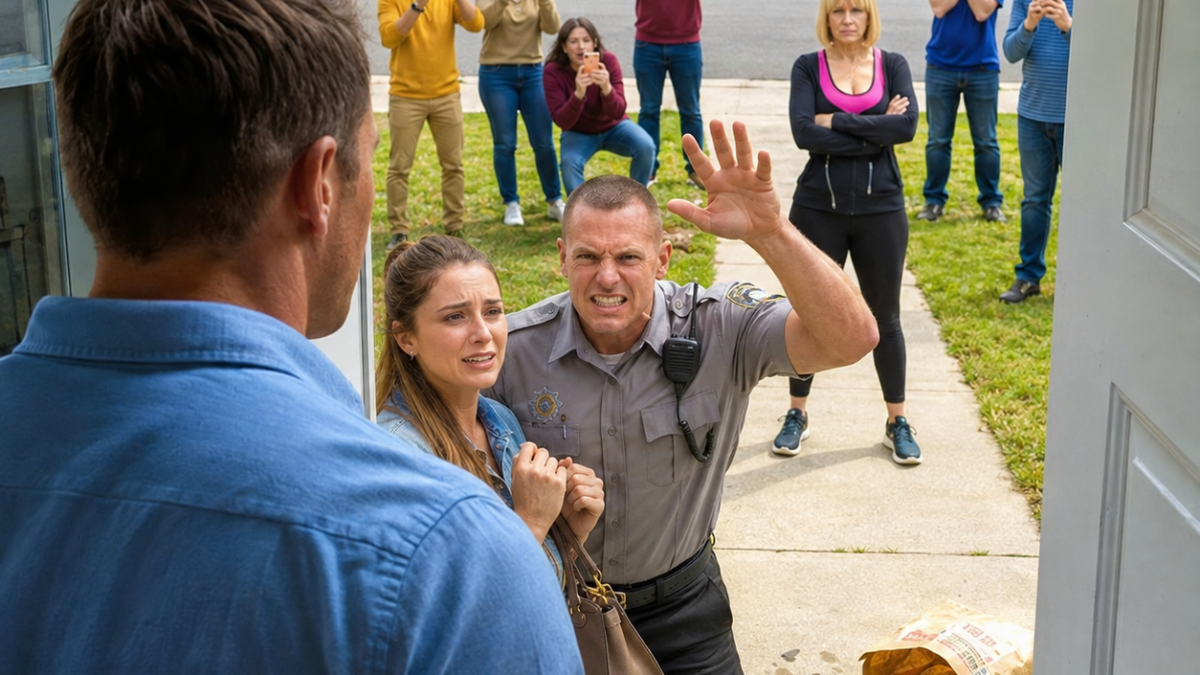
I was standing at our kitchen window in suburban San Antonio when I saw Sarah beside her car, a grocery bag split open at her feet.
What made my stomach turn was the way he straightened his uniform afterward, as though hurting her were simply another neighborhood rule he’d enforced.
Sarah was still wearing her hospital scrubs. She’d worked twelve hours caring for sick children, stopped for groceries, and come home hoping to eat lunch before picking up our kids.
Now milk was running down our driveway.
Her glasses lay near the front tire.
And the man standing over her was Derek Hartwell, the security guard our homeowners association had hired six weeks earlier.
“Next time, follow the rules,” he said.
Sarah pressed a hand against her cheek.
“I wasn’t breaking any rules.”
Derek pointed toward a manila envelope that had fallen from her grocery bag.
“Then hand that over.”
I was already moving.
For nearly twenty years, the Navy had trained me to recognize danger, keep a clear head, and make decisions under pressure. But nothing in that training prepared me for seeing my wife frightened on the driveway of the house we’d bought to give our children a peaceful life.
“Step away from her,” I said.
Derek turned. His eyes dropped to my Navy T-shirt before returning to my face.
“This is HOA business. Stay out of it.”
I looked at Sarah.
She gave me the smallest shake of her head. Not because she wanted me to leave, but because she knew how hard I was working to control myself.
“Sarah, are you hurt?”
“I’m okay,” she whispered.
She wasn’t.
One side of her face was turning red, and her hands shook as she tried to gather the groceries.
Across the street, Mrs. Chen stood frozen on her porch, her phone pressed against her ear.
I told Derek to stay where he was and called 911.
His expression changed when he realized I wasn’t going to argue about his badge, threaten him, or give him the confrontation he seemed to want.
He began explaining that my wife had been interfering with official community business.
I didn’t answer.
I knelt beside Sarah and helped her up.
That’s when she gripped my wrist.
Her eyes moved toward the envelope lying beneath a crushed carton of eggs.
“Jake,” she said quietly, “he wasn’t here about the lawn.”
[END OF FACEBOOK CAPTION]
[FIRST COMMENT / FULL STORY CONTINUATION]
I followed Sarah’s gaze.
The manila envelope had absorbed a thin line of milk, but the writing across the front was still clear.
PETITION FOR SPECIAL MEETING — OAKWOOD ESTATES HOMEOWNERS ASSOCIATION.
I picked it up carefully.
Inside were forty-eight signatures.
Forty-eight homeowners who had agreed to put their names on a document challenging the people running our neighborhood.
I knew Sarah had been talking to neighbors. I knew she was unhappy with how the HOA had been treating people. But I hadn’t realized how far she’d gotten.
And judging by Derek’s face, those signatures mattered a great deal to him.
“That document belongs to the association,” he said.
“No,” Sarah answered. “It belongs to the people who signed it.”
Derek took a step toward us.
I stood.
“Don’t come any closer.”
For the first time since I’d reached the driveway, he hesitated.
I wasn’t threatening him. My hands were open, and my voice was level. But I wasn’t moving out of his way, either.
From the street came the low sound of an approaching engine.
A Bexar County sheriff’s cruiser slowed beside our mailbox.
Mrs. Chen was still standing on her porch. As the deputy stepped out, she raised her hand.
“I called, too,” she said. “I saw what happened.”
Derek’s expression changed immediately.
He straightened his shoulders and reached for the badge clipped to his uniform.
“Officer, I’m conducting an authorized community enforcement action.”
The deputy, a broad-shouldered man with gray at his temples, looked at the badge.
“What agency are you with?”
“Oakwood Community Security.”
“That’s not what I asked.”
Derek lowered his hand.
The deputy turned to Sarah.
“Ma’am, are you injured?”
Sarah tried to answer, but her voice caught.
That frightened me more than the slap.
My wife had spent thirteen years working with children in pain. She could calm a terrified six-year-old during an emergency and explain heartbreaking news to parents without losing her composure.
Now she couldn’t get a sentence out.
I reached for her hand.
She held on.
The deputy waited patiently.
Finally, Sarah said, “He hit me.”
Something in the deputy’s face changed.
He asked Derek to move toward the cruiser while another responding officer took our statements.
Mrs. Chen crossed the street with her phone held against her chest.
“Mr. Steele,” she said, “my camera faces your driveway.”
She looked at Sarah’s cheek.
Her mouth trembled.
“I think it caught everything.”
For a moment, nobody spoke.
Then Derek said something that would stay with me for a long time.
“All this over a stupid HOA petition?”
The deputy turned toward him.
“Derek, I need you to stop talking for a minute.”
Derek opened his mouth again.
The deputy repeated himself.
This time, Derek listened.
I looked down at the envelope.
Forty-eight signatures.
Until that afternoon, I had thought our biggest problem was an arrogant security guard who enjoyed intimidating people.
Standing beside my injured wife, I began to understand that someone was afraid of what our neighbors might discover.
And fear had made that person careless.
My name is Jake Steele.
At the time, I was forty-three years old, a Navy commander with almost two decades of service in Naval Special Warfare. I had spent much of my career away from home, and my current assignment involved training and planning work that finally gave me something I’d been missing.
Regular evenings with my family.
I could help Marcus with his homework. I could attend Emma’s school concerts. Sometimes I could even make breakfast before Sarah left for the hospital.
Those may sound like ordinary things.
To me, they were extraordinary.
Sarah and I had been married fifteen years.
We met at a charity run in Virginia Beach. I had finished the course, misplaced my phone, and spent twenty minutes checking the same pockets while everyone else enjoyed the post-race breakfast.
Sarah found it near the registration table.
When she handed it back, she said, “For a guy who looks organized, you’re kind of a disaster.”
I asked if I could buy her coffee.
She said she’d already had coffee.
I asked about lunch.
She said, “That depends. Can you keep track of your wallet?”
I married her two years later.
Sarah was never impressed by a uniform or a title. She cared whether I remembered our anniversary, whether I listened when she talked, and whether I showed up when our children needed me.
She could be stubborn.
So could I.
Sometimes we spent an entire evening arguing about something small because neither of us wanted to admit we were really worried about something bigger.
But when things were difficult, Sarah was the person I wanted beside me.
Our daughter, Emma, was twelve, quiet around strangers and outspoken at home. She loved photography and had recently developed a habit of taking pictures of ordinary things from strange angles.
A cracked sidewalk.
A bird sitting on a sprinkler.
Her little brother asleep with a book on his face.
Marcus was nine and believed most problems could be solved with enough questions.
He wanted to know how helicopters stayed in the air, why the moon looked larger near the horizon, and whether his mother could tell if he was pretending to be sick.
She could.
Always.
We bought our house in Oakwood Estates because it seemed like the sort of place where our children could grow up without worrying about much beyond school, friendships, and whose turn it was to take out the trash.
Two hundred homes arranged around curved streets, a small community pool, sidewalks shaded by young oak trees, and a playground near the entrance.
Our house had a wide front porch and a kitchen that caught the morning sunlight.
Sarah fell in love with the backyard.
I fell in love with the idea that we’d stay somewhere long enough for the children to remember it as home.
On moving day, our neighbor Mrs. Chen arrived carrying a dish of homemade dumplings.
She was seventy-one, small, energetic, and completely unimpressed by my attempt to carry three boxes at once.
“Put one down,” she ordered. “You only have two hands.”
Her husband had died four years earlier. They had lived in Oakwood since the neighborhood was built.
Across the street, Rafael Rodriguez helped me unload the moving truck.
His wife, Ana, brought lemonade for the kids.
Mrs. Patterson, a widow two houses down, gave Sarah a handwritten list of local restaurants.
It felt like the beginning we’d hoped for.
Then we met Brenda Hartwell.
She arrived on a Saturday morning driving a white SUV, carrying a welcome basket and a thick folder.
Brenda was the president of the homeowners association.
She was also a real estate agent who had been involved in several property sales in the neighborhood.
She wore a pressed white blouse and spoke in the pleasant, efficient tone of someone accustomed to running meetings.
“Oakwood has standards,” she told us. “That’s why people choose to live here.”
At the time, I thought she meant people cared about maintaining their homes.
So did Sarah.
Brenda showed us the community rules and explained how to request permission for exterior changes.
She reminded us not to leave trash cans near the street after collection day.
Then she complimented Sarah’s garden plans.
“You two are going to fit right in.”
For almost two weeks, I believed her.
The first notice arrived on a Wednesday.
A bright orange violation letter had been attached to our front door.
It said the mounting bracket for the American flag on our porch hadn’t been approved.
The association wanted us to submit an architectural application.
I wasn’t thrilled.
But the paperwork was simple enough, and I figured a conversation would resolve the misunderstanding.
Sarah took the letter to the HOA office.
She came home an hour later, quiet.
“What happened?” I asked.
She put her purse on the kitchen counter.
“Brenda said military families sometimes have trouble understanding civilian rules.”
I looked up.
“She said that?”
“Almost exactly.”
“Did you tell her we’ve been homeowners before?”
“Yes.”
“And?”
Sarah gave a tired smile.
“She said this neighborhood is different.”
I wanted to call Brenda immediately.
Sarah asked me not to.
“It’s a flag bracket, Jake. We can fill out the form.”
So we did.
A week later, we received another notice.
This one accused us of parking a commercial vehicle in the driveway.
The vehicle was my personal Ford pickup.
It had Texas registration, veteran plates, and nothing about it that suggested it was being used commercially.
I sent a copy of the registration to the management company.
They corrected the violation.
No apology.
The following week, someone cited our grass for being too tall.
I measured it.
The lawn was within the association’s stated limit.
That notice was withdrawn, too.
At first, I thought we were dealing with sloppy administration.
Then Derek Hartwell appeared.
He was twenty-nine, Brenda’s nephew, and apparently the neighborhood’s new security contractor.
His white pickup carried magnetic signs reading OAKWOOD COMMUNITY SECURITY.
He wore a dark uniform, a black utility belt, and a shield-shaped badge.
He introduced himself to residents as “Officer Hartwell.”
I first met him while washing my truck.
He pulled into the driveway without asking.
“You Steele?”
“Yes.”
“You’re accumulating violations.”
“I’ve had two withdrawn.”
He glanced at the truck.
“Your attitude isn’t helping.”
I turned off the hose.
“What exactly is the problem?”
He tapped a small citation book against his palm.
“People move into places like this and think rules don’t apply to them.”
I asked which rule I’d broken.
He didn’t answer.
Instead, he looked at my Navy shirt.
“Military doesn’t mean you’re in charge here.”
That was the first time I understood he had an issue with more than my lawn.
I told him to leave my property.
He did.
But as he backed his truck into the street, he rolled down the window.
“Your wife seems more reasonable.”
It was an odd thing to say.
I mentioned it to Sarah that evening.
She stopped chopping vegetables and looked at me.
“He’s been by when you’re gone.”
“How many times?”
“Three, maybe four.”
“Why didn’t you tell me?”
“Because every time something happens, you want to handle it yourself.”
Her words stung because they were partly true.
I had spent years making decisions quickly, often in situations where hesitation carried a cost.
At home, that habit didn’t always help.
Sometimes Sarah needed me to listen rather than take command.
“I’m not trying to take over,” I said.
“I know. But I live here, too.”
She went back to chopping carrots.
I stood beside the sink, feeling foolish.
She was right.
It was her home.
Her problem.
Her voice mattered as much as mine.
I just hadn’t realized how much she’d soon need to use it.
The trouble spread beyond our house.
At first, people mentioned it in passing.
Mrs. Chen received a warning about decorative lanterns hanging near her porch.
They had been there for years.
Rafael Rodriguez received a citation over music during his daughter’s birthday party, even though he’d followed the community’s published quiet hours.
Mrs. Patterson was told her late husband’s woodworking shed required inspection.
The shed had stood in the same place since the house was built.
One evening, I found Mrs. Patterson sitting alone on her front steps, holding a notice.
“Everything okay?” I asked.
She smiled without looking up.
“Apparently my birdhouse is a neighborhood problem.”
She handed me the paper.
The notice described an unauthorized exterior structure.
It was a cedar birdhouse mounted on a fence post.
Her husband had made it during his last summer.
“I told that young man it was important to me,” she said. “He told me sentimental value wasn’t an exemption.”
I read the letter twice.
It carried Derek’s signature.
Mrs. Patterson reached for it.
“Don’t make a fuss, honey. I just wanted someone else to see how silly it is.”
I asked whether I could make a copy.
She thought for a moment.
Then nodded.
That copy became the first page of a folder.
Sarah started the folder, not me.
She placed Mrs. Patterson’s notice beside our withdrawn citations, added the relevant HOA rules, and wrote the dates on a sheet of paper.
It was such a Sarah thing to do.
At the hospital, she kept careful notes because small details could make a difference in a patient’s care.
At home, she did the same thing with our neighborhood.
Within two weeks, the folder was nearly an inch thick.
Mrs. Chen contributed copies of her warnings.
Rafael shared the emails he’d exchanged with Brenda.
A young couple named Allison and Peter brought a notice concerning their children’s bicycles.
Sarah organized everything by date.
Then she noticed something I had missed.
The violations were inconsistent.
One family had been fined for leaving a garden hose visible from the street.
Another house had the same kind of hose lying across its lawn for weeks.
One homeowner was told to remove holiday decorations three days after a celebration.
Another homeowner kept decorations up for a month without receiving a warning.
There might have been innocent explanations for some differences.
But there were too many.
And the same names kept appearing on the notices.
Derek’s signature.
Brenda’s authorization.
Sometimes both.
Sarah raised the issue at a regular HOA board meeting.
I went with her.
The meeting was held in a small community room beside the pool.
The carpet smelled faintly of cleaning solution. A ceiling fan clicked above our heads.
Brenda sat at the front table with four other board members.
Bob Mercer, the treasurer, was a retired accountant in his late sixties.
He had a nervous habit of adjusting his glasses whenever Brenda spoke.
Nancy Pike, another board member, took meeting notes.
The other two directors said very little.
Sarah waited until the open comment period.
Then she stood.
“I’d like to understand how violations are being documented and reviewed.”
Brenda smiled.
“Of course.”
Sarah held up several notices.
“Different households are receiving different enforcement actions for similar conditions. Some have photographs. Others don’t. Some cite sections of the rules that don’t seem to apply.”
Brenda folded her hands.
“We use professional judgment.”
“Whose judgment?”
“Authorized personnel.”
“Does Derek have written authorization to impose fines?”
Brenda’s smile disappeared.
“Mr. Hartwell is our security contractor.”
“That wasn’t my question.”
The room grew quiet.
I glanced at Sarah.
Her shoulders were straight, and she was speaking calmly.
Brenda looked toward Bob.
“Financial and operational decisions are handled by the board.”
Sarah nodded.
“Then may we see the meeting minutes approving his contract?”
Bob began shifting papers.
Brenda interrupted him.
“Sarah, this is beginning to feel like an interrogation.”
“I’m asking about a contract.”
“And I’ve explained the situation.”
“No,” Sarah said. “You haven’t.”
Nobody moved.
Then Nancy cleared her throat.
“We can put the request on the agenda for next month.”
Brenda gave her a sharp look.
But Nancy wrote something down.
After the meeting, Brenda approached us in the hallway.
“I think you misunderstand how much work goes into keeping this neighborhood attractive.”
Sarah zipped her folder.
“We appreciate the volunteers who do that work.”
“Then perhaps you could stop making everything difficult.”
I felt my jaw tighten.
Sarah touched my arm.
“Good night, Brenda.”
We walked out together.
In the parking lot, I said, “You handled that well.”
Sarah looked at me.
“She didn’t answer a single question.”
“No.”
“And everyone let her.”
That bothered Sarah more than anything else.
Not the arrogance.
Not the fines.
The silence.
She had watched frightened parents make hard decisions for sick children. She knew what happened when people felt too overwhelmed to ask questions.
And she believed a neighborhood shouldn’t make people feel that way.
The first time Derek approached our children, Emma waited until dinner to tell us.
She pushed peas around her plate.
“Mom?”
Sarah looked up.
“What is it, sweetheart?”
“Is that security man allowed to talk to kids?”
My fork stopped halfway to my mouth.
“What did he say?”
Emma glanced at Marcus.
“He came to the bus stop this morning.”
“Was anyone else there?”
“Olivia and two other kids.”
She swallowed.
“He said families that cause trouble don’t usually stay in Oakwood very long.”
Sarah put down her glass.
“Did he speak directly to you?”
Emma nodded.
“He said maybe we should find a neighborhood where we fit better.”
Marcus looked confused.
“Are we moving?”
“No,” I said.
Too quickly.
Sarah gave me a look.
I turned toward my son.
“We aren’t planning to move.”
Emma stared at her plate.
“He said Dad thinks he’s special because he’s in the military.”
I felt something tighten in my chest.
But what I remember most is that Emma seemed embarrassed.
As if she’d done something wrong by repeating the words.
I moved my chair closer.
“Emma, look at me.”
She did.
“You don’t have to answer that man if he approaches you. Stay with your friends, and tell a teacher or us immediately.”
She nodded.
“Am I in trouble?”
“No, honey.”
“Because I told him to leave us alone.”
I almost smiled.
“No. You’re not in trouble.”
Later that night, Sarah found me in the garage staring at Derek’s truck on the security footage.
I’d recently installed cameras around the front and side entrances.
The recording showed him parked near the bus stop.
It showed him talking to Emma.
It did not capture his words.
Sarah stood beside me.
“Don’t do anything stupid.”
“I wasn’t planning to.”
She raised an eyebrow.
I sighed.
“I was considering several unhelpful conversations.”
“That’s what I thought.”
We stood together in silence.
Then Sarah said, “This needs to stop before someone gets hurt.”
I agreed.
What I didn’t understand was how close we already were to that point.
I contacted the HOA management company and requested a copy of Derek’s contract and insurance information.
I also asked what authority he had been given under the governing documents.
A week passed.
Then another.
No contract arrived.
The management company replied that the board would review my request.
Meanwhile, Derek continued driving through the neighborhood.
He sometimes parked across from our house for twenty minutes at a time.
Once, Sarah saw him outside the hospital parking garage after her shift.
He claimed he needed to discuss a violation.
She told him that her workplace wasn’t an appropriate place for HOA business.
He stepped aside only when a hospital security officer approached.
Sarah filed an incident report with the hospital.
She also called the sheriff’s non-emergency number.
The person she spoke with recommended documenting any future encounters and making a report if she felt threatened.
We followed that advice.
I wanted a faster solution.
Sarah wanted a solution that would last.
Neither of us was entirely wrong.
But we weren’t working together as well as we should have been.
One night, after another argument about whether I should confront Brenda directly, Sarah sat at our kitchen table and said something I still remember.
“Jake, when you were deployed, I didn’t sit around waiting for you to come home and solve everything.”
I said nothing.
“I raised two kids. I worked. I handled the broken water heater and the hospital bills and the nights Marcus cried because he missed you.”
“I know.”
“I don’t think you do.”
That hurt.
She saw it and softened.
“I’m not saying you weren’t there for us. I’m saying I’m capable of handling difficult things.”
I pulled out the chair across from her.
“You’re right.”
She looked surprised.
I almost laughed.
“Don’t look so shocked.”
For the first time that evening, she smiled.
Then she reached across the table.
“I need you with me, Jake. Not in front of me.”
I took her hand.
“Okay.”
Neither of us knew how important that promise would become.
Sarah’s first neighborhood gathering wasn’t supposed to be political.
She invited Mrs. Chen, Ana Rodriguez, Mrs. Patterson, and three other women over for coffee.
They sat around our dining table while Marcus played quietly in the living room.
I was in the backyard repairing a sprinkler head.
Through the open kitchen window, I could hear occasional laughter.
Then the laughter stopped.
Later, Sarah told me what had happened.
Allison, the young mother from Maple Street, had received a warning because her toddler’s plastic playhouse could be seen above the backyard fence.
She hadn’t told anyone because she was afraid another violation might create trouble when she sold the house.
Mrs. Chen admitted she had removed her lanterns.
“I was tired of feeling watched,” she said.
Ana described Derek questioning her teenage daughter about visitors arriving for a family celebration.
Mrs. Patterson showed everyone the birdhouse notice.
Then she reached into her purse and pulled out a photograph.
It showed her late husband, George, sitting in their backyard with sawdust on his shirt.
He was holding the birdhouse.
“He made it after his heart surgery,” she said. “He couldn’t do much, but he could sit at his little workbench.”
Nobody spoke for a while.
Then Allison said, “Why are we all acting like we’ve done something wrong?”
That question changed the gathering.
They began comparing notices.
They noticed that most residents had been dealing with Derek separately.
Nobody knew how many others were having similar problems.
Brenda had made each dispute sound like an isolated incident.
But it wasn’t.
Sarah suggested they write a joint letter requesting clearer enforcement policies and an independent review of the security arrangement.
Everyone agreed.
By the end of the week, twelve households had signed.
The following Sunday, the number reached twenty-seven.
Sarah didn’t use public social media posts to pressure anyone.
She knocked on doors.
She listened.
She gave people copies of the actual complaints and governing documents.
And she told every neighbor they were free to decline.
Some did.
One man said he didn’t want trouble.
Sarah thanked him for his time.
A woman near the entrance said Brenda had helped sell her mother’s house and she wasn’t comfortable taking sides.
Sarah understood.
She didn’t argue.
But one afternoon, she came home from visiting Mrs. Patterson with tears in her eyes.
“What happened?” I asked.
She handed me a folded note.
It was written in shaky handwriting.
Sarah, I was afraid to say anything because I live alone. I don’t want that man coming back. Thank you for asking.
I read it twice.
Then I looked at my wife.
She was standing by the kitchen sink with her coat still on.
“I used to think people weren’t speaking up because they didn’t care,” she said.
“And now?”
“Now I think some of them are scared.”
I put my arms around her.
She leaned against me.
For a long time, neither of us moved.
That was when I began to see the situation differently.
I had been thinking about a problem that needed to be defeated.
Sarah was thinking about people who needed to feel safe again.
The distinction mattered.
Our next lead came from an unexpected place.
Bob Mercer’s wife, Linda, approached Sarah at the grocery store.
Linda was a bookkeeper for a local dental practice.
She and Bob had lived in Oakwood for eleven years.
She wasn’t part of the HOA board, but she understood accounting records better than most people.
She asked whether Sarah had a few minutes.
They sat in the small coffee shop beside the supermarket.
Linda looked uncomfortable.
“I heard you’re asking questions about Derek’s contract.”
“Yes.”
Linda stirred her coffee.
“Bob doesn’t like talking about association business at home.”
Sarah waited.
“Something’s been bothering him.”
“About Derek?”
Linda hesitated.
“About the payments.”
That evening, Sarah told me about the conversation.
According to Linda, Bob had noticed regular payments to a vendor named Hill Country Property Services.
The amounts varied, but several were close to three thousand dollars.
Brenda had described them as security and maintenance expenses.
Bob assumed the arrangement had been approved before he became treasurer.
When he asked for the contract, Brenda told him the management company had it.
The management company told him to ask Brenda.
That was all Linda knew.
But it gave us something specific to investigate.
I reviewed the HOA financial summaries available to homeowners.
There were line items for landscaping, pool maintenance, insurance, repairs, and security.
What bothered me was the timing.
The neighborhood had not employed a security patrol when we moved in.
Yet payments under a vaguely named maintenance account had started months earlier.
I printed the statements and laid them across the kitchen table.
Sarah sat down beside me.
“Could there be a legitimate reason?”
“Sure.”
“What kind?”
“A contract nobody’s produced yet. A service we don’t know about. Accounting mistakes.”
She studied the numbers.
“And if there isn’t?”
“Then the board needs answers.”
She looked at me for a moment.
“That’s what I’ve been saying.”
I smiled.
“I know.”
We requested the association records again, this time in writing and with the specific provisions of the governing documents identified.
The management company acknowledged the request.
A few days later, Brenda called.
She asked to speak with me.
I put the phone on speaker.
“Jake, I understand you and Sarah have concerns.”
“Yes.”
“I’m hoping we can settle them privately.”
“That depends on whether we get the documents we’ve requested.”
She sighed.
“This community has functioned peacefully for years.”
“Then an independent review shouldn’t be a problem.”
A pause.
“Your wife has been encouraging residents to undermine the board.”
“She’s been asking questions.”
“She’s creating division.”
Sarah leaned toward the phone.
“Brenda, I’m right here.”
Another pause.
Then Brenda said, “Sarah, I’m disappointed. I thought we had a better understanding.”
“We could still have one,” Sarah replied. “Just let the homeowners see the records.”
Brenda’s voice hardened.
“You’re making a very simple matter unnecessarily complicated.”
The call ended soon after.
Sarah stared at the phone.
“She sounds nervous.”
“Maybe.”
But I was beginning to wonder whether Brenda was less concerned about community standards than about losing control of who could ask questions.
Two days later, Derek issued three new citations to our household.
One concerned a garden hose.
One concerned a trash can that had been moved out of sight hours before the cited inspection.
The third accused us of obstructing an HOA inspection.
Sarah was at work during the alleged inspection.
I was on base.
Our cameras showed no one approaching the house.
I sent the footage to the management company.
All three citations were withdrawn.
Derek returned the next evening.
He parked near our driveway and stood beside his truck.
I walked onto the porch.
“Can I help you?”
“You need to tell your wife to stop stirring people up.”
I stayed where I was.
“Don’t discuss my wife that way.”
He laughed.
“She’s making promises she can’t keep.”
“What promises?”
He looked toward the house.
“People who challenge the board usually regret it.”
I felt the familiar urge to close the distance between us.
Instead, I took my phone out.
“Would you repeat that?”
His expression changed.
“You’re recording me?”
“Yes.”
He got into his truck.
As he drove away, I realized something.
He had not mentioned the citations.
He hadn’t mentioned our lawn.
He had come to tell me to stop Sarah.
The formal petition began with a question about the HOA bylaws.
Sarah had spent an evening reading them while I helped Marcus construct a cardboard model of the solar system.
She came into the living room holding a page covered in sticky notes.
“Jake, look at this.”
The governing documents allowed homeowners representing at least twenty percent of the properties to request a special membership meeting.
Oakwood had two hundred homes.
That meant forty qualifying owners.
Sarah already had more than enough neighbors willing to discuss a review.
But asking for a special meeting required an actual petition, with names, property addresses, and a stated purpose.
She drafted one.
It requested a meeting to discuss security enforcement, the association’s financial records, and a vote on whether to recall the existing board leadership.
She asked Maria Gonzalez, a local attorney who had previously handled association disputes, to review the language.
Maria recommended a few changes.
She also warned Sarah that a petition would not automatically remove anyone.
The board would have to receive proper notice. Voting procedures would matter. Owners would need to attend or submit valid proxies.
“Expect resistance,” Maria said.
Sarah nodded.
“I already do.”
Maria looked at her.
“Then don’t give them a procedural excuse to dismiss your work.”
Sarah took that advice seriously.
She checked every address.
She made sure signatures came from owners rather than tenants who weren’t authorized to sign.
She kept copies.
And she explained the purpose to each person before asking for a signature.
Some residents signed immediately.
Others asked for time.
A few thanked her but declined.
By the end of the second week, she had forty-eight verified signatures.
I knew she had passed forty.
I didn’t know she’d reached forty-eight.
She had planned to surprise me that evening.
The original petition was supposed to go to the association’s management company by certified delivery.
Before mailing it, she wanted to make copies.
That Thursday morning, she stopped at Linda Mercer’s house.
Linda had offered to help confirm which homeowners were listed on the property records.
They reviewed the petition together.
Then Sarah went to a copy shop.
Afterward, she stopped for milk, eggs, bread, and the coffee creamer I’d forgotten to buy.
The envelope stayed inside her grocery bag because she didn’t want to leave it visible in the car.
She didn’t know Derek had been watching her movements.
And she didn’t know Brenda had already learned about the petition.
We discovered that later.
At the time, all Sarah knew was that Derek’s white truck pulled behind her as she entered our driveway.
He blocked the street-side end of our driveway and approached her car.
She was lifting groceries from the back seat.
“Mrs. Steele.”
She kept her voice polite.
“Hello, Derek.”
“Where’s the petition?”
Sarah froze.
“What petition?”
“The one you’ve been taking around the neighborhood.”
“That’s not your business.”
“Brenda wants it turned over.”
Sarah set down one of the grocery bags.
“We’re submitting it through the management company.”
Derek stepped closer.
“Give it to me.”
“No.”
He reached toward the bag.
Sarah moved it away.
“Don’t touch my things.”
He accused her of interfering with official association business.
She told him he had no reason to be on our property.
Then she tried to walk past him.
He grabbed the paper bag.
It tore.
Groceries fell across the driveway.
Sarah caught the envelope before it landed in the spilled milk.
Derek reached for it.
She pulled away.
He slapped her.
I saw it from the kitchen window.
A moment that lasted less than a second changed the way our family felt about the place we called home.
After the deputies took our statements, I drove Sarah to an urgent care clinic.
Her cheek was swollen.
The doctor examined her, documented the injury, and recommended follow-up care if her symptoms worsened.
She had a mild headache and was shaken, but there was no sign of a more serious injury that afternoon.
I sat beside her in the exam room.
The paper covering the examination table crinkled every time she moved.
She stared at her hands.
“I’m sorry.”
I looked up.
“For what?”
“For not telling you how bad things were getting.”
I pulled my chair closer.
“Sarah, you didn’t cause this.”
“I thought if I stayed calm, he’d eventually stop.”
She wiped at her eyes.
“I really thought I could handle him.”
“You did handle yourself. He chose to hurt you.”
She shook her head.
“But I knew he was getting worse.”
I reached for her hand.
“So did I. And I kept thinking there was one more complaint I could file, one more conversation that might fix it.”
Her fingers tightened around mine.
We sat there without speaking.
Outside the exam room, someone pushed a cart down the hallway.
The sound reminded me of the hospital corridors where Sarah spent so much of her life helping other families.
For once, she was the one who needed care.
I hated that.
But I also knew that making my anger the center of everything would only give her another burden to carry.
So I asked the question I should have asked sooner.
“What do you need from me right now?”
She looked at me for a long moment.
“Take me home.”
I nodded.
“And don’t let this become about your job.”
I understood.
She didn’t want reporters or lawyers or neighbors treating her as a Navy SEAL’s wife who’d been attacked.
She wanted them to understand she was Sarah Steele.
A mother.
A nurse.
A homeowner.
A person who had every right to feel safe.
“I promise,” I said.
The sheriff’s office collected statements from Mrs. Chen and two other neighbors.
Mrs. Chen’s doorbell camera provided a clear view of the assault.
Another camera showed Derek arriving behind Sarah’s vehicle.
Derek was arrested that afternoon.
He was released the following day under bond conditions, including restrictions on contacting Sarah.
Those restrictions were important.
They did not make the fear disappear.
When we got home, my sister Caroline was waiting with the children.
I’d asked her to pick them up from school.
Emma rushed toward her mother.
“Mom!”
Sarah crouched to hug her.
Emma stopped short when she saw the swelling.
“What happened?”
Sarah pulled her gently into an embrace.
“Something upsetting happened today.”
Marcus stood behind his sister.
“Did that man do it?”
Nobody answered quickly enough.
He looked at me.
“Dad?”
I knelt in front of him.
“Yes, buddy. He hurt Mom. The sheriff’s office is handling it now.”
Marcus’s face crumpled.
“Is he coming back?”
I wanted to say no.
I wanted to promise that nothing bad would ever happen near our home again.
But children deserve the truth in a form they can understand.
“We’re taking steps to keep everyone safe,” I said. “And you can always tell us if you’re worried.”
He nodded.
Then he wrapped his arms around my neck.
That night, Emma asked to sleep in our room.
Marcus brought his pillow, too.
We made a little camp on the floor beside our bed.
Sarah fell asleep holding Emma’s hand.
I stayed awake longer than I wanted to.
At some point, Marcus whispered into the darkness.
“Dad?”
“Yeah?”
“Did you hit him back?”
“No.”
“Why not?”
I looked toward Sarah.
She was finally sleeping.
“Because Mom needed me to help her. And I wasn’t going to make things worse.”
Marcus considered that.
Then he said, “Good.”
I closed my eyes.
For the first time since the assault, I felt myself breathe normally.
The morning after the attack, Brenda came to our house.
She rang the doorbell at nine o’clock.
I saw her on the camera monitor and stepped onto the porch.
I did not invite her inside.
She wore a pale blue cardigan and carried a small flower arrangement.
“Jake,” she said softly. “I’m so sorry about what happened.”
I looked at the flowers.
“Thank you.”
“I had no idea Derek would behave that way.”
“He’s your contractor.”
“He’s my nephew,” she corrected. “And I trusted him.”
I said nothing.
She glanced toward the front window.
“Is Sarah home?”
“She’s resting.”
“I’d like to apologize personally.”
“Not today.”
Brenda looked hurt.
“Of course. I understand.”
Then she shifted her weight.
“I do hope we can keep this from becoming a larger public problem.”
I studied her.
“What does that mean?”
“These situations can get out of control. People start posting things online. Rumors spread. Property values suffer.”
“My wife was assaulted.”
“I know. And that’s terrible.”
She paused.
“But I hope you understand the association can’t be responsible for one man’s personal conduct.”
I looked at the flowers again.
“That will be for the appropriate people to determine.”
She sighed.
“Jake, we’ve all made mistakes.”
I felt my temper rise.
But my voice stayed even.
“Sarah didn’t make a mistake by collecting signatures.”
Brenda looked away.
It was brief.
Barely a second.
But I noticed.
“That petition has nothing to do with the unfortunate incident,” she said.
“I didn’t bring up the petition until now.”
She looked back at me.
For the first time, she had no immediate answer.
Then she put the flowers on the porch railing.
“I hope Sarah feels better.”
She left without another word.
I watched her SUV disappear around the corner.
Inside, Sarah was standing by the kitchen doorway.
She had heard enough.
“She knew,” Sarah said.
“About the petition?”
Sarah nodded.
“And she knew Derek wanted it.”
We couldn’t prove that yet.
But the way Brenda had spoken made us both uneasy.
That afternoon, our attorney advised us not to contact Brenda or Derek directly.
We followed that advice.
Sarah also asked Maria to handle correspondence with the HOA.
That gave us something we’d badly needed.
Distance.
For the next several days, our house became quieter than it had ever been.
The children were careful around Sarah.
Emma offered to make breakfast.
Marcus kept asking whether Mom needed another ice pack.
I tried to help without hovering.
That was harder than it sounds.
Sarah caught me checking the front camera for the third time one evening.
“Jake.”
I turned.
She pointed toward the chair beside her.
“Sit down.”
I sat.
She rested her head on my shoulder.
“You’re allowed to be scared, too.”
I stared at the television.
“I’m not scared.”
She lifted her head.
I sighed.
“Okay. I’m scared.”
“Of what?”
I thought about it.
“Of not being here when you need me.”
She took my hand.
“You were here.”
“That day.”
“And you’re here now.”
I wanted to argue that it wasn’t enough.
Instead, I stayed beside her.
Sometimes that was the better choice.
The neighborhood’s reaction surprised us.
We expected sympathy from a few friends.
We did not expect the number of people who began coming forward.
Mrs. Chen spoke to three neighbors who had witnessed Derek’s behavior over the previous months.
Rafael arranged a small gathering at his house.
Allison offered to contact residents who had received fines.
Within a week, more than thirty households had shared notices, photographs, or written accounts of troubling encounters.
Several people described Derek following them through the neighborhood.
Others said he’d demanded access to fenced backyards without proper notice.
One family reported that he had approached their teenage daughter while she was walking home.
The daughter had been too frightened to tell her parents until she heard about Sarah.
That conversation broke my heart.
Not because every complaint necessarily proved wrongdoing.
Some disputes were ordinary disagreements over community rules.
But a number of residents described the same pattern.
Derek would appear without warning.
He would claim broad authority.
He would threaten fines or other consequences.
And he would mention Brenda whenever someone questioned him.
Sarah asked everyone to distinguish clearly between what they’d witnessed and what they’d heard from others.
She didn’t want rumors entering the record.
She also insisted that residents avoid attacking Derek or Brenda online.
“We have documents,” she said during one meeting. “We have our own experiences. We don’t need to invent anything.”
I was proud of her.
But I worried about how much responsibility she was taking on while recovering.
One evening, I found her at the dining table surrounded by papers.
It was nearly midnight.
“Sarah, you need sleep.”
“I know.”
“Then come upstairs.”
“Five more minutes.”
I sat across from her.
She was examining a complaint from Mrs. Patterson.
I waited.
Finally, she put down the pen.
“I keep thinking about Mrs. Patterson being afraid in her own house.”
“I know.”
“She lived there with George for twenty-six years. She helped raise half the kids on this street. And now she’s scared to answer the door.”
Sarah rubbed her forehead.
“I can’t just forget about that.”
“You don’t have to.”
“Then why do you look worried?”
“Because I don’t want you to carry the whole neighborhood on your shoulders.”
She looked down.
For a moment, I thought she might argue.
Instead, she said, “I don’t know how to stop.”
That was the first time she admitted how deeply the assault had affected her.
During the day, she could organize papers and speak calmly with neighbors.
At night, she replayed the driveway scene.
She jumped when someone knocked.
She stopped parking outside the garage.
And once, when a delivery driver reached toward her to hand over a package, she flinched.
She was embarrassed afterward.
I told her she had nothing to be embarrassed about.
But telling someone not to feel afraid doesn’t make the fear disappear.
So we made room for it.
Sarah arranged to speak with a counselor recommended through her hospital.
I began attending some family sessions with her.
The children had their own opportunity to talk with a school counselor.
We stopped pretending everything was fine.
And slowly, the house began to feel like ours again.
Meanwhile, the question of the missing contract was growing harder for Brenda to avoid.
Maria sent a formal records request.
The association’s management company eventually produced several years of financial summaries, board minutes, and invoices.
Some documents were incomplete.
Some were missing signatures.
A few invoices listed services in such broad terms that it was impossible to tell what had actually been provided.
There were payments for “community monitoring.”
Payments for “grounds support.”
Payments for “special neighborhood services.”
Many went to Hill Country Property Services.
The company’s mailing address led to a small office building on the north side of San Antonio.
Our attorney checked the public business records.
The company had been registered by someone with a close connection to Brenda’s real estate business.
Derek’s name appeared on several invoices.
That didn’t automatically prove a crime.
But it raised serious questions about conflicts of interest and whether homeowners’ money had been spent with proper approval.
Maria recommended an independent forensic review.
The HOA board refused.
Brenda sent residents a letter accusing a small group of homeowners of creating unnecessary legal expenses.
She wrote that the board had acted in good faith and that all financial decisions were made for the benefit of the community.
Sarah read the letter at the kitchen counter.
Then she placed it beside the petition.
“She still hasn’t answered what the money paid for.”
“No.”
“Or who approved it.”
“No.”
She looked at me.
“Then we’re going to keep asking.”
The special meeting petition was submitted by certified delivery.
The management company acknowledged receiving it.
But Brenda disputed the signatures.
She claimed several homeowners had been misled about the petition’s purpose.
She also argued that the association needed additional time to verify ownership.
Maria reviewed the objections.
A few were valid administrative questions.
Most were not.
We gathered the requested proof.
The signature count remained comfortably above the required threshold.
After more back-and-forth, the association was required under its governing documents to schedule the special meeting.
It was set for a Thursday evening, six weeks away.
That seemed like an eternity.
But Sarah reminded me that the point wasn’t to win an argument in a parking lot.
It was to make sure the meeting was legitimate.
“Nobody gets to say we skipped the rules,” she told me.
I nodded.
“Agreed.”
She smiled.
“Look at you. Learning patience.”
I kissed her forehead.
“Under excellent supervision.”
The first major break came from Bob Mercer.
He showed up at our front door on a rainy Sunday afternoon.
He looked older than I remembered.
His hair was damp. He was holding a cardboard file box against his chest.
I invited him inside.
Sarah joined us at the kitchen table.
Bob set down the box.
“I think I’ve made a terrible mistake,” he said.
I poured him coffee.
He didn’t touch it.
For almost a minute, he stared at the lid.
Then he began talking.
When Bob became treasurer, Brenda had told him the association’s finances were in good shape.
She said the previous board had approved an expanded security and maintenance arrangement.
Bob trusted her.
He signed checks based on invoices she presented.
Sometimes he asked questions.
She answered quickly, often referring him to documents she promised to send later.
Then his wife began noticing the payments.
Linda asked whether he’d seen the security contract.
He hadn’t.
She asked why the vendor’s invoices contained no itemized hours.
He didn’t know.
Finally, after Sarah raised the issue publicly, Bob searched the board’s records.
He couldn’t find an approval vote.
He couldn’t find a properly executed contract.
And he discovered that several maintenance expenses had been recorded under accounts that didn’t match the bank withdrawals.
“I thought it was disorganized bookkeeping,” Bob said.
He opened the box.
Inside were copies of invoices, meeting minutes, and account summaries.
“Then I found these.”
He handed Sarah a sheet of paper.
It was a vendor payment authorization bearing Bob’s signature.
Underneath was a second signature.
Brenda Hartwell.
The payment was for $4,850.
The description read: emergency grounds maintenance.
The invoice attached to it referred to a landscaping project near the community pool.
But Bob had checked.
The landscaping company listed on the invoice had never performed the work.
He contacted the owner personally.
The man told him his company hadn’t serviced Oakwood in almost two years.
I looked at Bob.
“Did you report this?”
He swallowed.
“Not yet.”
“Why not?”
He looked at the floor.
“Because I signed it.”
The silence was uncomfortable.
Sarah spoke first.
“Bob, did you know the invoice was false when you approved the payment?”
“No.”
“Do you have anything showing Brenda told you the work was completed?”
He nodded.
“Emails.”
“Then you need to give everything to the attorney and investigators.”
Bob rubbed his face.
“I should have caught it.”
Neither of us contradicted him.
He should have.
Being misled didn’t erase his responsibility to review the accounts.
But admitting that was different from deciding he deserved no chance to make things right.
After a while, Sarah said, “You can still help the homeowners understand what happened.”
Bob looked at her.
“After what I allowed?”
“Especially after.”
His eyes filled.
He took off his glasses and wiped them with a handkerchief.
Then he pushed the entire box toward us.
“I’ll cooperate.”
That afternoon, Maria arranged for Bob to provide the records directly to the appropriate investigators and to an independent accountant.
We did not post the documents online.
We didn’t want to damage the investigation or accuse anyone beyond what the evidence could support.
But the financial picture was beginning to change.
The question was no longer simply whether Derek had a legitimate contract.
It was whether significant amounts of community money had been diverted through businesses connected to Brenda.
And Bob’s files suggested the problem had started long before our family moved into Oakwood.
There was something almost painful about learning how ordinary the financial problems began.
Brenda hadn’t become HOA president by promising to control everyone.
Years earlier, neighbors said, she had volunteered to organize holiday decorations and community cleanups.
She was energetic.
She got things done.
When the previous president moved away, Brenda agreed to serve.
At first, she had a reputation for answering emails promptly and arranging repairs.
People appreciated her.
Then her marriage ended.
Her real estate business slowed.
The board lost two experienced volunteers.
Brenda began making more decisions on her own.
She called them temporary measures.
The temporary measures became habits.
Eventually, people stopped asking questions because Brenda seemed to have an answer for everything.
That didn’t excuse what she had done.
But it made the situation more understandable.
People often imagine abuse of authority beginning with someone announcing that they intend to take advantage of others.
Sometimes it begins with smaller choices.
An unrecorded meeting.
An expense approved without proper review.
A question brushed aside because everyone is busy.
Then another.
Then another.
By the time someone notices the pattern, too many people have become accustomed to it.
Brenda had also surrounded herself with residents who trusted her judgment.
Nancy Pike was one of them.
Nancy had once taught elementary school and now spent much of her time caring for her elderly mother.
She told Sarah later that she’d supported Brenda because she believed the board needed stability.
“I thought she was keeping things together,” Nancy admitted.
Sarah asked, “Did you know Derek was contacting people’s children?”
Nancy shook her head.
“No.”
“Did you know about the hospital visits?”
“No.”
“Then why did you keep voting to support him?”
Nancy looked down.
“Because Brenda said the complaints were exaggerated.”
The answer made me angry.
But Sarah didn’t attack her.
She simply placed several written statements on the table.
“Then please read these.”
Nancy did.
When she reached Emma’s account, her hands began to shake.
“I taught children for thirty-two years,” she whispered.
She set down the paper.
“I should have asked.”
It wasn’t a dramatic confession.
It didn’t fix anything immediately.
But it was the beginning of one person choosing to stop looking away.
As the special meeting approached, tensions rose.
Brenda’s supporters worried that the association would be destroyed by lawsuits and legal costs.
Some residents feared property values might fall.
Others were angry about the possibility that common funds had been misused.
A few simply wanted the conflict to end.
At a neighborhood gathering, a man named Tom asked me a question I hadn’t expected.
“Jake, why not just move?”
He wasn’t being cruel.
He sounded exhausted.
“You’re a military guy. You could sell this place and go somewhere else.”
I looked toward the playground, where several children were climbing the slide.
“That’s true.”
“Then why stay?”
I considered how to answer.
Part of me wanted to say that I wasn’t going to let Brenda drive us out.
But the truth was more complicated.
Sarah and I had talked about moving.
We’d looked at listings.
We’d argued about whether the children would be happier somewhere new.
There were nights when leaving seemed like the simplest way to protect our family.
I looked back at Tom.
“Because my kids love their school. Sarah loves her job. We have friends here. And we shouldn’t have to leave because someone else behaved badly.”
He nodded.
“But what if it doesn’t get better?”
“Then we’ll make another decision.”
He seemed surprised.
“You’d still move?”
“Of course.”
I shrugged.
“My job is to take care of my family. Not win a contest.”
Tom was quiet.
Then he said, “That makes sense.”
A few days later, he signed the petition.
Not because I’d talked him into fighting.
Because he’d decided the questions were worth asking.
That mattered to me.
I didn’t want neighbors choosing sides out of loyalty to Sarah or me.
I wanted them to decide based on the facts.
Two weeks before the special meeting, Maria called us into her office.
She had received an update from the independent accountant reviewing the records Bob had supplied.
The findings were preliminary.
But they were troubling.
Over a period of roughly twenty months, more than sixty thousand dollars in association funds had been paid through questionable or improperly documented arrangements.
Some payments related to Derek’s security services.
Others involved maintenance invoices that could not be matched to completed work.
The accountant had also identified transfers connected to a business in which Brenda held an interest.
A full accounting would require additional bank records and formal investigative authority.
Maria was careful with her words.
“We have substantial grounds to question these transactions,” she said. “That doesn’t mean every payment was theft, and it doesn’t mean we can determine criminal liability ourselves.”
I appreciated that.
The last thing our neighborhood needed was another person making sweeping accusations without proof.
Sarah sat beside me with her hands folded in her lap.
“Could the homeowners get the money back?”
“Possibly. It depends on what the investigation establishes, what funds remain available, and what recovery options are realistic.”
“And Derek?”
“The assault case is proceeding separately. The association’s financial practices may be relevant to some broader questions, but one doesn’t automatically prove the other.”
Sarah nodded.
Then she asked the question that mattered most to her.
“Can we stop the association from using him while all this is being investigated?”
Maria explained the options.
We could demand the board suspend the security arrangement.
We could seek appropriate court relief if the circumstances supported it.
And at the special meeting, owners could vote on leadership changes under the bylaws.
The process wasn’t quick.
It wasn’t satisfying.
But it was real.
As we left the office, Sarah stopped near the elevator.
“Jake?”
“Yeah?”
“Do you think this would’ve happened if we’d just ignored the first citation?”
I looked at her.
“Maybe not to us.”
She nodded.
“That’s what I keep thinking.”
She pressed the elevator button.
“Someone else would’ve been standing in that driveway.”
I didn’t have an answer.
The elevator doors opened.
We stepped inside together.
The night before the special meeting, Emma came into my office.
She was holding a photograph.
“Can I show you something?”
I moved my papers aside.
She handed it to me.
It was a picture she’d taken through our front window a few days earlier.
Sarah stood in the driveway talking with Mrs. Chen.
The older woman was holding a plate covered with aluminum foil.
Both were smiling.
Emma had caught the moment just before Sarah reached out to take the plate.
The sunlight made the pavement look almost white.
“I like this one,” I said.
Emma sat in the chair across from me.
“Mom looks happy.”
“She does.”
Emma studied my face.
“Are you still mad?”
I looked down at the picture.
“Sometimes.”
“At the man?”
“Yes.”
“At the lady who hired him?”
“Yes.”
She waited.
Then she asked, “At yourself?”
I looked up.
She was twelve years old.
Too young, I thought, to understand the things adults carried.
And somehow old enough to see right through me.
“A little,” I admitted.
“Why?”
“Because I wish I’d known sooner how frightened Mom was.”
Emma considered that.
“Mom didn’t tell you everything.”
“No.”
“She didn’t tell us everything, either.”
I nodded.
Emma looked at the photo.
“Maybe she was trying to keep us from being scared.”
“Maybe.”
Then Emma said something I have never forgotten.
“I think she was brave. But I think she needed help, too.”
My throat tightened.
“You’re right.”
She stood.
“Can you put that picture somewhere?”
“Where would you like it?”
“By the door.”
I smiled.
“Why there?”
“So Mom sees it when she comes home.”
I looked at the photograph again.
Sarah smiling in the driveway.
The same driveway where she’d been hurt.
“That’s a good idea.”
Emma headed toward the hallway.
Then she stopped.
“Dad?”
“Yeah?”
“I’m glad you didn’t hit that man.”
I sat very still.
“Me, too.”
She nodded and disappeared into the hall.
I stayed at my desk for a long time.
That evening, I printed the photograph and placed it in a small frame by the front door.
Sarah noticed it the next morning.
She picked it up.
“Where did this come from?”
“Emma took it.”
Sarah smiled.
Then tears filled her eyes.
She touched the edge of the frame.
“That’s my favorite picture of me in a long time.”
She put it back beside the door.
And when we left for the meeting that evening, she looked at it once more.
The special meeting was held in the auditorium of a nearby elementary school.
The community room at Oakwood was too small for the expected attendance.
By six-thirty, the parking lot was nearly full.
Neighbors carried folders, printed agendas, and envelopes containing proxy forms.
Rafael stood near the entrance helping people find the correct line.
Ana checked names against the attendance list.
Mrs. Chen arrived wearing a navy cardigan and carrying a small purse.
Mrs. Patterson came with her daughter.
Bob sat near the front, holding a binder.
I helped arrange chairs while Sarah spoke with Maria.
She was nervous.
I could tell by the way she kept adjusting the papers in her hands.
I walked over.
“How are you doing?”
She exhaled.
“Ask me after.”
I smiled.
“Fair.”
She glanced around the room.
“I didn’t think this many people would come.”
“Neither did I.”
There were more than a hundred homeowners present or properly represented by proxy.
Some had come to support the petition.
Others had come because they wanted answers.
A few supported Brenda.
That was their right.
The meeting was not supposed to be a public punishment.
It was an association meeting.
And it needed to be conducted fairly.
Brenda arrived ten minutes before the scheduled start.
She wore a dark blazer and carried a leather folder.
Nancy walked behind her.
Brenda looked around the auditorium.
For a moment, her expression revealed surprise.
Then she straightened her shoulders.
She took her place at the front table.
When the meeting began, she reminded everyone that Oakwood had long been a desirable community.
She spoke about property values, volunteer service, and the importance of respectful disagreement.
Some people nodded.
Then she turned toward Sarah.
“Unfortunately, recent events have created an atmosphere of suspicion and hostility.”
I felt Sarah stiffen beside me.
Brenda continued.
“Certain residents have chosen to question the integrity of volunteers who have devoted years to this community.”
A murmur moved through the room.
Maria stood.
“Madam President, the meeting agenda calls for the financial and security issues to be addressed through the scheduled presentations and member questions. We should follow the agenda.”
Brenda looked irritated.
But she agreed.
The association’s attorney reviewed the procedures.
The independent accountant summarized the preliminary financial concerns without assigning guilt.
Bob then stood to explain his role as treasurer.
He looked terrified.
His voice shook.
“I trusted information I should have verified.”
He held the edge of the podium.
“I approved payments without reviewing all the underlying documents. That’s my responsibility.”
The room was silent.
He glanced toward Brenda.
“I don’t know where every dollar went. I do know we need an independent audit, and I should have requested one sooner.”
He paused.
“I’m sorry.”
Nobody applauded.
Nobody shouted.
There was simply a long, uncomfortable silence.
Then Bob returned to his seat.
I thought that took courage.
Not the kind that makes for exciting stories.
The quieter kind.
The courage to admit you failed people who trusted you.
When Sarah’s turn came, she walked to the microphone carrying a thin folder.
She hadn’t prepared an angry speech.
She’d written three pages in her careful handwriting.
She unfolded them.
Then she looked around.
“My name is Sarah Steele. My husband and I moved here because we wanted a safe neighborhood for our children.”
Her voice was steady.
“Many of you welcomed us. You brought food, helped us move, and made us feel at home.”
She looked toward Mrs. Chen.
The older woman smiled.
Sarah continued.
“Over the past several months, a number of families have reported confusing enforcement notices, intimidating encounters, and concerns about how association money is being spent.”
She raised a page.
“We documented those concerns because we wanted the board to review them.”
Brenda shifted in her chair.
Sarah took a breath.
“On a Thursday afternoon, the security contractor approached me in my driveway and demanded a petition that homeowners had signed.”
The room became completely still.
“He tried to take it. I refused. He struck me.”
I watched Sarah’s hands.
They were shaking slightly.
But she kept speaking.
“I am not here to describe myself as brave. I was frightened. My children were frightened. For a while, I was afraid to come home alone.”
She paused.
Then she looked toward the audience.
“But I’m not the only person who felt that way.”
Mrs. Patterson lowered her head.
Ana reached for Rafael’s hand.
Sarah continued.
“Some of you received notices that made no sense. Some of you were afraid to question them. Some of you worried that saying anything might create more problems.”
She put down the page.
“I understand that fear.”
Her voice softened.
“I also understand that most of us want the same thing. We want to come home, close our doors, raise our families, and trust that the people managing our neighborhood are acting responsibly.”
She looked at the board.
“I’m asking for transparency. I’m asking for fair enforcement. And I’m asking that no resident ever be made to feel unsafe for requesting information they’re entitled to receive.”
She stopped.
For several seconds, the room remained silent.
Then Mrs. Chen stood.
She began clapping.
Rafael joined her.
Then others.
The applause spread slowly.
Sarah looked surprised.
She wasn’t smiling.
She was trying not to cry.
I wanted to go to her.
But I stayed where I was.
She had earned that moment herself.
Brenda was given an opportunity to respond.
She stood with her prepared notes.
“I want to begin by saying that what happened to Sarah was unacceptable.”
Sarah remained seated.
Brenda continued.
“Derek acted outside the instructions he was given. The board never authorized physical confrontation, intimidation, or any form of violence.”
I believed that part might be true.
There was no evidence Brenda had ordered Derek to slap my wife.
But other questions remained.
Brenda acknowledged that the security arrangement had been implemented without the documentation residents expected.
She described the financial discrepancies as accounting problems.
She said the board had made decisions in good faith.
Then a homeowner near the center aisle stood.
“Why was Derek paid through a company connected to your business?”
Brenda looked toward the association attorney.
The attorney advised her not to address matters under active investigation.
Another homeowner asked why security expenses had been recorded as landscaping.
Again, no direct answer.
A woman near the back asked whether any board members had disclosed a family relationship with the contractor before payments began.
Brenda said the relationship was common knowledge.
That wasn’t what the woman had asked.
The questions continued.
Some were angry.
Others were painfully calm.
Brenda had answers for the ordinary complaints.
She had fewer answers for the documents.
Finally, Nancy Pike stood.
“I’d like to say something.”
Brenda turned.
“Nancy, we have an agenda.”
“I know.”
Nancy held a folded sheet of paper.
“I’ve served on this board for three years. I supported decisions I didn’t fully understand because I trusted the president’s explanations.”
She swallowed.
“I recently reviewed complaints from several residents, including a statement from a child who was approached by our security contractor.”
I felt Emma’s hand slip into mine.
She and Marcus were sitting beside us with Caroline.
Nancy continued.
“I should have asked questions sooner.”
Brenda’s face tightened.
“Nancy, this is not the place—”
“Yes,” Nancy said quietly. “It is.”
A hush fell over the room.
Nancy looked toward Sarah.
“I am sorry.”
Then she looked at the homeowners.
“I support an independent audit and an immediate end to the current security arrangement.”
She sat down.
Brenda stared at her.
For a moment, I could almost see the years of friendship between them breaking apart.
It wasn’t satisfying.
It was sad.
And it was necessary.
The voting process took nearly an hour.
The association attorney explained each ballot and the applicable requirements under the bylaws.
Owners voted on recalling directors and selecting replacements.
The ballots were collected and counted with independent observers present.
Nobody was allowed to announce results early.
I sat beside Sarah.
My knee bounced beneath the chair.
She placed a hand on it.
“Stop.”
I looked at her.
“Sorry.”
She smiled faintly.
“You’re making me nervous.”
I forced my leg still.
Across the aisle, Bob stared at the floor.
Brenda sat with her arms folded.
Nancy looked exhausted.
When the count was complete, the meeting chair returned to the microphone.
The membership had voted to recall Brenda from the board.
Two other directors were also recalled.
A new board was elected according to the procedures in the governing documents.
The result passed by a clear margin.
There was applause.
Some people stood.
Others remained seated.
Brenda didn’t move.
For a long moment, she stared at the papers in front of her.
Then she gathered her folder.
She stood and walked toward the exit.
I expected myself to feel triumphant.
Instead, I felt something closer to relief.
The hardest part wasn’t over.
The assault case still had to proceed.
The financial investigation was unfinished.
Homeowners still needed answers about the money.
But Brenda no longer controlled the association.
And Derek’s security arrangement could finally be addressed by a board willing to review it openly.
Sarah watched Brenda leave.
Then she turned to me.
“Do you think she’ll ever understand why this happened?”
I looked toward the doors.
“I don’t know.”
Sarah nodded.
After a moment, she said, “I hope she does.”
That was my wife.
Even then, she could imagine the possibility of another person changing.
The newly elected board held its first official meeting the following week.
The directors voted to terminate the questionable security arrangement, subject to legal review of any contractual obligations.
They authorized a full independent audit.
They also established a process for reviewing contested fines and correcting improper charges.
The board asked Sarah to serve on a temporary homeowner advisory committee.
She hesitated.
She had already spent months gathering records, speaking with neighbors, and recovering from an assault.
She was tired.
At dinner, she asked our children what they thought.
Emma answered immediately.
“You should do it.”
Marcus looked concerned.
“Would the meetings be at night?”
“Sometimes.”
“Would you still come to my games?”
Sarah smiled.
“Of course.”
He considered this.
“Then okay.”
I laughed.
Sarah looked at me.
“And what do you think?”
I took a moment.
“I think you should decide based on what you want, not what anyone expects from you.”
She studied my face.
“That’s a very careful answer.”
“I’ve learned from experience.”
She smiled.
Then she reached under the table and squeezed my hand.
Sarah accepted the committee position.
Not because she wanted a title.
She wanted the association to be less dependent on a handful of people making decisions behind closed doors.
She helped develop a homeowner information packet explaining how to request records, contest violations, and attend meetings.
She encouraged residents who disagreed with her to participate.
Especially those residents.
“We can’t fix this by replacing one group of people who won’t listen with another,” she said.
I thought that was one of the smartest things I’d heard throughout the entire ordeal.
The independent audit took months.
That frustrated everyone.
Some homeowners wanted immediate answers.
Others feared the association would run out of money before the review was complete.
The pool needed repairs.
The entrance landscaping was neglected.
A storm damaged several sections of fencing.
For the first time, residents were seeing how much ordinary work went into maintaining their community.
It was a useful reminder.
An HOA wasn’t inherently the enemy.
Poor decisions, secrecy, and misuse of authority were the problems.
The new board faced difficult choices.
They had to review existing contracts.
They had to determine which maintenance projects could be delayed.
They had to keep paying legitimate bills while protecting the funds that remained.
Sarah came home from one committee meeting looking exhausted.
“What’s wrong?” I asked.
“We spent forty minutes discussing pool filters.”
I smiled.
“Sounds exciting.”
“Jake, I have spent my whole day caring for children and my whole evening listening to adults argue about filters.”
“Welcome to community leadership.”
She threw a dish towel at me.
I caught it.
She laughed for the first time in days.
Then she sat down.
“One guy accused us of destroying the neighborhood because the pool might open two weeks late.”
“Did you tell him why?”
“Three times.”
“And?”
“He still wanted to argue.”
I poured her a glass of water.
“Some people just like arguing.”
She looked at me.
“You’re telling me.”
I raised both hands.
“Fair.”
The small moments mattered.
Our life was no longer entirely consumed by what Derek and Brenda had done.
There were school projects.
Soccer practices.
Burned dinners.
A leaky faucet.
A flat tire.
Normal problems.
I had never appreciated them so much.
The legal cases moved more slowly than the neighborhood vote.
Derek’s assault charge was supported by Sarah’s medical records, the witness statements, and the camera footage.
His attorney initially argued that the incident had been a misunderstanding that escalated unexpectedly.
Later, Derek admitted that he had struck Sarah.
He entered a guilty plea.
The court imposed a sentence that included supervised probation, counseling requirements, and restrictions on contact with Sarah.
His ability to work in regulated security roles was also reviewed through the appropriate process.
It wasn’t the dramatic punishment some neighbors expected.
A few people were angry.
One man told me Derek should have been sent away for years.
I understood the feeling.
I had imagined worse myself.
But Sarah had a different response.
“He admitted what he did in court,” she said. “There are consequences. And he can’t come near us.”
She paused.
“I don’t want my life to revolve around how miserable his becomes.”
That stayed with me.
She wasn’t forgiving him.
She wasn’t pretending the assault was insignificant.
She was choosing not to measure her recovery by his suffering.
I had to learn that lesson more slowly.
There were still days when I saw his face in my mind.
The smirk.
The badge.
Sarah falling backward.
On those days, I sometimes went for a long run.
Other times, I sat beside my wife and told her I was having a hard afternoon.
She listened.
And after a while, the memory lost some of its power.
Not because I forgot.
Because it no longer controlled what happened next.
The financial investigation produced a different kind of reckoning.
The completed audit identified approximately sixty-eight thousand dollars in unsupported or improperly diverted association expenditures over a period of nearly two years.
Not every questionable payment was treated the same way.
Some represented services that had been provided without proper authorization.
Others involved inflated invoices, misleading descriptions, or transfers connected to Brenda’s business interests.
Investigators obtained additional bank and business records.
Bob cooperated.
So did several people who had handled paperwork for the vendor companies.
The resulting evidence supported criminal charges related to the misuse of association funds.
Brenda’s attorney maintained that some transactions had been misunderstood and that she had intended to reimburse certain expenses.
Ultimately, Brenda entered a negotiated guilty plea on a theft charge.
The resolution required restitution and imposed court supervision with strict conditions.
She was also removed from any position where she could manage Oakwood’s finances.
The court process didn’t restore all the money immediately.
Recovery took time.
Assets had to be sold.
Repayment arrangements had to be monitored.
The association’s legal expenses were substantial.
For homeowners, it wasn’t a perfect ending.
But it was accountability grounded in documents, witnesses, and a legal process.
Sarah attended the sentencing hearing.
I sat beside her.
Brenda stood at the front of the courtroom, wearing a plain gray jacket.
She looked different without the polished confidence she’d carried at HOA meetings.
When given an opportunity to speak, she acknowledged that she’d failed the homeowners who trusted her.
She apologized.
I don’t know how much of that apology came from remorse and how much came from understanding the consequences she faced.
Maybe both.
People are complicated that way.
Sarah listened without moving.
When the hearing ended, she stood.
Brenda turned as we walked toward the aisle.
For a moment, their eyes met.
Brenda said quietly, “Sarah, I am sorry about what happened to you.”
Sarah stopped.
“Thank you.”
Brenda seemed to be waiting for something else.
Sarah took a breath.
“I hope you understand that you didn’t just lose people’s money. You made them afraid to speak in their own neighborhood.”
Brenda lowered her eyes.
Sarah continued.
“You can’t fix that with an apology. You have to accept what you’ve done.”
Then Sarah walked away.
I followed her into the hallway.
She leaned against the wall and closed her eyes.
“Are you okay?” I asked.
She nodded.
Then shook her head.
Then laughed softly at herself.
“I think so.”
I put my arm around her.
For the first time in months, I saw her shoulders relax completely.
The most difficult part of the entire experience wasn’t what happened in court.
It was what came afterward.
People expected us to move on.
Some neighbors assumed that because Derek had pleaded guilty and Brenda was no longer president, Sarah would feel safe again.
But recovery doesn’t work according to meeting minutes or court calendars.
There were days when she felt entirely like herself.
There were other days when a truck slowing near our house made her stomach tighten.
She continued counseling.
She returned to her normal hospital shifts.
At first, she parked near the entrance.
Then, as her confidence returned, she began parking in her usual area.
She started walking around the neighborhood again.
Sometimes alone.
Sometimes with Mrs. Chen.
Sometimes with me.
We never made a celebration out of those moments.
They were simply parts of her life returning.
One afternoon, she asked whether I’d help move the patio furniture.
We’d left it covered for months.
Nobody had wanted to sit outside.
I carried the chairs onto the porch.
Sarah wiped down the table.
Emma brought out lemonade.
Marcus dragged a small speaker through the front door.
Within half an hour, the four of us were sitting outside listening to music.
A neighbor walked past with a golden retriever.
Marcus called out to the dog.
Mrs. Chen waved from across the street.
Nothing extraordinary happened.
And that was exactly what made the afternoon special.
Sarah leaned back in her chair.
“I missed this.”
I looked at her.
“What?”
She glanced around the street.
“Just being outside without thinking about who’s watching.”
I reached for her hand.
She took it.
We stayed on the porch until the sun went down.
Emma changed in ways I didn’t expect.
Before the incident, she’d been shy about speaking in front of adults.
Afterward, she started asking direct questions.
At school, she joined the photography club and submitted a picture of our street to a student exhibition.
She titled it Home Again.
It showed Mrs. Chen watering her flowers while Marcus rode his bicycle along the sidewalk.
There was no dramatic sunset.
No waving flag.
No courthouse.
Just an ordinary neighborhood afternoon.
When the teacher asked Emma why she’d chosen that picture, she said, “Because everybody looks comfortable.”
Sarah cried when she heard that.
Marcus processed things differently.
For a while, he wanted to know exactly when Derek’s court appearances would happen.
He asked whether Brenda could return to the neighborhood.
He worried about who could make rules and what happened if adults ignored them.
I answered his questions as honestly as I could.
One evening, while we were building a model airplane, he asked, “Dad, does being in the Navy mean people have to listen to you?”
I set down the glue.
“Not everybody, buddy.”
“But you’re a commander.”
“That means I have responsibilities in my job. It doesn’t mean I get to tell everyone else what to do.”
He thought about that.
“Then why did that man act like he could?”
I looked at the tiny wing he’d carefully painted.
“Because he wanted people to believe he had more authority than he really did.”
Marcus frowned.
“That’s not fair.”
“No.”
“Did he know it was wrong?”
“I can’t tell you everything he was thinking. But he knew he wasn’t allowed to hurt Mom.”
Marcus nodded slowly.
Then he asked, “Is being strong the same as being in charge?”
I smiled.
“No.”
“What’s being strong?”
I thought about Sarah standing at the microphone.
About Bob admitting his mistakes.
About Nancy changing her mind.
About Mrs. Patterson signing a petition despite being afraid.
“Sometimes,” I said, “it’s doing the right thing even when you’re scared.”
Marcus considered that.
Then he returned to painting the airplane.
A few minutes later, he said, “Mom’s pretty strong.”
I looked toward the kitchen.
She was laughing with Emma over something on her phone.
“Yeah,” I said.
“She really is.”
The new HOA board made changes slowly.
That was by design.
Residents had spent too long watching major decisions happen without adequate explanation.
The board began publishing detailed meeting agendas and minutes.
Financial reports became easier for homeowners to review.
Contracts above a specified amount required a more transparent approval process.
The association adopted written procedures for handling complaints, with opportunities for homeowners to challenge citations.
And security services, if ever needed again, would require proper licensing, documented duties, board authorization, and clear limits on what personnel could do.
The board also reviewed old fines.
Some were valid.
Others lacked required documentation or violated the association’s own procedures.
Improper charges were reversed or refunded where appropriate.
Mrs. Chen was told she could restore her lanterns.
Mrs. Patterson received written confirmation that her birdhouse did not violate the applicable rules.
The Rodriguez family received an apology for the way their daughter’s birthday celebration had been handled.
Those weren’t enormous victories in the eyes of the world.
But they mattered to the people involved.
One afternoon, Mrs. Patterson asked me to come over.
She was standing beside the cedar birdhouse.
Her hands were wrapped around a small screwdriver.
“Could you tighten this for me?”
“Of course.”
I climbed a short step stool and secured the bracket.
When I finished, she handed me a glass of iced tea.
“George would’ve liked you,” she said.
I smiled.
“I wish I’d met him.”
She looked toward the birdhouse.
“He was a quiet man. Never wanted any trouble.”
She paused.
“But if something wasn’t right, he’d say so.”
I took a sip of tea.
“Sounds like a good man.”
“He was.”
We sat on her porch for a while.
Then she said, “You know, I almost took that birdhouse down.”
I looked at her.
“Really?”
She nodded.
“I didn’t want to argue with that young man. I thought maybe it was easier to put it away.”
Her voice softened.
“But that was one of the last things George made.”
She looked down at her hands.
“I would’ve regretted it.”
I didn’t know what to say.
So I sat beside her.
After a while, a sparrow landed on the roof of the birdhouse.
Mrs. Patterson smiled.
“Well,” she said, “at least somebody appreciates it.”
Sarah eventually accepted a nomination to serve on the HOA board.
I wasn’t surprised.
She was.
When several homeowners approached her, she told them she didn’t have enough experience.
Mrs. Chen laughed.
“You have more experience than you think.”
Sarah said she was a nurse, not an accountant or attorney.
Rafael reminded her that board members could consult professionals.
Ana said what the community needed most was someone willing to listen.
Sarah took a week to think about it.
Then she told me she wanted to run.
I asked whether she was sure.
She nodded.
“I’m not doing it because of Derek.”
“Then why?”
“Because I live here.”
I smiled.
“Good answer.”
She was elected later that year.
She wasn’t selected as president immediately.
She preferred to begin as a regular director, learn the finances, and understand the association’s responsibilities.
I thought that showed more wisdom than rushing to take charge.
Her first several meetings were not dramatic.
They involved insurance premiums, irrigation repairs, overdue assessments, and a long discussion about whether the community should replace the aging playground equipment.
She came home tired.
Sometimes frustrated.
But she was doing work she believed mattered.
And she was doing it alongside neighbors who had learned to disagree without treating one another as enemies.
Nancy attended several meetings as an ordinary homeowner.
At first, the relationship between her and Sarah was awkward.
Then one afternoon, Sarah brought extra sandwiches to a neighborhood cleanup.
Nancy helped distribute them.
They talked about their children.
Then their mothers.
Then the best way to keep weeds out of flower beds.
They didn’t become close friends overnight.
Trust takes time.
But the distance between them became smaller.
One day, Nancy approached Sarah after a meeting.
“I’ve been meaning to tell you something.”
Sarah waited.
“I used to think you were trying to embarrass Brenda.”
Sarah didn’t answer.
Nancy continued.
“I didn’t understand that you were trying to get answers. I wish I’d listened sooner.”
Sarah looked at her.
“Thank you.”
Nancy nodded.
“I really am sorry.”
“I know.”
It was a small conversation.
But it was the sort of conversation Oakwood had been missing.
One person admitting she was wrong.
Another allowing her the dignity to change.
Nearly a year after the assault, I received an unexpected letter.
It came through our attorney.
Derek had written it as part of work he was doing during his court-supervised counseling.
He wanted Sarah to know that he understood he’d crossed a line.
Maria asked whether we wanted to read it.
Sarah thought about it overnight.
Then she said yes.
We sat together at the kitchen table.
The letter was three pages long.
Derek wrote about feeling disrespected whenever homeowners challenged him.
He admitted that he had treated the badge and uniform as proof that he deserved obedience.
He acknowledged following Sarah and confronting her at home.
He said he’d convinced himself she was trying to destroy his job.
He also admitted that his anger had nothing to do with actual threats to the neighborhood.
Then he wrote a sentence that stayed with me.
I knew you were afraid of me, and I liked that you were afraid.
Sarah stopped reading.
She stared at the page.
I watched her face.
She looked sad.
Not frightened.
Not angry.
Sad.
After a while, she continued.
The letter ended with an apology and a statement that he understood she owed him nothing.
Sarah folded it.
I asked, “What do you think?”
She looked toward the window.
“I think he finally said something true.”
“Do you want to respond?”
“No.”
I nodded.
She rested her hand on the letter.
“I hope he changes. I really do.”
Then she pushed it away.
“But I don’t need to be part of that.”
We placed the letter with the other legal documents.
And we went on with our evening.
That was all.
No grand confrontation.
No public forgiveness.
Just a boundary.
I respected her for it.
I also had to face a few things about myself.
For years, I’d thought of calmness as something I practiced under pressure.
I could assess a situation, identify risks, and act without letting fear dictate my choices.
That was useful in the Navy.
But at home, I sometimes mistook control for care.
When Sarah was frightened, my instinct was to make a plan before I asked what she needed.
When Emma was worried, I wanted to promise that I could prevent every danger.
When Marcus asked difficult questions, I wanted to provide answers that left no room for uncertainty.
The experience forced me to understand something.
My family didn’t need me to control everything.
They needed me to be honest.
They needed me to listen.
And they needed to know I would remain beside them even when I couldn’t immediately solve the problem.
Sarah noticed the difference.
One evening, as we cleaned up after dinner, she leaned against the counter.
“You’re different.”
I looked up.
“Good different?”
She smiled.
“Mostly.”
I laughed.
“That’s encouraging.”
She walked over and wrapped her arms around me.
“You ask more questions now.”
“Do I?”
“Yes.”
“Is that annoying?”
“Sometimes.”
We both laughed.
Then she grew serious.
“Thank you for not turning everything into a fight.”
I held her close.
“I wanted to.”
“I know.”
“More than once.”
“I know that, too.”
I kissed the top of her head.
“I still get angry about what happened.”
She nodded.
“So do I.”
“But I don’t want it to be the thing that defines us.”
She looked up at me.
“It doesn’t.”
I believed her.
For the first time, I truly believed her.
The following spring, Oakwood held its first community picnic under the new board.
Nothing elaborate.
A few grills.
Folding tables.
A children’s bicycle decorating contest.
Someone brought a portable speaker.
Rafael volunteered to cook.
Mrs. Chen brought dumplings.
Ana made enough rice for a small army.
Mrs. Patterson brought lemonade and several batches of cookies.
The association didn’t spend a fortune on decorations.
The event came together because neighbors volunteered.
I spent the morning setting up chairs.
Marcus helped hang paper signs.
Emma carried her camera around the park, photographing everything.
Sarah worked at the registration table for the children’s games.
At one point, I stood near the playground and looked around.
People were talking.
Some were laughing.
Children were running across the grass.
The same residents who had once avoided one another were standing together discussing ordinary things.
School schedules.
New pets.
Recipes.
The weather.
It wasn’t a perfect neighborhood.
There were still disagreements.
A homeowner had recently complained about parking.
Another wanted to change the pool rules.
Two neighbors disagreed over a fence.
But nobody acted as though a disagreement made someone an enemy.
And the board was expected to explain its decisions.
That felt like real progress.
I saw Bob standing near a picnic table.
He was speaking with Rafael.
I walked over.
Bob shook my hand.
“Good turnout.”
“Looks like it.”
He glanced around.
“I wasn’t sure people would want another neighborhood event after everything.”
“Neither was I.”
He looked toward Sarah.
“She’s done a lot of good.”
“She has.”
Bob hesitated.
“I still think about the money.”
I nodded.
“I imagine you do.”
“I keep wondering what I could’ve done differently.”
I looked at him.
“You’ve probably already figured that out.”
He gave a tired smile.
“I have.”
“Then use it.”
He nodded.
He had been helping the new treasurer review financial procedures.
He also attended meetings and answered questions from homeowners who wanted to understand how the previous oversight failures had occurred.
It couldn’t erase his mistakes.
But he wasn’t hiding from them anymore.
I respected that.
Near the end of the picnic, Emma found me beside the grills.
“Dad, come here.”
“What’s up?”
“I want to take a picture.”
“Of what?”
“You and Mom.”
I wiped my hands on a towel.
She led me toward the small community garden.
Sarah was standing near Mrs. Chen’s flowers.
Emma positioned us beneath a tree.
“Closer,” she instructed.
I put my arm around Sarah.
“Like this?”
“Closer.”
Sarah laughed.
“We’re married, honey.”
“I know. Just move.”
I pulled Sarah toward me.
She rested her head against my shoulder.
Emma raised the camera.
Then she lowered it.
“Mom, can you look at Dad?”
Sarah turned toward me.
I looked down at her.
Her smile was warm and completely unguarded.
The camera clicked.
Emma checked the screen.
“Perfect.”
Later, she showed us the photograph.
I was looking at Sarah.
Sarah was looking at me.
Neither of us was facing the camera.
Behind us, children were playing near the garden.
The photograph wasn’t particularly formal.
But it captured something I hadn’t known how to describe.
We were happy without checking whether it was safe to be happy.
I asked Emma to send me a copy.
She smiled.
“I already did.”
That summer, we finally installed a permanent flagpole bracket on the front porch.
The association had approved the mounting location months earlier.
I’d been putting off the work.
One Saturday morning, Marcus came into the garage while I was sorting tools.
“Dad, are we ever putting the flag back up?”
I looked at him.
“Sure. Why?”
He shrugged.
“I just miss it.”
I set down the wrench.
“Then let’s do it.”
We spent the morning measuring, drilling, and making sure the bracket was secure.
Marcus handed me screws.
Emma checked the level.
Sarah stood in the doorway drinking coffee.
“That’s crooked,” she said.
I looked at the bracket.
“No, it isn’t.”
She tilted her head.
I checked the level again.
It was crooked.
Emma laughed.
Mom was right.
As usual.
We adjusted it.
When the flag was finally in place, Marcus stepped back onto the lawn.
He looked up.
“Looks good.”
I stood beside him.
“Yeah.”
Sarah came down the porch steps.
She slipped her arm through mine.
For a long moment, we watched the flag move in the breeze.
I remembered the first violation notice.
The arguments.
The security truck.
The driveway.
The hospital.
The courtroom.
All the things that had happened since we’d moved into Oakwood.
Then Marcus asked whether he could ride his bike.
And just like that, the moment became ordinary again.
“Helmet,” Sarah called.
“I know!”
He ran toward the garage.
Emma followed him, camera in hand.
Sarah and I stayed on the porch.
She leaned against me.
“I didn’t think I’d ever feel this comfortable here again,” she said.
I looked toward the street.
“Neither did I.”
She was quiet for a moment.
“Are you glad we stayed?”
I considered the question.
There had been difficult months when I thought leaving would be the better decision.
Maybe in another situation, it would have been.
But our children had grown more confident.
Sarah had discovered how much her voice mattered.
Our neighbors had learned to work together.
And we’d found something deeper than the peaceful suburban life we’d imagined.
We’d found people willing to stand beside one another when things became difficult.
“Yeah,” I said.
“I’m glad.”
Sarah smiled.
“Me, too.”
Two years after the incident, the framed photograph Emma had taken of Sarah and Mrs. Chen still sat beside our front door.
The original manila envelope was stored safely with the legal documents.
Its edges were wrinkled.
One corner still carried a faint stain from the milk that had spilled on the driveway.
We didn’t keep it as a trophy.
We kept it because the signatures inside represented something important.
Forty-eight people had been willing to put their names on a request for answers.
Some had been frightened.
Some had doubted anything would change.
Some had signed only after careful thought.
But they had signed.
And when one of those people was hurt, the others didn’t disappear.
Mrs. Chen had called for help and provided the video.
Rafael had organized neighbors.
Linda had raised questions about the accounts.
Bob had admitted what he knew.
Nancy had changed her mind.
Mrs. Patterson had spoken despite her fear.
And Sarah had kept going, even when her confidence had been shaken.
I was proud of every one of them.
The final restitution payments were still being managed.
A few legal matters had taken longer than expected.
Not everything was neatly tied up.
Real life rarely is.
But Derek no longer worked in our neighborhood.
Brenda no longer controlled its finances.
The association had procedures designed to prevent the same failures from happening again.
And our children could walk to the bus stop without looking for a white security truck.
That mattered more to me than any headline or courtroom speech.
One evening that fall, Sarah came home late from the hospital.
Rain had been falling since lunchtime.
I was standing at the kitchen counter making grilled cheese sandwiches.
Marcus was working on a science project.
Emma was upstairs editing pictures.
I heard the garage door open.
A moment later, Sarah came inside.
She dropped her purse beside the kitchen table.
“Long day?” I asked.
She nodded.
“Very.”
I turned off the stove.
“Everything okay?”
She thought for a moment.
“One of my patients went home today.”
“That’s good.”
“It is.”
She smiled.
“He’d been in the hospital a long time. His mom cried when they brought the discharge papers.”
I handed her a glass of water.
“Sounds like a good day.”
Sarah took a sip.
“A hard day. But a good one.”
Then she looked out the window.
Rain was running down the glass.
Across the street, Mrs. Chen’s porch light glowed beneath the trees.
The small flag on our porch moved gently in the wind.
Sarah stood beside me.
“Do you ever think about that Thursday?”
I didn’t have to ask which Thursday.
“Sometimes.”
“Me, too.”
I put my arm around her.
She looked toward the driveway.
“For a long time, every time I came home, I thought about what happened there.”
I nodded.
“And now?”
She considered her answer.
“Now I think about how Mrs. Chen brought soup when I was recovering.”
I looked at her.
“And how Emma put that picture by the door. And how Marcus slept on our floor because he wanted to be close to us.”
Her voice softened.
“And how everybody showed up for the meeting.”
I held her hand.
Sarah continued.
“I don’t think about him first anymore.”
I looked at her.
“That’s good.”
She nodded.
Then she smiled.
“That’s really good.”
From the other room, Marcus shouted that he’d spilled water on his science project.
Emma yelled that he should have used a tray.
Sarah closed her eyes.
I laughed.
“Welcome home.”
She laughed, too.
Then she kissed my cheek and went to help our son.
I stayed by the kitchen window for another moment.
Two years earlier, I’d stood in almost the same place and watched a man in a borrowed uniform hurt the person I loved most.
I’d thought being strong meant making sure he never had another opportunity to frighten us.
But the longer I lived with what happened, the more I understood that strength had taken many forms.
It was Sarah telling the truth when her hands were shaking.
It was Mrs. Chen standing on her porch and refusing to look away.
It was Bob admitting he had failed his neighbors.
It was Nancy finding the courage to change her mind.
It was our children learning that fear didn’t have to decide how they lived.
And sometimes, for me, it was simply putting down my anger long enough to hold my wife’s hand.
I turned off the kitchen light and joined my family.
There were sandwiches to finish, homework to check, and a wet science project spread across the table.
Sarah was laughing at something Marcus had said.
Emma was explaining how to fix the ruined cardboard.
Outside, the rain kept falling.
Inside, our home was warm.
And for the first time in a very long time, none of us was listening for a truck coming down the street.
We were just a family having dinner.
Exactly what we’d wanted when we moved there.
Exactly what we’d fought, in our own different ways, to have again.
THE END