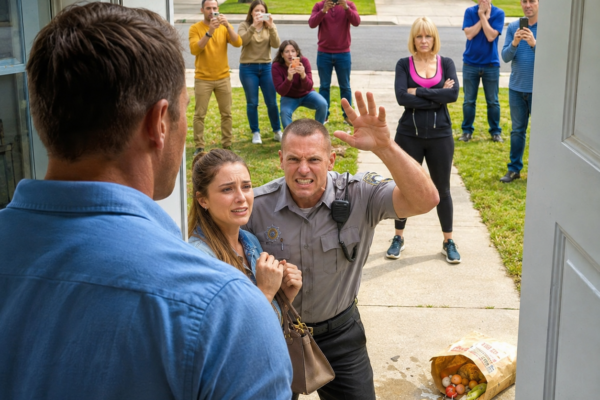
HOA Karen Set Fire to My Corn Harvest — Then Firefighters Came to Her Door.
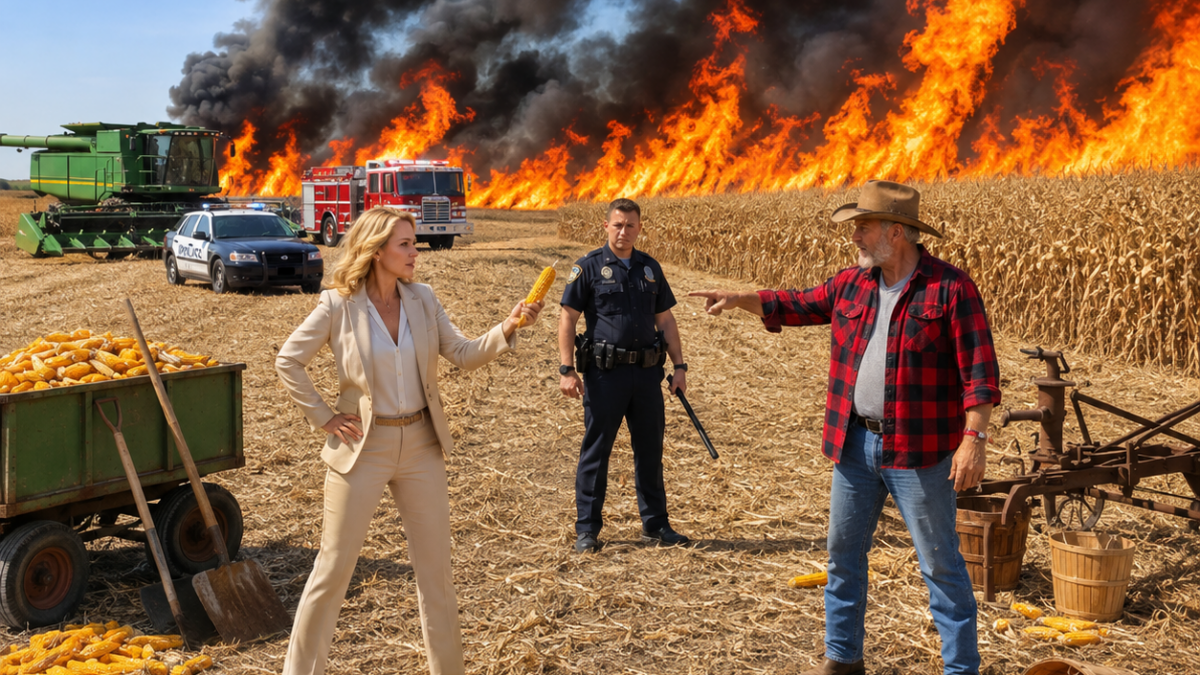
HOA Karen Set Fire to My Corn Harvest — Then Firefighters Came to Her Door.
My eighteen-year-old daughter stood barefoot on our front porch, holding her college acceptance letter as firefighters worked to save the field my grandfather had planted for decades.
Across the property line, our neighbor, Brenda Hartwell, was arguing with the fire chief about why his crew needed to inspect her backyard.
“That farm has been a safety problem for years,” she insisted.
Fire Chief Morrison glanced toward our barn, then back at her house.
“Mrs. Hartwell, that’s not what I’m asking you.”
Her expression changed.
My name is Charlie Fieldstone. I’m a third-generation Ohio farmer, an Army veteran, and the father of twin daughters who were supposed to begin college that fall.
Sarah wanted to become a veterinarian. Emma dreamed of studying engineering.
My wife, Denise, taught third grade, and between her salary and our harvest income, we’d spent years putting together enough money to help our girls pursue their dreams.
That field was more than eight acres of farmland.
It was our family’s future.
Brenda had moved into the neighboring subdivision three years earlier. As an HOA representative and local real estate agent, she repeatedly complained about our tractors, our barn, and even the appearance of our cornfields.
Our farm wasn’t part of her HOA. My grandfather had purchased the land in 1953, decades before her neighborhood existed.
But explaining that hadn’t stopped the letters, complaints, or unexpected county inspections.
Then came the fire.
Emma stood beside her sister, staring at the smoke drifting above the field.
“Dad, what happens to college now?”
I opened my mouth, but nothing came out.
Denise wrapped an arm around both girls.
“We’ll figure it out together.”
She was trying to sound certain. I could see her fingers trembling.
A sheriff’s deputy approached our porch and asked whether our property cameras had been working that evening.
I nodded and handed him the recordings we’d already saved.
Meanwhile, our elderly neighbor, Harold, walked toward us carrying a worn brown envelope.
He looked at the damaged field and lowered his head.
“Charlie, I’m sorry I didn’t bring this to you sooner.”
Inside were documents concerning a proposed housing development on our land.
Denise unfolded the first page beneath the porch light, and for the first time that night, I understood why Brenda had been so determined to make us leave.
[END OF FACEBOOK CAPTION]
[FIRST COMMENT / FULL STORY CONTINUATION]
The document showed a drawing of thirty-two townhomes arranged along two curved streets.
There were little green circles representing trees, neatly outlined parking spaces, and a landscaped entrance with a decorative stone sign.
The name printed across the top was Fieldstone Commons.
I stared at it.
They had used my family’s name.
They had drawn houses over the ground where my grandfather had taught me to plant corn, where my father had worked until his knees gave out, and where my daughters had spent their childhoods chasing fireflies.
And nobody had asked us a single question.
“Where did you get this?” Denise asked.
Harold removed his glasses and wiped them with the corner of his shirt.
“Brenda gave copies to several people at a neighborhood meeting. She said the development was practically approved.”
“Approved by whom?”
He shook his head.
“She made it sound like you’d already agreed to sell.”
I looked toward the field.
Firefighters were still working along the damaged section of the property. Their lights flashed against the side of our barn.
“I haven’t agreed to sell anything.”
“I know that, Charlie.”
Harold’s voice broke.
“That’s why I kept the papers.”
Denise turned to the second page.
It contained a proposed construction schedule and a statement describing our farm as property expected to become available for redevelopment.
There was a projected acquisition price.
Two million eight hundred thousand dollars.
My wife read the number twice.
Then she looked at me.
Neither of us spoke.
From the neighboring property, we heard Brenda’s voice rise again.
“This is completely unnecessary. I have guests coming tomorrow.”
Fire Chief Morrison remained beside her back steps.
“Ma’am, we’re checking properties along the affected boundary. We’ll be finished as soon as we can.”
Brenda crossed her arms.
She looked toward our porch and saw Harold standing with us.
Then she noticed the documents in Denise’s hands.
For several seconds, she didn’t move.
Her attention shifted from Harold to me, then back to the papers.
She stopped arguing with the firefighters.
And quietly went inside her house.
My grandfather bought our farm in 1953.
His name was Walter Fieldstone.
He was twenty-seven years old, newly married, and had exactly one good suit, which he wore to church, funerals, and the bank.
According to my grandmother, he bought the original eight acres from a man who wanted to retire and move closer to his children.
The property didn’t have much.
A small farmhouse.
An aging barn.
A shallow well.
And soil that Grandpa described as being good enough to make an honest living if a man was willing to work.
He was willing.
There are photographs of him standing beside his first tractor, wearing overalls and a smile so wide you can almost hear him laughing.
My father inherited that tractor, although he eventually replaced it with a newer John Deere.
When I was eleven, Dad taught me how to check the oil.
When I was fourteen, he let me drive it across the empty field.
When I was eighteen, I announced that I was joining the Army.
He didn’t argue.
He just stood beside the barn, rubbing his hands together.
“You’ll come back when you’re ready,” he said.
I thought he was disappointed.
Years later, I understood that he was trying not to cry.
I spent nearly twenty years in uniform.
I saw places I’d never imagined visiting and learned things about myself that I sometimes wished I hadn’t learned.
Through all of it, there was one place I pictured whenever somebody asked me where home was.
Not the farmhouse exactly.
Not the barn.
The field.
That long stretch of ground beneath the Ohio sky, with corn moving in the wind and my father’s tractor disappearing toward the tree line.
When I returned home for good, Denise was waiting for me.
We’d met before my second deployment.
She was teaching elementary school, and I was visiting my parents for Christmas.
My mother introduced us at a church dinner.
Denise spilled cranberry sauce on my shirt.
I made a terrible joke about it.
She laughed anyway.
Two years later, we were married.
Then came Sarah and Emma.
Twins.
Seven minutes apart.
Completely different personalities.
Sarah rescued injured birds, named every stray cat, and once brought a frightened turtle into our kitchen because she thought it looked lonely.
Emma took apart a perfectly good alarm clock when she was nine because she wanted to understand how the numbers changed.
She never managed to put it back together.
But she kept trying.
Watching those girls grow up on the farm was the greatest privilege of my life.
I never imagined that someday their futures would become part of a dispute over the land beneath their feet.
The subdivision appeared gradually.
First came the survey crews.
Then the heavy equipment.
Then the roads.
A developer bought the neighboring property after its elderly owner passed away.
Within three years, the fields surrounding ours had become a neighborhood called Whispering Oaks Estates.
There were large homes with attached garages, carefully landscaped yards, and decorative mailboxes.
Most of the people who moved there were decent.
Some brought their children over to see our chickens.
Others bought sweet corn from our roadside stand.
One young father asked whether his son could watch me repair a tractor.
I was happy to oblige.
I understood why people wanted to live in the countryside.
It was beautiful.
What I didn’t understand was why some of them seemed surprised that the countryside contained farms.
The earliest complaints were minor.
A neighbor asked if I could avoid starting the tractor before seven on Saturday mornings.
I agreed when the weather allowed.
Another mentioned dust drifting toward her patio.
I adjusted where I drove whenever I reasonably could.
Denise believed in being considerate.
So did I.
We weren’t interested in making life difficult for anybody.
Then Brenda Hartwell moved into the house directly behind our eastern field.
She introduced herself one spring afternoon.
I was repairing a fence when she appeared beside our driveway wearing white trousers and carrying a clipboard.
“Mr. Fieldstone?”
“That’s me.”
“I’m Brenda Hartwell. I’m with the Whispering Oaks HOA.”
I offered my hand.
She shook it briefly.
“I wanted to discuss a few community concerns.”
“What kind of concerns?”
She looked toward the tractor parked beside our barn.
“Equipment visibility, mostly.”
I followed her gaze.
The tractor was older than she was.
My father had maintained it meticulously.
I’d spent hundreds of hours on it.
“What about it?”
“It’s visible from several homes.”
I waited for the rest of the explanation.
There wasn’t one.
“It’s a tractor,” I said.
“Yes. I understand that.”
She smiled.
“But we have to consider the appearance of the neighborhood.”
I glanced around my property.
“Well, this is a farm.”
Her smile faded slightly.
“Of course. But the area is changing.”
I set my hammer down.
“Not this part.”
She handed me a printed copy of the subdivision’s exterior appearance guidelines.
I looked at the pages.
Then I handed them back.
“We’re not in your HOA.”
“That doesn’t mean you aren’t affected by community expectations.”
“It means those rules don’t apply to my property.”
Her expression became noticeably cooler.
“Good neighbors make adjustments, Mr. Fieldstone.”
“I’ve made plenty.”
She glanced toward the barn again.
“Perhaps we can revisit this conversation.”
She walked away.
At dinner that evening, I told Denise about the encounter.
She continued cutting her chicken.
“Maybe she’s just enthusiastic.”
“About tractors?”
“About being in charge.”
Emma laughed.
Sarah shook her head.
“Wait until she meets Hannibal.”
Hannibal was our rooster.
He had strong opinions about visitors and absolutely no respect for neighborhood quiet hours.
We laughed about Brenda that night.
I wish laughing had remained the only thing we ever needed to do.
Two weeks later, a real estate flyer appeared in our mailbox.
Denise brought it inside with the groceries.
“Have you seen this?”
It advertised a home for sale in Whispering Oaks Estates.
The photograph showed a large patio overlooking our cornfield.
Beneath the image was a paragraph describing the neighborhood’s expanding residential opportunities.
One sentence caught Denise’s attention.
Future development anticipated on adjacent agricultural property.
I read it twice.
“That’s our land.”
“I know.”
“Who told them we’re developing it?”
Denise turned over the flyer.
Brenda’s photograph appeared beside her real estate office information.
I reached for my phone.
Denise stopped me.
“Before you call her, let’s ask the county.”
The next morning, I contacted the planning office.
A woman named Margaret told me there were no approved residential development plans for our parcel.
No pending zoning application had been filed by us.
And no one could represent our consent without actual authorization.
“Could somebody have made preliminary inquiries?” I asked.
“Certainly. People ask about possible development all the time.”
“But that’s different from an approved project?”
“Very different.”
I thanked her.
Then I called Brenda.
She answered with the cheerful voice she probably used when showing houses.
“Charlie! What can I do for you?”
I told her about the flyer.
“Oh, that’s general marketing language.”
“It refers to my property.”
“It’s simply acknowledging the area’s growth.”
“My land isn’t for sale.”
There was a brief pause.
“Have you considered what it might be worth?”
“No.”
“You might be surprised.”
“I’m not interested.”
“People say that until they see the numbers.”
I gripped the phone.
“Please remove any suggestion that my property is available for development.”
She gave a light laugh.
“You’re taking this very personally.”
“It is personal. I own it.”
She ended the conversation shortly afterward.
That evening, I saved the flyer in a drawer.
I didn’t yet realize it would become the first document in a collection that would eventually fill several boxes.
The first serious damage occurred in July.
It was a hot morning.
I walked out to inspect the irrigation equipment and discovered that part of the system had been damaged overnight.
Water had collected where it shouldn’t have.
Several rows weren’t receiving what they needed.
I stood there for a long time, looking at the damage.
Farm equipment breaks.
Anyone who has worked the land knows that.
But this didn’t resemble ordinary wear.
I photographed everything before making repairs.
Then I called the sheriff’s department to file a report.
A deputy came out, took notes, and explained that without additional evidence, determining who was responsible would be difficult.
I understood.
I still felt frustrated.
By noon, I’d spent several hundred dollars on replacement materials.
By evening, my shirt was soaked with sweat and my lower back hurt.
Denise brought me a glass of water.
“How bad?”
“Fixable.”
“Any idea who did it?”
I looked toward Brenda’s house.
Denise followed my gaze.
“Charlie.”
“I didn’t say anything.”
“You didn’t have to.”
I took a drink.
“Funny timing.”
“It is.”
She waited.
“But timing isn’t proof.”
I knew she was right.
I hated that she was right.
The following weekend, we installed ordinary security cameras covering our barn, driveway, and equipment storage areas.
I didn’t want cameras overlooking anybody’s private yard.
I wanted to know what happened on ours.
It seemed like a sensible precaution.
At the time, I still believed whoever damaged the irrigation equipment would move on once they realized we were paying attention.
Instead, the complaints increased.
Fire Marshal Dave Peterson arrived on a Tuesday afternoon.
His county vehicle rolled into the driveway while I was cleaning tools.
Dave had inspected our farm before.
We knew each other well enough to talk about weather and baseball.
This time, he looked uncomfortable.
“Charlie, I’ve got a complaint I need to investigate.”
“About what?”
“Unauthorized agricultural burning.”
I stared at him.
“We haven’t burned anything since spring.”
He nodded.
“That’s what I figured.”
He opened a folder and showed me several photographs.
They appeared to show smoke rising behind our property.
I recognized the tree line immediately.
“That’s Tom Henderson’s place.”
Dave looked at the photograph.
“You sure?”
“Absolutely. That’s his grain storage building over there.”
I pointed to the corner of the image.
“He’s almost three miles away.”
Dave examined it more closely.
Then he sighed.
“Mind if I look around anyway?”
“Go ahead.”
He reviewed our existing records, inspected the relevant areas, and found no evidence supporting the complaint.
Before he left, he leaned against his truck.
“I’ll document what I found.”
“Can you tell me who reported it?”
“Not right now.”
I nodded.
He closed his folder.
“Charlie, sometimes people make honest mistakes.”
“Sure.”
“But if you start receiving a lot of complaints that don’t make sense, keep records.”
I looked at him.
“You think this was deliberate?”
“I think you should keep records.”
He climbed into his truck.
That afternoon, I bought a notebook.
On the first page, I wrote the date and the words:
Fire inspection. No violation found.
I left several lines underneath.
I would need them.
My daughters noticed the changes before I realized how obvious they’d become.
One evening, Emma came into the barn while I was checking a piece of equipment.
She stood beside the workbench, holding a college financial aid packet.
“Dad?”
“What’s up?”
“Can we talk about the tuition deposit?”
I set down my wrench.
“Of course.”
She handed me the packet.
I’d already reviewed the numbers with Denise.
The girls had scholarships and some financial aid, but there was still a considerable amount for us to cover.
We had savings.
Denise’s salary helped.
And our harvest income was an important part of the plan.
It wasn’t going to be easy.
But we’d worked out a budget.
Emma watched me read the document.
“If it’s too much, I can start at community college.”
I looked up.
“Why are you saying that?”
She shrugged.
“I know you’ve had some unexpected expenses.”
“That’s farm business.”
“It’s still money.”
I folded the packet.
“Emma, your mom and I have been saving for this since before you knew how to spell college.”
She smiled weakly.
“I just don’t want you worrying.”
I looked at my daughter.
She was eighteen, standing on the edge of everything she’d spent years working toward.
And instead of being excited, she was calculating whether her education might be too expensive for her parents.
I put an arm around her.
“You focus on school. Let us handle the rest.”
She rested her head briefly against my shoulder.
“Okay.”
But as she walked away, I knew she wasn’t entirely convinced.
Neither was I.
Harold Grayson had lived on the adjoining road longer than nearly anyone else.
He was seventy-five.
A retired postal worker.
His wife, Helen, had passed away the previous spring.
Since then, he’d developed a habit of taking long walks in the evening.
Sometimes he stopped beside our fence and talked while I worked.
He knew every family that had lived nearby.
He remembered my grandfather.
He remembered my father.
He even remembered the time I accidentally drove Dad’s tractor into a muddy ditch and needed three neighbors to pull it out.
“Still don’t know how you managed that,” he’d tease.
One Thursday evening, he came to the fence without his usual smile.
“Charlie, got a minute?”
“Always.”
He looked toward the subdivision.
“That Hartwell woman came to my house yesterday.”
I set down the board I was holding.
“What’d she want?”
“Asked if I’d noticed any unsafe activity on your farm.”
“Have you?”
He gave me a flat look.
“Only your driving.”
I laughed.
He didn’t.
“She wanted to know when you’d be away. Whether you left equipment unattended. Whether I’d ever smelled anything unusual.”
My smile disappeared.
“Why?”
“She said the neighborhood was gathering information for a safety review.”
He rubbed the fence rail with his thumb.
“Then she offered to compensate me for documenting concerns.”
“Compensate you?”
“Five hundred dollars, depending on what information I could provide.”
I stared at him.
“What did you say?”
“I told her I’ve spent forty years delivering other people’s mail, and I wasn’t about to spend retirement making up stories.”
I looked toward Brenda’s house.
Harold spoke again.
“Helen loved this farm, Charlie.”
His voice softened.
“She used to sit on our porch when your dad was working. Said the sound of that tractor made her feel like the world was still in its proper place.”
He swallowed.
“I don’t want trouble. But I thought you ought to know.”
I nodded.
“Thank you.”
He placed a hand on my shoulder.
“Your grandfather would’ve done the same for me.”
After he left, I stood beside the fence until the sky grew dark.
Then I went inside and added another entry to my notebook.
Denise suggested calling Jake Thornfield.
Jake was an attorney who handled agricultural property matters.
We’d served together years earlier, before he’d left the military and gone to law school.
He was the sort of friend who could disappear for six months, call on a random Tuesday, and immediately pick up a conversation where we’d left it.
When I explained the situation, he didn’t laugh.
He asked questions.
“Are you actually subject to their HOA?”
“No.”
“Any recorded restrictions benefiting the subdivision?”
“Not that I’m aware of.”
“Have they filed anything against your property?”
“Not yet.”
“Have you saved the correspondence?”
“Denise has.”
“Good. Keep doing that.”
I told him about the flyer, the damaged irrigation system, the fire complaint, and Harold’s conversation with Brenda.
Jake remained quiet for several seconds.
“Charlie, I want you to be careful about connecting things before there’s evidence.”
“Everybody keeps telling me that.”
“Because it’s important.”
He explained that complaints, even irritating ones, weren’t necessarily unlawful.
People had the right to report legitimate concerns.
The question was whether someone was knowingly misrepresenting facts or interfering with our property and business.
“Don’t get pulled into confrontations,” he said.
“Don’t make threats. Don’t assume every inspection is part of a scheme.”
“What am I supposed to do?”
“Run your farm. Document what happens. Let me review your property records.”
I sighed.
“That’s not exactly satisfying.”
“Most useful legal advice isn’t.”
Before hanging up, Jake asked a final question.
“Has anybody actually offered to buy the land?”
“Not formally.”
“Tell me when they do.”
Two days later, an envelope arrived from a development company.
Inside was an expression of interest in purchasing our entire property.
The proposed price was more money than Denise and I had ever imagined possessing.
And Brenda Hartwell’s name appeared as the local real estate contact.
We sat at the kitchen table that evening.
The offer lay between us.
Emma was upstairs.
Sarah was working an evening shift at a veterinary clinic.
Denise read the letter carefully.
“Two point eight million.”
I nodded.
For a while, neither of us spoke.
That kind of money could change a family’s life.
We could pay both girls’ college expenses.
Retire our remaining mortgage.
Replace the old pickup truck.
Buy a smaller property somewhere quiet.
I could stop worrying about equipment repairs and unpredictable harvests.
Denise looked at me.
“What are you thinking?”
“That Grandpa would’ve fallen out of his chair.”
She smiled.
“Probably.”
I leaned back.
“We’re not selling.”
She nodded slowly.
Then she surprised me.
“Can we at least talk about it?”
I looked at her.
“What’s there to talk about?”
“Charlie, it’s a lot of money.”
“I know what it is.”
“We have two children starting college.”
“I know that too.”
She folded her hands.
“I’m not saying we should accept it. I’m saying we’re married, and a decision this big deserves a conversation.”
I felt defensive.
The land had always been something I considered nonnegotiable.
My father’s land.
My grandfather’s land.
Our family’s land.
I hadn’t thought about what it meant that Denise’s family hadn’t owned it for generations.
She had married into its responsibilities.
The early mornings.
The difficult seasons.
The financial uncertainty.
She had taught school all day and helped with bookkeeping at night.
She’d spent summers preparing the roadside stand and freezing vegetables.
She’d postponed vacations when equipment failed.
And now I was treating a decision that affected her future as though it belonged to me alone.
I looked down.
“You’re right.”
She reached across the table.
“I love this place, Charlie.”
“I know.”
“But I want us to stay because we choose to. Not because you’re afraid your grandfather would be disappointed.”
That sentence hurt.
Mostly because it was true.
I stood and walked to the window.
Beyond the glass, corn moved gently in the evening wind.
After a while, Denise came beside me.
“Do you want to leave?” I asked.
She shook her head.
“No.”
I looked at her.
“Really?”
“Really.”
She slipped her hand into mine.
“But I needed you to ask.”
We stood there together.
Then we returned to the kitchen and wrote a polite refusal.
The property was not for sale.
We both signed it.
Brenda visited the following afternoon.
She stood near the porch wearing a pale blue blouse and holding a leather folder.
“I understand you’ve received the proposal.”
“We declined it.”
“Without negotiating?”
“We’re not interested.”
She looked genuinely confused.
“Charlie, do you understand what they’re offering?”
“Yes.”
“It’s an extraordinary opportunity.”
“I appreciate that.”
“You could move anywhere.”
“I don’t want to move anywhere.”
She glanced toward the farmhouse.
“You can’t possibly believe this is the best use of eight acres in a growing residential area.”
Denise stepped outside.
“That depends on what you value.”
Brenda turned toward her.
“Denise, surely you understand the financial benefits.”
“I understand them.”
“Your girls are going to college.”
My wife became very still.
“That’s our private business.”
Brenda gave a practiced smile.
“I’m simply saying this could make their lives much easier.”
Denise stepped down from the porch.
“Please don’t use our daughters to negotiate with us.”
Brenda looked between us.
For the first time, her professional composure slipped.
“Sometimes people hold on to things long after they stop making sense.”
I looked at the barn.
“Sometimes people have reasons you don’t understand.”
She closed her folder.
“Well, the offer won’t remain available forever.”
“That’s fine.”
She walked toward her car.
Before getting in, she turned back.
“I hope you don’t regret this.”
Denise waited until Brenda drove away.
Then she looked at me.
“I didn’t like that.”
“Neither did I.”
She crossed her arms.
“Especially the part about the girls.”
That evening, we told Sarah and Emma about the offer.
We wanted them to understand what was happening without hearing distorted versions from other people.
Sarah asked whether we would ever consider selling.
Emma asked whether the money would eliminate our financial worries.
We answered honestly.
It probably would eliminate many of them.
But money wasn’t the only consideration.
Sarah looked around our kitchen.
“I don’t want somebody tearing down the barn.”
Emma nodded.
“Me neither.”
Then she looked at us.
“But I don’t want you keeping the farm just because of us.”
Denise smiled.
“We’re not.”
It was the first time I realized my daughters were becoming adults in ways that had nothing to do with their birthdays.
They were beginning to understand that every important choice came with a cost.
By August, Brenda had organized what she called a Neighborhood Safety Committee.
Several subdivision residents participated.
Some were genuinely concerned about unfamiliar aspects of farming.
Others seemed to enjoy the attention that came with carrying clipboards.
They photographed our barn from the road.
They documented our tractor movements.
They complained about dust, equipment noise, and agricultural odors.
One woman named Janet Kowalski appeared near our fence on a Monday morning.
She was taking photographs when I walked over.
“Morning, Janet.”
She jumped.
“Oh. Hello, Charlie.”
“Everything okay?”
“Just gathering information.”
“About what?”
She glanced at her phone.
“There are concerns about the equipment storage.”
“Specific concerns?”
She hesitated.
“I don’t know exactly. Brenda asked us to document things.”
I looked toward our barn.
“Would you like me to explain how we store everything?”
Her expression softened.
“Actually, I would.”
I showed her the general equipment area from the driveway.
I explained what the various machines did.
She asked sensible questions.
By the time she left, she seemed embarrassed.
“I didn’t realize how much work goes into this.”
“Most people don’t.”
She looked toward the subdivision.
“Brenda said you were refusing to cooperate.”
“We’ve tried.”
Janet nodded.
“Maybe I should’ve talked to you first.”
“You’re welcome anytime.”
That evening, Brenda sent a letter accusing me of interfering with committee activities.
I passed it to Denise.
She read it and laughed.
“Apparently, answering questions is interference.”
I wanted to laugh too.
But the growing pile of paperwork was beginning to feel overwhelming.
The farm required my attention.
So did the constant complaints.
I couldn’t afford to give either one everything it demanded.
The county water inspection was the first time I genuinely feared losing the harvest.
Carol Hendricks arrived carrying paperwork concerning reported irregularities in our irrigation usage.
The documents included consumption estimates that were far above what our system normally produced.
She explained that the county needed additional information before the matter could be resolved.
Depending on the findings, temporary restrictions could become necessary.
I felt sick.
We were in the middle of a dry spell.
The corn was already under stress.
“Where did these numbers come from?” I asked.
“I can’t discuss the source of the complaint.”
“Are these actual measurements?”
“That’s what we need to establish.”
I pointed toward the equipment.
“Our system couldn’t reasonably produce the volume they’re claiming.”
Carol studied the papers.
“Then provide the supporting information.”
She wasn’t hostile.
She was doing her job.
But I knew that a bureaucratic misunderstanding could damage a crop just as effectively as bad weather.
After she left, I called Jake.
He recommended an independent assessment and helped us communicate with the appropriate office.
It cost money we hadn’t budgeted.
But the results supported our explanation.
The extraordinary consumption figures did not match the actual system’s capabilities or available usage records.
The county ultimately found no basis for the proposed restrictions.
That should have been good news.
Instead, I felt exhausted.
We’d spent days answering questions about something we hadn’t done.
Meanwhile, the farm still needed work.
The girls still needed tuition money.
And our savings were beginning to shrink.
One afternoon, Denise found me sitting on an overturned bucket beside the barn.
I wasn’t working.
I was staring at the field.
“Charlie?”
I looked up.
She sat on another bucket.
“What happened?”
“Nothing.”
She waited.
I rubbed my face.
“I’m tired of proving I’m allowed to exist.”
Denise didn’t immediately respond.
She looked across the field.
Then she rested her hand on my knee.
“You don’t have to prove that to me.”
I nodded.
For some reason, that nearly made me cry.
The next incident involved damaged corn along the eastern property boundary.
I discovered the plants early one morning.
They were discolored and wilted in a way that didn’t resemble the surrounding crop.
I contacted an agricultural specialist and reported the damage.
Samples were collected.
Photographs were taken.
The preliminary assessment suggested exposure to a chemical that shouldn’t have been there.
This time, our cameras had recorded someone entering the relevant section of the property.
The footage was imperfect.
The lighting was poor.
But the person’s clothing, movements, and vehicle provided investigators with useful leads.
I believed I recognized Brenda.
Denise recognized her too.
Jake cautioned us against making public accusations while the matter was being investigated.
So we provided the original recordings and waited.
The damaged section looked small from the farmhouse.
But when I stood beside it, the loss felt personal.
Every plant represented seed, fertilizer, fuel, labor, and months of attention.
Sarah found me examining the affected rows.
She wore her veterinary clinic sweatshirt.
“Is it bad?”
“Some of these plants won’t recover.”
She crouched beside one.
“Can anything be done?”
“Not for this section.”
She touched a wilted leaf.
“I hate this.”
I looked at her.
“Me too.”
She stood.
“Dad, I can take more shifts at the clinic.”
“No.”
“But—”
“You’re already working enough.”
She crossed her arms.
“You’re not the only person who cares about this family.”
I stared at her.
Then I looked away.
She was right.
My instinct had always been to carry every burden myself.
Protect Denise.
Protect the girls.
Keep the bills paid.
Keep the farm running.
But my daughters were old enough to see what was happening.
And pretending otherwise wasn’t protecting them.
It was excluding them.
“Let’s talk about it with your mom,” I said.
Sarah nodded.
Then she put an arm around my waist.
We stood beside the damaged plants for a while.
Neither of us said anything else.
Harold brought over a newspaper clipping the following weekend.
It concerned a proposed development on the other side of the county.
The article mentioned disputes between developers and several existing property owners.
Nothing established that the project involved unlawful conduct.
But some of the company names were familiar.
One appeared on the offer we’d received.
“Thought you should see it,” Harold said.
I took the clipping.
“Where’d you find this?”
“Library.”
He smiled.
“Some of us still know how to read newspapers that don’t require batteries.”
I laughed.
Then he grew serious.
“Charlie, Brenda’s been telling people the farm is going to become available soon.”
“She’s wrong.”
“I know.”
“Has she said why?”
Harold looked uncomfortable.
“She says you’re under financial pressure.”
I frowned.
“Who told her that?”
“Nobody had to. I think she’s guessing.”
That bothered me more than I wanted to admit.
A person could look at an old tractor, a modest farmhouse, and two daughters preparing for college and assume they understood our finances.
Brenda seemed to have mistaken ordinary financial responsibilities for weakness.
Harold handed me another piece of paper.
It was an invitation to a neighborhood presentation concerning future development opportunities.
The meeting had already occurred.
Harold had attended because several neighbors encouraged him to go.
“They showed pictures,” he said.
“Pictures of what?”
“Possible houses. Roads. Landscaping.”
“On our land?”
He nodded.
“Did they say we had agreed?”
“They made it sound like negotiations were progressing.”
I felt my stomach tighten.
“We refused the offer.”
“I know that, Charlie.”
He looked at the clipping in my hand.
“I think you need to tell your lawyer.”
Jake came to the farmhouse three days later.
He wore a wrinkled suit and carried a briefcase that looked as though it had survived several natural disasters.
Denise offered him coffee.
He accepted immediately.
Then we spread the documents across the kitchen table.
The marketing flyer.
The purchase proposal.
The HOA letters.
The inspection reports.
Photographs of the damaged crops.
Harold’s account of his conversations with Brenda.
Jake read everything carefully.
He didn’t make dramatic promises.
He didn’t tell us Brenda was going to prison.
He didn’t claim we would become wealthy from a lawsuit.
Instead, he separated the documents into several groups.
“These establish your ownership and the absence of the restrictions she’s been asserting.”
He moved another pile.
“These concern statements made about the property’s future availability.”
Then another.
“These involve possible interference with your agricultural operations.”
Finally, he touched the inspection records.
“And these may be relevant if someone knowingly provided misleading information to public authorities.”
I looked at him.
“How much trouble is she in?”
“That depends on what can be proved.”
Denise nodded.
“What should we do now?”
Jake recommended formal notice to Brenda and the development company.
He would make it clear that the land wasn’t available, that we had not authorized any representations concerning its future sale, and that further unsupported claims could have legal consequences.
He also discussed reporting concerns about real estate marketing to the appropriate licensing authorities.
Then he mentioned something neither of us had seriously considered.
“Have you thought about agricultural conservation?”
I leaned forward.
“What do you mean?”
“A conservation easement. There are programs and organizations that work with landowners who want to preserve agricultural land over the long term.”
Denise looked interested.
“Would that stop residential development?”
“Depending on the arrangement, it can permanently restrict certain nonagricultural uses.”
I looked at the window.
“Even after we’re gone?”
“Potentially, yes.”
The idea settled into the room.
For years, I’d wondered what would happen to the farm after I could no longer work it.
I didn’t want to force either daughter into agriculture.
They deserved lives of their own.
But I also didn’t want our family’s history bulldozed simply because we weren’t there to defend it.
Jake held up a hand.
“Don’t rush into anything. These arrangements have significant consequences. You’ll need to understand the restrictions, financial implications, and effect on future owners.”
Denise asked several questions.
I listened.
For the first time in weeks, we were discussing the future of the farm on our terms.
Not Brenda’s.
And that felt good.
We began exploring conservation options.
The process was neither quick nor simple.
There were consultations.
Property records to review.
Questions about eligibility.
Discussions about agricultural use, maintenance responsibilities, and future ownership.
Denise insisted we involve the girls.
One Sunday afternoon, we sat together on the porch.
Jake had provided information explaining the general process.
Emma read it first.
“So if you do this, somebody can’t just buy the farm and build houses?”
“That’s the idea,” I said.
“Depending on what the final agreement permits.”
Sarah looked thoughtful.
“What if neither of us becomes a farmer?”
Denise answered before I could.
“Then the property could eventually belong to someone else who wants to use it appropriately.”
Sarah looked at me.
“Would that upset you?”
I thought about it.
Once, it would have.
I’d imagined the farm passing directly to my daughters.
Then to their children.
But imagining a future for somebody didn’t give me the right to demand it.
“No,” I said finally. “I don’t want either of you feeling trapped here.”
Emma looked surprised.
“Really?”
“Really.”
I smiled.
“Your grandfather told me I could leave when I joined the Army. I figure you deserve the same freedom.”
Sarah leaned back.
“I’d still like to come home.”
“You always can.”
She smiled.
Emma returned to the information.
“Could I do engineering projects here someday?”
“I hope so.”
She looked toward the old barn.
“There’s a lot of equipment that could use improving.”
I laughed.
“Try telling your grandfather that.”
Denise squeezed my hand.
We didn’t make a final decision that afternoon.
But all four of us agreed to continue exploring the option.
Whatever happened, the decision would belong to our family.
Unfortunately, Brenda had no intention of respecting that decision.
Her complaints became more aggressive after Jake’s formal letter arrived.
She circulated a neighborhood statement describing the farm as an obstacle to residential improvement.
She implied that several unresolved safety issues threatened nearby homeowners.
Some residents believed her.
Others began asking questions.
Janet came to our house one evening.
She held a copy of the neighborhood statement.
“Charlie, can I ask you something?”
“Sure.”
“Is any of this true?”
I read the paper.
Several claims referred to inspections that had already concluded without findings supporting the complaints.
I invited her inside.
Denise showed her the relevant documents.
Janet looked increasingly uncomfortable.
“Brenda told us the county was considering shutting down your operation.”
“That isn’t what these records say,” Denise replied.
Janet read the water assessment again.
Then she looked at me.
“I took pictures for her.”
“I remember.”
“She gave me a gift card.”
I waited.
“She said the committee appreciated my help.”
Denise asked whether Janet still had any written instructions she’d received.
Janet nodded.
“Emails.”
“Would you be comfortable sharing those with our attorney?”
She hesitated.
“What if I get in trouble?”
“We can’t promise anything,” Denise said. “You should make your own decision, and you can seek independent advice if you’re worried.”
Janet looked down at the papers.
“I don’t want to be part of something dishonest.”
She stayed for coffee.
Before leaving, she apologized.
Not dramatically.
Not with tears.
She simply said she should have asked more questions.
I appreciated that.
I also appreciated what it meant.
People were beginning to realize that Brenda’s version of events wasn’t the only one.
The girls’ departure for college was getting closer.
Their bedrooms filled with cardboard boxes.
Sarah labeled hers carefully.
Emma labeled nothing and insisted she knew where everything was.
Denise bought towels, laundry detergent, and two inexpensive desk lamps.
Every purchase reminded us of the financial pressure we were under.
One evening, I discovered Sarah sitting on the kitchen floor surrounded by papers.
She was comparing housing costs.
“What’re you doing?”
“Trying to figure out whether I can get a cheaper room.”
I sat beside her.
“Your housing is arranged.”
“I know.”
She looked toward the stairs.
“Emma and I talked.”
“About?”
“Taking out more loans.”
I felt my chest tighten.
“We have a plan.”
“Dad, plans change.”
She said it kindly.
That made it worse.
“We know what the farm’s been dealing with,” she continued.
“We don’t want you and Mom using every dollar you have just to keep us from borrowing money.”
I looked at her financial aid papers.
Then at the little girl I could still remember carrying a cardboard box full of kittens.
“I’m supposed to help you get started.”
“You are helping.”
“Not enough.”
Sarah took my hand.
“Dad, you taught me how to work. How to take care of things. How to keep going when something doesn’t work out.”
She smiled.
“That’s a pretty good start.”
I looked away.
For years, I’d measured fatherhood partly by what I could provide.
A safe home.
A reliable car.
Money for school.
The idea that I might not be able to give my daughters everything I’d promised felt like failure.
Sarah seemed to understand.
She rested her head against my shoulder.
“We’ll be okay.”
I wanted to believe her.
That evening, I told Denise about the conversation.
She listened.
Then she said, “You know what scares me?”
“What?”
“Not the girls needing loans.”
She looked toward the staircase.
“I’m scared they’ll think their dreams are something they have to apologize for.”
I nodded.
“We can’t let that happen.”
“No,” she said. “We can’t.”
Several days before the fire, Harold came to our farmhouse with a worried expression.
He sat at the kitchen table and refused the coffee Denise offered.
That alone told me something was wrong.
“Charlie, Brenda’s under a lot of pressure.”
“From whom?”
“The development people.”
He explained that he’d overheard part of a conversation during a neighborhood gathering.
Brenda was discussing deadlines.
There appeared to be financial obligations associated with her work on the proposed project.
She had expected substantial compensation if the acquisition succeeded.
But the property wasn’t available.
And the deadline she’d been discussing was approaching.
“How do you know this?” Denise asked.
“She was talking loud enough for half the room to hear.”
He rubbed his hands together.
“She said your refusal was going to cost her everything.”
I looked at Denise.
Harold continued.
“I think she’s borrowed money expecting that deal to happen.”
“That’s not our responsibility,” I said.
“I know.”
He looked frightened.
“But I’m worried she doesn’t see it that way.”
Jake later advised us to treat Harold’s information seriously without assuming every detail was accurate.
We informed the appropriate authorities about the growing concerns.
We reviewed our property security.
And we made sure the family understood what to do if anything suspicious happened.
There would be no confrontation.
No attempt to catch anybody ourselves.
No effort to turn our property into some kind of trap.
I had spent enough years in the military to understand the difference between being prepared and deliberately putting people in danger.
My family’s safety mattered more than evidence.
More than the harvest.
More than the farm itself.
I wish I could say those precautions prevented what happened next.
They didn’t.
But they helped us respond when it mattered.
The night of the fire was supposed to be quiet.
Denise had made spaghetti.
Emma was sitting at the kitchen table checking her class schedule.
Sarah had brought home a college acceptance packet she’d been using to organize her enrollment documents.
I was washing dishes.
A baseball game played softly on the radio.
Nothing unusual.
Nothing that suggested our lives were about to change.
Then Emma looked toward the window.
“What’s that?”
I dried my hands.
“What?”
“Outside.”
A strange glow was visible beyond the eastern field.
For a second, I couldn’t understand what I was seeing.
Then I smelled smoke.
“Denise, call the fire department.”
My voice sounded unfamiliar.
I told the girls to stay away from the field and move toward the safe side of the house.
Denise was already speaking with emergency services.
We followed the dispatcher’s instructions and waited for responders.
Those minutes felt endless.
I could see smoke rising above the corn.
The wind carried the smell across our property.
Sarah appeared beside her mother, still holding the papers she’d been sorting.
Emma stood near the porch steps.
Neither girl spoke.
I wanted to do something.
Anything.
But rushing into the field would have created another emergency.
So I stayed with my family.
When the fire trucks arrived, the sight of them brought an enormous sense of relief.
Chief Danny Morrison coordinated the response.
His crews worked to contain the fire and protect nearby structures.
Other responders checked the surrounding properties.
We moved where they instructed us.
Nobody in our family was injured.
That was the most important fact of the evening.
But as I stood watching the firefighters, I couldn’t stop thinking about the months of work disappearing before us.
I remembered planting those rows in spring.
Checking the growth through early summer.
Worrying about rain.
Doing the calculations for tuition.
And now part of that harvest was gone.
I heard Emma ask the question I’d been trying not to think about.
“Dad, what happens to college now?”
I couldn’t answer her.
Denise pulled both girls close.
“We’ll figure it out together.”
Then Harold arrived with the envelope.
And the development proposal showed us what somebody else had imagined for the land we were watching burn.
Firefighters remained on the property until they were satisfied the immediate danger had passed.
The following morning, the affected section looked unfamiliar.
Darkened ground.
Damaged stalks.
A thin layer of residue across parts of the field.
The air smelled different.
I stood at the edge, holding a cup of coffee I hadn’t touched.
Nearly three acres had been affected.
Some areas were completely lost.
Other sections would need professional assessment before we knew whether anything could be salvaged.
Denise came beside me.
“Did you sleep?”
“A little.”
She gave me a look.
“Charlie.”
“Not much.”
She took my coffee and handed me a fresh one.
I stared across the field.
“I planted this section with Dad’s old tractor.”
“I know.”
“Emma helped me.”
“I remember.”
My throat tightened.
“I don’t know what we’re going to do.”
Denise stood quietly beside me.
Then she said, “We’ll find out what insurance covers. We’ll talk to the college financial aid offices. We’ll adjust.”
I shook my head.
“We shouldn’t have to.”
“No.”
She reached for my hand.
“But we do.”
A county investigator arrived later that morning.
The fire’s cause required a formal investigation.
Evidence was collected.
Our camera recordings were preserved.
Witnesses were interviewed.
We answered questions and provided the documentation we’d accumulated.
The investigator asked about previous disputes.
I mentioned Brenda.
But I also told him I hadn’t personally witnessed anyone start the fire.
I didn’t want anger turning into an unsupported statement.
He nodded.
“That’s helpful. Tell us what you know. We’ll work on establishing the rest.”
It wasn’t a satisfying answer.
But it was the right one.
The footage became an important part of the investigation.
Our cameras had recorded activity near the farm boundary before the fire was discovered.
Another neighbor’s camera captured relevant vehicle movements.
Additional information came from witnesses who had seen people near the affected area.
No single recording told the entire story.
Investigators had to compare the footage, physical evidence, statements, and other records obtained through the proper legal process.
During the following days, Brenda was interviewed.
So was a man named Rick Paulson, whom she’d hired to gather information concerning the farm.
We knew very little about him.
Harold had heard his name mentioned during a neighborhood meeting.
Janet remembered him attending a committee gathering.
He had been described as a professional investigator.
Exactly what he’d been hired to do became one of the questions authorities examined.
Meanwhile, Brenda told several neighbors she had nothing to do with the fire.
She suggested our equipment might have been responsible.
That possibility was investigated.
But as the examination progressed, the findings increasingly pointed toward a deliberately set fire.
I learned that information from Jake after investigators had reached preliminary conclusions.
I sat down at our kitchen table.
“Someone actually did this?”
He nodded.
“That’s what the evidence is indicating.”
For weeks, I had suspected that Brenda wanted to drive us off the property.
But suspicion had allowed room for uncertainty.
I could still tell myself I was misreading things.
That the complaints were coincidental.
That the vandalism was unrelated.
That somebody would eventually explain everything.
Now I was looking at the damaged field outside our window.
And I knew someone had been willing to put our home, our neighbors, and our family at risk.
Denise sat beside me.
She looked at Jake.
“What happens now?”
“Investigators continue their work.”
“And us?”
Jake closed his folder.
“You take care of yourselves.”
Brenda’s reaction to the firefighters at her house became a subject of conversation around the neighborhood.
Some residents claimed she’d been furious.
Others said she’d been frightened.
Harold told us she appeared particularly distressed when she realized responders were examining the properties bordering the affected field.
But fear and anger weren’t evidence of guilt by themselves.
People become upset during emergencies.
Investigators understood that.
What mattered were the inconsistencies that emerged afterward.
Brenda initially gave an account of her evening that placed her away from the relevant area.
Certain records did not support that account.
Rick Paulson provided statements that differed from hers.
Further investigation uncovered communication concerning the farm, the acquisition deadline, and actions intended to put pressure on us.
Some of the messages were deeply troubling.
They indicated that the financial consequences of a failed development agreement had become a major concern.
Investigators also examined whether earlier property damage was connected to the same individuals.
The process took time.
During that time, Brenda remained in her house.
She occasionally appeared in the yard.
Her car still came and went.
People in the neighborhood began avoiding conversations with her.
Not everyone.
But enough that the difference was noticeable.
One afternoon, I saw her standing near the fence.
She looked toward the damaged field.
For a moment, I considered walking over.
I wanted to ask how anyone could look at something that had taken months to grow and decide it was acceptable to destroy it.
I wanted to tell her what she’d done to Sarah and Emma.
I wanted answers.
Instead, I returned to the barn.
There were investigators handling the matter.
There were attorneys.
There would be opportunities for the facts to be addressed.
Nothing useful would come from me confronting her across a fence.
That was one of the hardest decisions I’d made.
The financial aftermath began almost immediately.
An insurance representative arrived to assess the loss.
Our coverage was not as simple as I’d imagined.
Different portions of the property and agricultural operation were protected under different terms.
Some losses were covered.
Others required additional documentation.
Certain expenses would not be reimbursed.
There were deductibles, exclusions, and calculations.
I spent hours locating receipts and reviewing records.
Denise handled calls between school responsibilities.
She made lists of outstanding expenses.
We adjusted our budget.
The girls offered to help wherever they could.
Then the first tuition deadlines arrived.
I remember sitting at our kitchen table with the insurance documents on one side and the college bills on the other.
Denise was beside me.
The numbers didn’t match the plan we’d made in spring.
“We can cover the first semester,” she said.
“Then what?”
“We’ll keep working on it.”
I rubbed my forehead.
“We promised them.”
“We promised to help them.”
“That’s not what I wanted.”
Denise closed the notebook.
“Charlie, look at me.”
I did.
“Our daughters are going to college. Whether we pay every dollar ourselves or they need additional assistance doesn’t change that.”
I stared at the papers.
“I don’t want them starting life in debt because somebody destroyed our harvest.”
“Neither do I.”
She placed her hand over mine.
“But feeling guilty won’t bring the crop back.”
I knew that.
I simply didn’t know how to stop feeling guilty.
The most difficult moment came when Emma found me in the barn one evening.
I was sitting beside Grandpa’s old tractor.
The lights were off except for the one above the workbench.
Emma leaned against the doorway.
“You missed dinner.”
“Wasn’t hungry.”
She came inside.
“Mom made pot roast.”
“I’ll have some later.”
She looked at me.
Then she sat on the tractor step.
“Dad, I need you to stop doing this.”
I frowned.
“Doing what?”
“Acting like somebody else’s decisions were your fault.”
I looked away.
She continued.
“Sarah and I can get jobs. We can apply for more scholarships. We can change our plans if we need to.”
“You shouldn’t have to change anything.”
“But sometimes people do.”
Her voice became gentler.
“You always tell me that when something breaks.”
I looked at her.
“You say we figure out what’s wrong, then we work with what we’ve got.”
She smiled faintly.
“You’re pretty good at saying it when you’re talking about machinery.”
Despite everything, I laughed.
Emma reached for my hand.
“I’m not disappointed in you.”
That was when I realized what I’d been afraid of hearing.
Not that college would become more expensive.
Not that the farm might struggle.
That my daughters might think I’d failed them.
Emma squeezed my fingers.
“You’re my dad. Not my scholarship program.”
I lowered my head.
She hugged me.
And for the first time since the fire, I allowed myself to cry.
Not loudly.
Not dramatically.
Just enough that my daughter held me a little tighter.
The community response began with a pickup truck.
It arrived on Saturday morning.
Tom Henderson was driving.
He climbed out wearing work gloves and carrying a thermos.
“Morning, Charlie.”
“Morning.”
He looked toward the damaged field.
“Heard you could use some help.”
Before I could answer, another truck arrived.
Then another.
Ray Miller, who farmed several miles south of us, brought equipment.
A neighbor offered help clearing damaged materials after the investigators released the relevant area.
Pete from the hardware store brought supplies.
Janet arrived with sandwiches.
She looked embarrassed.
“I wasn’t sure whether you’d want me here.”
Denise smiled.
“Of course we do.”
By ten o’clock, more than a dozen people were on our property.
Nobody asked for payment.
Nobody gave a speech.
They simply worked.
Harold sat near the porch, sorting supplies and directing people toward cold drinks.
When I tried to thank him, he waved me away.
“Go do something useful.”
I laughed.
For the first time in days, laughter didn’t feel wrong.
At noon, we gathered beneath the shade of Grandpa’s oak tree.
Denise served sandwiches.
Sarah brought lemonade.
Emma sat beside a retired agricultural equipment mechanic, asking questions about older machinery.
I looked around.
Some of these people had known my family for generations.
Others had moved into the subdivision recently.
They had different jobs, different backgrounds, and different reasons for living in the area.
But that afternoon, nobody cared whether their house had a decorative mailbox or a century-old fence.
They saw a family that needed help.
And they showed up.
I wished Brenda had understood that this was what a neighborhood could be.
Several days later, the first formal charges were filed.
Brenda Hartwell and Rick Paulson were accused of offenses connected to the farm fire.
Additional allegations remained under investigation.
Jake explained that charges were not convictions.
The prosecution would have to establish what happened through evidence.
The defendants had the right to legal representation and to challenge the case against them.
I understood all of that.
Still, hearing Brenda’s name associated with the fire made the situation feel different.
For months, she had walked around our neighborhood as though she possessed authority over everyone else’s decisions.
Now the legal system was examining her own.
Denise learned about the charges while preparing a lesson for her third-grade class.
She called me during her lunch break.
“Have you talked to Jake?”
“Yeah.”
“How do you feel?”
I looked across the field.
“I don’t know.”
“Me neither.”
We were quiet for a moment.
Then she said, “I’ll be home around four.”
“Okay.”
“Don’t forget to eat.”
I smiled.
“Yes, ma’am.”
After the call, I returned to work.
There was still undamaged corn to harvest.
Still equipment to maintain.
Still a life that required attention.
I had imagined that hearing about criminal charges would bring a tremendous feeling of satisfaction.
Instead, I mostly felt tired.
Accountability was necessary.
But it couldn’t restore the months we’d lost.
Brenda’s financial situation became clearer during the legal proceedings.
The proposed development had never been as certain as she’d represented.
The company was interested in acquiring the property, but our consent was essential.
Brenda had nevertheless made confident statements about her ability to secure the land.
She expected a substantial commission if the acquisition and project moved forward.
She had taken on financial obligations based partly on that expectation.
When we refused to sell, those obligations became a problem.
That was not something we’d caused.
We hadn’t made promises to her.
We hadn’t authorized a development plan.
We hadn’t agreed to negotiations beyond receiving an unsolicited offer.
But Brenda had convinced herself that eventually we would accept.
Perhaps she genuinely believed the money would persuade us.
Perhaps she assumed financial difficulties would change our minds.
Whatever she’d expected, she had built her plans around a decision that wasn’t hers to make.
And when we remained unwilling to sell, she began treating our independence as an obstacle.
Rick Paulson’s involvement also became clearer.
Records showed he had been hired to collect information intended to support pressure on our family.
Some of that work had gone far beyond legitimate investigation.
He eventually provided information to authorities concerning his role and Brenda’s instructions.
We learned these details gradually through the proceedings.
The truth was less theatrical than some of the rumors.
There had been no enormous secret organization controlling the entire county.
No elaborate conspiracy involving every person who had inspected our farm.
There had been a financially desperate real estate agent, a hired associate willing to cross serious boundaries, and a number of people who had either believed misleading information or failed to question it.
That was frightening enough.
Ordinary people had made a series of choices.
Each choice had made the next one easier.
Until our field was burning.
The county scheduled a public meeting to discuss concerns about conflicts between residential development and existing agricultural properties.
The meeting had originally been planned as a general discussion.
Following the fire and the growing number of complaints, interest increased considerably.
Jake advised us to attend if we wanted to discuss our experience.
But he warned us against turning the meeting into a public trial.
“The criminal case belongs in court,” he said.
“The county meeting can address planning, property boundaries, complaint procedures, and community relations.”
Denise agreed.
I wasn’t sure I wanted to go.
By then, I was tired of sitting in rooms where people discussed whether my family farm deserved to exist.
Harold convinced me.
“Charlie, nobody’s asking you to defend the farm.”
“Feels like it.”
He shook his head.
“Sometimes people need to hear from the person who actually lives there.”
So we went.
The meeting room was filled.
Farmers occupied several rows.
Subdivision residents sat alongside them.
County staff were present.
There were representatives from agricultural organizations and local planning offices.
I recognized people who had submitted complaints.
I recognized people who had helped with the cleanup.
I recognized others who had never spoken to us.
Denise sat beside me.
Sarah and Emma were there too.
They had already begun preparing for college and wanted to attend before leaving.
Harold sat near the aisle.
The county officials explained the importance of understanding property boundaries and existing land uses.
They discussed how residents could report legitimate concerns.
They also emphasized that the existence of an HOA did not automatically give it authority over neighboring land outside its jurisdiction.
Then they invited public comments.
Several people spoke.
Some expressed worries about agricultural equipment and traffic.
Others described the difficulties farmers faced as residential development approached their properties.
Most concerns were reasonable.
Most people wanted practical solutions.
Listening to them, I realized how different the conversation could have been if Brenda had approached us honestly from the beginning.
When my turn came, I walked to the microphone.
I had prepared a statement.
Denise had helped me organize it.
Jake had reviewed the legal portions.
But when I looked around the room, I folded the paper.
“My name is Charlie Fieldstone.”
Several people nodded.
“My grandfather bought our property in 1953. My father worked it. And I’ve been fortunate enough to continue that work.”
I looked toward my daughters.
“We’re not opposed to people moving into the neighborhood. Some of our closest friends live in the subdivision.”
Janet lowered her eyes.
I continued.
“But our farm isn’t vacant land waiting for someone to decide what should happen to it. It’s our home and our business.”
I explained that we’d received complaints concerning ordinary farm activities.
We’d cooperated with inspections.
We’d corrected issues where appropriate.
And where allegations were unsupported, we’d provided the necessary information.
I didn’t discuss evidence that belonged in the pending criminal case.
I didn’t accuse anyone in the room of conduct I couldn’t prove.
Instead, I spoke about the consequences of constant uncertainty.
“The hardest part hasn’t been answering questions. It’s been watching my daughters worry that pursuing their education might put too much pressure on their parents.”
My voice caught.
I looked down.
Sarah was wiping her eyes.
Emma stared at her hands.
I took a moment.
“We’ve spent years teaching those girls they can build their own futures. Nobody should be made to feel that their family’s home is something they have to give up to make somebody else’s business plan work.”
The room remained quiet.
Then I added something I hadn’t planned to say.
“I think we all want a neighborhood where our children can grow up feeling safe. I don’t see why that should require any of us to stop being who we are.”
I thanked the officials and returned to my seat.
Denise reached for my hand.
She didn’t say anything.
She didn’t need to.
Harold spoke shortly afterward.
He approached the microphone carrying an old photograph.
It showed the area before the subdivision was built.
Our farm occupied the center of the image.
Other fields stretched into the distance.
“My wife and I moved here in 1978,” he began.
His voice trembled.
“Back then, you could walk down this road and know which family owned every field.”
He looked at the photograph.
“Things changed. People moved. Land was sold. New families arrived.”
He smiled.
“That’s life.”
Then he turned toward the audience.
“I don’t expect everything to remain the way it was when I was young.”
He paused.
“But I do expect people to respect what still belongs to somebody else.”
His fingers tightened around the photograph.
“My wife loved watching the farms through the seasons. She’d sit on our porch in the evenings and tell me how lucky we were.”
He looked toward me.
“After she passed, I stopped sitting out there for a while.”
His voice grew quieter.
“Then I started again. I could hear Charlie working in the field. Somehow, it made the evenings easier.”
Nobody moved.
Harold cleared his throat.
“I understand that land has financial value. But it has other kinds of value too. You can’t always fit those into a development proposal.”
He returned to his seat.
I stood and shook his hand.
He looked embarrassed.
“Don’t make a fuss.”
I smiled.
“Wouldn’t dream of it.”
But I held his hand a little longer than usual.
After the meeting, Janet approached us in the hallway.
She was holding her purse against her chest.
“Charlie, Denise, I owe you another apology.”
Denise shook her head gently.
“You already apologized.”
“I know. But I keep thinking about those photographs.”
She looked down.
“I thought I was helping the neighborhood.”
“You probably were trying to,” I said.
She nodded.
“Brenda made everything sound so urgent. She kept saying property values would decline and families could lose money.”
Janet hesitated.
“My husband and I stretched ourselves financially to buy our house. I was afraid.”
I understood that feeling.
The house she lived in wasn’t inexpensive.
Her family had probably made sacrifices of their own.
Fear could make somebody believe the person who sounded most certain.
“I wish I’d asked you questions first,” she said.
Denise touched her arm.
“You can ask us now.”
Janet looked up.
“About the farm?”
“Anything.”
She smiled.
It was a small moment.
But it mattered.
If we treated every neighbor who had misunderstood us as an enemy forever, Brenda’s influence would continue long after her conduct had been addressed.
We didn’t want that.
We wanted a neighborhood.
Sarah and Emma left for college the following week.
We loaded their belongings into two vehicles.
Denise checked the lists.
Sarah worried she’d forgotten something.
Emma insisted she hadn’t, despite forgetting her phone charger on the kitchen counter.
I walked through their bedrooms after the cars were packed.
The walls looked strangely empty.
Sarah’s stuffed animals were gone from her shelf.
Emma’s collection of broken electronics had been reduced to a single box labeled IMPORTANT STUFF.
I sat on the edge of Emma’s bed.
Denise appeared in the doorway.
“Ready?”
“No.”
She laughed softly.
“Me neither.”
We drove Sarah to her university first.
Her roommate was friendly.
The dormitory smelled like new furniture and cleaning products.
I assembled a small storage unit while Denise helped make the bed.
Sarah stood in the middle of the room, looking excited and overwhelmed.
When it was time to leave, she hugged us both.
“Call when you get home.”
Denise smiled.
“You’re the one who’s supposed to call.”
Sarah laughed.
Then she hugged me again.
“Love you, Dad.”
“Love you too, sweetheart.”
I walked down the hallway before she could see my eyes filling.
Emma’s goodbye was no easier.
She showed me the engineering building.
She talked about laboratories and design teams.
She was already imagining projects.
At her dormitory door, she wrapped her arms around me.
“Don’t work too hard.”
“I won’t.”
She pulled back.
“That’s a lie.”
I laughed.
“Probably.”
Then she grew serious.
“Keep the farm going, okay?”
I nodded.
“I’ll do my best.”
She smiled.
“That’s all anybody can do.”
On the drive home, Denise and I barely spoke.
The farmhouse felt enormous when we arrived.
Two empty bedrooms.
No music upstairs.
No arguments about whose turn it was to wash dishes.
Just us.
And the field outside.
For the first time in eighteen years, Denise and I had dinner alone without expecting the girls to appear.
She made soup.
I set two bowls on the kitchen table.
We kept glancing toward the empty chairs.
Finally, Denise laughed.
“This is strange.”
“Really strange.”
She took a spoonful of soup.
“Remember when they were babies?”
“Remember when we didn’t sleep?”
“That’s what I mean.”
We smiled.
Then she looked at the window.
“Charlie, we did it.”
“What?”
“We got them there.”
I looked down.
“We still have a lot to pay.”
“I know.”
She reached for my hand.
“But they’re there. They’re learning. They’re building their lives.”
I nodded.
For months, I’d been thinking about everything that could go wrong.
I’d nearly forgotten to celebrate what had gone right.
That evening, we called both girls.
Sarah told us about her first classes.
Emma had already joined a student engineering organization.
They sounded happy.
Not completely free of worry.
But happy.
Afterward, Denise and I sat on the porch.
The damaged section of the field was visible in the distance.
I couldn’t change what had happened there.
But the two young women we’d raised were already moving forward.
Maybe I could too.
The remaining harvest was smaller than we’d hoped.
There were still good sections of corn.
I worked long days gathering what could be sold.
Neighbors continued helping when their own schedules permitted.
Tom lent equipment when ours needed repairs.
Harold helped organize the roadside stand.
Denise tracked sales.
We discovered that several customers had heard about the fire and wanted to buy directly from the farm.
We didn’t raise prices.
We didn’t turn the loss into a marketing spectacle.
We simply sold what we had.
One Saturday, an elderly woman approached the stand.
She bought six ears of corn.
Then she handed Denise an envelope.
“What’s this?” Denise asked.
“Something for the girls.”
Denise tried to return it.
“Oh, no. We couldn’t.”
The woman smiled.
“Your father helped my husband years ago.”
I looked up.
She turned toward me.
“When our tractor broke during harvest, your dad came over and stayed until it was working.”
She nodded toward the field.
“He wouldn’t take any money.”
I remembered Dad doing things like that.
He never announced them.
He just came home later than expected.
The woman placed the envelope on the table.
“Let somebody help his grandchildren.”
Denise looked at me.
I didn’t know what to say.
After the woman left, we opened the envelope.
There was fifty dollars inside.
And a handwritten note.
For the two young ladies. Their grandfather was a good man.
I sat beneath the roadside canopy and read it several times.
Fifty dollars wouldn’t replace the lost harvest.
It wouldn’t cover a semester of college.
But I treasured that note more than some of the much larger checks we would eventually receive.
Our insurance claim was eventually resolved.
The payment covered a meaningful portion of the documented losses, although not everything.
Jake also pursued civil claims relating to the damage and interference with our operation.
Those matters took months.
There were negotiations, requests for documentation, disagreements over calculations, and difficult conversations about what could realistically be recovered.
I learned that an enormous number written in a legal complaint did not automatically become an enormous check.
I learned that being right didn’t eliminate expenses.
I learned that settlements involved compromises.
Most importantly, I learned that patience was a form of work.
And it was work I wasn’t naturally good at.
Denise was better.
She kept the records organized.
She answered questions.
She reminded me when deadlines approached.
One evening, I found her reading material concerning agricultural property disputes.
“You studying for something?”
She looked up.
“Just trying to understand.”
“You already understand more than I do.”
She smiled.
“I teach eight-year-olds. Explaining complicated things clearly is half my job.”
Eventually, she became interested in formal legal support training.
Jake encouraged her.
Not because she suddenly wanted to abandon teaching.
But because she had discovered how difficult it was for ordinary families to navigate unfamiliar legal systems.
“I keep thinking about people who don’t have someone like Jake to call,” she told me.
“People who receive an official-looking letter and assume they have no choice.”
I nodded.
She closed the book.
“I’d like to help them.”
I looked at her.
During the months when I’d believed the fire had taken everything from us, Denise had quietly begun imagining something new.
That was one of the reasons I’d fallen in love with her.
She could look at a difficult situation and still see possibilities.
The conservation process continued through the fall and winter.
We worked with professionals who helped us understand the options available for our particular property.
There were surveys, financial considerations, title reviews, and discussions about the restrictions we were prepared to accept.
We didn’t agree to anything until we understood how it could affect the farm.
The girls participated whenever they were home.
Sarah wanted to know whether animals could still be kept on the property.
Emma asked whether agricultural research and equipment improvements could remain possible.
Denise raised questions about future finances.
I asked what would happen if someday we couldn’t maintain the farm ourselves.
Every question mattered.
Every answer helped us make a more informed decision.
Eventually, we reached an arrangement designed to preserve the land’s agricultural character over the long term.
The necessary documents were completed and recorded.
I remember holding the final paperwork.
There was nothing particularly impressive about its appearance.
Just signatures, legal descriptions, and pages of carefully written terms.
Yet those pages represented something enormous to me.
My grandfather had purchased the land because he wanted to build a life.
My father had maintained it because he wanted to provide for his family.
And now Denise and I had taken steps to protect the place beyond our own years.
The decision wasn’t about defeating Brenda.
It wasn’t about making a development company lose money.
It was about choosing what we wanted our family’s contribution to be.
I took the documents home.
Denise placed them in our fireproof file cabinet.
Then she looked at me.
“How do you feel?”
I thought about it.
“Lighter.”
She smiled.
“Me too.”
Brenda’s criminal case moved toward resolution the following spring.
Rick Paulson entered a plea agreement concerning his role in the offenses.
His cooperation provided additional information relevant to the investigation.
Brenda eventually entered a negotiated guilty plea to serious charges connected to the fire and related conduct.
The agreement addressed what prosecutors could establish through the available evidence.
It did not include every rumor that had circulated throughout the neighborhood.
It didn’t need to.
What had been proved was serious enough.
At sentencing, affected people were given an opportunity to describe how the offenses had impacted them.
Denise asked whether I wanted to speak.
I wasn’t sure.
For months, I’d imagined telling Brenda exactly what I thought of her.
I’d imagined describing every damaged plant, every inspection, every financial worry.
But now that the opportunity was approaching, I found myself reluctant.
“What would it change?” I asked.
Denise thought for a moment.
“Maybe nothing for her.”
Then she looked at me.
“But perhaps something for you.”
I spent several evenings writing a statement.
The first version was angry.
The second was longer.
The third contained details Jake advised me to remove because they concerned separate disputed matters.
Finally, I wrote something simple.
I wanted Brenda to understand what she had treated as collateral damage.
Not just corn.
People.
The courthouse was smaller than I’d expected.
A plain room with wooden benches.
A clock on the wall.
Attorneys carrying folders.
Family members sitting quietly.
No television cameras.
No crowd cheering.
Brenda sat beside her lawyer wearing a navy sweater.
I hadn’t seen her closely in months.
She looked older.
Her hair was pulled back.
Her hands remained folded on the table.
When I saw her, I expected anger to return immediately.
Instead, I remembered her standing in our driveway the first time we met.
Telling me the tractor was visible from the street.
It seemed impossible that such an ordinary conversation could have led us here.
Yet it had.
The judge reviewed the plea agreement and the relevant circumstances.
When it was my turn, I approached the designated place to speak.
I unfolded my statement.
“My name is Charlie Fieldstone.”
My hands trembled slightly.
I had spoken in front of soldiers.
I’d addressed community meetings.
I’d handled difficult situations overseas.
But speaking about my family in that quiet courtroom was harder than I expected.
“The property involved in this case has belonged to my family since 1953.”
I described the harvest.
The financial plans.
The additional expenses.
The months of worrying about whether our daughters would be able to continue their education as planned.
Then I looked toward Brenda.
“You knew we had children preparing for college.”
She kept her eyes down.
“You mentioned them when you were trying to persuade us to sell.”
I paused.
“That made it especially difficult to understand what happened afterward.”
The courtroom was silent.
“I don’t expect you to love my farm. I don’t expect you to understand why we turned down the money.”
I looked at my statement.
“But you didn’t have to understand our decision. You only had to respect it.”
My voice grew unsteady.
I waited.
Then I continued.
“My family will recover. We’re fortunate to have people who have helped us.”
I folded the paper.
“I hope nobody else has to go through something like this simply because they want to remain in their own home.”
I returned to my seat.
Denise took my hand.
Brenda didn’t look at me.
But I no longer needed her to.
The judge imposed a sentence that included incarceration, supervision afterward, and financial restitution obligations.
Rick Paulson also received consequences for his participation.
Separate proceedings addressed Brenda’s professional real estate activities.
Ultimately, she lost the ability to continue practicing under her former license.
The development company was also drawn into civil litigation concerning representations made about the proposed acquisition and its agents’ activities.
A negotiated resolution provided additional compensation without requiring every disputed issue to proceed through a lengthy trial.
The company’s agreement did not establish responsibility for every action Brenda had taken.
That distinction mattered.
Jake made sure we understood it.
But the combined recovery helped address substantial portions of our losses, legal expenses, and the financial strain we’d experienced.
When the final sentencing hearing ended, Denise and I walked outside.
It was a bright spring morning.
The courthouse steps were warm from the sun.
Jake stood beside us.
“How are you holding up?”
I looked toward the parking lot.
“Better than I expected.”
Denise nodded.
Jake shook my hand.
Then he hugged me.
“Your dad would’ve been proud of you.”
I swallowed.
“Thanks.”
He looked at Denise.
“And probably even prouder of you.”
She laughed through tears.
“That sounds right.”
We walked to our truck.
I started the engine.
Then I turned it off again.
Denise looked at me.
“What?”
I stared at the steering wheel.
“I thought I’d feel happier.”
She nodded.
“I know.”
“After everything, I thought this would feel like winning.”
She reached for my hand.
“Maybe winning is going home.”
I looked at her.
Then I started the truck.
And we did.
A letter arrived several weeks later.
It was addressed to both Denise and me.
The handwriting was unfamiliar.
Inside was a short note from Brenda’s adult daughter, Rebecca.
We had met her only once, at a neighborhood gathering before the disputes began.
She lived in another part of Ohio and rarely visited.
Her letter explained that she had learned much more about the situation during the legal proceedings.
She had known her mother was struggling financially.
She hadn’t known the extent of what was happening at our farm.
I am not writing to excuse my mother’s behavior, she wrote.
I know there is no excuse for what happened to your family.
She explained that some of the money Brenda had expected from the development deal had influenced decisions within their own family.
Rebecca had believed her mother when she described the project as nearly complete.
She had never imagined the property owners had refused to sell.
The final paragraph stayed with me.
My mother made choices that hurt people who had done nothing wrong. I am trying to understand those choices without allowing them to define my own life. I hope your daughters are able to continue their education, and I hope your family finds peace again.
I read the letter twice.
Denise sat beside me.
“What do you think?”
I handed it to her.
She read it quietly.
Then she folded it.
“That poor woman.”
I nodded.
Rebecca was not responsible for her mother’s actions.
She hadn’t chosen the development scheme.
She hadn’t set our field on fire.
Yet she was carrying consequences too.
I thought about Sarah and Emma.
How deeply their lives had been affected by choices they hadn’t made.
Now another daughter was trying to build a future while dealing with her mother’s mistakes.
Denise wrote a short response.
She told Rebecca we appreciated her letter.
She said our daughters were doing well in college.
And she wished Rebecca the chance to move forward with her own life.
There was no demand for further explanation.
No attempt to make her apologize for somebody else.
Just kindness where kindness was appropriate.
I loved Denise for that.
By the time spring planting began, our finances were finally stabilizing.
The insurance recovery and civil resolution had allowed us to rebuild some of the savings we’d used.
We were able to repair equipment and address outstanding expenses.
And after meeting with a financial adviser, we established dedicated education funds for Sarah and Emma.
Between those funds, their scholarships, and their existing financial aid arrangements, we could cover the remaining costs we’d originally committed to helping with.
Their longer-term educational plans would still require careful budgeting.
Veterinary school wasn’t inexpensive.
Neither were some of the opportunities Emma hoped to pursue.
But the immediate uncertainty had lifted.
We invited them home for dinner one Friday.
Denise made their favorite chicken casserole.
I set two envelopes beside their plates.
Emma looked suspicious.
“What’s this?”
“Open it.”
Sarah opened hers first.
Inside was a summary of the education funding arrangements.
She read it slowly.
Then looked at Denise.
“Does this mean—”
Denise smiled.
“It means we’ve got the remaining undergraduate costs we promised to help with accounted for.”
Emma stared at her own page.
“Seriously?”
“Seriously.”
Sarah covered her mouth.
Emma stood so quickly her chair scraped backward.
“Dad!”
I laughed.
Both girls came around the table and hugged us.
For several minutes, nobody cared that the casserole was getting cold.
Sarah pulled away first.
“Are you sure you’re okay financially?”
Denise nodded.
“We’ve been careful.”
Emma looked toward me.
“You’re not selling anything important?”
“No.”
She smiled.
“Good.”
Then she hugged me again.
I remembered her standing barefoot on the porch the night of the fire, asking what would happen to college.
I’d been unable to answer.
Now I could.
And the relief was almost overwhelming.
Emma spent part of her spring break helping me prepare the equipment.
She arrived wearing old jeans and a university sweatshirt.
Within an hour, she was criticizing the placement of several components on Grandpa’s tractor.
“Who designed this?”
“People who knew what they were doing.”
She gave me a look.
“Did they?”
I laughed.
“Don’t insult the tractor.”
She grinned.
Then she explained several ideas she’d encountered during her engineering classes.
She was interested in equipment accessibility, agricultural efficiency, and practical design improvements.
“There’s a lot of technology for big farms,” she said.
“But small farms need affordable solutions too.”
I nodded.
“Tell me about it.”
She looked across the field.
“I’ve been thinking about studying agricultural engineering more seriously.”
I turned toward her.
“Because of what happened?”
“Partly.”
She considered the question.
“But also because I like it.”
That was the answer I wanted.
Not an obligation.
Not a promise to devote her life to avenging what had happened.
A genuine interest in work she found meaningful.
“Then give it a shot,” I said.
She smiled.
Later that afternoon, I watched her drive the old tractor across the field.
Her grandfather had taught me on that same machine.
I could almost hear Dad’s voice telling me to keep my eyes ahead.
For the first time, I wondered whether some traditions survived precisely because they were allowed to change.
My grandfather had farmed with the tools available to him.
My father had improved what he could.
Emma might someday design equipment neither of them could have imagined.
The land could remain.
The future didn’t have to stand still.
Sarah came home a few weeks later.
She had been volunteering with an animal care organization near campus.
She told us about the veterinarians she’d met, the challenges of her science classes, and a nervous dog she’d helped during a routine examination.
Her enthusiasm filled the kitchen.
Denise listened while preparing dinner.
I pretended to understand every scientific term.
Then Sarah looked out toward the barn.
“Could we ever have a few more animals here?”
I smiled.
“You’re trying to turn the place into a veterinary school?”
“Maybe just a little.”
She laughed.
A neighboring farmer had recently asked whether we could help care for a young calf temporarily.
Sarah was delighted.
She spent much of that weekend preparing supplies and helping with its care under appropriate guidance.
One evening, I found her sitting beside the barn.
The calf rested nearby.
She looked peaceful.
“Dad?”
“Yeah?”
“Remember when I said I’d take more shifts at the clinic?”
“I remember.”
“I’m glad we didn’t have to leave.”
I sat beside her.
“Me too.”
She looked toward the pasture.
“I know a lot of people would think turning down all that money was ridiculous.”
“Probably.”
“Sometimes I wondered if we were making a mistake.”
I nodded.
“So did I.”
She seemed surprised.
“Really?”
“Of course. Big decisions aren’t always easy just because they’re right for you.”
She smiled.
Then she leaned her head against my shoulder.
“I’m glad this is still home.”
We sat together until Denise called us for dinner.
Harold began spending more time at our farmhouse.
At first, he came over to help with small tasks.
Then he started staying for coffee.
Eventually, we stopped pretending his visits needed a purpose.
Some mornings, he arrived with newspaper clippings.
Other days, he brought photographs.
He had dozens of pictures of the neighborhood before the subdivision existed.
There were photographs of my grandfather, my father, and farms that had long since disappeared.
One photograph showed Helen standing beside our roadside corn stand.
She was laughing at something outside the frame.
Harold held it carefully.
“Your grandmother took that one.”
I studied it.
“She looks happy.”
“She was.”
He smiled.
“She loved your grandmother.”
We sat quietly.
Then he said, “You know, Charlie, I didn’t realize how lonely I’d gotten.”
I looked at him.
He kept his eyes on the photograph.
“After Helen died, people were very kind. For a while.”
He swallowed.
“Then everybody went back to living their lives.”
I understood.
Grief didn’t follow anybody else’s schedule.
The casseroles stopped arriving.
The telephone rang less often.
And the empty chair remained.
“When all this started with Brenda,” Harold continued, “I thought helping you might give me something useful to do.”
I nodded.
“It did.”
He looked toward the field.
“But somewhere along the way, I remembered I still had people.”
I placed a hand on his shoulder.
“You’ve always got people here.”
He smiled.
“Don’t tell Denise. She’ll start making me wash dishes.”
I laughed.
From the kitchen, Denise called, “Too late!”
Harold laughed harder than I’d heard him laugh in months.
The new HOA leadership contacted us that summer.
Brenda was no longer involved.
Several residents had become concerned about the way the association had handled its relationship with neighboring properties.
They wanted to establish a better approach.
A woman named Maria Alvarez came to our farmhouse with another board member.
Maria was a nurse.
She had moved into Whispering Oaks several years earlier.
She apologized for the confusion caused by previous association communications.
Then she handed us a letter confirming that the HOA would not claim authority over our farm outside any legitimately established rights or agreements.
“We should’ve made this clear much sooner,” she said.
I read the letter.
“Thank you.”
Maria looked toward the barn.
“We’d also like to talk about better communication.”
“About what?”
“Farm schedules. Road safety. Things that affect both properties.”
Her tone was entirely different from Brenda’s.
She wasn’t demanding control.
She was asking whether we could cooperate.
We discussed several practical issues.
During harvest, equipment sometimes moved slowly along the road.
Subdivision children occasionally rode bicycles nearby.
Residents had questions about seasonal agricultural activities.
We agreed that sharing useful information could help everyone.
But we also established clear boundaries.
Cooperation would remain cooperation.
It wouldn’t become permission for the HOA to regulate our private farm.
Maria understood.
“That’s fair.”
Before she left, Denise offered her some sweet corn.
She accepted.
Then she asked whether she could bring her children to see the farm someday.
“Of course,” I said.
She smiled.
It was remarkable how easily two neighbors could reach an understanding when neither was trying to control the other.
Denise completed additional legal support training the following year.
She continued teaching while occasionally assisting Jake with educational materials and organizing information for agricultural property clients.
Her experience as a teacher made her particularly good at translating complicated procedures into plain language.
She never presented herself as an attorney.
She understood the limits of her role.
But she could help people prepare documents, recognize the importance of certain records, and know when to seek qualified legal advice.
One evening, she came home carrying a folder.
“There’s a family near Dayton dealing with repeated complaints about their orchard.”
I looked up.
“Similar to ours?”
“Some similarities. Different facts.”
She sat beside me.
“They’ve been overwhelmed.”
“Can Jake help them?”
“He’s reviewing their situation.”
She opened the folder.
“I’m helping put their records in order.”
I smiled.
“Look at you.”
She laughed.
“Never thought I’d spend my evenings reading property documents.”
“You used to grade spelling tests.”
“I still do.”
She leaned against me.
“But I know how frightening it is when somebody starts making claims you don’t understand.”
She looked out the window.
“If we can help another family feel a little less alone, I’d like to do that.”
I kissed the top of her head.
We had both changed.
Not because we’d wanted our lives to become more complicated.
Because something difficult had happened, and we’d found a way to carry part of the experience forward without letting it consume us.
The idea for the Heritage Harvest Festival came from Harold.
He mentioned it one morning while eating toast at our kitchen table.
“People around here don’t know much about the old farms.”
I looked at him.
“Most of the old farms are gone.”
“Exactly.”
Denise set down her coffee.
“What are you thinking?”
Harold suggested a small community gathering.
Farm photographs.
Local produce.
Demonstrations of older agricultural equipment.
An opportunity for families to learn about the area’s history.
Nothing elaborate.
Just something that brought people together.
Maria loved the idea when we mentioned it.
Several HOA residents volunteered.
Local farmers offered displays.
Pete said he’d sponsor refreshments.
The historical society contributed photographs.
Emma helped design a simple display explaining agricultural equipment.
Sarah organized an educational activity concerning farm animals with appropriate supervision.
Denise coordinated the children’s activities.
I mostly moved tables and repaired things.
Which suited me fine.
The first festival attracted more people than we’d expected.
Not thousands.
But enough to fill the yard with families, folding chairs, and conversation.
Children looked at old tractors.
Older residents recognized people in Harold’s photographs.
Newer homeowners asked questions about the history of the neighborhood.
There was music.
There were homemade pies.
There was sweet corn.
And there was an enormous sense of something being repaired.
Not just our reputation.
Not just our finances.
The relationship between people who had been encouraged to see one another as obstacles.
That afternoon, Janet stood beside me while her grandchildren admired the tractor.
“I used to complain about the noise,” she said.
I smiled.
“I remember.”
She laughed.
“Now my grandson wants one.”
“That’s how it starts.”
We both laughed.
A year earlier, I couldn’t have imagined sharing that moment with her.
I was glad I hadn’t let anger decide what our future relationships would be.
At the festival, Harold unveiled a small historical display.
It included photographs of the Fieldstone farm dating back to the 1950s.
There was Grandpa beside his first tractor.
Grandma standing in the farmhouse doorway.
Dad repairing equipment.
Me as a teenager, looking awkward and wearing jeans several inches too short.
And Sarah and Emma as little girls, sitting in a wagon filled with corn.
I stood in front of the photographs for a long time.
Harold came beside me.
“Recognize that ugly kid?”
I pointed at my teenage photograph.
“Unfortunately.”
He laughed.
Then he grew quiet.
“Your grandfather would’ve enjoyed this.”
I nodded.
“He liked people.”
“Your dad too.”
We looked at the photographs.
I had spent much of my adult life worrying about whether I was living up to the men who came before me.
Whether I was working hard enough.
Whether I was making the right decisions.
Whether I was preserving what they’d built.
Standing there, I finally understood that their legacy wasn’t a test I had to pass.
It was something I could continue in my own way.
Dad hadn’t demanded that I become a farmer.
Grandpa hadn’t dictated how every future generation should live.
They had worked so the people they loved would have choices.
And that was what Denise and I were trying to give our daughters.
Choices.
The freedom to build lives they believed in.
The freedom to leave.
The freedom to return.
I put my arm around Harold.
“Thanks for remembering all this.”
He smiled.
“Somebody’s got to.”
A small educational fund grew out of the festival.
We didn’t have the resources to promise full college scholarships.
We were still rebuilding our own financial security.
But several local businesses and families contributed enough to provide modest grants for students pursuing agricultural studies.
Denise helped establish transparent guidelines.
A small committee reviewed applications.
We made sure no one person controlled the money.
The first recipient was a young woman from a neighboring county.
Her family operated a modest vegetable farm.
She planned to study environmental science and hoped to work on practical conservation projects.
When we presented her with the grant, she cried.
“It means I don’t have to buy used textbooks for every class,” she said.
Emma smiled.
“Used textbooks are still pretty great.”
The young woman laughed.
Then she hugged Denise.
Watching them, I thought about the fifty-dollar envelope from the elderly woman at our roadside stand.
Sometimes a modest amount of money arrived at exactly the right moment.
Sometimes it meant more than the person giving it could understand.
We hadn’t created the fund because we were wealthy.
We created it because people had helped our daughters when we needed support.
Passing a little of that kindness forward felt natural.
Brenda’s house eventually went on the market.
The listing appeared online during the following winter.
I saw it accidentally while looking for information about a nearby property.
The photographs showed polished floors, large windows, a beautiful kitchen, and a carefully landscaped backyard.
Our farm appeared beyond the fence in one image.
The listing described the property as offering peaceful countryside views.
I stared at that sentence.
Peaceful countryside views.
The same cornfield Brenda had once described as an obstacle to neighborhood improvement was now presented as an attractive feature.
I almost laughed.
Then I closed the page.
There had been a time when I would have shown the listing to every person I knew.
I would have pointed out the irony.
I would have enjoyed imagining Brenda’s disappointment.
But by then, I no longer wanted to spend my evenings thinking about her.
Her conduct had been addressed through the legal system.
Our family had recovered much of what we could.
The land was protected under the conservation arrangement.
And the girls were doing well.
I didn’t need anything else from Brenda Hartwell.
Not another apology.
Not another explanation.
Not another sign that her life had become difficult.
She had responsibilities of her own to face.
I had mine.
So I went outside and checked the equipment before the snow arrived.
The family who purchased Brenda’s former house moved in the following spring.
They were a young couple named Andrew and Melissa.
They had two children and a dog that seemed to believe our fence was an exciting destination.
Andrew introduced himself while I was repairing a gate.
“Mr. Fieldstone?”
“Charlie.”
“Andrew.”
He offered his hand.
“We just moved in next door.”
“Welcome.”
He looked toward the field.
“Hope you don’t mind us saying hello.”
“Not at all.”
He hesitated.
“We heard there’d been some trouble with the previous owner.”
I nodded.
“There was.”
“We don’t want any trouble.”
“Neither do we.”
He smiled.
“My kids are fascinated by the tractor.”
I looked toward the barn.
“Most kids are.”
“Would it be okay if they watched sometime?”
“From a safe place, absolutely.”
He seemed relieved.
“Thanks.”
Before leaving, he asked whether farming activities would create any particular concerns he should understand.
We discussed ordinary seasonal work.
He listened.
He asked questions.
And we agreed to keep communication open.
Later that afternoon, Denise and I watched the children playing in their backyard.
I thought about how different our experience might have been if Brenda’s first conversation had gone that way.
But I couldn’t change the past.
I could only decide how I treated the next person who introduced himself.
And I intended to give Andrew and Melissa the same welcome I would have offered before any of it happened.
Two years after the fire, the eastern field looked healthy again.
The damaged areas had been assessed and restored through appropriate agricultural work.
The soil supported new growth.
The rows stretched toward the same fence.
At sunset, the corn turned gold beneath the light.
Sometimes I walked along the boundary and remembered the night we’d stood on the porch.
I remembered the smoke.
The emergency lights.
The expression on Emma’s face.
For a long time, those memories appeared whenever I looked toward that section.
But eventually, other memories began joining them.
Neighbors arriving with tools.
Denise holding my hand.
Sarah working beside the barn.
Emma driving the tractor.
Harold laughing beneath the oak tree.
The field became a field again.
Not immediately.
Not completely.
But gradually.
One evening, I stood beneath Grandpa’s oak while Emma examined a small agricultural monitoring project she’d designed through her university coursework.
She explained how the system could help farmers collect useful information about growing conditions without requiring expensive commercial equipment.
I understood about half of it.
Probably less.
She laughed when I asked my third question.
“Dad, you don’t have to know how every part works.”
“Your grandfather would’ve disagreed.”
“Grandpa would’ve told you to read the instructions.”
I smiled.
She was probably right.
Across the yard, Sarah was helping with animal care.
Denise sat on the porch reviewing some documents.
Harold was drinking coffee beside her.
The farmhouse windows reflected the setting sun.
I stood there quietly.
This was the future Brenda had never understood.
The land wasn’t being preserved because we wanted everything to remain unchanged.
It was being preserved so something meaningful could continue growing.
That Thanksgiving, both girls came home.
Denise spent the morning cooking.
Sarah made the cranberry sauce.
Emma attempted to fix a drawer that had been sticking for years.
She made it worse.
I told her I was reconsidering my confidence in her engineering career.
She threw a dish towel at me.
Harold arrived shortly before dinner.
Maria brought a pie from her family.
Andrew and Melissa stopped by with their children to deliver a card.
Jake called to wish us a happy Thanksgiving.
The farmhouse was full.
Exactly the way I liked it.
Before we ate, Denise asked whether anyone wanted to say something.
Sarah thanked us for helping with college.
Emma thanked Harold for keeping the family photographs safe.
Harold thanked Denise for inviting him.
Then everyone looked at me.
I cleared my throat.
Public speaking still wasn’t my favorite thing.
“I suppose I’m thankful we’re all here.”
Denise smiled.
I looked around the table.
“There was a time when I thought keeping this farm meant making sure nothing ever changed.”
I looked at my daughters.
“But things are changing. You two are building your own lives. Your mom’s found new ways to help people. We’ve made friends we might never have met otherwise.”
Harold raised his eyebrows.
“I was already your friend.”
Everyone laughed.
“Yes, Harold. You were.”
I smiled.
“Anyway, I’m grateful we still get to come home to one another.”
Denise reached for my hand.
Then Sarah did the same on my other side.
We sat quietly for a moment.
And Harold, who never tolerated prolonged sentimentality before a meal, finally said, “Well, are we eating or not?”
We laughed.
Denise passed him the potatoes.
After dinner, I went into the barn.
There was something I’d been working on for several weeks.
I had found an old wooden sign in Grandpa’s storage area.
It had once marked the roadside entrance to the farm.
The lettering had faded.
One corner was damaged.
But the wood itself was still strong enough to restore.
I’d cleaned it carefully and repaired what I could.
The original words were barely visible.
Fieldstone Family Farm.
Beneath them, Grandpa had painted the year.
1953.
I carried the sign into the farmhouse.
Denise looked up.
“Oh, Charlie.”
Sarah came closer.
“Is that Grandpa Walter’s?”
I nodded.
“Found it behind some old boards.”
Emma ran her fingers over the edge.
“This is amazing.”
I set it against the kitchen wall.
“Thought we should put it back up.”
Denise smiled.
“Absolutely.”
The following morning, we carried it outside together.
Emma helped secure it in an appropriate place near the roadside entrance.
Sarah stepped back to make sure it was straight.
Harold supervised from a folding chair, offering opinions nobody had requested.
When we finished, I looked at the sign.
The restored lettering stood clearly against the weathered wood.
FIELDSTONE FAMILY FARM.
ESTABLISHED 1953.
Beneath it, we’d added a smaller line.
Growing for generations.
Denise took a photograph.
Then she asked us all to stand together.
Harold insisted he didn’t belong in the family picture.
Sarah pulled him into it.
“Of course you do.”
He pretended to complain.
But he smiled when Denise took the photograph.
Several months later, a young farmer contacted me through Jake.
His name was Michael.
He and his wife had recently purchased land near a growing residential community.
They were experiencing repeated disagreements with neighbors about noise and agricultural activity.
He sounded frustrated.
“Sometimes I feel like everybody wants us gone,” he told me.
I understood immediately.
But I also knew every situation was different.
I encouraged him to establish exactly which rules applied to his property, preserve relevant records, and seek advice from professionals familiar with local agricultural issues.
I told him that some complaints could reflect genuine misunderstandings.
Not every frustrated neighbor was another Brenda.
“Try talking to the reasonable people,” I said. “You might have more allies than you realize.”
He was quiet.
Then he asked, “Did you ever think about giving up?”
I looked toward the field.
“Absolutely.”
“What made you stay?”
I considered the question.
There were many possible answers.
My grandfather.
My father.
The girls.
The conservation arrangement.
The neighbors who helped.
But ultimately, one answer mattered most.
“My wife and I decided we wanted to.”
He seemed surprised.
“That’s it?”
“That’s it.”
I smiled.
“It doesn’t mean staying is always the right choice for every family. Sometimes moving is the right decision. Sometimes changing plans is sensible.”
I looked toward Denise, who was sitting at the kitchen table.
“The important thing is that the decision belongs to you and your family.”
Michael thanked me.
We talked a little longer.
When I hung up, Denise looked over.
“Everything okay?”
I nodded.
“Just somebody trying to figure things out.”
She smiled.
“We’ve been there.”
We certainly had.
The anniversary of the fire passed without much attention.
I didn’t organize a ceremony.
I didn’t mark the date on the calendar.
I realized what day it was only when I noticed an old photograph while sorting agricultural records.
It showed the damaged field the morning after the fire.
The darkened ground.
The broken stalks.
The exhausted firefighters preparing to leave.
I looked at the photograph for several minutes.
Then I opened another picture on my phone.
It showed the same section of the field that summer.
Healthy corn.
Blue sky.
Emma standing beside the tractor.
I placed the old photograph in our records.
I didn’t throw it away.
It was part of our history.
But it no longer belonged at the center of everything.
That evening, I told Denise I’d remembered the anniversary.
She looked surprised.
“Was that today?”
“Yeah.”
She considered it.
“How are you feeling?”
I looked toward the window.
“Pretty good.”
She smiled.
“Good.”
Then she asked whether I wanted to go into town for dinner.
We did.
We ordered burgers at a little restaurant we’d been visiting for years.
We talked about Sarah’s classes, Emma’s projects, Harold’s latest complaints about his lawn mower, and whether we should repaint the kitchen.
We didn’t discuss Brenda.
We didn’t discuss the court case.
We didn’t discuss the damage.
It was simply an ordinary evening with my wife.
And ordinary had become something I appreciated deeply.
On a warm August morning, I woke before sunrise.
The farmhouse was quiet.
Sarah and Emma were home for a few days before their next academic commitments.
Denise was still sleeping.
I made coffee and walked outside.
Mist hung above the lowest section of the field.
The corn moved gently in the breeze.
Somewhere near the barn, Hannibal announced his opinion of the morning.
He was getting older.
Still loud.
Still completely unimpressed by neighborhood expectations.
I laughed.
Then I walked toward the eastern fence.
The place where the fire had begun was now almost indistinguishable from the rest of the field.
I touched one of the cornstalks.
The leaves were cool with morning moisture.
I remembered Grandpa teaching me to pay attention to the plants.
Dad telling me not to hurry through work that deserved care.
Denise carrying lemonade out to the field when I was too stubborn to take a break.
The girls running between the rows when they were little.
For a moment, all those years seemed close together.
Not because nothing had changed.
Because everything had.
And somehow, this place had held those changes.
I heard footsteps behind me.
Emma approached carrying two mugs.
“Mom said you’d probably be out here.”
I accepted the coffee.
“She’s usually right.”
Emma stood beside me.
We looked across the field.
“Pretty good crop this year,” she said.
“Looks promising.”
She smiled.
Then she asked, “Dad, do you ever wish you’d taken the money?”
I thought about it.
Two million eight hundred thousand dollars.
A life with different responsibilities.
Perhaps easier in some ways.
Perhaps harder in others.
I shook my head.
“Not anymore.”
Emma nodded.
We stood quietly.
Then she said, “I’m glad you didn’t.”
I smiled.
“Me too.”
From the farmhouse, Sarah called that breakfast was ready.
Emma started walking back.
I followed.
The old tractor stood beside the barn.
Grandpa’s restored sign was visible near the driveway.
Harold’s car was approaching along the road.
And Denise stood on the porch wearing the same faded apron she’d worn when the girls were small.
She waved.
“Hurry up before everything gets cold!”
Emma laughed.
I raised my coffee in acknowledgment.
As we walked toward the house, I realized something I wished I’d understood years earlier.
The most valuable thing my grandfather had passed down wasn’t eight acres of fertile ground.
It was the opportunity to build a life that belonged to us.
The farm had given our daughters roots without demanding that they stay.
It had given Denise and me work, memories, friendships, and a place to grow old together.
It had survived difficult seasons, mistakes, financial uncertainty, and a fire that once made me question whether we could keep going.
And now, beneath the morning sun, there was another harvest waiting.
Another season.
Another chance.
I reached the porch.
Denise handed me a plate.
Sarah was laughing about something Harold had said.
Emma was already explaining an engineering idea nobody at the table fully understood.
I took my usual chair.
For a while, I simply listened to them.
There had been a night when I stood in that same spot and couldn’t answer my daughter’s question about her future.
I’d believed I needed to have every solution before I could reassure her.
I knew better now.
We hadn’t recovered because one person had all the answers.
We recovered because we shared what we had, accepted help when we needed it, and refused to let fear make our most important decisions.
Denise noticed me smiling.
“What are you thinking about?”
I looked around the table.
“Just how lucky I am.”
She smiled.
“Eat your breakfast, Charlie.”
I laughed.
Outside, the corn moved beneath the Ohio sky.
Inside, our daughters were making plans for lives that were becoming their own.
And the old farmhouse, which had sheltered three generations of Fieldstones, was filled with the sound I’d come to treasure more than anything.
The ordinary, beautiful noise of my family coming home.