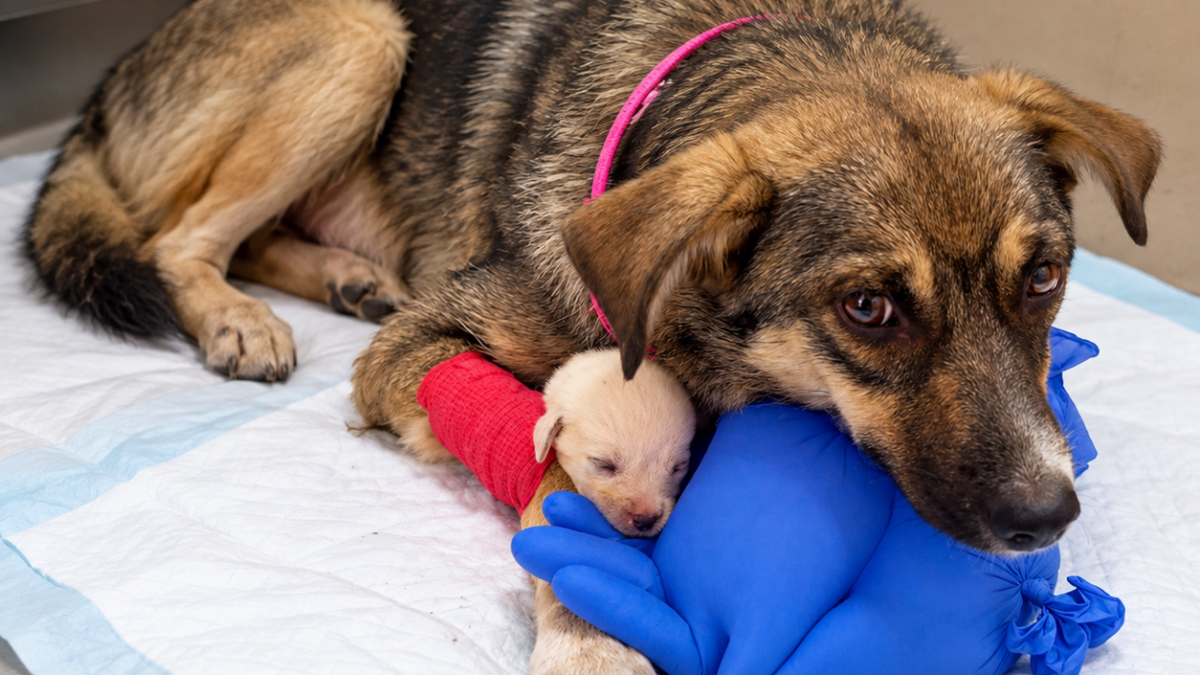
By the time we reached the veterinary clinic, the young mother was curled around one tiny white puppy as if her own body could keep his fading heartbeat from disappearing. T
I leaned closer.
“Why?”
The veterinarian looked at Sima before answering.
“Because she was crashing.”
For a second, I thought I had misunderstood him.
“What do you mean, crashing?”
“Her body was failing after the birth.”
He turned the paper toward me, though most of the numbers meant nothing to me.
“She’s severely anemic. Dehydrated. Her protein levels are extremely low. She has an infection we believe began after delivery, and she’s been trying to produce milk without enough nutrition to sustain herself.”
I looked at the young dog curled protectively around her white puppy.
“She was leaving because she was sick?”
“Probably because she was sick, scared, and searching for food or somewhere she felt safer. Maybe all three.”
The room seemed to tilt slightly.
For two days, I had been asking the wrong question.
Why would a mother abandon her puppies?
Now the real question was painfully obvious.
How had a mother this young kept six newborn puppies alive while her own body was shutting down?
The veterinarian continued.
“She may also have been uncomfortable nursing. If her mammary tissue was inflamed, feeding could have hurt.”
I remembered her at the school.
The puppies rushing beneath her.
Sima standing after less than a minute.
The untouched chicken.
The way she stared toward the gate.
I had interpreted that moment as rejection.
Maybe she had simply been overwhelmed by pain.
“She kept coming back,” I whispered.
“What?”
“To the school. Even when she ran, she stayed nearby.”
He nodded.
“That matters.”
I crouched beside her.
Sima’s eyes met mine.
The little white puppy lay beneath her chin, so still that every few seconds I found myself watching his side to make sure it moved.
“You were trying,” I said.
Her ears shifted.
“I know.”
I didn’t know whether she understood the words.
But she understood the hand against her cheek.
This time, she leaned into it.
The white puppy needed more support than we could safely provide at home that night.
His temperature remained low.
His blood sugar kept dropping.
He had lost strength so quickly that even swallowing became dangerous.
The veterinary team decided to keep him for observation.
Sima refused to leave his warming box.
Every time we encouraged her toward the door, she turned back.
Finally, the veterinarian sighed.
“Let her stay.”
We placed a blanket beside the incubator.
Sima lay down immediately.
Her nose touched the clear plastic.
The puppy was only inches away.
That seemed to be enough.
At midnight, I brought her a bowl of warm chicken and rice.
She smelled it.
Turned her head.
“Please.”
Nothing.
I tore a piece of chicken into something smaller than my fingernail.
Held it near her mouth.
She looked at me.
Then at the incubator.
Then back at me.
“You can’t help him if you fall apart too.”
I offered the piece again.
She took it.
One bite.
Then another.
By the fifth, she stopped turning away.
I fed her with my fingers for almost twenty minutes.
It was slow.
Messy.
Completely ordinary.
And somehow it felt like one of the most important things I had ever done.
Around two in the morning, one of the technicians persuaded me to go home.
“You need sleep.”
“So do you.”
“We’re used to bad decisions.”
I looked at Sima.
She had finally closed her eyes.
The little puppy slept beneath the warm glow of the incubator.
“Call me if anything changes.”
“We will.”
“Anything.”
“I promise.”
The drive home felt endless.
The remaining puppies were waiting with one of our volunteers, Maria.
The moment I entered the house, their cries started.
Five had come home from the clinic earlier.
Now only four were in the box.
The empty space where the white puppy should have been seemed enormous.
Maria handed me a bottle.
“Your shift.”
I laughed weakly.
“You’re cruel.”
“They’re hungry.”
That was the thing about newborn animals.
They do not care that your heart is breaking.
Life keeps demanding practical things.
Warm formula.
Clean bedding.
A dry towel.
A full stomach.
A bathroom break.
A clock set for two hours from now.
I sat on the floor and lifted the first puppy.
A brown female with a white patch on her chest.
She latched immediately.
“That’s right,” I whispered. “Make this easy.”
The second did too.
The third drank more slowly.
The fourth kept falling asleep.
I rubbed his back.
“Stay with me.”
His tiny paws kneaded the blanket.
He drank.
At four thirty in the morning, I checked my phone.
No call.
At five fifteen, still nothing.
At six, a message appeared from the clinic.
He’s holding steady.
Holding steady.
Two words that would have sounded unimpressive in any other part of life.
That morning they felt like victory.
I slept for forty-seven minutes.
Then the puppies woke again.
By ten, I was back at the clinic.
Sima stood when she saw me.
Actually stood.
Her tail moved once.
Then she went straight back to the incubator.
“How is he?”
The veterinarian rubbed tired eyes.
“Still critical.”
“But alive.”
“Yes.”
I looked through the plastic.
The little white puppy seemed impossibly small beneath the warming pad.
“What’s wrong with him?”
“We may be dealing with what people commonly call fading puppy syndrome.”
I had heard the phrase.
I hated it immediately.
It sounded too gentle for something that could kill so quickly.
He explained that newborn puppies could deteriorate for many reasons—low birth weight, poor nutrition, infection, congenital problems, temperature instability, inadequate milk, complications from the mother’s condition.
Sometimes there was no single cause.
“He was weak from birth,” the veterinarian said. “That matters.”
“Can you save him?”
“We’re trying.”
“That’s not what I asked.”
He looked at me.
“I know.”
I closed my eyes.
There are moments in rescue when you want someone to lie.
Not because you believe the lie.
Because you need a few minutes inside it.
Tell me he will live.
Tell me all of this effort guarantees something.
Tell me love counts as medicine.
But good veterinarians don’t make promises biology may break.
“We’re trying,” he repeated.
I nodded.
That would have to be enough.
By afternoon, the puppy seemed slightly stronger.
He swallowed tiny amounts of formula.
His temperature stabilized.
Sima received another round of fluids.
Her antibiotics continued.
We took her outside for five minutes.
It was the first time I had seen her away from the puppies without trying to escape.
She walked beside me.
Slowly.
The sun was out after days of rain.
Sima lifted her face toward it.
For just a moment, she looked less like a terrified young mother and more like what she really was.
A puppy herself.
Not even a year old.
I stopped.
She stopped too.
“You should be chasing tennis balls.”
She looked at me.
“You should be chewing somebody’s shoes.”
Her tail moved.
“You shouldn’t know any of this yet.”
She stepped closer.
Her shoulder touched my leg.
I swallowed hard.
“We’ll figure it out.”
Back inside, she immediately returned to her baby.
That evening, the veterinarian let us take the white puppy home under strict instructions.
Keep him warm.
Feed carefully.
Watch his breathing.
Return immediately if he weakens.
The ride home was silent.
Sima sat beside the carrier.
Every few seconds, she put her nose near the opening.
At the house, we created a warm corner beside her bed.
Heating pad under layers of blankets.
Thermometer.
Formula.
Syringes.
Towels.
A notebook to record every feeding.
It looked less like a living room and more like a tiny neonatal unit.
The other puppies crawled toward their mother the moment she lay down.
Sima lowered herself carefully.
They searched for milk.
This time, there was a little.
Not enough.
But more than before.
Maria looked at me.
“Is she producing?”
“I think so.”
We both leaned closer like two people inspecting a miracle.
One puppy latched.
Then another.
Sima stayed.
No getting up.
No running.
No desperate look toward the door.
She closed her eyes while they nursed.
I wanted to apologize to her.
For doubting her.
For deciding what kind of mother she was before I understood what her body had been fighting.
Instead, I scratched behind her ear.
“You’re doing fine.”
She exhaled.
The white puppy still needed supplemental feeding.
At eleven that night, he took almost an entire small feeding.
At one in the morning, he took another.
At three, less.
At five, more again.
Hope became a line on a piece of paper.
5 mL.
4 mL.
6 mL.
Temperature normal.
Urinated.
Resting.
Each small fact became something we could hold.
For the next two days, he improved.
Not dramatically.
Enough.
He squirmed more when handled.
His cry became louder.
His mouth searched for the bottle again.
Sima remained obsessed with him.
She checked him before the others.
Licked his face longer.
Slept with one foreleg curved around his body.
Maria noticed it too.
“She knows he’s the weak one.”
“Probably.”
“Think she understands?”
I watched Sima nudge him toward her belly.
“Yes.”
The third night brought a storm.
Rain hammered the windows.
Thunder rolled somewhere beyond town.
The power flickered once.
Then steadied.
Sima became restless.
She paced between the puppy box and the back door.
“Easy.”
Thunder cracked again.
The puppies squeaked.
Sima jumped into the box and curled around them.
I checked the white puppy.
Warm.
Breathing.
We were okay.
At 1:17 a.m., I woke to a sound I could not immediately identify.
Not barking.
Not crying.
A low, frantic whine.
Sima.
I turned on the lamp.
She was standing over the white puppy.
Nudging him.
Licking him.
Pushing him with her nose.
He didn’t respond.
My body went cold.
“No.”
I lifted him.
He was warm from the heating pad.
Too limp.
“Sima, move.”
She tried to follow my hands.
I grabbed the emergency kit.
Rubbed him.
Checked his mouth.
Stimulated him.
Nothing.
“Come on.”
Sima whined louder.
Maria came running from the guest room.
“What happened?”
“I don’t know.”
She looked at my face.
“I’ll call the clinic.”
I kept working.
Tiny chest.
Tiny body.
Tiny life.
“Come on, baby.”
Sima pawed at my leg.
“Not now.”
The moment I said it, I hated myself.
She didn’t understand.
She was asking the same thing I was.
Do something.
Do anything.
Maria put the clinic on speaker.
The overnight veterinarian talked me through what I was already doing.
Warmth.
Airway.
Stimulation.
A tiny amount of sugar solution at the gums if safe.
We tried.
The puppy gave one weak movement.
I almost shouted.
“There.”
Then nothing.
We wrapped him and ran to the car.
Sima followed.
I tried to stop her.
“No, stay.”
She pushed past my leg.
“Sima.”
She jumped into the back seat.
There was no time to argue.
Maria drove.
I sat beside Sima with the puppy in my hands.
Rain struck the roof so hard we could barely hear each other.
Sima pressed against me.
Her nose never left her baby.
The clinic doors opened before we stopped moving.
A technician took him.
Sima tried to follow.
I held her harness.
She screamed.
I had never heard that sound from a dog.
Not a bark.
Not a whine.
A raw, desperate cry.
“He’s right there.”
She pulled.
“Sima, please.”
The treatment room doors closed.
She stared at them.
Then sat.
Her entire body trembled.
I sat on the floor beside her.
Maria sat on the other side.
None of us spoke.
Five minutes.
Ten.
Fifteen.
The storm moved farther away.
Water dripped from my coat onto the tile.
Sima did not take her eyes off the door.
When the veterinarian came out, I knew.
Maybe it was his face.
Maybe some part of me had known in the car.
He crouched.
“I’m sorry.”
Two words.
The opposite of holding steady.
Maria covered her face.
I looked at the floor.
“What happened?”
“We don’t know for certain. He arrested. We tried to resuscitate him.”
“But he was better.”
“I know.”
“He ate.”
“I know.”
“He was warmer.”
“I know.”
I hated him for agreeing.
I hated myself for asking.
I hated the storm.
The school.
The concrete.
Every empty pet store shelf that hadn’t had the right formula.
Every hour Sima had been hungry during pregnancy.
Every missing answer.
“He was getting better.”
The veterinarian’s voice softened.
“Sometimes very fragile newborns rally before they decline again.”
I looked at Sima.
She was still watching the treatment room.
“Can she see him?”
Maria turned toward me.
The veterinarian paused.
“Yes.”
They brought the puppy wrapped in a small towel.
Sima stood before anyone could call her.
She moved toward him.
Sniffed his face.
Then his body.
Once.
Twice.
She nudged him.
No response.
She nudged harder.
My throat closed.
“Sima.”
She licked his head.
Then she lay down.
And pulled him against her chest.
Nobody in the room moved.
Not the veterinarian.
Not the technicians.
Not Maria.
Sima curled around her baby exactly as she had when he was alive.
One foreleg over him.
Nose against his ear.
Holding.
Waiting.
For several minutes, we let her.
Then ten.
Then more.
I stopped looking at the clock.
At some point, one of the technicians began crying quietly.
Sima kept licking him.
Not frantically anymore.
Slowly.
Carefully.
As though cleaning him before sleep.
When I finally touched her shoulder, she looked at me.
Her eyes were exhausted.
There are emotions we should be cautious about assigning to animals.
We interpret them through our human minds.
But grief does not belong only to us.
Whatever word you choose for what Sima felt, she understood one fact.
Her baby was no longer responding.
And she did not want to leave him.
“We have to go home,” I whispered.
She looked back at him.
I waited.
Eventually, she stood.
Then turned around and nudged the towel again.
I lifted the puppy.
Sima followed us to the door.
We buried him the next afternoon beneath a flowering tree behind the rescue property.
Not because Sima needed a ceremony.
Maybe she didn’t.
We did.
The first weak puppy who had died at the clinic days earlier was buried nearby.
Two tiny lives.
Neither had lasted long enough to open their eyes properly.
Still, they had mattered.
That evening, Sima searched.
Under blankets.
Behind the puppy box.
Around the room.
She sniffed each surviving baby.
Then walked to the front door.
Maria looked at me.
“She’s looking for him.”
“I know.”
For three days, Sima barely ate again.
Not because of postpartum illness this time.
At least not entirely.
We had her examined.
Her fever was gone.
Her infection was improving.
Her bloodwork was better.
The veterinarian said physically she was moving in the right direction.
Emotionally, she seemed to have stopped.
She stayed with the puppies.
Too much.
If one cried, she immediately repositioned herself around it.
If we lifted one for feeding, she stood and followed.
If I carried a puppy across the room, Sima came with me.
“She thinks she’ll lose another one,” Maria said.
Maybe.
We could not ask her.
What we could do was give her routine.
Food at the same time.
Short walks.
Quiet.
No unnecessary handling.
We encouraged her to leave the puppies for five minutes.
Then ten.
At first, she refused.
I clipped on the leash.
She planted all four feet.
“Sima.”
Nothing.
“Outside.”
She looked toward the puppy box.
Maria sat beside it.
“I’ve got them.”
Sima stared at her.
Maria raised both hands.
“I swear.”
Sima still wouldn’t move.
I crouched.
“You need to be a dog for ten minutes.”
Her ears shifted.
“Come on.”
Eventually she took one step.
Then another.
Outside, she kept trying to turn back.
We made it to the end of the driveway.
That was enough.
The next day, we went two houses farther.
On the third day, she stopped to smell a patch of grass.
I nearly cried.
Grief makes ordinary curiosity look miraculous.
A week after losing the white puppy, Sima chased a falling leaf.
Only two steps.
Then she remembered herself and stopped.
But I saw it.
“You’re still in there.”
She looked at me.
I smiled.
“Good.”
At home, the remaining four puppies were growing.
Slowly.
Three gained weight every day.
The smallest male did not.
We called him Bean because he was barely bigger than one when curled up.
Bean drank.
Slept.
Crawled.
But his weight chart flattened.
I became obsessed with the scale.
Morning.
Night.
Morning.
Night.
Maria finally took it away from me.
“You’re weighing him every four hours.”
“I’m monitoring.”
“You’re losing your mind.”
“He hasn’t gained.”
“He gained four grams.”
“That’s barely anything.”
“It’s not zero.”
Claire, one of our longtime rescue volunteers, overheard us.
“Remember when four grams would have made you happy?”
I hated reasonable people.
Bean developed a runny nose first.
Then another puppy sneezed.
My stomach dropped.
“Not again.”
Within twenty-four hours, three puppies had nasal discharge.
One sounded congested when breathing.
I called the veterinarian.
“Bring them.”
All of them went.
Sima too.
The clinic felt too familiar now.
Same parking space.
Same hallway.
Same metallic table.
Sima trembled when we entered.
She had never done that before.
I knelt.
“You remember.”
She leaned into my leg.
The veterinarian examined each puppy.
Temperature.
Lungs.
Hydration.
Mucous membranes.
They were still active.
That was encouraging.
Likely respiratory infection.
Medication.
Warmth.
Careful monitoring.
Return if appetite decreased or breathing worsened.
“What about Bean?”
The veterinarian listened again.
“He worries me more.”
“Why?”
“He’s smaller. Less reserve.”
Those words followed us home.
Less reserve.
Meaning less room for error.
Less room for another cold night.
Another missed feeding.
Another infection.
Another unlucky turn.
For three days, Sima barely moved away from them.
By then, her milk had finally begun coming in properly.
The irony almost hurt.
When the puppies needed her most, her body had finally caught up.
They nursed.
We supplemented.
They slept in warm piles.
Medication times turned our kitchen into a pharmacy.
I wrote names on a whiteboard.
Brown girl.
Black boy.
Bean.
Gold girl.
Sima.
Dose.
Time.
Feeding.
Weight.
Every day became a schedule.
Every night became an argument with sleep.
On the second night, Bean worsened.
His breathing became faster.
I called the emergency clinic.
They had us count respirations.
Watch color.
Check temperature.
At two in the morning, I decided not to risk waiting.
Sima and I went back.
Bean was admitted.
Again.
Another warming unit.
Another tiny body separated from his mother by clear plastic.
Sima paced.
I felt the past repeating.
“No.”
She looked at me.
“We’re not doing this again.”
Of course we had no authority over that.
We stayed.
Bean received oxygen and fluids.
His lungs were not yet in severe distress, but the infection had hit him harder.
The veterinarian warned us.
“He’s vulnerable.”
“I know.”
“We’ll do everything we can.”
“I know.”
Sima lay beside the incubator.
I sat beside her.
Around four in the morning, I woke with my head against the wall.
Sima was awake.
Watching Bean.
Always watching.
At sunrise, his breathing eased slightly.
By noon, he accepted formula.
By evening, he was stronger.
This time, improvement held.
Bean came home two days later.
Sima washed him for so long his fur stood in every direction.
Maria laughed.
“He looks electrocuted.”
It was the first real laugh in the house since the white puppy died.
Sima looked up at the sound.
Her tail moved.
Maria pointed.
“There she is.”
But the illness was not finished with us.
The gold female stopped nursing the following morning.
She had been one of the strongest.
That was what scared me.
Weak puppies teach you to watch them.
Strong puppies trick you into relaxing.
Her temperature was high.
We went back again.
The infection had moved into her lungs.
Treatment started immediately.
She fought.
For forty-eight hours, she fought.
Then, despite oxygen and medication, she declined.
She died on a Tuesday morning.
The third puppy we lost.
Eight born.
Two gone before we arrived.
One died during the first clinic visit.
The little white puppy died after his brief rally.
Now the gold girl.
Three survived.
Three.
I stared at that number on the whiteboard.
Three.
Brown girl.
Black boy.
Bean.
I erased Gold girl.
Then I sat on the floor and cried.
Not quietly.
Not gracefully.
Maria found me there.
She did not tell me to stop.
She sat beside me.
After a while, she said, “We still have three.”
I wiped my face.
“I know.”
“And Sima.”
“I know.”
“Then today we take care of four.”
That was rescue stripped of every inspirational phrase people like to put around it.
Today we take care of four.
Not everyone.
Not forever.
The four still here.
Sima grieved differently this time.
Or maybe we understood her better.
She searched briefly.
Then became even more attentive to the remaining puppies.
But she ate.
That mattered.
She took chicken from my hand.
Then from the bowl.
Eventually, without encouragement.
Her body was stronger now.
Her milk supply increased.
Her coat changed.
It became softer.
Shinier.
The sharp bones along her back slowly disappeared beneath healthy weight.
One morning, I realized I could no longer see every rib.
I called Maria.
“Come here.”
She rushed in.
“What?”
“Look at her.”
Maria stared.
“What am I looking at?”
“You can’t see her ribs.”
Maria’s face softened.
“No.”
We stood smiling at a dog eating breakfast.
That was all.
It felt enormous.
The puppies began opening their eyes.
Bean was last.
Of course.
For two days, one eye opened before the other, giving him a permanently suspicious expression.
“You look ridiculous,” I told him.
Sima pushed my hand away with her nose.
“Your son looks ridiculous.”
She licked Bean’s head.
“Fine. He’s beautiful.”
Her tail wagged.
Once their eyes opened, the world changed quickly.
The puppy box was no longer enough.
They crawled over the edges.
They discovered each other’s ears.
They discovered Sima’s tail.
They discovered that human toes were apparently edible.
The black male, whom Ethan—yes, the same boy from another rescue family who sometimes volunteered—wanted to call Rocket, learned to escape first.
I refused the name because he moved like a potato.
Ethan insisted.
“He has potential.”
“Potential for what?”
“Speed.”
Rocket took three steps and fell into the water dish.
Ethan pointed.
“See? Fearless.”
We kept the name.
The brown female became Maple.
Bean remained Bean because by then nothing else fit.
Sima began playing with them.
At first, carefully.
A play bow.
A soft paw.
A gentle mouth around an ear.
Then, as they grew, she became less delicate.
She rolled Rocket across the rug.
He returned for more.
Maple attacked her tail.
Bean climbed onto her back while she was lying down and fell asleep there.
The first time I saw all four playing, I stood in the doorway and did nothing.
No camera.
No phone.
I just watched.
After weeks of measuring survival in milliliters and grams, joy looked almost irresponsible.
They were loud.
Messy.
Healthy.
Sima barked for the first time.
A real bark.
Sharp.
Playful.
I laughed.
She barked again.
Rocket ran into a chair.
Maple attacked a towel.
Bean bit my sock.
The house was chaos.
It was wonderful.
We still needed answers about Sima.
Who had she belonged to?
How had a dog under one year old ended up pregnant and giving birth beneath school stairs?
We posted photographs.
Checked for a microchip.
None.
Spoke with neighbors.
Asked school staff.
Several people had seen her before.
One crossing the road near an apartment complex.
Another near a convenience store.
A teacher remembered a similar dog following teenagers several weeks earlier.
Eventually, a woman named Denise contacted us.
“I think I know that dog.”
My heart tightened.
“Are you the owner?”
“No.”
She sent a photograph.
Sima, thinner but unmistakable, standing behind a chain-link fence.
“Where was this taken?”
“At my neighbor’s house.”
“When?”
“About three months ago.”
“Who lives there?”
“A family used to.”
“Used to?”
“They moved.”
My jaw tightened.
“When?”
“Maybe six weeks ago.”
Before the puppies were born.
“Did they have a dog?”
“Yes.”
“Was it Sima?”
“I don’t know what they called her.”
Denise told me the family had rented a small house.
They had two dogs at one point.
A male and a younger female.
The male disappeared first.
Then the family moved.
Denise assumed they took the female with them.
Apparently they hadn’t.
“Do you know where they moved?”
“No.”
“Landlord?”
She gave us the name.
The landlord confirmed a young dog had lived there.
He also said the tenants left suddenly after falling behind on rent.
“Was the dog there when you inspected?”
“No.”
“Were you told what happened to her?”
“They said a friend took her.”
“What friend?”
“I don’t know.”
Another missing piece.
Animal control took the information.
No abandonment charge could be pursued without stronger evidence.
Maybe someone had taken Sima and she escaped.
Maybe she had been left.
Maybe she wandered during the move.
What mattered was that she had been pregnant.
Alone.
Underfed.
And eventually found the schoolyard.
I visited the school again.
Mr. Harris showed me the spot where she had given birth.
The concrete was dry now.
Children shouted from the playground nearby.
“You sure it was here?”
“Right there.”
He pointed under the stairs.
There was barely enough room for her to turn around.
“How did she fit eight puppies?”
He shook his head.
“I don’t know.”
The little wooden shelter he had built still stood against the wall.
“You kept it?”
“Couldn’t throw it away.”
I understood.
He had lined it with old towels.
The same tarp hung over the top.
“I thought she hated me,” he said.
“Why?”
“Every time I brought food, she ran.”
“She was scared.”
“I know now.”
He looked at the shelter.
“I wish I’d found them sooner.”
There it was.
The sentence rescuers say too often.
I wish.
I wish I had come yesterday.
I wish I had seen the post.
I wish the neighbor had called.
I wish the storm had waited.
I wish the puppy had eaten.
I wish.
There is no end to what grief can rewrite.
“You found them when you found them,” I said.
He nodded.
It did not erase his regret.
Nothing could.
Before I left, he handed me a small cardboard box.
Inside were three little knitted blankets.
“My wife made them.”
“For the puppies?”
He nodded.
“One each.”
I swallowed.
“Thank you.”
“She said babies should go home with something.”
Home.
We were finally beginning to think about that word.
The puppies were now old enough to begin weaning.
Soft food arrived like a revelation.
Rocket stepped directly into the plate.
Maple learned to eat from the edge.
Bean sat in the center and licked food off his paws.
Sima watched them with visible relief.
For the first time since we had brought her inside, motherhood no longer consumed every minute of her life.
She began sleeping several feet away from the puppies.
Then across the room.
Eventually, she chose the couch.
The first time she did it, I stared.
Maria walked in.
“What?”
I pointed.
Sima was stretched across two cushions, belly up, snoring.
Maria smiled.
“She retired.”
“Temporarily.”
Rocket began screaming because Maple had stolen a toy.
Sima opened one eye.
Then closed it.
I laughed.
“Definitely retired.”
Her walks grew longer.
At first, she still checked behind us as though worried the puppies might vanish.
Then she learned the routine.
We always came back.
One morning, we reached a small park.
Sima stopped beside a tree.
A squirrel dropped from a branch and ran across the grass.
Sima stared.
I felt the leash tighten.
“No.”
She crouched.
“Sima.”
The squirrel ran.
Sima exploded.
I barely kept my feet.
For twenty yards, she was not a mother.
Not a neglected dog.
Not a patient.
Not a survivor.
She was a young dog chasing something she had absolutely no chance of catching.
When the leash stopped her, she turned in a circle and looked at me.
Her mouth open.
Eyes bright.
I laughed.
“There you are.”
She jumped against my leg.
“You’re a menace.”
Her tail whipped back and forth.
That was when I began thinking about her future too.
The puppies would be adopted.
Everyone knew that.
But Sima?
At first, I had assumed she would need an experienced home.
Maybe someone patient.
Quiet.
No small animals.
No young children until we knew more.
Then she kept destroying every expectation.
She loved people.
She loved children.
She tolerated other dogs after careful introductions.
She had no food aggression despite everything she had survived.
She learned house training in days.
She slept through the night.
She stole socks but never destroyed them.
Mostly she carried them to her bed.
A collector.
One afternoon, I found nine socks around her.
“Are you opening a store?”
She looked pleased.
“None of these match.”
Tail wag.
“Terrible inventory.”
We began receiving adoption applications for the puppies.
Dozens.
Cute puppies are easy to love from a photograph.
We screened carefully.
Fenced yards.
Veterinary references.
Household schedules.
Expectations.
Return policy.
Training plans.
Everyone wanted Bean.
The puppy who had almost died became the most popular because he had a white stripe down his forehead and one ear that folded backward.
“Absolutely not,” I told Maria.
“What?”
“He’s getting adopted by people who want a dog, not people who want a sad story.”
Maria nodded.
That became our rule for all three.
Their history mattered.
But it would not be the reason they were chosen.
Maple’s family came first.
A school counselor named Rachel, her husband Sam, and their daughter Lily.
Lily was eight.
She sat on the floor and waited instead of grabbing.
Maple approached her.
Sniffed her knee.
Climbed into her lap.
Decision made.
Lily looked at me.
“Can she sleep in my bed?”
Rachel said, “No.”
Sam said, “Eventually.”
Rachel looked at him.
“Absolutely not.”
Maple yawned.
I smiled.
“This is going well.”
Rocket’s family had an older Labrador named Duke.
We did three meetings.
Rocket adored Duke immediately.
Duke looked like a tired uncle assigned to babysitting duty.
During the second meeting, Rocket bit his tail.
Duke turned around.
Rocket froze.
Duke sighed and walked away.
“Perfect,” I said.
The adopters laughed.
Bean was harder.
Not because no one wanted him.
Because I did.
I told myself I was being objective.
Then Maria caught me rejecting an application because the family lived forty-five minutes away.
“That is ridiculous.”
“They’re far.”
“Forty-five minutes.”
“What if something happens?”
“They have a veterinarian.”
“Not ours.”
“Most dogs don’t use our veterinarian.”
“I know.”
She folded her arms.
“You’re attached.”
“No.”
Bean walked over and climbed onto my foot.
Maria looked down.
Then back at me.
“Embarrassing.”
I picked him up.
“He nearly died.”
“So did Sima.”
“That’s different.”
“How?”
I had no answer.
A rescue coordinator named Dana eventually intervened.
“You don’t have to adopt him out until you’re ready.”
“That sounds dangerous.”
“It is.”
“What if I keep him?”
“Then you keep him.”
I looked at Bean.
He was chewing the drawstring of my sweatshirt.
“I already have two dogs.”
“Then you have three.”
“That’s how rescue people become cautionary documentaries.”
Dana laughed.
I did not keep Bean.
Not because I didn’t love him.
Because a better home appeared.
An older couple named Tom and Evelyn had lost their dog the previous year.
They did not care about Bean’s dramatic history.
They barely asked about it.
Instead, Tom wanted to know what food he ate.
Evelyn asked whether he liked car rides.
They wanted to know his energy level.
His training.
Whether he slept through the night.
Whether he barked when left alone.
Ordinary questions.
Perfect questions.
During the visit, Bean fell asleep on Tom’s shoe.
Tom looked down.
“Guess I’m stuck.”
Evelyn smiled.
“You’ve been stuck for thirty years.”
Something inside me unclenched.
When they left, I told Maria, “I hate them.”
“Because they’re perfect?”
“Yes.”
She hugged me.
Adoption day arrived faster than I expected.
Mr. Harris’s wife’s knitted blankets were packed into three bags.
Each puppy got medical records.
Food.
A toy.
A blanket smelling like Sima and the litter.
A photograph from the first healthy week.
I refused to include the worst pictures.
Their new families did not need to frame suffering.
Maple left first.
Sima watched from the hallway.
She sniffed Rachel.
Sniffed Lily.
Then licked Maple’s face.
Maple climbed into Lily’s arms.
My throat tightened.
The door closed.
Sima stood looking at it.
I held my breath.
She turned around.
Went to the water bowl.
That was it.
Rocket left the following day.
His new family brought Duke.
Rocket ran to him like they had been separated for years.
Duke looked resigned.
Sima greeted everyone.
Rocket wrestled with her once.
Then followed Duke outside.
Again, Sima watched the door.
Again, she moved on.
Bean was last.
That was hardest.
Not for Sima.
For me.
Tom and Evelyn arrived carrying the ridiculous amount of equipment first-time puppy parents somehow accumulate.
Harness.
Bed.
Three toys.
Two blankets.
Portable water bowl.
A bag containing something called calming music for dogs.
I stared.
“He is not going to college.”
Evelyn laughed.
“We’re prepared.”
Bean waddled toward them.
Tom picked him up.
Bean licked his glasses.
Traitor.
I crouched beside Sima.
“Your last baby.”
She smelled Bean.
Then licked one ear.
Bean grabbed her cheek with his mouth.
Sima pulled away.
No sentimental final embrace.
No dramatic cry.
Just a mother who had spent weeks teaching her puppy how to leave her.
Tom held Bean against his chest.
I handed him the bag.
“The formula notes are old. Ignore those.”
“Got it.”
“He’s eating three meals.”
“We know.”
“He sometimes coughs after drinking too fast.”
“We’ll watch.”
“He sleeps better if—”
Evelyn touched my arm.
“We’ll call.”
I stopped.
“Okay.”
She smiled.
“We’ll call.”
The door closed.
The house became silent.
Too silent.
For weeks, every corner had contained movement.
Now there was none.
I looked at Sima.
She looked at me.
“Well.”
She sneezed.
“Just us.”
She walked into the living room.
Sniffed the empty puppy pen.
Then stepped inside.
She circled twice.
Lay down.
I sat beside her.
For the first time since the school, she was no longer responsible for anyone.
I expected her to relax.
Instead, she looked lost.
That night, she carried three socks into the empty pen.
The next morning, she carried a stuffed toy.
Then another.
Maria found her sleeping among them.
“She made replacement puppies.”
I smiled sadly.
“Apparently.”
For several days, Sima seemed quieter.
She ate.
Walked.
Played a little.
But her routine had disappeared.
No babies to clean.
No feeding cries.
No little bodies climbing over her.
The veterinary team had warned us.
Hormones take time.
Behavior takes time.
Recovery does too.
We gave her both.
A week later, Maple’s family sent a video.
Maple was asleep beside Lily beneath a pink blanket.
Another showed Rocket chasing Duke around a backyard.
Bean appeared on video sitting in a shopping cart at a pet store wearing a sweater that said SECURITY.
I laughed so hard I cried.
I showed Sima.
She smelled the phone.
Then walked away.
“Fair.”
She did not need proof.
I did.
Now it was her turn.
Applications came for Sima.
Fewer than for the puppies.
That was expected.
Puppies attract people.
Young adult mothers often become background characters in their own rescue stories.
Everyone celebrates the babies surviving.
Then the mother waits.
I refused to let that happen to her.
We wrote her profile without turning her into tragedy.
Sima is young, gentle, learning to enjoy being a dog, loves long walks, carries socks without destroying them, and believes squirrels are a personal challenge.
That was who she was now.
Not “abandoned mother.”
Not “dog who lost babies.”
Sima.
A woman named Caroline applied.
Forty-six.
Widowed.
Two grown children.
Worked from home as an accountant.
No other pets.
Large fenced yard.
Her application was almost suspiciously boring.
I liked it.
During the first meeting, Caroline sat on the porch.
She did not call Sima.
Did not slap her knees.
Did not say, “Come here, baby.”
She waited.
Sima approached slowly.
Smelled her shoes.
Walked away.
Caroline smiled.
“She doesn’t owe me attention.”
That sentence got my attention.
Ten minutes later, Sima came back.
Caroline scratched beneath her chin.
Sima stayed.
Twenty minutes later, Sima sat on her foot.
Caroline looked at me.
“Is that good?”
“Depends. Do you like socks?”
“What?”
“You’ll find out.”
We arranged a home visit.
Caroline’s house was quiet.
A small ranch home on a tree-lined street.
Dog bed near the desk.
Water bowl in the kitchen.
No elaborate setup.
Just space.
The backyard was large.
Sima ran the fence line.
Then rolled in grass.
Caroline laughed.
Something about that laugh made Sima stop.
She ran toward her.
No hesitation.
I felt the answer before anyone said it.
Caroline knelt.
Sima crashed into her knees.
“Okay,” Caroline whispered.
I looked away.
Adoption day was two weeks later.
I packed Sima’s things.
Her blanket.
Food.
Medication history.
The worn leash from her first walks.
One sock.
Maria saw me put it into the bag.
“Seriously?”
“She likes it.”
“That is your sock.”
“She likes that one.”
“You are giving away laundry now?”
“Mind your business.”
Sima rode with me to Caroline’s house.
The whole way, I talked.
“You know, you could ruin this.”
She looked out the window.
“Bark at her neighbors.”
Nothing.
“Eat the couch.”
Nothing.
“Refuse to sleep.”
She yawned.
“Maybe she’ll return you.”
Her head turned toward me.
My voice broke.
“I’m kidding.”
At the house, Caroline was waiting on the porch.
Sima recognized her.
The tail started immediately.
That helped.
We went through paperwork.
Again.
Food.
Again.
Vet.
Again.
Emergency contact.
Again.
I was delaying.
Everyone knew.
Finally, Caroline signed.
She looked at me.
“I’ll take good care of her.”
“I know.”
“You can visit.”
“I know.”
“I’ll send pictures.”
“I know.”
Sima stood between us.
I crouched.
For a moment, I saw every version of her.
Wet beneath the school awning.
Ribs visible.
Running from food.
Curled around newborn puppies.
Pressed against an incubator.
Holding a baby who would never wake.
Standing outside in sunlight.
Chasing a squirrel.
Sleeping on the couch.
Carrying socks.
“You did enough,” I whispered.
She licked my chin.
“No more babies.”
Tail wag.
“No more concrete.”
Another wag.
“No more running because you’re scared.”
She leaned against me.
I closed my eyes.
“Go be somebody’s spoiled dog.”
Caroline cried.
I cried.
Sima sneezed.
Then she walked to Caroline.
That was it.
Sometimes the right goodbye is simple.
I drove home alone.
At the first traffic light, I looked at the empty passenger seat and almost turned around.
I didn’t.
That evening, Caroline sent a photograph.
Sima was asleep on the couch.
My sock was beneath her chin.
The caption read:
I think she’s home.
I saved the picture.
Months passed.
Maple grew long-legged and elegant.
Rocket became exactly what Ethan predicted—fast enough to exhaust Duke daily.
Bean became enormous.
Not fat.
Just inexplicably large.
Tom sent a photo of him standing beside a kitchen chair.
“This was supposed to be the tiny one,” he wrote.
I laughed.
The puppy we had once measured in grams now stole entire sandwiches from countertops.
Life has a sense of humor.
Sima flourished with Caroline.
Her coat became thick.
Her body filled out.
Her eyes changed most.
The constant vigilance disappeared.
In early photos, Sima always looked as though she was listening for danger.
In later ones, she looked directly at the camera.
Calm.
Present.
Sometimes ridiculous.
Caroline bought her a bright yellow raincoat.
The first photograph made me laugh.
The second made me cry.
Rain.
For so long, rain had meant the schoolyard.
Cold concrete.
Newborn puppies.
Loss.
Now Sima stood on a sidewalk in a yellow coat, refusing to step around a puddle.
Caroline wrote:
She LOVES rain.
That was healing in one sentence.
Almost a year after the rescue, Caroline invited us to Sima’s adoption anniversary.
I expected a small visit.
Instead, she had arranged something.
All three puppies came.
Maple arrived first.
Rocket next.
Bean last, dragging Tom across the yard.
I stood near the gate.
“Caroline.”
She smiled.
“I thought she deserved a reunion.”
Sima came outside.
She saw the dogs.
Stopped.
The puppies were no longer puppies.
Nearly grown.
Different smells.
Different lives.
For a second, nobody knew what would happen.
Then Rocket ran toward her.
Sima stiffened.
He slowed.
They smelled each other.
Maple joined.
Bean pushed between everyone because Bean had never learned manners.
Sima sniffed them carefully.
Then her tail began to move.
Slowly.
Faster.
Rocket play-bowed.
Sima answered.
The yard exploded.
They ran.
All four.
Maple cutting wide circles.
Rocket chasing.
Bean trying to keep up.
Sima in the middle.
Caroline stood beside me.
“Do you think she knows?”
I watched them.
“I think she knows they’re familiar.”
“Does she know they’re hers?”
I smiled.
“I don’t need to know.”
We watched instead.
At one point, Bean knocked into Sima.
She rolled him into the grass exactly as she had when he was tiny.
Tom shouted, “Bean!”
Sima stood over him.
Bean looked delighted.
“I think she remembers that one,” I said.
We laughed.
Later, after the dogs tired themselves out, we sat beneath a tree.
Lily leaned against Maple.
Rocket slept beside Duke.
Bean occupied most of Tom’s lap despite weighing far too much.
Sima lay near Caroline.
I looked around.
This was what people mean when they use the word rescue.
But they often imagine only the first part.
The dramatic part.
The call.
The rain.
The starving dog.
The dying puppy.
The bottle at two in the morning.
Those moments matter.
But rescue is not one moment.
It is the long chain after.
The medication.
The cleaning.
The mistakes.
The sleeplessness.
The losses you cannot undo.
The food chopped small enough for a sick mother to swallow.
The walk to the end of a driveway.
The first squirrel.
The adoption applications.
The silence after the puppy pen is empty.
The decision to let someone else become the person your animal waits for.
The photographs months later.
The reunion a year later.
That is rescue too.
At sunset, Caroline brought out a small wooden box.
“I made something.”
Inside were photographs.
The school shelter.
Sima at the clinic.
The puppies nursing.
The three survivors at six weeks.
Their adoption days.
Sima asleep with my sock.
Sima in her yellow raincoat.
She had made a photo album.
On the front, she had written:
THE FAMILY THAT MADE IT HOME
I touched the cover.
For a long time, I couldn’t speak.
Finally, I said, “Not all of them did.”
Caroline’s smile faded.
“I know.”
I thought of the five puppies who never reached this yard.
The two who died before we arrived.
The first weak baby at the clinic.
The white puppy Sima held against her chest.
The gold girl who fought through the respiratory infection.
They were not here.
I would never pretend a happy ending erased them.
Caroline opened the album.
Near the back were five small blank spaces.
Not photographs.
Just names.
For the two we never named, she had written:
Little One.
Little One.
Then the names we had used at the clinic.
Scout.
Snow.
Goldie.
I looked at her.
“How did you know?”
“Maria told me.”
I laughed softly.
“Of course she did.”
Caroline closed the book.
“They’re part of the family too.”
Sima walked over and put her head on Caroline’s knee.
I rubbed her ear.
“Yes.”
They were.
Happy endings are sometimes misunderstood.
They are not endings where nothing terrible happened.
Those stories barely exist.
A happy ending is when terrible things happened and love still managed to build something afterward.
Not replace.
Not erase.
Build.
Years later, I visited Sima again when her muzzle had begun turning gray.
Caroline had moved a dog bed beside her office desk.
My old sock was long gone.
Apparently Sima had upgraded to stealing Caroline’s slippers.
“She doesn’t chew them,” Caroline insisted.
“That’s worse.”
“How?”
“She’s organized crime.”
Sima lifted her head at my voice.
For one second, I wondered whether she remembered me.
Then she stood.
Slowly.
Walked across the room.
And pushed her entire body against my legs.
I laughed.
“Okay.”
Her tail wagged.
“Okay, you remember.”
Caroline smiled from the doorway.
“She does that with very few people.”
I sat on the floor.
Sima lowered herself beside me.
The years had softened her.
She was still gentle.
Still watchful in certain situations.
But no longer afraid of doors.
No longer afraid of food bowls.
No longer panicked when separated from another dog.
I touched the side of her face.
“You were such a mess.”
She licked my wrist.
“You caused a lot of trouble.”
Tail wag.
“You know that?”
Another wag.
Caroline brought coffee.
We sat near the window.
Rain began tapping softly against the glass.
Sima slept between us.
I looked outside.
“You ever think about where she started?”
Caroline followed my gaze.
“The school?”
“Yeah.”
“Sometimes.”
“Does rain bother her?”
Caroline smiled.
“No. She still loves it.”
That made me happier than it should have.
A storm had once surrounded the worst night of Sima’s life.
Now rain meant a walk in a yellow coat.
Meaning can change.
Maybe that is one of the kindest things time does.
A few years later, Maple’s family sent me a Christmas card.
Maple sat beside Lily, who was now a teenager.
Rocket’s family sent a video of him swimming in a lake while Duke watched from shore.
Bean’s family sent a photograph of him wearing a birthday hat beside Tom.
The caption said:
Still tiny.
He weighed sixty pounds.
I forwarded all three to Caroline.
She replied with Sima sleeping upside down on the couch.
Her message said:
Motherhood really exhausted her.
I laughed until my eyes watered.
Then I looked again.
Sima’s belly, once stretched by eight puppies, had long since healed.
A faint scar remained from her spay surgery.
Her paws were relaxed.
Mouth slightly open.
Completely safe.
That was the image I wished I could send backward through time.
Not to myself.
To Sima beneath those school stairs.
Look.
I would tell her.
This is where you are going.
I know you can’t imagine it.
I know your body hurts.
I know you are hungry.
I know the babies keep crying and you have nothing left to give.
I know you think every person approaching you might be another danger.
But there will be warm floors.
There will be food you cannot finish.
There will be a woman who buys you ridiculous raincoats.
There will be slippers to steal.
There will be puppies who grow up.
There will be losses too.
I cannot lie about that.
Some of your babies will not survive.
You will look for them.
You will grieve them.
We will grieve with you.
But you will not always be in this night.
That is what I would tell her.
You will not always be in this night.
Sima lived many good years with Caroline.
When age finally began slowing her, it happened gradually.
Arthritis first.
Then shorter walks.
Then a heart murmur.
Caroline called me after one appointment.
“She’s okay.”
That opening meant something wasn’t.
“What did the vet say?”
“We’re managing it.”
I heard the fear beneath her voice.
“She’s old now.”
“I know.”
“I don’t like it.”
“I know.”
We had spent so much time trying to get Sima to survive being young.
It felt unfair that she had eventually become old.
But it was not unfair.
It was the gift.
Old age was the thing we had fought for.
Gray fur.
Slow steps.
Long naps.
Medication hidden in cheese.
A ramp beside the porch.
These were not tragedies.
They were evidence.
She had received years.
On one of my final visits, rain was falling again.
Caroline opened the door.
Sima lay on a thick bed near the window.
She did not stand.
I went to her.
“Hey, Mama.”
Her eyes opened.
Tail.
One slow thump.
Then another.
I knelt and touched her face.
She smelled my hand.
Her breathing was slower.
Her body thinner again, though nothing like the school days.
Caroline sat beside us.
“She still eats.”
“Good.”
“She still wants her evening walk.”
“How far?”
“Mailbox.”
“That counts.”
“She stole a slipper yesterday.”
I smiled.
“That definitely counts.”
We sat with her for almost an hour.
At some point, thunder rolled far away.
Sima lifted her head.
Not fear.
Interest.
Rain streaked the window.
Caroline whispered, “Want to go out?”
I looked at her.
“In this?”
“She likes rain.”
Of course.
We helped Sima stand.
Caroline put on the yellow raincoat.
It was newer than the first one but just as ridiculous.
We walked slowly.
Three people accompanying one old dog twenty yards down a driveway.
Sima stopped at the mailbox.
Turned her face upward.
Rain touched her nose.
Her eyes closed.
For several seconds, nobody moved.
I thought of cold concrete.
The school.
Eight newborn puppies.
A mother too sick to eat.
The first night we misunderstood her.
Then the clinic.
Her foreleg around the white baby.
The look in her eyes.
Please.
Please save him.
We couldn’t.
Not all of them.
That truth remained.
But standing in the rain years later, I understood something I had been too young in rescue to understand then.
Saving does not always mean preventing death.
Sometimes you cannot.
Saving can mean preventing fear.
Preventing loneliness.
Preventing hunger.
Creating comfort.
Giving an animal enough safety to stop running.
Giving a mother a chance to be cared for after spending everything she had caring for others.
Giving three puppies decades they almost did not receive.
Giving grief somewhere gentle to land.
Sima took another step.
Then another.
At the porch, she looked tired.
We carried her inside.
Caroline removed the raincoat.
Sima settled onto the bed.
I kissed her forehead.
“Good walk.”
Tail thump.
I left that evening knowing it might be the last time.
It was.
Three weeks later, Caroline called.
Sima had stopped eating.
Then drinking.
Her veterinarian believed her heart was failing and her kidneys were beginning to follow.
Caroline’s voice shook.
“I think it’s time.”
I closed my eyes.
“Does she?”
A long pause.
“Yes.”
I drove there.
Maria came too.
So did Mr. Harris.
He surprised everyone by appearing with his wife.
They had stayed in touch through photographs over the years.
When Sima saw him, her tail moved.
He crouched.
“Look at you.”
His voice broke.
“You finally stopped running.”
Sima rested her head on his hand.
Caroline had arranged for the veterinarian to come to the house.
No clinic.
No fluorescent lights.
No strange smells.
Sima lay beside the window.
Rain was not falling that day.
The sky was clear.
The yellow raincoat hung near the door.
Caroline sat closest.
That was right.
Sima belonged to her.
Not because she had signed a document.
Because years of ordinary mornings had made it true.
I sat on the other side.
Maria touched Sima’s paw.
Mr. Harris stood near the doorway with his wife.
No one made speeches.
There was nothing left to explain.
The veterinarian gave the first medication.
Sima relaxed.
Her breathing deepened.
Caroline bent over her.
“Thank you.”
She whispered it again.
“Thank you.”
I knew what she meant.
Thank you for finding me.
Thank you for trusting me.
Thank you for staying.
Thank you for the stolen slippers.
Thank you for every rainy walk.
Thank you for growing old.
Sima’s eyes were almost closed.
I touched the side of her face.
For one moment, I felt the young mother from the clinic beneath my hand.
Terrified.
Exhausted.
Clutching her baby.
Then that image gave way to the dog in front of me.
Old.
Loved.
Safe.
The veterinarian gave the final medication.
Sima’s last breath came quietly.
Caroline kept her hand against Sima’s chest long after it stopped moving.
Nobody asked her to let go.
That mattered to me.
Years earlier, Sima had held her dying puppy and refused to release him until she was ready.
Now we gave her person the same kindness.
Time.
No rushing.
No pulling away.
No telling grief when it should move.
Eventually, Caroline lifted her head.
“I’m okay.”
She wasn’t.
Neither were we.
But those words did not mean what they sounded like.
They meant:
You can move now.
So we did.
A week later, Caroline gave me the yellow raincoat.
“I can’t throw it away.”
“Then keep it.”
“I have her collar.”
She pressed the folded coat into my hands.
“You keep this.”
I took it.
It still carried a few gray hairs.
For years, it hung in the rescue office beside our emergency leashes.
Not as a sad thing.
As a reminder.
Whenever someone new volunteered and asked about the tiny yellow coat, I told them about Sima.
Not the polished version.
The real one.
Eight puppies beneath school stairs.
Two already gone.
A mother who ran and made us think she didn’t care.
Six babies brought home.
Formula at impossible hours.
One dying at the clinic.
A little white puppy fighting, rallying, then slipping away.
Sima holding him.
Another puppy lost to infection.
Three survivors.
A mother who slowly learned to eat.
Then walk.
Then chase squirrels.
Then rest.
Then let her babies go.
Then go home herself.
People always asked the same question.
“How did she keep going?”
I never knew how to answer.
Animals do not narrate courage to themselves.
They do not wake up and announce they will be inspirational.
They respond to what is in front of them.
A crying puppy.
A bowl of food.
An open door.
A hand.
Rain.
A leash.
A warm bed.
The next breath.
Maybe courage is often that simple.
Years after Sima died, I returned to the elementary school.
Mr. Harris had retired.
The stairs were still there.
The concrete had been resurfaced.
Children’s paintings covered the wall beside it.
Flowers.
Stars.
Dogs.
One drawing showed a brown dog beneath a rainbow.
Probably coincidence.
I stood there longer than I expected.
A new custodian asked if I needed help.
“No.”
I smiled.
“I’m just remembering somebody.”
He nodded politely and continued working.
I walked beneath the stairs.
The space looked impossibly small.
I imagined Sima there.
Young.
Pregnant.
Alone.
Rain blowing across the concrete.
Then labor.
One puppy.
Two.
Three.
Eight.
No food.
No soft blanket.
No human hand.
Just instinct.
Her body doing what bodies do.
Her babies pressing against her.
And somehow, when morning came, she kept moving.
The story used to make me angry.
Now it makes me grateful too.
Because Mr. Harris noticed.
Because he built a shelter.
Because he called.
Because friends searched.
Because veterinarians stayed awake.
Because Maria fed bottles at two in the morning.
Because people adopted not just puppies but responsibilities.
Because Caroline saw a young mother after everyone else had already fallen in love with the babies.
A thousand ordinary choices changed what came after that concrete floor.
That is the part worth remembering.
We cannot rewrite where a life begins.
We can sometimes change where it goes.
Maple eventually died at thirteen, asleep beside Lily, who was no longer a child.
Rocket made it to fourteen and spent his old age bossing a younger dog around the same yard where Duke had once tolerated him.
Bean—tiny Bean—lived longest.
Fifteen years.
Tom sent me one final photograph before Bean died.
An old white-faced dog asleep in his favorite chair.
Beneath the picture, Tom wrote:
He spent his whole life being loved.
I read that sentence several times.
Then I thought of Sima.
That was all she had wanted for them.
Not literally.
Not in words.
But from the first day, everything she did pointed in the same direction.
Keep them warm.
Stay close.
Find food.
Return.
Protect.
Hold.
When she had no milk, she still lay with them.
When she was sick, she still circled the school.
When the white puppy weakened, she refused to leave.
When he died, she held him.
She could not save every baby.
Neither could we.
But three lived long enough to become old dogs.
Three families built years around them.
And Sima herself received the life she had nearly spent before it had truly begun.
Sometimes I think about the title people might give her story.
The starving mother.
The abandoned dog.
The dog who lost her puppies.
All of them are true.
None are enough.
I remember her differently.
I remember a yellow raincoat moving through rain.
A squirrel escaping by inches.
Nine stolen socks around one dog bed.
A young mother finally sleeping on a couch while her puppies screamed from the other room and deciding, for once, that someone else could handle it.
I remember the first time she walked away from the puppy pen without looking back.
That may have been the bravest thing she ever did.
Because love is not only holding on.
Sometimes love is learning that it is safe to let go.
Sima learned both.
She held when her baby needed her.
She let go when he was gone.
She held the surviving puppies until they could stand.
Then she let families carry them away.
She held fear inside her body for months.
Then slowly let that go too.
And in the end, when her own body was finished, the people who loved her held on until she no longer needed us to.
That is the story I carry.
Not that a mother’s love can conquer everything.
It can’t.
Love did not stop the storm.
It did not save every puppy.
It did not make Sima immortal.
Love is not magic.
It is something harder.
It stays present when magic fails.
It feeds what can still be fed.
Warms what can still be warmed.
Carries what can still be carried.
And when there is nothing left to fix, it sits beside the loss and refuses to make it lonely.
That was what Sima did for her baby.
And, years later, it was what we were able to do for her.