Five days before giving birth, a heavily pregnant dog collapsed outside a shopping mall after waiting almost an entire day for the person who had walked in with her and apparently left through another exit.
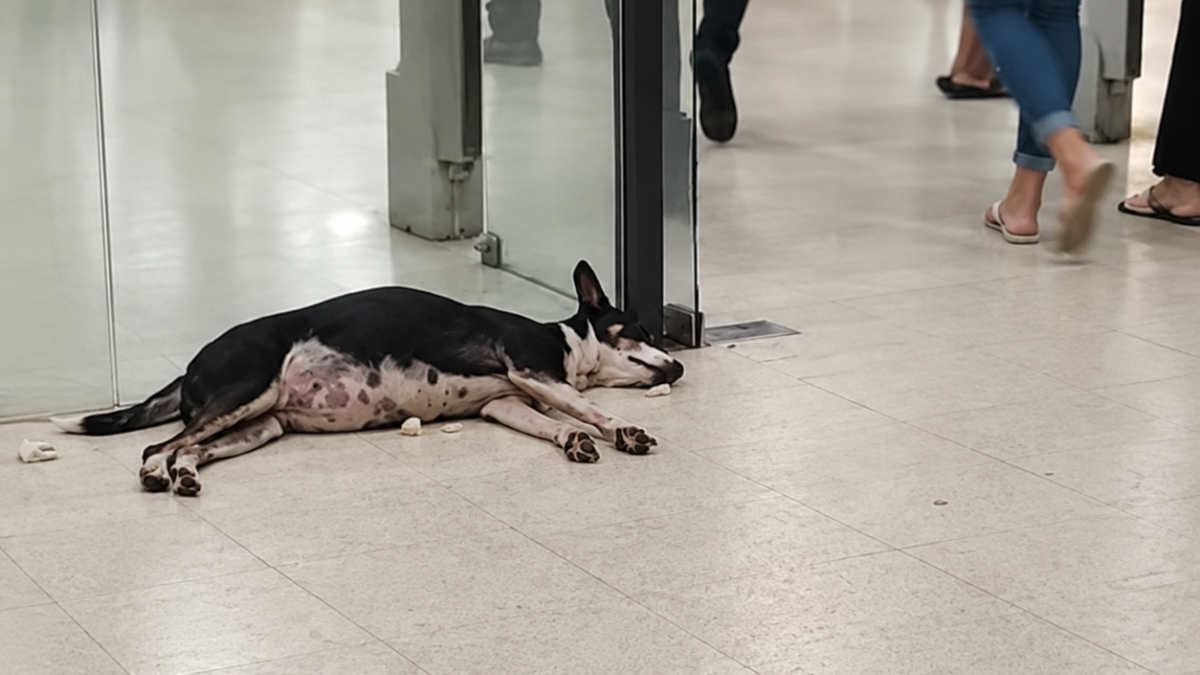
Five days before giving birth, a heavily pregnant dog collapsed outside a shopping mall after waiting almost an entire day for the person who had walked in with her and apparently left through another exit.
Hundreds of people passed while she lay exhausted and panting—one person even bumped her leg and stepped around her, while another whispered, “Poor dog,” and simply kept walking.
By the time we reached her, her belly was so enormous she could barely move, and we had no idea that saving this exhausted mother would only be the beginning of a much harder fight for her ten puppies.
A security guard told us he had seen the dog enter the mall with her owner.
But the woman apparently never came back for her.
So the dog waited.
Hour after hour.
Pregnant, malnourished, thirsty, and becoming weaker until her body finally gave out.
Food and water helped almost immediately, but one look at her abdomen told us we were running out of time.
We named her Louisa.
Five days later, she gave birth to ten beautiful puppies.
Despite the damage long-term malnutrition had done to her body, Louisa gave everything she had to them.
At first, she barely trusted us.
She stayed wrapped around her litter, watching carefully whenever we came near, as though she feared the babies might disappear too.
Slowly, she realized nobody was taking them away.
She began eating enormous amounts to produce enough milk, and she became one of the most devoted mother dogs we had ever cared for.
By day 30, the puppies were growing beautifully, eating on their own, and the entire family moved to a foster home with a large yard.
It finally seemed as though the worst was behind them.
Authorities even contacted Louisa’s former owner, who claimed she had never realized her dog had followed her to the mall.
But there was one question nobody could understand: if that was true, why had she never gone looking for her?
Then came day 60.
One puppy tested positive for parvovirus.
Within hours, more became sick.
By evening, eight puppies were hospitalized.
And suddenly, after everything Louisa had survived to bring them safely into the world, we were fighting not to lose them.
[END OF FACEBOOK CAPTION]
[FIRST COMMENT / FULL STORY CONTINUATION]
The first time I saw Louisa, she was lying outside a shopping mall as though her body had finally reached the point where waiting was no longer possible.
People were moving around her.
That was one of the things I remember most clearly.
Movement everywhere.
Shoes.
Shopping bags.
Doors opening and closing.
People entering.
People leaving.
The ordinary rhythm of a busy commercial center continuing around a dog whose entire world had stopped.
She was heavily pregnant.
So heavily pregnant that her abdomen looked almost impossibly large against the rest of her body.
Her breathing was fast.
She panted continuously.
Her head rested low.
She did not have the energy to move far enough away from the foot traffic.
And still people passed.
Hundreds, according to what we were told and what the scene suggested.
Some glanced down.
Most kept going.
At one point, someone bumped against her leg.
The person moved around her and continued on.
Another person looked down and said something like, “Poor dog.”
Then walked away quickly.
That detail stayed with me.
Not because sympathy is meaningless.
But because sympathy that never becomes action cannot lift a collapsed animal from the ground.
Louisa did not need someone to think she looked unfortunate.
She needed water.
Food.
Medical attention.
A safe place to give birth.
She needed someone to stop.
By the time we arrived, she looked completely exhausted.
Her tongue was out.
Her sides moved rapidly.
Her legs seemed reluctant to support her.
Even before we knew her story, the physical facts were alarming.
Then the security guard told us what he had seen.
The dog had not simply wandered there alone.
He remembered seeing her enter the shopping center with a woman who appeared to be her owner.
The dog followed her inside.
At some point, the woman apparently left through another exit.
Louisa remained.
We did not immediately know whether that had been intentional.
That mattered.
It would have been easy, looking at Louisa’s condition, to assume the worst and turn assumption into fact.
But rescue work requires separating what we feel from what we can actually establish.
What we knew then was this:
Louisa had entered with her owner.
Her owner left.
Louisa stayed near the mall.
And she waited for nearly a day.
Almost an entire day.
That was the part that broke me.
She could have wandered.
Could have followed strangers.
Could have tried to find food somewhere else.
Instead, she remained near the place where she had last been with the person she knew.
I do not know exactly what a dog understands about abandonment.
I cannot say Louisa was consciously thinking, She will come back through this door.
But her behavior looked like waiting.
She stayed.
Hour after hour.
Pregnant.
Hungry.
Thirsty.
Already weakened by what we would later recognize as long-term malnutrition.
And eventually she collapsed.
The shopping center kept functioning around her.
Doors continued opening.
The person she knew did not come through them.
When we approached, Louisa watched us carefully.
She did not leap up.
She did not have the energy.
I remember crouching near her and trying to understand how close she was to giving birth.
Her stomach was enormous.
Not simply a pregnant belly that had begun to show.
This dog was close.
Very close.
Her entire body seemed organized around the weight she was carrying.
Standing was difficult.
Walking was worse.
Her hind end shifted carefully whenever she tried to move.
The contrast between the size of her abdomen and the condition of the rest of her body was painful.
Pregnancy demands nutrition.
Growing puppies take from the mother whether the mother has enough to spare or not.
A well-fed dog needs increased support during pregnancy.
Louisa had apparently been living with too little for too long.
Her body had been asked to build new lives while struggling to maintain her own.
We brought water.
Then food.
Her response was immediate enough to tell us how much she needed both.
She drank.
She ate.
And after some time, her breathing began to settle.
Not completely.
She was still exhausted.
Still heavily pregnant.
Still physically compromised.
But there was a noticeable difference.
Sometimes rescue begins with remarkably simple things.
A bowl of water.
Food.
Shade.
A vehicle.
A hand that stays instead of walking past.
Those actions do not solve everything.
They create enough stability to reach the next problem.
With Louisa, the next problem was obvious.
She was going to give birth soon.
Very soon.
We needed to move her somewhere safe.
I kept looking at the mall entrance.
Part of me expected a woman to suddenly appear.
To call her name.
To say there had been a terrible misunderstanding.
Nothing happened.
Louisa came with us.
She did not trust us completely.
Why would she?
From her perspective, strangers had approached after hours of uncertainty and were now moving her to another place while she was physically vulnerable.
Pregnant animals can be protective.
A dog whose recent circumstances are unclear may be even more cautious.
So we did not demand affection.
Our first job was not to make Louisa like us.
It was to keep her safe.
We gave her space.
Food.
Water.
A quiet area.
We observed.
We waited.
We began calling her Louisa.
A name made her easier to talk about, but more importantly, it made her feel like an individual in our care rather than simply “the pregnant dog from the mall.”
Louisa.
The name began appearing in every conversation.
Has Louisa eaten?
How is Louisa breathing?
Did Louisa drink?
Is Louisa resting?
How close do we think Louisa is?
The mall slowly became something behind her.
Her immediate world narrowed to safety and preparation.
Five days passed.
Five days.
That number still feels strange.
Only five days separated the exhausted dog collapsed outside the shopping center from the moment she had to bring ten puppies into the world.
Had no one stopped?
Had she remained outside?
Had the heat, cold, foot traffic, stress, hunger, or dehydration continued?
I try not to dwell on alternate endings.
They do not help Louisa.
But the question haunted us.
What would have happened to the puppies if no one had stepped in?
Five days after rescue, labor began.
Louisa’s body was already weakened.
Long-term malnutrition had taken a toll.
We could see it.
She did not have the reserves a mother should ideally have when facing the physical work of delivery and then nursing a large litter.
And this was not a small litter.
Ten.
Ten puppies.
Being a mother to one newborn is demanding.
To ten is almost relentless.
But before the feeding came the birth.
Louisa labored.
She did what her body needed to do.
One puppy.
Then another.
Then another.
We watched carefully.
Every arrival carried relief.
Breathing.
Movement.
A small body.
Another.
The count continued.
By the end, there were ten.
Ten beautiful puppies gathered around a mother who only five days earlier had been lying outside a mall while strangers walked around her.
The emotional contrast was difficult to absorb.
She looked exhausted after delivery.
Of course she did.
But when the puppies were close to her, there was a visible softening in her body.
The source of this story says happiness was clear on her face.
I remember it that way too.
Not as a scientific measurement of emotion.
As an impression based on how she settled with them.
She curled around the litter.
Allowed them to nurse.
Adjusted when they moved.
Cleaned.
Watched.
The tension of labor gave way to maternal focus.
She had made it through.
So had they.
But rescue had not yet become trust.
That distinction mattered.
Louisa allowed us to care for her.
She did not yet believe us completely.
Whenever we approached the puppies, she became alert.
Her head lifted.
Her body remained close to them.
She watched hands carefully.
Sometimes her posture tightened as though she expected us to take a puppy away.
Again, we could not know exactly what she feared.
But her behavior made us cautious.
We did not force closeness.
We did not repeatedly handle puppies for no reason.
Necessary care happened gently.
Then we backed away.
Louisa needed to learn a new fact.
These people approach.
The puppies stay.
Again.
Again.
Again.
Trust grows from patterns.
The first day, she watched intensely.
The next, still cautious.
Then gradually, there were moments when one of us could come near and she did not tense immediately.
She rested.
That was progress.
When Louisa finally seemed to understand that nobody was removing her babies, the change was visible.
She relaxed more deeply.
Her head could remain down while we moved nearby.
She could eat without constantly scanning.
She could sleep while the litter pressed against her.
The safety we had created began reaching her behavior.
That was when we started seeing just how extraordinary a mother she was.
Ten puppies are work.
Constant work.
They need warmth.
Milk.
Cleaning.
Positioning.
They crawl over one another.
Push.
Search.
Cry.
Sleep.
Wake.
Nurse again.
Louisa was surrounded by small bodies almost every moment.
Her own nutritional needs became enormous.
She ate a lot.
Far more than a normal maintenance amount, because her body was now producing milk for ten growing puppies.
We wanted that.
Every meal she finished was fuel.
Not only for Louisa.
For the litter.
Her body had already been depleted before labor.
Now it had to recover while feeding ten.
So food became one of the central parts of her day.
Bowls.
Meals.
Water.
Rest.
Puppies.
Repeat.
I watched her eat and remembered the dog at the mall.
Panting.
Collapsed.
The difference between those scenes was not abstract compassion.
It was calories.
Hydration.
Safety.
Resources.
Love matters, but love becomes real for an animal when it takes physical form.
Food in a bowl is care.
Clean water is care.
A dry place is care.
Medical observation is care.
Enough quiet to nurse ten puppies is care.
Louisa needed all of it.
She received it.
As days passed, the puppies became stronger.
Newborn fragility began turning into the restless energy of growing dogs.
Their bodies filled out.
They moved with more purpose.
They found their mother more efficiently.
They slept in piles.
Then woke and competed again.
Louisa managed them with astonishing patience.
We started calling her one of the most wonderful mother dogs we had ever known.
Not because she was perfect by some sentimental standard.
Because she was attentive.
Consistent.
Despite her own depleted condition, she stayed engaged with them.
And as her nutrition improved, she became better able to sustain the work.
There was also sadness beneath all the joy.
We still did not understand why she had been left.
If it had been intentional, how could someone walk away from a dog this close to giving birth?
If it had somehow been accidental, how could a heavily pregnant dog disappear and not trigger a search?
Those questions stayed.
We did not have answers.
So we contacted authorities.
We asked for the situation to be investigated.
Again, this was important.
Rescue can save the animal in front of you.
Investigation can sometimes prevent another animal from entering the same situation.
We documented what we knew.
The guard’s observation.
Louisa’s condition.
The time she had remained near the mall.
Her pregnancy.
The fact that she had been left there long enough to collapse.
Authorities began looking into it.
Meanwhile, Louisa did not know any of that.
She had more immediate responsibilities.
Ten of them.
The puppies grew.
Day by day, their dependence changed.
At first, Louisa was almost their entire world.
Milk.
Warmth.
Protection.
Then, little by little, they began interacting with more than her body.
They noticed sounds.
People.
Each other.
Food.
Space.
By the time we reached day 30, they were about one month old.
One month.
That milestone felt significant.
The newborn stage had passed.
They were growing well.
They could already feed themselves.
That did not mean they no longer needed their mother.
They did.
But the relationship was changing.
Louisa could get small breaks.
The puppies could eat without every calorie coming through her body.
That mattered for her recovery.
At day 30, we moved Louisa and the litter to another foster home.
Moving a mother and ten puppies is not a tiny logistical event.
You count constantly.
One.
Two.
Three.
Where is that one?
Who moved?
Check again.
Ten small bodies.
One mother watching.
We wanted the transition quiet.
Safe.
The foster home was ready for them.
When they arrived, everyone was happy to welcome the family.
That reception mattered to me.
Louisa’s story had begun, from our perspective, with people walking around her.
Now people were waiting for her arrival.
The emotional direction had reversed.
The new foster space had a large yard.
For Louisa, that was an enormous change.
At the mall, she had waited on hard ground surrounded by strangers.
Now there was space.
A place where the family could move.
Where growing puppies would eventually be able to run.
Where Louisa could step away from them when she needed.
The first time I watched her take in that environment, she looked different.
Less compressed.
Less vigilant.
There is a kind of happiness that looks like expansion.
A dog who has spent days protecting a litter in a confined safe area suddenly has grass, distance, smells, room.
Louisa explored.
The puppies, as they became more mobile, had room too.
They were obedient in the loose way one-month-old puppies can be described as manageable and responsive.
They were healthy-looking.
Growing.
Eating.
The family had reached a point where it seemed reasonable to think the most dangerous part might be behind them.
That is one of the cruel tricks of rescue.
Sometimes the moment you begin relaxing is exactly when the next problem arrives.
But before that happened, authorities reached Louisa’s former owner.
A woman.
They contacted her for clarification.
Her explanation was that she had not known Louisa followed her into the shopping mall.
She said she did not realize the dog had come with her.
That was her statement.
We listened.
And then the obvious question remained.
If Louisa was her dog, and Louisa disappeared, why had she not searched?
Why did nobody come back to the mall?
Why did a dog this pregnant remain there nearly a day?
The answer was not clear to us.
I do not pretend to know exactly what was in that woman’s mind.
Perhaps authorities learned more than we did.
Perhaps there were circumstances we never fully understood.
But from our position, the explanation did not resolve the central problem.
Louisa had been missing.
Louisa had been close to labor.
Louisa had waited until collapse.
No one who knew her came.
That fact remained.
The investigation continued.
We returned our attention to the dogs.
For a while, things went beautifully.
That may be why day 60 hit so hard.
Two months into the story.
The puppies were no longer fragile newborns.
They had grown.
They had survived the first month.
They had food.
Foster care.
Space.
We had been careful.
We had not allowed casual contact with unknown animals.
We were already conscious of disease risk.
Then one puppy became sick.
Testing was done.
The result came back positive for parvovirus.
Parvo.
The word changed the entire atmosphere.
Anyone who has cared for puppies knows how frightening infectious disease can be.
Young dogs can deteriorate quickly.
They can become dehydrated.
Weak.
Lose appetite.
Need intensive treatment.
The source of our experience at the time described their chances in frightened, very pessimistic terms.
What mattered practically was that we understood this could become serious fast.
The other puppies went into quarantine.
Immediately.
We tightened everything.
Contact.
Movement.
Cleaning.
Observation.
We watched every puppy.
Who ate?
Who looked tired?
Who had stool changes?
Who seemed different?
When you have a group of puppies, normal activity is chaos.
They tumble.
Sleep suddenly.
Wake suddenly.
Eat unevenly.
You have to learn what is normal for each one.
Now every quiet puppy looked suspicious.
Every meal mattered.
The first positive case was frightening enough.
Then more began showing symptoms.
Three additional puppies were hospitalized.
That brought the crisis into a different category.
One case might have remained isolated.
Four sick puppies meant something was moving through the litter.
We were confused.
They had been quarantined.
Contact with other animals had been limited.
We kept asking the same question.
How?
How did this happen?
Where had exposure occurred?
Had the virus already been present before we realized?
Had there been contamination we missed?
The source does not give a definitive explanation.
We never reached an answer that made the situation feel understandable.
That uncertainty was exhausting.
People like causes because causes create the illusion of control.
If you know exactly how something happened, you can tell yourself what to prevent next time.
Here, we were already trying to be careful.
And still puppies were getting sick.
By evening, the number had climbed again.
Five more puppies were admitted to the hospital.
In total, eight puppies were now under veterinary care.
Eight.
I remember hearing the number and feeling as though the floor had changed.
Ten puppies had been born.
Eight were now at the vet.
Louisa remained the center of a family suddenly scattered by illness.
We had gone from counting puppies for growth to counting them in hospital beds.
The emotional whiplash was almost unbearable.
Only weeks earlier, everyone had celebrated the foster move.
Big yard.
Healthy puppies.
A mother gaining confidence.
Now we were terrified.
The veterinary team did everything they could.
This is where I refuse to invent detailed treatments the source does not provide.
I will not add specific medications, transfusions, feeding tubes, or procedures we were not told about.
What I know is that the doctors treated them actively.
They worked.
We waited.
There are few forms of helplessness worse than having multiple sick puppies hospitalized at once.
You cannot personally control every body.
You cannot tell a puppy to fight.
You cannot bargain with a virus.
You can authorize care.
Provide information.
Follow instructions.
Wait for calls.
Hope.
That is all.
The situation felt out of our control because it was.
That was one of the most difficult admissions.
Rescuers become accustomed to solving visible problems.
Hungry?
Feed.
Thirsty?
Water.
Pregnant?
Safe nesting area.
Needs foster care?
Arrange it.
But disease can ignore effort.
You can do many things right and still face loss.
We had to accept that possibility while continuing to hope.
Louisa did not understand where the puppies had gone.
At least, she could not understand in human terms.
Her litter had been around her constantly.
Then illness separated them.
Again.
This time not because they were simply moving to foster care.
Because they were sick.
I watched Louisa’s behavior and felt sick myself.
She had already shown how protective she was after birth.
How anxious she became when we approached the litter.
We had spent weeks teaching her that her puppies were safe with us.
Now we were carrying them away to the hospital.
Necessary.
Absolutely necessary.
But from her perspective, all she could experience was absence.
We did not know how to explain it.
We kept her cared for.
Fed.
Close to whichever puppies remained with her during different stages.
We tried to maintain as much stability as possible.
But the household felt wrong without the full litter.
The days blurred.
Updates arrived.
Some better.
Some worse.
We listened to the doctors.
Tried not to react to every small change as if it determined the ending.
Parvo can make recovery uneven.
A puppy may look slightly better, then worse.
Hope becomes dangerous if you let every small improvement convince you the crisis is over.
Fear becomes dangerous if every setback convinces you recovery is impossible.
We lived between the two.
Then came the news we had been dreading.
Not all of them survived.
Four puppies died.
Four.
I wish I could write that sentence in a way that makes it less final.
I cannot.
We had started with ten.
Louisa had delivered ten despite her depleted body.
She had nursed them.
Cleaned them.
Protected them.
We had watched them grow.
They had reached one month.
Then two.
We had believed we were moving toward easier days.
And four were gone.
There is no rescue language that makes loss noble.
We did not say they had fulfilled some purpose.
We did not tell ourselves everything happens for a reason.
They were puppies.
They should have had more time.
We were devastated.
The source of the story says Louisa seemed sad when she saw four puppies return.
I remember the moment as another quiet shift in her behavior.
Four of the recovering puppies came back into her space, and the family looked suddenly smaller.
Whether Louisa counted the way humans count, I do not know.
Whether she understood death as we do, I cannot know.
But mother dogs know presence.
Smell.
Sound.
Bodies.
A litter has a shape.
And the shape had changed.
Louisa looked subdued.
She stayed near the puppies who were there.
I did not need to claim human grief to feel the sadness of that scene.
The absence was visible enough.
Four puppies had not survived.
The surviving puppies were still recovering.
They had been through illness severe enough to require hospitalization.
But gradually, those who returned became more active.
That was the beginning of the next phase.
Not happiness exactly.
Not yet.
Relief mixed with grief.
A puppy stands.
Good.
A puppy eats.
Good.
A puppy plays weakly.
Good.
Then your mind remembers the four who are not there.
Both emotions coexist.
That is rescue after loss.
You do not get to choose only one.
We were grateful for survivors.
Heartbroken for the dead.
Louisa cared for whoever was still beside her.
That is what animals do.
They live inside what remains.
Humans are the ones constantly comparing present numbers to past numbers.
Ten.
Eight hospitalized.
Four died.
The mathematics became a wound.
I tried to stop reducing them to numbers.
They were individual puppies.
The source does not give their names or separate personalities, so I will not invent them.
But they were not interchangeable.
Four losses were four lives.
The surviving puppies were not replacements.
They were survivors.
That distinction matters.
The virus had taken almost everything emotionally from us.
That is how it felt.
We had gone from rescue optimism to fear and loss.
But it had not taken Louisa.
It had not taken every puppy.
And that meant our job was not finished.
We could mourn and still care.
Again, practical love.
Food.
Cleaning.
Observation.
Veterinary follow-up.
Keeping the recovering puppies close.
Keeping Louisa supported.
We decided that the puppies would remain with their mother through the rest of this journey.
I did not want to separate them again if we could safely avoid it.
That decision came from everything we had seen.
Louisa had been separated from the person she knew at the mall.
Then had to learn to trust us around her newborns.
Then the litter moved foster homes.
Then illness forced hospital separation.
Enough.
Whatever came next, we wanted the family together as much as health and safety allowed.
Here, they could begin again quietly.
Peacefully.
No mall entrance.
No endless waiting.
No crowded hospital if treatment was no longer needed.
No forced separation beyond what had already been necessary.
A quieter life.
That became the goal.
The word “new life” is used often in rescue stories.
Sometimes so often it loses meaning.
With Louisa, I knew exactly what it meant.
A new life did not mean pretending the old one never happened.
The mall still existed.
The former owner’s explanation still raised questions.
Long-term malnutrition had still weakened Louisa.
Four puppies had still died.
No amount of positive language could erase those facts.
A new life meant the next day did not have to repeat them.
That is enough.
Louisa could eat.
Rest.
Stay near her puppies.
Move through a yard.
Respond to people who had proven they would return.
The surviving puppies could recover.
Grow.
Play again.
That was the future we could offer.
Not perfect.
Real.
I think back often to the first hours outside the shopping center.
People walking past.
One person bumping her leg.
Another saying “poor dog.”
The guard remembering the owner.
Louisa panting.
What strikes me now is how close the entire future was to never happening.
Five days.
Only five.
The ten puppies were already almost ready to enter the world.
Louisa had almost no margin.
A dog in that condition does not need abstract sympathy.
She needs intervention.
Someone finally intervened.
That gave her a chance to deliver safely.
It gave the puppies a chance to live at all.
Four were later lost to parvo.
That loss is terrible.
But it does not make the rescue meaningless.
Without the rescue, we cannot know what would have happened.
We do know the family at least had care.
The puppies who died were not alone outside a mall.
They were treated.
Doctors tried.
They were fought for.
That matters.
It does not make death acceptable.
It makes the response humane.
Sometimes that is all rescue can guarantee.
Not survival.
Care.
That truth is painful but important.
We like stories where effort equals outcome.
Feed the dog, dog recovers.
Treat the puppy, puppy survives.
Life is not always fair enough to obey that equation.
Four puppies taught us that.
We did everything we could.
Doctors did everything they could.
Still, they died.
I do not turn that into failure.
The loss was real.
So was the effort.
Both truths.
Louisa’s survival and the surviving puppies’ recovery became more precious because we stopped assuming care could control everything.
Care does not control.
It accompanies.
It improves chances.
It reduces suffering.
It creates safety.
Sometimes it saves.
Sometimes it cannot.
But it remains morally necessary either way.
Louisa taught me the first part.
The puppies taught me the second.
When I look at Louisa now in my memory, I do not want to see only a mother dog.
She was a mother, yes.
An extraordinary one.
But her life mattered beyond reproduction.
This is important because the entire story could accidentally reduce her to what happened to her puppies.
Pregnant dog.
Ten puppies.
Parvo.
Loss.
But before and after those events, Louisa was an individual.
She had hunger.
Fear.
Trust.
Preferences.
A body that needed recovery.
A relationship to people.
A life that deserved stability.
She had spent so much of the early story giving.
Pregnancy.
Birth.
Milk.
Protection.
We needed to care for her too.
That is why food remained important even after the puppies began eating themselves.
Her body had been depleted before pregnancy ended.
Nursing ten intensified that.
Recovery was not automatic just because labor was over.
We watched her condition.
Made sure she ate.
Let her rest.
As the puppies became less dependent, more nutrition could remain with Louisa rather than being converted into milk.
That change mattered.
Her own strength could return.
I remember the first time she moved through the larger foster yard with no immediate puppy attached to her.
Just a few minutes.
A mother stepping away.
Sniffing.
Looking around.
She was allowed to be a dog.
Again, the source does not give detailed play behavior or special routines, so I do not invent them.
The simple fact of space was enough.
A yard.
Room.
The possibility of movement.
Contrast with the mall.
Contrast with confinement around a litter.
That is freedom on a modest scale.
I loved it.
I also thought about her former owner’s explanation more than I wanted.
“I didn’t know she followed me.”
Maybe.
We reported facts.
Authorities contacted her.
We did not personally deliver a legal verdict.
That restraint matters.
But one question continued to bother all of us.
If your heavily pregnant dog disappears, what do you do?
You look.
You call.
You return to places.
You ask.
You search.
At least, that is what we would expect.
The source gives no evidence of such a search.
Louisa waited near the mall until she collapsed.
That absence of a search was what made the explanation so difficult for us to accept emotionally.
I leave the final judgment to the authorities who handled the case.
Louisa did not need us consumed by anger forever.
She needed us present.
So eventually I stopped rehearsing the former owner’s words.
They changed nothing about the bowl in front of Louisa.
Nothing about parvo.
Nothing about grieving puppies.
Nothing about the future.
There is a point where investigation belongs to institutions and healing belongs to daily care.
We reached that point.
I turned my attention back to Louisa.
That shift helped.
Anger can create energy at first.
It can motivate reporting.
Documentation.
Action.
But sustained anger can take resources away from care.
Louisa deserved more of me than the person who left her.
So I gave my attention to the dog who stayed.
That is how I think of her now.
The one who stayed.
At the mall.
With the puppies.
Through labor.
Through nursing.
Through foster moves.
Through disease.
Louisa stayed.
Not because she understood our narrative about loyalty.
Because she lived where she was and cared for the lives around her.
Still, the pattern was powerful.
Her owner disappeared from the scene.
Louisa remained beside her litter.
Again, I avoid simplistic moral comparison between human and animal behavior, but emotionally it was difficult not to feel the contrast.
The dog everyone might have considered dependent was the one doing the most consistent caregiving.
She deserved consistency back.
We tried to give it.
The puppies, as they recovered, began showing more activity.
That was what we watched for.
Movement.
Interest.
Food.
Energy.
Each small increase felt like permission to believe the crisis might truly be ending.
Not erased.
Ending.
There is a difference.
A crisis can end while grief remains.
Our household did not suddenly become joyful because the survivors were improving.
We still remembered the four.
But the day-to-day medical emergency began loosening.
We could think beyond the next phone call.
Beyond whether another puppy would be admitted.
Beyond whether everyone would survive the night.
Future returned.
That is a major milestone after prolonged crisis.
The future can feel dangerous when every new hour brings bad news.
Then one day, you make a plan for next week.
That is hope.
Not a speech.
A plan.
Where will Louisa stay?
Where will the puppies stay?
How do we keep them together?
How do we let them recover calmly?
Those questions meant we believed there would be a next phase.
We were ready for it.
The source ends with us saying we were prepared for that beautiful journey with her.
That is how it felt.
Not because everything ahead would be easy.
We had learned not to promise easy.
But new.
Quiet.
Peaceful.
Those words were enough.
Louisa had spent too much of her story surrounded by uncertainty.
Mall doors.
Waiting.
Labor.
Protecting puppies.
Authorities.
Foster transfer.
Parvo.
Hospitalization.
Loss.
Quiet was a luxury.
Peace was a goal.
We wanted ordinary days.
Meals without emergency.
Puppies sleeping because they were tired from being puppies, not because illness had drained them.
Louisa resting because she wanted to, not because she had collapsed.
Those differences matter.
A normal day can be the best possible rescue ending.
I began to understand that more deeply with Louisa.
People often want dramatic finales.
Adoption ceremonies.
Reunions.
Arrests.
Miraculous recoveries.
The source of Louisa’s story gives none of those.
And it does not need them.
She was safe.
The surviving puppies were improving.
They would remain together.
The most dangerous chapter had passed.
That is enough.
I do not invent permanent adopters for every puppy.
The source does not say.
I do not invent a legal punishment for the former owner.
The source does not say.
I do not invent that Louisa forgot the woman who once owned her.
We cannot know.
I do not invent that she lived ten more years.
We cannot know.
I stay where the story stays.
Mother.
Puppies.
Together.
Safe.
A new future in front of them.
That is an honest ending.
And honesty matters more than a more dramatic conclusion.
Still, I cannot help returning to certain images.
Louisa outside the mall.
Louisa eating after rescue.
Louisa five days later surrounded by ten newborns.
Louisa watching us carefully, afraid we might take them.
Louisa later relaxing.
Louisa eating enough to make milk.
Louisa in a larger yard.
The puppies one month old.
The positive test on day 60.
Eight hospitalized.
Four lost.
Four returning to her at one stage, their bodies recovering.
Louisa lowering herself beside them.
The story moves through bodies.
Tired body.
Pregnant body.
Nursing body.
Sick puppy bodies.
Recovering bodies.
This is why care must also be physical.
Emotional language alone would be dishonest.
Rescue is dirty sometimes.
Exhausting.
Medical.
Full of cleaning.
Feeding.
Monitoring stool.
Watching appetite.
Transport.
Quarantine.
Counting.
Washing.
Calling veterinarians.
Waiting.
The source does not list every task, so I do not fabricate a procedural diary.
But the reality sits behind the events.
Parvo did not resolve through hope.
Doctors worked.
Caregivers maintained quarantine.
People watched.
That labor matters.
I honor it without inventing detail.
The same with Louisa’s early malnutrition.
She did not recover because we called her beautiful.
She recovered because food and care became consistent.
That practical foundation is what allowed trust and happiness to emerge.
I think that is one of the central lessons in all rescue stories.
Love is a verb with infrastructure.
You need bowls.
Transportation.
Veterinary access.
Foster homes.
People willing to wake up and check.
Good intentions without systems can fail animals.
Louisa needed both.
Compassion got us to the mall.
Organization carried her beyond it.
The second foster home with the large yard was part of that organization.
So was quarantine.
So was hospitalization.
So was reporting to authorities.
Different kinds of care.
All connected.
I sometimes think of the people who walked past and wonder what prevented them from stopping.
Fear of dogs?
Being late?
Assuming someone else would help?
Not knowing what to do?
Discomfort?
We cannot know.
It is easy to judge a crowd from outside.
Harder to understand each individual.
Still, the result was the same.
Louisa stayed on the ground.
This is why I try to turn the memory into a practical lesson rather than a moral performance.
If you see an animal clearly in distress and you can safely help, do something appropriate.
Call someone.
Notify security.
Contact local rescue.
Bring water if safe.
Do not assume another person has already taken responsibility.
Because sometimes everyone assumes.
And the animal waits.
Louisa waited almost a day.
That is too long.
The sentence “poor dog” did nothing for her.
Action did.
That is what I remember.
At the same time, not everyone should approach an unfamiliar pregnant dog directly.
Safety matters.
Call trained help when needed.
Again, practical compassion.
Not reckless heroics.
The people who eventually intervened created a chain of care.
That is what mattered.
I think about the security guard too.
His observation gave us a critical piece of the story.
Without him, we might have assumed Louisa had wandered there alone.
He had seen the entry.
Dog with owner.
That fact shaped the investigation.
Observation matters.
People who work in public places often notice patterns others miss.
The guard’s memory gave Louisa a voice she did not have.
Not a complete story.
But evidence.
I am grateful.
Then authorities carried the question further.
Again, a chain.
No one person does every part.
Rescue works when different people contribute what they can.
A passerby notices.
A rescue responds.
A guard remembers.
A foster opens space.
A veterinarian treats.
Authorities investigate.
The dog benefits from collective action.
Louisa’s story is full of that.
That is why I resist narratives where one rescuer “saves everything.”
We did not.
Many people held different parts.
Even the doctors during parvo carried a part we could not.
We were terrified.
They treated.
Teamwork.
That is the real structure.
Louisa herself carried the heaviest biological work at the beginning.
Birth.
Nursing.
Ten puppies.
She deserves recognition too.
Again, not romanticizing maternal sacrifice.
Her body should have been better nourished before pregnancy ended.
She should not have had to do so much while depleted.
Her devotion does not excuse the failure that put her there.
Important.
People sometimes admire mothers so much that they normalize what they endure.
“She’s so strong.”
Yes.
But strength should not become permission to neglect.
Louisa was strong.
She also needed help.
Both true.
Her body deteriorating from long-term malnutrition was not proof of love.
It was evidence that care had been insufficient.
Her continued nursing was maternal behavior within that condition.
We helped so the strength did not have to carry everything alone.
That is the humane response.
The same with surviving puppies after parvo.
We could call them fighters.
Maybe that language feels uplifting.
But they survived because bodies, treatment, and care interacted.
We do not need to assign moral virtue to survival.
The four who died were not weaker in character.
They were sick.
That distinction matters.
Survival is not a measure of worth.
All ten mattered.
The four lost mattered just as much.
I refuse to turn their deaths into a motivational contrast.
The survivors do not become “better fighters.”
They were fortunate enough to make it through.
We cared for them.
That is enough.
This perspective helped with grief.
Otherwise, people ask terrible questions.
Did we not try hard enough?
Did they not fight enough?
No.
Disease can kill despite effort.
Accepting that prevents unfair blame.
We mourned.
Then cared for who remained.
Louisa seemed to do the same in her own nonhuman way.
She stayed near the puppies who were there.
Life continues through presence.
That is perhaps one of the gentlest lessons animals give us.
Humans carry absence in stories.
Animals often orient toward the bodies still nearby.
Again, I do not claim they do not grieve.
They can show behavioral changes after loss.
Louisa seemed subdued.
But she also continued mothering.
Both.
Grief and function.
That helped us too.
Feed the puppies.
Clean.
Watch.
Do the next thing.
The next thing keeps you moving when the whole story feels too heavy.
That is rescue.
One task.
Then another.
Eventually a day passes.
Then another.
And one morning, the surviving puppies are more active.
Hope returns through behavior.
Not philosophy.
A tail.
A meal.
A play movement.
These are the signs.
We held onto them.
Louisa’s new life after all of this would be quieter by necessity.
She had already experienced enough intense transitions.
I wanted her future to be repetitive in the best way.
Same safe place.
Same people.
Food reliably.
Puppies nearby.
No sudden disappearance.
That is what peace means to an animal more than abstract freedom, I think.
Predictability.
Again, based on behavior and welfare principles generally, but in this story I keep it simple.
Louisa relaxed when safety repeated.
So we repeated.
That is enough.
The source says she still remembered her old owner.
I phrase this carefully.
We believed some attachment or memory remained.
Dogs recognize familiar people and routines.
The owner was part of Louisa’s history.
We did not expect rescue to erase that overnight.
Nor did we need it to.
A dog can carry previous attachment and still build new trust.
There is no requirement to forget in order to heal.
Humans sometimes want rescued animals to reject old owners emotionally because it makes the moral story cleaner.
Animals do not owe us that.
Louisa may have remembered.
That does not invalidate her new safety.
It simply means her life had history.
We respected it.
When authorities contacted the former owner, we wanted facts.
Not emotional revenge.
Her claim—that she did not know Louisa had followed her—became part of the record.
We still had questions.
But Louisa’s care did not depend on getting satisfying answers.
That was freeing.
Sometimes closure is unavailable.
You build forward anyway.
Louisa did.
So did we.
There is a point in every rescue story where the original person who failed the animal must stop being central.
Otherwise, the animal’s future remains narratively owned by the person who caused the harm.
I did not want that for Louisa.
The owner mattered in the beginning.
Then less.
Louisa grew larger in the story.
Her puppies.
Her foster home.
Her recovery.
The parvo crisis.
Her continued motherhood.
Those became central.
That is healthier.
The past explains.
It should not dominate forever.
I think about the title people might give this story.
“Left behind five days before labor.”
Accurate enough emotionally.
But Louisa’s story is not only being left.
It is what came after.
Wait.
Collapse.
Rescue.
Birth.
Trust.
Motherhood.
Loss.
Recovery.
Future.
If we stop at abandonment, we miss most of her life.
That is why the full story matters.
A headline captures injury.
A life contains more.
Louisa deserves the more.
She is not simply “the abandoned pregnant dog.”
She is Louisa.
Mother of ten.
Careful.
Protective.
Slow to trust.
Hungry enough to eat enormous amounts while nursing.
Able to relax when safety became real.
Moved to a larger foster space.
Present through illness and loss.
Still there at the end.
That identity is richer.
The puppies also deserve more than “parvo litter.”
Before disease, they were growing well.
One month old.
Feeding themselves.
Manageable.
Welcomed.
After disease, surviving puppies became active again.
Illness is a chapter.
Not total identity.
This matters because trauma-focused storytelling can accidentally freeze animals at their worst.
I prefer arcs.
Who were they before the crisis?
Who after?
What remains?
Louisa remains a mother.
The puppies remain puppies.
Life continues.
That is hope.
I do not need to promise a perfect future.
Just a future.
The source says one waits for them.
Good.
Let that remain open.
A new journey.
Not a guaranteed fairy tale.
A possibility.
That is more honest.
Perhaps permanent homes come later.
Perhaps not.
The source stops before that.
We stop there too.
I know the user often values complete satisfying endings.
A complete ending does not require closing every future door.
It requires closing the central emotional question.
Will Louisa remain abandoned and alone?
No.
Will her surviving puppies remain without care?
No.
Are they together and safe at the end?
Yes.
That is satisfying.
The legal question remains partly open.
The adoption future remains open.
But the emotional crisis has resolution.
Safe.
Together.
Recovering.
That is enough.
I return one last time to day 60.
Why?
Because day 60 taught us not to confuse progress with invulnerability.
We had been proud.
Puppies growing.
Foster yard.
Owner contacted.
Maybe we thought the story was moving neatly toward closure.
Then virus.
Stories in real life do not respect neat arcs.
That makes truthful retelling more powerful.
There is no simple upward line.
Rescue.
Birth.
Improvement.
Then collapse again.
Loss.
Then improvement again.
That is life.
If I had invented the story, I might have made all ten puppies survive.
It would feel kinder.
But it would be false.
Four died.
We honor them by not erasing the loss for a happier ending.
At the same time, we do not let the deaths erase the survivors.
Balance.
Truthful emotion.
That is the hardest part.
People sometimes think a sad event ruins the rescue success.
It does not.
The story becomes more complicated.
That is all.
Louisa was still saved from the mall.
Ten were still born alive.
Four were lost.
Others survived.
Both success and loss coexist.
We do not have to choose a single label.
Life is rarely that tidy.
I find peace in complexity now.
Maybe that is what the story gave me.
You can be grateful and heartbroken in the same hour.
You can celebrate a puppy standing while mourning another.
You can be angry at a former owner and still focus on care.
You can call Louisa an amazing mother while wishing she never had to struggle so hard.
Contradictions do not cancel each other.
They make the truth complete.
Louisa’s journey is complete enough for me.
Not because every problem vanished.
Because she is no longer waiting outside that mall.
That image belongs to the past.
Now, in the final image, she is with the puppies who remain beside her.
There is space.
Care.
People around them who want them there.
No one stepping over her.
No one merely saying “poor dog” and disappearing.
That is a real transformation.
From ignored to protected.
From waiting to belonging.
From collapse to motherhood.
From fear of losing puppies to keeping them close.
From chaos to a quieter future.
This is where I want to leave her.
Not at the hospital.
Not at the mall.
At the threshold of peace.
The surviving puppies becoming more active.
Louisa still caring for them.
People ready for the next stage.
The worst behind them, at least for now.
No more unnecessary separation.
That is a good ending.
I remember looking at Louisa and thinking how strange it was that one dog’s life could contain so much in sixty days.
A mall floor.
Ten births.
A new foster home.
An investigation.
A contagious disease.
Eight puppies hospitalized.
Four deaths.
Recovery.
Most humans would need years to process that many changes.
Dogs do not narrate time as we do.
They adapt through routines.
So we gave Louisa a routine.
Feed.
Rest.
Puppies.
Yard.
People.
Repeat.
Let the nervous system settle through predictability.
Again, we do not need a technical psychological explanation.
The behavioral effect was enough.
She relaxed when things became safe.
That is what we wanted to continue.
I think of the large yard again.
At day 30, it represented possibility.
After parvo, it represented return.
A place puppies could eventually use again when safe.
A place not defined by illness.
Environment can hold multiple meanings over time.
Mall: waiting.
Foster yard: growth.
Hospital: fear.
Home again: recovery.
The story moves through places as much as events.
That spatial movement mirrors emotional movement.
Away from public neglect.
Toward private care.
Beautiful.
No need for more.
I want to mention the moment Louisa first ate and drank after collapse because it shows how close care often is to obvious need.
There is something almost infuriating about it.
She felt better after food and water.
Not cured.
But better.
Such basic things.
It means some part of her suffering outside the mall was preventable in the simplest possible way.
That is what neglect does.
It turns basic needs into emergencies.
Rescue reverses.
Give basics consistently until they stop being emergencies.
Louisa eventually ate not as a starving abandoned dog but as a nursing mother with regular meals.
That change is huge.
Same act.
Eating.
Different context.
One is survival.
One is care.
Then later, as puppies fed themselves, eating could become Louisa’s own nourishment again.
Progress measured through bowls.
I like that concrete metric.
No metaphors needed.
Similarly, puppies feeding themselves at one month was a milestone.
It relieved pressure on Louisa.
It meant development.
Growth.
Independence beginning.
Then parvo interrupted.
But development resumed in survivors.
Again, not linear.
Still movement.
I can imagine nothing more satisfying than seeing a recovering puppy eat independently after hospitalization, though the source does not explicitly give that scene, so I will not claim it happened in a specific moment.
I only know they became more active.
That is enough.
Activity after severe illness is an encouraging sign.
We celebrated it.
One step at a time.
I also think about the decision to keep them with Louisa “until the end,” as the source phrases it.
I interpret that as through the remainder of this recovery journey, not a literal guarantee they would never be adopted separately later.
Important.
Puppies eventually need individual futures.
The source does not describe those.
So the immediate promise was no more separation during this fragile stage.
That was compassionate.
Louisa had already experienced repeated absence.
The puppies had too.
Let them stabilize together.
Then future decisions could come when the source no longer follows them.
That is responsible interpretation.
No invented lifelong group household.
Just together now.
That is enough.
Perhaps that is one reason the ending feels peaceful.
We are not rushing them into the next transition.
No immediate adoption montage.
No more movement.
Stay.
Rest.
Recover.
Sometimes the best next step is no new step for a while.
After chaos, stability is progress.
Louisa had earned stability.
So had the puppies.
That is where the story closes.
I think about the four puppies who died one last time.
They do not disappear because the story ends hopefully.
Their absence is part of why we guard the remaining family so closely.
I do not name them because the source does not.
I do not invent final moments.
That would be exploitative.
I simply acknowledge them.
Four small lives.
Loved while they were here.
Treated.
Lost.
Remembered.
Then I look back at Louisa.
She is still there.
That matters.
Grief does not require the whole story to stop.
Life and memory can continue side by side.
That is what we did.
If this were only a sad story, it would end with the hospital.
If it were only a happy story, it would hide the deaths.
It is neither.
It is a rescue story.
Which means both.
Pain answered by care.
Loss beside survival.
Uncertainty beside commitment.
That is more honest.
And, to me, more moving.
Louisa’s story also changed how I think about public spaces.
A mall is designed for people to pass through.
That is exactly what happened.
Everyone passing.
The dog waiting.
There is symbolic power there, but the fact is simple.
A place of constant movement can still contain someone who is stuck.
We should notice.
That lesson extends beyond animals, but I will not turn the story into a broad sermon.
Louisa is enough.
She lay there.
People moved.
Someone finally stopped.
Everything else followed.
The importance of one interruption.
Stop.
Look.
Call.
Help.
The future of ten puppies came through that interruption.
Even though four were later lost, six? Here I need caution because source numbers become ambiguous at return stage. Better not calculate survivors. We know four died, some survived. The future of the remaining family came through that interruption.
That is enough.
I sometimes think of the woman who said she did not know Louisa followed her.
Maybe she told the truth.
Maybe not.
I cannot know.
I leave judgment where evidence ends.
But I know what responsibility looks like now.
If a dog in my care disappears, I search.
Pregnant or not.
Old or young.
I do not assume she will find her way.
That seems obvious.
Louisa makes obvious responsibility emotionally vivid.
Perhaps that is useful.
Stories do not always teach new principles.
Sometimes they make us feel the importance of principles we already know.
Feed.
Search.
Protect.
Do not abandon.
Get medical help.
Simple.
Yet when ignored, lives suffer.
Louisa shows the stakes.
That is enough lesson.
At the end, I do not want her framed as loyal because she waited for someone who may have failed her.
Loyalty is often romanticized in dogs to the point of making their suffering beautiful.
I resist that.
Louisa’s waiting was not beautiful.
It was dangerous.
Her body collapsed.
There is nothing romantic about a pregnant dog waiting almost a day without adequate support.
If we call her loyal, we should not use loyalty to excuse the human who did not return.
Her devotion is hers.
Our responsibility is ours.
Important.
The title may say loyal dog waits outside mall.
Fine.
But the full story should reveal the cost.
Loyalty without reciprocal care becomes vulnerability.
Louisa deserved reciprocity.
She finally received it from the people who stepped in.
That is the better love story.
Not waiting.
Being cared for after waiting ends.
I want that distinction clear.
She did not need to prove loyalty to deserve rescue.
Even if she had wandered immediately, she still deserved help.
Her waiting simply tells us something about her behavior.
Worth is not conditional.
Same with motherhood.
She did not need to be an amazing mother to deserve food.
She deserved food because she was a living being dependent on human care.
The fact she mothered ten puppies devotedly is beautiful.
Not a prerequisite.
These moral distinctions matter because sentimental stories can accidentally reward suffering.
I want to honor without glorifying.
Louisa survived malnutrition.
I wish she had never been malnourished.
She waited.
I wish she had never needed to.
She delivered ten.
I wish her body had been stronger.
She nursed.
I wish that nourishment had not required her already depleted body to work so hard.
Four puppies died.
I wish they had lived.
The story is meaningful not because bad things were necessary.
Because people responded once they saw.
That response is the light.
Not the suffering itself.
I think that is why I can end with hope without feeling dishonest.
Hope is not “everything happened for a reason.”
Hope is “what happened will not be allowed to define every next day.”
That is Louisa’s new future.
Past:
Mall.
Collapse.
Now:
Safe place.
Puppies.
Care.
That change is real.
Enough.
Maybe one day the puppies will go to homes.
Maybe Louisa will too.
The source does not say.
We leave that unopened.
I do not need a photograph of adoption to believe this chapter mattered.
Sometimes rescue work is about stabilizing a life so future choices become possible.
We did that.
That is success.
The family had a future again.
At the mall, future looked dangerously narrow.
Five days to labor.
No care.
At the end, future is open.
That is a huge transformation.
Open future.
I like that as the final idea.
No promises about what fills it.
Just possibility.
We were ready for the journey.
That is exactly where the source ends.
I honor it.
I imagine—not as an invented event, but as the emotional frame—the quiet after everything.
Louisa lying down.
Surviving puppies nearby.
No alarms.
No urgent call.
No hospital transport at that moment.
Just breath.
A mother.
Her young.
People nearby who know their history and intend to keep caring.
Peace does not need to be dramatic.
Sometimes peace is simply the absence of the next crisis.
That is enough.
I hope readers understand why that ending feels large to us.
When you have spent weeks reacting to emergencies, an uneventful evening can feel like a gift.
Louisa deserved uneventful evenings.
The puppies too.
So we stopped asking life for a spectacular ending.
We asked for ordinary tomorrow.
Food.
Rest.
A little more energy.
No new symptoms.
Stay together.
That became our dream.
Simple dreams after complicated pain.
There is humility in that.
Rescue teaches it.
You cannot control everything.
You can care.
Then hope.
That is what we did.
If I could return to the first day and whisper anything to the exhausted dog outside the mall, I would not tell her the whole future.
She would not understand the words anyway.
And honestly, I would not want to tell her about the losses.
I would do what mattered then.
Bring water.
Bring food.
Stay near.
Move her somewhere safe.
The future can arrive later.
That is another lesson.
Do not let fear of everything ahead prevent the next necessary act.
When we saw Louisa, we did not know there would be ten puppies.
We did not know about parvo.
We did not know four would die.
We only knew she needed help now.
We helped.
Then the next problem.
Then the next.
That is how impossible stories become manageable.
One step at a time.
If we had somehow known the full hardship in advance, maybe it would have felt overwhelming.
But care is usually given in installments.
Today’s task.
That is enough.
Five days later, labor.
Thirty days, foster move.
Sixty days, parvo.
Numbers marked the journey.
But Louisa did not live by those numbers.
She lived through moments.
Bowl.
Rest.
Puppy.
Touch.
Yard.
Absence.
Return.
Humans keep the calendar.
Dogs keep the present.
Maybe that is why being with them can help us survive hard timelines.
Louisa never asked, “Why day 60?”
She responded to the puppies in front of her.
We tried to follow.
Present.
Who needs care now?
Good question.
Still is.
I think that is where I finally stop.
Not because nothing happened after.
Because this is the last place where the source gives us certainty.
Louisa and the surviving puppies were together.
Their condition was improving.
The worst of the parvo crisis had passed.
They had a safe place to begin again.
We intended to keep them together through recovery.
We were ready for the new journey.
That is enough.
The pregnant dog who once lay outside a shopping mall while people stepped around her no longer had to wait for someone to notice.
She had already been noticed.
The mother who guarded ten newborns with a body weakened by hunger no longer had to protect them alone.
People were helping.
The dog who feared we might take her puppies learned, slowly, that our hands were there to care.
The puppies who survived a terrible outbreak became more active again.
And although four small lives were missing from the family they began as, the lives still there deserved every bit of love we could give.
So that is what we chose to give them.
Not a promise that nothing painful would ever happen again.
No one can make that promise.
A simpler promise.
You will not face the next day alone.
There will be food.
There will be care.
There will be people watching.
There will be a safe place to rest.
And for now, there will be your family beside you.
Louisa waited almost an entire day outside that mall for someone who never came back for her.
At the end of this story, she is no longer the one waiting.
She is the one surrounded.
Surrounded by the puppies still beside her.
Surrounded by people ready to care for them.
Surrounded by the quiet future that once seemed almost impossible.
The mall is behind her.
The hospital is behind them.
The hardest days are behind them.
And whatever comes next, Louisa will meet it in a very different way from the dog we first found collapsed on the ground.
Not abandoned.
Not unseen.
Not alone.
Together.