He dragged his exhausted body through the snow, stopping only once to look into the distance before forcing himself forward again with legs that could barely carry him.
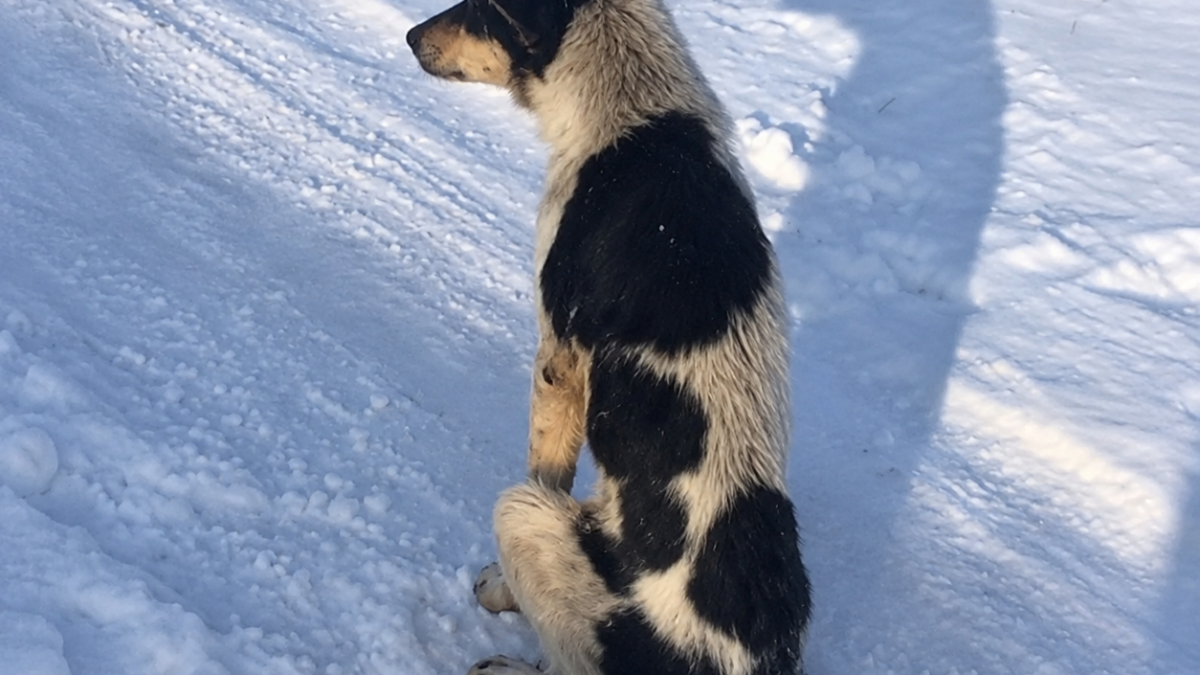
He dragged his exhausted body through the snow, stopping only once to look into the distance before forcing himself forward again with legs that could barely carry him.
At the veterinary hospital, we learned his stomach was packed with foreign objects—likely trash and pieces of plastic he had swallowed while starving—but even that was not the worst thing hidden inside his body.
The doctors found a bullet lodged in the area of his spinal cord.
We named him Bagel.
Before anyone could even begin thinking about whether he might walk again, the doctors had to deal with what was inside his stomach.
He underwent surgery to remove the accumulated foreign material, including pieces of bone and debris that appeared to have been sitting there for days.
He was exhausted afterward.
Then came the news that a second major operation was still waiting for him.
Five days later, Bagel underwent spinal surgery.
For a moment, it seemed to give him a chance.
He tried desperately to stand.
He tried to eat on his own.
He tried to play with us even while pain kept pulling him back down.
But the bullet had already damaged his spinal cord, and sensation in his legs was disappearing.
Doctors later told us that if help had reached him earlier, his chances might have been different.
We had found him too late for that.
So we tried everything that was still possible.
Massage.
Physical therapy.
Rehabilitation classes.
Then a wheelchair.
The first time Bagel realized the wheels could carry him, the dog who had once dragged himself through the snow suddenly took off down the road as if someone had given him his freedom back.
We thought that might finally be the turning point.
Instead, one of his legs continued getting worse until it lost sensation completely.
Then the veterinarian gave us the recommendation I had been dreading.
Amputation.
I needed two days before I could say yes.
And when I finally did, it was because keeping the leg would mean keeping Bagel in pain.
[END OF FACEBOOK CAPTION]
[FIRST COMMENT / FULL STORY CONTINUATION]
The first image I have of Bagel is not inside a clinic.
It is not on an operating table.
It is not in a wheelchair.
It is in the snow.
A dog moving through cold white ground with a body that no longer seemed to obey him properly.
He dragged himself forward.
His hindquarters were weak, his movement awkward and exhausting, and each small stretch of distance seemed to demand more effort than a healthy dog should ever have to give.
There was no joyful running.
No clear destination.
No person beside him.
Only a tired dog pulling himself through the cold.
After he had gone some distance, he stopped.
He lifted his head.
Looked far ahead.
For a moment he seemed to be searching the distance for something.
Someone.
A place.
We could not know.
Then he lowered himself again and continued.
That detail stayed with me.
The looking back—or perhaps simply looking out toward somewhere beyond us.
It was as though a part of him still expected an answer from the world.
None came.
So he kept moving.
Slowly.
Without direction we could understand.
His body told us immediately that something was badly wrong.
The problem was not simple exhaustion from walking in snow.
His movement itself was abnormal.
There was weakness in the rear of his body.
He could not use himself the way a dog should.
And he looked hungry.
Not the kind of hunger that makes a healthy dog stare at a bowl before dinner.
The kind that changes the body.
The kind that makes an animal begin eating things that are not really food because the stomach keeps demanding something.
Anything.
We got him to veterinary care.
At first, we were focused on what we could see.
The weakness.
The way he moved.
His exhaustion.
His condition.
But the doctors began examining the whole dog, and the first major discovery came from his stomach.
It was filled with foreign material.
Not normal food.
Objects.
Debris.
Things a dog should never need to swallow.
The most likely explanation was hunger.
Bagel had probably been searching through garbage.
Plastic.
Discarded bags.
Bits of whatever smelled edible.
Pieces of bone and other debris.
When hunger lasts long enough, the line between food and nonfood can become dangerously thin.
A starving dog does not stand over a trash pile and conduct a careful safety inspection.
He smells something.
His body tells him to eat.
So he eats.
We could not know exactly where each object had come from.
We did not know how many days he had been scavenging.
But the doctors believed some of that material had accumulated inside him over several days.
When they showed us what was happening internally, I felt sick.
He had already been dragging himself through snow with an injured body.
Meanwhile, his stomach was carrying its own emergency.
Foreign material can block.
Cut.
Inflame.
Prevent proper digestion.
Whatever the exact complications in Bagel’s case, the doctors were clear about one thing:
It had to come out.
Surgery could not wait indefinitely.
I remember thinking that perhaps this explained everything.
Maybe once the stomach was cleared and he received nutrition, strength would return.
Maybe the weakness in his legs was partly from starvation.
Maybe the frightening way he moved would improve once his body had fuel again.
Those hopes lasted only until the doctors found what was worse.
A bullet.
There was a bullet lodged in the area of Bagel’s spinal cord.
I remember the silence after hearing it.
A bullet.
Not an old scrape.
Not a minor accident.
Not a simple fall.
Something had entered his body with enough force to damage the very structure responsible for carrying signals between his brain and the rest of him.
Suddenly the way he moved through the snow made sense in the worst possible way.
His body was not simply weak.
His spinal cord had been affected.
And somewhere in that history was a human act we could not explain.
Who had done it?
Why?
Was Bagel someone’s dog?
Had he been deliberately shot?
Had the shooting happened during some other event?
How long had he been like this before we saw him?
We had no answers.
Even now, there are parts of Bagel’s past that remain completely unknown.
No owner came forward with a clear story.
No person stepped up to explain the bullet.
No one told us where he had slept before the snow.
No one told us how long he had been hungry.
All we had was what his body carried.
Trash in the stomach.
A bullet near the spinal cord.
Pain.
Weakness.
And a dog still trying to move.
That was enough.
The first surgery focused on the emergency inside his stomach.
The doctors removed the foreign material.
Among it were bits of bone and other debris that had been collecting there.
It was difficult to look at those things after they had been taken out.
Each piece represented a moment when Bagel had been hungry enough to swallow something unsafe.
Maybe he found it beside a garbage pile.
Maybe in a torn bag.
Maybe somewhere on the street.
We did not know.
I kept returning to the same thought:
How hungry do you have to be before plastic becomes worth swallowing?
How long do you have to go without reliable food before your body stops being selective?
Bagel could not tell us.
His stomach already had.
After surgery, he was exhausted.
That was expected.
He had been weak before the procedure.
Now his body had been through anesthesia and an operation on top of everything else.
He slept.
We watched.
Every time he shifted, we looked.
Every time he opened his eyes, we were there.
There is something about an exhausted dog after major surgery that makes the room feel quieter.
You do not want unnecessary noise.
You do not want to disturb the fragile work happening inside the body.
Healing.
Stabilizing.
Recovering from one crisis while another still waits.
Because Bagel’s story was not finished with the first surgery.
The doctors had removed the foreign material.
That did not remove the bullet.
It did not repair the damage in his spine.
A second major operation was still ahead.
Five days.
That was the interval.
Five days after the first procedure, Bagel underwent spinal surgery.
Those five days were filled with a strange combination of relief and dread.
Relief because the stomach emergency had been addressed.
Dread because the larger question remained.
Could his ability to stand be restored?
Could the damage be reduced?
Was there still enough function left in the spinal cord for recovery?
No one could promise us anything.
That uncertainty is one of the hardest things about spinal injuries.
People want a clean answer.
Will he walk?
Yes or no.
Bodies rarely give answers that quickly.
Swelling matters.
Nerve damage matters.
Time matters.
The exact location matters.
And, crucially in Bagel’s case, how long the injury had gone untreated mattered.
We went into the spinal surgery knowing there was hope, but not certainty.
The operation was performed.
Afterward, Bagel seemed to have been given at least a small opening.
He tried to stand.
That image is burned into me.
A dog whose body had already endured starvation, foreign objects, one surgery, and now a second operation gathering everything he had in order to push upward.
His front half worked harder.
His hind legs struggled.
He trembled.
But he tried.
He tried with an intensity that made everyone around him hold their breath.
Stand.
Just stand.
He got himself partly up.
For a moment, hope rose with him.
Then exhaustion pulled him down.
Bagel tried to eat too.
He wanted to participate in his own recovery.
Wanted to move toward food.
Wanted to do normal things.
But pain and fatigue were always there.
After a while, his strength gave out.
He collapsed from exhaustion and discomfort.
I hated seeing that.
Not because I expected an immediate miracle after surgery.
I knew better.
But effort without reward is painful to witness.
Bagel was doing everything a dog could do.
His body was the part refusing.
The doctors explained what the injury had done.
The bullet had affected the spinal cord.
That was what had taken movement away from him.
That was what had made the snow so hard to cross.
That was what stood between him and normal walking now.
After surgery, pain remained significant.
Discomfort remained.
He could not simply wake and move freely.
There were days when it seemed like every position bothered him.
He tried to play with us once.
That moment almost hurt more than if he had simply stayed still.
His mind wanted to be a young, happy dog.
He moved toward interaction.
Tried to engage.
Then his body reminded him.
He could not.
Movement stopped.
The play ended before it properly began.
I remember kneeling near him and thinking how unfair it was that joy had become physically difficult.
Play should be effortless.
A dog should not need a rehabilitation plan to reach a toy.
But Bagel did.
So we started doing what remained possible.
Massage.
Physical therapy.
Gentle movement.
Repeated treatment.
The purpose was partly to help with pain and discomfort.
Partly to maintain what function he still had.
Partly to encourage any recovery that his nervous system might still be capable of.
We massaged his legs.
Worked carefully.
Watched his reactions.
The therapy was not dramatic.
No instant transformation.
No moment where he suddenly jumped up.
It was repetitive.
Hands.
Legs.
Position.
Movement.
Rest.
Again.
The next day.
Again.
Bagel tolerated it.
More than tolerated it, really.
He seemed happy simply because we were paying attention to him.
That broke something in me.
Here was a dog in pain.
A dog with a bullet in his history.
A dog who had eaten trash out of hunger.
A dog whose body had undergone two surgeries within days.
And yet when people gathered around him gently, he responded with warmth.
He wanted affection.
He wanted to be included.
He wanted love.
The source of his story says Bagel had a huge desire to live and to be loved.
That is exactly how he felt to us.
He did not spend the day crying or complaining.
Even when we knew he was uncomfortable, he was remarkably quiet.
That does not mean he did not hurt.
Dogs do not have to vocalize for pain to be real.
His body told us.
His difficulty moving told us.
His tension told us.
The doctors told us.
But Bagel did not use his pain to push us away.
He seemed almost grateful for company.
I try not to humanize that too much.
I cannot know whether he understood gratitude the way we do.
But his behavior made one thing clear:
He liked being cared for.
He liked hands that were gentle.
He liked voices directed toward him with kindness.
He liked knowing someone was nearby.
Sometimes I would catch him looking at us and wonder what his life had been before.
Had anyone ever stroked him this way?
Had anyone ever sat beside him simply because they wanted to?
Had he lived in a home?
Had someone abandoned him?
Had he been born into neglect?
Had the person who fired the bullet known him?
We knew none of it.
And because we knew none of it, I tried not to manufacture answers.
But there was one thought I could not shake.
Maybe Bagel had been waiting his entire life to be loved.
That thought came back repeatedly.
Especially when he relaxed during therapy.
Especially when he leaned toward us.
Especially when attention seemed to make him happier even on painful days.
Then another thought followed.
Why would anyone do this to a dog like him?
Again, no answer.
The bullet remained a fact without a story attached.
Sometimes that is harder than having an explanation.
Cruelty without context leaves the mind searching.
Maybe if you knew why, anger could point somewhere.
We did not.
So we redirected it.
Not toward an imagined person.
Toward care.
Bagel needed us in the present.
That was something we could control.
Days passed.
Pain did not disappear immediately.
Treatment continued.
Massage.
Physical therapy.
Medication as directed.
Rest.
More treatment.
Slowly, the intensity of his discomfort began to reduce.
It took many days.
There was no single morning when Bagel woke and suddenly looked completely fine.
Recovery happened in small changes.
A more relaxed posture.
Less tension when touched.
A slightly easier movement.
A longer period of rest without discomfort.
Tiny things.
Then, one day, we realized he was finally comfortable enough for a proper bath.
That sounds trivial compared with spinal surgery.
It did not feel trivial.
Bagel had spent days being handled medically.
Cleaned around wounds.
Moved for treatment.
Positioned for therapy.
A warm shower was different.
It was care without a needle.
Warmth without an examination.
Water ran over him.
Bagel sat still.
At first, I expected him to be nervous.
Instead, he seemed to enjoy it.
The warm water touched his body.
His muscles softened.
He remained there quietly, almost as though warmth itself was something new he had discovered.
I watched his face.
The sadness in his eyes was still there.
You could see that his body had been through too much.
But for those minutes, there was also peace.
He was clean.
Warm.
Surrounded by people who were not hurting him.
That should be ordinary for a dog.
For Bagel, it felt like an event.
His eyes made me think again about the story we did not know.
They seemed older than the dog in front of us.
Not old in age necessarily.
Old in experience.
That is human interpretation, of course.
Eyes do not literally narrate biographies.
But anyone who has spent time with traumatized animals knows the feeling.
Sometimes you look at them and understand only this:
Something happened.
Something large.
Something they cannot explain.
Bagel had more visible evidence than most.
A bullet.
That was enough.
As pain eased, happiness began appearing more clearly.
It did not erase the physical problem.
His legs still did not work properly.
The spinal injury remained serious.
But emotional life expanded.
He became more responsive.
More interested.
More curious.
He looked for people.
Accepted touch.
Wanted interaction.
Then something happened at the veterinary clinic that changed him in a different way.
Bagel met a girl.
A beautiful female dog.
The source does not give her name.
We never need to invent one.
What mattered was the effect she had on him.
Their meeting seemed to wake something playful and social in Bagel that pain had been suppressing.
He looked at her.
She looked at him.
They interacted.
And suddenly he was not only a patient.
Not only the dog with the spinal injury.
Not only the dog everyone was worried about.
He was a dog meeting another dog.
That distinction mattered.
Illness can swallow identity.
Every conversation becomes medical.
How is the pain?
Did he eat?
Did he urinate?
Can he stand?
What did the doctor say?
Where is the wound?
How much sensation remains?
Necessary questions.
But an animal still needs experiences that are not treatment.
Friendship gave Bagel one.
His attention shifted.
His expression changed.
There was interest.
Warmth.
Something resembling joy.
The meeting changed him noticeably.
His heart, as we described it, seemed warmer with friendship and affection around him.
Again, I do not claim to know his inner emotional vocabulary.
I know what we observed.
He became brighter.
More engaged.
That mattered.
But friendship could not fix the spinal cord.
We still had a long road ahead.
The central question remained:
Could Bagel ever walk?
Not simply stand for a second.
Walk.
Move independently without dragging himself.
Use his legs.
Feel the ground.
The doctors had not closed the door completely, but optimism was limited.
We enrolled Bagel in rehabilitation.
This became another stage of his life.
A class built around effort.
Movement.
Repetition.
Trainers worked with him carefully.
They were dedicated.
Patient.
The kind of people willing to celebrate tiny changes because they understand that a centimeter can matter.
Bagel worked hard.
That was never the problem.
Motivation was there.
If determination alone could repair a spinal cord, Bagel would have been running almost immediately.
He tried despite pain.
Tried despite fatigue.
Tried even when his legs gave him very little feedback.
The trainers supported him.
Helped position him.
Encouraged movement.
Repeated exercises.
Bagel responded with everything he had.
But his medical condition remained serious.
The spinal cord had been damaged.
Sensation in the legs was already reduced.
In one leg, sensitivity became almost absent.
That was the point when hope changed shape.
At the beginning, hope had meant:
Maybe he will recover enough to walk normally.
Later, we began asking:
How do we give him the best life if normal walking never returns?
Those are very different questions.
The second is not surrender.
It is adaptation.
But emotionally, reaching it hurts.
Because it means accepting that love cannot reverse every injury.
The doctors explained something that hurt even more.
If Bagel had received help earlier, his chance of recovery could have been better.
Earlier.
That word stayed with me.
How much earlier?
Hours?
Days?
We did not know exactly.
But the injury had been present long enough that damage had progressed beyond what treatment could fully restore.
Our help had come too late.
I hated that sentence.
Not because anyone on our team had deliberately delayed.
We helped when we found him.
But timing had already been decided by whatever happened before.
Someone fired the bullet.
Bagel survived.
Then he went without the treatment he needed.
By the time he reached us, the window had narrowed.
Maybe nearly closed.
That is one of the hardest realities in rescue.
You can do everything right after the animal reaches you and still be limited by what happened before.
Medicine does not reset the clock.
We could not travel backward into the snow.
Could not reach him before nerve function disappeared.
Could not stop the bullet.
We could only work with the body we had now.
So we did.
Therapy continued.
More frequently.
Massage.
Rehabilitation.
Observation.
Bagel kept trying.
And we began thinking about mobility assistance.
If his legs would not carry him, perhaps something else could.
We bought him a wheelchair.
A canine mobility cart.
The first time we prepared it, I felt nervous.
Would he understand?
Would he hate being strapped into something?
Would it frighten him?
Would his front body be strong enough to use it?
Would he just stand there confused?
We adjusted it carefully.
Supported him.
Placed him in the cart.
For a moment, Bagel was still.
Then he moved.
One step with the front.
The wheels followed.
Another.
Something seemed to click.
Movement.
Forward movement.
Without dragging the dead weight of his hindquarters through the ground.
Bagel moved again.
Then faster.
I wish I could fully describe the change in him.
The dog who had once dragged himself through snow now had wheels beneath him.
The road opened.
He pushed with his working legs.
The cart rolled.
Bagel accelerated.
His face changed.
His entire body seemed to become more alive.
He ran.
Actually ran in the way available to him.
Wheels turning.
Front legs pumping.
Speed building.
We laughed because we could not believe it.
Bagel seemed thrilled.
There are moments when assistive equipment stops looking like medical equipment and starts looking like freedom.
That wheelchair was one of them.
It did not make his spine normal.
It did not restore sensation.
It did not erase pain history.
It gave him movement.
That was enormous.
Bagel wanted to go fast.
Very fast.
Perhaps because it had been so long since speed was possible.
Perhaps because he was simply a dog and running feels good.
We do not need a grand psychological explanation.
He had the chance to move.
He took it.
Watching him race down the road was one of the happiest moments of the entire journey.
The contrast with the snow was almost unbearable.
Then:
dragging.
Stopping.
Looking into the distance.
Pulling himself again.
Now:
wheels.
Speed.
Direction.
Joy.
That is why mobility devices matter.
They do not represent defeat.
For Bagel, the wheelchair expanded life.
He could explore.
Keep up.
Move with purpose.
Exercise.
Feel the world coming toward him instead of slowly crawling past it.
We began imagining a future around that.
Maybe the legs would not recover fully.
Okay.
He had wheels.
Maybe mobility would always require assistance.
Okay.
He was happy.
A dog’s quality of life does not have to look identical to every other dog’s.
Bagel had found his version.
For a while, we believed the worst was behind us.
That sentence seems to appear often in difficult rescue stories.
We believed the stomach surgery was the hardest part.
Then the spinal surgery came.
We believed rehabilitation might restore function.
Then sensation continued disappearing.
We got the wheelchair and thought:
Now we understand the future.
Then the leg worsened.
More and more.
One leg eventually lost sensation completely.
No meaningful feeling.
The limb was no longer simply weak.
It had become a source of concern in its own right.
The doctors kept trying.
We kept trying.
Treatment became more frequent.
We did not stop because we were tired of the process.
We stopped only when continuing no longer meant helping.
There is a difference.
For a long time, every therapy session carried the same hope.
Maybe.
Maybe sensation will improve.
Maybe circulation and function will stabilize.
Maybe this is the day something changes.
Bagel worked.
Doctors worked.
We worked.
But effort does not guarantee biology will cooperate.
The leg continued deteriorating.
Eventually, the veterinarian said what we had been trying not to hear.
Amputation was necessary.
I remember looking at Bagel after hearing the recommendation.
He was still himself.
Same eyes.
Same desire for attention.
Same excitement when the wheelchair appeared.
But now we had to decide whether to remove one of his legs.
I did not say yes immediately.
I needed two days.
Two full days to think about it.
That fact matters because people sometimes tell animal rescue stories as if difficult medical decisions are obvious once a veterinarian recommends them.
They are not.
You know the logic.
You trust the doctor.
You understand the leg has lost sensation.
You understand pain and complications.
Still, the emotional part says:
Another thing taken from him?
Hasn’t he lost enough?
He lost normal mobility.
He endured starvation.
He swallowed trash.
He carried a bullet in his spine.
He underwent two major surgeries.
He worked through rehabilitation.
And now we remove a leg?
I hated the idea.
For the first day, my mind kept searching for an alternative that perhaps the doctors had missed.
More therapy?
More time?
Another technique?
Something.
Anything.
But wanting another option does not create one.
The medical reality remained.
The leg was no longer helping Bagel.
It was contributing to pain and risk.
Keeping a nonfunctional limb simply because we were emotionally attached to the idea of his body remaining whole would not be kindness.
That was the truth I had to accept.
The second day, I started thinking less about what Bagel would lose and more about what he might gain.
Less pain.
Less discomfort.
A body easier to manage.
A future where the wheelchair could still give him mobility without a useless leg causing suffering.
That changed the decision.
We agreed.
Not because we stopped caring about his leg.
Because we cared more about Bagel than about the leg.
That distinction got me through it.
The surgery was scheduled.
Another operating room.
Another waiting period.
By then, Bagel had been through more veterinary treatment than any dog should need in such a short section of life.
I wondered how he still trusted us.
Every time we brought him to doctors, something uncomfortable followed.
Exams.
Incisions.
Therapy.
Yet he remained affectionate.
That trust made the responsibility heavier.
We had to make sure the procedure was truly for him, not for our convenience.
The veterinarian was clear.
Amputation was necessary to remove the source of pain and protect his quality of life.
So we let the surgeons do their work.
The operation was successful.
Safe.
Uneventful in the way you pray major surgery will be uneventful.
When we got the news that he had come through well, relief arrived differently than after the earlier procedures.
The first surgeries had been attempts to save function.
This one was about ending pain.
That difference mattered.
We had accepted that some restoration was no longer possible.
Now success meant comfort.
There is dignity in changing the goal when the old goal becomes unrealistic.
Bagel did not need us stubbornly chasing a perfect body.
He needed a livable one.
The surgery gave him that.
He recovered.
The wound healed well.
As always, healing took time.
But there were no new dramatic complications described in his source.
The surgical site progressed normally.
Bagel adapted.
That is another thing animals often teach us.
Humans can spend days grieving a decision.
The dog wakes and begins adjusting to the body he has.
Not instantly.
Not without discomfort.
But practically.
What works?
How do I move?
Where are my people?
Where is the food?
Can I still go outside?
Bagel accepted the change with a resilience that made our two days of fear feel almost larger than his own reaction afterward.
We supported him.
Adjusted.
Watched.
Soon, he was able to return home.
Home.
That word meant more after everything.
Bagel had no known owner waiting.
No identified person claiming him.
No one came to explain what had happened.
We still did not know who had fired the bullet.
We did not know whether the shooter and owner were the same person.
We did not know whether Bagel had been abandoned before or after the injury.
We did not know where he came from.
Those questions remained unanswered.
At first, they bothered me constantly.
I wanted a complete story.
A name.
A reason.
Accountability.
Something.
But Bagel did not need us to solve the past in order to live the present.
Eventually, I accepted that.
All we knew for certain was that he was here.
He was loved.
Protected.
Fed.
Warm.
Medically cared for.
No longer dragging himself through snow.
That had to be enough.
The source says no one knows who his owner was or who caused what happened to him.
We leave that uncertainty intact.
Sometimes rescue ends without justice because there is simply no trail to follow.
That is frustrating.
But it does not make the rescue incomplete.
Bagel’s life was the part we could still influence.
So we poured ourselves into it.
His wheelchair became almost an extension of him.
At first, people who had not seen him use it might look at the cart and see disability.
Then Bagel started moving.
Disability was not the first thing anyone noticed anymore.
Speed was.
He could take off like lightning.
That is not exaggeration in the emotional sense.
He moved so quickly that keeping up became difficult.
The front of his body was strong.
His enthusiasm did the rest.
Wheels bounced over uneven ground.
Bagel leaned into motion.
Sometimes we would call after him, laughing because the dog who once could barely move was now creating the opposite problem.
Slow down.
Wait for us.
He did not seem interested in slowing down.
The wheelchair had given him back something he had missed for too long.
Freedom to choose speed.
Imagine what that means for a dog.
The world is made of scent.
Distance.
Exploration.
Following companions.
Reaching interesting things before they disappear.
A dog who cannot move independently loses access to a huge part of normal canine life.
The cart gave Bagel access again.
He could keep up with us even on rough terrain.
That amazed everyone.
Uneven ground did not automatically stop him.
He learned how to manage the chair.
How to turn.
How to push.
How much momentum he needed.
Soon, watching him became less about whether he could do it and more about whether we could keep up.
That shift was beautiful.
At first:
Can Bagel move?
Later:
Can we keep up with Bagel?
That is recovery measured not by normal anatomy but by lived capability.
I came to value that distinction deeply.
People can become obsessed with making disabled animals look physically typical.
Sometimes that is not possible.
Quality of life matters more than visual normality.
Bagel did not have four fully functioning legs.
He had joy.
Mobility.
Friends.
Adventure.
Comfort.
Those things mattered more.
He loved going on walks.
Hiking.
Moving across terrain that once would have trapped him.
The wheelchair did not confine him.
It enabled him.
Sometimes the cart itself became dusty from the places he took it.
That made me happy.
A mobility aid should be used.
Scratched.
Rolled over ground.
Not preserved as a symbol.
Bagel used his.
He also loved spending time with his furry friend.
The source does not tell us whether this was the same female dog he met earlier at the clinic or another close companion, so I will not pretend to know.
What matters is that he had canine friendship in his life.
He liked going out with a furry companion.
Walking alongside.
Pausing.
Interacting.
What we jokingly called “chatting.”
Dogs communicate in their own ways.
Scent.
Posture.
Movement.
Presence.
Bagel enjoyed companionship.
That mattered because so much of his early story was solitary.
Snow.
No visible human.
Pain.
Hunger.
Unknown history.
Now he had someone beside him.
Maybe a dog friend.
Maybe us.
Often both.
That changed the emotional texture of every outing.
He was not dragging himself alone toward nowhere.
He was traveling somewhere with others.
That contrast never stopped affecting me.
There is a peaceful scene near the end of Bagel’s story.
Nothing dramatic.
No surgery.
No emergency.
No medical decision.
Just a quiet, beautiful moment.
Bagel outside.
His wheelchair supporting him.
A furry friend nearby.
The world calm around them.
He had been through enough that stillness itself felt earned.
That scene is where I like to stay.
Not in the snow.
Not in the operating room.
Not in the two days when I could not decide about amputation.
There.
Peace.
Bagel living.
I often think about how easy it would have been to define him by what he lost.
Normal use of his legs.
One leg entirely.
A pain-free early life.
Maybe an owner.
Maybe years of trust.
But that would be an incomplete story.
Bagel gained too.
Not in exchange for suffering.
I would never say the suffering was worth it.
It was not.
But after suffering happened, good things still entered his life.
Care.
Food.
Warmth.
Medical treatment.
Friendship.
A wheelchair.
Movement.
Home.
Love.
Those things do not justify the bullet.
They refuse to let the bullet be the final fact.
That distinction matters.
There is a temptation in rescue storytelling to say everything happens for a reason.
I cannot say that about Bagel.
I cannot find a reason for a dog to be shot.
I cannot call starvation necessary.
I cannot say he needed to swallow garbage so that we would learn compassion.
No.
Those things were wrong.
What I can say is that once they happened, we had a choice about what followed.
Pain could continue.
Or care could begin.
We chose care.
Bagel chose life whenever his body allowed him.
That was enough.
His will to live was visible in almost everything.
The attempt to stand after spinal surgery.
The effort to eat.
The way he worked in rehabilitation despite pain.
The instant enthusiasm for the wheelchair.
The speed afterward.
That did not mean he understood our goal.
It meant he engaged with life.
He kept participating.
That is what I admired.
Sometimes people say an animal is “a fighter.”
The phrase can be overused.
It can accidentally imply that animals who die simply did not fight hard enough.
That is unfair.
Biology decides many outcomes beyond will.
So I use the phrase carefully.
Bagel’s survival was not proof of moral strength.
But his behavior showed determination.
He tried.
That deserves recognition without turning survival into virtue.
His body had limits.
We respected them.
His spirit, as people like to say, seemed much less limited.
He wanted interaction.
Movement.
Attention.
That is what we built his life around.
The wheelchair was not a consolation prize.
It was equipment matched to his needs.
The amputation was not failure.
It was a medical decision designed to end pain.
Those reframings took time for me.
At first, every loss felt like defeat.
No walking?
Defeat.
No sensation?
Defeat.
Amputation?
Defeat.
Then I watched Bagel run faster than us on wheels.
Clearly, my definition was wrong.
Success did not require restoring the exact body he had before injury.
Success required giving the body he had a good life.
That is a very different goal.
Once I understood that, everything became lighter.
We no longer measured him against an imaginary healthy Bagel we had never met.
We measured his actual quality of life.
Is he in pain?
Can he move?
Does he eat?
Does he enjoy attention?
Does he engage with friends?
Does he want to go outside?
Can he rest?
Those questions mattered.
Bagel answered them increasingly well.
Pain reduced after the amputation.
The wound healed.
He adapted to the wheelchair.
He sought activities.
Good.
That is success.
There are many ways to be a dog.
Four working legs is one.
A wheelchair is another route to movement.
Bagel did not lose doghood because his body worked differently.
That sounds obvious, but people sometimes pity disabled animals so intensely that they stop seeing personality.
Bagel had personality.
Speed.
Affection.
Curiosity.
Persistence.
A love for outings.
A love for companionship.
Those traits deserved more attention than the missing leg.
We gave them that.
When visitors saw him race, pity often disappeared quickly.
It is hard to feel sorry for a dog disappearing down the path faster than you can follow.
You laugh instead.
That was healthier.
Bagel did not need everyone grieving his body.
He needed people participating in his life.
Walk.
Run.
Help with the cart.
Scratch his head.
Talk.
Move.
That is what we did.
There were practical challenges, of course.
A wheelchair requires fitting.
Monitoring.
Terrain awareness.
Helping the dog in and out.
Watching skin.
Making sure equipment does not create new discomfort.
The source does not list these details, so I do not build an elaborate routine that was never given.
But any mobility device requires care.
We treated the chair as part of supporting Bagel, not as a one-time solution.
The important fact remains:
He could use it beautifully.
He ran freely.
That was what mattered.
He even kept up over rough ground.
Sometimes better than we expected.
That gave us confidence to let him enjoy more.
Disabled animals often teach caregivers to stop underestimating.
At first, you protect too much.
Don’t go there.
Don’t move fast.
Careful.
Then the dog shows you what he can do.
Your role shifts.
From limiting risk to enabling safe independence.
Bagel taught that quickly.
We still protected him.
We did not become careless.
But we allowed speed.
Adventure.
Exploration.
He deserved those.
A safe life should not become a small life simply because his body is disabled.
That was another lesson.
Safety and freedom have to balance.
The snow had given him freedom without safety.
He could move where he wanted, but his body was failing and no one was there to help.
A cage-like approach would have given safety without freedom.
We wanted neither extreme.
The wheelchair gave a middle path.
Support plus movement.
That was ideal for Bagel.
His happiness in the chair was the proof.
There were moments when he almost seemed to forget the device.
He moved as though wheels were simply part of him.
That is what good assistive technology can do.
It disappears into function.
We stopped staring at the chair.
Started watching where Bagel was going.
That is progress in how humans see disability too.
First, the device.
Then, the individual.
Eventually, mostly the individual.
Bagel.
The dog who likes to run too fast.
That identity made me smile.
I sometimes thought about the bullet while watching him.
Not constantly.
But occasionally.
A tiny piece of metal had changed the architecture of his entire body.
One act.
One second.
Then surgeries.
Rehabilitation.
Loss of sensation.
Amputation.
Wheelchair.
So much consequence from one moment we never witnessed.
That is sobering.
Violence has a long tail.
The person who fired may have experienced only a brief event.
Bagel lived the aftermath for months and beyond.
That injustice made me angry.
No owner.
No shooter identified.
No accountability.
The anger had nowhere to go.
So again, care became the answer.
We could not make the past fair.
We could make the future kind.
That became almost a motto in my head.
Not spoken.
Lived.
Past unfair.
Future kind.
Food.
Medical treatment.
Warm bath.
Friendship.
Wheelchair.
Home.
These were our responses to a bullet we could not undo.
Maybe that is the best rescue can do.
Not erase.
Counterbalance.
Create enough good that life becomes worth living despite what cannot be changed.
Bagel showed us when that point arrived.
He ran.
A dog who wants to run is participating in the future.
He was not only enduring.
That mattered.
His affection showed it too.
He wanted connection.
He had not withdrawn from life entirely.
That gave us confidence in his quality of life.
Again, this is why we could make the amputation decision.
The goal was to preserve the part of life Bagel clearly wanted.
Movement.
People.
Friends.
If a painful leg threatened those, removing it served the whole dog.
Two days of thought eventually led there.
I no longer regret agreeing.
I regret that he ever needed it.
Different.
One is a medical choice made in love.
The other is sorrow about the injury.
Do not confuse them.
That helped me emotionally.
Sometimes caregivers delay necessary procedures because guilt gets mixed into the decision.
But protecting the body from ongoing pain can be the kindest path.
We followed the veterinarian.
Bagel improved.
That evidence mattered.
No fantasy.
Outcome.
Less pain.
Healing wound.
Return home.
Good.
I have learned to respect outcomes more than appearance.
A complete-looking body in pain is not better than a changed body in comfort.
Bagel made that obvious.
When he raced in the wheelchair after amputation, there was no debate left inside me.
He was living.
That was the point.
The source says all the hardships passed and only beautiful things remained.
I understand the sentiment, though reality is usually more nuanced.
Bagel still needed a wheelchair.
He still had permanent spinal damage.
Disability did not vanish.
What vanished was the crisis.
The uncontrolled pain.
The uncertainty about whether he could move at all.
The untreated hunger.
The surgical emergencies.
The terrible question of whether the leg should stay.
Those hardships passed.
What remained in the story was manageable.
A life adapted around him.
That is beautiful.
Beauty does not require physical perfection.
Bagel proves that.
The peaceful scene near the end is beautiful precisely because we know what came before.
Not because suffering was necessary to create contrast.
But because peace after suffering is visible.
You notice the quiet.
The way he pauses near a friend.
The way the chair sits beneath him as naturally as legs might.
The absence of panic.
The lack of urgent medical hands.
No snow cutting beneath a dragging body.
No operating lights.
No waiting for biopsy or X-rays.
Just life.
I could watch that scene for a long time.
Sometimes the best ending to a rescue story is not dramatic happiness.
It is calm.
A dog no longer needing rescue.
Bagel reached that.
He had people who loved him.
Protected him with all their hearts.
That is the source’s final truth before the closing thanks.
We stop there.
No need to create another adoption if none is mentioned.
No need to invent a named family.
No need to say he moved somewhere else.
He lives happily here.
That is the established ending.
We respect it.
He is ours in the sense of responsibility.
Family.
Protected.
No future epilogue.
No imagined death.
No “years later.”
Present tense.
Bagel runs.
That is where he belongs.
I keep coming back to the first scene because endings gain meaning from beginnings.
Snow.
A tired body.
Looking into the distance.
Then dragging forward.
What did he see?
Maybe nothing.
Maybe he was simply orienting himself.
Maybe some instinct told him to keep going.
We cannot know.
But now, when Bagel looks into the distance, he can go there.
That is the difference.
The wheelchair carries him.
If he sees us ahead, he can catch us.
Often faster than we expect.
If his furry friend moves, he can follow.
If a path turns, he can take it.
Movement is choice.
Pain had taken choice away.
Care gave some of it back.
That is why the wheelchair meant so much.
Not walking.
Choice.
Where do I want to go?
There.
Then go.
Simple.
Profound.
When a body is immobilized, humans often focus on the mechanics.
Standing.
Steps.
Muscle.
But mobility is also agency.
Bagel regained agency on wheels.
That may have mattered emotionally as much as exercise did physically.
Again, I cannot measure his internal experience scientifically.
I can observe enthusiasm.
The speed itself told us enough.
He wanted to move.
The chair let him.
That is quality of life in action.
The rehabilitation period before the wheelchair taught us another lesson about hope.
Hope should change when facts change.
At first, hope meant nerve recovery.
Then sensation worsened.
If we had clung stubbornly to the original hope, we might have viewed the wheelchair as failure.
Instead, we updated.
Hope became mobility through adaptation.
Then the leg deteriorated.
Again, update.
Hope became pain relief through amputation.
Then healing.
Hope became adventure.
This is mature hope.
Not denial.
Adaptation.
Bagel’s journey forced us to learn it.
Hope is not always believing the original dream will happen.
Sometimes hope is finding a new dream that fits reality.
For Bagel:
Not necessarily four-leg walking.
But running.
Yes.
On wheels.
Still running.
That was beautiful.
The trainers helped us reach that emotional shift too.
They worked hard.
They did not give up on him casually.
That mattered because we needed to know we had tried.
Physical therapy.
Rehabilitation.
Repeated sessions.
Medical reassessment.
When sensation disappeared, the conclusion was not based on one bad day.
There had been effort.
Evidence.
Progress monitored.
Then decline.
This gave the amputation decision integrity.
We did not choose it because care was inconvenient.
We chose it after other attempts could no longer protect him from pain.
Important.
Bagel deserved that diligence.
The source says treatments became more frequent as the leg worsened.
We honored that.
We tried harder before deciding.
That fact helped me sleep afterward.
There was no lingering question:
Did we give up too soon?
No.
We tried.
The body answered.
We listened.
That is responsible care.
Listening to the body can be emotionally brutal.
Humans want desire to override facts.
It does not.
Bagel wanted to live.
That did not restore nerves.
But it gave us a reason to build a life around the function he still had.
We did.
I think that’s why his story is not tragic to me now.
It contains tragedy.
Absolutely.
The bullet.
Hunger.
Late rescue.
Permanent damage.
But the ending is not tragedy.
A tragic event can exist inside a good life.
That distinction is important.
We do not have to call Bagel’s whole life sad because something terrible happened.
He is happy now.
That present truth deserves equal or greater weight.
Disabled does not mean tragic.
Amputated does not mean ruined.
Wheelchair does not mean suffering.
Those assumptions would misread Bagel completely.
He showed joy.
Speed.
Interest.
Affection.
That is what matters.
I wish the person who caused his injury could see him now.
Not as revenge.
Not because Bagel needs their regret.
Simply because I wish they understood what they tried, intentionally or otherwise, to take away.
Life.
Movement.
Trust.
And yet Bagel still has all three in changed forms.
Maybe that is the quiet victory.
The person remains unknown.
Bagel remains known.
We know him.
His likes.
His speed.
His desire for affection.
His furry friendships.
The unknown human fades.
The dog becomes central.
Good.
Cruelty should not get the last word or the most attention.
Bagel should.
When I tell his story now, I try to spend less time asking “who shot him?” and more time describing who he became.
We may never know the first answer.
We know the second.
Happy.
Loved.
Protected.
Fast.
Very fast.
That is a better use of words.
The veterinary clinic, once a place of frightening procedures, also became a place associated with friendship because of the beautiful female dog he met there.
I like that contrast.
Same building.
Pain and joy.
Humans tend to categorize places as good or bad.
For Bagel, perhaps experience was more layered.
Needles.
Warm hands.
Surgery.
Friend.
Massage.
Food.
Different things.
Eventually, the clinic was part of the path to life.
That is enough.
The warm shower carries a similar duality.
His body had been handled constantly.
Then warm water made handling pleasant.
That mattered.
Small positive experiences can coexist with hard treatment.
We tried to create them.
No formal psychological program.
Just kindness.
Touch.
Warmth.
Companionship.
These things soften medical life.
Animals need that.
People do too.
I remember Bagel sitting quietly under the warm water.
He looked almost meditative.
Maybe he was simply tired.
No need to romanticize.
But he enjoyed it.
That is fact enough.
Pleasure after pain.
A small thing.
Important.
Sometimes rescue is made of small things arranged correctly.
Warm bath.
Soft place.
Food that is actually food.
A hand.
A friend.
A wheelchair.
None alone tells the whole story.
Together, they create life.
Bagel’s story has huge medical events, but daily comfort mattered too.
We cannot live in surgeries.
We live between them.
Bagel had days.
We filled them with as much gentleness as possible.
That is perhaps why he remained so affectionate.
Again, not because kindness erased trauma.
Because the present was consistently kind enough to become believable.
His trust deepened.
That was a privilege.
A dog who had every reason to fear humans chose closeness.
I do not take that lightly.
When he leaned toward us, we answered.
No forced affection.
No teasing pain.
Respect.
That became part of protection.
Protection is more than keeping danger away.
It is also making the immediate environment predictable and safe.
Bagel had that now.
Predictability is underrated.
Food comes.
Therapy happens.
Then ends.
People return.
Wheelchair appears.
Then adventure.
Home.
No sudden bullet.
That kind of routine can settle a nervous system.
Again, we observed the effect.
Bagel relaxed.
That is enough.
His furry friend helped too.
Other animals can normalize life.
A companion moves.
Sniffs.
Rests.
Shows no fear.
Bagel joins.
Friendship can be rehabilitation in a way equipment cannot.
Not formal.
Emotional.
He had that.
We were grateful.
There is something touching about two dogs moving together when one uses a wheelchair.
The friend does not care about the metal frame.
Dogs generally respond to behavior, scent, energy.
Bagel remains Bagel.
That social acceptance is beautiful because humans can become overly focused on visible disability.
The furry friend simply sees a companion.
That is freedom from pity.
I loved watching them together.
No speeches.
No inspirational framing.
Just dogs.
That is perhaps the best gift.
Let Bagel be a dog.
Not a symbol of survival every minute.
He needs sniffing.
Exploring.
Speed.
Companionship.
Rest.
That is ordinary doghood adapted to his body.
We gave him as much as possible.
His wheelchair enabled rough terrain, which surprised me most.
I expected smooth paths.
Flat roads.
But Bagel learned to handle more.
He could keep up with us across uneven ground.
That expanded where we could go.
Again, we remained careful.
But he was capable.
The chair did not turn him into something fragile.
It supported his strength.
That reframe mattered.
Assistive devices are often seen as signs of limitation.
For Bagel, the chair was a sign of access.
When it came out, he became excited.
That emotion tells you everything.
If a device creates joy and function, it is not a tragedy.
It is freedom equipment.
I began thinking of it that way.
Freedom equipment.
Good phrase.
Bagel seemed to agree through speed.
The first time he nearly outran us, the room—or road—filled with laughter.
Laughter was important.
So much of early care had been serious.
Whispered conversations.
Medical concerns.
Questions.
Waiting.
Then laughter.
A dog on wheels making humans chase him.
That is a shift.
Rescue should eventually become funny.
Animals are funny when safe.
Bagel was.
That meant crisis no longer dominated.
We welcomed it.
I would rather complain about keeping up than wonder whether he could ever move.
Perspective.
Bagel gave us plenty.
The doctors’ statement that earlier care might have improved his chances remained painful even after he adapted.
I still sometimes thought:
What if?
What if someone had found him the same day?
What if the bullet had been treated immediately?
Could sensation have remained?
Could the leg have been saved?
Maybe.
But “maybe” can eat the present if you let it.
We could not use regret to give Bagel anything.
So we limited it.
Learn the lesson:
Early care matters.
Then return to the dog in front of you.
He is running.
Watch him.
That became my discipline.
Past informs.
Present deserves attention.
Bagel’s present was good.
Stay there.
The same applied to the unknown shooter.
Anger could consume hours.
It could not identify anyone magically.
We had no information.
So we stopped giving an unknown person more emotional space than Bagel.
This is difficult.
Justice matters.
But when justice is impossible due to lack of evidence, endless obsession can become another way the harm controls your life.
Bagel had moved on behaviorally.
We tried to.
Protection in present became our form of justice.
No one would hurt him here.
That we could promise.
The source says we love and protect him with all our hearts.
That is not just sentimental.
Protection included practical decisions.
Medical care.
Amputation when necessary.
Wheelchair.
Environment.
Supervision.
Those are love in action.
Words alone do not protect.
Actions do.
Bagel received them.
That gives the ending weight.
He is not only “loved” in an abstract caption.
He is cared for.
Good.
The phrase “all the hardships are gone and only beautiful things remain” is emotionally satisfying, but I interpret it with responsibility.
Permanent spinal damage remains.
Wheelchair remains.
Missing leg remains.
Those are not hardships if managed well, but they are realities.
Beautiful life can include them.
That is perhaps an even stronger ending.
Beauty does not require the body to return to before.
Bagel’s beauty includes adaptation.
The wheels.
The scar.
The way he moves.
The joy.
All of it.
Nothing needs hiding.
He is beautiful as he is.
That is why the final peaceful scene feels so complete.
Not because Bagel became physically typical.
Because he became happy.
That is the true goal.
I think about the title:
He looked back, then crawled into the cold with something still in his spine.
It captures uncertainty.
He looked.
Then continued.
A bullet remained inside.
He had no idea we would find it.
No idea surgery waited.
No idea a wheelchair existed.
No idea a friend would appear.
That version of Bagel knew only the next movement.
Forward.
Maybe that is what saved him long enough to meet us.
Not some philosophical courage.
Basic animal persistence.
Move.
Seek.
Survive.
One movement at a time.
Then humans took over part of the burden.
He no longer had to survive alone.
That is rescue.
Transfer burden.
Animal has carried too much.
Humans pick up what they can.
Food.
Medical decisions.
Mobility.
Protection.
Then the animal can spend energy on living instead of merely surviving.
Bagel did.
That is the whole arc in one idea.
Survival burden to living.
At first, all energy went toward dragging a body through snow and finding scraps.
Later, energy went toward racing us.
Imagine the difference.
Same dog.
Different environment.
That is why environment matters so much.
Potential can remain hidden under suffering.
Bagel’s playful, social, fast personality was already in him.
Pain had buried it.
Care revealed it.
That is a powerful thing to witness.
We did not create his joy.
We made room for it.
I like that framing better than “we made him happy.”
Bagel participated.
The wheelchair gave opportunity.
He used it.
Friendship offered connection.
He accepted it.
Warm water offered comfort.
He relaxed.
Home offered safety.
He lived.
Animal agency matters.
Rescuers are not authors of the entire transformation.
We provide conditions.
The dog responds.
Bagel responded beautifully.
That humility keeps the story centered where it belongs.
On him.
Not us.
Even the two-day amputation decision, though narrated through my difficulty, was about him.
I had to get my emotion out of the way enough to see his welfare.
That is caregiving.
Sometimes loving means making a choice that hurts you emotionally because it helps the patient physically.
I wanted to keep the leg.
Bagel needed freedom from pain.
His need won.
That is how it should be.
After surgery, seeing him adapt validated the decision.
I did not need anyone to tell me again.
His comfort did.
Good decisions often show themselves in quality of life afterward.
Bagel’s improved life was the evidence.
The wound healed.
He returned home.
He ran.
Yes.
Worth it.
I still wish no one had ever needed to cut into his body.
No contradiction.
You can hate necessity and accept it.
That is maturity in medical care.
Bagel forced us to grow into it.
The story contains three major medical stages:
Stomach.
Spine.
Leg.
Each had a different purpose.
First surgery: remove dangerous foreign material.
Second: address spinal injury and preserve whatever chance remained.
Third: amputation to eliminate pain from a nonfunctional worsening limb.
Three surgeries.
Different hopes.
All connected to one dog’s chance at life.
That is a lot for any body.
Bagel endured it.
No need to add more.
The real facts are enough.
After each, he recovered enough to move forward.
That is remarkable.
His appetite after the early surgeries mattered too.
The source says he tried to stand and eat.
Eating after having foreign objects removed from the stomach must have carried special meaning for us.
Now food was safe.
Actual nutrition.
No trash.
No plastic.
No desperation.
Every proper meal helped replace the survival pattern.
I sometimes watched him eat and thought about what doctors had removed.
The contrast made me grateful.
Again, Bagel did not need our sadness around his bowl.
We let him eat normally.
No ceremony.
That is how trauma eventually becomes background.
Good.
He deserved normal meals.
The rehabilitation trainers also deserve quiet recognition.
The source describes them as very dedicated.
That matters.
Disabled animals often require more time than a standard appointment allows.
Positioning.
Repetition.
Patience.
Encouragement.
The trainers gave that.
Even though the final prognosis remained poor for restoring sensation, their work was not wasted.
Therapy helped comfort.
Maintained conditioning.
Taught us what function remained.
Prepared Bagel’s body for adaptation.
And perhaps, equally important, showed him humans could work with his body gently and consistently.
No effort disappears simply because the original goal changes.
Rehabilitation contributed to the life he built later.
I believe that.
Not by claiming a specific medical effect beyond the source.
By recognizing continuity of care.
The wheelchair running depended on strong functioning parts of his body.
Rehab supported overall movement.
Reasonable.
We respect the professionals.
Bagel’s desire to play during the painful period also predicted his later joy.
The impulse was already there.
He could not physically express it then.
Later, wheels gave expression.
That is satisfying.
The personality never disappeared.
The body caught up in a different way.
He wanted play.
Eventually, he got it.
That arc feels almost like a promise fulfilled.
Not the promise of normal walking.
The deeper promise:
You will have a life beyond this bed.
We did not say it because we could not guarantee.
But we worked toward it.
The wheelchair made it true.
Sometimes the solution is not curing the condition.
It is changing the environment so the condition stops defining opportunity.
Bagel embodies that principle.
Spinal damage remained.
Opportunity expanded.
That is rehabilitation at its best.
Not erasing disability.
Enabling participation.
I learned so much from him without intending to.
No grand lecture.
Just watching.
The dog runs because wheels exist.
Therefore, ask:
What else becomes possible with the right support?
That question reaches beyond animals.
But I keep the story with Bagel.
He is enough.
His furry companion walking beside him is also an image of participation.
Not isolated as “special needs.”
Included.
Outing together.
Terrain together.
Conversation in dog language.
That matters.
Inclusion is often simple.
Bring him.
Adapt equipment.
Let him keep up.
Do not leave him home simply because movement requires planning.
Bagel loved getting out.
So we planned.
That is love too.
Extra effort can become normal when someone belongs.
At first, the wheelchair may have felt like equipment to manage.
Later, it was just part of leaving the house.
That normalization is healthy.
No constant drama around disability.
Attach.
Adjust.
Go.
Bagel probably preferred the “go” part.
We did too.
The rough terrain surprised us, but it also became fun.
Bagel could move like a rocket.
The source uses that exact kind of comparison.
Rocket.
Lightning.
Hard to catch.
Those images are perfect because they reverse the opening.
The dog who could not move now creates speed metaphors.
That is poetic without invention.
Reality provided the poetry.
Snow drag.
Rocket run.
What more does the story need?
No fabricated miracle.
Adaptation itself is miraculous enough emotionally.
I think about whether Bagel remembers the snow.
Probably not in the narrative way I do.
Memory in dogs works differently.
It does not matter.
We remember.
Not to make him sad.
To appreciate how far the life changed.
The beginning belongs to our understanding.
The present belongs to his experience.
He does not need to carry the story.
We can.
That is another form of care.
Let the dog live without constantly making him a trauma symbol.
We tell when needed.
Then return to play.
Bagel did.
There were days when no one talked about the bullet.
Wonderful.
Days when the biggest problem was keeping up with him.
Better.
Days when he hung out with his furry friend.
Perfect.
That is what healed life looks like.
Not forgetting.
Normal days accumulating until crisis becomes a small percentage of the whole.
We wanted many of those normal days.
The source leaves Bagel in them.
Good.
We do too.
No future tragedy.
No death.
No invented anniversary.
Just ongoing happiness.
That matches fidelity.
If I could change one thing about how people see his story, it would be this:
Do not pity the ending.
Pity the neglect if you must.
Be angry about the bullet.
Be sad about the late help.
But do not pity Bagel in the wheelchair.
Look at him.
He is running.
He is enjoying life.
He is not sitting there thinking his body is incomplete in the human aesthetic sense.
He wants to move.
He moves.
That is success.
Too much pity can become another form of limitation.
It makes people hesitate to let disabled animals live fully.
Bagel did not need hesitation.
He needed wheels.
We gave them.
Then got out of his way.
Almost literally, because he was fast.
That image always makes me smile.
No saintly suffering.
A dog speeding past us.
Good.
Joy should be allowed to be funny.
The story begins heavy enough.
Let the end laugh.
Bagel earned nothing through suffering—again, suffering is not a price—but he deserves joy because he is alive.
That is enough.
His final peaceful moments also show he can rest after speed.
A good life has both.
Run.
Then lie somewhere beautiful.
Friend nearby.
People around.
No pain dominating.
Balance.
That is what we wanted.
I think the rehabilitation journey also changed us as caregivers.
At first, we sought restoration.
Then we learned adaptation.
At first, “better” meant walking.
Later, “better” meant no pain and full engagement.
That conceptual shift is important in veterinary care.
Sometimes cure is impossible.
Care remains possible.
Quality remains possible.
Love remains possible.
Bagel taught us all three.
If we had defined success only as normal walking, we might have considered his case a failure.
What a terrible mistake that would be.
He is happy.
Therefore the case is not failure.
Medicine did not restore everything.
Life adapted successfully.
Both truths coexist.
That is mature outcome thinking.
I wish more people understood it.
Again, not a lecture.
Bagel demonstrates.
Watch him in the chair.
Argument over.
He is living.
That is enough.
The bullet remains unknown in origin.
I want to mention that again because stories often feel pressure to solve mysteries.
We do not.
No invented villain.
No neighbor confession.
No police finding someone.
No former owner suddenly appearing.
Nothing.
The source does not provide it.
So the mystery remains.
That is responsible storytelling.
Real life often leaves gaps.
Bagel’s value does not depend on closing them.
Who did it?
Unknown.
Who owned him?
Unknown.
Does that frustrate us?
Yes.
Does it prevent happy life?
No.
Good.
Move on.
The unanswered questions belong behind him.
The wheelchair path is ahead.
That is where we look.
I sometimes imagine the bullet still as a symbol even after surgery—some fragment of cruelty lodged in history.
But we have to be careful.
The source says the spinal surgery addressed the bullet injury; it does not specify whether the bullet itself was physically removed. We should not invent exact surgical details beyond what is given.
What we know is that doctors operated on the spine five days after the stomach procedure.
They removed bone fragments and debris earlier from the stomach.
The spine was damaged.
Sensation declined.
That is enough.
Medical accuracy matters.
No need to claim a bullet was extracted if the source does not explicitly say so.
The important consequence was damage, not whether the metal remained after surgery.
Again, fidelity.
This is how we honor Bagel.
No sensational extra details.
His real story carries enough.
Likewise, the beautiful female dog at the clinic remains unnamed.
No romance story invented.
The source says friendship and love warmed his heart.
We keep it at companionship.
Dogs form social bonds.
Good.
No puppies.
No mating.
No extra plot.
Same with the furry friend later.
Could be same dog.
Could be another.
Unknown.
We say companion.
Perfect.
The amputation leg is not specified exactly in the source beyond being one of the affected legs.
We do not claim left or right unless source says.
One leg lost all sensation.
That limb worsened.
Veterinarian recommended amputation.
Done.
Precision through restraint.
This may sound technical, but factual trust makes emotional writing stronger.
Readers can feel when stories invent.
Bagel does not need invention.
He dragged through snow.
Had foreign objects in stomach.
Bullet damaged spinal cord.
Two early surgeries.
Rehab.
Wheelchair.
Amputation.
Running.
Friendship.
Home.
That is extraordinary already.
I would rather expand the meaning of those facts than add another event.
That is what this retelling does.
For example, the two days of deliberation deserve space.
Not because nothing else happened.
Because decision-making is an event too.
Caregivers suffer choices.
We should acknowledge that.
I did not simply sign a form.
I argued with myself.
Thought about his pain.
Loss.
Future.
Then accepted the veterinarian’s recommendation.
That emotional process is in the source through the two-day delay.
We deepen it without inventing external incidents.
Good.
Same with five days between surgeries.
That waiting matters.
Same with many days until pain eased.
Same with rehabilitation class.
Time is story.
We do not need extra plot.
Bagel’s timeline itself has enough depth.
I often return to the phrase “help came too late.”
It sounds final.
But it was only final for one outcome.
Too late to restore full sensation, perhaps.
Not too late to save him.
Not too late to remove dangerous material from his stomach.
Not too late to reduce pain.
Not too late to give mobility.
Not too late to love.
That distinction is the deepest hope in his story.
Too late for one thing is not necessarily too late for everything.
Rescue people need to remember that.
You may find an animal after irreversible damage.
Still help.
There may be quality of life ahead.
Bagel proves it.
Again, not every case has the same outcome.
But irreversible does not automatically mean hopeless.
Adaptation matters.
Care matters.
Bagel’s wheelchair is the physical proof.
Too late for normal legs.
In time for a beautiful life.
That sentence summarizes his journey.
I like it.
We grieved what could not be saved.
Then protected what could.
That is good care.
Not denial.
Prioritization.
Bagel had enough working body and enough desire to enjoy life.
We supported that.
Outcome:
joy.
This is the kind of story that changes how you define rescue.
At first I thought rescue meant pulling a dog out of danger.
Then it meant surgery.
Then therapy.
Then equipment.
Then making a painful amputation decision.
Then learning to live with unanswered questions.
Then going on hikes.
Rescue was not a moment.
It was a sequence.
Sometimes long.
Sometimes expensive.
Sometimes emotionally brutal.
But eventually, if you are lucky, rescue disappears into life.
Bagel stopped being rescued.
He became family.
That is the goal.
No constant emergency identity.
The wheelchair is part of life.
The missing leg is part of life.
The past is background.
Family is present.
Beautiful.
There is a quiet dignity in not needing the world to know every day what happened to him.
Bagel can be anonymous on a trail.
Just another dog moving with people.
Someone may notice the wheels.
Ask.
Maybe we tell.
Maybe not.
He does not owe his history to everyone.
That is another kind of freedom.
Trauma privacy, if you will.
He can exist without performing resilience.
I like that.
The source ends publicly with thanks, but our retelling does not need a call to viewers.
We close inside Bagel’s life.
That respects his story more.
No “share.”
No “follow.”
No “see you next video.”
The dog is enough.
Let the final image stand.
Bagel on his wheelchair.
Furry friend close.
Path ahead.
People struggling to keep up.
Then later, quiet.
A peaceful scene.
His heart, as we felt it, full of beauty.
That is the emotional endpoint.
Before we close, I want to return one last time to the warm shower.
It might seem strange to choose that among surgeries and running.
But the bath represented a threshold.
For days, Bagel’s body had been an emergency.
Touched only because something needed treating.
Then warm water became simple comfort.
He sat still.
Enjoyed it.
That was the first glimpse of a life where the body could experience pleasure again instead of intervention.
Then friendship.
Then rehabilitation.
Then wheels.
Then running.
Comfort came before freedom.
Maybe that sequence matters.
Pain had to reduce enough for him to notice other things.
Warmth.
Another dog.
A path.
Life widened.
That is how healing often works.
First, stop the worst suffering.
Then, possibility returns.
Bagel’s world widened gradually.
Snow survival was narrow.
Find food.
Move somehow.
Endure.
Home life is broad.
Friend.
Walk.
Warm water.
Speed.
Attention.
Rest.
Choice.
That widening is what we really rescued.
Not only a body.
A life horizon.
He can want things now beyond immediate survival.
That is beautiful.
When Bagel looks into the distance now, I do not feel the same ache.
He can go.
Maybe not on four legs.
But he can go.
Wheels turn.
Front legs push.
We follow.
Or try to.
The dog who once moved inch by inch can now disappear ahead of us if we are not careful.
That reversal is almost impossible to describe without smiling.
It is not a miracle of nerve regeneration.
It is a miracle in the everyday human sense:
Something we once feared would never be possible became possible through another route.
That is enough.
Bagel does not need normal legs to be free.
He needed movement.
He has it.
He does not need the person who once owned him, if anyone did.
He has people.
He does not need an explanation from whoever fired the bullet.
He has protection.
He does not need trash.
He has food.
Each old deprivation now has an answer.
Hunger → meals.
Cold → home.
Pain → treatment.
Immobility → wheelchair.
Isolation → friendship.
Unknown past → known present.
That structure makes the ending feel complete.
Not because every wrong was corrected.
Because every current need has care around it.
We cannot fix history.
We can answer it.
Bagel’s life is our answer.
Sometimes he races over rough ground so quickly that all we can do is laugh and call after him.
Other times, he settles near his furry friend and the world becomes quiet.
Both Bagels are real.
The fast one.
The peaceful one.
The injured dog in the snow is real too.
But he is no longer the only version.
That matters.
Trauma does not get exclusive ownership of identity.
Bagel has chapters after it.
That is hope grounded in fact.
I do not know how many chapters.
The source stops now.
So do we.
No future invented.
Today, Bagel is living happily here.
Loved.
Protected.
His surgical wound healed.
His pain reduced.
His wheelchair carries him wherever his energy wants to go.
He can keep up with us on difficult ground.
Sometimes he can outrun us.
He loves going out.
He loves spending time with his furry companion.
He has already endured more than any dog should.
So now, when I watch him move, I do not ask him to prove anything else.
No more proving strength.
No more proving resilience.
No more earning love through suffering.
He has done enough.
He can simply be Bagel.
A dog on wheels.
Fast as a rocket.
Loved completely.
And when the day slows and he settles beside his friend, the scene is so quiet and beautiful that it is hard to connect it with the dog who once dragged himself through frozen ground.
But I remember.
I remember because it makes the present clearer.
Not more tragic.
Clearer.
He was alone.
Now he is not.
He was hungry.
Now he is cared for.
He was in pain.
Now comfort is part of his life.
He could barely move.
Now we struggle to keep up.
No one knows exactly who hurt him.
But we know who he is now.
Bagel.
And that is the part of his story that matters most.
The snow is behind him.
The path is open.
And this time, when Bagel looks into the distance, he does not have to drag himself toward it.
He runs.