HOA Karen Called Cops and Sabotaged My Life — Then Froze When She Learned I’m Her Landlord.

HOA Karen Called Cops and Sabotaged My Life — Then Froze When She Learned I’m Her Landlord.
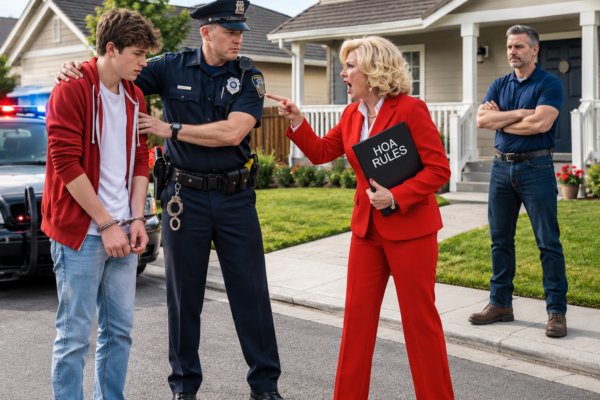
The police cruiser was in my driveway when my sixteen-year-old daughter stepped off the school bus.
Across the street, HOA president Karen Peton stood beside her white SUV, holding a folder she had spent weeks building against me.
My daughter, Sophia, stopped at the curb. She looked at the officer on our porch, then at Karen, and tightened her grip on her backpack.
“Dad?” she called.
“It’s okay, sweetheart.”
But my voice didn’t sound convincing, even to me.
Officer Brooks had just explained that Karen reported me for threatening her and trespassing on her property. According to her statement, I had confronted her outside her home the previous afternoon.
There was one problem.
I’d been forty miles away, repairing an air-conditioning system at a medical clinic.
And I had the service records to prove it.
Eleven weeks earlier, I’d moved into Willowbrook Estates hoping to give Sophia something resembling a normal childhood again.
My divorce had been hard on her. She’d spent too many evenings listening to adults argue about custody schedules, money, and who was responsible for a marriage falling apart.
I was forty-five, running a small HVAC business, and starting over with a mortgage that kept me awake at night.
Our little ranch house wasn’t impressive. The kitchen cabinets were old, the garage door rattled, and the backyard needed work.
But Sophia had chosen yellow curtains for her bedroom.
That meant more to me than she knew.
Then Karen introduced herself.
First came the complaints about my work truck.
Then fines for violations I couldn’t find in the HOA rules.
Then emails to my customers suggesting my business wasn’t properly licensed.
A maintenance contract I’d spent six years building was suddenly placed on hold.
I tried to handle everything through meetings, paperwork, and polite conversations.
Karen responded by calling the police.
Now my daughter was standing on our front lawn, watching another adult turn our home into a place where she felt unsafe.
“Mr. Sullivan,” Officer Brooks said gently, “I need to ask a few more questions.”
Sophia walked toward us.
Karen raised her phone, apparently recording.
My daughter noticed. Her face changed.
“She’s been filming me, too,” Sophia said quietly.
I turned toward her.
“What?”
Sophia swallowed and looked down at her shoes.
“Dad, there’s something I haven’t told you.”
She reached into her backpack and took out her phone.
Whatever she had been carrying alone, she was finally ready to show me.
[END OF FACEBOOK CAPTION]
[FIRST COMMENT / FULL STORY CONTINUATION]
The video was forty-three seconds long.
Sophia had recorded it the previous afternoon while sitting on our front steps, waiting for her friend Emma to pick her up for a study session.
The camera pointed mostly at the sidewalk. At first, all I could see were Sophia’s sneakers, the edge of our flower bed, and Karen’s white SUV parked across the street.
Then Karen’s voice came through.
“I’ve told the board about him. He’s aggressive, he runs some kind of business out of that garage, and I don’t think it’s safe having him around the children.”
Someone answered her. A woman’s voice I recognized as belonging to Mrs. Henderson, our neighbor two doors down.
“He seems nice enough to me, Karen.”
“You don’t know what goes on behind closed doors.”
Then Karen noticed Sophia.
The camera shifted as my daughter stood up.
“Are you recording me?” Karen demanded.
Sophia said nothing.
“Your father needs to learn that this neighborhood has standards.”
The video ended there.
Officer Brooks watched it twice without speaking. He was a broad-shouldered man in his late thirties, with tired eyes and the patient manner of someone who had spent years listening to people describe very different versions of the same afternoon.
“Can you send me that?” he asked Sophia.
She nodded.
Karen was still across the street. She had lowered her phone, but she hadn’t left.
Brooks looked at the service invoice on my phone. It showed the time I’d arrived at the clinic, the equipment I’d repaired, and the customer’s electronic signature confirming the work had been completed.
“Do you have anyone who can verify you were there?”
“My technician, Luis. The clinic’s facilities manager. Probably half the maintenance staff.”
He wrote their names down.
“I’m not making any determination based on one conversation,” he said. “But I’ll document what you’ve shown me and follow up.”
I appreciated that.
After weeks of dealing with people who treated Karen’s word like a court order, it felt strange to speak with someone who simply wanted facts.
Before leaving, Brooks turned to Sophia.
“Are you feeling safe here?”
She glanced at me before answering.
“Most of the time.”
Those three words landed harder than anything Karen had said.
I had spent months convincing myself that if I kept working, paid the mortgage, and stayed calm, Sophia would eventually feel settled.
I hadn’t realized she was measuring safety one afternoon at a time.
Brooks gave us his card and told us to call if anyone threatened us or came onto our property without permission.
When the cruiser pulled away, Karen climbed into her SUV.
She didn’t wave.
Neither did I.
I closed the front door, locked it, and found Sophia standing beside the kitchen counter, twisting the strap of her backpack around her fingers.
“How long has she been talking to you?” I asked.
“A few weeks.”
“Why didn’t you tell me?”
She shrugged, but her eyes were wet.
“You’ve already got enough stuff going on.”
I had no answer for that.
My daughter was sixteen years old, and she had decided that protecting her father meant carrying her own fear quietly.
That evening, I made spaghetti because it was the only dinner I knew she would eat even when she was upset.
She pushed the noodles around her plate.
“Do you think Mom will hear about the police?”
“Probably.”
“Will she make me stay with her more?”
I set my fork down.
“Your mom loves you. She’s going to want to know you’re safe.”
“But will she?”
The question wasn’t really about her mother.
It was about whether everything we’d worked so hard to rebuild could disappear because one woman kept making accusations.
I reached across the table.
“Listen to me, Soph. Nobody is taking you away because somebody filed a complaint. We’re going to deal with this properly.”
She looked at my hand before taking it.
“You always say we’re going to deal with things.”
“I know.”
“Sometimes I wish things would just stop happening.”
I looked around our little kitchen.
There were unpacked boxes beside the refrigerator, a crooked calendar on the wall, and two mugs in the sink because I’d been too exhausted to wash them.
I’d bought the house because I wanted to give her peace.
Instead, I’d brought her into another argument she hadn’t chosen.
“I’m working on that,” I said.
And for once, I didn’t pretend I had everything under control.
Three months earlier, Karen Peton had introduced herself while I was carrying a washing machine into the garage.
It was a cold March morning in Willowbrook Estates, a neighborhood on the edge of Marlowe, Colorado, where the houses were built close enough for neighbors to know your business but far enough apart that they could pretend they didn’t.
I’d bought a three-bedroom ranch on Alder Lane.
The place needed new gutters, fresh paint, and about a thousand small repairs.
It was also the first house I’d ever purchased entirely in my own name.
That mattered.
My divorce from Jennifer had taken two years to finish. We’d divided our savings, sold the family home, and spent more money on attorneys than either of us liked admitting.
We hadn’t been terrible people.
We had simply become two people who could no longer make each other happy, and we’d waited too long to acknowledge it.
Sophia had paid the price for that delay.
She stopped inviting friends over during our last year together. Her grades slipped. She learned to recognize the sound of an argument beginning in another room.
When Jennifer and I finally separated, Sophia asked one question.
“Are we going to keep moving?”
I promised her that once I found the right place, we would stay.
Willowbrook seemed like that place.
There were mature maple trees, a community playground, and a little creek behind the houses on the western side of the neighborhood.
People walked their dogs in the evening. Children rode bicycles in circles around the cul-de-sac.
The HOA dues were reasonable, and the neighborhood rules looked straightforward.
I had owned Sullivan Heating and Air for eleven years. Before that, I’d served in the Army and worked commercial construction jobs around the country.
I wasn’t rich.
But I’d built a decent business with three employees, a reputation for showing up on time, and enough savings to make a down payment.
I thought I understood hard work.
I also thought I understood difficult people.
Then I met Karen.
She stood at the bottom of my driveway wearing a cream-colored coat and carrying a leather folder.
“Marcus Sullivan?”
“That’s me.”
“Karen Peton. President of the Willowbrook Homeowners Association.”
I wiped my hands on my jeans.
“Nice to meet you.”
Her gaze moved past me to my truck.
A blue Ford F-150 with Sullivan Heating and Air printed neatly on the doors.
“Is that a commercial vehicle?”
“It’s my work truck.”
“We have restrictions regarding commercial vehicles.”
“Okay. I’ll review them.”
“Most people do that before purchasing a house.”
I remember being surprised by the sharpness of her voice.
I was standing in a driveway surrounded by cardboard boxes. I’d slept four hours. My daughter was upstairs trying to figure out where to put her books.
I didn’t have the energy for an argument.
“Well,” I said, “I guess I’m reviewing them now.”
Karen looked toward the garage.
“Will you be storing equipment here?”
“Some tools. Nothing unusual.”
“We don’t allow businesses to operate from residential properties.”
“My business has an office across town. This is where I live.”
She made a note.
I noticed that.
Not because it was threatening, exactly.
Because there was something peculiar about watching a stranger write things down while you explained how you intended to live in your own home.
“Anything else?” I asked.
Karen smiled.
“Only that we take neighborhood standards very seriously.”
After she left, I went inside and found Sophia sitting on the floor of her bedroom, surrounded by books.
“Who was that?”
“The HOA president.”
“Was she mad?”
“I think that’s just how she talks.”
Sophia smiled.
It was a small smile, but it was enough.
For the next few weeks, I told myself Karen was simply a difficult neighbor.
I had no idea how much trouble she could cause.
The first violation notice arrived nine days after we moved in.
It concerned my truck.
According to the letter, I had parked a prohibited commercial vehicle in a residential driveway.
The proposed fine was $125.
I read the notice twice, then opened the HOA documents I’d received at closing.
The relevant rule restricted heavy commercial vehicles, oversized trailers, and equipment parked overnight.
My pickup didn’t meet those restrictions.
I emailed Karen a polite explanation with photographs and a copy of the truck’s registration.
She replied six hours later.
The board maintains discretion when determining whether a vehicle affects neighborhood appearance.
I asked which section granted that discretion.
She didn’t answer.
Instead, a second notice arrived.
This one concerned my garbage cans being visible from the street after collection day.
That complaint was technically correct.
I’d forgotten to bring them inside.
I moved the cans and paid the smaller fine.
It was easier than arguing.
That was my first mistake.
Not because paying a legitimate fine was wrong.
Because I assumed Karen would distinguish between someone correcting a mistake and someone surrendering.
Two days later, she complained about the color of my garage door.
The following week, she questioned whether Sophia’s basketball hoop required architectural approval.
By April, I had a folder on my kitchen counter filled with letters bearing the HOA logo.
Sophia called it the Bad News Folder.
Every time another envelope arrived, she would glance at it before asking whether I wanted coffee.
She had developed a habit of making coffee when I was upset.
I wished she hadn’t learned to do that.
One Saturday morning, while I was replacing a broken gate latch, an older man stopped beside my driveway.
He was thin, wore a faded Colorado Rockies cap, and carried a grocery bag filled with tomatoes.
“You must be Sullivan.”
“That’s me.”
“Walter Chen. I live at number twenty-two.”
We shook hands.
He looked at the gate.
“Fixing it?”
“Trying to.”
“Karen tell you the hinges aren’t approved yet?”
I laughed.
Walter didn’t.
He set his grocery bag on the grass.
“Son, I’m going to tell you something I wish someone had told the last fellow who lived here.”
I straightened.
“What’s that?”
“Don’t mistake her confidence for authority.”
That was the beginning of my friendship with Walter.
He was seventy-six, a retired school administrator whose wife had died four years earlier.
He had lived in Willowbrook for nearly thirty years.
He knew which neighbors had raised children together, which families had moved away, and which disputes had quietly damaged friendships.
Karen had been HOA president for eight years.
Walter had spent most of those years trying to get someone to examine how the association was being run.
“She doesn’t own the neighborhood,” he told me. “She’s just convinced enough people that arguing with her isn’t worth the trouble.”
He explained that Karen’s approach was always similar.
She would begin with minor complaints.
If someone challenged her, the letters became more frequent.
Eventually, the target either stopped pushing back or moved.
Walter knew a widow who had received repeated notices about her overgrown garden while recovering from surgery.
He knew a young family whose children’s bicycles had prompted so many complaints that the parents stopped letting them ride outside.
He knew a contractor who had sold his home after a long fight about his work van.
“Some of those people were wrong about some things,” Walter said. “I’m not pretending every complaint was invented. But the rules shouldn’t depend on whether the president likes you.”
I asked why nobody voted Karen out.
Walter picked up his tomatoes.
“Because most people are busy living their lives. They don’t start paying attention until the trouble comes to their own driveway.”
My first HOA meeting was held on a Tuesday evening in the community clubhouse.
The room smelled like stale coffee and floor cleaner.
Twelve people attended.
Karen sat at the front table beside the treasurer, Linda Porter, and a board member named Frank Delaney.
A stack of printed agendas stood beside her water bottle.
She began precisely at seven.
We spent fifteen minutes discussing flower-bed maintenance.
Another twenty went to a proposal for replacing the pool furniture.
When the meeting reached homeowner questions, I raised my hand.
“I’d like clarification on the commercial vehicle rule.”
Karen looked at me as though she had been expecting trouble.
“We’ve already discussed your truck privately, Mr. Sullivan.”
“I understand. But I haven’t been able to find a rule that prohibits it.”
“The board has interpreted the covenant consistently for years.”
“Could I see that interpretation in writing?”
A few people shifted in their chairs.
Karen closed her folder.
“This is not the appropriate forum for an individual enforcement dispute.”
“Then where is the appropriate forum?”
“You may request a hearing.”
“I did.”
“Then you’ll receive a response.”
She moved to the next agenda item.
After the meeting, a woman approached me near the coffee urn.
She had short curly hair and wore a hospital employee badge clipped to her jacket.
“I’m Tasha Greene,” she said. “I live behind you.”
We talked for a few minutes.
Tasha was a respiratory therapist and a single mother with two boys.
She worked rotating shifts, which meant her yard wasn’t always perfectly maintained.
Karen had sent her multiple notices about outdoor toys and weeds.
Last summer, Tasha had received a warning because her younger son left a plastic dinosaur beside the community sidewalk.
She kept the notice in a drawer.
“I thought I was losing my mind,” she said. “Everyone else kept telling me it was just a little fine.”
“Why didn’t you fight it?”
She looked tired.
“Because when you’ve worked twelve hours at the hospital and your kid is sick, sometimes paying seventy-five dollars feels easier than finding the energy to argue.”
That stayed with me.
I had been thinking about Karen as a problem I needed to solve.
I hadn’t considered how many other people were simply too exhausted to keep defending themselves.
The business trouble began in late April.
A facilities manager named Claire Whitmore called while I was repairing an air-conditioning unit at a dental office.
Claire managed maintenance contracts for Riverside Medical Center, one of my oldest clients.
“Marcus, I need to ask you something uncomfortable.”
“Go ahead.”
“Has your contractor’s license been suspended?”
I nearly dropped my phone.
“No. Why?”
“We received an email saying you’re under investigation for operating illegally from a residential property.”
“Who sent it?”
“Someone identifying herself as a representative of your homeowners association.”
I sat down on a bucket of tools.
There was a long silence.
“Claire, my license is active. My company address hasn’t changed. I can send you everything.”
“I believe you. But our compliance department has to review the complaint.”
The center temporarily paused a contract renewal worth nearly eighteen thousand dollars.
We continued completing existing authorized work, but the proposed extension went on hold.
That money wasn’t simply extra income.
It covered payroll during slower months.
It paid the lease on our small office and helped keep my technicians working when there weren’t enough emergency calls.
I had three employees depending on me.
Luis Rivera had worked beside me for six years.
He had a wife, two young children, and a mortgage of his own.
Dana Brooks handled scheduling and invoices. She was a single mother who had come to my company after her previous employer closed.
Eddie Malone was our youngest technician, still learning the trade.
I couldn’t look any of them in the eye and pretend an eighteen-thousand-dollar contract didn’t matter.
That afternoon, I sent Claire copies of our licenses, insurance certificates, business registration, and the public records showing our operating address.
I also asked for a copy of the complaint.
When she forwarded it, my stomach tightened.
The email displayed the Willowbrook HOA logo.
It described me as a contractor with “ongoing compliance problems and repeated safety concerns.”
It included no dates, inspection findings, or citations.
The sender’s name was Karen Peton.
I stared at the screen for a long time.
An HOA president had contacted one of my customers about a business she had no professional authority to regulate.
She hadn’t merely complained about my truck anymore.
She had stepped into my livelihood.
I called her.
She answered on the third ring.
“Karen, did you email Riverside Medical Center about my business?”
“I’m not sure what you’re referring to.”
“I have the email.”
“Then you should understand that community standards have consequences.”
I stood beside my truck, watching employees load their equipment.
“What does my medical-center contract have to do with a driveway dispute?”
“Perhaps your customers deserve to know who they’re doing business with.”
I took a breath.
“Those people work in a hospital. They depend on us to maintain equipment safely. You’re making claims you can’t support.”
“If everything is legitimate, you have nothing to worry about.”
Then she hung up.
I stood there with the phone still against my ear.
For the first time since meeting Karen, I felt something close to panic.
Not anger.
Panic.
Because someone who barely knew me had discovered how to threaten everything I was trying to keep together.
That night, I called Jennifer.
We weren’t close anymore, but we’d worked hard to become decent co-parents.
She listened while I explained the complaints and the contract problem.
“Marcus,” she said, “you need an attorney.”
“I can’t afford another attorney.”
“You can’t afford not to.”
I rubbed my forehead.
“I just finished paying the last one.”
“I know.”
Neither of us spoke for a moment.
Then Jennifer asked, “Does Sophia know?”
“Not everything.”
“She’s smarter than you think.”
“I know she’s smart.”
“That’s not what I mean.”
Jennifer sighed.
“She can tell when you’re scared, Marcus. You don’t have to explain every detail, but don’t make her guess whether everything is falling apart.”
Her words irritated me because they were true.
During our marriage, I had believed that providing meant handling problems privately.
If a bill was overdue, I worked more hours.
If something needed fixing, I fixed it.
If I was worried, I kept quiet until I had a solution.
Jennifer had once told me that living with me sometimes felt like standing outside a locked room.
I hadn’t understood then.
I was beginning to.
The next morning, I contacted a local attorney named Elena Ruiz.
Her office occupied the second floor of an old brick building near the courthouse.
She listened without interrupting while I described the fines, the emails, and the police reports that had begun to accumulate.
She examined the documents I’d brought.
Then she asked a question I wasn’t expecting.
“What do you want, Mr. Sullivan?”
“I want her to stop.”
“That’s a beginning. Anything else?”
I thought about Sophia.
“My daughter needs to feel safe in our home. I need to protect my business. And I don’t want to spend the next ten years fighting with my neighbor.”
Elena nodded.
“Then we need to be careful not to turn this into a personal war.”
She explained the difference between an HOA enforcement dispute, potentially defamatory business statements, and complaints that belonged with law enforcement.
She didn’t promise a dramatic courtroom victory.
She didn’t tell me I could sue Karen for millions.
Instead, she gave me a legal pad and asked me to make a timeline.
Every letter.
Every fine.
Every communication with a customer.
Every witness.
Every police incident number.
“Facts first,” she said. “Conclusions later.”
When I left her office, I felt disappointed.
I had expected a lawyer to give me a way to fight.
Instead, she’d given me homework.
It turned out to be the best advice I received that year.
By the time Officer Brooks visited our driveway, I had three folders of documentation.
But I hadn’t understood the effect on Sophia until she showed him that video.
The following morning, I drove her to school instead of letting her take the bus.
She sat quietly beside me, watching neighborhoods pass through the windshield.
At a red light, I said, “You can tell me when something happens, Soph. Even if I’m busy.”
“I know.”
“No, I don’t think you do.”
She turned toward me.
I kept my eyes on the road.
“I’ve made you feel like you have to protect me from bad news. That’s my mistake.”
She was quiet.
Then she said, “When you and Mom were getting divorced, you both kept saying everything was fine.”
I felt my throat tighten.
“It wasn’t fine,” she continued. “But if I asked questions, everybody looked sad. So I stopped asking.”
The light turned green.
I drove another block before answering.
“I’m sorry.”
She nodded, almost as though she’d been waiting a long time to hear that particular sentence.
At the school entrance, she unbuckled her seat belt.
“Can I ask you something?”
“Anything.”
“Are we going to move again?”
I looked at her.
“No.”
“Promise?”
I wanted to say yes immediately.
But promises had become complicated in our family.
“I promise I won’t give up this home just because somebody makes living here difficult.”
She studied me for a moment.
Then she leaned over and hugged me.
It was quick and awkward because we were still sitting in the truck.
But I held her until the car behind us gave a gentle tap of its horn.
“Love you, Dad.”
“Love you more.”
She climbed out, turned once to wave, and disappeared into the school.
I remained parked for another minute.
Then I called Elena.
“I think we need to take this seriously.”
“We already are,” she said.
“No. I mean seriously enough that I stop hoping Karen will suddenly become reasonable.”
Elena was quiet.
“That,” she said, “is probably a useful distinction.”
Walter helped me understand the association’s history.
He invited me over one Sunday afternoon.
His kitchen was tidy, with family photographs on the refrigerator and an old radio playing softly beside the window.
He served iced tea in heavy glasses and brought out a banker box filled with papers.
“I started keeping these after Karen became president.”
There were meeting minutes, budget summaries, enforcement notices, and letters written by homeowners who had eventually stopped attending meetings.
Walter had been a board member years earlier.
He understood how the association was supposed to operate.
“Our bylaws were written when nearly half these homes were rentals,” he explained. “They allow any full-time resident to serve as a director if elected by the owners. That includes renters. It was meant to encourage people to participate.”
He paused.
“Most of us thought that was a good idea.”
“Isn’t Karen an owner?”
Walter shrugged.
“She lives here. That’s what I know.”
I didn’t think much about that answer.
Not then.
We spent two hours comparing the notices Karen had sent me with the rules recorded in the association’s governing documents.
Some complaints were legitimate.
Others were questionable.
Several seemed to rely on interpretations that had never been adopted by the board.
Walter showed me correspondence from a former homeowner named Anthony Ramirez.
Anthony had challenged a fine related to his work van.
The board eventually withdrew it.
Six months later, his family moved.
“Do you think she drove them out?” I asked.
Walter considered the question.
“I think she made staying unpleasant. Whether that’s why they moved, only Anthony can tell you.”
I appreciated his caution.
He was angry with Karen, but he wasn’t interested in inventing things to make her look worse.
That made him someone I trusted.
He pulled out another folder.
“This is what concerns me more.”
Inside were association financial statements.
The HOA collected roughly two hundred thousand dollars in dues every year.
Most went to landscaping, insurance, maintenance, utilities, and reserves.
But Walter had noticed a recurring consulting expense.
Every few months, a company called Mountain Crest Community Services received payment for “resident communications” or “compliance support.”
The charges weren’t enormous individually.
Some were eight hundred dollars.
Others were closer to fifteen hundred.
But they added up.
“Who owns the company?” I asked.
“That’s what I’d like to know.”
“Have you asked Linda?”
“Twice. She says Karen handles the contracts.”
I studied the records.
This was no longer just about my driveway.
If association money was being spent improperly, every homeowner had a reason to ask questions.
But Elena had warned me not to accuse people of theft without evidence.
So I made copies of the documents, thanked Walter, and went home.
That evening, Sophia found me at the kitchen table.
“More Karen stuff?”
“Unfortunately.”
She glanced at the papers.
“Do you ever think about anything else anymore?”
The question bothered me because I couldn’t remember the last evening I’d spent watching a movie with her without checking my email.
I closed the folder.
“Want to get ice cream?”
She gave me a suspicious look.
“Right now?”
“Right now.”
We drove to a little place downtown that served soft-serve cones through a walk-up window.
Sophia ordered chocolate with rainbow sprinkles.
I bought vanilla.
We sat on a bench watching people walk past the bookstore.
For forty minutes, we didn’t talk about Karen, the HOA, my business, or the divorce.
We talked about a boy in Sophia’s chemistry class who had accidentally set off the classroom alarm.
We talked about her upcoming school play.
We talked about whether our dog, if we ever got one, should be named Biscuit or Captain Waffles.
I remember thinking that this was the life I’d been fighting to protect.
Not a house.
Not a driveway.
Forty ordinary minutes with my daughter.
In June, my aunt Ruth passed away.
She was seventy-nine and had lived alone in a small town outside Fort Collins since her husband died.
Ruth had been a court stenographer for thirty-five years.
She had a dry sense of humor, a fondness for strong coffee, and an almost unreasonable belief that people should keep their promises.
When I was a child, she was the adult who noticed when I was unhappy.
She never forced me to explain myself.
She would simply put a sandwich in front of me and sit nearby until I was ready to talk.
After my divorce, she had sent me a handwritten card.
Starting over isn’t failure, Marcus. Just make sure you build a life you actually want to live.
I kept it in my desk drawer.
Ruth had been ill for several months, but her death still shocked me.
I had spoken to her shortly before moving.
She knew I’d bought a house in Marlowe, but I hadn’t given her the address yet.
I kept meaning to visit.
There was always another job, another school event, another piece of paperwork.
I told myself there would be time.
Then there wasn’t.
Sophia and I drove north for the funeral.
Jennifer came too.
That surprised me.
She and Ruth had always gotten along, even during the final ugly months of our marriage.
After the service, Jennifer stood beside me outside the church while people moved toward the parking lot.
“She was good to you,” she said.
“Yeah.”
“She’d be proud of how you’ve looked after Sophia.”
I looked down.
“I don’t know about that.”
“Marcus.”
I turned toward her.
“You don’t have to be perfect to be a good father.”
For a moment, we stood there as two people who had once shared a life and still knew exactly where the other’s old wounds were.
Then Jennifer squeezed my arm.
“Just don’t forget to look after yourself.”
Ruth’s attorney contacted me several weeks later.
I was named as the primary beneficiary of her estate.
I’d known she had some savings.
I’d also known she owned rental property through a small business she and her late husband had started decades earlier.
But Ruth rarely discussed money.
She thought people’s finances were private, especially those of her tenants.
The attorney explained that much of the estate had already been placed in a trust.
There was a retirement account, some investments, and an ownership interest in a company called Red Cedar Property Holdings.
The company owned several rental homes managed by an agency.
I was overwhelmed.
Not because I suddenly felt wealthy.
I didn’t.
The properties had mortgages, maintenance expenses, and responsibilities attached to them.
I was overwhelmed because Ruth had trusted me with something she had spent years building.
Her attorney handed me a letter.
It was written in Ruth’s familiar, careful handwriting.
Marcus,
If you’re reading this, I’ve finally gotten out of paying someone to fix my old furnace.
I laughed through tears.
The houses are not a gift without responsibility. People live in them. They have birthdays, bills, family troubles, and days when everything goes wrong.
Remember that a landlord can own a building without owning the lives inside it.
Treat people fairly. Keep good records. And please, for once, let someone else handle the plumbing.
I folded the letter and put it in my wallet.
At that point, I had no idea how important those words would become.
Back in Willowbrook, Karen’s campaign continued.
The police visit had not produced the result she appeared to expect.
Officer Brooks had documented my work records and Sophia’s video.
He also spoke with Claire at Riverside Medical Center.
The trespassing allegation remained unsubstantiated.
But Karen had found other ways to make life difficult.
She began sending emails to the HOA board claiming my truck created an unsafe environment for pedestrians.
She submitted photographs of my garage door standing open while I loaded tools.
She questioned whether my business insurance covered the storage of equipment at my residence.
Then she contacted the state licensing office.
The licensing office sent me a routine request for information about a complaint.
I supplied my business records, operating address, and proof of current licensing.
The complaint was eventually closed without disciplinary action.
But it took hours of paperwork and telephone calls to resolve.
Hours I wasn’t spending with customers.
Hours I wasn’t spending with Sophia.
One Friday afternoon, Luis came into my office and closed the door.
He sat across from me.
“Boss, I need to ask you something.”
“Sure.”
“Is everything okay with the company?”
I stared at him.
“Why?”
“Two customers asked me whether we’re going out of business.”
I felt a cold weight settle in my chest.
“We’re not.”
“I know. But people are talking.”
Luis looked embarrassed.
“My wife heard something from one of the school parents. She said there was a woman telling people you were in trouble with the state.”
I rubbed my eyes.
Luis leaned forward.
“Marcus, I’ve worked for you a long time. If something’s wrong, just tell me.”
I looked at this man who had worked through blizzards with me, crawled through overheated attics, and once spent Christmas Eve helping restore heat to a nursing home.
He deserved the truth.
So I told him.
Not every detail.
Enough.
When I finished, he sat back.
“That’s ridiculous.”
“Yeah.”
“Why didn’t you tell us?”
“Because I didn’t want you worried.”
He gave me the same tired look Jennifer used to give me.
“Boss, we’re already worried. We just don’t know what about.”
I laughed despite myself.
Then Luis said something I’ll never forget.
“You hired me when nobody else would because I had a record from when I was nineteen. You gave me a chance to prove who I was. Don’t think we disappear the first time you need somebody.”
I looked away.
My eyes were burning.
“Thanks, man.”
He stood up.
“Now tell me which paperwork you need help with.”
That night, Dana organized our compliance files.
Eddie scanned old permits.
Luis contacted customers who knew our work and asked whether they’d be willing to confirm our service history.
Nobody asked for overtime.
They just helped.
For the first time in weeks, I didn’t feel like I was fighting alone.
Karen didn’t know how to handle that.
I could see it in small ways.
She stopped waving to my neighbors when they spoke with me.
She grew more abrupt at meetings.
She began correcting people over minor procedural matters that hadn’t bothered her before.
One Saturday, I found her standing beside the community mailbox while Tasha Greene was helping her younger son attach a new reflector to his bicycle.
Tasha’s boy, Caleb, was eight.
He had a mop of dark curls and a habit of asking questions faster than adults could answer them.
Karen was holding a violation form.
“Children cannot leave toys in common areas,” she told Tasha.
“The bike’s not being left here,” Tasha replied. “I’m fixing the reflector.”
“Then you should do that on your own property.”
Tasha straightened.
“Karen, he’s eight. We’re standing here for two minutes.”
“Rules exist for a reason.”
I was walking back from Walter’s house when I heard the exchange.
I stopped nearby.
“Morning,” I said.
Karen looked at me.
“Mr. Sullivan, this is a private conversation.”
“Then I’ll keep walking.”
But Caleb had already stepped behind his mother.
He looked frightened.
Tasha saw it too.
She knelt to his height.
“Hey. You’re not in trouble. We’re going home.”
Karen pressed her lips together.
“I simply expect residents to be considerate.”
Tasha stood.
“And I expect adults to speak kindly to children.”
There was a moment of silence.
I watched Karen’s expression change.
Not rage.
Embarrassment.
For a second, she looked like someone who had been publicly reminded that other people could judge her too.
Then she turned and walked away.
Tasha waited until Karen was out of earshot.
“She’s going to send me another letter.”
“Maybe.”
“I hate that my first thought is how much it’s going to cost me.”
I looked at Caleb, who was trying not to cry.
“Come on,” I told them. “Let’s finish that reflector.”
We carried the bicycle to my driveway.
Sophia came outside and helped Caleb tighten the little plastic bracket.
Ten minutes later, he was riding circles around our cul-de-sac.
Tasha stood beside me with her arms folded.
“He’s been asking whether we’re allowed to play outside anymore.”
I watched Caleb pedal past.
“That’s not okay.”
“No,” she said. “It isn’t.”
Around that time, I met Karen’s son.
Daniel Peton was twenty-one, home for the summer after his junior year at college.
He worked part-time at a local print shop and occasionally helped his mother prepare HOA newsletters.
I first saw him standing near Karen’s SUV, carrying boxes of printed notices.
He was tall, quiet, and looked uncomfortable when his mother spoke sharply to the delivery driver.
A few days later, he came to my door.
Sophia answered while I was in the garage.
“Dad, somebody’s here.”
Daniel stood on the porch holding a plain white envelope.
“Mr. Sullivan?”
“Yeah.”
“I’m Daniel. Karen’s son.”
I waited.
He looked down at the envelope.
“I think this belongs to you.”
Inside was a maintenance invoice from our community landscaping contractor.
It had my name written across the top in Karen’s handwriting.
I frowned.
“Where did you get this?”
“It was mixed in with some paperwork Mom asked me to copy.”
“Why would my name be on it?”
Daniel shifted his weight.
“I don’t know.”
He clearly knew more than he wanted to say.
I didn’t push.
“Thanks for bringing it over.”
He nodded and turned to leave.
Then he stopped.
“Mr. Sullivan?”
“Yeah?”
“My mom can be difficult.”
I almost laughed.
“That’s one way to describe it.”
He looked genuinely ashamed.
“I just wanted you to know not everybody in my family agrees with her.”
He walked away before I could answer.
I stood on the porch looking at the envelope.
It was the first time someone close to Karen had acknowledged that something was wrong.
But what struck me most was Daniel’s face.
He wasn’t afraid of me.
He was afraid of what might happen if his mother found out he’d spoken to me.
In July, the HOA announced a special meeting to address “ongoing neighborhood conflicts.”
The notice didn’t name me.
It didn’t need to.
Karen had spent weeks describing a disruptive resident in her emails.
I asked Elena to review the notice.
She read it and shook her head.
“You can attend. Just don’t turn it into a shouting match.”
“I wasn’t planning to.”
She raised an eyebrow.
I sighed.
“Okay. I was considering it.”
“Bring your documents. Ask clear questions. Let other people speak.”
The meeting drew thirty-one homeowners.
That was more than twice the usual attendance.
Walter sat beside me.
Tasha sat on my other side.
Sophia wanted to come, but I asked Jennifer to take her to dinner instead.
I didn’t want my daughter spending another evening watching adults argue about her home.
Karen began with a prepared statement about neighborhood harmony.
She spoke of preserving property values, respecting community standards, and maintaining the peaceful character of Willowbrook.
Then she looked directly at me.
“Unfortunately, a small number of residents have chosen confrontation over cooperation.”
A few people glanced in my direction.
I felt heat rise in my face.
But I stayed seated.
Karen continued.
“These individuals have challenged legitimate enforcement actions and created unnecessary tension.”
When she finished, Walter raised his hand.
“Madam President, I’d like the minutes to reflect that several homeowners have requested financial records without receiving a complete response.”
Karen’s smile tightened.
“That’s unrelated to the purpose of this meeting.”
“It’s related to whether the board is following its own rules.”
Linda Porter, the treasurer, looked down at her papers.
Walter continued calmly.
“We’ve also asked for clarification of several enforcement decisions. I don’t believe those requests have been answered.”
A man in the back stood.
“My family got a fine for our son’s basketball hoop. Three houses down, another family has the exact same hoop and didn’t get anything.”
A woman raised her hand.
“I’ve asked three times why we’re paying a consulting company for newsletters that volunteers used to prepare.”
Tasha stood next.
“I want to know why my children are being photographed while playing outside.”
The room went quiet.
Karen looked startled.
She had expected one angry contractor.
Instead, she was hearing from homeowners she’d previously spoken to one at a time.
That was different.
People were beginning to realize their experiences weren’t isolated.
When my turn came, I stood with my folder in my hands.
“I’ve received several enforcement notices since moving in,” I said. “Some were valid. I corrected those issues. Others don’t appear to match the written rules.”
Karen opened her mouth.
I continued before she could interrupt.
“I’ve asked for a hearing. I’ve provided documents. I’ve tried to resolve this privately.”
I took a breath.
“Then an email was sent to one of my customers, using the HOA’s name, alleging that my business had licensing and safety problems.”
There was movement around the room.
“I have copies of that email. I have proof that my license was active. And I have documentation showing the financial impact.”
Karen leaned toward the microphone.
“I acted out of concern for the community.”
I looked at her.
“My customers aren’t part of this community.”
She said nothing.
“They’re people who trust my company to do a job. You had no reason to contact them about a disagreement over my driveway.”
A chair scraped against the floor.
Someone near the back murmured, “That’s not right.”
Karen’s face flushed.
“I will not tolerate intimidation.”
Neither would I.
But I didn’t say that.
Instead, I placed my folder on the table.
“I’d like the board to review this evidence and address the complaints through the procedures in our governing documents.”
Then I sat down.
My hands were shaking.
Walter patted my shoulder once.
The meeting continued for another hour.
Nothing dramatic happened.
Nobody was removed from office.
No judge appeared to announce a verdict.
But three homeowners volunteered to form an independent committee to review enforcement practices.
And Linda Porter agreed to provide financial records to the board.
For the first time, Karen had to answer questions she hadn’t chosen.
Two days later, a towing notice appeared on my truck.
It was taped beneath the windshield wiper.
The notice claimed my vehicle would be removed if it remained in the driveway after midnight.
I called the management company listed on the notice.
The woman who answered sounded confused.
“We haven’t authorized any towing from that address.”
I gave her the notice number.
She asked me to email a photograph.
An hour later, she called back.
“Mr. Sullivan, this isn’t one of our forms.”
I stared at the paper.
“You’re sure?”
“Yes. We don’t use that logo anymore, and this notice doesn’t carry our dispatch information.”
I thanked her and called Elena.
She asked me not to confront Karen.
“Preserve the original. Take photographs. We’ll add it to the timeline.”
I wanted to march across the street.
I wanted to hold the paper in Karen’s face and demand an explanation.
Instead, I stood in the driveway until my anger settled enough for me to go inside.
Sophia was making a sandwich.
“Another letter?” she asked.
“Something like that.”
She watched me put it in the folder.
“Are you okay?”
I looked at her.
There it was again.
The question she asked when she was worried about me.
I sat down at the kitchen table.
“No,” I said. “I’m frustrated.”
She put the knife down.
“With her?”
“Mostly.”
“With me?”
I stared at her.
“Why would I be frustrated with you?”
She shrugged.
“Because everything got worse after I showed the officer my video.”
I stood and crossed the kitchen.
“Come here.”
She stepped into my arms.
“Nothing about this is your fault,” I told her. “You told the truth. That’s all.”
She held onto my shirt.
“I just want us to be normal.”
I rested my chin on her head.
“Me too.”
The inheritance paperwork kept moving forward in the background.
I met with Ruth’s attorney several more times.
The business she left me, Red Cedar Property Holdings, owned three single-family rental homes in Marlowe and two small properties farther north.
Each property had its own mortgage, lease, maintenance history, and reserve account.
A property management company handled day-to-day operations.
The company was called Westbridge Residential Management.
Its senior manager, Camille Harris, had worked with Ruth for almost fifteen years.
Camille was a practical woman in her fifties who wore reading glasses on a chain and spoke about rental properties the way a good nurse speaks about patients.
Not as numbers.
As responsibilities.
During our first meeting, she showed me financial statements, maintenance schedules, and the outstanding repairs.
“Your aunt was very clear about how she wanted tenants treated,” Camille said.
“That sounds like her.”
“She didn’t tolerate unpaid rent forever, but she also didn’t treat every late payment as a character flaw.”
Camille smiled.
“Once, a tenant called because her refrigerator failed the day before Thanksgiving. Ruth personally drove over with a cooler and groceries while we arranged a replacement.”
I laughed.
“She would do that.”
We reviewed the properties one by one.
A ranch house near the elementary school.
A duplex north of town.
A smaller rental on the west side.
Then Camille opened the next file.
“Twenty-six Alder Lane, Willowbrook Estates.”
I looked up.
“Say that again.”
“Twenty-six Alder Lane.”
I stared at the address.
My own house was number nineteen.
Karen lived at number twenty-six.
Across the street, two houses down.
I leaned forward.
“Who’s the tenant?”
Camille checked the lease.
“Karen Elizabeth Peton.”
For a moment, I heard nothing but the office air conditioner.
Camille looked at me.
“Do you know her?”
I couldn’t answer immediately.
I had spent months arguing with this woman.
I’d received fines, police visits, and complaints to my customers.
I’d watched my daughter grow frightened of walking to the mailbox.
And now I was looking at a lease bearing Karen’s name.
The house she’d stood in front of while telling me I didn’t belong in Willowbrook was part of the company Ruth had left me.
I read the file again.
Karen had rented the property for six years.
Her payments were current.
She had signed a lease renewal the previous winter through the management company.
The property was registered under Red Cedar’s name.
Camille had handled every communication.
Karen had never dealt with Ruth directly.
There was no reason for her to know that the owner of the company had changed.
I turned to Camille.
“You’re telling me I own the company that owns Karen Peton’s house?”
“Yes.”
I sat back.
The absurdity of it nearly made me laugh.
Then I remembered Ruth’s letter.
People live in them.
I took my wallet out and unfolded the paper.
Camille waited while I read the relevant lines.
When I finished, she asked, “Is there a problem with the tenant?”
I looked at the lease.
“There’s a problem with the neighbor.”
I told Camille a little of what had happened.
She listened carefully.
Then she said, “We need to keep these matters separate.”
I nodded.
She was right.
The fact that I now controlled the company that owned the property did not give me the right to threaten Karen’s housing because of a personal dispute.
It didn’t give me the right to enter her home without proper notice.
It didn’t erase her lease.
And it certainly didn’t make me judge and jury over what had happened between us.
Still, as I drove home, I couldn’t stop thinking about the strange turn my life had taken.
Karen had spent months telling me who belonged in Willowbrook.
She had never imagined the man she wanted gone might be the person responsible for maintaining the roof over her own head.
I told Elena before I told anyone else.
She listened while I explained the inheritance.
There was a long pause.
Then she said, “Well. That complicates things.”
“You’re not kidding.”
“Marcus, I want you to promise me something.”
“What?”
“Do not threaten her lease. Do not approach her as her landlord about your HOA dispute. Do not suggest that her housing depends on leaving you alone.”
“I wasn’t planning to.”
“Good. Because even if you have legitimate claims against her, using your position as a landlord to gain leverage would create serious problems.”
“I understand.”
“Keep Camille in charge of the property. Any legitimate tenancy issues go through her and the appropriate procedures.”
I looked across my kitchen toward the window.
Karen’s house was partly visible through the maple trees.
For months, I had looked at that building with dread.
Now I saw it differently.
Not as a prize.
Not as a weapon.
As another responsibility Ruth had trusted me to handle.
“I don’t want to become like her,” I said.
Elena’s voice softened.
“Then don’t.”
That evening, I told Sophia.
She was sitting cross-legged on the living room floor, painting a cardboard backdrop for the school play.
I sat beside her.
“I learned something strange about Aunt Ruth’s properties.”
She dipped her brush into blue paint.
“Strange good or strange bad?”
“I’m not sure yet.”
I explained the inheritance and the rental company.
Then I told her about twenty-six Alder Lane.
She stopped painting.
“Wait.”
I nodded.
“Karen’s house?”
“Yes.”
“You own Karen’s house?”
“Technically, the company owns it. And I own the company.”
Sophia stared at me.
Then she started laughing.
Not a polite laugh.
A real, surprised, uncontrollable laugh that made her put the paintbrush down before she spilled blue paint on the carpet.
I couldn’t help laughing too.
It was the first time we’d laughed together about anything connected to Karen.
After a moment, Sophia wiped her eyes.
“Are you going to kick her out?”
“No.”
The laughter faded.
“Why not?”
“Because she has a lease. Because people have rights. And because owning a house doesn’t mean I get to use someone’s home to punish them.”
Sophia considered that.
“But she’s trying to make us move.”
“I know.”
“That doesn’t seem fair.”
“It isn’t.”
She looked toward the window.
Then she said, “I guess Aunt Ruth wouldn’t want you to do that.”
“No,” I said. “She wouldn’t.”
Sophia picked up her paintbrush again.
“Well, it’s still pretty funny.”
I smiled.
“Yeah. A little.”
Karen found out several weeks later.
Not because I marched up to her door.
Not because I posted the property records in the neighborhood Facebook group.
And not because I wanted to embarrass her.
She learned during a meeting she had demanded.
By then, the independent HOA committee had begun reviewing enforcement complaints.
The board had also received a formal letter from Elena about the statements sent to my customers.
Karen responded by accusing me of harassment.
She claimed I was using attorneys and financial pressure to intimidate a community volunteer.
Her attorney proposed a private settlement conference.
Elena agreed, provided we discussed specific claims and brought the necessary records.
Camille attended because Karen had also made an allegation involving the rental property.
The issue concerned a fence panel near Karen’s driveway.
Karen had recently submitted documents to the HOA claiming she possessed the owner’s authorization to modify a shared boundary.
Camille had no record of approving the work.
The document included a signature that appeared to be from Red Cedar Property Holdings.
But neither Camille nor the company’s authorized representative had signed it.
It wasn’t proof of a crime by itself.
It was enough to require an explanation.
The meeting took place in a conference room at Elena’s office.
Karen arrived wearing a navy suit and carrying her familiar leather folder.
Her attorney, Martin Voss, was a quiet man with silver hair and a weary expression.
We sat on opposite sides of the table.
For the first half hour, the discussion went about as badly as I’d expected.
Karen described my conduct as hostile.
I described the repeated notices and customer complaints.
Elena asked for supporting documents.
Martin asked questions about the HOA’s authority.
Nobody raised their voice.
But the tension was unmistakable.
Then Camille opened the property file.
“Mrs. Peton, I’d like to address the fence authorization.”
Karen straightened.
“I’ve already provided the owner approval.”
Camille placed the document on the table.
“Who gave you this?”
“The property owner.”
“Did you communicate with the owner directly?”
Karen hesitated.
“I’ve lived there for years. I’m familiar with the company.”
“That wasn’t my question.”
Karen’s jaw tightened.
“I don’t appreciate being interrogated about my own home.”
Camille remained calm.
“Your tenancy is not in question. We’re discussing a document submitted in the owner’s name.”
Karen looked at her attorney.
Martin examined the paper.
Then he asked, “Who is currently authorized to act for Red Cedar?”
Camille turned slightly toward me.
“Mr. Sullivan is the company’s sole owner and authorized representative.”
Karen didn’t move.
At first, I thought she hadn’t heard.
Then she slowly turned her head.
“Marcus?”
I said nothing.
She looked at Camille.
“That’s not possible.”
Camille handed Martin a copy of the company ownership documentation.
“The ownership transferred following Ruth Sullivan’s death. The existing lease remains with Red Cedar Property Holdings, and Westbridge continues to manage the property.”
Karen stared at the papers.
Her fingers tightened around the edge of the table.
“You’re telling me Marcus Sullivan owns my house?”
Camille corrected her gently.
“He owns the company that owns the property you lease.”
Karen looked back at me.
“You’re my landlord?”
I held her gaze.
“Yes.”
For the first time since I’d met her, Karen had nothing to say.
She looked down at her folder.
Then at the document on the table.
Then at me again.
Her face had gone pale.
I could hear the soft hum of the ventilation system above us.
Martin cleared his throat.
“I think we should take a short break.”
Nobody objected.
Karen left the conference room with her attorney.
I remained seated.
I thought I would feel victorious.
After everything she’d done, I had imagined that watching her discover the truth would bring some extraordinary satisfaction.
Instead, I felt tired.
Camille gathered the lease documents into a neat stack.
“That went about as well as could be expected,” she said.
Elena looked at me.
“You handled it correctly.”
“I barely said anything.”
“Exactly.”
I stared at the closed door.
“Do you think she’s scared?”
Camille took off her glasses.
“Probably.”
I thought about Sophia standing on our front lawn while an officer questioned me.
I remembered the way she’d tightened her backpack strap.
For months, fear had lived in our house.
Now it had crossed the street.
I didn’t enjoy that as much as I’d once imagined I would.
When Karen returned, her expression had changed.
The confidence was gone.
But what replaced it wasn’t humility.
It was suspicion.
“This explains everything,” she said.
Elena looked up.
“What does?”
“He’s been planning this. He’s trying to take my home.”
I felt my temper rise.
“No, Karen.”
She pointed at me.
“You’ve been looking for a way to get rid of me.”
I leaned forward.
“I didn’t know Aunt Ruth owned your house until the estate paperwork was reviewed. I haven’t threatened your tenancy, and I’m not going to.”
“How can I believe that?”
I looked at her.
“Because I’m saying it in front of two attorneys and the property manager responsible for administering your lease.”
Martin touched her arm.
“Karen, let me handle this.”
She sat back.
Her hands were trembling.
Camille spoke quietly.
“Mrs. Peton, your lease remains valid. Rent payments, maintenance requests, and communication will continue through Westbridge. Mr. Sullivan has instructed us to follow the terms of the agreement and applicable law.”
Karen’s eyes filled with tears.
She looked away quickly.
For a moment, I saw not the woman who had made my life miserable, but someone who suddenly understood how vulnerable she could be.
Then she spoke.
“You don’t understand what that house means to me.”
I almost answered that she hadn’t cared what mine meant to me.
The words were right there.
But Ruth’s letter was in my wallet.
And Sophia was waiting at home.
So I said something else.
“I understand more than you think.”
Karen looked at me.
“Your home isn’t part of the settlement discussion. Your conduct toward my family and my business is.”
Elena nodded.
“That’s the distinction we need to maintain.”
The rest of the meeting was difficult.
Karen denied intentionally spreading false information.
She claimed she’d simply relayed concerns from neighbors.
But the emails contained statements she couldn’t support.
And the fence authorization remained unexplained.
By the end, Martin agreed to review the evidence with his client and respond in writing.
There was no dramatic agreement.
No sudden apology.
No handshake.
Karen left without looking at me.
As the elevator doors closed behind her, I heard Martin speaking softly.
“Karen, you need to tell me exactly what happened.”
That sentence stayed with me.
Because for the first time, someone on Karen’s side was asking her for the truth.
The next morning, Karen’s son appeared at my business office.
Dana called me from the front desk.
“Marcus, there’s a young man here asking for you. Says his name is Daniel Peton.”
I came out of the workshop.
Daniel was standing near the chairs, holding a manila envelope.
He looked exhausted.
“Can we talk somewhere private?”
I took him into my office.
He sat down but kept the envelope on his knees.
“My mom told me about the house.”
I nodded.
“Okay.”
“She thinks you’re going to evict her.”
“I’m not.”
“That’s what I told her.”
He stared at the floor.
Then he looked up.
“Mr. Sullivan, I need to show you something.”
He opened the envelope.
Inside were printed emails and screenshots of files from the HOA newsletter account.
Daniel explained that he’d helped his mother with community communications during the summer.
Karen had asked him to format newsletters, distribute meeting notices, and organize a shared folder.
At first, he hadn’t paid much attention.
But after the police visit, he began noticing that some of the documents his mother asked him to format contained claims he couldn’t verify.
One file was labeled Sullivan Contractor Concerns.
Another contained a draft letter to Riverside Medical Center.
The draft stated that my professional license had been suspended.
Daniel had apparently questioned the statement.
He showed me an email exchange.
Mom, are you sure this is accurate? I can’t find anything saying his license is suspended.
Karen’s reply was brief.
Use the wording I sent you. The goal is to make them take the complaint seriously.
I read it twice.
Daniel watched my face.
“I didn’t send the email,” he said quickly. “I told her I didn’t want to be involved.”
“I believe you.”
“She sent it herself.”
He looked ashamed.
“I should have said something earlier.”
I placed the papers on my desk.
“Daniel, why are you giving me this now?”
He was quiet.
Then he said, “Because she keeps telling herself she’s doing the right thing.”
He rubbed his palms together.
“She talks about you like you’re dangerous. Like you’re some kind of threat to the neighborhood. But I’ve seen you with your daughter. I’ve seen how your employees talk about you.”
His voice broke.
“And I know she lied.”
He lowered his head.
“I love my mom. I don’t want to destroy her life.”
I waited.
“But I don’t know how to keep loving her and keep pretending this is okay.”
I understood that kind of conflict more than he realized.
The people we love aren’t always the people we wish they were.
Sometimes the truth about them arrives slowly.
Sometimes we spend years explaining away things we would never accept from a stranger.
I moved the envelope back toward him.
“Daniel, before I take any of this, I want you to speak with my attorney. She can explain what it may mean for you and how to preserve the records properly.”
He looked surprised.
“You’re not going to use it right now?”
“Not without making sure we handle it correctly.”
He sat silently for a while.
Then he whispered, “Thank you.”
When he left, I remained at my desk.
I thought about how easily this situation could have become a story where one person was entirely good and another entirely bad.
But real life had put a young man in my office who loved his mother and was frightened of what she had done.
There was nothing simple about that.
Daniel’s evidence changed the direction of the business dispute.
Elena arranged for copies of the relevant communications to be preserved.
The documents were reviewed alongside records from Riverside Medical Center and the licensing office.
The dates lined up.
The draft language closely matched the complaint the clinic had received.
There were also internal notes suggesting Karen had considered contacting two other clients.
We couldn’t prove every lost opportunity was caused by her.
Elena was careful about that.
A customer might choose another contractor for any number of reasons.
An estimate might be rejected because of price.
A contract might be delayed for reasons unrelated to an HOA dispute.
But the Riverside complaint was documented.
The licensing allegations were documented.
And Karen’s own messages showed she knew at least some of the statements needed verification.
That mattered.
Claire Whitmore agreed to provide a written account of the complaint’s effect on the renewal process.
She also called me one afternoon.
“Marcus, I want you to know something.”
I was in the warehouse checking equipment inventory.
“What’s that?”
“The review committee approved your renewal.”
I sat down on a crate.
“Seriously?”
“Seriously. All your credentials checked out, and we’ve worked with your company long enough to know the quality of your service.”
I closed my eyes.
“Claire, you have no idea what that means.”
“I think I have some idea.”
She paused.
“We should have called you before placing the renewal on hold. We were trying to be cautious, but we should have verified the complaint sooner.”
I appreciated her honesty.
The contract wasn’t quite as large as the original proposal.
Some maintenance work had already been reassigned.
But enough was restored to stabilize our schedule.
I drove to the office and bought lunch for the entire crew.
Luis opened the takeout container and grinned.
“What’s the occasion?”
“We got Riverside back.”
He stood up.
For one ridiculous moment, I thought he was going to hug me.
Instead, he slapped the table.
“About time.”
Dana actually cried.
Eddie asked if that meant we could finally replace the old service van.
“One victory at a time,” I told him.
We ate sandwiches around the conference table.
Nobody gave a speech.
Nobody talked about justice.
We just enjoyed the relief of knowing there would be work next month.
While the business situation improved, the HOA financial review became more serious.
Linda Porter had finally provided the independent committee with bank statements and vendor invoices.
Walter spent several evenings helping organize them.
One Thursday, he called and asked me to come over.
Tasha was already there when I arrived.
So was Frank Delaney, who had resigned from the board’s enforcement committee after becoming uncomfortable with how complaints were being handled.
Walter spread the records across his dining table.
“Mountain Crest Community Services,” he said. “We found out who owns it.”
He handed me a copy of the business registration.
The company belonged to Karen’s sister, Denise Harper.
I looked up.
“Was that disclosed?”
Frank shook his head.
“Not to me.”
Tasha examined an invoice.
“What exactly did the company do?”
“Some newsletter work, apparently,” Walter said. “But the committee couldn’t verify much of the compliance consulting.”
The payments totaled more than fourteen thousand dollars over several years.
Not all of that money was necessarily improper.
Some newsletters had been produced.
Some administrative work had been completed.
But the board had not documented a competitive selection process, and the family relationship had not been disclosed in meeting minutes.
Frank looked miserable.
“I should have asked more questions.”
Walter folded his hands.
“Maybe. But asking questions is harder when the president treats every question as a personal attack.”
Tasha looked toward me.
“What happens now?”
I shook my head.
“That isn’t my decision.”
We agreed the association needed an independent accountant and legal advice.
Not another neighbor acting as investigator, prosecutor, and judge.
Walter nodded.
“That’s exactly what Karen never understood.”
The special election was scheduled for September.
By then, more than forty homeowners had signed a petition calling for a board review and a vote on Karen’s continued leadership.
The petition followed the HOA’s governing procedures.
A neutral management representative reviewed the notice requirements and voting process.
Karen remained president while the process moved forward.
She had every right to respond.
And she did.
She sent a long letter to residents describing her years of volunteer service.
She listed projects completed during her presidency.
The playground renovation.
The new security lighting.
The landscaping improvements near the front entrance.
Some of those accomplishments were real.
Walter acknowledged them.
“She did good work in the beginning,” he told me. “That’s part of why people trusted her.”
Karen also accused critics of trying to undermine the association.
That part was harder to accept.
She had begun describing legitimate questions as attacks.
Every document request became harassment.
Every disagreement became disrespect.
Every neighbor who challenged her was somehow threatening the community.
I recognized the pattern because I’d seen it used against me.
The evening before the vote, I found Sophia at the kitchen table working on an assignment.
She was writing an essay about leadership.
I tried not to smile.
“What’s your argument?”
She looked at me.
“That leadership isn’t the same thing as control.”
I pulled out a chair.
“That’s pretty good.”
“It’s for English class.”
“Still pretty good.”
She looked at her notebook.
“Can I ask you a question?”
“Sure.”
“Do you hate Karen?”
I thought about it.
A few months earlier, my answer might have been easy.
Now it wasn’t.
“I hate what she’s done,” I said.
“That’s not what I asked.”
I smiled sadly.
“No. It isn’t.”
Sophia waited.
“I don’t think I hate her. But I don’t trust her. And I don’t want her making decisions that can hurt us anymore.”
Sophia considered that.
“Is that different from forgiving her?”
“Very different.”
She wrote something in her notebook.
I leaned forward.
“What did you write?”
She covered the page.
“You’re not allowed to steal my essay.”
I laughed.
For a few seconds, we were simply a father and daughter at the kitchen table.
It felt wonderful.
The clubhouse was full the next evening.
People stood along the back wall because there weren’t enough chairs.
Karen sat at the front with Martin Voss.
She looked composed, but I noticed she kept touching the same corner of her folder.
The meeting began with an explanation of the voting process.
Then both sides were given time to speak.
Karen went first.
She described volunteering countless hours.
She talked about neighborhood safety.
She said she’d made mistakes but had always acted in good faith.
Her voice trembled once when she mentioned her family.
I looked toward Daniel.
He was seated near the back.
He kept his eyes lowered.
When Karen finished, there was polite applause from a handful of residents.
Walter spoke next.
He didn’t attack her character.
He didn’t repeat rumors.
He simply described the procedural problems the review committee had documented.
Enforcement notices issued without proper hearings.
Records requests delayed or left incomplete.
Financial relationships that should have been disclosed.
“Good intentions don’t replace accountability,” he said.
Then Tasha spoke.
She described the way repeated complaints had affected her children.
Her voice shook.
“I don’t care whether my yard is the prettiest in Willowbrook. I care whether my sons feel comfortable riding their bikes outside.”
She looked toward Karen.
“I shouldn’t have to teach an eight-year-old to be afraid of the HOA president.”
The room was silent.
When my turn came, I stood holding one sheet of paper.
I’d written a longer speech.
Elena had helped me cut it down.
I didn’t mention the rental property.
Karen’s housing arrangement was not the community’s business.
I spoke about the customer complaints and the enforcement notices.
I explained that I supported reasonable neighborhood rules.
“I moved here because I wanted my daughter to grow up somewhere peaceful,” I said. “I don’t think reasonable people have to agree about every rule. But I do think everyone deserves the same rules, the same process, and the same chance to be heard.”
I looked around the room.
“This shouldn’t depend on whether the person sitting at the front table likes you.”
Then I sat down.
The vote followed.
It wasn’t unanimous.
Some residents still supported Karen.
Others believed the board could have corrected the problems without removing her.
But the required majority voted to remove her from office.
Karen stared at the result.
For several seconds, she didn’t move.
Then she stood.
“I gave eight years to this neighborhood.”
Nobody answered.
She looked at Walter.
He lowered his eyes.
Then she looked toward me.
I could see anger there.
But also something else.
The stunned expression of someone realizing that the people she’d believed would always support her had made a different choice.
She gathered her folder and walked toward the exit.
Daniel stood as she passed.
“Mom?”
She stopped.
He reached toward her.
She moved past him.
The doors closed behind her.
The room remained quiet.
There was no cheering.
No applause.
Just the uncomfortable knowledge that a long and painful chapter had finally changed direction.
I hoped that would end it.
It didn’t.
Removing Karen from the board took away her authority over association business.
It didn’t repair the damage already done.
The police had been reviewing her allegations against me.
The HOA had begun an independent financial audit.
And Elena was preparing a civil claim concerning the business interference.
Karen was facing consequences from several directions.
A week after the election, she came to my driveway.
I was unloading a replacement motor from my truck.
It was late afternoon.
Sophia was inside working on homework.
Karen stood near the sidewalk.
“Marcus.”
I put the motor down.
“Karen.”
She looked thinner than I remembered.
Her hair was pulled back, and she wasn’t wearing the expensive jewelry she usually wore to meetings.
“I want to talk.”
“About what?”
“My lease.”
I felt my stomach tighten.
“That goes through Camille.”
“Please.”
I looked toward the house.
“We can speak for a minute. But I’m not discussing changes to your lease.”
Karen folded her arms.
“You have to understand something. I never thought I’d be renting at this age.”
I waited.
“My husband and I owned a beautiful house before we moved here. We lost it after his business failed.”
She looked toward her driveway.
“People knew. They talked.”
I was surprised.
I’d heard that Karen and her husband were separated.
I hadn’t known about the house.
She continued.
“When we came to Willowbrook, I wanted a fresh start. I wanted people to see us as successful.”
I thought about my own move.
My mortgage.
My daughter.
The yellow curtains.
For the first time, Karen sounded like someone whose story I might recognize.
But then she said, “And you came here with that truck and your equipment, treating the neighborhood like it didn’t matter.”
I stared at her.
“My truck?”
“It changed the way the street looked.”
I took a breath.
“Karen, my truck is how I pay my mortgage. It’s how I keep my employees working. It’s not a statement about you.”
She looked down.
I continued.
“You could have talked to me like a neighbor. Instead, you contacted my customers. You called the police. You frightened my daughter.”
Her eyes filled with tears.
“I didn’t mean to frighten her.”
“But you did.”
She swallowed.
“I thought if you moved, things would go back to normal.”
There it was.
Not an apology.
But an admission of what she’d wanted.
I felt the old anger rise.
“You wanted my family to leave our home because you didn’t like my work truck?”
She didn’t answer.
The silence was enough.
I picked up the motor.
“Karen, I’ll follow the law and the terms of your lease. I won’t use your home against you.”
She looked relieved.
“But that doesn’t erase what happened.”
Her face changed again.
“You’re still going ahead with the lawsuit?”
“Yes.”
“After everything I’ve just told you?”
I looked at her.
“I can understand why someone is afraid without agreeing that their fear excuses hurting other people.”
She stood there for another moment.
Then she walked home.
I watched her cross the street.
I didn’t feel like I’d won anything.
I felt as though I’d finally seen how much damage a person could do while trying to protect an image of herself.
October brought a harder problem.
Karen’s attorney requested a settlement conference regarding my civil claims.
By then, Elena had completed a detailed accounting of the losses we could reasonably document.
The Riverside delay had cost us labor opportunities and some revenue.
Two smaller customers had terminated maintenance agreements after receiving complaints.
We had spent money responding to licensing inquiries.
There were legal fees.
There was also the time I had lost from work.
But Elena refused to put a fictional price on every sleepless night.
“We need damages we can support,” she told me.
She assembled invoices, contract records, customer communications, and employee schedules.
The total was substantial.
Not enough to make me rich.
Enough to matter deeply to a small business.
Karen’s attorney reviewed the documents.
Their first proposed settlement was far below our documented losses.
It also included language suggesting both parties had contributed equally to the dispute.
I refused.
“I’m not signing something that says I harassed her,” I told Elena.
“Then we won’t.”
Over the next several weeks, negotiations continued.
Karen disputed some of our calculations.
We agreed that certain claimed losses were difficult to prove.
Other items were supported by clear documentation.
I learned that legal disputes rarely produce the clean emotional satisfaction people imagine.
There were spreadsheets.
Phone calls.
Revised proposals.
Deadlines.
More invoices from my attorney.
Meanwhile, I still had furnaces to repair.
One particularly miserable Tuesday, I spent ten hours replacing ductwork in a restaurant kitchen, then came home to three pages of settlement questions.
Sophia found me sitting at the kitchen table after midnight.
“Why are you still awake?”
“Work.”
She looked at the documents.
“Karen work?”
“Yeah.”
She pulled out a chair.
“Can I tell you something?”
I set the papers aside.
“Of course.”
“I don’t like her.”
I nodded.
“But I don’t want her to be our whole life.”
I stared at her.
She looked embarrassed.
“I know that’s selfish.”
“No,” I said. “It isn’t.”
She hesitated.
“Emma invited me to go skiing with her family over winter break. I didn’t tell you because I figured you’d be busy.”
I felt my chest tighten.
“Why wouldn’t you tell me?”
“Because everything costs money right now.”
I reached across the table.
“Sophia, you don’t need to manage our finances.”
“But I know things are hard.”
“Yes. They are.”
I took a breath.
“But we still get to live. We still get to do things we enjoy. And you still get to be sixteen.”
She looked down.
“I miss when we did stuff together.”
I swallowed.
“So do I.”
The following morning, I called my office and arranged to take the next Saturday off.
I took Sophia to the mountains.
We rented skis.
I fell twice on the beginner slope.
Sophia laughed so hard she had to sit down in the snow.
For the first time in months, my phone stayed in my jacket.
The financial audit results arrived in November.
The independent accountant found that several consulting payments had been approved without adequate disclosure of Karen’s family relationship with the vendor.
Some of the services had been performed.
Others lacked sufficient documentation.
The audit also identified problems with the board’s recordkeeping and reimbursement procedures.
Those issues hadn’t all begun with Karen.
Some were the result of years of volunteers handling association business without consistent oversight.
The report recommended recovering unsupported payments where appropriate, improving purchasing rules, and requiring written disclosure of conflicts of interest.
The new board adopted the recommendations.
Karen and her sister disputed parts of the findings.
Their attorney eventually negotiated repayment for several unsupported charges and the return of records that had been missing from the association files.
There was no dramatic announcement of a massive criminal conspiracy.
No neighborhood-wide financial collapse.
Just a serious, documented failure of accountability that had allowed one person’s influence to grow too large.
Walter was relieved.
But he wasn’t celebratory.
“I wish we’d done this years ago,” he told me.
“Why didn’t you?”
He looked at his hands.
“Because I told myself the trouble wasn’t big enough yet.”
I thought about that.
“So what changed?”
Walter glanced toward Tasha’s house, where Caleb and his brother were playing basketball in the driveway.
“Eventually you realize small injustices become normal if everybody keeps stepping around them.”
I carried that sentence home.
The police investigation was slower.
Officer Brooks had reviewed my work records and the available video.
Additional records established that I had been at a customer location during one of Karen’s alleged confrontations.
A second complaint described me threatening her near the community mailbox at a time when I was attending Sophia’s school rehearsal.
The school had attendance records.
Jennifer had photographs from that afternoon.
The accusations were not supported.
Brooks contacted me in late November.
“Mr. Sullivan, I wanted to update you.”
I stepped outside the workshop.
“We’ve completed our review of the reports. The prosecutor has accepted a referral concerning the false statements.”
I leaned against the wall.
“What happens now?”
“There’ll be a process. Mrs. Peton will have the opportunity to respond. I don’t want you to assume a particular outcome.”
“I understand.”
He paused.
“And Mr. Sullivan?”
“Yes?”
“I know this has been stressful. Your daughter handled herself very well when we spoke with her.”
I closed my eyes.
“Thank you.”
After the call, I sat in my truck for a while.
I wasn’t hoping to see Karen humiliated.
I wanted there to be a clear record that the accusations were false.
I wanted Sophia to know that an official-looking complaint wasn’t automatically the truth.
That distinction had become important to both of us.
In December, Elena called with news of the civil settlement.
Karen had agreed to compensate my business for documented losses and certain costs.
The agreement also required her to retract specific statements she had made to customers and refrain from contacting them about my business without a legitimate, independently supportable reason.
It did not require me to declare her a good person.
It did not require her to pretend she liked me.
It required conduct.
That was enough.
I signed the documents in Elena’s office.
The payment arrangement would take time.
Some money came immediately.
The rest would be paid according to a schedule.
I knew there would still be expenses we wouldn’t recover.
There were clients who had moved on.
Hours my employees had spent dealing with uncertainty.
Evenings with Sophia I could never get back.
A settlement couldn’t restore those things.
But it could acknowledge that harm had occurred.
When I told Luis, he nodded.
“Good.”
Then he asked, “Does this mean we can stop talking about that woman?”
I laughed.
“I hope so.”
He grinned.
“Because I’ve got three rooftop units that need ordering, and I’d rather spend my afternoon doing that.”
It was the most welcome change of subject I’d heard in months.
Two weeks before Christmas, Daniel called me.
He hadn’t spoken to his mother much since the HOA election.
He was staying with a friend while finishing his final college semester.
We met at a diner on Main Street.
He arrived wearing a worn green jacket and carrying a backpack stuffed with textbooks.
We ordered coffee.
For a while, we talked about school.
Daniel was studying public administration.
He wanted to work in city government.
Then he looked at me.
“Do you ever think I betrayed her?”
I set down my mug.
“Why do you ask?”
“Because she does.”
I waited.
“She says family should stay loyal. She says I should’ve talked to her instead of bringing you those emails.”
“Did you try talking to her?”
“More than once.”
“What happened?”
He stared at the coffee.
“She told me I was too young to understand.”
I thought for a moment.
“Daniel, loving someone doesn’t mean agreeing with everything they do.”
He smiled sadly.
“That’s what my professor said.”
“Your professor sounds smarter than me.”
He laughed.
Then his expression grew serious.
“She wasn’t always like this.”
I nodded.
“Tell me.”
He spoke about his childhood.
Karen had been organized, demanding, and determined.
She attended every school event.
She helped him with homework.
When his father lost his business, she took extra work and kept the family going.
But after they lost their home, Daniel said, something changed.
His mother became preoccupied with what people thought.
She bought expensive clothes they couldn’t afford.
She stopped inviting certain old friends over.
She talked constantly about standards, appearances, and the kind of people who belonged in their neighborhood.
“She started treating everything like somebody was judging us,” Daniel said.
“And if someone disagreed with her, she acted like they were trying to take something away.”
I listened.
He wasn’t making excuses.
He was trying to understand the mother he remembered and the woman she had become.
“Do you think she’ll change?” he asked.
I looked toward the diner window.
Snow was beginning to fall.
“I don’t know.”
He nodded.
“Me neither.”
Then I said, “But whether she changes isn’t your responsibility.”
Daniel stared at me.
“You can love her. You can leave the door open for a healthier relationship. But you can’t make her tell the truth.”
He looked down at his hands.
After a moment, he said, “I needed to hear that.”
Christmas Eve arrived quietly.
The house smelled like cinnamon, baked ham, and the pine tree Sophia had insisted we buy from a local farm.
Jennifer joined us for dinner.
We had started spending certain holidays together again, not because we were reconciling, but because Sophia deserved to have both parents in the same room without tension.
That evening, Jennifer brought a casserole.
I made the ham.
Sophia handled dessert.
She had attempted a chocolate cake that leaned slightly to one side.
We all pretended not to notice until she announced, “Okay, it looks terrible, but it tastes amazing.”
Jennifer laughed.
I cut the first slice.
We ate at the kitchen table beneath the old light fixture I’d been promising to replace.
After dinner, Sophia opened a small present from Jennifer.
It was a silver necklace with a tiny mountain charm.
Then she handed me a wrapped box.
Inside was a framed photograph.
It showed the two of us standing in our driveway on moving day.
I was holding a cardboard box.
Sophia was beside me, smiling toward the camera.
Behind us stood the little ranch house with its faded shutters and overgrown flower beds.
Across the bottom, she’d written:
Our first day home.
I stared at the photograph.
“Where did you find this?”
“Mom took it.”
I looked at Jennifer.
She smiled.
“I thought you might want it.”
I turned the frame over.
On the back, Sophia had written another message.
Thanks for staying.
My throat closed.
I tried to say something.
Nothing came out.
Sophia stood and hugged me.
I held her tightly.
For months, I had thought the most important thing I could give my daughter was proof that I could defeat the person making our lives difficult.
But what she’d wanted was simpler.
She wanted to know that when life became hard, I wouldn’t disappear into work, anger, or silence.
She wanted me to stay present.
Not just stay in the house.
Stay with her.
Karen’s case concerning the false police reports moved forward after the holidays.
Her attorney negotiated an agreement with the prosecutor.
She accepted responsibility for specific false statements, completed the court’s required process, and agreed to comply with conditions imposed as part of the resolution.
The outcome included financial penalties, community service, and an explicit prohibition against using false reports to harass or retaliate against me.
It wasn’t the sort of courtroom spectacle people imagine when they hear about a neighborhood feud.
The hearing lasted less than an hour.
The judge spoke calmly.
Karen answered questions.
The prosecutor summarized the evidence.
Her attorney explained that she had accepted the agreement voluntarily.
I attended with Elena.
I wasn’t asked to give a long speech.
I submitted a brief statement describing the effect the false reports had on my daughter and my family.
Karen stood quietly when the judge addressed her.
I watched her hands.
They were clasped so tightly that her knuckles had turned white.
At one point, the judge asked whether she understood why false reports harmed more than the person being accused.
Karen answered, “Yes, Your Honor.”
The judge waited.
Karen swallowed.
“They use resources that people who need help may depend on.”
“And?”
She looked down.
“They can damage innocent people’s lives.”
I felt something move in my chest.
Not forgiveness.
Not satisfaction.
Recognition.
For months, Karen had described herself as the person responsible for protecting the neighborhood.
Now she was being asked to acknowledge the harm she’d done while claiming to protect it.
That mattered.
Outside the courthouse, Daniel approached his mother.
I watched from a distance.
They stood beside a concrete planter, speaking quietly.
At first, Karen didn’t look at him.
Then Daniel said something I couldn’t hear.
She lifted her face.
He reached for her hand.
She let him take it.
I turned away.
Their relationship was not mine to repair.
The landlord situation remained complicated.
Karen continued living at twenty-six Alder Lane while her lease was in effect.
Camille managed the property as before.
Maintenance requests went through the office.
Rent went into the company account.
I did not discuss our neighbor dispute with the contractors sent to her house.
I didn’t show up unannounced.
I didn’t review her private tenancy file for entertainment or use information from it in the HOA dispute.
Elena insisted on those boundaries.
So did I.
In January, Camille contacted me about a routine plumbing repair.
The kitchen sink in Karen’s house had developed a leak.
The repair estimate was reasonable.
I approved it.
Camille paused on the phone.
“You know who lives there.”
“Yes.”
“Just making sure.”
I smiled.
“Fix the sink.”
A week later, she called again.
“Mrs. Peton asked me to thank the owner for handling the repair promptly.”
I was silent.
Camille continued.
“She also asked whether you’d be willing to discuss her plans for the end of the lease.”
I leaned back.
“What plans?”
“She may want to move.”
I looked toward the window.
“That’s her decision.”
“She understands that.”
Camille hesitated.
“Marcus, I think she’s trying to find a way to begin again somewhere else.”
I thought of Daniel’s stories.
The old house Karen had lost.
The shame she’d carried.
The identity she’d built around being the person in charge.
Maybe moving would help her.
Maybe it wouldn’t.
I couldn’t decide that for her.
“Tell her you’ll help her understand her options under the lease,” I said. “And make sure everything is handled fairly.”
Camille agreed.
That was the extent of my involvement.
A few days later, Karen left an envelope in my mailbox.
I knew it was from her because she had written her name on the back.
I carried it inside and set it on the kitchen table.
For a long time, I didn’t open it.
Sophia noticed when she came home.
“What’s that?”
“A letter from Karen.”
She stopped.
“Are you going to read it?”
“Eventually.”
She sat across from me.
“Want me to stay?”
I smiled.
“Yeah.”
I opened the envelope.
Inside was a handwritten note.
It wasn’t long.
Karen wrote that she understood her conduct had caused harm.
She acknowledged contacting my customers with claims she hadn’t properly verified.
She acknowledged that her police reports had been false.
She apologized for involving Sophia.
Then she wrote something that made me stop.
I told myself I was protecting the neighborhood because admitting I was protecting my own pride would have meant facing things I didn’t want to face.
I read that sentence twice.
Karen continued.
I don’t expect you to forgive me. I know a letter doesn’t repair what I damaged.
I am sorry your daughter became afraid in her own home.
At the bottom, she signed her name.
Sophia watched me fold the paper.
“What does it say?”
I handed it to her.
She read quietly.
When she reached the end, she looked up.
“Do you believe her?”
I thought about it.
“I believe she wrote it.”
Sophia almost smiled.
“That’s not an answer.”
“It’s the answer I have right now.”
She looked at the letter again.
“At least she said sorry.”
“Yeah.”
“Does that mean we’re done?”
I looked at my daughter.
“I think we’re getting there.”
Spring returned slowly to Willowbrook.
The snow melted along the sidewalks.
The creek behind the neighborhood rose with runoff.
People began opening their windows again.
The new HOA board held regular meetings and posted financial reports for homeowners to review.
They created a written enforcement schedule with clear notice and hearing procedures.
They required board members to disclose potential conflicts of interest.
They also established an appeals process that didn’t depend on the personal approval of the president.
The changes weren’t glamorous.
They were spreadsheets, meeting minutes, and properly maintained records.
They were also exactly what the neighborhood needed.
Walter joined an advisory committee but refused to run for president.
“I’ve spent enough of my life in meetings,” he told me.
Tasha eventually accepted a board position.
She wasn’t sure she had time.
But she said she wanted residents with demanding jobs and young children to have a voice.
I attended meetings when I could.
Sometimes I disagreed with the board.
Sometimes the board disagreed with me.
That was fine.
The difference was that disagreement no longer felt like a personal threat.
One Saturday morning, I was washing my truck when Caleb Greene rode into the driveway.
“Mr. Sullivan?”
“What’s up, buddy?”
“Can you fix my bike?”
I looked at the bicycle.
The chain had slipped off.
“Let’s take a look.”
He watched while I put it back.
Then he asked, “Is the bike allowed here?”
I froze for a second.
He was looking toward the sidewalk.
I followed his gaze.
Nothing was there.
Just sunshine and a neighbor walking a golden retriever.
I knelt beside him.
“Caleb, you’re allowed to ride your bike.”
He smiled.
“Okay.”
He pedaled away.
I stood in the driveway with grease on my fingers.
That small moment meant more to me than most of the legal documents I’d signed.
The neighborhood was becoming ordinary again.
And ordinary was beautiful.
Karen moved out at the end of her tenancy through an arrangement handled by Camille.
She chose not to remain in Willowbrook.
According to Daniel, she rented a smaller apartment closer to her sister.
I didn’t ask for details.
I didn’t watch the movers.
I wasn’t standing on the porch waiting for some final confrontation.
On the day she left, I was across town repairing a refrigeration unit.
When I came home, the white SUV was gone.
The driveway at number twenty-six was empty.
Sophia was sitting on our front steps with a glass of lemonade.
She looked toward the house.
“Karen moved.”
“I heard.”
“Does it feel weird?”
I sat beside her.
“A little.”
We watched a bird hop across the sidewalk.
Sophia leaned against my shoulder.
“Do you feel bad for her?”
I considered the question.
“Some.”
“Even after everything?”
“Yeah.”
She turned toward me.
“Why?”
“Because I know what it feels like when the life you built doesn’t turn out the way you thought it would.”
She thought about that.
“But she hurt people.”
“She did.”
“Both things can be true?”
I nodded.
“Both things can be true.”
Sophia rested her head against my arm.
We stayed there until the shadows grew long across the lawn.
The rental house needed some work after Karen moved.
Nothing extraordinary.
Fresh paint.
New carpet in one bedroom.
A leaking faucet that had been repaired but needed a better replacement.
There were a few disagreements over the final condition report, which Camille resolved according to the lease and documentation.
I let her handle it.
Eventually, a new family rented the property.
A couple named Andrew and Melissa Park moved in with their six-year-old daughter, Lily.
On moving day, I saw them unloading a minivan.
I was tempted to walk over and introduce myself as the landlord.
Then I decided to introduce myself as a neighbor instead.
I crossed the street carrying a bag of muffins Sophia had baked.
“Hi. I’m Marcus. I live over there.”
Andrew smiled.
“Nice to meet you.”
Melissa looked exhausted.
“We’ve been driving since six this morning.”
“I remember that feeling.”
I handed her the bag.
“Welcome to Willowbrook.”
Lily peeked around her father’s leg.
Sophia had come with me.
She crouched beside the little girl.
“Do you like dogs?”
Lily nodded.
“We don’t have one.”
“Neither do we,” Sophia said. “But we’re working on it.”
I raised an eyebrow.
Sophia ignored me.
Melissa laughed.
For a moment, I could see our own moving day in the family’s faces.
The tired excitement.
The uncertainty.
The hope that a new address might become a good beginning.
I didn’t say anything about Karen.
They didn’t need to inherit our old conflict.
They deserved the chance to make their own memories.
My business recovered gradually.
Not overnight.
Not through some miraculous flood of new customers.
We repaired relationships.
We finished jobs well.
We answered questions honestly when customers asked about the licensing complaint.
Eventually, most people stopped asking.
That was a relief.
The Riverside contract stabilized.
A school district hired us for seasonal maintenance.
Dana helped organize a better system for storing compliance documents.
Luis became our field supervisor.
Eddie passed his certification exam.
I finally replaced the old service van.
One Friday afternoon, I stood outside the office watching the new van pull into its parking space.
Luis climbed out.
“Looks good, doesn’t it?”
I nodded.
“Yeah.”
He looked at me.
“You know what I remember most about last year?”
“What?”
“How quiet you got.”
I frowned.
“What do you mean?”
“You stopped joking. Stopped eating lunch with us. You were always looking at your phone.”
I looked down.
“I was worried.”
“I know.”
Luis leaned against the van.
“Just glad you’re back.”
I didn’t know what to say.
He grinned.
“Now, if you could stop buying coffee that tastes like burnt rubber, we’d be in great shape.”
I laughed.
Then we went inside.
The following summer, Sophia turned seventeen.
We celebrated in the backyard.
Jennifer came with her husband, Mark.
Walter brought potato salad.
Tasha brought lemonade and two boys who immediately started a water-balloon game.
Luis arrived with his family.
Dana showed up carrying a cake that was much too large for the number of guests.
Daniel came too.
He had graduated and accepted an entry-level position with a county administrative office.
His relationship with Karen was still complicated.
They spoke occasionally.
He told me she was attending counseling and trying to rebuild some of the relationships she’d damaged.
I hoped it helped.
I didn’t ask for regular updates.
I wanted Daniel to have a life that wasn’t defined by his mother’s mistakes.
He stood beside the grill while I cooked burgers.
“Mr. Sullivan?”
“Marcus,” I corrected him.
He smiled.
“Marcus. Thanks for inviting me.”
“You’re welcome.”
He looked around the backyard.
Sophia was laughing with Emma near the patio.
Caleb was trying to convince Walter to throw a football.
Jennifer and Tasha were discussing school schedules.
Daniel watched them for a moment.
“It’s nice here.”
I looked around too.
“Yeah.”
He hesitated.
“I know things could’ve gone differently.”
“They could have.”
He looked at me.
“You didn’t have to be kind to me.”
I turned toward him.
“Daniel, your mother’s choices weren’t yours.”
He lowered his eyes.
“Thanks.”
Then Luis shouted from the picnic table.
“Marcus, you’re burning the burgers!”
I turned back to the grill.
Sure enough, smoke was rising from the patties.
Daniel laughed.
“Need help?”
“Apparently.”
He grabbed the spatula.
We saved most of the food.
It was a good birthday.
Nothing extraordinary happened.
No police arrived.
No one argued about driveway regulations.
No one photographed the children.
At sunset, we brought out the cake.
Sophia stood in front of seventeen candles, smiling while everyone sang.
Before blowing them out, she looked toward me.
I gave her a little nod.
She closed her eyes and made a wish.
Later, after everyone had gone home, I asked what she’d wished for.
She smiled.
“Can’t tell you.”
“Come on.”
“Nope.”
“Not even a hint?”
She looked around the backyard.
Then she said, “I think it’s already happening.”
A year later, Sophia graduated from high school.
I sat beside Jennifer in the auditorium, holding a program that had been folded and unfolded so many times the paper was beginning to tear.
When Sophia’s name was called, we both stood.
I cheered too loudly.
Jennifer elbowed me.
Then she started crying.
I laughed at her.
She laughed at me.
On the stage, our daughter accepted her diploma, shook the principal’s hand, and turned toward the crowd.
For a moment, her eyes found us.
She smiled.
I remembered the frightened sixteen-year-old who had stepped off the school bus and seen a police cruiser in our driveway.
I remembered the girl who had hidden videos on her phone because she thought I already had too much to worry about.
And I saw the young woman standing on that stage.
She was going to study environmental design at Colorado State.
She wanted to create public spaces where people felt welcome.
When she first told me that, I asked whether the idea had anything to do with Willowbrook.
She thought about it.
“Maybe.”
Then she said, “I think places can make people feel small or make them feel like they belong. I want to make the second kind.”
I couldn’t have been prouder.
After graduation, we took photographs on the school lawn.
Jennifer insisted on a picture of all three of us.
Sophia stood between us in her cap and gown.
For once, Jennifer and I didn’t look like divorced parents carefully managing a difficult moment.
We looked like two people grateful for the same wonderful daughter.
That August, I helped Sophia pack for college.
Her room was filled with boxes again.
Clothes.
Books.
A desk lamp.
A photograph of her friends.
The same stuffed bear she’d carried into the house on moving day.
I stood in the doorway watching her fold sweaters.
“Need help?”
She looked up.
“You can carry the heavy stuff.”
“That’s what dads are for?”
“Mostly.”
I walked over to the window.
The yellow curtains were still hanging there.
They had faded slightly in the sunlight.
I touched the edge of one.
“Remember when we bought these?”
Sophia smiled.
“You let me pick them even though they were ugly.”
“They’re not ugly.”
“Dad.”
“Okay. They’re a little bright.”
She laughed.
Then she grew quiet.
“Can we leave them up?”
I turned.
“Of course.”
She looked around the room.
“I want it to look the same when I come home.”
I felt the familiar pressure behind my eyes.
“It will.”
She stood and hugged me.
I held her for a long time.
“Thanks for not moving,” she whispered.
I closed my eyes.
“Thanks for making it worth staying.”
There was one final thing I needed to do.
Several weeks after Sophia left for college, I drove to Ruth’s old house.
The estate had been settled, and another family now lived there.
I had arranged to pick up a small box of photographs the new owners found in the attic.
On the drive home, I stopped at the cemetery.
Ruth’s grave was beneath a maple tree.
Someone had left fresh flowers.
I sat on a bench nearby and took her letter from my wallet.
The paper was worn.
The creases had softened from being unfolded so many times.
I read the words again.
Remember that a landlord can own a building without owning the lives inside it.
I thought about how differently things might have gone.
I could have used my new position to frighten Karen.
I could have threatened her home and made the conflict even uglier.
For a while, the temptation had been real.
I had wanted her to understand what fear felt like.
But Ruth had left me something more important than property.
She’d left me an example.
Power wasn’t permission to treat people however you wanted.
And revenge wasn’t the same thing as justice.
I folded the letter.
“Thanks, Aunt Ruth,” I said quietly.
Then I drove home.
Willowbrook looked different when I returned.
Not because the houses had changed.
Most of them hadn’t.
The streets were the same.
The maple trees were taller.
The sidewalks still cracked in the winter.
The HOA still occasionally sent notices about garbage cans, overgrown lawns, and holiday decorations.
But now those notices followed written procedures.
And people weren’t afraid to ask questions.
Walter still sat on his porch most evenings.
Tasha’s sons still rode their bicycles through the neighborhood.
The Park family’s little girl had started school.
Sometimes she and her friends drew colorful chalk pictures across the sidewalk.
I walked past one afternoon and saw a crooked yellow sun surrounded by purple flowers.
Lily looked up.
“Mr. Marcus, do you like my drawing?”
I smiled.
“I love it.”
She pointed at the sun.
“That’s our house.”
I looked at the picture.
There was a little square building beneath the sun.
Three stick figures stood beside it.
All smiling.
“Looks like a good home,” I said.
She nodded.
“It is.”
I stood there for a moment after she ran inside.
Then I walked across the street to my own house.
The porch light needed replacing.
There were leaves in the gutters.
My work truck was parked in the driveway.
Nothing about the place was perfect.
But it was ours.
Inside, the kitchen was quiet.
Sophia was away at college.
Her coffee mug still sat in the cabinet beside mine.
The framed photograph from moving day stood on the living room shelf.
I took it down and looked at it.
There we were.
A tired father and a sixteen-year-old girl standing in front of a house that needed work.
I remembered how certain I’d been that buying a home would solve everything.
It hadn’t.
But we’d learned something there.
We’d learned that staying didn’t mean refusing to change.
That defending yourself didn’t require becoming cruel.
That people could be held accountable without losing their humanity.
And that sometimes the greatest victory was getting your ordinary life back.
My phone buzzed.
It was a message from Sophia.
Dad, did you remember to eat dinner?
I laughed.
She was still looking after me.
I typed back.
Yes. Actual vegetables and everything.
Three dots appeared.
Proud of you. Love you.
I looked around the kitchen.
The old cabinets were still there, although I’d finally replaced the light fixture.
The Bad News Folder was gone.
The counter was clear.
Through the window, I could see twenty-six Alder Lane.
The porch light was on.
The Parks were eating dinner.
Lily was standing at the table, apparently telling a story with her whole body while her parents laughed.
I watched them for a second.
Then I turned away.
I didn’t need to keep looking across the street.
There was nothing left for me to prove.
I picked up my phone.
Love you more, Soph. See you Friday.
I placed it on the table and started washing the dishes.
Outside, someone called goodnight to a neighbor.
A dog barked.
A car rolled slowly down Alder Lane.
Ordinary sounds.
The sounds of a neighborhood where people were finally free to live their own lives.
And as I stood in the kitchen of the house I’d nearly lost the joy of living in, I understood what Ruth had meant.
A home isn’t valuable because you can use it to control someone.
It isn’t valuable because the neighbors admire it or because an association approves of every little detail.
It’s valuable because of the people who feel safe enough to laugh inside it, the memories they make there, and the freedom to close the door at night knowing they belong.
Karen had once tried to convince me I wasn’t welcome in Willowbrook.
In the end, I didn’t need to make her homeless to prove her wrong.
I only needed to keep the promise I’d made to my daughter.
We stayed.
And eventually, our house became what I’d hoped it would be from the very beginning.
Home.